Exodus 19:20

Hebrew (Westminster Leningrad Codex) Exodus 19:20 appears in the Hebrew Old Testament. The text above is from the Westminster Leningrad Codex. Each word links to its Strong’s number, a concise gloss, and parsing drawn from the Open Scriptures Hebrew Bible morphology. Click any word for its full Brown-Driver-Briggs (BDB) entry.
Download image
Cite this verse

Exodus 19:20 (World English Bible). Public Domain. Lemma interlinear Bible study tool, https://lemma.gebible.app/v/exodus/19/20.

Show BibTeX & RIS
BibTeX
RIS
English Translation
Yahweh came down on Mount Sinai, to the top of the mountain. Yahweh called Moses to the top of the mountain, and Moses went up.
World English Bible · Public Domain
Download a study sheet

One document with this verse’s original text, its word-by-word gloss line, the meaning frame, cross-references with their text, attributed commentary, and full source and license credits — printable, and it pastes into notes with its structure intact.

This verse Autodidact and up

Study sheet (.html) Plain text (.txt)

A passage Seminary Student

Up to 50 verses in one chapter. A passage sheet keeps up to 6 commentary sources and 12 cross-references per verse, in the order this page ranks them, and says so on the sheet whenever that leaves anything out. Ask for a single verse and you get the Autodidact verse sheet above.

Everything on this page stays free to read, with no account — the sheet is a download of what is already on screen, not access to it.

Want to remove ads? Support Godless Engineer
Compare translations 3

The same verse in 3 English versions, stacked beneath the original-language interlinear above. Click any original word for its lexicon entry.

Each is an independent rendering of the whole verse — the interlinear is not word-aligned to these translations.

Highlighted words mark where these versions differ — a whole-verse word diff, not a word-by-word alignment.

  • World English Bible Public Domain
    Yahweh came down on Mount Sinai, to the top of the mountain. Yahweh called Moses to the top of the mountain, and Moses went up.
  • King James Version Public Domain
    And the LORD came down upon mount Sinai, on the top of the mount: and the LORD called Moses up to the top of the mount; and Moses went up.
  • unfoldingWord Literal Text CC BY-SA 4.0
    And Yahweh descended on Mount Sinai, to the top of the mountain, and Yahweh called Moses to the top of the mountain. And Moses ascended.

unfoldingWord Literal Text — © unfoldingWord, licensed CC BY-SA 4.0. Word-aligned USFM3 via Door43 (git.door43.org/unfoldingWord/en_ult).

Versions to compare (up to 4)

3 of 4 selected

Show all 18 translations

Every available English version of this verse, each an independent rendering of the whole verse.

  • World English Bible Public Domain
    Yahweh came down on Mount Sinai, to the top of the mountain. Yahweh called Moses to the top of the mountain, and Moses went up.
  • Berean Standard Bible Public Domain
    The LORD descended to the top of Mount Sinai and called Moses to the summit. So Moses went up,
  • Majority Standard Bible Public Domain
    The LORD descended to the top of Mount Sinai and called Moses to the summit. So Moses went up,
  • King James Version Public Domain
    And the LORD came down upon mount Sinai, on the top of the mount: and the LORD called Moses up to the top of the mount; and Moses went up.
  • American Standard Version (1901) Public Domain
    And Jehovah came down upon mount Sinai, to the top of the mount: and Jehovah called Moses to the top of the mount; and Moses went up.
  • Revised Version (1885) Public Domain
    And the LORD came down upon mount Sinai, to the top of the mount: and the LORD called Moses to the top of the mount; and Moses went up.
  • Geneva Bible (1599) Public Domain
    (For the Lord came downe vpon mount Sinai on the toppe of the mount) and when the Lord called Moses vp into the top of the mount, Moses went vp.
  • Douay-Rheims (1899) Public Domain
    And the Lord came down upon mount Sinai, in the very top of the mount, and he called Moses unto the top thereof. And when he was gone up thither,
  • Young's Literal Translation Public Domain
    And Jehovah cometh down on mount Sinai, unto the top of the mount, and Jehovah calleth for Moses unto the top of the mount, and Moses goeth up.
  • Literal Standard Version CC BY-SA 4.0
    And YHWH comes down on Mount Sinai, to the top of the mountain, and YHWH calls for Moses to the top of the mountain, and Moses goes up.
  • Unlocked Literal Bible CC BY-SA 4.0
    Yahweh came down on Mount Sinai, to the top of the mountain, and he summoned Moses to the top. So Moses went up.
  • unfoldingWord Literal Text CC BY-SA 4.0
    And Yahweh descended on Mount Sinai, to the top of the mountain, and Yahweh called Moses to the top of the mountain. And Moses ascended.
  • Darby Bible Public Domain
    And Jehovah came down on mount Sinai, on the top of the mountain; and Jehovah called Moses to the top of the mountain, and Moses went up.
  • World Messianic Bible Public Domain
    The LORD came down on Mount Sinai, to the top of the mountain. The LORD called Moses to the top of the mountain, and Moses went up.
  • Webster's Bible Public Domain
    And the LORD came down upon mount Sinai, on the top of the mount: and the LORD called Moses to the top of the mount; and Moses went up.
  • Free Bible Version CC BY-SA 4.0
    The Lord descended on the top of Mount Sinai, and he called Moses to come up there. So Moses went up,
  • Bible in Basic English Public Domain
    Then the Lord came down on to Mount Sinai, to the top of the mountain, and the Lord sent for Moses to come up to the top of the mountain, and Moses went up.
  • JPS Tanakh (1917) Public Domain
    And the LORD came down upon mount Sinai, to the top of the mount; and the LORD called Moses to the top of the mount; and Moses went up.

Literal Standard Version (2020), Covenant Press — licensed CC BY-SA 4.0. Text via the HelloAO Bible API (eBible.org). Unlocked Literal Bible (unfoldingWord) — licensed CC BY-SA 4.0. Text via the HelloAO Bible API (eBible.org). unfoldingWord Literal Text — © unfoldingWord, licensed CC BY-SA 4.0. Word-aligned USFM3 via Door43 (git.door43.org/unfoldingWord/en_ult). Free Bible Version, Dr. Jonathan Gallagher — licensed CC BY-SA 4.0. Text via the HelloAO Bible API (eBible.org).

Word by word

More ways to search: Search by grammar → Find every occurrence → Compare this word →

Practice this passage: Drill this verse → Learn its vocabulary →

סִינַ֖י
Çîynay
H5514
“Sinai”
Noun, Proper
Part of Speech
Noun
Type
Proper
Full BDB Definition

Origin: of uncertain derivation

TWOT: 1488

Sinai = "thorny" - the mountain where Moses received the Law from Jehovah; located at the southern end of the Sinai peninsula between the horns of the Red Sea; exact site unknown
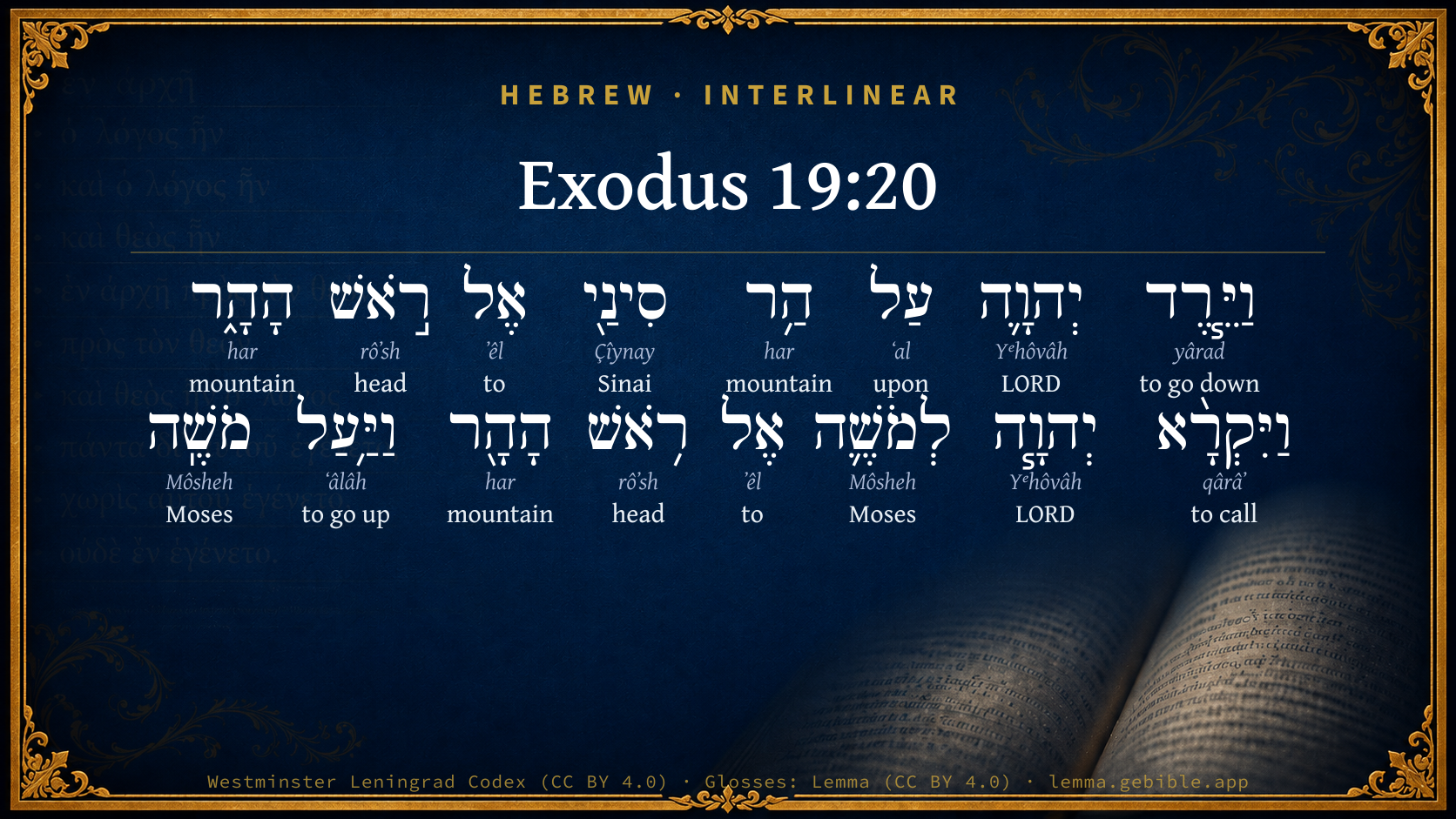
  1. וַיֵּ֧רֶד yârad H3381 “and · to go down” Conjunction + Verb, Qal, Sequential Imperfect, 3rd Person, Masculine, Singular
  2. יְהוָ֛ה Yᵉhôvâh H3068 “LORD” Noun, Proper
  3. עַל ʻal H5921 “upon” Preposition
  4. הַ֥ר har H2022 “mountain of” Noun, Common, Masculine, Singular, Construct
  5. אֶל ʼêl H413 “to” Preposition
  6. רֹ֣אשׁ rôʼsh H7218 “head of” Noun, Common, Masculine, Singular, Construct
  7. הָהָ֑ר har H2022 “the · mountain” Particle, Definite Article + Noun, Common, Masculine, Singular, Absolute
  8. וַיִּקְרָ֨א qârâʼ H7121 “and · to call” Conjunction + Verb, Qal, Sequential Imperfect, 3rd Person, Masculine, Singular
  9. יְהוָ֧ה Yᵉhôvâh H3068 “LORD” Noun, Proper
  10. לְמֹשֶׁ֛ה Môsheh H4872 “to/for · Moses” Preposition + Noun, Proper
  11. אֶל ʼêl H413 “to” Preposition
  12. רֹ֥אשׁ rôʼsh H7218 “head of” Noun, Common, Masculine, Singular, Construct
  13. הָהָ֖ר har H2022 “the · mountain” Particle, Definite Article + Noun, Common, Masculine, Singular, Absolute
  14. וַיַּ֥עַל ʻâlâh H5927 “and · to go up” Conjunction + Verb, Qal, Sequential Imperfect, 3rd Person, Masculine, Singular
  15. מֹשֶֽׁה Môsheh H4872 “Moses” Noun, Proper

About this verse

These counts appear in no published source. They are computed here, from the morphology-tagged text and Lemma’s own curated glosses. What Lemma adds →

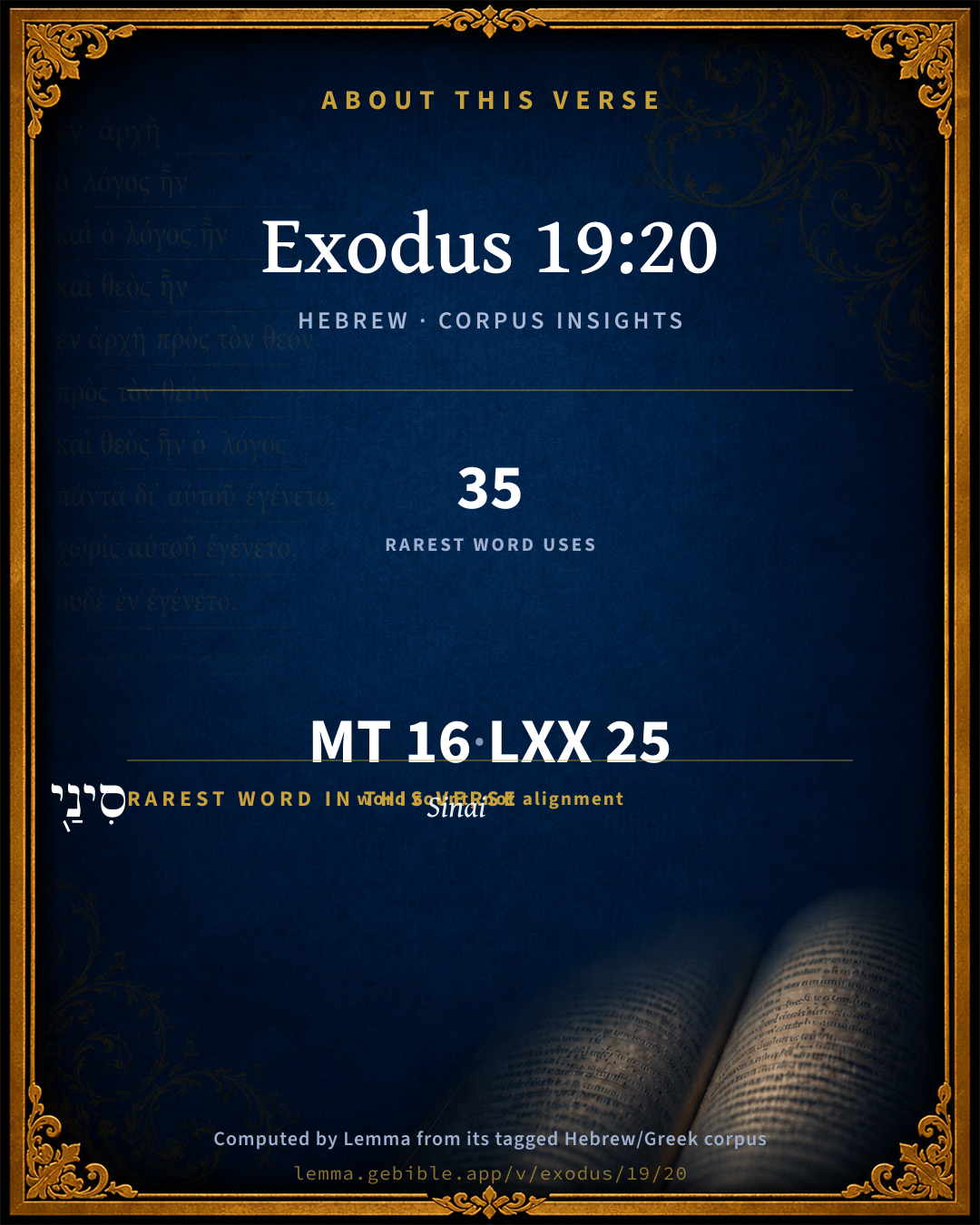
16
words
10
distinct lemmas
Pentateuch
section

Shared distinctive vocabulary

סִינַ֖י Sinai H5514 occurs in 34 verses of the Hebrew Bible. Also found in:

Grammatical profile

  • 3 verbs
  • 10 nouns
  • 3 prepositions

Verb forms

  • וַיֵּ֧רֶד Qal · Sequential Imperfect
  • וַיִּקְרָ֨א Qal · Sequential Imperfect
  • וַיַּ֥עַל Qal · Sequential Imperfect

Repetition

Words recur within this verse — often emphatic in Hebrew:

  • הַ֥ר mountain H2022 ×3
  • יְהוָ֛ה LORD H3068 ×2
  • רֹ֣אשׁ head H7218 ×2
  • לְמֹשֶׁ֛ה Moses H4872 ×2
  • אֶל to H413 ×2

Hebrew & Septuagint length

In English translation the verse runs 25 words from the Hebrew and 29 from the Septuagint (LXX English) — closely comparable.

A rough comparison of the two English renderings, which tokenize alike — not a word-level alignment.

Word counts can differ between the Hebrew and the Greek without any difference in meaning — e.g. the Hebrew direct-object marker אֵת has no separate Greek word, and Greek often adds the article ὁ.

In the original languages it is 16 Hebrew tokens and 25 Greek tokens — but the two are counted differently (Hebrew bundles its prefixes and suffixes into one token; the Greek is in lemma form), so that isn’t a like-for-like length.

Cross-references

9

Topical passages linked to Exodus 19:20 in the Treasury of Scripture Knowledge — connected by theme and wording, ordered by reader-vote popularity; previews shown in the World English Bible.

  • Nehemiah 9:13 You came down also on Mount Sinai, and spoke with them from heaven, and gave them right ordinances and true laws, good statutes and commandments,
  • Exodus 19:3 Moses went up to God, and Yahweh called to him out of the mountain, saying, "This is what you shall tell the house of Jacob, and tell the children of Israel:
  • Exodus 19:11 and be ready against the third day; for on the third day Yahweh will come down in the sight of all the people on Mount Sinai.
  • Exodus 24:12–13 Yahweh said to Moses, "Come up to me on the mountain, and stay here, and I will give you the tables of stone with the law and the commands that I have written, that you may teach them."
  • Exodus 24:18 Moses entered into the midst of the cloud, and went up on the mountain; and Moses was on the mountain forty days and forty nights.
  • Exodus 34:2 Be ready by the morning, and come up in the morning to Mount Sinai, and present yourself there to me on the top of the mountain.
  • Exodus 34:4 He chiseled two tablets of stone like the first; and Moses rose up early in the morning, and went up to Mount Sinai, as Yahweh had commanded him, and took in his hand two stone tablets.
  • Psalms 81:7 You called in trouble, and I delivered you. I answered you in the secret place of thunder. I tested you at the waters of Meribah." Selah.
  • Deuteronomy 9:9 When I was gone up onto the mountain to receive the tables of stone, even the tables of the covenant which Yahweh made with you, then I stayed on the mountain forty days and forty nights; I did neither eat bread nor drink water.

Cross-references courtesy of OpenBible.info (CC BY 4.0).

Hebrew and Greek witnesses Masoretic Hebrew ↔ Greek Septuagint

The same verse in the two great witnesses to the Old Testament, shown verse-for-verse.

These are two independent witnesses, not word-aligned to each other, and the Septuagint is shown in lemma (dictionary) form.

Hebrew Exodus 19:20 Masoretic · Westminster Leningrad Codex

וַיֵּ֧רֶד יְהוָ֛ה עַל הַ֥ר סִינַ֖י אֶל רֹ֣אשׁ הָהָ֑ר וַיִּקְרָ֨א יְהוָ֧ה לְמֹשֶׁ֛ה אֶל רֹ֥אשׁ הָהָ֖ר וַיַּ֥עַל מֹשֶֽׁה

Yahweh came down on Mount Sinai, to the top of the mountain. Yahweh called Moses to the top of the mountain, and Moses went up.

World English Bible · Public Domain

Greek LXX Exodus 19:20 Septuagint · lemma form

καταβαίνω δέ κύριος ἐπί ὁ ὄρος ὁ σινα ἐπί ὁ κορυφή ὁ ὄρος καί καλέω κύριος μωυσῆς ἐπί ὁ κορυφή ὁ ὄρος καί ἀναβαίνω μωυσῆς

And the Lord came down upon mount Sina on the top of the mountain; and the Lord called Moses to the top of the mountain, and Moses went up.

LXX2012 (modern English Septuagint) · Public Domain

Hebrew: Westminster Leningrad Codex (CC BY 4.0). Greek: Septuagint (public domain); English from LXX2012 (modern English Septuagint) (Public Domain). How the Septuagint differs from the Hebrew →

Targum (Aramaic paraphrase)

2

The Targum is the ancient Jewish Aramaic paraphrase of the Hebrew Scriptures — an interpretive translation, not the Hebrew text itself. Onkelos (literal) and Pseudo-Jonathan (expansive) render the Torah, and Jonathan the Prophets. Coverage is partial: where no permissively-licensed English translation exists for a verse, only the Aramaic is shown. This is verse-level text, not a word-by-word alignment to the Hebrew.

  1. Targum Onkelos Torah (Genesis–Deuteronomy)
    וְאִתְגְלִי יְיָ עַל טוּרָא דְסִינַי לְרֵישׁ טוּרָא וּקְרָא יְיָ לְמשֶׁה לְרֵישׁ טוּרָא וּסְלִיק משֶׁה:

    (no public-domain English translation for this verse)

    Targum Onkelos — Aramaic: “Onkelos Genesis” (public domain); “Onkelos Exodus” (public domain); “Onkelos Leviticus” (public domain); “Onkelos Numbers” (public domain); “Onkelos Deuteronomy” (public domain). English: “Sefaria Community Translation” (CC0 1.0 (public-domain dedication)); “J.W. Etheridge. The Targums of Onkelos and Jonathan Ben Uzziel on the Pentateuch. London: Longmans, Green, 1862” (public domain). Text via Sefaria.

  2. Targum Pseudo-Jonathan Torah (Genesis–Deuteronomy)
    וְאִתְגְּלֵי יְיָ עַל טַוְורָא דְסִינַי עַל רֵישׁ טַוְורָא וּקְרָא יְיָ לְמשֶׁה לְרֵישׁ טַוְורָא וּסְלֵיק משֶׁה

    And the Lord revealed Himself on mount Sinai upon the summit of the mountain, and the Lord called unto Mosheh from the summit of the mount, and Mosheh went up.

    Targum Pseudo-Jonathan — Aramaic: “Targum Jonathan on Genesis” (public domain); “Targum Jonathan on Exodus” (public domain); “Targum Jonathan on Leviticus” (public domain); “Targum Jonathan on Numbers” (public domain); “Targum Jonathan on Deuteronomy” (public domain). English: “The Targum of Jonathan ben Uzziel, trans. J. W. Etheridge, London, 1862” (public domain). Text via Sefaria.

Commentary

Notes on Exodus 19:20 from classic Christian and Jewish commentators (each source and its license shown beneath its notes). The classic Christian expositions comment on the surrounding passage and are grouped to its opening verse, so a note may address several verses; the Jewish commentaries on the Tanakh (Rashi and others) are per-verse, so they appear only where the commentator wrote on this verse.

Lemma curates 59 commentaries, every one of them public domain or Creative Commons licensed, each selected and text-cleaned for this edition rather than reprinted as found. About our sources →

Trapp's Complete Commentary

John Trapp

Exo 19:20 And the LORD came down upon mount Sinai, on the top of the mount: and the LORD called Moses [up] to the top of the mount; and Moses went up.

Ver. 20. And Moses went up.] As a mediator between God and his people. {Gal 3:19 Act 7:38} A mediator Moses was, not of redemption, as Christ that "Mediator of the new covenant" and "surety of a better testament," {Heb 7:22; Heb 9:15} but of receiving the law, and delivering it to the people, for which end here he went up.

John Trapp, A Commentary or Exposition upon All the Books of the Old and New Testament (1647–1656) — public domain. Text from a community e-Sword module.

Adam Clarke's Commentary

Verse 20. The Lord came down] This was undoubtedly done in a visible manner, that the people might witness the awful appearance. We may suppose that every thing was arranged thus: the glory of the Lord occupied the top of the mountain, and near to this Moses was permitted to approach. Aaron and the seventy elders were permitted to advance some way up the mountain, while the people were only permitted to come up to its base. Moses, as the lawgiver, was to receive the statutes and judgments from God's mouth; Aaron and the elders were to receive them from Moses, and deliver them to the people; and the people were to act according to the direction received. Nothing can be imagined more glorious, terrible, majestic, and impressive, than the whole of this transaction; but it was chiefly calculated to impress deep reverence, religious fear, and sacred awe; and he who attempts to worship God uninfluenced by these, has neither a proper sense of the Divine majesty, nor of the sinfulness of sin. It seems in reference to this that the apostle says, Let us have grace whereby we may serve God acceptably with REVERENCE and GODLY FEAR: for our God is a CONSUMING FIRE; Heb 12:28-29. Who then shall dare to approach him in his own name and without a mediator?

Adam Clarke's Commentary on the Bible (1810–1826) — public domain. Text from a community e-Sword/MySword module.

Ellicott's Commentary for English Readers

(20) On the top of the mount.—On the summit of the Ras Sufsafeh, not on the Jebel Musa, which is out of sight from the plain of Er Rahah.

A Bible Commentary for English Readers, edited by Charles John Ellicott (1878–1897) — public domain. Text from a community e-Sword module.

The Cambridge Bible for Schools and Colleges

gen. ed. J. J. S. Perowne

20. came down] according to v. 18, Jehovah had already done this. Perhaps (Bä.) v. 18 is misplaced, and stood originally after v. 20a.

20–25. After the theophany has begun (vv. 18, 20a), Moses is summoned to the top of the mountain, where he is told to go down again at once and check the too eager curiosity of the people, and when he has done this to come up again with Aaron (v. 24). In E the people, so far from evincing any desire to trespass upon the mountain, are in alarm, and ‘tremble’ (v. 16; cf. Exo_20:18).

The Cambridge Bible for Schools and Colleges (gen. ed. J. J. S. Perowne; Cambridge University Press, 1878–1918) — public domain. Text from a community e-Sword module.

John Gill's Exposition

And the Lord came down on Mount Sinai,.... In the above visible tokens of his presence and power; otherwise he is the incomprehensible Jehovah, that immense and omnipotent Being, who fills heaven and earth, and cannot be contained and circumscribed in either:

on the top of the mount; where the fire he descended in rested, and where the smoke and thick cloud were, as a token of his presence:

and the Lord called Moses up to the top of the mount; who either was at the bottom of it with the people, or in a higher ascent of it between God and them:

and Moses went up; to the top of it, where the Lord was, as he ordered him: a certain traveller (y) tells us that the top of this mount was scarce thirty feet in circumference.

(y) Baumgarten Peregrinatio, l. 1. c. 24. p. 61.

John Gill's Exposition of the Whole Bible (1746–1763) — public domain (CC PDM 1.0). Text via the HelloAO Bible API.

Matthew Poole's English Annotations

So here are three parts of the mount manifestly distinguished; the top, where the cloud was; the middle part, where Moses now stood, and about which the bounds seem to have been put; and the nether or lower part, where the people were.

Matthew Poole's English Annotations on the Holy Bible (1683–1685) — public domain. Text from a community e-Sword/MySword module.

Whedon's Commentary on the Bible

Daniel D. Whedon

20. The Lord came down — In the midst of the sublime exhibitions of his power and splendour mentioned above; though not so that the Israelites saw any likeness or similitude of Jehovah. See Deu_4:12; Deu_4:15.

Daniel D. Whedon (gen. ed.), Commentary on the Old and New Testaments (1874–1909) — public domain. Text from a community e-Sword module.

The Pulpit Commentary

On the top of the mount. Not, probably, on the highest point of the Sinaitic group, the Jebel Musa, which is out of sight from the plain Er-Rahah, where the Israelites must have been assembled; but on the highest part of the face of Sinai fronting that plain, the Ras Sufsafeh, which would be to the Israelites at the base "the top of the mount." The Lord called Moses up. Perhaps with Aaron, who certainly accompanied him when he next ascended (ver. 24), and who seems to be glanced at in the phrase used at the end of ver. 23

The Pulpit Commentary (1880–1919), ed. H.D.M. Spence-Jones & Joseph S. Exell — public domain. Text from a community e-Sword module.

Rashi

Rabbi Shlomo Yitzchaki (Rashi)

וירד ה׳ על הר סיני AND THE LORD CAME DOWN UPON MOUNT SINAI — One might think, then, that He actually came down upon it! Therefore it states, (Exodus 20:19) “Ye have seen that I have spoken to you from heaven”. These two texts together teach us that He bent down the upper and lower heavens and spread them out over the top of the mountain like a bed-spread over a bed and the throne of Glory descended upon it (Mekhilta).

Rashi on the Tanakh — English translations: “The Judaica Press complete Tanach with Rashi, translated by A. J. Rosenberg” (CC BY 4.0); “Pentateuch with Rashi's commentary by M. Rosenbaum and A.M. Silbermann, 1929-1934” (public domain); “The Metsudah Tanach series, Lakewood, N.J” (CC BY 4.0); and “The Book of Joshua, Metsudah Publications, 1997” (CC BY 4.0). Text via Sefaria.

Ramban (Nachmanides)

Rabbi Moshe ben Nachman (Ramban / Nachmanides)

AND THE ETERNAL CAME DOWN UPON MOUNT SINAI. If you will succeed in having insight into this section [of the Torah], you will understand that His Great Name, [i.e., the Tetragrammaton], came down upon Mount Sinai, and that He abode thereon in fire and spoke to Moses. The communication to Moses in the entire section was by this Proper Name of the Eternal. However, the ascent [of Moses — as mentioned in Verse 3: And Moses went up unto G-d] — and his bringing forth [the people out of the camp — as mentioned in Verse 17] — were towards the place of the Glory, as I have explained. And He warned, lest they break through unto the Eternal to gaze, because even the nobles of the children of Israel did not see Him, and all Israel heard the Voice of G-d out of the midst of the fire. It is this which Scripture says, And ‘Elokim’ (G-d) spoke all these words, just as our Rabbis have said: “Elokim designates the Judge.” ) And they have also said [with reference to the first two commandments]: (the Almighty) is analogous to “the Judge.” “We have heard them from Hagvurah (the Almighty Himself).” In Deuteronomy it is written: These words the Eternal spoke unto all your assembly. spoke.” That is because, etc. That is because Scripture explains there [in the same verse] that He spoke out of the midst of the fire., 5:4. And this is the sense of the verse, The Eternal spoke with you face to face in the mount out of the midst of the fire., 5:4. And this is why it is said, I am the Eternal thy G-d., etc.” (Abusaula). The allusion is to the two Divine Names — the Tetragrammaton and Elokim — mentioned together here in 20:2. Now do not find a difficulty in what the people said to Moses, For who is there of all living flesh, that hath heard the Voice of the living G-d speaking out of the midst of the fire? speaking (Abusaula). They did not say “that they heard G-d speaking out of the midst of the fire,” but they said the Voice of G-d, referring to what they perceived. This is why they said, Go thou near, and hear all that the Eternal our G-d may say., Verse 24. And so did Moses say to them, Did ever a people hear the Voice of G-d speaking out of the midst of the fire?, 4:33. The word “speaking” here is referring to “the Voice,” something like the verse, and he heard the Voice speaking unto him. From this you will understand what the Rabbis have always said in Midrashic homilies, i.e., that the Torah was given in seven voices. They are the ones to which David alluded in the psalm: Ascribe unto the Eternal, O ye sons of might., 343). The voice of the Eternal appears seven times in this psalm: The voice of the Eternal is upon the waters (Verse 3); The voice of the Eternal is powerful; the voice of the Eternal is full of majesty (Verse 4); The voice of the Eternal breaketh the cedars (Verse 5); The voice of the Eternal heweth out flames of fire (Verse 7); The voice of the Eternal shaketh the wilderness (Verse 8); The voice of the Eternal maketh the hinds to calve (Verse 9). This is also the number of times [that the Voice] is alluded to in this section of the Torah. (Verse 16). Since the word koloth is written defectively without the letter vav, it signifies the singular: “and there was a voice.” 2. And the voice of a horn (ibid.) 3. And the voice of the horn (Verse 19). 4. And G-d answered him by a voice (ibid.) 5. And all the people perceived ‘hakoloth’ (20:15). Here too the Hebrew hakoloth is written defectively and therefore refers only to one voice: “and all the people perceived the voice.” 6. And the voice of the horn (ibid.) 7. And G-d spoke (20:1). Thus there are seven voices mentioned in this section of the Torah (Abusaula). The verse, And there were ‘koloth’ and lightnings, is written defectively and therefore counted as one; likewise, the verse, And all the people perceived ‘hakoloth,’, number 5. is missing the vav which signifies the plural, [and thus refers to only one voice]. Thus there are six [‘voices’ mentioned here in the section], and [in addition] it clearly says, And G-d spoke., number 7. In Deuteronomy, Scripture likewise mentions seven ‘voices’ in connection with the Giving of the Torah. (Deuteronomy 4:12). 2. Only a voice (ibid.) 3. A great voice (5:19). 4. The voice out of the midst of the darkness (5:20). 5. And we have heard His voice (Verse 21). 6. If we hear the voice of the Eternal our G-d (Verse 22). 7. The voice of the living G-d speaking (Verse 23). In Tractate Berachoth, however, the Rabbis have said in the Gemara, Note 204. that the Torah was given in five ‘voices.’ That is because they counted only the voices which are concealed, while the two — i.e., I am the Eternal thy G-d and Thou shalt have no other gods before Me] — are explained in Scripture. The purport of this is that Moses our teacher was given the Torah in seven ‘voices,’ and he was the one who heard them and contemplated them. The Israelites, however, heard one voice, as it is said, a great voice, and it went on no more, and it is said again, Ye heard the voice of words, but ye saw no form; only a voice., 4:12. Here also Scripture alluded thereto in saying, And all the people perceived ‘hakoloth,’ with one vav missing, [thus making it singular, ‘the voice’], for all voices appeared as one. By way of the Truth, [the mystic lore of the Cabala], this is Scripture’s intent in saying, G-d hath spoken once, twice we have heard this.. The sections of the Torah are thus explained, without anything being changed with another.

Ramban (Nachmanides) on the Tanakh — English translation: “Commentary on the Torah by Ramban (Nachmanides). Translated and annotated by Charles B. Chavel. New York, Shilo Pub. House, 1971-1976” (CC BY 4.0). Text via Sefaria.

Lesson kit

Teaching starters — assembled from the data on this page, not authored interpretation. Every prompt links to the verse data it draws on. Edit before teaching.

Exodus, in the Pentateuch, opens this verse with 16 words (10 distinct Hebrew lemmas). Its most distinctive word is Çîynay (“Sinai”). A historical commentator’s framing appears above. Read the whole chapter for the surrounding context.

Discussion questions

  1. How does “Sinai” (Çîynay) shape what this verse is saying?
  2. Exodus 16:1 shares the word «Sinai» with this verse. How do the two illuminate each other?
  3. “mountain” occurs 3× in this one verse. What is the effect of the repetition?
  4. These translations render this verse differently. What is at stake in choosing one wording over another?
  5. The verb «וַיֵּ֧רֶד» is Qal Sequential Imperfect. How does its form color the action?
  6. Reading how Trapp's Complete Commentary and Adam Clarke's Commentary read this verse, where do the two commentators agree and where do they part?

Things to notice

Reading settings

Reading text

Shown beneath each verse's original-language words.

Old Testament
Old Testament edition

Read the OT as the Masoretic Hebrew (MT) or the Greek Septuagint (LXX).

English shown for the Greek Septuagint (in the Hebrew ↔ Greek comparison).

Comparing translations? Open the Compare panel on any verse page to stack up to four side by side.