Leviticus 11:3

Hebrew (Westminster Leningrad Codex) Leviticus 11:3 appears in the Hebrew Old Testament. The text above is from the Westminster Leningrad Codex. Each word links to its Strong’s number, a concise gloss, and parsing drawn from the Open Scriptures Hebrew Bible morphology. Click any word for its full Brown-Driver-Briggs (BDB) entry.
Download image
Cite this verse

Leviticus 11:3 (World English Bible). Public Domain. Lemma interlinear Bible study tool, https://lemma.gebible.app/v/leviticus/11/3.

Show BibTeX & RIS
BibTeX
RIS
English Translation
Whatever parts the hoof, and is cloven-footed, and chews the cud among the animals, that you may eat.
World English Bible · Public Domain
Highlights
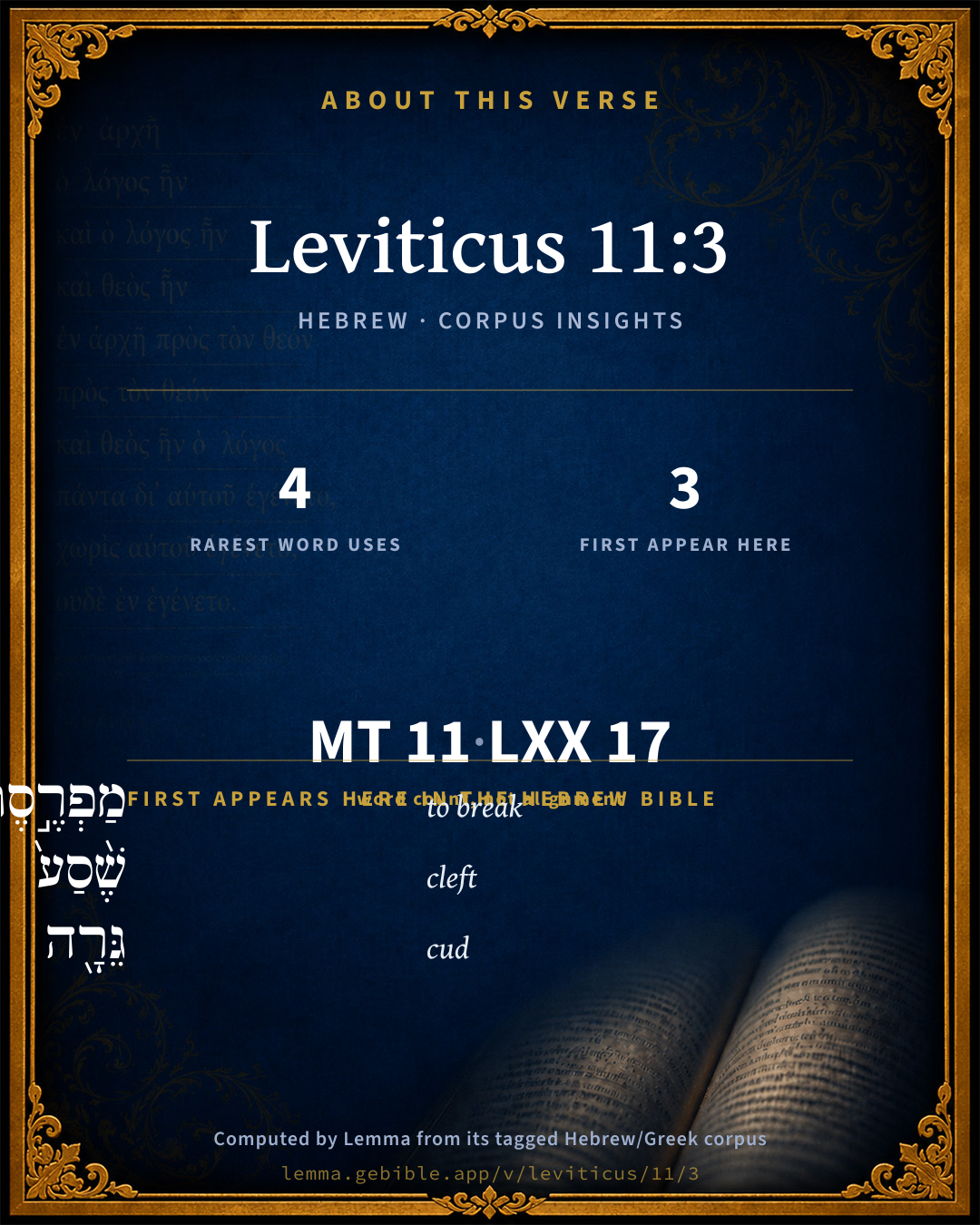
  • 3 first appearances in the Hebrew Bible
Full analysis ↓
Download a study sheet

One document with this verse’s original text, its word-by-word gloss line, the meaning frame, cross-references with their text, attributed commentary, and full source and license credits — printable, and it pastes into notes with its structure intact.

This verse Autodidact and up

Study sheet (.html) Plain text (.txt)

A passage Seminary Student

Up to 50 verses in one chapter. A passage sheet keeps up to 6 commentary sources and 12 cross-references per verse, in the order this page ranks them, and says so on the sheet whenever that leaves anything out. Ask for a single verse and you get the Autodidact verse sheet above.

Everything on this page stays free to read, with no account — the sheet is a download of what is already on screen, not access to it.

Want to remove ads? Support Godless Engineer
Compare translations 3

The same verse in 3 English versions, stacked beneath the original-language interlinear above. Click any original word for its lexicon entry.

Each is an independent rendering of the whole verse — the interlinear is not word-aligned to these translations.

Highlighted words mark where these versions differ — a whole-verse word diff, not a word-by-word alignment.

  • World English Bible Public Domain
    Whatever parts the hoof, and is cloven-footed, and chews the cud among the animals, that you may eat.
  • King James Version Public Domain
    Whatsoever parteth the hoof, and is cloven-footed, and cheweth the cud, among the beasts, that shall ye eat.
  • unfoldingWord Literal Text CC BY-SA 4.0
    Anything dividing a hoof and splitting the cleft of hooves, making the cud go up among the livestock—you shall eat it.

unfoldingWord Literal Text — © unfoldingWord, licensed CC BY-SA 4.0. Word-aligned USFM3 via Door43 (git.door43.org/unfoldingWord/en_ult).

Versions to compare (up to 4)

3 of 4 selected

Show all 18 translations

Every available English version of this verse, each an independent rendering of the whole verse.

  • World English Bible Public Domain
    Whatever parts the hoof, and is cloven-footed, and chews the cud among the animals, that you may eat.
  • Berean Standard Bible Public Domain
    You may eat any animal that has a split hoof completely divided and that chews the cud.
  • Majority Standard Bible Public Domain
    You may eat any animal that has a split hoof completely divided and that chews the cud.
  • King James Version Public Domain
    Whatsoever parteth the hoof, and is cloven-footed, and cheweth the cud, among the beasts, that shall ye eat.
  • American Standard Version (1901) Public Domain
    Whatsoever parteth the hoof, and is clovenfooted, `and' cheweth the cud, among the beasts, that may ye eat.
  • Revised Version (1885) Public Domain
    Whatsoever parteth the hoof, and is clovenfooted, and cheweth the cud, among the beasts, that shall ye eat.
  • Geneva Bible (1599) Public Domain
    Whatsoeuer parteth the hoofe, and is clouen footed, and cheweth the cudde, among the beastes, that shall ye eate.
  • Douay-Rheims (1899) Public Domain
    Whatsoever hath the hoof divided, and cheweth the cud among the beasts, you shall eat.
  • Young's Literal Translation Public Domain
    any dividing a hoof, and cleaving the cleft of the hoofs, bringing up the cud, among the beasts, it ye do eat.
  • Literal Standard Version CC BY-SA 4.0
    any dividing a hoof, and cleaving the cleft of the hooves, bringing up the cud, among the beasts—you eat it.
  • Unlocked Literal Bible CC BY-SA 4.0
    You may eat any animal that has a split hoof and that also chews the cud.
  • unfoldingWord Literal Text CC BY-SA 4.0
    Anything dividing a hoof and splitting the cleft of hooves, making the cud go up among the livestock—you shall eat it.
  • Darby Bible Public Domain
    Whatever hath cloven hoofs, and feet quite split open, and cheweth the cud, among the beasts -- that shall ye eat.
  • World Messianic Bible Public Domain
    Whatever parts the hoof, and is cloven-footed, and chews the cud among the animals, that you may eat.
  • Webster's Bible Public Domain
    Whatever parteth the hoof, and is cloven-footed, and cheweth the cud among the beasts, that shall ye eat.
  • Free Bible Version CC BY-SA 4.0
    any animal that both has a divided hoof and also chews the cud.
  • Bible in Basic English Public Domain
    You may have as food any beast which has a division in the horn of its foot, and whose food comes back into its mouth to be crushed again.
  • JPS Tanakh (1917) Public Domain
    Whatsoever parteth the hoof, and is wholly cloven-footed, and cheweth the cud, among the beasts, that may ye eat.

Literal Standard Version (2020), Covenant Press — licensed CC BY-SA 4.0. Text via the HelloAO Bible API (eBible.org). Unlocked Literal Bible (unfoldingWord) — licensed CC BY-SA 4.0. Text via the HelloAO Bible API (eBible.org). unfoldingWord Literal Text — © unfoldingWord, licensed CC BY-SA 4.0. Word-aligned USFM3 via Door43 (git.door43.org/unfoldingWord/en_ult). Free Bible Version, Dr. Jonathan Gallagher — licensed CC BY-SA 4.0. Text via the HelloAO Bible API (eBible.org).

Word by word

More ways to search: Search by grammar → Find every occurrence → Compare this word →

Practice this passage: Drill this verse → Learn its vocabulary →

שֶׁ֨סַע֙
sheçaʻ
H8157
“cleft of”
Noun, Common, Masculine, Singular, Construct
Part of Speech
Noun
Type
Common
Gender
Masculine
Number
Singular
State
Construct
Full BDB Definition

Origin: from H8156

TWOT: 2427a

cleft, cloven, split
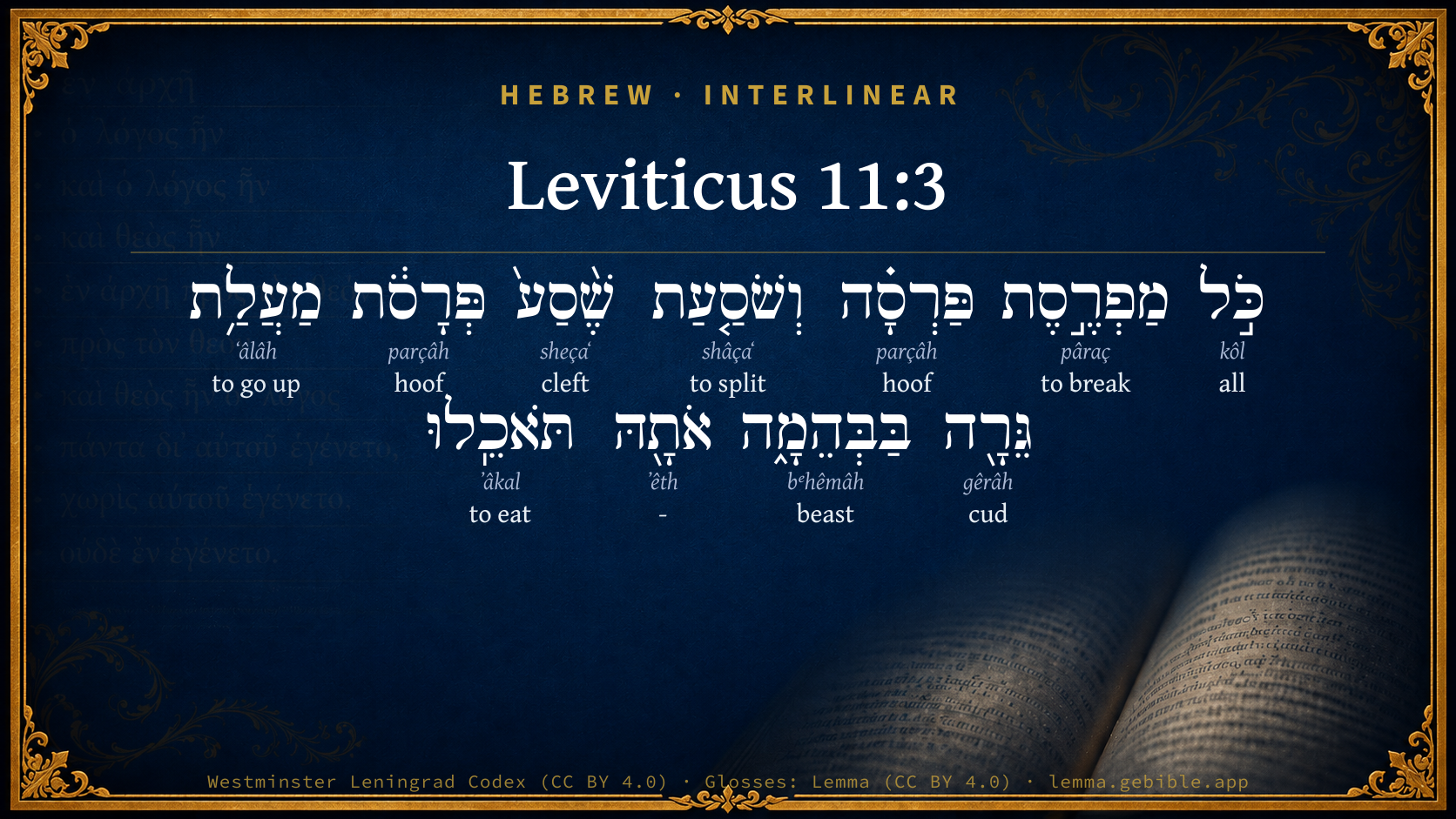
  1. כֹּ֣ל kôl H3605 “all” Noun, Common, Masculine, Singular, Absolute
  2. מַפְרֶ֣סֶת pâraç H6536 “breaking” Verb, Hiphil, Participle Active, Feminine, Singular, Absolute
  3. פַּרְסָ֗ה parçâh H6541 “hoof” Noun, Common, Feminine, Singular, Absolute
  4. וְשֹׁסַ֤עַת shâçaʻ H8156 “and · splitting” Conjunction + Verb, Qal, Participle Active, Feminine, Singular, Absolute
  5. פְּרָסֹ֔ת parçâh H6541 “hooves” Noun, Common, Feminine, Plural, Absolute
  6. מַעֲלַ֥ת ʻâlâh H5927 “going up” Verb, Hiphil, Participle Active, Feminine, Singular, Construct
  7. גֵּרָ֖ה gêrâh H1625 “cud” Noun, Common, Feminine, Singular, Absolute
  8. בַּבְּהֵמָ֑ה bᵉhêmâh H929 “in/at the · beast” Preposition, Determined + Noun, Common, Feminine, Singular, Absolute
  9. אֹתָ֖הּ ʼêth H853 “- · her” Particle, Direct Object + Suffix, Personal, 3rd Person, Feminine, Singular
  10. תֹּאכֵֽלוּ ʼâkal H398 “to eat” Verb, Qal, Imperfect, 2nd Person, Masculine, Plural

About this verse

These counts appear in no published source. They are computed here, from the morphology-tagged text and Lemma’s own curated glosses. What Lemma adds →

11
words
10
distinct lemmas
Pentateuch
section

Notable vocabulary

The rarest word here is שֶׁ֨סַע֙ cleft H8157 — appearing just 4 times in the whole Hebrew Bible.

First appearance in Scripture

These words make their first canonical appearance in the Hebrew Bible here:

  • מַפְרֶ֣סֶת to break H6536
  • שֶׁ֨סַע֙ cleft H8157
  • גֵּרָ֖ה cud H1625

Shared distinctive vocabulary

שֶׁ֨סַע֙ cleft H8157 occurs in 4 verses of the Hebrew Bible. Also found in:

Grammatical profile

  • 4 verbs
  • 6 nouns
  • 1 particle

Verb forms

  • מַפְרֶ֣סֶת Hiphil · Participle Active
  • וְשֹׁסַ֤עַת Qal · Participle Active
  • מַעֲלַ֥ת Hiphil · Participle Active
  • תֹּאכֵֽלוּ Qal · Imperfect

Repetition

A word recurs within this verse — often emphatic in Hebrew:

  • פַּרְסָ֗ה hoof H6541 ×2

Hebrew & Septuagint length

In English translation the verse runs 18 words from the Hebrew and 21 from the Septuagint (LXX English) — closely comparable.

A rough comparison of the two English renderings, which tokenize alike — not a word-level alignment.

Word counts can differ between the Hebrew and the Greek without any difference in meaning — e.g. the Hebrew direct-object marker אֵת has no separate Greek word, and Greek often adds the article ὁ.

In the original languages it is 11 Hebrew tokens and 17 Greek tokens — but the two are counted differently (Hebrew bundles its prefixes and suffixes into one token; the Greek is in lemma form), so that isn’t a like-for-like length.

Cross-references

8

Topical passages linked to Leviticus 11:3 in the Treasury of Scripture Knowledge — connected by theme and wording, ordered by reader-vote popularity; previews shown in the World English Bible.

  • Proverbs 2:10 For wisdom will enter into your heart. Knowledge will be pleasant to your soul.
  • 2 Corinthians 6:17 Therefore, "'Come out from among them, And be separate,' says the Lord, 'Touch no unclean thing. I will receive you.
  • Deuteronomy 6:6–7 These words, which I command you this day, shall be on your heart;
  • Deuteronomy 16:3–8 You shall eat no leavened bread with it; seven days shall you eat unleavened bread therewith, even the bread of affliction; for you came forth out of the land of Egypt in haste: that you may remember the day when you came forth out of the land of Egypt all the days of your life.
  • Psalms 1:1–2 Blessed is the man who doesn't walk in the counsel of the wicked, Nor stand in the way of sinners, Nor sit in the seat of scoffers;
  • Proverbs 9:6 Leave your simple ways, and live. Walk in the way of understanding."
  • Acts 17:11 Now these were more noble than those in Thessalonica, in that they received the word with all readiness of the mind, examining the Scriptures daily to see whether these things were so.
  • 1 Timothy 4:15 Be diligent in these things. Give yourself wholly to them, that your progress may be revealed to all.

Cross-references courtesy of OpenBible.info (CC BY 4.0).

Hebrew and Greek witnesses Masoretic Hebrew ↔ Greek Septuagint

The same verse in the two great witnesses to the Old Testament, shown verse-for-verse.

These are two independent witnesses, not word-aligned to each other, and the Septuagint is shown in lemma (dictionary) form.

Hebrew Leviticus 11:3 Masoretic · Westminster Leningrad Codex

כֹּ֣ל מַפְרֶ֣סֶת פַּרְסָ֗ה וְשֹׁסַ֤עַת שֶׁ֨סַע֙ פְּרָסֹ֔ת מַעֲלַ֥ת גֵּרָ֖ה בַּבְּהֵמָ֑ה אֹתָ֖הּ תֹּאכֵֽלוּ

Whatever parts the hoof, and is cloven-footed, and chews the cud among the animals, that you may eat.

World English Bible · Public Domain

Greek LXX Leviticus 11:3 Septuagint · lemma form

πᾶς κτῆνος διχηλέω ὁπλή καί ὀνυχιστήρ ὀνυχίζω δύο χήλη καί ἀναἄγω μηρυκισμός ἐν ὁ κτῆνος οὗτος ἐσθίω

Every beast parting the hoof and making divisions of two claws, and chewing the cud among beasts, these you⌃ shall eat.

LXX2012 (modern English Septuagint) · Public Domain

Hebrew: Westminster Leningrad Codex (CC BY 4.0). Greek: Septuagint (public domain); English from LXX2012 (modern English Septuagint) (Public Domain). How the Septuagint differs from the Hebrew →

Targum (Aramaic paraphrase)

2

The Targum is the ancient Jewish Aramaic paraphrase of the Hebrew Scriptures — an interpretive translation, not the Hebrew text itself. Onkelos (literal) and Pseudo-Jonathan (expansive) render the Torah, and Jonathan the Prophets. Coverage is partial: where no permissively-licensed English translation exists for a verse, only the Aramaic is shown. This is verse-level text, not a word-by-word alignment to the Hebrew.

  1. Targum Onkelos Torah (Genesis–Deuteronomy)
    כֹּל דִי סְדִיקָן פַּרְסָתָא וּמַטִלְפָן טִלְפִין פַּרְסָתָא מַסְקָּא פִשְׁרָא בִּבְעִירָא יָתַהּ תֵּיכְלוּן

    (no public-domain English translation for this verse)

    Targum Onkelos — Aramaic: “Onkelos Genesis” (public domain); “Onkelos Exodus” (public domain); “Onkelos Leviticus” (public domain); “Onkelos Numbers” (public domain); “Onkelos Deuteronomy” (public domain). English: “Sefaria Community Translation” (CC0 1.0 (public-domain dedication)); “J.W. Etheridge. The Targums of Onkelos and Jonathan Ben Uzziel on the Pentateuch. London: Longmans, Green, 1862” (public domain). Text via Sefaria.

  2. Targum Pseudo-Jonathan Torah (Genesis–Deuteronomy)
    כָּל דִסְדִיקָא פַּרְסָתָא וּמַטִילְפָא טִילְפִין פַּרְסָתָא וּדְאִית לָהּ קַרְנִין מַסְקָא פִּישְׁרָא בִּבְעִירָא יָתָהּ תֵּיכְלוּן

    Whatsoever divideth the hoof and is cloven-footed, and that which hath horns bringing up the cud among the beasts, that you may eat.

    Targum Pseudo-Jonathan — Aramaic: “Targum Jonathan on Genesis” (public domain); “Targum Jonathan on Exodus” (public domain); “Targum Jonathan on Leviticus” (public domain); “Targum Jonathan on Numbers” (public domain); “Targum Jonathan on Deuteronomy” (public domain). English: “The Targum of Jonathan ben Uzziel, trans. J. W. Etheridge, London, 1862” (public domain). Text via Sefaria.

Commentary

Notes on Leviticus 11:3 from classic Christian and Jewish commentators (each source and its license shown beneath its notes). The classic Christian expositions comment on the surrounding passage and are grouped to its opening verse, so a note may address several verses; the Jewish commentaries on the Tanakh (Rashi and others) are per-verse, so they appear only where the commentator wrote on this verse.

Lemma curates 59 commentaries, every one of them public domain or Creative Commons licensed, each selected and text-cleaned for this edition rather than reprinted as found. About our sources →

Trapp's Complete Commentary

John Trapp

Lev 11:3 Whatsoever parteth the hoof, and is clovenfooted, [and] cheweth the cud, among the beasts, that shall ye eat.

Ver. 3. Whatsoever parteth the hoof, and cheweth the cud.] To teach them to think upon God’s commandments to do them, {Psa 103:18} cleansing themselves from all filthiness of flesh and spirit. {2Co 7:1} Moreover clean Christians, typed by those clean beasts, must rightly part the hoof; that is, rightly divide their time; giving a due share thereof to either of their callings.

John Trapp, A Commentary or Exposition upon All the Books of the Old and New Testament (1647–1656) — public domain. Text from a community e-Sword module.

Joseph Benson's Commentary

Lev 11:3. Whatsoever parteth the hoof — That is, divides it into two parts only; or, is cloven-footed — As is here expressed. These qualities are not assigned as reasons why such animals are proper for food, but merely as marks whereby to distinguish them. In some animals the hoofs are solid, and not divided at all, as horses, asses, and mules; in others they are divided into several parts like toes, as in lions, wolves, dogs, (of which see Lev 11:27;) in a third sort, they are cloven or divided into two parts, as oxen, deer, sheep, goats. These last are of two kinds; for in some the hoof is divided, but not cloven quite through, as the camel; in others it is both parted and cloven, which are those allowed by this law to be clean creatures. And cheweth the cud — Some creatures, such as oxen, sheep, and goats, for want of the upper fore-teeth, cannot chew their food perfectly at once; nor can the stomach make a perfect digestion till it be ground a second time. Therefore such animals are provided with a double stomach; an upper, into which the food goes down after the first chewing; and another, into which it is sent after the second. Such creatures as chew the cud are reckoned more wholesome, because they grind and digest what they eat better, and consequently yield a lighter and more nutritious food than others. Under the prohibition of eating beasts which do not answer this description, all beasts of prey, and those which eat flesh, are included, whose juices, Dr. James observes, are highly alkalescent, and injurious to health. All animals of the horse and ass kind are here also prohibited, and it is well known that the flesh of these is difficult to be digested, and that the juices are rank and unwholesome.

Joseph Benson's Commentary on the Old and New Testaments (1811–1818) — public domain. Text from a community e-Sword module.

Geneva Bible (1599)

Geneva Bible translators

He noteth four sorts of beasts, some chew the cud only, and some have only the foot cleft: others neither chew the cud, nor have the hoof cleft: the fourth both chew the cud and have the hoof divided, which may be eaten.

Geneva Bible (1599) marginal notes — public domain. Text via Bolls.life.

Jamieson, Fausset & Brown

Robert Jamieson, A. R. Fausset & David Brown

Whatsoever parteth the hoof, and is cloven-footed, and cheweth the cud--Ruminating animals by the peculiar structure of their stomachs digest their food more fully than others. It is found that in the act of chewing the cud, a large portion of the poisonous properties of noxious plants eaten by them, passes off by the salivary glands. This power of secreting the poisonous effects of vegetables, is said to be particularly remarkable in cows and goats, whose mouths are often sore, and sometimes bleed, in consequence. Their flesh is therefore in a better state for food, as it contains more of the nutritious juices, is more easily digested in the human stomach, and is consequently more easily assimilated. Animals which do not chew the cud, convert their food less perfectly; their flesh is therefore unwholesome, from the gross animal juices with which they abound, and is apt to produce scorbutic and scrofulous disorders. But the animals that may be eaten are those which "part the hoof as well as chew the cud," and this is another means of freeing the flesh of the animal from noxious substances. "In the case of animals with parted hoofs, when feeding in unfavorable situations a prodigious amount of fœtid matter is discharged, and passes off between the toes; while animals with undivided hoofs, feeding on the same ground, become severely affected in the legs, from the poisonous plants among the pasture" [WHITLAW, Code of Health]. All experience attests this, and accordingly the use of ruminating animals (that is, those which both chew the cud and part the hoof) has always obtained in most countries though it was observed most carefully by the people who were favored with the promulgation of God's law.

Jamieson, Fausset & Brown — Commentary Critical and Explanatory on the Whole Bible (1871) — public domain (CC PDM 1.0). Text via the HelloAO Bible API.

Adam Clarke's Commentary

Verse 3. Whatsoever parteth the hoof, and is cloven-footed] These two words mean the same thing - a divided hoof, such as that of the ox, where the hoof is divided into two toes, and each toe is cased with horn.

Cheweth the cud] Ruminates; casts up the grass, c., which had been taken into the stomach for the purpose of mastication. Animals which chew the cud, or ruminate, are provided with two, three or four stomachs. The ox has four: in the first or largest, called the ventriculus or paunch, the food is collected without being masticated, the grass, c., being received into it as the beast crops it from the earth. The food, by the force of the muscular coats of this stomach, and the liquors poured in, is sufficiently macerated after which, formed into small balls, it is thrown up by the oesophagus into the mouth, where it is made very small by mastication or chewing, and then sent down into the second stomach, into which the oesophagus or gullet opens, as well as into the first, ending exactly where the two stomachs meet. This is what is termed chewing the cud. The second stomach, which is called the reticulum, honeycomb, bonnet, or king's hood, has a great number of small shallow cells on its inward surface, of a pentagonal or five-sided form, exactly like the cells in a honey-comb in this the food is farther macerated, and then pushed onward into the third stomach, called the omasum or many-plies, because its inward surface is covered with a great number of thin membraneous partitions. From this the food passes into the fourth stomach, called the abomasum, or rede. In this stomach it is digested, and from the digested mass the chyle is formed, which, being absorbed by the lacteal vessels, is afterwards thrown into the mass of blood, and becomes the principle of nutrition to all the solids and fluids of the body. The intention of rumination, or chewing the cud, seems to be, that the food may be sufficiently comminuted, that, being more fully acted on by the stomachs, it may afford the greatest possible portion of nutritive juices.

The word cud is probably not originally Saxon, though found in that language in the same signification in which it is still used. Junius, with great show of probability, derives it from the Cambro-British chwyd, a vomit, as it is the ball of food vomited, or thrown up, from the first stomach or paunch through the oesophagus into the mouth, which is called by this name. Those who prefer a Saxon derivation may have it in the verb [Anglo-Saxon] whence our word chew; and so cud might be considered a contraction of chewed, but this is not so likely as the preceding.

Adam Clarke's Commentary on the Bible (1810–1826) — public domain. Text from a community e-Sword/MySword module.

Ellicott's Commentary for English Readers

(3) Whatsoever parteth the hoof, and is clovenfooted.—Better, Whatsoever is clovenfooted, and entirely separateth the hoofs. The first rule laid down by which the clean quadruped is to be distinguished is that the hoofs must be completely cloven or divided above as well as below, or, as the parallel passage in Deu_14:6 has it, “and cleaveth the cleft into two claws.” Such is the case in the foot of the ox, the sheep, and the goat, where the hoof is wholly divided below as much as above. The foot of the dog, the cat, and the lion, though exhibiting a division into several distinct toes or claws, is contrary to the regulation here laid down, inasmuch as the division is simply on the upper side, the lower side being united by a membrane, and hence the hoof is not “entirely separated.”

And cheweth the cud.—In addition to the foot being perfectly cloven, the quadruped to be clean is to be ruminating. The canon which obtained during the second Temple is thus formulated: “Every quadruped which has no upper teeth is known to be ruminant, and when it is also clovenfooted is clean.” According to the law of Manu the highest Hindoo castes were also forbidden to eat the flesh or drink the milk of quadrupeds with uncloven hoof. The same was the case with the Egyptian priests: they abstained from eating the flesh of any animal which had uncloven hoofs or many claws.

A Bible Commentary for English Readers, edited by Charles John Ellicott (1878–1897) — public domain. Text from a community e-Sword module.

John Gill's Exposition

Whatsoever parteth the hoof, and is cloven footed,.... That is, whose hoof is parted and cloven quite through; for there are some creatures that have partitions in their feet, but not quite through, they are parted above, but underneath are joined together by a skin; wherefore both these phrases are used to describe the beasts lawful to be eaten: the Egyptians seem to have borrowed this law from the Jews, for Chaeremon says (x), that they abstain from such four footed beasts that have only one hoof, or have many partitions, or have no horns: and so the Targum of Jonathan adds here,"which have horns,''which, though not in the text, agrees well with the creatures allowed by this law to be eaten, see Deu 14:4 for such are all horned cattle; nor are there any cattle horned forbid to be eaten:

and cheweth the cud among the beasts, that shall ye eat: who having no upper teeth cannot thoroughly chew their food at once, and therefore bring it up again out of their stomachs into their mouths and chew it over again, that it may be better prepared for digestion in the stomach, and so yield better nourishment; and this makes the flesh of such creatures fitter for food: and these creatures have more stomachs than one; the ventricles for rumination are four; the first is the paunch, which in oxen is so big as to hold food of fifty pound weight, the second the honeycomb, the third the tripe, the fourth the honey tripe, and to which are helpful the pectoral muscle, the abdomen, with the diaphragm (y): all this might have a moral and spiritual meaning in it, and may be applied either to ministers of the word; who ought rightly to divide the word of truth, and give to everyone their part, and who should walk uprightly according to it, and who should give themselves up wholly to the meditation of it, and thoroughly digest it; and study to show themselves workmen, that need not to be ashamed; or to private Christians, who have a discerning spirit in spiritual things, and can distinguish not only morality from immorality, but spiritual things from carnal, heavenly things from earthly, the voice of Christ from the voice of a stranger, and the doctrines of Christ from the doctrines of men; and who also walk as they should do, by faith on Christ, in the ways of God, and according to the Gospel; these chew the cud, meditate on the word, feed upon it while delivered, recall it, and have it brought to their remembrance by the divine Spirit, and ponder it in their hearts; see Psa 1:1.

(x) Apud Porphyr. de Abstinentia, l. 4. sect. 7. (y) Scheuchzer. Physic. Sacr. vol. 2. p. 278, 279.

John Gill's Exposition of the Whole Bible (1746–1763) — public domain (CC PDM 1.0). Text via the HelloAO Bible API.

Albert Barnes' Notes on the Bible

Parteth ... - Rather, is clovenfooted and completely separates the hoofs.

Albert Barnes' Notes on the Bible (1834–1885) — public domain. Text from a community e-Sword/MySword module.

Haydock's Catholic Bible Commentary

Hoof divided, and cheweth the cud. The dividing the hoof, and chewing the cud, signify discretion between good and evil, and meditating on the law of God: and where either of these is wanting, a man is unclean. In like manner, fishes were reputed unclean that had not fins and scales: that is, souls that did not raise themselves up by prayer, and cover themselves with the scales of virtues, (Challoner) particularly of mortification and penance. (Worthington)

George Leo Haydock (1774–1849), Haydock's Catholic Family Bible and Commentary, 1859 edition — public domain. Excludes Psalms (Douay-Rheims chapter numbering differs from Protestant) and Deuterocanonical books (Catholic canon only).

Matthew Poole's English Annotations

Cloven-footed, to wit, is divided into two parts only, as in the coney, swine, &c., whereas the horse, camel, &c. have their hoofs entire and undivided. This clause is added only to explain and limit the former, as appears from Lev 11:26; for the feet or hoofs of dogs, cats, &c. are parted or cloven into many parts. Cheweth the cud, Heb. and bringeth up the cud, i.e. the meat once chewed out of the stomach into the mouth again, that it may be chewed a second time for better concoction. And this branch is to be joined with the former, both properties being necessary for the allowed beasts. But the reason hereof must be resolved into the will of the lawgiver; though interpreters guess that God would hereby signify their duties by the first, that of dividing the word of God aright, and discerning between good and evil, between God’s institutions and men’s inventions; and by the latter, that duty of recalling God’s word to our minds, and serious meditation upon it.

Matthew Poole's English Annotations on the Holy Bible (1683–1685) — public domain. Text from a community e-Sword/MySword module.

Whedon's Commentary on the Bible

Daniel D. Whedon

3. Whatsoever parteth the hoof — There is here no limit to the number of divisions, but in Deu_14:6 we find the words “cleft into two claws.” Thus also the Seventy in this verse.

And cheweth the cud — Literally, Causeth what has been chewed to come up. This describes the method of rumination. The ruminant is endowed with four stomachs. The first receives the vegetables coarsely bruised by a first mastication, which pass into the second, where they are moistened and formed into little pellets, which are brought up again to the mouth to be chewed again, then swallowed into the third stomach, from which they pass into the fourth, for final digestion. The qualities required in this verse exclude all carnivorous, but do not include all graminivorous, animals.

Daniel D. Whedon (gen. ed.), Commentary on the Old and New Testaments (1874–1909) — public domain. Text from a community e-Sword module.

The Pulpit Commentary

Vers. 3, 4. Whatsoever parteth the hoof, and is clovenfooted, should rather be translated, Whatsoever parteth the hoof, and completely divides it, The camel parts but does not wholly divide the hoof, as there is ball at the back of the foot, of the nature of a heel.

Health a duty as wall as a blessing.

Undoubtedly there were moral and religious grounds for the legislation of this chapter (see subsequent Homilies). It was designed to express and convey religious truth. But we may well believe that the Divine purpose therein was, in part, sanitary. It was chiefly as the Father of their spirits and Sovereign of their souls that God thus spoke on the "clean and the unclean;" but it was also as the Author of their bodily frames. He desired that those who were to be known for ever as his people should be healthy in frame as well as pure in heart. The injunctions given in this chapter tended to that result. Those animals there allowed are the best fitted for food. Human science confirms, here as elsewhere, Divine instruction. "The grain-eating and ruminative animals, which divide the hoof and chew the cud, are altogether the most healthful and delightful for the table." The flesh of swine, interdicted by sacred Law, has been proved to be the source of hurtful and repulsive maladies. No nation on earth has been healthier than the Hebrew. While providing for the religious education and moral security of his people, God was concerning himself for their bodily well being.

Health is the greatest of earthly blessings. Without it we can do little and enjoy nothing. With it we can accomplish much and triumph over almost every obstacle in our way. A sound constitution is a thing to be profoundly thankful for. But it is for us not only to accept this great gift thankfully, but also to guard it diligently and religiously, There are four reasons why we should regard it as a sacred duty to preserve the health of our body by those obvious means which are within our reach (activity, moderation, cleanliness, contentedness, etc.).

I BECAUSE THE HUMAN BODY IS THE FAIR WORKMANSHIP OF GOD. That which our heavenly Father has made so exquisitely (Psa_139:14) we should treat as a thing to be protected, to be preserved in its excellency. "Everything is beautiful in its season;" every period and phase of our humanity smiling infancy, blithe childhood, sunny youth, vigorous young manhood, grave prime, headed-headed age, etc.

II BECAUSE THE HUMAN BODY IS THE HOME AND ORGAN OF THE HUMAN SPIRIT. In our bodies we ourselves dwell our thinking, reasoning, loving, hoping, striving selves. Our bodily faculties are the organs of our spiritual activities; therefore they are sacred.

III BECAUSE THE HUMAN BODY IS THE DWELLING-PLACE OF THE HOLY GHOST. (1Co_3:16, 17 6:19, 20 2Co_6:16)

IV BECAUSE HEALTH IS A CONDITION OF USEFULNESS. It is true that men have been found (like Richard Baxter) to work for years in sickness and pain, but it is only a few rare spirits that can triumph thus over bodily infirmity. If we desire to bear the fullest possible witness and to do the noblest possible work for our God and our generation, we must not be indifferent to the state of our body. The stronger and healthier we are in our physical frame the more cheerful will be the tone of our spirit, the more attractive will be the aspect of our life, the more strenuous and the longer continued gill be the labours of our hand. C.

The Pulpit Commentary (1880–1919), ed. H.D.M. Spence-Jones & Joseph S. Exell — public domain. Text from a community e-Sword module.

John Wesley's Explanatory Notes

Cloven-footed - That is, divided into two parts only: This clause is added to explain and limit the former, as appears from ver. 26, for the feet of dogs, cats &c. are parted or cloven into many parts. And cheweth the cud - Hebrew. and bringeth up the cud, that is, the meat once chewed, out of the stomach in the mouth again, that it may be chewed a second time for better concoction. And this branch is to be joined with the former, both properties being necessary for the allowed beasts. But the reason hereof must be resolved into the will of the law-giver; though interpreters guess that God would hereby signify their duties, by the first, that of discerning between good and evil; and by the latter, that duty of recalling God's word to our minds and meditating upon it.

John Wesley, Explanatory Notes Upon the Whole Bible (1754–1765) — public domain. Text via the GEBible commentary corpus.

unfoldingWord translationNotes

Door43 World Missions Community

General Information:

Yahweh continues telling Moses and Aaron what he permits the people to eat and what he forbids them to eat.

split hoof

This means a hoof that is split into two parts instead of being one whole.

chews the cud

This means an animal that brings its food up from its stomach and chews it again.

some animals either chew the cud or have a split hoof

That is, they have one or the other, but not both.

the camel is unclean to you

The camel being unfit for the people to eat is spoken of as if it were physically unclean. (See: Metaphor)

translationWords

hoof

camel

clean

unfoldingWord translationNotes — © Distant Shores Media and the Door43 World Missions Community, licensed CC BY-SA 4.0. Source: git.door43.org/Door43/en_tn.

Rashi

Rabbi Shlomo Yitzchaki (Rashi)

מפרסת — Explain this as the Targum does: that is split.

פרסה — plante in O. F.; English= hoof.

ושסעת שסע AND HATH CLOVEN FEET — which are divided above and below into two nails (The hoof must be cloven over the entire height, so that from top to bottom they are split, and the hoofs are covered therefore not by one nail but by two); as the Targum has it: which has nails (plural). For there are animals whose hoofs are cleft on top but are not cleft and separated entirely, because they are joined below (cf. Rashi on v. 26).

מעלת גרה WHICH CHEWETH THE CUD — which brings up and spues up the food from its entrails and returns it into its mouth to pound it small and to grind it thin.

גרה THE CUD — This is its name (that of the food thus returned to the mouth); and it seems likely that it is of the same derivation as the word we find in (II Samuel 14:14) “water which is drawn towards (הנגרים) the earth”, and it (the cud) is so called because it is drawn towards the mouth. The translation of the Targum,however, is פשרא which denotes something dissolved, for through the rumination the food is dissolved and becomes pulpy (cf. Bava Kamma 28b).

בבהמה AMONGST (lit., in) THE BEAST — This is a redundant word and therefore may be used for an Halachic derivation — to permit the embryo found within the dam (בבהמה — within the beast) to be used as food without itself being slaughtered (Sifra, Shemini, Chapter 3 1; Chullin 69a).

אתה תאכלו THAT YE MAY EAT, and not an unclean animal. But is not this implied in the prohibition in the following verse? But what is here expressed in a positive form is there stated as a negative command, so that now, one who eats such food transgresses thereby a positive and a negative command (because a prohibition that is not plainly expressed, but can only be drawn by inference from a positive command, is itself regarded only as a positive command — לאו הבא מכלל עשה עשה) (Sifra, Shemini, Chapter 3 2).

Rashi on the Tanakh — English translations: “The Judaica Press complete Tanach with Rashi, translated by A. J. Rosenberg” (CC BY 4.0); “Pentateuch with Rashi's commentary by M. Rosenbaum and A.M. Silbermann, 1929-1934” (public domain); “The Metsudah Tanach series, Lakewood, N.J” (CC BY 4.0); and “The Book of Joshua, Metsudah Publications, 1997” (CC BY 4.0). Text via Sefaria.

Ramban (Nachmanides)

Rabbi Moshe ben Nachman (Ramban / Nachmanides)

WHATSOEVER PARTETH THE HOOF, AND IS WHOLLY CLOVEN-FOOTED, AND CHEWETH THE CUD, AMONG THE BEASTS; THAT MAY YE EAT. The meaning of this verse is that every animal which has these two signs, you may eat, but you may not eat it if it has only one sign. Now it would have been proper if He would merely state the law in this general way. However, He singled out the camel, the rock-badger, and the hare as having only the one sign of chewing the cud, and the swine as having the one sign of a parted hoof, because there are no other animals in the world that have only one sign. He then repeated [as a general rule applying to those with no sign at all, and those with only one sign], Of their flesh ye shall not eat, which denotes a negative commandment.Now Rashi wrote: “From this verse I know only about these [four animals mentioned]. Whence do I know that other unclean animals that have no signs of purity, may not be eaten? You derive it by the rule of kal vachomer., p. 133, Note 208, for further explanation. How is it with these four animals mentioned, that have some of the signs of purity? They are forbidden! [It follows all the more so that those which have none of the signs, are surely forbidden to be eaten!]” In the words of the Sifra: 3:2. “What is the law concerning those animals that have some of the signs of purity? They are forbidden to be eaten by a negative commandment. Is it not logical that other unclean animals which have none of the characteristics of purity, should be forbidden to be eaten by means of a negative commandment! Thus we find that the camel, the rock-badger, the hare and the swine are explicitly forbidden by Scripture, whilst the other impure animals are forbidden on the strnegth of a kal vachomer., p. 133, Note 208, for further explanation. It is also established that the positive commandment [regarding unclean animals] is Scriptural, (Verse 2). From this we deduce the converse, negative commandment, that any animal which does not have these two characteristics of a permissible animal, is not allowed as food; and a negative commandment derived from a positive commandment has the force of a positive commandment. Hence one who eats an impure animal violates both a positive commandment [these ye may eat, as explained above], and negative commandment [of their flesh ye shall not eat], See “The Commandments,” Vol. II, pp. 167-168). while the negative commandment regarding them is derived from a kal vachomer.” Thus far is the text of the Beraitha. 3:2.But in my opinion this is not in accordance with the conclusion of the discussions in the Talmud. For if so, one would not be liable to whipping for eating of all the other unclean animals [which have none of the characteristics of purity], and which are forbidden only on the strength of a kal vachomer, for a law derived from logical argument is not one for which punishment can be administered. Thus the Rabbis have said in the Torath Kohanim 10:10-11. with respect to [having intercourse with] one’s sister, which Scripture prohibited if she is the daughter of thy father, or the daughter of thy mother, that it was necessary to find a Scriptural reference prohibiting one’s sister if she be the daughter of both one’s father and mother, (ibid., 20:17). even though that prohibition might have been derived from a kal vachomer[for if the Torah prohibited a sister who is the daughter of either one’s father or one’s mother, surely she is prohibited] if she be the daughter of both one’s father and mother! [But the special Scriptural reference was necessary to teach us the principle] that a law derived from logical argument is not one for which punishment can be administered, as is stated in Tractate Yebamoth, Chapter Keitzad. But this Beraitha [quoted by Rashi] may either be in accordance with the opinion of the Sages who say that a law derived from a logical argument is one for which punishment can be administered, as stated in Tractate Sanhedrin, or it cannot be satisfactorily explained.Now the reason why whipping is [in fact] incurred for eating unclean beasts [which have none of the characteristics of purity, since they are only derived through a kal vachomer], is because Scripture states in connection with the rock-badger that it is prohibited because it parteth not the hoof, the rock-badger is forbidden as food, it follows that any animal to which the same reason applies, is likewise forbidden on the strength of that verse, and not because of some other logical reasoning. and in connection with the swine, because it cheweth not the cud. This being the case, any animal that does not chew the cud or have a parted hoof is included in the terms of this prohibition, and there is no need at all to derive them from a kal vachomer., p. 133, Note 208, for further explanation.

THESE MAY YE EAT. “But not an unclean animal. Has it not already been forbidden by means of a negative commandment? But [this verse is stated] so that [if he eats of it] he transgresses both a positive and a negative commandment.” This is Rashi’s language, and so it is found in the Torath Kohanim. 3:1.Now Rabbi Moshe [ben Maimon] said 2:3. that this verse is in order to forbid human flesh – “these may ye eat, but not human flesh. Thus the flesh and the milk are forbidden by means of a positive commandment.” But we have not found such an interpretation by our Rabbis. Perhaps he [Rabbi Moshe ben Maimon] thought this to be the case because of that which we have learned there in the Torath Kohanim: 4:4. “I might think that the flesh of those that walk on two legs and the milk of those that walk on two legs should also be forbidden to be eaten by means of a negative commandment? Therefore Scripture says: These ye shall not eat — these are forbidden to be eaten by means of a negative commandment, but the flesh of those that walk on two legs and the milk of those that walk on two legs are not forbidden to be eaten by means of a negative commandment.” From this text the Rabbi [Moshe ben Maimon] may have deduced that they are not forbidden by means of a negative commandment, but are forbidden by means of a positive commandment, and he derived it from the verse: these may ye eat.But the matter is not so. For our Rabbis have clearly said in connection with the blood of those that walk on two legs and the milk of those that walk on two legs, 22 a). that there is not even a commandment to abstain from eating them by Rabbinical enactment. If the flesh thereof would be prohibited [by Scriptural law], then [the blood and milk thereof would also be prohibited in accordance with the general rule]: “anything that comes out of that which is impure, is also impure.” The blood of crawling reptiles and that of human beings the Sages have excluded from the prohibition against blood, and they have said: “The blood of the crawling reptile is like its flesh, and one incurs whipping for eating a crawling reptile,” meaning that it is not forbidden as blood [for the wanton violation of which one incurs excision]; thus they made it like flesh [but we find no such statement in connection with human blood]. Rather, when they said that there is no negative commandment against eating them, they meant to say that you cannot exclude them on the basis of it [i.e., on the basis of a specific Scriptural verse], and they are thus permitted. According to my opinion, however, this only applies to flesh [or blood] of a live person [which can not be prohibited on the basis of a definitive verse and hence if a person’s teeth are bleeding he may suck the blood thereof and not be afraid of having committed a sin]. ). However, the Rabbis have learned in connection with a corpse by means of an analogous use of words found when speaking of it and of the heifer whose neck is broken that it is forbidden to have any benefit from it. prohibition entailed and the punishment to which the violator would be subject to by the hand of the court. Ramban and Rambam thus differ as to the nature of the prohibition the violator must be reminded of, in order that he be punishable by the court.

Ramban (Nachmanides) on the Tanakh — English translation: “Commentary on the Torah by Ramban (Nachmanides). Translated and annotated by Charles B. Chavel. New York, Shilo Pub. House, 1971-1976” (CC BY 4.0). Text via Sefaria.

Lesson kit

Teaching starters — assembled from the data on this page, not authored interpretation. Every prompt links to the verse data it draws on. Edit before teaching.

Leviticus, in the Pentateuch, opens this verse with 11 words (10 distinct Hebrew lemmas). Its most distinctive word is sheçaʻ (“cleft”). A historical commentator’s framing appears above. Read the whole chapter for the surrounding context.

Discussion questions

  1. How does “cleft” (sheçaʻ) shape what this verse is saying?
  2. 3 words make their first appearance in Scripture here. What does this debut establish?
  3. How does Leviticus 11:7, which shares the word «cleft», read alongside this verse?
  4. What does the repetition of “hoof” (2× in this one verse) do in this verse?
  5. These translations render this verse differently. What is at stake in choosing one wording over another?
  6. «מַפְרֶ֣סֶת» is a Hiphil Participle Active verb. How does that grammatical form shape the action described?
  7. Compare how Trapp's Complete Commentary and Joseph Benson's Commentary read this verse. Where do they agree or differ?

Things to notice

Reading settings

Reading text

Shown beneath each verse's original-language words.

Old Testament
Old Testament edition

Read the OT as the Masoretic Hebrew (MT) or the Greek Septuagint (LXX).

English shown for the Greek Septuagint (in the Hebrew ↔ Greek comparison).

Comparing translations? Open the Compare panel on any verse page to stack up to four side by side.