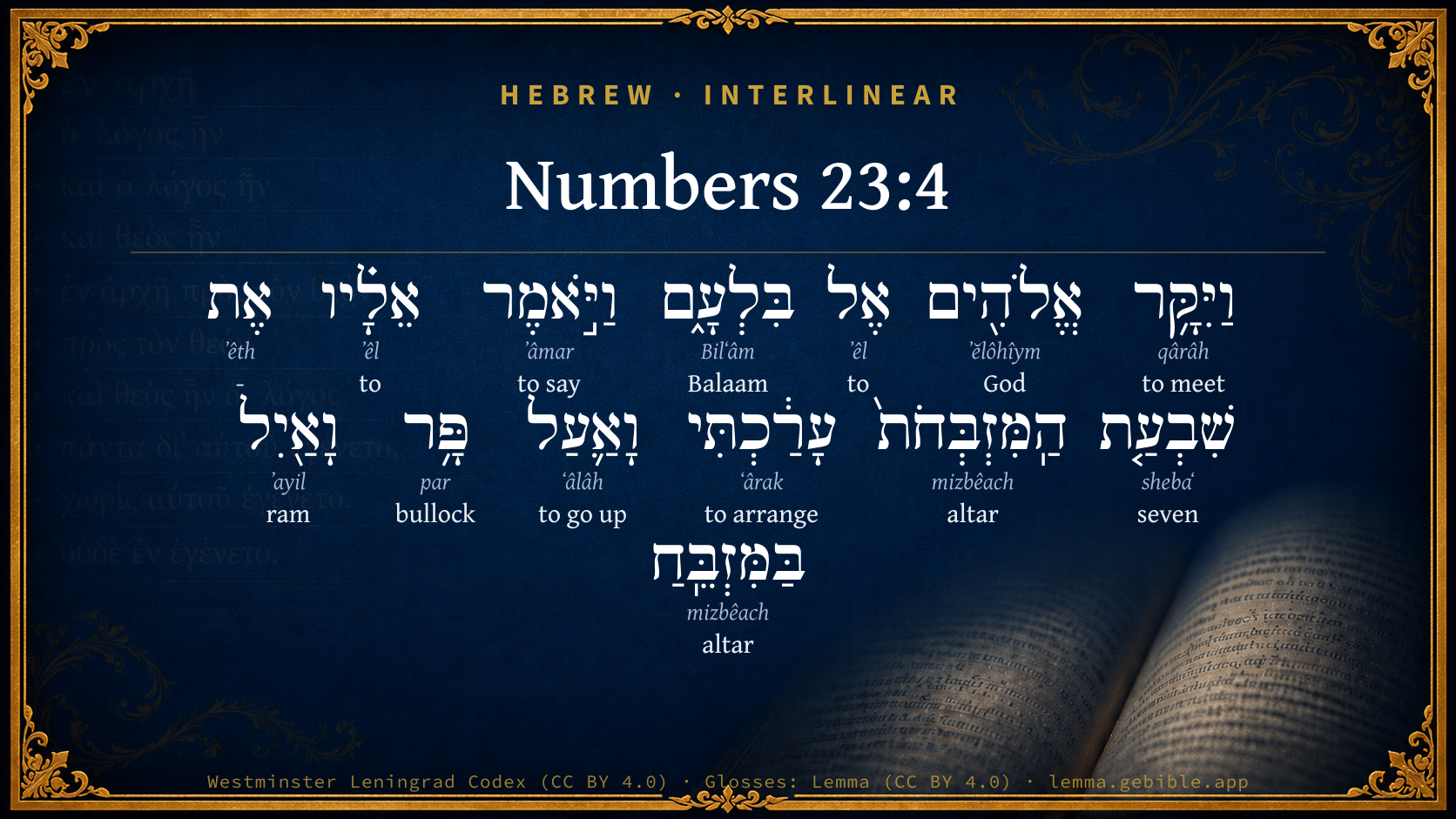
Numbers 23:4

Hebrew (Westminster Leningrad Codex) Numbers 23:4 appears in the Hebrew Old Testament. The text above is from the Westminster Leningrad Codex. Each word links to its Strong’s number, a concise gloss, and parsing drawn from the Open Scriptures Hebrew Bible morphology. Click any word for its full Brown-Driver-Briggs (BDB) entry.
Download image
Cite this verse

Numbers 23:4 (World English Bible). Public Domain. Lemma interlinear Bible study tool, https://lemma.gebible.app/v/numbers/23/4.

Show BibTeX & RIS
BibTeX
RIS
English Translation
God met Balaam: and he said to him, I have prepared the seven altars, and I have offered up a bull and a ram on every altar.
World English Bible · Public Domain
Download a study sheet

One document with this verse’s original text, its word-by-word gloss line, the meaning frame, cross-references with their text, attributed commentary, and full source and license credits — printable, and it pastes into notes with its structure intact.

This verse Autodidact and up

Study sheet (.html) Plain text (.txt)

A passage Seminary Student

Up to 50 verses in one chapter. A passage sheet keeps up to 6 commentary sources and 12 cross-references per verse, in the order this page ranks them, and says so on the sheet whenever that leaves anything out. Ask for a single verse and you get the Autodidact verse sheet above.

Everything on this page stays free to read, with no account — the sheet is a download of what is already on screen, not access to it.

Want to remove ads? Support Godless Engineer
Compare translations 3

The same verse in 3 English versions, stacked beneath the original-language interlinear above. Click any original word for its lexicon entry.

Each is an independent rendering of the whole verse — the interlinear is not word-aligned to these translations.

Highlighted words mark where these versions differ — a whole-verse word diff, not a word-by-word alignment.

  • World English Bible Public Domain
    God met Balaam: and he said to him, I have prepared the seven altars, and I have offered up a bull and a ram on every altar.
  • King James Version Public Domain
    And God met Balaam: and he said unto him, I have prepared seven altars, and I have offered upon every altar a bullock and a ram.
  • unfoldingWord Literal Text CC BY-SA 4.0
    And God met Balaam, and he said to him, “I have arranged the seven altars, and I have offered up a bull and a ram on the altar.”

unfoldingWord Literal Text — © unfoldingWord, licensed CC BY-SA 4.0. Word-aligned USFM3 via Door43 (git.door43.org/unfoldingWord/en_ult).

Versions to compare (up to 4)

3 of 4 selected

Show all 18 translations

Every available English version of this verse, each an independent rendering of the whole verse.

  • World English Bible Public Domain
    God met Balaam: and he said to him, I have prepared the seven altars, and I have offered up a bull and a ram on every altar.
  • Berean Standard Bible Public Domain
    and God met with him. “I have set up seven altars,” Balaam said, “and on each altar I have offered a bull and a ram.”
  • Majority Standard Bible Public Domain
    and God met with him. “I have set up seven altars,” Balaam said, “and on each altar I have offered a bull and a ram.”
  • King James Version Public Domain
    And God met Balaam: and he said unto him, I have prepared seven altars, and I have offered upon every altar a bullock and a ram.
  • American Standard Version (1901) Public Domain
    And God met Balaam: and he said unto him, I have prepared the seven altars, and I have offered up a bullock and a ram on every altar.
  • Revised Version (1885) Public Domain
    And God met Balaam: and he said unto him, I have prepared the seven altars, and I have offered up a bullock and a ram on every altar.
  • Geneva Bible (1599) Public Domain
    And God met Balaam, and Balaam sayd vnto him, I haue prepared seuen altars, and haue offred vpon euery altar a bullocke and a ramme.
  • Douay-Rheims (1899) Public Domain
    And when he was gone with speed, God met him. And Balaam speaking to him, said: I have erected seven altars, and have laid on everyone a calf and a ram.
  • Young's Literal Translation Public Domain
    And God cometh unto Balaam, and he saith unto Him, `The seven altars I have arranged, and I offer a bullock and a ram on the altar;'
  • Literal Standard Version CC BY-SA 4.0
    And God comes to Balaam, and he says to Him, “I have arranged the seven altars, and I offer a bullock and a ram on the altar”;
  • Unlocked Literal Bible CC BY-SA 4.0
    While he was on the hilltop, God met him, and Balaam said to him, “I have built seven altars, and I have offered up a bull and a ram on each one.”
  • unfoldingWord Literal Text CC BY-SA 4.0
    And God met Balaam, and he said to him, “I have arranged the seven altars, and I have offered up a bull and a ram on the altar.”
  • Darby Bible Public Domain
    And God met Balaam; and [Balaam] said to him, I have disposed seven altars, and have offered up a bullock and a ram upon [each] altar.
  • World Messianic Bible Public Domain
    God met Balaam, and he said to him, “I have prepared the seven altars, and I have offered up a bull and a ram on every altar.”
  • Webster's Bible Public Domain
    And God met Balaam: and he said to him, I have prepared seven altars, and I have offered upon every altar a bullock and a ram.
  • Free Bible Version CC BY-SA 4.0
    God met with him there, and Balaam said. “I have built seven altars and on each altar I have offered a bull and a ram.”
  • Bible in Basic English Public Domain
    And God came to Balaam, and Balaam said to him, I have made ready seven altars, offering an ox and a male sheep on every altar.
  • JPS Tanakh (1917) Public Domain
    And God met Balaam; and he said unto Him: 'I have prepared the seven altars, and I have offered up a bullock and a ram on every altar.'

Literal Standard Version (2020), Covenant Press — licensed CC BY-SA 4.0. Text via the HelloAO Bible API (eBible.org). Unlocked Literal Bible (unfoldingWord) — licensed CC BY-SA 4.0. Text via the HelloAO Bible API (eBible.org). unfoldingWord Literal Text — © unfoldingWord, licensed CC BY-SA 4.0. Word-aligned USFM3 via Door43 (git.door43.org/unfoldingWord/en_ult). Free Bible Version, Dr. Jonathan Gallagher — licensed CC BY-SA 4.0. Text via the HelloAO Bible API (eBible.org).

Word by word

More ways to search: Search by grammar → Find every occurrence → Compare this word →

Practice this passage: Drill this verse → Learn its vocabulary →

וַיִּקָּ֥ר
qârâh
H7136
“and · to meet”
Conjunction + Verb, Niphal, Sequential Imperfect, 3rd Person, Masculine, Singular
Part of Speech
Conjunction + Verb
Stem
Niphal
Form
Sequential Imperfect
Person
3rd Person
Gender
Masculine
Number
Singular
Full BDB Definition

Origin: a primitive root

TWOT: 2068 , 2068e

to encounter, meet, befall, happen, come to meet - (Qal) - to encounter, meet - to befall - (Niphal) - to encounter, meet (without pre-arrangement) - to chance to be present - to come to meet - (Hiphil) to cause to meet, appoint - to build with beams - (Piel) to lay the beams of, furnish with beams
  1. אֱלֹהִ֖ים ʼĕlôhîym H430 “God(s)” Noun, Common, Masculine, Plural, Absolute
  2. אֶל ʼêl H413 “to” Preposition
  3. בִּלְעָ֑ם Bilʻâm H1109 “Balaam” Noun, Proper
  4. וַיֹּ֣אמֶר ʼâmar H559 “and · to say” Conjunction + Verb, Qal, Sequential Imperfect, 3rd Person, Masculine, Singular
  5. אֵלָ֗יו ʼêl H413 “to · him” Preposition + Suffix, Personal, 3rd Person, Masculine, Singular
  6. אֶת ʼêth H853 “-” Particle, Direct Object
  7. שִׁבְעַ֤ת shebaʻ H7651 “seven” Adjective, Cardinal number, Masculine, Singular, Construct
  8. הַֽמִּזְבְּחֹת֙ mizbêach H4196 “the · altars” Particle, Definite Article + Noun, Common, Masculine, Plural, Absolute
  9. עָרַ֔כְתִּי ʻârak H6186 “to arrange” Verb, Qal, Perfect, 1st Person, Common, Singular
  10. וָאַ֛עַל ʻâlâh H5927 “and · to go up” Conjunction + Verb, Hiphil, Sequential Imperfect, 1st Person, Common, Singular
  11. פָּ֥ר par H6499 “bullock” Noun, Common, Masculine, Singular, Absolute
  12. וָאַ֖יִל ʼayil H352 “and · ram” Conjunction + Noun, Common, Masculine, Singular, Absolute
  13. בַּמִּזְבֵּֽחַ mizbêach H4196 “in/at the · altar” Preposition, Determined + Noun, Common, Masculine, Singular, Absolute

About this verse

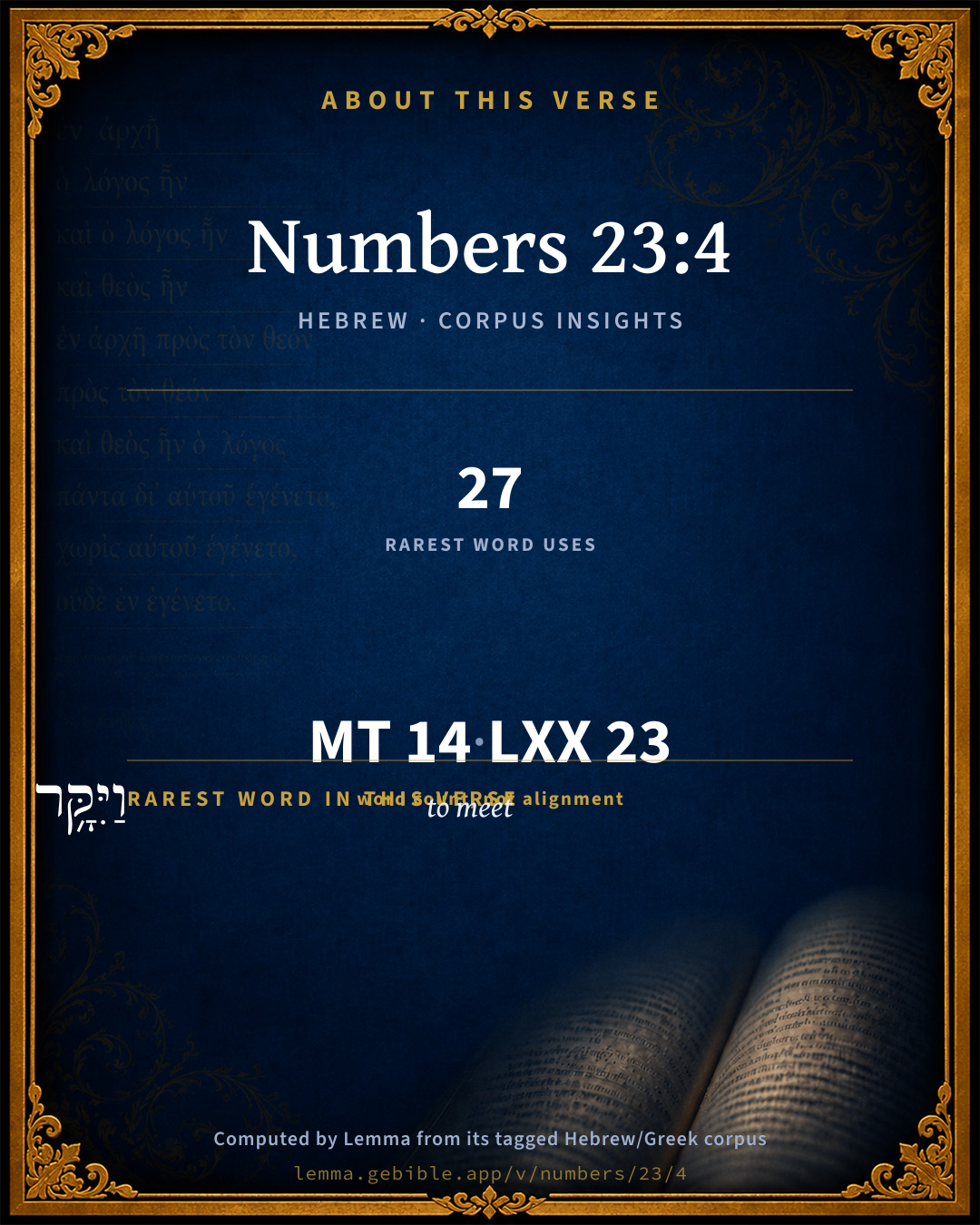
These counts appear in no published source. They are computed here, from the morphology-tagged text and Lemma’s own curated glosses. What Lemma adds →

14
words
12
distinct lemmas
Pentateuch
section

Shared distinctive vocabulary

וַיִּקָּ֥ר to meet H7136 occurs in 27 verses of the Hebrew Bible. Also found in:

Grammatical profile

  • 4 verbs
  • 6 nouns
  • 1 adjective
  • 2 prepositions
  • 1 particle

Verb forms

  • וַיִּקָּ֥ר Niphal · Sequential Imperfect
  • וַיֹּ֣אמֶר Qal · Sequential Imperfect
  • עָרַ֔כְתִּי Qal · Perfect
  • וָאַ֛עַל Hiphil · Sequential Imperfect

Repetition

Words recur within this verse — often emphatic in Hebrew:

  • הַֽמִּזְבְּחֹת֙ altar H4196 ×2
  • אֶל to H413 ×2

Hebrew & Septuagint length

In English translation the verse runs 27 words from the Hebrew and 39 from the Septuagint (LXX English) — the Septuagint runs noticeably longer here. See the side-by-side →

A rough comparison of the two English renderings, which tokenize alike — not a word-level alignment.

Word counts can differ between the Hebrew and the Greek without any difference in meaning — e.g. the Hebrew direct-object marker אֵת has no separate Greek word, and Greek often adds the article ὁ.

In the original languages it is 14 Hebrew tokens and 23 Greek tokens — but the two are counted differently (Hebrew bundles its prefixes and suffixes into one token; the Greek is in lemma form), so that isn’t a like-for-like length.

Cross-references

10

Topical passages linked to Numbers 23:4 in the Treasury of Scripture Knowledge — connected by theme and wording, ordered by reader-vote popularity; previews shown in the World English Bible.

  • Numbers 23:16 Yahweh met Balaam, and put a word in his mouth, and said, Return to Balak, and thus shall you speak.
  • Luke 18:12 I fast twice a week. I give tithes of all that I get.'
  • Ephesians 2:9 not of works, that no one would boast.
  • Numbers 22:9 God came to Balaam, and said, What men are these with you?
  • Numbers 22:20 God came to Balaam at night, and said to him, If the men are come to call you, rise up, go with them; but only the word which I speak to you, that shall you do.
  • Numbers 23:1 Balaam said to Balak, Build me here seven altars, and prepare me here seven bulls and seven rams.
  • Isaiah 58:3–4 Why have we fasted, [say they], and you don't see? [why] have we afflicted our soul, and you take no knowledge? Behold, in the day of your fast you find [your own] pleasure, and exact all your labors.
  • Matthew 20:12 saying, 'These last have spent one hour, and you have made them equal to us, who have borne the burden of the day and the scorching heat!'
  • John 16:2 They will put you out of the synagogues. Yes, the time comes that whoever kills you will think that he offers service to God.
  • Romans 3:27 Where then is the boasting? It is excluded. By what manner of law? Of works? No, but by a law of faith.

Cross-references courtesy of OpenBible.info (CC BY 4.0).

Hebrew and Greek witnesses Masoretic Hebrew ↔ Greek Septuagint

The same verse in the two great witnesses to the Old Testament, shown verse-for-verse.

Here the Septuagint runs noticeably longer than the Hebrew — LXX2012 (modern English Septuagint) 39 words vs World English Bible 27. A rough length comparison of the two English translations, not a word-level alignment — read both below.

These are two independent witnesses, not word-aligned to each other, and the Septuagint is shown in lemma (dictionary) form.

Hebrew Numbers 23:4 Masoretic · Westminster Leningrad Codex

וַיִּקָּ֥ר אֱלֹהִ֖ים אֶל בִּלְעָ֑ם וַיֹּ֣אמֶר אֵלָ֗יו אֶת שִׁבְעַ֤ת הַֽמִּזְבְּחֹת֙ עָרַ֔כְתִּי וָאַ֛עַל פָּ֥ר וָאַ֖יִל בַּמִּזְבֵּֽחַ

God met Balaam: and he said to him, I have prepared the seven altars, and I have offered up a bull and a ram on every altar.

World English Bible · Public Domain

Greek LXX Numbers 23:4 Septuagint · lemma form

καί φαίνω ὁ θεός ὁ βαλααμ καί εἶπον πρός αὐτός βαλααμ ὁ ἑπτά βωμός ἑτοιμάζω καί ἀναβιβάζω μόσχος καί κριός ἐπί ὁ βωμός

And Balaam went to enquire of God; and he went straight forward, and God appeared to Balaam; and Balaam said to him, I have prepared the seven altars, and have offered a calf and a ram on every altar.

LXX2012 (modern English Septuagint) · Public Domain

On this verse, Haydock's Catholic Bible Commentary discusses the Septuagint’s reading. Read the note in Commentary ↓

Hebrew: Westminster Leningrad Codex (CC BY 4.0). Greek: Septuagint (public domain); English from LXX2012 (modern English Septuagint) (Public Domain). How the Septuagint differs from the Hebrew →

Targum (Aramaic paraphrase)

2

The Targum is the ancient Jewish Aramaic paraphrase of the Hebrew Scriptures — an interpretive translation, not the Hebrew text itself. Onkelos (literal) and Pseudo-Jonathan (expansive) render the Torah, and Jonathan the Prophets. Coverage is partial: where no permissively-licensed English translation exists for a verse, only the Aramaic is shown. This is verse-level text, not a word-by-word alignment to the Hebrew.

  1. Targum Onkelos Torah (Genesis–Deuteronomy)
    וְעָרַע מֵימַר מִן קֳדָם יְיָ לְוַת בִּלְעָם וַאֲמַר לֵיהּ יַת שַׁבְעָא מַדְבְּחִין סְדָרִית וְאַסֵקִית תּוֹר וּדְכַר עַל כָּל מַדְבְּחָא

    (no public-domain English translation for this verse)

    Targum Onkelos — Aramaic: “Onkelos Genesis” (public domain); “Onkelos Exodus” (public domain); “Onkelos Leviticus” (public domain); “Onkelos Numbers” (public domain); “Onkelos Deuteronomy” (public domain). English: “Sefaria Community Translation” (CC0 1.0 (public-domain dedication)); “J.W. Etheridge. The Targums of Onkelos and Jonathan Ben Uzziel on the Pentateuch. London: Longmans, Green, 1862” (public domain). Text via Sefaria.

  2. Targum Pseudo-Jonathan Torah (Genesis–Deuteronomy)
    וְאַרַע מֵימְרָא מִן קֳדָם יְיָ בְּבִלְעָם וַאֲמַר קֳדָמוֹהִי יַת שׁוּבְעָתֵי אוֹגָרַיָא סְדָרִית וְאַסֵיקִית תּוֹר וּדְכַר עַל כָּל אַגוֹרָא

    And the Word from before the Lord met with Bileam, who said before Him, The seven altars I have set in order, and have offered a bullock and a ram upon every altar.

    Targum Pseudo-Jonathan — Aramaic: “Targum Jonathan on Genesis” (public domain); “Targum Jonathan on Exodus” (public domain); “Targum Jonathan on Leviticus” (public domain); “Targum Jonathan on Numbers” (public domain); “Targum Jonathan on Deuteronomy” (public domain). English: “The Targum of Jonathan ben Uzziel, trans. J. W. Etheridge, London, 1862” (public domain). Text via Sefaria.

Commentary

Notes on Numbers 23:4 from classic Christian and Jewish commentators (each source and its license shown beneath its notes). The classic Christian expositions comment on the surrounding passage and are grouped to its opening verse, so a note may address several verses; the Jewish commentaries on the Tanakh (Rashi and others) are per-verse, so they appear only where the commentator wrote on this verse.

Lemma curates 59 commentaries, every one of them public domain or Creative Commons licensed, each selected and text-cleaned for this edition rather than reprinted as found. About our sources →

Trapp's Complete Commentary

John Trapp

Num 23:4 And God met Balaam: and he said unto him, I have prepared seven altars, and I have offered upon [every] altar a bullock and a ram.

Ver. 4. I have prepared seven altars.] He boasts of his devotions, and so thinks to demerit God’s favour. So those hypocrites in Isaiah. {Isa 58:3} Non sic deos coluimus, ut ille nos vinceret, We have not so served the gods, as that the enemy should have the better of us, said the Emperor Antonius, the philosopher.

John Trapp, A Commentary or Exposition upon All the Books of the Old and New Testament (1647–1656) — public domain. Text from a community e-Sword module.

Geneva Bible (1599)

Geneva Bible translators

Appeared unto him.

Geneva Bible (1599) marginal notes — public domain. Text via Bolls.life.

Jamieson, Fausset & Brown

Robert Jamieson, A. R. Fausset & David Brown

God met Balaam--not in compliance with his incantations, but to frustrate his wicked designs and compel him, contrary to his desires and interests, to pronounce the following benediction [Num 23:8-10].

Jamieson, Fausset & Brown — Commentary Critical and Explanatory on the Whole Bible (1871) — public domain (CC PDM 1.0). Text via the HelloAO Bible API.

John Gill's Exposition

And God met Balaam,.... Not in a kind and gracious manner; not out of any respect to him and his offerings; not to indulge him with any spiritual communion with him; nor to communicate his mind and will to him as a friend of his; not to gratify his desires, and grant the request of the king of Moab, or to smile upon and succeed the scheme that they had concerted; but for the sake of his people Israel, to counterwork the designs of their enemies; to blast and confound them, and turn their curses into blessings; and particularly to oblige Balaam to bless the people he was so desirous of cursing for the sake of gain:

and he said unto him; in a bragging boasting way, in order to gain his favour, and carry his point:

I have prepared seven altars, and I have offered upon every altar a bullock and a ram: that is, to him the Lord; for had they been offered to Baal, he could never have had the nerve to have spoken of them to God; and which he could never have proposed as a reason why he should be regarded by him, or expect on account of them any favour from him: and indeed these altars and sacrifices were not at his expense, though they were prepared and offered at a motion of his; nor were they offered in a right manner, nor with a right end, nor from a right principle, and were far from being acceptable unto God, yea, were abominable unto him; see Pro 21:27.

John Gill's Exposition of the Whole Bible (1746–1763) — public domain (CC PDM 1.0). Text via the HelloAO Bible API.

Albert Barnes' Notes on the Bible

God met Balaam - God served His own purposes through the arts of Balaam, and manifested His will through the agencies employed to seek it, dealing thus with Balaam in an exceptional manner. To God’s own people auguries were forbidden Lev 19:26.

I have prepared seven altars - And therefore Balaam expected that God on His part would do what was desired by the donor; compare Num 22:15 note.

Albert Barnes' Notes on the Bible (1834–1885) — public domain. Text from a community e-Sword/MySword module.

Haydock's Catholic Bible Commentary

Speed. Hebrew shephi, may signify also "on the straight road," (Septuagint) "into the plain," (Louis de Dieu) "all alone," (Onkelos) or most probably "upon an eminence." (Kimchi) (Calmet) --- God, in the visible form of an angel. (Menochius) --- To him. Balaam might suppose that he was addressing his idol. But Moses informs us, that the true God or his angel was present, and forced Balaam to deliver an unwelcome message to the king. (Haydock)

George Leo Haydock (1774–1849), Haydock's Catholic Family Bible and Commentary, 1859 edition — public domain. Excludes Psalms (Douay-Rheims chapter numbering differs from Protestant) and Deuterocanonical books (Catholic canon only).

Matthew Poole's English Annotations

God met Balaam, not to comply with Balaam’s charms, nor to gratify, but to oppose, his wicked desires, and to fierce him against his own inclination and interest to utter the following words.

A bullock and a ram, which I pray thee accept, and give me leave to curse thy people, as their abundant wickedness deserves.

Matthew Poole's English Annotations on the Holy Bible (1683–1685) — public domain. Text from a community e-Sword/MySword module.

Whedon's Commentary on the Bible

Daniel D. Whedon

4. God met Balaam — Not in the flight of birds or in any natural sign of doubtful signification, but by a distinct and unequivocal message which he was commanded to declare to Balak. This was done, not for the sake of Balak, but for the good of Israel. Where his people are concerned God may direct the result of a pagan divination. Eze_21:19-23.

Daniel D. Whedon (gen. ed.), Commentary on the Old and New Testaments (1874–1909) — public domain. Text from a community e-Sword module.

The Pulpit Commentary

I have prepared seven altars. Balaam, acting for the king of Moab, his heathen patron, in this difficult business, points out to God that he had given him the full quota of sacrifices to begin with. It was implied in this reminder that God would naturally feel disposed to do something for Balaam in return.

The Pulpit Commentary (1880–1919), ed. H.D.M. Spence-Jones & Joseph S. Exell — public domain. Text from a community e-Sword module.

Keil & Delitzsch

C. F. Keil & F. Delitzsch

"And God came to meet Balaam," who thought it necessary, as a true hariolus, to call the attention of God to the altars which had been built for Him, and the sacrifices that had been offered upon them. And God made known His will to him, though not in a natural sign of doubtful signification. He put a very distinct and unmistakeable word into his mouth, and commanded him to make it known to the king.

Keil & Delitzsch — Biblical Commentary on the Old Testament (1861–1891) — public domain (CC PDM 1.0). Text via the HelloAO Bible API. (Old Testament only.)

unfoldingWord translationNotes

Door43 World Missions Community

I have offered up a bull and a ram

It has already been stated that he killed these animals as a burnt offering. AT: "I have killed a bull and a ram and burnt them as an offering" (See: Assumed Knowledge and Implicit Information)

Yahweh put a message in Balaam's mouth

Here Yahweh giving Balaam a message to speak is spoken of as if Yahweh placed it in his mouth. AT: "Yahweh told Balaam what he wanted him to say to Balak" (See: Metaphor)

translationWords

God

altar

sacrifice

Yahweh

burnt offering

Moab

unfoldingWord translationNotes — © Distant Shores Media and the Door43 World Missions Community, licensed CC BY-SA 4.0. Source: git.door43.org/Door43/en_tn.

Rashi

Rabbi Shlomo Yitzchaki (Rashi)

ויקר AND [GOD] HAPPENED TO MEET [BALAAM] — This is an expression ordinarily used to denote events of a casual character, an expression for something shameful, an expression for an unclean happening (קרי). It is as much as to say: with reluctance and in a contemptuous manner. And on this occasion He revealed Himself to him by day, only to show how dear Israel was to Him (cf. Genesis Rabbah 52:5; Rashi on Leviticus 1:1).

את שבעת המזבחות — “Seven altars I have set in order” is not written here, but “THE SEVEN ALTARS”. He said to Him: The ancestors of these people together built before Thee seven altars, but I alone have built altars equal to all of them. — Abraham built four: (Genesis 12:7) “And he built there an altar to the Lord who had appeared to him”; (Genesis 12:8) “And he removed thence unto the mount… [and he built there an altar]; (Genesis 13:18) “And Abraham moved his tent … [and built there an altar]”; and one he built on Mount Moriah (Genesis 22:9). Isaac built one: (Genesis 26:25) “And he built there an altar”. Jacob built two, one at Shechem and one at Bethel (Genesis 33:20 and Genesis 35:7);

ואעל פר ואיל במזבח AND I HAVE OFFERED UPON EVERY ALTAR A BULLOCK AND A RAM — “but Abraham”, said he, “offered only a single ram” (cf. Midrash Tanchuma, Balak 11, Midrash Tanchuma, Tzav 1).

Rashi on the Tanakh — English translations: “The Judaica Press complete Tanach with Rashi, translated by A. J. Rosenberg” (CC BY 4.0); “Pentateuch with Rashi's commentary by M. Rosenbaum and A.M. Silbermann, 1929-1934” (public domain); “The Metsudah Tanach series, Lakewood, N.J” (CC BY 4.0); and “The Book of Joshua, Metsudah Publications, 1997” (CC BY 4.0). Text via Sefaria.

Ramban (Nachmanides)

Rabbi Moshe ben Nachman (Ramban / Nachmanides)

AND G-D HAPPENED TO MEET BALAAM. Because this man had not reached the status of prophecy, therefore Scripture speaks of him in this way, [meaning to say] that now the [Divine] communication came to him by way of chance, and in honor of Israel. Hence it says concerning him, and G-d ‘came’ unto Balaam, for this expression is not used in connection with [true] prophets, but only about a person who has not attained this status. Similarly [we find]: and G-d ‘came’ to Abimelech; and G-d ‘came’ to Laban., 31:24. It is possible that [the term “coming” in these verses] means the “coming” through speech of the Will from the Most High to the [Separate] Intelligences, pp. 228-231, where Ramban discusses at length the subject of angels in relation to prophecy. that cause one to dream, for Balaam also would fall down at daytime, and a deep sleep would fall upon him while he was yet with opened eyes.

AND G-D HAPPENED TO MEET BALAAM AND HE SAID UNTO HIM. The meaning [of this verse] is that when an occurrence happened to Balaam in the nature of those experiences which occur to men of Ruach Hakodesh, Note 71 and Ramban ibid. when dwelling alone and a spirit passed before his face that made the hair of his flesh to stand up, fear came upon him, and trembling, and all his bones were made to shake, Verse 14. and his vigor turned into weakness and he fell upon his face to the ground — and then Balaam said, I have prepared the seven altars, this being by way of prayer, as I have explained. But G-d did not hearken to him and his intention, but told him: Thus shalt thou speak.

Ramban (Nachmanides) on the Tanakh — English translation: “Commentary on the Torah by Ramban (Nachmanides). Translated and annotated by Charles B. Chavel. New York, Shilo Pub. House, 1971-1976” (CC BY 4.0). Text via Sefaria.

Lesson kit

Teaching starters — assembled from the data on this page, not authored interpretation. Every prompt links to the verse data it draws on. Edit before teaching.

Numbers, in the Pentateuch, opens this verse with 14 words (12 distinct Hebrew lemmas). Its most distinctive word is qârâh (“to meet”). The Greek Septuagint runs longer here. A historical commentator’s framing appears above. Read the whole chapter for the surrounding context.

Discussion questions

  1. What does “to meet” (qârâh) contribute to the verse as a whole?
  2. How does Genesis 24:12, which shares the word «to meet», read alongside this verse?
  3. What does the repetition of “altar” (2× in this one verse) do in this verse?
  4. The Septuagint runs longer here than the Hebrew. What might account for the difference?
  5. These translations render this verse differently; the difference is in the English rendering, not the original. What questions does that raise?
  6. «וַיִּקָּ֥ר» is a Niphal Sequential Imperfect verb. How does that grammatical form shape the action described?
  7. Compare how Trapp's Complete Commentary and Geneva Bible (1599) read this verse. Where do they agree or differ?

Things to notice

Reading settings

Reading text

Shown beneath each verse's original-language words.

Old Testament
Old Testament edition

Read the OT as the Masoretic Hebrew (MT) or the Greek Septuagint (LXX).

English shown for the Greek Septuagint (in the Hebrew ↔ Greek comparison).

Comparing translations? Open the Compare panel on any verse page to stack up to four side by side.