
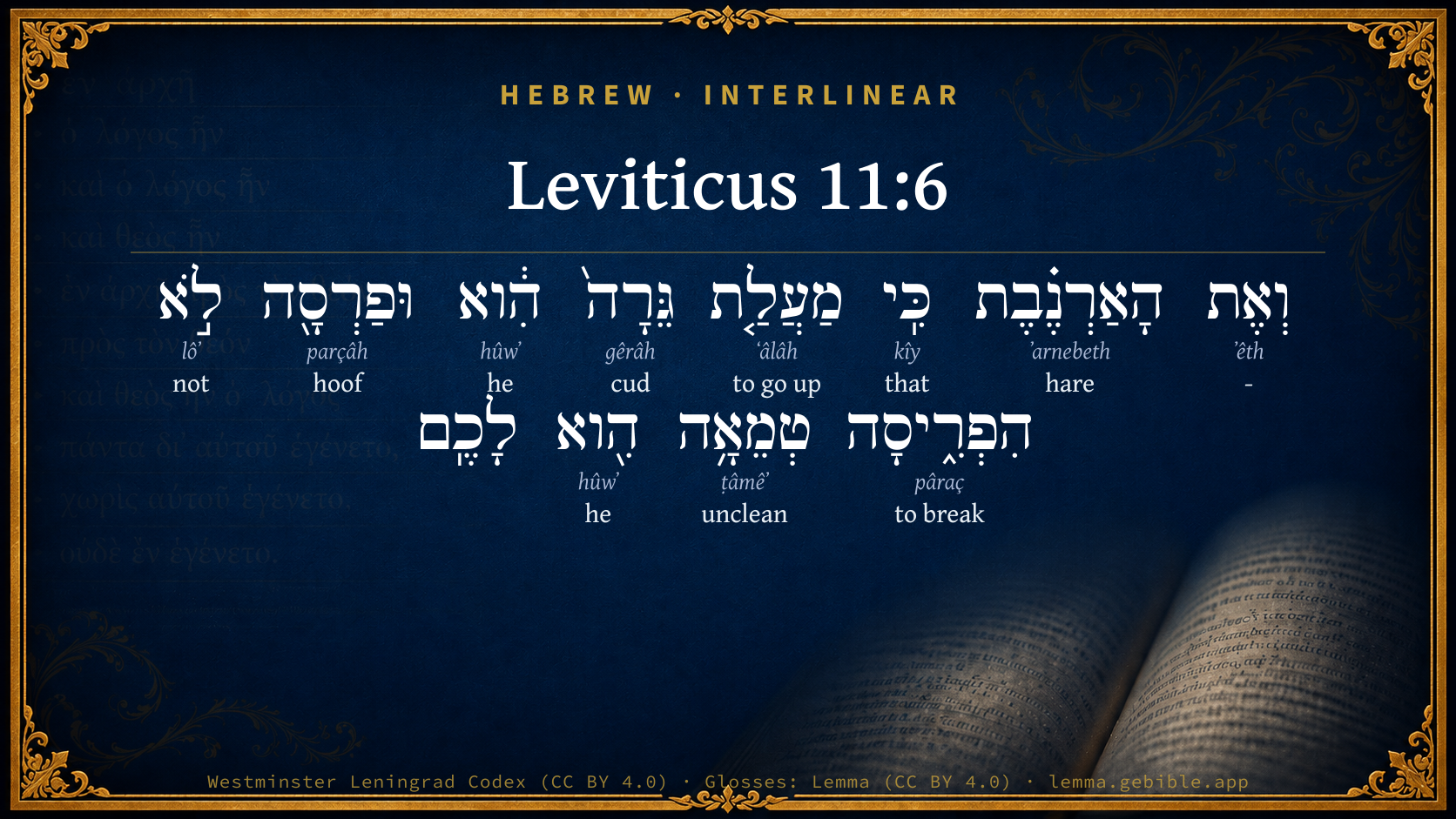
Leviticus 11:6

Hebrew (Westminster Leningrad Codex) Leviticus 11:6 appears in the Hebrew Old Testament. The text above is from the Westminster Leningrad Codex. Each word links to its Strong’s number, a concise gloss, and parsing drawn from the Open Scriptures Hebrew Bible morphology. Click any word for its full Brown-Driver-Briggs (BDB) entry.
Download image
Cite this verse

Leviticus 11:6 (World English Bible). Public Domain. Lemma interlinear Bible study tool, https://lemma.gebible.app/v/leviticus/11/6.

Show BibTeX & RIS
BibTeX
RIS
English Translation
The hare, because she chews the cud but doesn't part the hoof, she is unclean to you.
World English Bible · Public Domain
Highlights
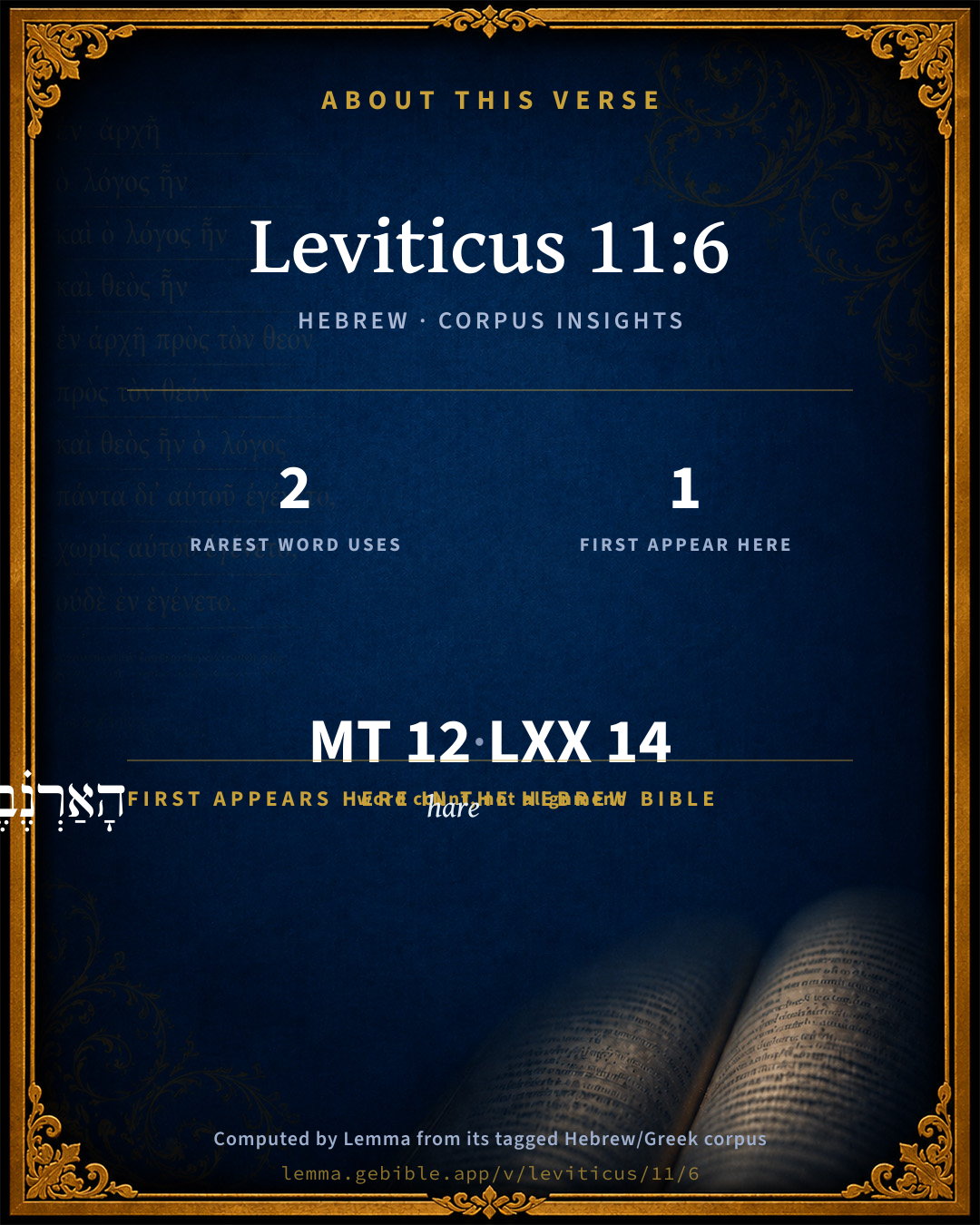
  • 1 first appearance in the Hebrew Bible
Full analysis ↓
Download a study sheet

One document with this verse’s original text, its word-by-word gloss line, the meaning frame, cross-references with their text, attributed commentary, and full source and license credits — printable, and it pastes into notes with its structure intact.

This verse Autodidact and up

Study sheet (.html) Plain text (.txt)

A passage Seminary Student

Up to 50 verses in one chapter. A passage sheet keeps up to 6 commentary sources and 12 cross-references per verse, in the order this page ranks them, and says so on the sheet whenever that leaves anything out. Ask for a single verse and you get the Autodidact verse sheet above.

Everything on this page stays free to read, with no account — the sheet is a download of what is already on screen, not access to it.

Want to remove ads? Support Godless Engineer
Compare translations 3

The same verse in 3 English versions, stacked beneath the original-language interlinear above. Click any original word for its lexicon entry.

Each is an independent rendering of the whole verse — the interlinear is not word-aligned to these translations.

Highlighted words mark where these versions differ — a whole-verse word diff, not a word-by-word alignment.

  • World English Bible Public Domain
    The hare, because she chews the cud but doesn't part the hoof, she is unclean to you.
  • King James Version Public Domain
    And the hare, because he cheweth the cud, but divideth not the hoof; he is unclean unto you.
  • unfoldingWord Literal Text CC BY-SA 4.0
    And the rabbit, because it is making the cud go up, but it does not divide a hoof, it unclean to you.

unfoldingWord Literal Text — © unfoldingWord, licensed CC BY-SA 4.0. Word-aligned USFM3 via Door43 (git.door43.org/unfoldingWord/en_ult).

Versions to compare (up to 4)

3 of 4 selected

Show all 18 translations

Every available English version of this verse, each an independent rendering of the whole verse.

  • World English Bible Public Domain
    The hare, because she chews the cud but doesn't part the hoof, she is unclean to you.
  • Berean Standard Bible Public Domain
    The rabbit, though it chews the cud, does not have a divided hoof; it is unclean for you.
  • Majority Standard Bible Public Domain
    The rabbit, though it chews the cud, does not have a divided hoof; it is unclean for you.
  • King James Version Public Domain
    And the hare, because he cheweth the cud, but divideth not the hoof; he is unclean unto you.
  • American Standard Version (1901) Public Domain
    And the hare, because she cheweth the cud but parteth not the hoof, she is unclean unto you.
  • Revised Version (1885) Public Domain
    And the hare, because she cheweth the cud but parteth not the hoof, she is unclean unto you.
  • Geneva Bible (1599) Public Domain
    Also the hare, because he cheweth the cud, and deuideth not the hoofe, he shalbe vncleane to you.
  • Douay-Rheims (1899) Public Domain
    The hare also: for that too cheweth the cud, but divideth not the hoof.
  • Young's Literal Translation Public Domain
    and the hare, though it is bringing up the cud, yet the hoof hath not divided -- unclean it `is' to you;
  • Literal Standard Version CC BY-SA 4.0
    and the hare, though it is bringing up the cud, yet the hoof has not divided—it [is] unclean to you;
  • Unlocked Literal Bible CC BY-SA 4.0
    The rabbit, because it chews the cud, but does not have a split hoof, is unclean to you.
  • unfoldingWord Literal Text CC BY-SA 4.0
    And the rabbit, because it is making the cud go up, but it does not divide a hoof, it unclean to you.
  • Darby Bible Public Domain
    and the hare, for it cheweth the cud, but hath not cloven hoofs -- it shall be unclean unto you;
  • World Messianic Bible Public Domain
    The hare, because it chews the cud but doesn’t have a parted hoof, is unclean to you.
  • Webster's Bible Public Domain
    And the hare, because he cheweth the cud, but divideth not the hoof: he is unclean to you.
  • Free Bible Version CC BY-SA 4.0
    The hare, which though it chews the cud doesn't have a divided hoof, so it is unclean for you.
  • Bible in Basic English Public Domain
    And the hare, because the horn of its foot is not parted in two, is unclean to you.
  • JPS Tanakh (1917) Public Domain
    And the hare, because she cheweth the cud but parteth not the hoof, she is unclean unto you.

Literal Standard Version (2020), Covenant Press — licensed CC BY-SA 4.0. Text via the HelloAO Bible API (eBible.org). Unlocked Literal Bible (unfoldingWord) — licensed CC BY-SA 4.0. Text via the HelloAO Bible API (eBible.org). unfoldingWord Literal Text — © unfoldingWord, licensed CC BY-SA 4.0. Word-aligned USFM3 via Door43 (git.door43.org/unfoldingWord/en_ult). Free Bible Version, Dr. Jonathan Gallagher — licensed CC BY-SA 4.0. Text via the HelloAO Bible API (eBible.org).

Word by word

More ways to search: Search by grammar → Find every occurrence → Compare this word →

Practice this passage: Drill this verse → Learn its vocabulary →

הָאַרְנֶ֗בֶת
ʼarnebeth
H768
“the · hare”
Particle, Definite Article + Noun, Common, Feminine, Singular, Absolute
Part of Speech
Particle + Noun
Type
Common
Gender
Feminine
Number
Singular
State
Absolute
Full BDB Definition

Origin: of uncertain derivation

TWOT: 123a

hare - probably an extinct animal because no known hare chews its cud, exact meaning is unknown, and best left untranslated as " arnebeth"
  1. וְאֶת ʼêth H853 “and · -” Conjunction + Particle, Direct Object
  2. כִּֽי kîy H3588 “that” Conjunction
  3. מַעֲלַ֤ת ʻâlâh H5927 “going up” Verb, Hiphil, Participle Active, Feminine, Singular, Construct
  4. גֵּרָה֙ gêrâh H1625 “cud” Noun, Common, Feminine, Singular, Absolute
  5. הִ֔וא hûwʼ H1931 “he” Pronoun, Personal, 3rd Person, Feminine, Singular
  6. וּפַרְסָ֖ה parçâh H6541 “and · hoof” Conjunction + Noun, Common, Feminine, Singular, Absolute
  7. לֹ֣א lôʼ H3808 “not” Particle, Negative
  8. הִפְרִ֑יסָה pâraç H6536 “to break” Verb, Hiphil, Perfect, 3rd Person, Feminine, Singular
  9. טְמֵאָ֥ה ṭâmêʼ H2931 “unclean” Adjective, Adjective, Feminine, Singular, Absolute
  10. הִ֖וא hûwʼ H1931 “he” Pronoun, Personal, 3rd Person, Feminine, Singular

About this verse

These counts appear in no published source. They are computed here, from the morphology-tagged text and Lemma’s own curated glosses. What Lemma adds →

12
words
10
distinct lemmas
Pentateuch
section

Notable vocabulary

The rarest word here is הָאַרְנֶ֗בֶת hare H768 — appearing just 2 times in the whole Hebrew Bible.

First appearance in Scripture

This word makes its first canonical appearance in the Hebrew Bible here:

  • הָאַרְנֶ֗בֶת hare H768

Shared distinctive vocabulary

הָאַרְנֶ֗בֶת hare H768 occurs in 2 verses of the Hebrew Bible. Also found in:

Grammatical profile

  • 2 verbs
  • 3 nouns
  • 1 adjective
  • 2 pronouns
  • 1 preposition
  • 1 conjunction
  • 2 particles

Verb forms

  • מַעֲלַ֤ת Hiphil · Participle Active
  • הִפְרִ֑יסָה Hiphil · Perfect

Repetition

A word recurs within this verse — often emphatic in Hebrew:

  • הִ֔וא he H1931 ×2

Hebrew & Septuagint length

In English translation the verse runs 17 words from the Hebrew and 21 from the Septuagint (LXX English) — closely comparable.

A rough comparison of the two English renderings, which tokenize alike — not a word-level alignment.

Word counts can differ between the Hebrew and the Greek without any difference in meaning — e.g. the Hebrew direct-object marker אֵת has no separate Greek word, and Greek often adds the article ὁ.

In the original languages it is 12 Hebrew tokens and 14 Greek tokens — but the two are counted differently (Hebrew bundles its prefixes and suffixes into one token; the Greek is in lemma form), so that isn’t a like-for-like length.

Cross-references

1

Topical passages linked to Leviticus 11:6 in the Treasury of Scripture Knowledge — connected by theme and wording, ordered by reader-vote popularity; previews shown in the World English Bible.

  • Deuteronomy 14:7 Nevertheless these you shall not eat of them that chew the cud, or of those who have the hoof cloven: the camel, and the hare, and the rabbit; because they chew the cud but don't part the hoof, they are unclean to you.

Cross-references courtesy of OpenBible.info (CC BY 4.0).

Hebrew and Greek witnesses Masoretic Hebrew ↔ Greek Septuagint

The same verse in the two great witnesses to the Old Testament, shown verse-for-verse.

These are two independent witnesses, not word-aligned to each other, and the Septuagint is shown in lemma (dictionary) form.

Hebrew Leviticus 11:6 Masoretic · Westminster Leningrad Codex

וְאֶת הָאַרְנֶ֗בֶת כִּֽי מַעֲלַ֤ת גֵּרָה֙ הִ֔וא וּפַרְסָ֖ה לֹ֣א הִפְרִ֑יסָה טְמֵאָ֥ה הִ֖וא לָכֶֽם

The hare, because she chews the cud but doesn't part the hoof, she is unclean to you.

World English Bible · Public Domain

Greek LXX Leviticus 11:6 Septuagint · lemma form

καί ὁ χοιρογρύλλιος ὅτι ἀναἄγω μηρυκισμός οὗτος καί ὁπλή οὐ διχηλέω ἀκάθαρτος οὗτος σύ

And the hare, because it does not chew the cud, and does not divide the hoof, this is unclean to you.

LXX2012 (modern English Septuagint) · Public Domain

On this verse, Haydock's Catholic Bible Commentary discusses the Septuagint’s reading. Read the note in Commentary ↓

Hebrew: Westminster Leningrad Codex (CC BY 4.0). Greek: Septuagint (public domain); English from LXX2012 (modern English Septuagint) (Public Domain). How the Septuagint differs from the Hebrew →

Targum (Aramaic paraphrase)

2

The Targum is the ancient Jewish Aramaic paraphrase of the Hebrew Scriptures — an interpretive translation, not the Hebrew text itself. Onkelos (literal) and Pseudo-Jonathan (expansive) render the Torah, and Jonathan the Prophets. Coverage is partial: where no permissively-licensed English translation exists for a verse, only the Aramaic is shown. This is verse-level text, not a word-by-word alignment to the Hebrew.

  1. Targum Onkelos Torah (Genesis–Deuteronomy)
    וְיָת אַרְנְבָא אֲרֵי מַסְקָא פִשְׁרָא הִיא וּפַרְסָתָא לָא סְדִיקָא מְסָאָבָא הִיא לְכוֹן

    (no public-domain English translation for this verse)

    Targum Onkelos — Aramaic: “Onkelos Genesis” (public domain); “Onkelos Exodus” (public domain); “Onkelos Leviticus” (public domain); “Onkelos Numbers” (public domain); “Onkelos Deuteronomy” (public domain). English: “Sefaria Community Translation” (CC0 1.0 (public-domain dedication)); “J.W. Etheridge. The Targums of Onkelos and Jonathan Ben Uzziel on the Pentateuch. London: Longmans, Green, 1862” (public domain). Text via Sefaria.

  2. Targum Pseudo-Jonathan Torah (Genesis–Deuteronomy)
    וְיַת אַרְנְבָא אֲרוּם מַסִיק פִּישְׁרָא הוּא וּפַרְסָתָא לָא סְדִיקָא מְסָאָב הוּא לְכוֹן

    And the hare, because he bringeth up the cud, but divideth not the hoof, is unclean to you.

    Targum Pseudo-Jonathan — Aramaic: “Targum Jonathan on Genesis” (public domain); “Targum Jonathan on Exodus” (public domain); “Targum Jonathan on Leviticus” (public domain); “Targum Jonathan on Numbers” (public domain); “Targum Jonathan on Deuteronomy” (public domain). English: “The Targum of Jonathan ben Uzziel, trans. J. W. Etheridge, London, 1862” (public domain). Text via Sefaria.

Commentary

Notes on Leviticus 11:6 from classic Christian and Jewish commentators (each source and its license shown beneath its notes). The classic Christian expositions comment on the surrounding passage and are grouped to its opening verse, so a note may address several verses; the Jewish commentaries on the Tanakh (Rashi and others) are per-verse, so they appear only where the commentator wrote on this verse.

Lemma curates 59 commentaries, every one of them public domain or Creative Commons licensed, each selected and text-cleaned for this edition rather than reprinted as found. About our sources →

Trapp's Complete Commentary

John Trapp

Lev 11:6 And the hare, because he cheweth the cud, but divideth not the hoof; he [is] unclean unto you.

Ver. 6. Because he cheweth the cud, but divideth not.] Meditation must end in practice: as lessons of music must be practised, and a copy not read only, but written after.

John Trapp, A Commentary or Exposition upon All the Books of the Old and New Testament (1647–1656) — public domain. Text from a community e-Sword module.

Joseph Benson's Commentary

Lev 11:6. The hare, because (rather, though) he cheweth the cud — He has a runnet in his stomach, as those animals have which chew the cud, and therefore is said to chew it. The hare is extremely timorous, and therefore uses a great deal of exercise, by way of precaution, when it goes to seek its food, and at the approach of danger, either real or imaginary. This probably contributes to the exaltation of the salts. Hence it has a very high taste, even in our cold climate, which is an evidence that the animal flesh which gives it is strongly inclined to alkaline putrefaction.

Joseph Benson's Commentary on the Old and New Testaments (1811–1818) — public domain. Text from a community e-Sword module.

Jamieson, Fausset & Brown

Robert Jamieson, A. R. Fausset & David Brown

the hare--Two species of hare must have been pointed at: the Sinai hare, the hare of the desert, small and generally brown; the other, the hare of Palestine and Syria, about the size and appearance of that known in our own country. Neither the hare nor the coney are really ruminating. They only appear to be so from working the jaws on the grasses they live on. They are not cloven-footed; and besides, it is said that from the great quantity of down upon them, they are very much subject to vermin--that in order to expel these, they eat poisonous plants, and if used as food while in that state, they are most deleterious [WHITLAW].

Jamieson, Fausset & Brown — Commentary Critical and Explanatory on the Whole Bible (1871) — public domain (CC PDM 1.0). Text via the HelloAO Bible API.

Adam Clarke's Commentary

Verse 6. The hare] ארנבת arnebeth, as Bochart and others suppose, from ארה arah, to crop, and ניב nib, the produce of the ground, these animals being remarkable for destroying the fruits of the earth. That they are notorious for destroying the tender blade of the young corn, is well known. It is very likely that different species of these animals are included under the general terms שפן shaphan, and ארנבת arnebeth, for some travellers have observed that there are four or five sorts of these animals, which are used for food in the present day in those countries. See Harmer, vol. iii., p. 331, edit. 1808. Some think the mountain rat, marmot, squirrel, and hedgehog, may be intended under the word shaphan.

Adam Clarke's Commentary on the Bible (1810–1826) — public domain. Text from a community e-Sword/MySword module.

Ellicott's Commentary for English Readers

(6) And the hare, because he cheweth the cud, but.—Better, though he cheweth the cud, yet. Other nations, too, shunned the flesh of hares. The Parsees considered the hare as the most unclean of all animals, and the ancient Britons abstained from eating it because of the loathsome disorders to which the hare is subject. Like the rabbit, or the hyrax, the hare has not the peculiar stomach of the true ruminant; but, like the rabbit, the hare, when sitting at rest, so moves its jaws that it appears to masticate. As the object of the legislator was to furnish the people with marks by which they were to distinguish the clean from the unclean animals, he necessarily adopted those which were in common vogue, and which alone were intelligible in those days.

A Bible Commentary for English Readers, edited by Charles John Ellicott (1878–1897) — public domain. Text from a community e-Sword module.

John Gill's Exposition

And the hare, because he cheweth the cud,.... Or, "though he chews" it:

but divideth not the hoof, he is unclean to you; and so not to be eaten; so Plutarch (q) says, that the Jews are said to abstain from the hare, disdaining it as a filthy and unclean animal, and yet was in the greatest esteem with the Romans of any four footed beast, as Martial says (r): Moses, as Bochart (s) and other learned men observe, is the only writer that speaks of the hare as chewing the cud; though they also observe, that Aristotle (t) makes mention of that in common with those that do chew the cud, namely a "coagulum" or "runnet" in its stomach; his words are,"all that have many bellies have what is called a coagulum or runnet, and of them that have but one belly, the hare;''only that: this creature being prone to lust, may be an emblem of lustful persons, who give up themselves to lasciviousness, to work all uncleanness with greediness, Eph 4:19. (The "hare" is this verse may be an animal that is now is extinct but was alive at the time of Moses. It is only other mentioned in Deu 14:7. Editor.)

(q) Sympos. l. 9. c. 5. (r) L. 13. Epigr. 87. (s) Ut supra, (Hierozoic par. 1. l. 3.) c. 31. col. 977. (t) De Part. Animal. l. 3. c. 15. & Hist. Animal. l. 3. c. 21.

John Gill's Exposition of the Whole Bible (1746–1763) — public domain (CC PDM 1.0). Text via the HelloAO Bible API.

Haydock's Catholic Bible Commentary

Cheweth. Some copies of the Septuagint add not, which agrees with the nature of the hare; though the people to whom Moses addresses himself were of a different persuasion. Its hoof is not divided into two parts only, and therefore it is accounted unclean.

George Leo Haydock (1774–1849), Haydock's Catholic Family Bible and Commentary, 1859 edition — public domain. Excludes Psalms (Douay-Rheims chapter numbering differs from Protestant) and Deuterocanonical books (Catholic canon only).

Whedon's Commentary on the Bible

Daniel D. Whedon

6. The hare — This is probably the species lepus Sinaiticus, seen by modern travellers in the Sinaitic Peninsula and in Mount Lebanon. Hares are hunted in Syria with falcon and greyhound. Only the Arabs eat their flesh.

Daniel D. Whedon (gen. ed.), Commentary on the Old and New Testaments (1874–1909) — public domain. Text from a community e-Sword module.

The Pulpit Commentary

The hare, because he cheweth the cud, but divideth not the hoof, There is little doubt that the same animal as our hare is meant. Neither the hare, however, nor the hyrax chews the cud in the strict sense of the words. But they have the appearance of doing so. The rule respecting chewing the cud was given to and by Moses as a legislator, not as an anatomist, to serve as a sign by which animals might be known to be clean for food. Phenomenal not scientific language is used here, as in Jos_10:12, "as we might speak of whales and their congeners as fish, when there is no need of scientific accuracy" (Clark). "All these marks of distinction in the Levitical law are wisely and even necessarily made on the basis of popular observation and belief, not on that of anatomical exactness. Otherwise the people would have been continually liable to error. Scientifically, the camel would be said to divide the hoof, and the hare does not chew the cud. But laws for popular use must necessarily employ terms as they are popularly understood. These matters are often referred to as scientific errors; whereas they were simply descriptions, necessarily popular, for the understanding and enforcement of the law" (Gardiner).

The Pulpit Commentary (1880–1919), ed. H.D.M. Spence-Jones & Joseph S. Exell — public domain. Text from a community e-Sword module.

Scofield Reference Notes

C. I. Scofield

hare

Heb. arnebeth, an unidentified animal, but certainly not a hare, possessing as it is said to, characteristics not possessed by the hare. The supposed error in the text is due entirely to the translators’ assumption that the English hare and the ancient "arnebeth" were identical.

The Scofield Reference Bible (1917 edition), notes by C. I. Scofield — public domain. Text from a community e-Sword module.

Ramban (Nachmanides)

Rabbi Moshe ben Nachman (Ramban / Nachmanides)

V’ETH HA’ARNEVETH’ (AND THE HARE). This is a species of which both the male and female are so called in the Sacred Language, [although the word itself is feminine]. A similar case is haya’anah (the ostrich) [although the actual word is feminine in form, both male and female are indicated]. In fowls [a word of the same structure is] yonah (a pigeon), the name for the male not being different from that of the female. [On the other hand], there are many [animal species] the names of which are masculine in form, while their females have no specific name, such as gamal (camel), shafan (rock-badger), chazir (swine), ‘dov oreiv’ (a bear lying in wait), is masculine in form. ‘parah v’dov tir’enah’ (the cow and the bear shall feed) is feminine in form, and dov is masculine in form, it nonetheless refers also to the female, as is shown by the feminine form of the verb tir’enah. A similar case amongst fowls is the word tor (turtle-dove) [which, though masculine in form, denotes also the female]. It is for this reason that Scripture states, ‘shtei’ (two) turtle-doves, or ‘shnei’ (two) young pigeons, thus mentioning [the feminine form] shtei with reference to torim (turtle-doves) which is masculine in form, and [the masculine shnei] with reference to yonah (the young pigeon) [which is feminine in form], in order to inform us that there it does not matter which of them [one brings as an offering, whether male or female]. Do not refute me from the expressions of our Rabbis who say: “cow and chazirah (sow);”, as opposed to the masculine chazir in Verse 7. “a camel born of a gamlah (a she-camel),”, 6 b. Here too, the Rabbis use a special term for the female of the camel. for these are terms they improvised from similar forms in the language in order to make their intent clear. Now the reason why these four animals [the camel, rock-badger, hare, and swine] are forbidden [to be eaten] is that they do not have the two characteristics of purity.

Ramban (Nachmanides) on the Tanakh — English translation: “Commentary on the Torah by Ramban (Nachmanides). Translated and annotated by Charles B. Chavel. New York, Shilo Pub. House, 1971-1976” (CC BY 4.0). Text via Sefaria.

Lesson kit

Teaching starters — assembled from the data on this page, not authored interpretation. Every prompt links to the verse data it draws on. Edit before teaching.

Leviticus, in the Pentateuch, opens this verse with 12 words (10 distinct Hebrew lemmas). Its most distinctive word is ʼarnebeth (“hare”). A historical commentator’s framing appears above. Read the whole chapter for the surrounding context.

Discussion questions

  1. What does “hare” (ʼarnebeth) contribute to the verse as a whole?
  2. The word “hare” first appears here in Scripture. What is being introduced at this debut?
  3. Deuteronomy 14:7 shares the word «hare» with this verse. How do the two illuminate each other?
  4. “he” occurs 2× in this one verse. What is the effect of the repetition?
  5. These translations render this verse differently; the difference is in the English rendering, not the original. What questions does that raise?
  6. The verb «מַעֲלַ֤ת» is Hiphil Participle Active. How does its form color the action?
  7. Reading how Trapp's Complete Commentary and Joseph Benson's Commentary read this verse, where do the two commentators agree and where do they part?

Things to notice

Reading settings

Reading text

Shown beneath each verse's original-language words.

Old Testament
Old Testament edition

Read the OT as the Masoretic Hebrew (MT) or the Greek Septuagint (LXX).

English shown for the Greek Septuagint (in the Hebrew ↔ Greek comparison).

Comparing translations? Open the Compare panel on any verse page to stack up to four side by side.