Numbers 23:14

Hebrew (Westminster Leningrad Codex) Numbers 23:14 appears in the Hebrew Old Testament. The text above is from the Westminster Leningrad Codex. Each word links to its Strong’s number, a concise gloss, and parsing drawn from the Open Scriptures Hebrew Bible morphology. Click any word for its full Brown-Driver-Briggs (BDB) entry.
Download image
Cite this verse

Numbers 23:14 (World English Bible). Public Domain. Lemma interlinear Bible study tool, https://lemma.gebible.app/v/numbers/23/14.

Show BibTeX & RIS
BibTeX
RIS
English Translation
He took him into the field of Zophim, to the top of Pisgah, and built seven altars, and offered up a bull and a ram on every altar.
World English Bible · Public Domain
Highlights
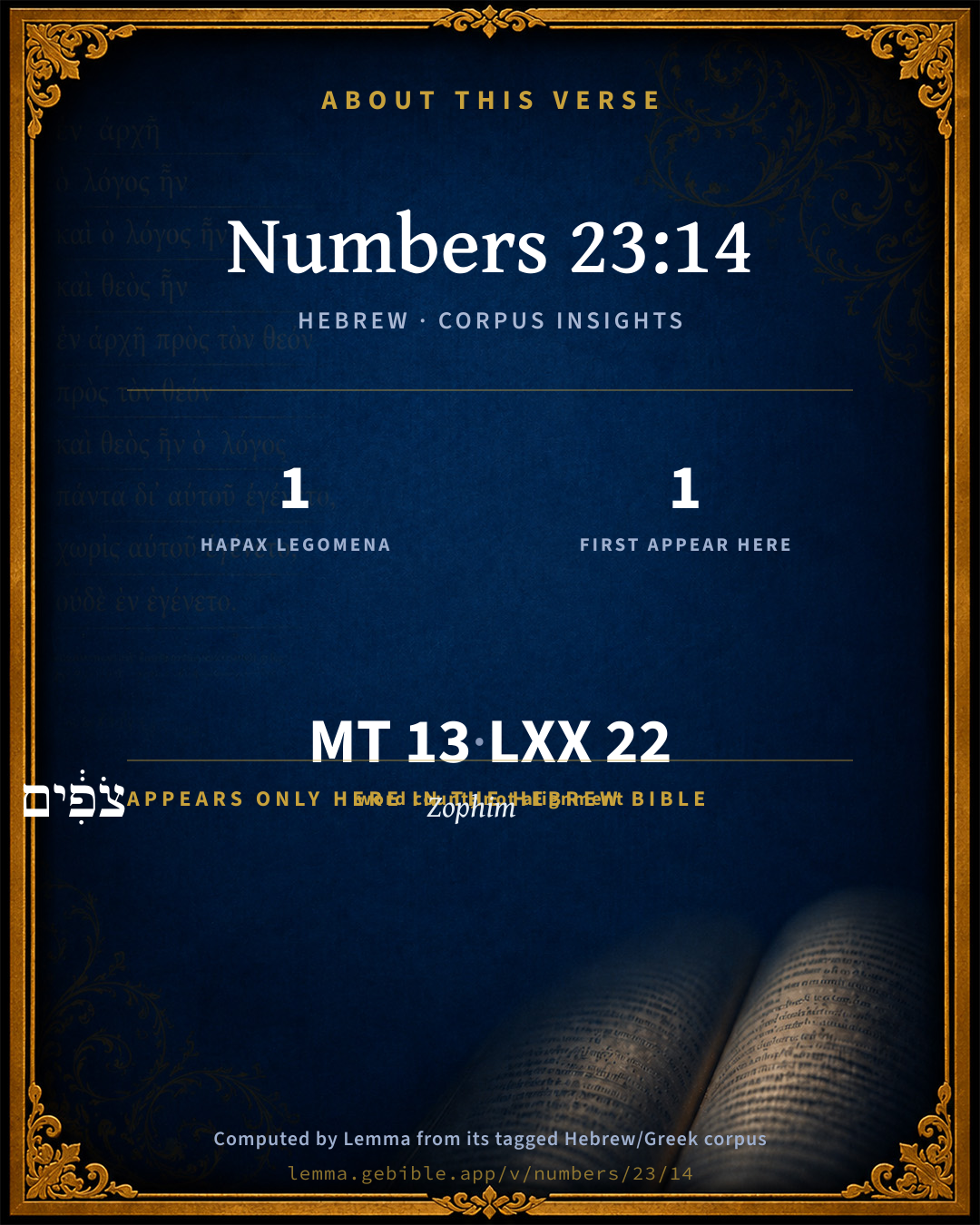
  • 1 hapax legomenon — only here in the Hebrew Bible
  • 1 first appearance in the Hebrew Bible
Full analysis ↓
Download a study sheet

One document with this verse’s original text, its word-by-word gloss line, the meaning frame, cross-references with their text, attributed commentary, and full source and license credits — printable, and it pastes into notes with its structure intact.

This verse Autodidact and up

Study sheet (.html) Plain text (.txt)

A passage Seminary Student

Up to 50 verses in one chapter. A passage sheet keeps up to 6 commentary sources and 12 cross-references per verse, in the order this page ranks them, and says so on the sheet whenever that leaves anything out. Ask for a single verse and you get the Autodidact verse sheet above.

Everything on this page stays free to read, with no account — the sheet is a download of what is already on screen, not access to it.

Want to remove ads? Support Godless Engineer
Compare translations 3

The same verse in 3 English versions, stacked beneath the original-language interlinear above. Click any original word for its lexicon entry.

Each is an independent rendering of the whole verse — the interlinear is not word-aligned to these translations.

Highlighted words mark where these versions differ — a whole-verse word diff, not a word-by-word alignment.

  • World English Bible Public Domain
    He took him into the field of Zophim, to the top of Pisgah, and built seven altars, and offered up a bull and a ram on every altar.
  • King James Version Public Domain
    And he brought him into the field of Zophim, to the top of Pisgah, and built seven altars, and offered a bullock and a ram on every altar.
  • unfoldingWord Literal Text CC BY-SA 4.0
    And he took him to the field of Zophim, to the top of Pisgah, and he built seven altars and offered up a bull and a ram on the altar.

unfoldingWord Literal Text — © unfoldingWord, licensed CC BY-SA 4.0. Word-aligned USFM3 via Door43 (git.door43.org/unfoldingWord/en_ult).

Versions to compare (up to 4)

3 of 4 selected

Show all 18 translations

Every available English version of this verse, each an independent rendering of the whole verse.

  • World English Bible Public Domain
    He took him into the field of Zophim, to the top of Pisgah, and built seven altars, and offered up a bull and a ram on every altar.
  • Berean Standard Bible Public Domain
    So Balak took him to the field of Zophim, to the top of Pisgah, where he built seven altars and offered a bull and a ram on each altar.
  • Majority Standard Bible Public Domain
    So Balak took him to the field of Zophim, to the top of Pisgah, where he built seven altars and offered a bull and a ram on each altar.
  • King James Version Public Domain
    And he brought him into the field of Zophim, to the top of Pisgah, and built seven altars, and offered a bullock and a ram on every altar.
  • American Standard Version (1901) Public Domain
    And he took him into the field of Zophim, to the top of Pisgah, and built seven altars, and offered up a bullock and a ram on every altar.
  • Revised Version (1885) Public Domain
    And he took him into the field of Zophim, to the top of Pisgah, and built seven altars, and offered up a bullock and a ram on every altar.
  • Geneva Bible (1599) Public Domain
    And he brought him into Sede-sophim to the top of Pisgah, and built seuen altars, and offred a bullocke, and a ramme on euery altar.
  • Douay-Rheims (1899) Public Domain
    And when he had brought him to a high place, upon the top of mount Phasga, Balaam built seven altars, and laying on every one a calf and a ram,
  • Young's Literal Translation Public Domain
    and he taketh him `to' the field of Zophim, unto the top of Pisgah, and buildeth seven altars, and offereth a bullock and a ram on the altar.
  • Literal Standard Version CC BY-SA 4.0
    and he takes him [to] the field of Zophim, to the top of Pisgah, and builds seven altars, and offers a bullock and a ram on the altar.
  • Unlocked Literal Bible CC BY-SA 4.0
    So he took Balaam into the field of Zophim, to the top of Mount Pisgah, and built seven more altars. He offered up a bull and a ram on each altar.
  • unfoldingWord Literal Text CC BY-SA 4.0
    And he took him to the field of Zophim, to the top of Pisgah, and he built seven altars and offered up a bull and a ram on the altar.
  • Darby Bible Public Domain
    And he took him to the watchmen's field, to the top of Pisgah, and built seven altars, and offered up a bullock and a ram on [each] altar.
  • World Messianic Bible Public Domain
    He took him into the field of Zophim, to the top of Pisgah, and built seven altars, and offered up a bull and a ram on every altar.
  • Webster's Bible Public Domain
    And he brought him into the field of Zophim, to the top of Pisgah, and built seven altars, and offered a bullock and a ram on every altar.
  • Free Bible Version CC BY-SA 4.0
    He took him to the field of Zophim at the top of Mount Pisgah. There he built seven altars and offered a bull and a ram on each altar.
  • Bible in Basic English Public Domain
    So he took him into the country of Zophim, to the top of Pisgah, and there they made seven altars, offering an ox and a male sheep on every altar.
  • JPS Tanakh (1917) Public Domain
    And he took him into the field of Zophim, to the top of Pisgah, and built seven altars, and offered up a bullock and a ram on every altar.

Literal Standard Version (2020), Covenant Press — licensed CC BY-SA 4.0. Text via the HelloAO Bible API (eBible.org). Unlocked Literal Bible (unfoldingWord) — licensed CC BY-SA 4.0. Text via the HelloAO Bible API (eBible.org). unfoldingWord Literal Text — © unfoldingWord, licensed CC BY-SA 4.0. Word-aligned USFM3 via Door43 (git.door43.org/unfoldingWord/en_ult). Free Bible Version, Dr. Jonathan Gallagher — licensed CC BY-SA 4.0. Text via the HelloAO Bible API (eBible.org).

Word by word

More ways to search: Search by grammar → Find every occurrence → Compare this word →

Practice this passage: Drill this verse → Learn its vocabulary →

צֹפִ֔ים
Tsôphîym
H6839
“Zophim”
Verb, Qal, Participle Active, Masculine, Plural, Absolute
Part of Speech
Verb
Stem
Qal
Form
Participle Active
Gender
Masculine
Number
Plural
State
Absolute
Full BDB Definition

Origin: pl. of act part of H6822

TWOT: None

Zophim = "watchers" - a spot on or near the top of Pisgah, the site of Balaam's oracles
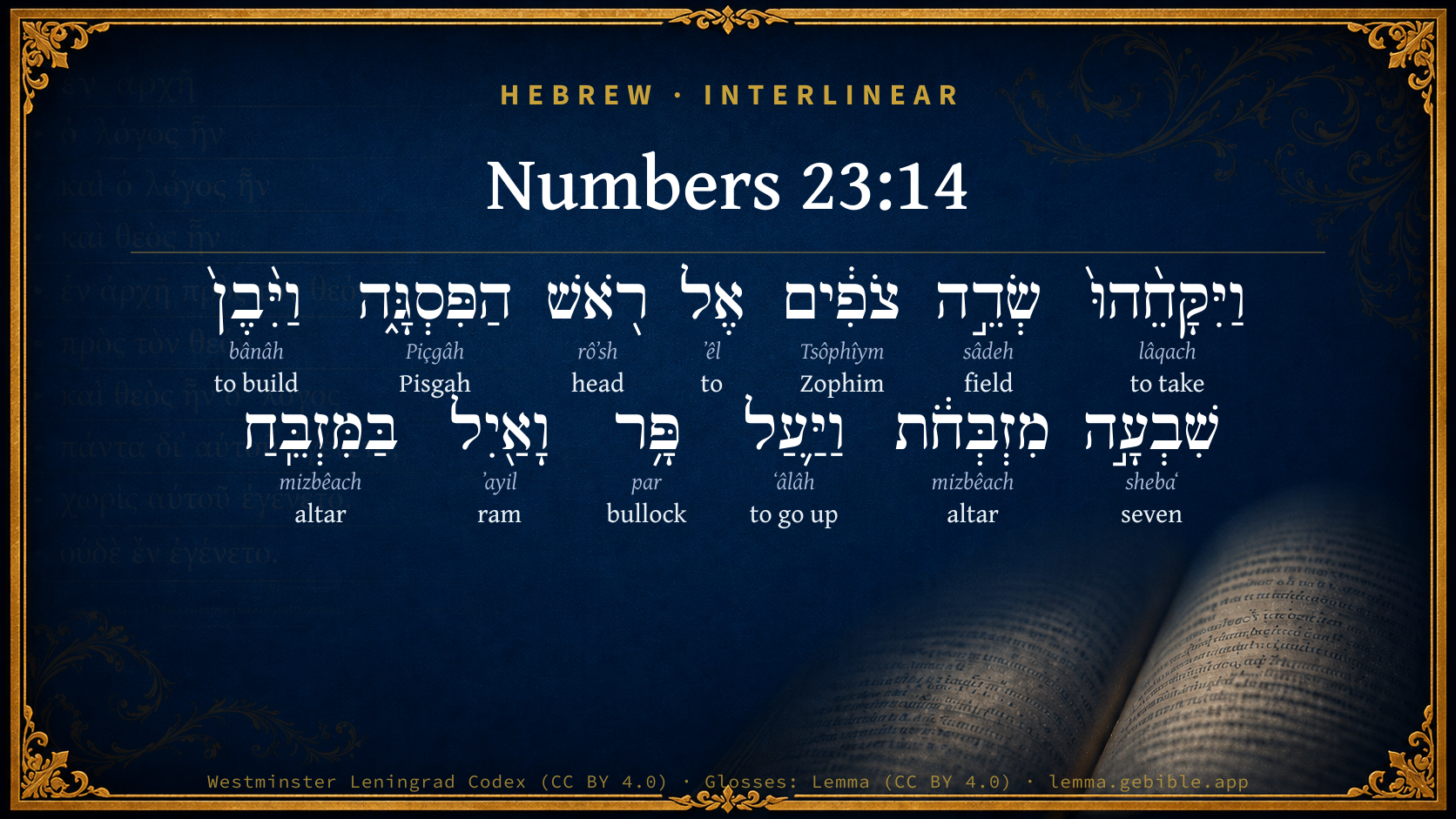
  1. וַיִּקָּחֵ֨הוּ֙ lâqach H3947 “and · to take · him” Conjunction + Verb, Qal, Sequential Imperfect, 3rd Person, Masculine, Singular + Suffix, Personal, 3rd Person, Masculine, Singular
  2. שְׂדֵ֣ה sâdeh H7704 “field of” Noun, Common, Masculine, Singular, Construct
  3. אֶל ʼêl H413 “to” Preposition
  4. רֹ֖אשׁ rôʼsh H7218 “head of” Noun, Common, Masculine, Singular, Construct
  5. הַפִּסְגָּ֑ה Piçgâh H6449 “the · Pisgah” Particle, Definite Article + Noun, Proper
  6. וַיִּ֨בֶן֙ bânâh H1129 “and · to build” Conjunction + Verb, Qal, Sequential Imperfect, 3rd Person, Masculine, Singular
  7. שִׁבְעָ֣ה shebaʻ H7651 “seven” Adjective, Cardinal number, Masculine, Singular, Absolute
  8. מִזְבְּחֹ֔ת mizbêach H4196 “altars” Noun, Common, Masculine, Plural, Absolute
  9. וַיַּ֛עַל ʻâlâh H5927 “and · to go up” Conjunction + Verb, Hiphil, Sequential Imperfect, 3rd Person, Masculine, Singular
  10. פָּ֥ר par H6499 “bullock” Noun, Common, Masculine, Singular, Absolute
  11. וָאַ֖יִל ʼayil H352 “and · ram” Conjunction + Noun, Common, Masculine, Singular, Absolute
  12. בַּמִּזְבֵּֽחַ mizbêach H4196 “in/at the · altar” Preposition, Determined + Noun, Common, Masculine, Singular, Absolute

About this verse

These counts appear in no published source. They are computed here, from the morphology-tagged text and Lemma’s own curated glosses. What Lemma adds →

13
words
12
distinct lemmas
Pentateuch
section

Notable vocabulary

1 hapax legomenon — a word that appears only here in the entire Hebrew Bible:

  • צֹפִ֔ים Zophim H6839

First appearance in Scripture

This word makes its first canonical appearance in the Hebrew Bible here:

  • צֹפִ֔ים Zophim H6839

Shared distinctive vocabulary

הַפִּסְגָּ֑ה Pisgah H6449 occurs in 8 verses of the Hebrew Bible. Also found in:

Grammatical profile

  • 4 verbs
  • 7 nouns
  • 1 adjective
  • 1 preposition

Verb forms

  • וַיִּקָּחֵ֨הוּ֙ Qal · Sequential Imperfect
  • צֹפִ֔ים Qal · Participle Active
  • וַיִּ֨בֶן֙ Qal · Sequential Imperfect
  • וַיַּ֛עַל Hiphil · Sequential Imperfect

Repetition

A word recurs within this verse — often emphatic in Hebrew:

  • מִזְבְּחֹ֔ת altar H4196 ×2

Hebrew & Septuagint length

In English translation the verse runs 28 words from the Hebrew and 34 from the Septuagint (LXX English) — closely comparable.

A rough comparison of the two English renderings, which tokenize alike — not a word-level alignment.

Word counts can differ between the Hebrew and the Greek without any difference in meaning — e.g. the Hebrew direct-object marker אֵת has no separate Greek word, and Greek often adds the article ὁ.

In the original languages it is 13 Hebrew tokens and 22 Greek tokens — but the two are counted differently (Hebrew bundles its prefixes and suffixes into one token; the Greek is in lemma form), so that isn’t a like-for-like length.

Cross-references

9

Topical passages linked to Numbers 23:14 in the Treasury of Scripture Knowledge — connected by theme and wording, ordered by reader-vote popularity; previews shown in the World English Bible.

  • Numbers 21:20 and from Bamoth to the valley that is in the field of Moab, to the top of Pisgah, which looks down on the desert.
  • Numbers 23:1–2 Balaam said to Balak, Build me here seven altars, and prepare me here seven bulls and seven rams.
  • Numbers 23:29 Balaam said to Balak, Build me here seven altars, and prepare me here seven bulls and seven rams.
  • Deuteronomy 3:27 Go up to the top of Pisgah, and lift up your eyes westward, and northward, and southward, and eastward, and see with your eyes: for you shall not go over this Jordan.
  • Deuteronomy 4:49 and all the Arabah beyond the Jordan eastward, even to the sea of the Arabah, under the slopes of Pisgah.
  • Deuteronomy 34:1 Moses went up from the plains of Moab to Mount Nebo, to the top of Pisgah, that is over against Jericho. Yahweh shown him all the land of Gilead, to Dan,
  • Isaiah 1:10–11 Hear the word of Yahweh, you rulers of Sodom! Listen to the law of our God, you people of Gomorrah!
  • Isaiah 46:6 Some pour out gold from the bag, and weigh silver in the balance. They hire a goldsmith, and he makes it a god. They fall down--yes, they worship.
  • Hosea 12:11 If Gilead is wicked, Surely they are worthless. In Gilgal they sacrifice bulls. Indeed, their altars are like heaps in the furrows of the field.

Cross-references courtesy of OpenBible.info (CC BY 4.0).

Hebrew and Greek witnesses Masoretic Hebrew ↔ Greek Septuagint

The same verse in the two great witnesses to the Old Testament, shown verse-for-verse.

These are two independent witnesses, not word-aligned to each other, and the Septuagint is shown in lemma (dictionary) form.

Hebrew Numbers 23:14 Masoretic · Westminster Leningrad Codex

וַיִּקָּחֵ֨הוּ֙ שְׂדֵ֣ה צֹפִ֔ים אֶל רֹ֖אשׁ הַפִּסְגָּ֑ה וַיִּ֨בֶן֙ שִׁבְעָ֣ה מִזְבְּחֹ֔ת וַיַּ֛עַל פָּ֥ר וָאַ֖יִל בַּמִּזְבֵּֽחַ

He took him into the field of Zophim, to the top of Pisgah, and built seven altars, and offered up a bull and a ram on every altar.

World English Bible · Public Domain

Greek LXX Numbers 23:14 Septuagint · lemma form

καί παραλαμβάνω αὐτός εἰς ἀγρός σκοπιά ἐπί κορυφή λαξεύω καί οἰκοδομέω ἐκεῖ ἑπτά βωμός καί ἀναβιβάζω μόσχος καί κριός ἐπί ὁ βωμός

And he took him to a high place of the field to the top of the quarried rock, and he built there seven altars, and offered a calf and a ram on every altar.

LXX2012 (modern English Septuagint) · Public Domain

Hebrew: Westminster Leningrad Codex (CC BY 4.0). Greek: Septuagint (public domain); English from LXX2012 (modern English Septuagint) (Public Domain). How the Septuagint differs from the Hebrew →

Targum (Aramaic paraphrase)

2

The Targum is the ancient Jewish Aramaic paraphrase of the Hebrew Scriptures — an interpretive translation, not the Hebrew text itself. Onkelos (literal) and Pseudo-Jonathan (expansive) render the Torah, and Jonathan the Prophets. Coverage is partial: where no permissively-licensed English translation exists for a verse, only the Aramaic is shown. This is verse-level text, not a word-by-word alignment to the Hebrew.

  1. Targum Onkelos Torah (Genesis–Deuteronomy)
    וְדַבְּרֵיהּ לַחֲקַל סְכוּתָא לְרֵישׁ רָמָתָא וּבְנָא שַׁבְעָא מַדְבְּחִין וְאַסֵיק תּוֹר וּדְכַר עַל כָּל מַדְבְּחָא

    (no public-domain English translation for this verse)

    Targum Onkelos — Aramaic: “Onkelos Genesis” (public domain); “Onkelos Exodus” (public domain); “Onkelos Leviticus” (public domain); “Onkelos Numbers” (public domain); “Onkelos Deuteronomy” (public domain). English: “Sefaria Community Translation” (CC0 1.0 (public-domain dedication)); “J.W. Etheridge. The Targums of Onkelos and Jonathan Ben Uzziel on the Pentateuch. London: Longmans, Green, 1862” (public domain). Text via Sefaria.

  2. Targum Pseudo-Jonathan Torah (Genesis–Deuteronomy)
    וְדַבְּרֵיהּ לַחֲקַל סָכוּתָא לְרֵישׁ רָמָתָא וּבְנָא שׁוּבְעָא אֲגוֹרִין וְאַסֵיק תּוֹר וּדְכַר עַל כָּל אֲגוֹרָא

    And he brought him to the field of the observatory on the top of the hill, and builded seven altars, and offered a bullock and a ram on every altar.

    Targum Pseudo-Jonathan — Aramaic: “Targum Jonathan on Genesis” (public domain); “Targum Jonathan on Exodus” (public domain); “Targum Jonathan on Leviticus” (public domain); “Targum Jonathan on Numbers” (public domain); “Targum Jonathan on Deuteronomy” (public domain). English: “The Targum of Jonathan ben Uzziel, trans. J. W. Etheridge, London, 1862” (public domain). Text via Sefaria.

Commentary

Notes on Numbers 23:14 from classic Christian and Jewish commentators (each source and its license shown beneath its notes). The classic Christian expositions comment on the surrounding passage and are grouped to its opening verse, so a note may address several verses; the Jewish commentaries on the Tanakh (Rashi and others) are per-verse, so they appear only where the commentator wrote on this verse.

Lemma curates 59 commentaries, every one of them public domain or Creative Commons licensed, each selected and text-cleaned for this edition rather than reprinted as found. About our sources →

Geneva Bible (1599)

Geneva Bible translators

Or, into the field of them that spied: to wit, lest the enemy should approach.

Geneva Bible (1599) marginal notes — public domain. Text via Bolls.life.

Jamieson, Fausset & Brown

Robert Jamieson, A. R. Fausset & David Brown

he brought him into the field of Zophim . . . top of Pisgah--a flat surface on the summit of the mountain range, which was cultivated land. Others render it "the field of sentinels," an eminence where some of Balak's guards were posted to give signals [CALMET].

Jamieson, Fausset & Brown — Commentary Critical and Explanatory on the Whole Bible (1871) — public domain (CC PDM 1.0). Text via the HelloAO Bible API.

Ellicott's Commentary for English Readers

(14) The field of Zophim.—i.e., of watchers. Tne spot seems to be identified with that from which Moses afterwards surveyed the promised land (Deu_3:27), and which is described in Deu_34:1 as “the mountain of Nebo,” or Mount Nebo. It is possible, however, that Pisgah may have had more than one of such summits.

A Bible Commentary for English Readers, edited by Charles John Ellicott (1878–1897) — public domain. Text from a community e-Sword module.

The Cambridge Bible for Schools and Colleges

gen. ed. J. J. S. Perowne

14. to the field of Zophim] The site is unknown. Ẓôphim means ‘watchers,’ and it was evidently high ground which afforded an extensive outlook.

the top of the Pisgah] See on Num_21:20. There were probably many places in the mountains of Moab which would be useful as posts for sentinels. This one is defined as lying somewhere among the western headlands.

The Cambridge Bible for Schools and Colleges (gen. ed. J. J. S. Perowne; Cambridge University Press, 1878–1918) — public domain. Text from a community e-Sword module.

John Gill's Exposition

And he brought him into the field of Zophim,.... Or Sede Tzophim, as Hillerus (i) reads it, so called from the watch tower, and watchmen in it: Jarchi says, it was a high place, where a watchman stood to observe if an army came against a city, and so a very proper place to take a view of the armies of Israel from:

to the top of Pisgah; a high hill in this place, where perhaps the watch tower was, or, however, the watchman stood: this looked towards Jeshimon or Bethjesimoth, in the plain of Moab, where Israel lay encamped, see Num 21:20, and built seven altars, and offered a bullock and a ram on every altar: as he had done before, Num 23:2.

(i) Onomastic Sacr. p. 935.

John Gill's Exposition of the Whole Bible (1746–1763) — public domain (CC PDM 1.0). Text via the HelloAO Bible API.

Albert Barnes' Notes on the Bible

The field of Zophim - Or, “of watchers.” It lay upon the top of Pisgah, north of the former station, and nearer to the Israelite camp; the greater part of which was, however, probably concealed from it by an intervening spur of the hill. Beyond the camp Balaam’s eye would pass on to the bed of the Jordan. It was perhaps a lion coming up in his strength from the swelling of that stream (compare Jer 49:19) that furnished him with the augury he awaited, and so dictated the final similitude of his next parable.

Albert Barnes' Notes on the Bible (1834–1885) — public domain. Text from a community e-Sword/MySword module.

Haydock's Catholic Bible Commentary

Place. Hebrew sede tsohpim, or "the field of the sentinels." (Chaldean) Such were commonly stationed on the top of high hills, to give notice, by kindling a fire, &c., of the approach of an enemy, Isaias xxi. 11., and Jeremias vi. 1. (Calmet)

George Leo Haydock (1774–1849), Haydock's Catholic Family Bible and Commentary, 1859 edition — public domain. Excludes Psalms (Douay-Rheims chapter numbering differs from Protestant) and Deuterocanonical books (Catholic canon only).

Matthew Poole's English Annotations

Zophim, a place so called from the spies and watches which were kept there. Pisgah, a high hill in the land of Moab, so called Deu 3:27; 34:1.

Matthew Poole's English Annotations on the Holy Bible (1683–1685) — public domain. Text from a community e-Sword/MySword module.

Whedon's Commentary on the Bible

Daniel D. Whedon

14. The field of Zophim was the cultivated field of the watchmen on the slope or top of the range of Pisgah. Mr. Porter identifies it with the ruins of Main, at the foot of Attarus, which he calls Pisgah. The watchers may have been sentinels in war or augurs in peace observing the heavens and the birds.

Daniel D. Whedon (gen. ed.), Commentary on the Old and New Testaments (1874–1909) — public domain. Text from a community e-Sword module.

The Pulpit Commentary

The field of Zophim, i.e., of the watchers. Probably a well-known outlook. To the top of Pisgah. They followed apparently on the track of their enemies. (see on Num_21:20)

The Pulpit Commentary (1880–1919), ed. H.D.M. Spence-Jones & Joseph S. Exell — public domain. Text from a community e-Sword module.

Kretzmann's Popular Commentary

Paul E. Kretzmann

The Second Sacrifice and Prophetic Utterance. —

v. 14. And he brought him into the field of Zophim, to the top of Pisgah, to a high plateau of the mountain range which overlooks the Plains of Moab, and built seven altars, as before, and offered a bullock and a ram on every altar.

v. 15. And he said unto Balak, Stand here by thy burnt offering, maintaining the position of the devout worshiper praying for the fulfillment of his desire, while I meet the Lord yonder, for the purpose of receiving omens concerning the success of their venture, the same mixture of proper religious rites with the ceremonies of heathenism as before.

v. 16. And the Lord met Balaam, as after the first sacrifice, and put a word in his mouth and said, Go again unto Balak and say thus; the exact form of the prophetic utterance was prescribed to him.

v. 17. And when he came to him (Balak), behold, he stood by his burnt offering, and the princes of Moab with him. And Balak said unto him, What hath the Lord spoken?

v. 18. And he took up his parable and said, Rise up, Balak, and hear; hearken unto me, thou son of Zippor. The king was to lift up heart and mind to the elevated plane which agreed with the message that was about to be delivered to him.

v. 19. God is not a man that He should lie, neither the son of man that He should repent, a statement which reproved the thought of Balak that God might take back His word concerning the blessing upon Israel. Hath He said, and shall He not do it? Or hath He spoken, and shall He not make it good?

v. 20. Behold, I have received commandment to bless, and He hath blessed; and I cannot reverse it. The unchangeability of the divine counsels is a necessary consequence of the divine faithfulness, as an expression of the essence of the Lord. The blessing which He had put into the mouth of Balaam after the first sacrifice could not be canceled, and the soothsayer was not in a position to cancel it, much as he personally might be inclined to do so.

v. 21. He hath not beheld iniquity in Jacob, neither hath He seen perverseness in Israel, no trouble or affliction. Since the Lord found no criminal wickedness, no moral and spiritual rottenness of a kind that would be followed by a curse, this being true of the people in their covenant relation to God, therefore His blessing was still with them. The Lord, his God, is with him, and the shout of a king is among them; they are full of happiness and rejoicing because Jehovah is living in their midst as king, Exo 15:18; Deu 33:5.

v. 22. God brought them out of Egypt, that occasion being the chief instance when He proved Himself their King, and this mighty work was still going on; he (Israel) hath, as it were, the strength of an unicorn, of the wild ox, which was considered the embodiment of fierceness and indomitable strength.

v. 23. Surely there is no enchantment against Jacob, neither is there any divination against Israel; the Israelites were not obliged to resort to any questionable methods of witchcraft, because they had the immediate Revelation of the true God in their midst, who personally led the host and equipped the army with power. According to this time it shall be said of Jacob and Israel, What hath God wrought! that is, whenever it was needed, at the right time, God took care to reveal to His people His counsel and will in His Word.

v. 24. Behold, the people shall rise up as a great lion, like a lioness setting out to seek food, and lift up himself as a young lion; he shall not lie down until he eat of the prey and drink the blood of the slain. In short, Israel, with the true God on his side, was invincible, for the blessing of Jehovah rested upon him. The words of blessing given Judah, Gen 49:9, were hereby transferred to the whole people.

v. 25. And Balak said unto Balaam, Neither curse them at all, nor bless them at all; since Balaam would apparently not curse the people, as Balak sees with indignation, therefore he also should not bless them, that is, he should discontinue his prophetic utterances entirely.

v. 26. But Balaam answered and said unto Balak, Told not I thee, saying, All that the Lord speaketh, that I must do? He was still under the influence of the terror of the Lord and must set aside all personal preferences.

v. 27. And Balak said unto Balaam, Come, I pray thee, I will bring thee unto another place; he still believed that the location and the conditions had something to do with the soothsayer’s power; peradventure it will please God that thou mayest curse me them from thence.

v. 28. And Balak brought Balaam unto the top of Peor, a peak in the mountain range which ran parallel to the Jordan and the Dead Sea, that looketh toward Jeshimon, with an unobstructed view over the entire country, also the wilderness.

v. 29. And Balaam said unto Balak, Build me here seven altars, and prepare me here seven bullocks and seven rams.

v. 30. And Balak did as Balaam had said, and offered a bullock and a ram on every altar, still with the idea that his object could be gained, which was, of course, rank foolishness. As the Lord held His sheltering hand over the people of the covenant at that time, so He now lives and reigns in the midst of His congregation, the people of the New Testament. In and with Him the Church is invincible and will conquer all her enemies.

Paul E. Kretzmann, Popular Commentary of the Bible (1921–1924) — public domain. Text from a community e-Sword module.

Rashi

Rabbi Shlomo Yitzchaki (Rashi)

שדה צפים FIELD OF ZOPHIM — There was a high spot upon which the watchman (צופה) used to stand to observe whether any hostile force was coming against the city.

ראש הפסגה THE TOP OF PISGAH — Balaam was not as expert a diviner as Balak. Balak forsaw that at some time a breach in Israel would originate from there — and as a matter of fact Moses died there, — and therefore he believed that there the curse would certainly fall upon them. “And this (the effects of the curse)” — he thought — “must be the breach which I behold” (Midrash Tanchuma, Balak 13).

Rashi on the Tanakh — English translations: “The Judaica Press complete Tanach with Rashi, translated by A. J. Rosenberg” (CC BY 4.0); “Pentateuch with Rashi's commentary by M. Rosenbaum and A.M. Silbermann, 1929-1934” (public domain); “The Metsudah Tanach series, Lakewood, N.J” (CC BY 4.0); and “The Book of Joshua, Metsudah Publications, 1997” (CC BY 4.0). Text via Sefaria.

Lesson kit

Teaching starters — assembled from the data on this page, not authored interpretation. Every prompt links to the verse data it draws on. Edit before teaching.

Numbers, in the Pentateuch, opens this verse with 13 words (12 distinct Hebrew lemmas). Its most distinctive word is Tsôphîym (“Zophim”). A historical commentator’s framing appears above. Read the whole chapter for the surrounding context.

Discussion questions

  1. How does “Zophim” (Tsôphîym) shape what this verse is saying?
  2. This verse holds 1 word here found nowhere else in the Hebrew Bible. What might the rare word draw attention to?
  3. The word “Zophim” first appears here in Scripture. What is being introduced at this debut?
  4. Numbers 21:20 shares the word «Pisgah» with this verse. How do the two illuminate each other?
  5. “altar” occurs 2× in this one verse. What is the effect of the repetition?
  6. These translations render this verse differently; the difference is in the English rendering, not the original. What questions does that raise?
  7. The verb «וַיִּקָּחֵ֨הוּ֙» is Qal Sequential Imperfect. How does its form color the action?
  8. Reading how Geneva Bible (1599) and Jamieson, Fausset & Brown read this verse, where do the two commentators agree and where do they part?

Things to notice

  • 1 word in this verse appears nowhere else in the Hebrew Bible.
  • 1 word makes its first canonical appearance in Scripture here.
  • This verse counts 13 Hebrew ↔ 22 Greek words.
  • These translations choose different wording for 7 words in this verse.
  • “altar” occurs 2× in this single verse.

Reading settings

Reading text

Shown beneath each verse's original-language words.

Old Testament
Old Testament edition

Read the OT as the Masoretic Hebrew (MT) or the Greek Septuagint (LXX).

English shown for the Greek Septuagint (in the Hebrew ↔ Greek comparison).

Comparing translations? Open the Compare panel on any verse page to stack up to four side by side.