
Exodus 10:12

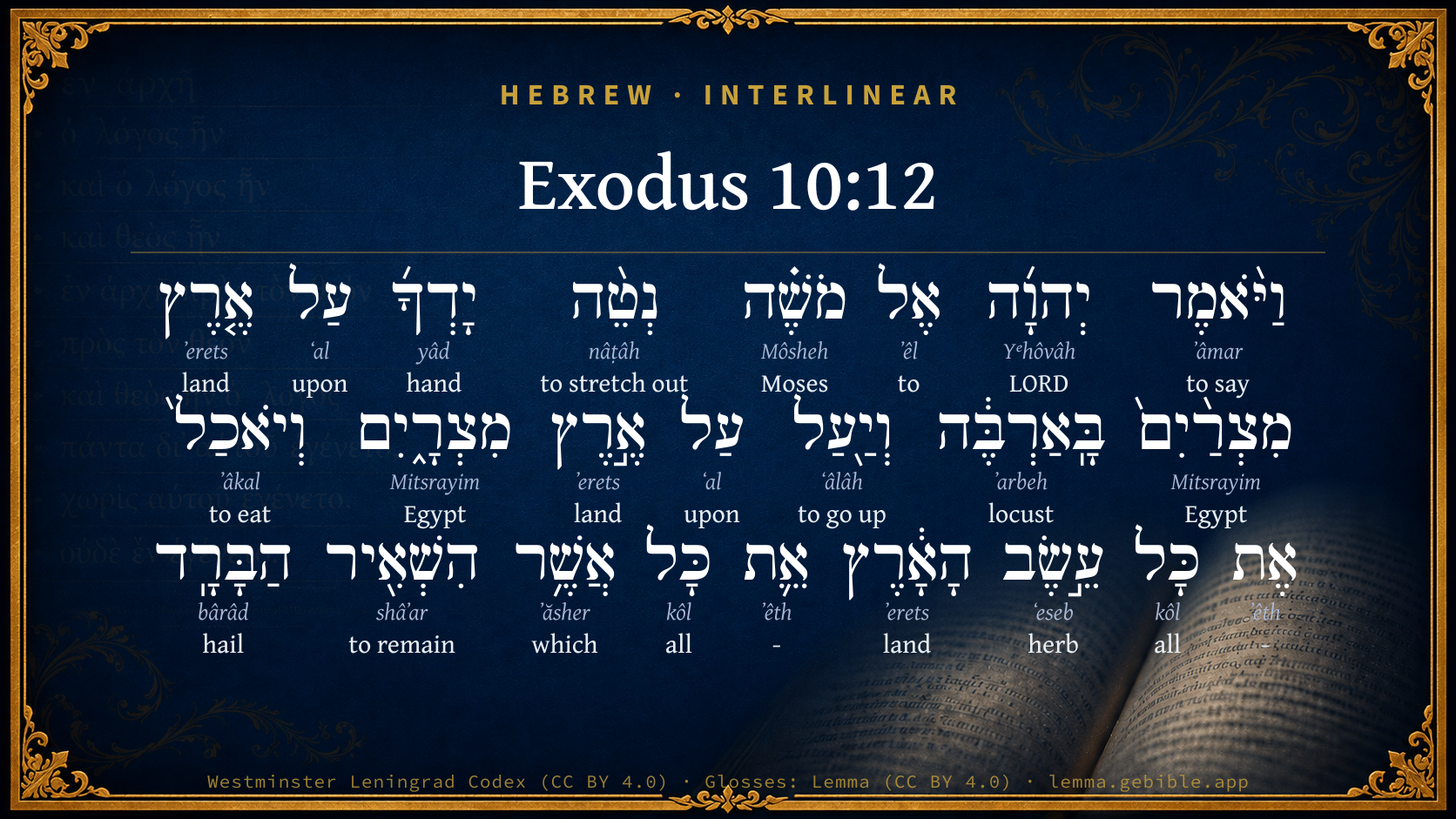
Hebrew (Westminster Leningrad Codex) Exodus 10:12 appears in the Hebrew Old Testament. The text above is from the Westminster Leningrad Codex. Each word links to its Strong’s number, a concise gloss, and parsing drawn from the Open Scriptures Hebrew Bible morphology. Click any word for its full Brown-Driver-Briggs (BDB) entry.
Download image
Cite this verse

Exodus 10:12 (World English Bible). Public Domain. Lemma interlinear Bible study tool, https://lemma.gebible.app/v/exodus/10/12.

Show BibTeX & RIS
BibTeX
RIS
English Translation
Yahweh said to Moses, "Stretch out your hand over the land of Egypt for the locusts, that they may come up on the land of Egypt, and eat every herb of the land, even all that the hail has left."
World English Bible · Public Domain
Download a study sheet

One document with this verse’s original text, its word-by-word gloss line, the meaning frame, cross-references with their text, attributed commentary, and full source and license credits — printable, and it pastes into notes with its structure intact.

This verse Autodidact and up

Study sheet (.html) Plain text (.txt)

A passage Seminary Student

Up to 50 verses in one chapter. A passage sheet keeps up to 6 commentary sources and 12 cross-references per verse, in the order this page ranks them, and says so on the sheet whenever that leaves anything out. Ask for a single verse and you get the Autodidact verse sheet above.

Everything on this page stays free to read, with no account — the sheet is a download of what is already on screen, not access to it.

Want to remove ads? Support Godless Engineer
Compare translations 3

The same verse in 3 English versions, stacked beneath the original-language interlinear above. Click any original word for its lexicon entry.

Each is an independent rendering of the whole verse — the interlinear is not word-aligned to these translations.

Highlighted words mark where these versions differ — a whole-verse word diff, not a word-by-word alignment.

  • World English Bible Public Domain
    Yahweh said to Moses, "Stretch out your hand over the land of Egypt for the locusts, that they may come up on the land of Egypt, and eat every herb of the land, even all that the hail has left."
  • King James Version Public Domain
    And the LORD said unto Moses, Stretch out thine hand over the land of Egypt for the locusts, that they may come up upon the land of Egypt, and eat every herb of the land, even all that the hail hath left.
  • unfoldingWord Literal Text CC BY-SA 4.0
    And Yahweh said to Moses, “Stretch out your hand over the land of Egypt with the locust, and let it rise up over the land of Egypt, and let it devour all of the plants of the land, everything which the hail had spared.”

unfoldingWord Literal Text — © unfoldingWord, licensed CC BY-SA 4.0. Word-aligned USFM3 via Door43 (git.door43.org/unfoldingWord/en_ult).

Versions to compare (up to 4)

3 of 4 selected

Show all 18 translations

Every available English version of this verse, each an independent rendering of the whole verse.

  • World English Bible Public Domain
    Yahweh said to Moses, "Stretch out your hand over the land of Egypt for the locusts, that they may come up on the land of Egypt, and eat every herb of the land, even all that the hail has left."
  • Berean Standard Bible Public Domain
    Then the LORD said to Moses, “Stretch out your hand over the land of Egypt, so that the locusts may swarm over it and devour every plant in the land—everything that the hail has left behind.”
  • Majority Standard Bible Public Domain
    Then the LORD said to Moses, “Stretch out your hand over the land of Egypt, so that the locusts may swarm over it and devour every plant in the land—everything that the hail has left behind.”
  • King James Version Public Domain
    And the LORD said unto Moses, Stretch out thine hand over the land of Egypt for the locusts, that they may come up upon the land of Egypt, and eat every herb of the land, even all that the hail hath left.
  • American Standard Version (1901) Public Domain
    And Jehovah said unto Moses, Stretch out thy hand over the land of Egypt for the locusts, that they may come up upon the land of Egypt, and eat every herb of the land, even all that the hail hath left.
  • Revised Version (1885) Public Domain
    And the LORD said unto Moses, Stretch out thine hand over the land of Egypt for the locusts, that they may come up upon the land of Egypt, and eat every herb of the land, even all that the hail hath left.
  • Geneva Bible (1599) Public Domain
    After, the Lord said vnto Moses, Stretch out thine hande vpon the lande of Egypt for the grashoppers, that they may come vpon the lande of Egypt, and eate all the herbes of the land, euen all that the haile hath left.
  • Douay-Rheims (1899) Public Domain
    And the Lord said to Moses: Stretch forth thy hand upon the land of Egypt unto the locust, that it may come upon it, and devour every herb that is left after the hail.
  • Young's Literal Translation Public Domain
    And Jehovah saith unto Moses, `Stretch out thy hand against the land of Egypt for the locust, and it goeth up against the land of Egypt, and doth eat every herb of the land -- all that the hail hath left.'
  • Literal Standard Version CC BY-SA 4.0
    And YHWH says to Moses, “Stretch out your hand against the land of Egypt for the locust, and it goes up against the land of Egypt, and eats every herb of the land—all that the hail has left.”
  • Unlocked Literal Bible CC BY-SA 4.0
    Then Yahweh said to Moses, “Reach out with your hand over the land of Egypt to the locusts, that they may attack the land of Egypt and eat every plant in it, everything that the hail has left.”
  • unfoldingWord Literal Text CC BY-SA 4.0
    And Yahweh said to Moses, “Stretch out your hand over the land of Egypt with the locust, and let it rise up over the land of Egypt, and let it devour all of the plants of the land, everything which the hail had spared.”
  • Darby Bible Public Domain
    And Jehovah said to Moses, Stretch out thy hand over the land of Egypt for the locusts, that they may come up over the land of Egypt, and eat every herb of the land -- all that the hail hath left.
  • World Messianic Bible Public Domain
    The LORD said to Moses, “Stretch out your hand over the land of Egypt for the locusts, that they may come up on the land of Egypt, and eat every herb of the land, even all that the hail has left.”
  • Webster's Bible Public Domain
    And the LORD said to Moses, Stretch out thy hand over the land of Egypt for the locusts, that they may come upon the land of Egypt, and eat every herb of the land, even all that the hail hath left.
  • Free Bible Version CC BY-SA 4.0
    The Lord told Moses, “Lift up your hand over Egypt, so that the locusts may swarm over it and eat every plant in the country—everything that was left by the hail.”
  • Bible in Basic English Public Domain
    And the Lord said to Moses, Let your hand be stretched out over the land of Egypt so that the locusts may come up on the land for the destruction of every green plant in the land, even everything untouched by the ice-storm.
  • JPS Tanakh (1917) Public Domain
    And the LORD said unto Moses: 'Stretch out thy hand over the land of Egypt for the locusts, that they may come up upon the land of Egypt, and eat every herb of the land, even all that the hail hath left.'

Literal Standard Version (2020), Covenant Press — licensed CC BY-SA 4.0. Text via the HelloAO Bible API (eBible.org). Unlocked Literal Bible (unfoldingWord) — licensed CC BY-SA 4.0. Text via the HelloAO Bible API (eBible.org). unfoldingWord Literal Text — © unfoldingWord, licensed CC BY-SA 4.0. Word-aligned USFM3 via Door43 (git.door43.org/unfoldingWord/en_ult). Free Bible Version, Dr. Jonathan Gallagher — licensed CC BY-SA 4.0. Text via the HelloAO Bible API (eBible.org).

Word by word

More ways to search: Search by grammar → Find every occurrence → Compare this word →

Practice this passage: Drill this verse → Learn its vocabulary →

בָּֽאַרְבֶּ֔ה
ʼarbeh
H697
“in/at the · locust”
Preposition, Determined + Noun, Common, Masculine, Singular, Absolute
Part of Speech
Preposition + Noun
Type
Common
Gender
Masculine
Number
Singular
State
Absolute
Full BDB Definition

Origin: from H7235

TWOT: 2103a

a kind of locust, locust swarm (collective) - (CLBL) - sudden disappearance (figuratively) - insignificance (figuratively) - activity (figuratively)
  1. וַיֹּ֨אמֶר ʼâmar H559 “and · to say” Conjunction + Verb, Qal, Sequential Imperfect, 3rd Person, Masculine, Singular
  2. יְהוָ֜ה Yᵉhôvâh H3068 “LORD” Noun, Proper
  3. אֶל ʼêl H413 “to” Preposition
  4. מֹשֶׁ֗ה Môsheh H4872 “Moses” Noun, Proper
  5. נְטֵ֨ה nâṭâh H5186 “stretch out” Verb, Qal, Imperative, 2nd Person, Masculine, Singular
  6. יָדְךָ֜ yâd H3027 “hand · your” Noun, Common, Both, Singular, Construct + Suffix, Personal, 2nd Person, Masculine, Singular
  7. עַל ʻal H5921 “upon” Preposition
  8. אֶ֤רֶץ ʼerets H776 “land of” Noun, Common, Both, Singular, Construct
  9. מִצְרַ֨יִם֙ Mitsrayim H4714 “Egypt” Noun, Proper
  10. וְיַ֖עַל ʻâlâh H5927 “and · to go up” Conjunction + Verb, Qal, Jussive, 3rd Person, Masculine, Singular
  11. עַל ʻal H5921 “upon” Preposition
  12. אֶ֣רֶץ ʼerets H776 “land of” Noun, Common, Both, Singular, Construct
  13. מִצְרָ֑יִם Mitsrayim H4714 “Egypt” Noun, Proper
  14. וְיֹאכַל֙ ʼâkal H398 “and · to eat” Conjunction + Verb, Qal, Imperfect, 3rd Person, Masculine, Singular
  15. אֶת ʼêth H853 “-” Particle, Direct Object
  16. כָּל kôl H3605 “all of” Noun, Common, Masculine, Singular, Construct
  17. עֵ֣שֶׂב ʻeseb H6212 “herb of” Noun, Common, Masculine, Singular, Construct
  18. הָאָ֔רֶץ ʼerets H776 “the · land” Particle, Definite Article + Noun, Common, Both, Singular, Absolute
  19. אֵ֛ת ʼêth H853 “-” Particle, Direct Object
  20. כָּל kôl H3605 “all of” Noun, Common, Masculine, Singular, Construct
  21. אֲשֶׁ֥ר ʼăsher H834 “which” Particle, Relative
  22. הִשְׁאִ֖יר shâʼar H7604 “to remain” Verb, Hiphil, Perfect, 3rd Person, Masculine, Singular
  23. הַבָּרָֽד bârâd H1259 “the · hail” Particle, Definite Article + Noun, Common, Masculine, Singular, Absolute

About this verse

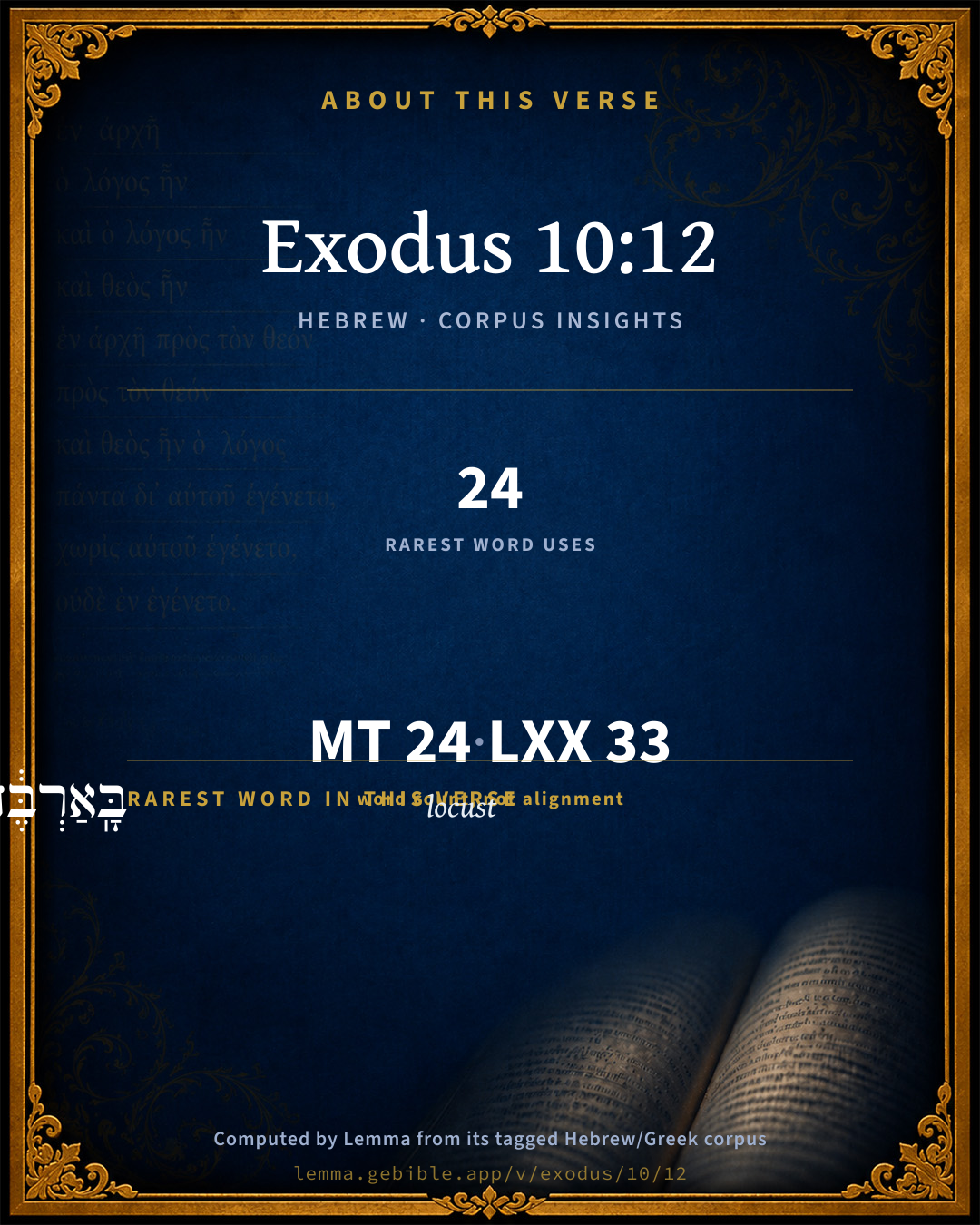
These counts appear in no published source. They are computed here, from the morphology-tagged text and Lemma’s own curated glosses. What Lemma adds →

24
words
18
distinct lemmas
Pentateuch
section

Notable vocabulary

The rarest word here is בָּֽאַרְבֶּ֔ה locust H697 — appearing just 24 times in the whole Hebrew Bible.

Shared distinctive vocabulary

בָּֽאַרְבֶּ֔ה locust H697 occurs in 21 verses of the Hebrew Bible. Also found in:

Grammatical profile

  • 5 verbs
  • 13 nouns
  • 3 prepositions
  • 3 particles

Verb forms

  • וַיֹּ֨אמֶר Qal · Sequential Imperfect
  • נְטֵ֨ה Qal · Imperative
  • וְיַ֖עַל Qal · Jussive
  • וְיֹאכַל֙ Qal · Imperfect
  • הִשְׁאִ֖יר Hiphil · Perfect

Repetition

Words recur within this verse — often emphatic in Hebrew:

  • אֶ֤רֶץ land H776 ×3
  • עַל upon H5921 ×2
  • מִצְרַ֨יִם֙ Egypt H4714 ×2
  • כָּל all H3605 ×2

Hebrew & Septuagint length

In English translation the verse runs 40 words from the Hebrew and 44 from the Septuagint (LXX English) — closely comparable.

A rough comparison of the two English renderings, which tokenize alike — not a word-level alignment.

Word counts can differ between the Hebrew and the Greek without any difference in meaning — e.g. the Hebrew direct-object marker אֵת has no separate Greek word, and Greek often adds the article ὁ.

In the original languages it is 24 Hebrew tokens and 33 Greek tokens — but the two are counted differently (Hebrew bundles its prefixes and suffixes into one token; the Greek is in lemma form), so that isn’t a like-for-like length.

Cross-references

2

Topical passages linked to Exodus 10:12 in the Treasury of Scripture Knowledge — connected by theme and wording, ordered by reader-vote popularity; previews shown in the World English Bible.

  • Exodus 7:19 Yahweh said to Moses, "Tell Aaron, 'Take your rod, and stretch out your hand over the waters of Egypt, over their rivers, over their streams, and over their pools, and over all their ponds of water, that they may become blood; and there shall be blood throughout all the land of Egypt, both in vessels of wood and in vessels of stone.'"
  • Exodus 10:4–5 Or else, if you refuse to let my people go, behold, tomorrow I will bring locusts into your country,

Cross-references courtesy of OpenBible.info (CC BY 4.0).

Hebrew and Greek witnesses Masoretic Hebrew ↔ Greek Septuagint

The same verse in the two great witnesses to the Old Testament, shown verse-for-verse.

These are two independent witnesses, not word-aligned to each other, and the Septuagint is shown in lemma (dictionary) form.

Hebrew Exodus 10:12 Masoretic · Westminster Leningrad Codex

וַיֹּ֨אמֶר יְהוָ֜ה אֶל מֹשֶׁ֗ה נְטֵ֨ה יָדְךָ֜ עַל אֶ֤רֶץ מִצְרַ֨יִם֙ בָּֽאַרְבֶּ֔ה וְיַ֖עַל עַל אֶ֣רֶץ מִצְרָ֑יִם וְיֹאכַל֙ אֶת כָּל עֵ֣שֶׂב הָאָ֔רֶץ אֵ֛ת כָּל אֲשֶׁ֥ר הִשְׁאִ֖יר הַבָּרָֽד

Yahweh said to Moses, "Stretch out your hand over the land of Egypt for the locusts, that they may come up on the land of Egypt, and eat every herb of the land, even all that the hail has left."

World English Bible · Public Domain

Greek LXX Exodus 10:12 Septuagint · lemma form

εἶπον δέ κύριος πρός μωυσῆς ἐκτείνω ὁ χείρ ἐπί γῆ αἴγυπτος καί ἀναβαίνω ἀκρίς ἐπί ὁ γῆ καί καταἐσθίω πᾶς βοτάνη ὁ γῆ καί πᾶς ὁ καρπός ὁ ξύλον ὅς ὑπολείπω ὁ χάλαζα

And the Lord said to Moses, Stretch out your hand over the land of Egypt, and let the locust come up on the land, and it shall devour every herb of the land, and all the fruit of the trees, which the hail left.

LXX2012 (modern English Septuagint) · Public Domain

On this verse, The Cambridge Bible for Schools and Colleges discusses the Septuagint’s reading. Read the note in Commentary ↓

Hebrew: Westminster Leningrad Codex (CC BY 4.0). Greek: Septuagint (public domain); English from LXX2012 (modern English Septuagint) (Public Domain). How the Septuagint differs from the Hebrew →

Targum (Aramaic paraphrase)

2

The Targum is the ancient Jewish Aramaic paraphrase of the Hebrew Scriptures — an interpretive translation, not the Hebrew text itself. Onkelos (literal) and Pseudo-Jonathan (expansive) render the Torah, and Jonathan the Prophets. Coverage is partial: where no permissively-licensed English translation exists for a verse, only the Aramaic is shown. This is verse-level text, not a word-by-word alignment to the Hebrew.

  1. Targum Onkelos Torah (Genesis–Deuteronomy)
    וַאֲמַר יְיָ לְמשֶׁה אֲרֵים יְדָךְ עַל אַרְעָא דְמִצְרָיִם וְיֵתֵי גוֹבָא וְיִסַק עַל אַרְעָא דְמִצְרָיִם וְיֵכוּל יָת כָּל עִסְבָּא דְאַרְעָא יָת כָּל דִי אַשְׁאַר בַּרְדָא:

    (no public-domain English translation for this verse)

    Targum Onkelos — Aramaic: “Onkelos Genesis” (public domain); “Onkelos Exodus” (public domain); “Onkelos Leviticus” (public domain); “Onkelos Numbers” (public domain); “Onkelos Deuteronomy” (public domain). English: “Sefaria Community Translation” (CC0 1.0 (public-domain dedication)); “J.W. Etheridge. The Targums of Onkelos and Jonathan Ben Uzziel on the Pentateuch. London: Longmans, Green, 1862” (public domain). Text via Sefaria.

  2. Targum Pseudo-Jonathan Torah (Genesis–Deuteronomy)
    וַאֲמַר יְיָ לְמשֶׁה אֲרֵים יַת יְדָךְ עַל אַרְעָא דְמִצְרָיִם בְּדִיל גּוֹבָא וְיַיסֵק עַל אַרְעָא דְמִצְרָיִם וִישֵׁיצֵי יַת כָּל עִיסְבָּא דְאַרְעָא יַת כָּל מַה דִּי שַׁיֵּיר בַּרְדָא

    And the Lord spake to Mosheh, Lift up thy hand over the land of Mizraim for the locust, that he may come up over the land of Mizraim, and destroy every herb of the earth, whatsoever the hail hath left.

    Targum Pseudo-Jonathan — Aramaic: “Targum Jonathan on Genesis” (public domain); “Targum Jonathan on Exodus” (public domain); “Targum Jonathan on Leviticus” (public domain); “Targum Jonathan on Numbers” (public domain); “Targum Jonathan on Deuteronomy” (public domain). English: “The Targum of Jonathan ben Uzziel, trans. J. W. Etheridge, London, 1862” (public domain). Text via Sefaria.

Commentary

Notes on Exodus 10:12 from classic Christian and Jewish commentators (each source and its license shown beneath its notes). The classic Christian expositions comment on the surrounding passage and are grouped to its opening verse, so a note may address several verses; the Jewish commentaries on the Tanakh (Rashi and others) are per-verse, so they appear only where the commentator wrote on this verse.

Lemma curates 59 commentaries, every one of them public domain or Creative Commons licensed, each selected and text-cleaned for this edition rather than reprinted as found. About our sources →

Matthew Henry's Commentary

Here is, I. The invasion of the land by the locusts - God's great army, Joe 2:11. God bids Moses stretch out his hand (Exo 10:12), to beckon them, as it wee (for they came at a call), and he stretched forth his rod, Exo 10:13. Compare Exo 9:22 23. Moses ascribes it to the stretching out, not of his own hand, but the rod of God, the instituted sign of God's presence with him. The locusts obey the summons, and fly upon the wings of the wind, the east wind, and caterpillars without number, as we are told, Psa 105:34, Psa 105:35. A formidable army of horse and foot might more easily have been resisted than this host of insects. Who then is able to stand before the great God?

II. The desolations they made in it (Exo 10:15): They covered the face of the earth, and ate up the fruit of it. The earth God has given to the children of men; yet, when God pleases, he can disturb their possession and send locusts and caterpillars to force them out. Herbs grow for the service of man; yet, when God pleases, those contemptible insects shall not only be fellow-commoners with him, but shall plunder him, and eat the bread out of his mouth. Let our labour be, not for the habitation and meat which thus lie exposed, but for those which endure to eternal life, which cannot be thus invaded, nor thus corrupted.

III. Pharaoh's admission, hereupon, Exo 10:16, Exo 10:17. He had driven Moses and Aaron from him (Exo 10:11), telling them (it is likely) he would have no more to do with them. But now he calls for them again in all haste, and makes court to them with as much respect as before he had dismissed them with disdain. Note, The day will come when those who set at nought their counsellors, and despise all their reproofs, will be glad to make an interest in them and engage them to intercede on their behalf. The foolish virgins court the wise to give them of their oil; and see Psa 141:6. 1. Pharaoh confesses his fault: I have sinned against the Lord your God, and against you. He now sees his own folly in the slights and affronts he had put on God and his ambassadors, and seems at least, to repent of it. When God convinces men of sin, and humbles them for it, their contempt of God's ministers, and the word of the Lord in their mouths, will certainly come into the account, and lie heavily upon their consciences. Some think that when Pharaoh said, "The Lord your God," he did in effect say, "The Lord shall not be my God." Many treat with God as a potent enemy, whom they are willing not to be at war with, but care not for treating with him as their rightful prince, to whom they are willing to submit with loyal affection. True penitents lament sin as committed against God, even their own God, to whom they stand obliged. 2. He begs pardon, not of God, as penitents ought, but of Moses, which was more excusable in him, because, by a special commission, Moses was made a god to Pharaoh, and whosesoever sins he remitted they were forgiven; when he prays, Forgive this once, he, in effect, promises not to offend in like manner any more, yet seems loth to express that promise, nor does he say any thing particularly of letting the people go. Note, Counterfeit repentance commonly cheats men with general promises and is loth to covenant against particular sins. 3. He entreats Moses and Aaron to pray for him. There are those who, in distress, implore the help of other persons' prayers, but have no mind to pray for themselves, showing thereby that they have no true love to God, nor any delight in communion with him. Pharaoh desires their prayers that this death only might be taken away, not this sin: he deprecates the plague of locusts, not the plague of a hard heart, which yet was much the more dangerous.

IV. The removal of the judgment, upon the prayer of Moses, Exo 10:18, Exo 10:19. This was, 1. As great an instance of the power of God as the judgment itself. An east wind brought the locusts, and now a west wind carried them off. Note, Whatever point of the compass the wind is in, it is fulfilling God's word, and turns about by his counsel. The wind bloweth where it listeth, as it respects any control of ours; not so as it respects the control of God: he directeth it under the whole heaven. 2. It was as great a proof of the authority of Moses, and as firm a ratification of his commission and his interest in that God who both makes peace and creates evil, Isa 45:7. Nay, hereby he not only commanded the respect, but recommended himself to the good affections of the Egyptians, inasmuch as, while the judgment came in obedience to his summons, the removal of it was in answer to his prayers. He never desired the woeful day, though he threatened it. His commission indeed ran against Egypt, but his intercession was for it, which was a good reason why they should love him, though they feared him. 3. It was also as strong an argument for their repentance as the judgment itself; for by this it appeared that God is ready to forgive, and swift to show mercy. If he turn away a particular judgment, as he did often from Pharaoh, or defer it, as in Ahab's case, upon the profession of repentance and the outward tokens of humiliation, what will he do if we be sincere, and how welcome will true penitents be to him! O that this goodness of God might lead us to repentance!

V. Pharaoh's return to his impious resolution again not to let the people go (Exo 10:20), through the righteous hand of God upon him, hardening his heart, and confirming him in his obstinacy. Note, Those that have often baffled their convictions, and stood it out against them, forfeit the benefit of them, and are justly given up to those lusts of their own hearts which (how strong soever their convictions) prove too strong for them.

Matthew Henry's Commentary on the Whole Bible (1708–1710) — public domain (CC PDM 1.0). Text via the HelloAO Bible API.

Trapp's Complete Commentary

John Trapp

Exo 10:12 And the LORD said unto Moses, Stretch out thine hand over the land of Egypt for the locusts, that they may come up upon the land of Egypt, and eat every herb of the land, [even] all that the hail hath left.

Ver. 12. Even all that the hail hath left.] How easily can God straiten, yea, starve us all, if he but send forth his foraging armies! {Joe 1:6}

John Trapp, A Commentary or Exposition upon All the Books of the Old and New Testament (1647–1656) — public domain. Text from a community e-Sword module.

The Biblical Illustrator

Joseph S. Exell

Exo_10:12-15

The locusts went up.

The plague of locusts; or, the residue of human comfort and enjoyment destroyed by the retribution of God

It has been observed that the plagues of Egypt, as they succeeded each other, were characterized with increasing severity. This one appears an exception to the rule. But only on first sight. The very name of locust was a terror to the Egyptians. They were an awful infliction (Joe_1:6-12).

I. That sometimes the retributions of God leave a residue of comfort to the lives of men. It is so in bereavement; if the wife is taken, the child is left. It is so in business; if the capital is lost, it may be the reputation is saved. It is so in personal attributes; if one sense grows dim, another remains yet more active. If the flax and barley are destroyed, the wheat and the rye are left. This is mere than is deserved. It is merciful. But it is the kind way of heaven.

II. That upon continued sin the residue of human comfort may be entirely removed by the retributive anger of God.

III. That upon continued sin the remaining comforts of man may be destroyed by the cooperation of primary and secondary causes. And the Lord brought an east wind upon the land all that day and all that night; and when it was morning, the east wind brought the locusts. The sceptic may say that the east wind alone brought the locusts upon his green things; but this is unreasonable and atheistical. Men in these days have too much Scripture knowledge to regard nature as the origin of their trouble. God commissions the wind that works desolation upon the hope of the wicked. (J. S. Exell, M. A.)

The Biblical Illustrator, edited by Joseph S. Exell (c. 1880s–1900s) — public domain. Text from a community e-Sword module.

The Preacher's Complete Homiletical Commentary

Joseph S. Exell (gen. ed.)

MAIN HOMILETICS OF THE PARAGRAPH.—Exo_10:12-15

THE PLAGUE OF LOCUSTS; OR, THE RESIDUE OF HUMAN COMFORT AND ENJOYMENT DESTROYED BY THE RETRIBUTION OF GOD

It has been observed that the plagues of Egypt, as they succeeded each other, were characterised by increasing severity. This one appears an exception to the rule. But only on first sight. The very name of locust was a terror to the Egyptians. They were an awful infliction (Joe_1:6-12). There were various species of locusts, which are called in the Bible by various names; the name in this place signifying “multitudinous:” and it is probable that the visitation consisted of several different kinds. Hence the land that had previously been visited by hail and fire, must now have been utterly desolated. Hence we see how human joys are devastated by the retributions of heaven.

I. That sometimes the retributions of God leave a residue of comfort to the lives of men. We read that though the flax and the barley were smitten by the hail and the fire, the “Wheat and the rie were not smitten.” Hence there was something valuable left to Egypt after the severe retribution had ceased. And so it is generally with individual life; the retributions of heaven do not take all away from a man at a stroke; they leave some hope and comfort behind. It is so in bereavement; if the wife is taken, the child is left. It is so in business; if the capital is lost, it may be the reputation is saved. It is so in personal attributes; if one sense grows dim, another remains yet more active. If the flax and barley are destroyed, the wheat and the rie are left. This is more than is deserved. It is merciful. But it is the kind way of heaven.

II. That upon continued sin the residue of human comfort may be entirely removed by the retributive anger of God. If the hail and the fire do not accomplish their mission to the soul of man, the locusts will be sent to “eat the residue of that which is escaped.” “They shall eat every tree which groweth for you out of the field,” His method of retribution appears pitiless and destitute of consideration for the consequent woe of man; but it is the just outcome of obstinate sin. How many lives have been spoiled of their comforts and left in solitary and defenceless pain by such a retribution! Sin is the explanation of much of the calamity we find around us. If men will not heed the voice of God, the locust will succeed the hail, and complete their woe; then all their glad things will vanish.

III. That upon continued sin the remaining comforts of man may be destroyed by the co-operation of primary and secondary causes. “And the Lord brought an east wind upon the land all that day and all that night; and when it was morning, the east wind brought the locusts.” Hence the retributions that are intended to destroy the remaining joys of the wicked are sent through the ordinary agencies of nature, and along the ordinary channels of life. God sends them by the agency of the east wind. The sceptic may say that the east wind alone brought the locusts upon his green things; but this is unreasonable and atheistical. Men in these days have too much Scripture knowledge to regard nature as the origin of their trouble. God commissions the wind that works desolation upon the hope of the wicked.

SUGGESTIVE COMMENTS ON THE VERSES

Exo_10:12. When persecutors drive out God’s servants, He hastens determined plagues on them.

The hand of man, stretched out at God’s word for plagues, is a terrible sign to His enemies.

The plague signified shall come by God’s word to verify the sign given.

The plague coming shall do full execution upon God’s enemies and creatures for their sakes.

God can make a latter plague finish that which a former plague only began to destroy.

Exo_10:13-15. At God’s command of signals to denote His word His servants must use them.

God’s true ministers show readiness and exactness in giving forth signs commanded by Him.

At God’s set times His plagues do come and are not delayed.

Locust plagues, as well as others, extend themselves and rest where God will have them.

Incomparable vermin God can create to plague persecutors of His Israel.

Locust plagues and the like cover over and transform the face of the earth at God’s word.

Devouring and killing plagues to creatures, God sends upon wicked persecutors.

The Preacher's Complete Homiletical Commentary (gen. ed. Joseph S. Exell; Funk & Wagnalls, c. 1892) — public domain (pre-1929). A full-Bible homiletical/sermon-outline anthology covering 65 of 66 books (2 John is absent from the source module). Text from a community e-Sword module.

The Cambridge Bible for Schools and Colleges

gen. ed. J. J. S. Perowne

12, 13a (E). The locusts are brought at the signal given by Moses with his rod. Cf. Exo_9:22-23 a, with the note.

12. (even) all that, &c.] LXX. Sam. read, and all the fruit of the trees that, &c., perhaps rightly: cf. v. 15, and Exo_9:25 end.

13b (J). The sequel of v. 11 in J: cf. Exo_9:23 b, similarly after an insertion from E.

brought (first time)] led (Exo_3:1), or brought along,—the word used in Psa_78:26 b of the wind which brought the quails.

an east wind] so Psa_78:26 a, for which the parallel clause has the south wind. The word does in fact include winds at least from the SE. The ‘east wind’ commonly denotes the violent and scorching sirocco (from Arab. sherḳîyeh, ‘eastern’), often described as ‘drying up’ vegetation, &c. (Eze_17:10; Eze_19:12, Hos_13:15); hence the Vulg. here has ‘ventus urens.’ ‘That the wind brings locusts is stated by ancient and modern authorities alike, e.g. Agatharc. p. 42, Strabo, 16. p. 772, Diod. Sic. iii. 28, Shaw, Travels (1738), p. 256’ Kn.).

brought (second time)] more exactly, bore along; cf. 1Ki_18:12 (‘carried’). For the construction of the Heb., cf. Gen_19:23; Gen_44:3; and see G.-K.§ 164b, or the writer’s Heb. Tenses, §§ 167–9.

The Cambridge Bible for Schools and Colleges (gen. ed. J. J. S. Perowne; Cambridge University Press, 1878–1918) — public domain. Text from a community e-Sword module.

John Gill's Exposition

And the Lord said unto Moses, stretch out thine hand over the land of Egypt,.... First one way, and then another, towards every quarter, and every part of the land, to signify that the following plague would come upon the whole land:

for the locusts, that they may come up upon the land of Egypt; the stretching out of his hand was to be the signal to them to come up and spread themselves over the land, which was brought about by the mighty power of God; for otherwise there was no such virtue in the hand or rod of Moses, to have produced so strange an event:

and eat every herb of the land, even all that the hail hath left; the wheat and the rye, or rice, the grass, herbs, and plants, it had beat down, but not utterly destroyed, as well as some boughs and branches of trees which were left unbroken by it.

John Gill's Exposition of the Whole Bible (1746–1763) — public domain (CC PDM 1.0). Text via the HelloAO Bible API.

Matthew Poole's English Annotations

This is no unusual plague in Africa and Arabia, where, when the harvest is ripe, they frequently come in vast numbers, and upon all their corn, and what they do not eat they infect with their touch, and the moisture coming from them, and afterwards dying in great numbers, they poison the air, and cause a pestilence. So that it is no wonder that Pharaoh and his servants were so concerned for this plague, so well known to them, especially considering that this was like to be far worse than all of the same kind which they had either seen or heard of.

Matthew Poole's English Annotations on the Holy Bible (1683–1685) — public domain. Text from a community e-Sword/MySword module.

Whedon's Commentary on the Bible

Daniel D. Whedon

12. That they may come up — The locusts appeared like a low hanging cloud in the distance, which rose and spread till it covered the land.

Daniel D. Whedon (gen. ed.), Commentary on the Old and New Testaments (1874–1909) — public domain. Text from a community e-Sword module.

The Pulpit Commentary

Vers. 12-15. The terribleness of God"s severer judgments.

is a fearful thing to fall into the bands of the living God." "Our God is a consuming fire." "If the wicked turn not, God will whet his sword; he hath bent his bow and made it ready. He hath also prepared for him the instruments of death; he ordaineth his arrows against the persecutors". (Psa_7:11-13) Every calamity which can visit man is at his disposal. God"s punishments are terrible

I BECAUSE HE IS OMNIPOTENT. He can smite with a thousand weapons with all the varieties of physical pain aches, sores, wounds, boils, nerve affections, inflammation, short breath, imperfect heart action, faintings, palpitations, weakness, cramps, chills, shiverings with mental sufferings, bad spirits, depression, despondency, grief, anguish, fear, want of brain power, loss of self-controls distaste for exertion, etc.; with misfortunes sickness, mutilation, loss of friends, ill-health, bereavement, death. He can accumulate sorrows, reiterate blows, allow no respite, proceed from bad to worse, utterly crush and destroy those who have offended him and made themselves his enemies.

II BECAUSE HE IS ABSOLUTELY JUST. God"s judgments are the outcome of his justice, and therefore most terrible. What have we not deserved at his hands? If, after all his gentle teaching, all his mild persuading, the preaching of his ministers, the promptings of his Holy Spirit, the warnings furnished by the circumstances of life, the special chastisements sent to evoke repentance, men continue obdurate what remains but a "fearful looking for of judgment and of fiery indignation, which shall devour the adversaries"? (Heb_10:27) If each sin committed is to receive its full, due, and appropriate penalty, what suffering can be sufficient? Even in this life, the vengeances that have overtaken the impenitent, have sometimes been most fearful; what must the full tale be if we take in the consideration of another?

III BECAUSE HE IS FAITHFUL, AND CANNOT LIE OR REPENT. God in his Word has plainly, clearly, unmistakably, over and over again, declared that the impenitent sinner shall be punished everlastingly. In vain men attempt to escape the manifest force of the words and to turn them to another meaning. As surely as the life of the blessed is never-ending, so is the "death" of the wicked. Vainly says one, that he would willingly give up his hope of everlasting life, if so be that by such sacrifice he could end the eternal sufferings of the lost ones. It is not what man feels, what he thinks he would do, or even what he would actually do, were it in his power, that proves anything; the question is one of fact. God tells us what he is about to do, and he will assuredly do it, whatever we may think or feel. "These (the wicked) shall go into everlasting punishment; but the righteous into life everlasting". (Mat_25:46) Oh! terrible voice of most just judgment which shall be pronounced on those to whom it shall be said, "Depart from me, ye cursed, into everlasting fire, prepared for the devil and his angels" ( (Mat_25:41) The crowning terror of the judgment of God is the perpetuity which he has declared attaches to it.

Vers. 12-20. The plague of locusts.

I GOD"S JUDGMENT.

1. Though restrained for a time, it will surely fall. It is no argument that thethreatening is vain, because, while the servants of God try to persuade, there is no token of the coming judgment.

2. When it does come, it is not less than was foretold (14, 15). God"s deedis his comment on his Word, and reveals the terror whose shadow lay in it. The flood was not less than Noah"s warnings painted it, nor Jerusalem"s judgment than the prophecies which predicted it. Nor shall the woes coming upon the nations, nor the end of sin, be less than God"s Word has said.

II PHARAOH"S CRY. It was sincere, both in confession and entreaty. He saw his folly, he desired relief, he purposed amendment. Good visits him, but it will not abide with him. The self-delusion of repentance born of the visitation of God and the need of heart-searching.

III PHARAOH"S HEART HARDENED THROUGH DELIVERANCE. With the outward blessing we need inward grace. If we wait upon the Lord he will increase fear, and zeal, and tenderness of heart, but if we still keep far from him we are reserved only for heavier punishment. Instead of forsaking evil we shall build upon God"s readiness to forgive, and repentance itself will become impossible through the soul"s deep insincerity. Have we received no warnings which have been forgotten? Have we made no vows as yet unfulfilled? God"s word says, "Flee from the wrath to come." Sin cries, "Tarry, there is no danger; wait for a more convenient season. U.

The Pulpit Commentary (1880–1919), ed. H.D.M. Spence-Jones & Joseph S. Exell — public domain. Text from a community e-Sword module.

Keil & Delitzsch

C. F. Keil & F. Delitzsch

After His messengers had been thus scornfully treated, Jehovah directed Moses to bring the threatened plague upon the land. "Stretch out thy hand over the land of Egypt with locusts;" i.e., so that the locusts may come. עלה, to go up: the word used for a hostile invasion. The locusts are represented as an army, as in Joe 1:6. Locusts were not an unknown scourge in Egypt; and in the case before us they were brought, as usual, by the wind. The marvellous character of the phenomenon was, that when Moses stretched out his hand over Egypt with the staff, Jehovah caused an east wind to blow over the land, which blew a day and a night, and the next morning brought the locusts ("brought:" inasmuch as the swarms of locusts are really brought by the wind).

Exo 10:13-14

"An east wind: not νότος (lxx), the south wind, as Bochart supposed. Although the swarms of locusts are generally brought into Egypt from Libya or Ethiopia, and therefore by a south or south-west wind, they are sometimes brought by the east wind from Arabia, as Denon and others have observed (Hgstb. p. 120). The fact that the wind blew a day and a night before bringing the locusts, showed that they came from a great distance, and therefore proved to the Egyptians that the omnipotence of Jehovah reached far beyond the borders of Egypt, and ruled over every land. Another miraculous feature in this plague was its unparalleled extent, viz., over the whole of the land of Egypt, whereas ordinary swarms are confined to particular districts. In this respect the judgment had no equal either before or afterwards (Exo 10:14). The words, "Before them there were no such locusts as they, neither after them shall be such," must not be diluted into "a hyperbolical and proverbial saying, implying that there was no recollection of such noxious locusts," as it is by Rosenmller. This passage is not at variance with Joe 2:2, for the former relates to Egypt, the latter to the land of Israel; and Joel's description unquestionably refers to the account before us, the meaning being, that quite as terrible a judgment would fall upon Judah and Israel as had formerly been inflicted upon Egypt and the obdurate Pharaoh. In its dreadful character, this Egyptian plague is a type of the plagues which will precede the last judgment, and forms the groundwork for the description in Rev 9:3-10; just as Joel discerned in the plagues which burst upon Judah in his own day a presage of the day of the Lord (Joe 1:15; Joe 2:1), i.e., of the great day of judgment, which is advancing step by step in all the great judgments of history or rather of the conflict between the kingdom of God and the powers of this world, and will be finally accomplished in the last general judgment.

Exo 10:15

The darkening of the land, and the eating up of all the green plants by swarms of locusts, have been described by many eye-witnesses of such plagues. "Locustarum plerumque tanta conspicitur in Africa frequentia, ut volantes instar nebulae solis radios operiant" (Leo Afric). "Solemque obumbrant" (Pliny, h. n. ii. 29).

Keil & Delitzsch — Biblical Commentary on the Old Testament (1861–1891) — public domain (CC PDM 1.0). Text via the HelloAO Bible API. (Old Testament only.)

Kretzmann's Popular Commentary

Paul E. Kretzmann

The Plague of Locusts

v. 12. And the Lord said unto Moses, Stretch out thine hand over the land of Egypt for the locusts that they may come up upon the land of Egypt, like a hostile military force, or like clouds carried by the wind, and eat every herb of the land, even all that the hail hath left.

v. 13. And Moses stretched forth his rod, his hand with the shepherd’s staff, over the land of Egypt; and the Lord brought an east wind upon the land all that day and all that night. So it was really the Lord, the Performer of all miracles, who drove the wind from the eastern desert over Egypt. And when it was morning, the east wind brought the locusts.

v. 14. And the locusts went up over all the land of Egypt, and rested, settled down to devour and devastate, in all the coasts of Egypt. Very grievous were they; before them there were no such locusts as they, neither after them shall be such, for it was a miraculous plague from the Lord. This is shown not only by the fact that the locusts came from very far, the wind blowing for twenty-four hours, but also that they covered the entire land, whereas ordinarily they will attack only certain regions and then move on.

v. 15. For they covered the face of the whole earth, so that the land was darkened; daylight was shut out by the density of the swarms as they came on; and they did eat every herb of the land, and all the fruit of the trees which the hail had left; and there remained not any green thing in the trees or in the herbs of the field through all the land of Egypt. It was a complete devastation of the land, a punishment whose severity had been increased over the preceding plagues.

v. 16. Then Pharaoh called for Moses and Aaron in haste; and he said, I have sinned against the Lord, your God, and against you. This is a distinct confession of sin, for Pharaoh was not lacking in knowledge of his transgression, but in willingness to repent.

v. 17. Now, therefore, forgive, I pray thee, my sin only this once, and intreat the Lord, your God, that He may take away from me this death only. Here was more hypocrisy; for Pharaoh did not desire forgiveness of his sins in order to turn to the Lord for mercy, but only to be delivered from this terrible plague, which gave him a feeling of utter helplessness. Only this time he wanted to be delivered from the deadly ruin staring him in the face, an expression which afterward condemned him.

v. 18. And he (Moses) went out from Pharaoh and intreated the Lord.

v. 19. And the Lord turned a mighty strong west wind, which took away the locusts and cast them into the Red Sea, on the eastern boundary of Egypt, where they were destroyed in the water; there remained not one locust in all the coasts of Egypt. This sudden deliverance was again indisputable evidence of the almighty power of Jehovah, the God of the Hebrews.

v. 20. But the Lord hardened Pharaoh’s heart, as He had said, v. 1. so that he would not let the children of Israel go. Jehovah was not yet done with His mighty miracles upon Pharaoh and upon Egypt. The condemnation of obduracy was upon the king, and he was being reserved for the final punishment.

Paul E. Kretzmann, Popular Commentary of the Bible (1921–1924) — public domain. Text from a community e-Sword module.

unfoldingWord translationNotes

Door43 World Missions Community

translationWords

hand

staff

unfoldingWord translationNotes — © Distant Shores Media and the Door43 World Missions Community, licensed CC BY-SA 4.0. Source: git.door43.org/Door43/en_tn.

Rashi

Rabbi Shlomo Yitzchaki (Rashi)

בארבה means on account of the plague of locusts (the prefix ב signifies “on account of”).

Rashi on the Tanakh — English translations: “The Judaica Press complete Tanach with Rashi, translated by A. J. Rosenberg” (CC BY 4.0); “Pentateuch with Rashi's commentary by M. Rosenbaum and A.M. Silbermann, 1929-1934” (public domain); “The Metsudah Tanach series, Lakewood, N.J” (CC BY 4.0); and “The Book of Joshua, Metsudah Publications, 1997” (CC BY 4.0). Text via Sefaria.

Lesson kit

Teaching starters — assembled from the data on this page, not authored interpretation. Every prompt links to the verse data it draws on. Edit before teaching.

Exodus, in the Pentateuch, opens this verse with 24 words (18 distinct Hebrew lemmas). Its most distinctive word is ʼarbeh (“locust”). A historical commentator’s framing appears above. Read the whole chapter for the surrounding context.

Discussion questions

  1. How does “locust” (ʼarbeh) shape what this verse is saying?
  2. Exodus 10:4 shares the word «locust» with this verse. How do the two illuminate each other?
  3. “land” occurs 3× in this one verse. What is the effect of the repetition?
  4. These translations render this verse differently; the difference is in the English rendering, not the original. What questions does that raise?
  5. The verb «וַיֹּ֨אמֶר» is Qal Sequential Imperfect. How does its form color the action?
  6. Reading how Matthew Henry's Commentary and Trapp's Complete Commentary read this verse, where do the two commentators agree and where do they part?

Things to notice

Reading settings

Reading text

Shown beneath each verse's original-language words.

Old Testament
Old Testament edition

Read the OT as the Masoretic Hebrew (MT) or the Greek Septuagint (LXX).

English shown for the Greek Septuagint (in the Hebrew ↔ Greek comparison).

Comparing translations? Open the Compare panel on any verse page to stack up to four side by side.