
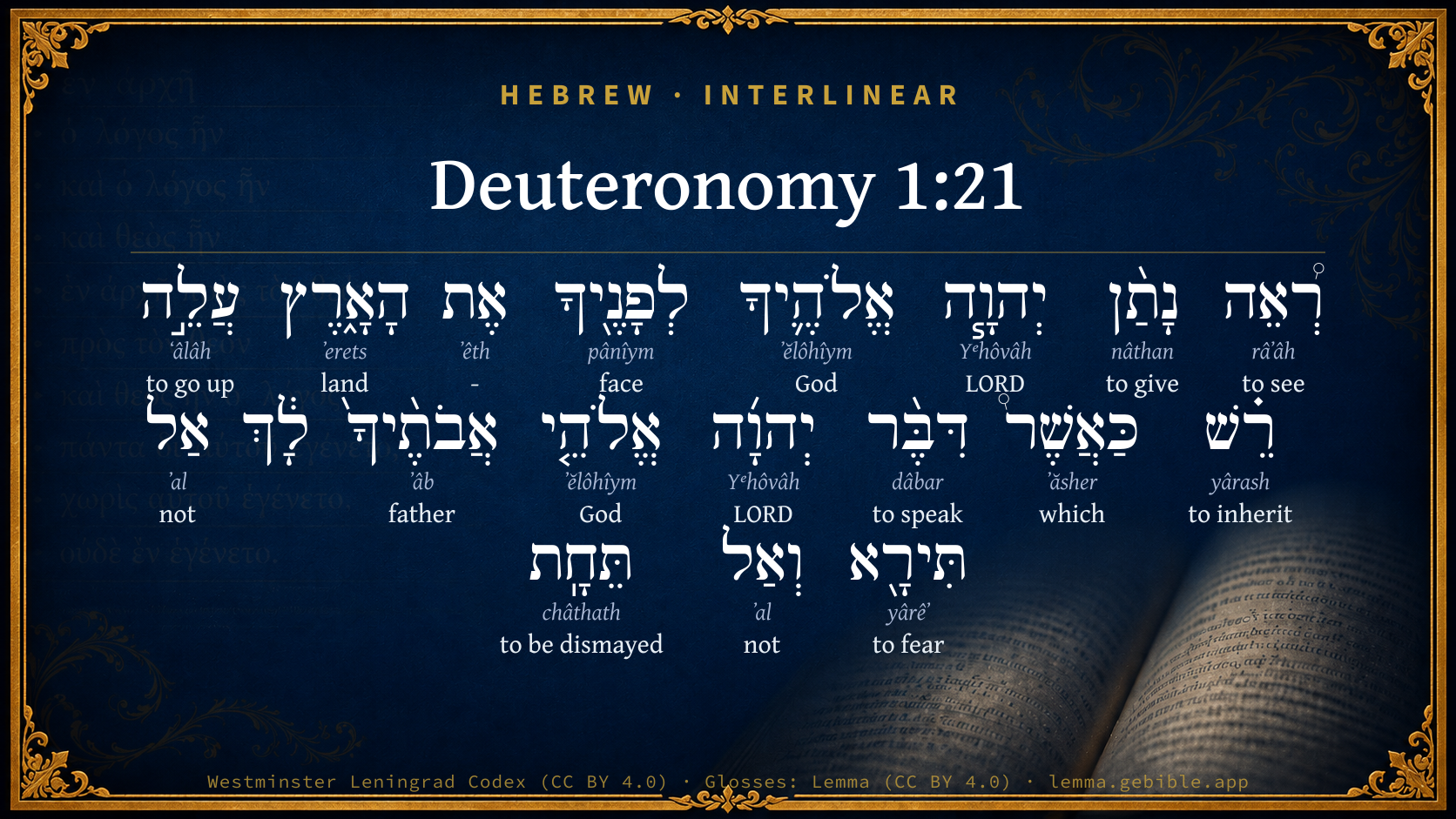
Deuteronomy 1:21

Hebrew (Westminster Leningrad Codex) Deuteronomy 1:21 appears in the Hebrew Old Testament. The text above is from the Westminster Leningrad Codex. Each word links to its Strong’s number, a concise gloss, and parsing drawn from the Open Scriptures Hebrew Bible morphology. Click any word for its full Brown-Driver-Briggs (BDB) entry.
Download image
Cite this verse

Deuteronomy 1:21 (World English Bible). Public Domain. Lemma interlinear Bible study tool, https://lemma.gebible.app/v/deuteronomy/1/21.

Show BibTeX & RIS
BibTeX
RIS
English Translation
Behold, Yahweh your God has set the land before you: go up, take possession, as Yahweh, the God of your fathers, has spoken to you; don't be afraid, neither be dismayed.
World English Bible · Public Domain
Highlights
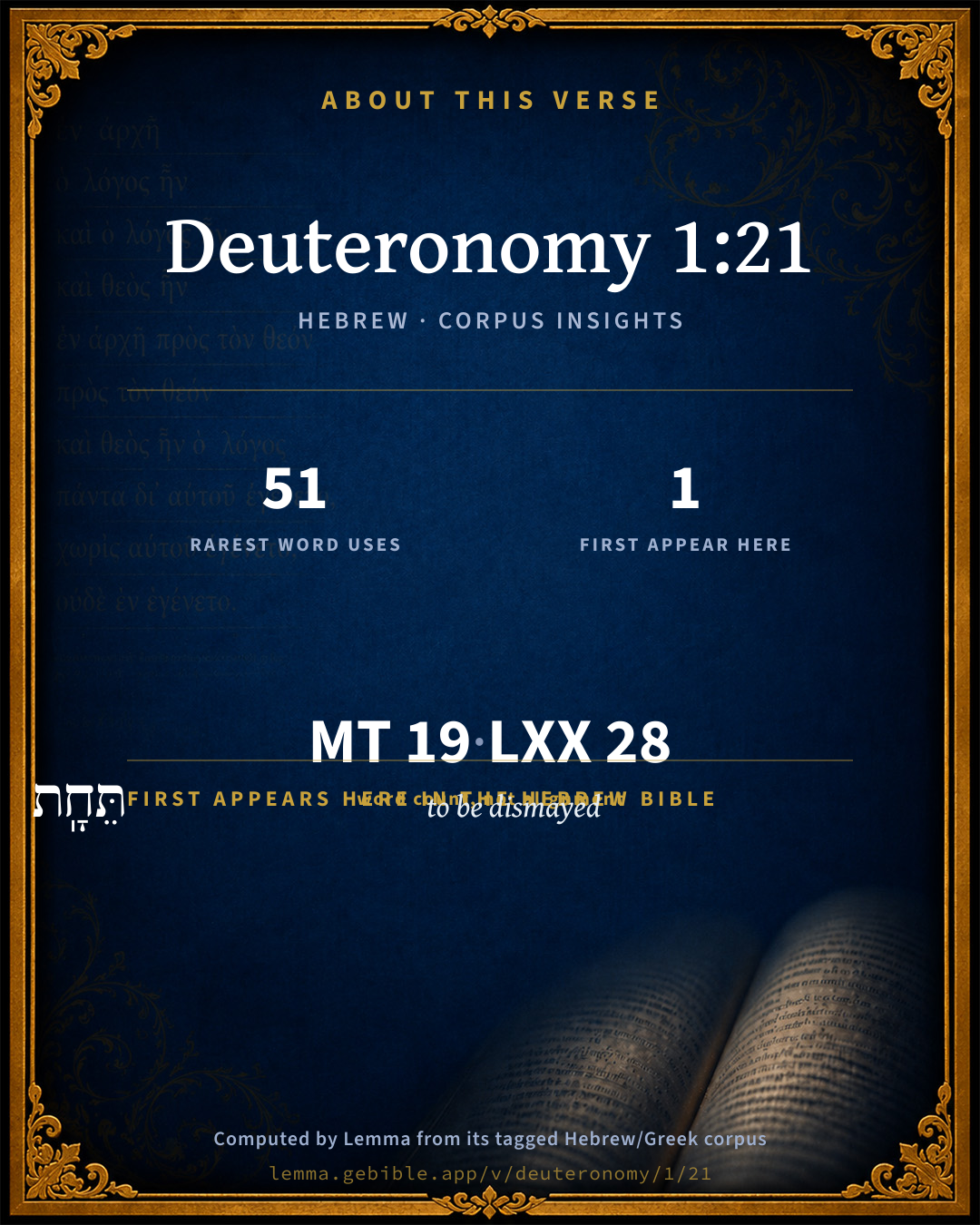
  • 1 first appearance in the Hebrew Bible
Full analysis ↓
Download a study sheet

One document with this verse’s original text, its word-by-word gloss line, the meaning frame, cross-references with their text, attributed commentary, and full source and license credits — printable, and it pastes into notes with its structure intact.

This verse Autodidact and up

Study sheet (.html) Plain text (.txt)

A passage Seminary Student

Up to 50 verses in one chapter. A passage sheet keeps up to 6 commentary sources and 12 cross-references per verse, in the order this page ranks them, and says so on the sheet whenever that leaves anything out. Ask for a single verse and you get the Autodidact verse sheet above.

Everything on this page stays free to read, with no account — the sheet is a download of what is already on screen, not access to it.

Want to remove ads? Support Godless Engineer
Compare translations 3

The same verse in 3 English versions, stacked beneath the original-language interlinear above. Click any original word for its lexicon entry.

Each is an independent rendering of the whole verse — the interlinear is not word-aligned to these translations.

Highlighted words mark where these versions differ — a whole-verse word diff, not a word-by-word alignment.

  • World English Bible Public Domain
    Behold, Yahweh your God has set the land before you: go up, take possession, as Yahweh, the God of your fathers, has spoken to you; don't be afraid, neither be dismayed.
  • King James Version Public Domain
    Behold, the LORD thy God hath set the land before thee: go up and possess it, as the LORD God of thy fathers hath said unto thee; fear not, neither be discouraged.
  • unfoldingWord Literal Text CC BY-SA 4.0
    Look, Yahweh your God has given the land to your face; go up, take possession, as Yahweh, the God of your fathers, has spoken to you. You shall not be afraid, and you shall not be discouraged.’

unfoldingWord Literal Text — © unfoldingWord, licensed CC BY-SA 4.0. Word-aligned USFM3 via Door43 (git.door43.org/unfoldingWord/en_ult).

Versions to compare (up to 4)

3 of 4 selected

Show all 18 translations

Every available English version of this verse, each an independent rendering of the whole verse.

  • World English Bible Public Domain
    Behold, Yahweh your God has set the land before you: go up, take possession, as Yahweh, the God of your fathers, has spoken to you; don't be afraid, neither be dismayed.
  • Berean Standard Bible Public Domain
    See, the LORD your God has placed the land before you. Go up and take possession of it as the LORD, the God of your fathers, has told you. Do not be afraid or discouraged.”
  • Majority Standard Bible Public Domain
    See, the LORD your God has placed the land before you. Go up and take possession of it as the LORD, the God of your fathers, has told you. Do not be afraid or discouraged.”
  • King James Version Public Domain
    Behold, the LORD thy God hath set the land before thee: go up and possess it, as the LORD God of thy fathers hath said unto thee; fear not, neither be discouraged.
  • American Standard Version (1901) Public Domain
    Behold, Jehovah thy God hath set the land before thee: go up, take possession, as Jehovah, the God of thy fathers, hath spoken unto thee; fear not, neither be dismayed.
  • Revised Version (1885) Public Domain
    Behold, the LORD thy God hath set the land before thee: go up, take possession, as the LORD, the God of thy fathers, hath spoken unto thee; fear not, neither be dismayed.
  • Geneva Bible (1599) Public Domain
    Beholde, the Lord thy God hath layde the land before thee: go vp and possesse it, as the Lord the God of thy fathers hath saide vnto thee: feare not, neither be discouraged.
  • Douay-Rheims (1899) Public Domain
    And departing from Horeb, we passed through the terrible and vast wilderness, which you saw, by the way of the mountain of the Amorrhite, as the Lord our God had commanded us. And when we were come into Cadesbarne,
  • Young's Literal Translation Public Domain
    see, Jehovah thy God hath set before thee the land; go up, possess, as Jehovah, God of thy fathers, hath spoken to thee; fear not, nor be affrighted.
  • Literal Standard Version CC BY-SA 4.0
    see, your God YHWH has set the land before you; go up, possess, as YHWH, God of your fathers, has spoken to you; do not fear, nor be frightened.
  • Unlocked Literal Bible CC BY-SA 4.0
    Look, Yahweh your God has set the land before you; go up, take possession, as Yahweh, the God of your fathers, has spoken to you; do not be afraid, neither be discouraged.'
  • unfoldingWord Literal Text CC BY-SA 4.0
    Look, Yahweh your God has given the land to your face; go up, take possession, as Yahweh, the God of your fathers, has spoken to you. You shall not be afraid, and you shall not be discouraged.’
  • Darby Bible Public Domain
    Behold, Jehovah thy God hath set the land before thee: go up, take possession, as Jehovah the God of thy fathers hath said unto thee; fear not, neither be dismayed.
  • World Messianic Bible Public Domain
    Behold, the LORD your God has set the land before you. Go up, take possession, as the LORD the God of your fathers has spoken to you. Don’t be afraid, neither be dismayed.”
  • Webster's Bible Public Domain
    Behold, the LORD thy God hath set the land before thee: go up and possess it, as the LORD God of thy fathers hath said to thee; fear not, neither be discouraged.
  • Free Bible Version CC BY-SA 4.0
    Look, the Lord your God has given you the land! Go and take ownership of the land as the Lord, the God of your forefathers, has told you. Don't be frightened or terrified.”
  • Bible in Basic English Public Domain
    See now, the Lord your God has put the land into your hands: go up and take it, as the Lord, the God of your fathers, has said to you; have no fear and do not be troubled.
  • JPS Tanakh (1917) Public Domain
    Behold, the LORD thy God hath set the land before thee; go up, take possession, as the LORD, the God of thy fathers, hath spoken unto thee; fear not, neither be dismayed.'

Literal Standard Version (2020), Covenant Press — licensed CC BY-SA 4.0. Text via the HelloAO Bible API (eBible.org). Unlocked Literal Bible (unfoldingWord) — licensed CC BY-SA 4.0. Text via the HelloAO Bible API (eBible.org). unfoldingWord Literal Text — © unfoldingWord, licensed CC BY-SA 4.0. Word-aligned USFM3 via Door43 (git.door43.org/unfoldingWord/en_ult). Free Bible Version, Dr. Jonathan Gallagher — licensed CC BY-SA 4.0. Text via the HelloAO Bible API (eBible.org).

Word by word

More ways to search: Search by grammar → Find every occurrence → Compare this word →

Practice this passage: Drill this verse → Learn its vocabulary →

תֵּחָֽת
châthath
H2865
“to be dismayed”
Verb, Niphal, Jussive, 2nd Person, Masculine, Singular
Part of Speech
Verb
Stem
Niphal
Form
Jussive
Person
2nd Person
Gender
Masculine
Number
Singular
Full BDB Definition

Origin: a primitive root

TWOT: 784

to be shattered, be dismayed, be broken, be abolished, be afraid - (Qal) - to be shattered, be broken - to be dismayed - (Niphal) to be broken, be dismayed - (Piel) to be shattered, be dismayed, be scared - (Hiphil) - to cause to be dismayed - to dismay, terrify - to shatter
  1. רְ֠אֵה râʼâh H7200 “see” Verb, Qal, Imperative, 2nd Person, Masculine, Singular
  2. נָתַ֨ן nâthan H5414 “to give” Verb, Qal, Perfect, 3rd Person, Masculine, Singular
  3. יְהוָ֧ה Yᵉhôvâh H3068 “LORD” Noun, Proper
  4. אֱלֹהֶ֛יךָ ʼĕlôhîym H430 “God(s) · your” Noun, Common, Masculine, Plural, Construct + Suffix, Personal, 2nd Person, Masculine, Singular
  5. לְפָנֶ֖יךָ pânîym H6440 “to/for · face(s) · your” Preposition + Noun, Common, Both, Plural, Construct + Suffix, Personal, 2nd Person, Masculine, Singular
  6. אֶת ʼêth H853 “-” Particle, Direct Object
  7. הָאָ֑רֶץ ʼerets H776 “the · land” Particle, Definite Article + Noun, Common, Both, Singular, Absolute
  8. עֲלֵ֣ה ʻâlâh H5927 “go up” Verb, Qal, Imperative, 2nd Person, Masculine, Singular
  9. רֵ֗שׁ yârash H3423 “inherit” Verb, Qal, Imperative, 2nd Person, Masculine, Singular
  10. כַּאֲשֶׁר֩ ʼăsher H834 “like/as · which” Preposition + Particle, Relative
  11. דִּבֶּ֨ר dâbar H1696 “to speak” Verb, Piel, Perfect, 3rd Person, Masculine, Singular
  12. יְהוָ֜ה Yᵉhôvâh H3068 “LORD” Noun, Proper
  13. אֱלֹהֵ֤י ʼĕlôhîym H430 “God(s) of” Noun, Common, Masculine, Plural, Construct
  14. אֲבֹתֶ֨יךָ֙ ʼâb H1 “fathers · your” Noun, Common, Masculine, Plural, Construct + Suffix, Personal, 2nd Person, Masculine, Singular
  15. אַל ʼal H408 “not” Particle, Negative
  16. תִּירָ֖א yârêʼ H3372 “to fear” Verb, Qal, Jussive, 2nd Person, Masculine, Singular
  17. וְאַל ʼal H408 “and · not” Conjunction + Particle, Negative

About this verse

These counts appear in no published source. They are computed here, from the morphology-tagged text and Lemma’s own curated glosses. What Lemma adds →

19
words
15
distinct lemmas
Pentateuch
section

First appearance in Scripture

This word makes its first canonical appearance in the Hebrew Bible here:

  • תֵּחָֽת to be dismayed H2865

Shared distinctive vocabulary

תֵּחָֽת to be dismayed H2865 occurs in 45 verses of the Hebrew Bible. Also found in:

Grammatical profile

  • 7 verbs
  • 7 nouns
  • 1 preposition
  • 4 particles

Verb forms

  • רְ֠אֵה Qal · Imperative
  • נָתַ֨ן Qal · Perfect
  • עֲלֵ֣ה Qal · Imperative
  • רֵ֗שׁ Qal · Imperative
  • דִּבֶּ֨ר Piel · Perfect
  • תִּירָ֖א Qal · Jussive
  • תֵּחָֽת Niphal · Jussive

Repetition

Words recur within this verse — often emphatic in Hebrew:

  • יְהוָ֧ה LORD H3068 ×2
  • אֱלֹהֶ֛יךָ God H430 ×2
  • אַל not H408 ×2

Hebrew & Septuagint length

In English translation the verse runs 31 words from the Hebrew and 33 from the Septuagint (LXX English) — closely comparable.

A rough comparison of the two English renderings, which tokenize alike — not a word-level alignment.

Word counts can differ between the Hebrew and the Greek without any difference in meaning — e.g. the Hebrew direct-object marker אֵת has no separate Greek word, and Greek often adds the article ὁ.

In the original languages it is 19 Hebrew tokens and 28 Greek tokens — but the two are counted differently (Hebrew bundles its prefixes and suffixes into one token; the Greek is in lemma form), so that isn’t a like-for-like length.

Cross-references

13

Topical passages linked to Deuteronomy 1:21 in the Treasury of Scripture Knowledge — connected by theme and wording, ordered by reader-vote popularity; previews shown in the World English Bible.

  • Joshua 1:9 Haven't I commanded you? Be strong and of good courage; don't be afraid, neither be dismayed: for Yahweh your God is with you wherever you go.
  • Numbers 14:8–9 If Yahweh delight in us, then he will bring us into this land, and give it to us; a land which flows with milk and honey.
  • Psalms 46:1 God is our refuge and strength, A very present help in trouble.
  • Hebrews 13:6 So that with good courage we say, "The Lord is my helper. I will not fear. What can man do to me?"
  • Numbers 13:30 Caleb stilled the people before Moses, and said, Let us go up at once, and possess it; for we are well able to overcome it.
  • Deuteronomy 20:1 When you go forth to battle against your enemies, and see horses, and chariots, [and] a people more than you, you shall not be afraid of them; for Yahweh your God is with you, who brought you up out of the land of Egypt.
  • Joshua 1:6 Be strong and of good courage; for you shall cause this people to inherit the land which I swore to their fathers to give them.
  • Psalms 27:1–3 Yahweh is my light and my salvation. Whom shall I fear? Yahweh is the strength of my life. Of whom shall I be afraid?
  • Psalms 46:7 Yahweh of Hosts is with us. The God of Jacob is our refuge. Selah.
  • Psalms 46:11 Yahweh of Hosts is with us. The God of Jacob is our refuge. Selah.
  • Isaiah 41:10 Don't you be afraid, for I am with you; don't be dismayed, for I am your God; I will strengthen you; yes, I will help you; yes, I will uphold you with the right hand of my righteousness.
  • Isaiah 43:1–2 But now thus says Yahweh who created you, Jacob, and he who formed you, Israel: Don't be afraid, for I have redeemed you; I have called you by your name, you are mine.
  • Luke 12:32 Don't be afraid, little flock, for it is your Father's good pleasure to give you the Kingdom.

Cross-references courtesy of OpenBible.info (CC BY 4.0).

Hebrew and Greek witnesses Masoretic Hebrew ↔ Greek Septuagint

The same verse in the two great witnesses to the Old Testament, shown verse-for-verse.

These are two independent witnesses, not word-aligned to each other, and the Septuagint is shown in lemma (dictionary) form.

Hebrew Deuteronomy 1:21 Masoretic · Westminster Leningrad Codex

רְ֠אֵה נָתַ֨ן יְהוָ֧ה אֱלֹהֶ֛יךָ לְפָנֶ֖יךָ אֶת הָאָ֑רֶץ עֲלֵ֣ה רֵ֗שׁ כַּאֲשֶׁר֩ דִּבֶּ֨ר יְהוָ֜ה אֱלֹהֵ֤י אֲבֹתֶ֨יךָ֙ לָ֔ךְ אַל תִּירָ֖א וְאַל תֵּחָֽת

Behold, Yahweh your God has set the land before you: go up, take possession, as Yahweh, the God of your fathers, has spoken to you; don't be afraid, neither be dismayed.

World English Bible · Public Domain

Greek LXX Deuteronomy 1:21 Septuagint · lemma form

ὁράω παραδίδωμι σύ κύριος ὁ θεός σύ πρό πρόσωπον σύ ὁ γῆ ἀναβαίνω κληρονομέω ὅς τρόπος εἶπον κύριος ὁ θεός ὁ πατήρ σύ σύ μή φοβέω μηδέ δειλιάω

behold, the Lord your God has delivered to us the land before you: go up and inherit it as the Lord God of your fathers said to you; fear not, neither be afraid.

LXX2012 (modern English Septuagint) · Public Domain

On this verse, The Cambridge Bible for Schools and Colleges discusses the Septuagint’s reading. Read the note in Commentary ↓

Hebrew: Westminster Leningrad Codex (CC BY 4.0). Greek: Septuagint (public domain); English from LXX2012 (modern English Septuagint) (Public Domain). How the Septuagint differs from the Hebrew →

Targum (Aramaic paraphrase)

2

The Targum is the ancient Jewish Aramaic paraphrase of the Hebrew Scriptures — an interpretive translation, not the Hebrew text itself. Onkelos (literal) and Pseudo-Jonathan (expansive) render the Torah, and Jonathan the Prophets. Coverage is partial: where no permissively-licensed English translation exists for a verse, only the Aramaic is shown. This is verse-level text, not a word-by-word alignment to the Hebrew.

  1. Targum Onkelos Torah (Genesis–Deuteronomy)
    חֲזֵי יְהַב יְיָ אֱלָהָךְ קֳדָמָךְ יָת אַרְעָא סַק אַחֲסֵין כְּמָא דִי מַלִיל יְיָ אֱלָהָא דַאֲבָהָתָךְ לָךְ לָא תִדְחַל וְלָא תִתְּבָּר

    (no public-domain English translation for this verse)

    Targum Onkelos — Aramaic: “Onkelos Genesis” (public domain); “Onkelos Exodus” (public domain); “Onkelos Leviticus” (public domain); “Onkelos Numbers” (public domain); “Onkelos Deuteronomy” (public domain). English: “Sefaria Community Translation” (CC0 1.0 (public-domain dedication)); “J.W. Etheridge. The Targums of Onkelos and Jonathan Ben Uzziel on the Pentateuch. London: Longmans, Green, 1862” (public domain). Text via Sefaria.

  2. Targum Pseudo-Jonathan Torah (Genesis–Deuteronomy)
    חָמוּן דִּיהַב יְיָ אֱלָהָכוֹן לְכוֹן יַת אַרְעָא סוּקוּ וְאַחֲסִינוּ הֵיכְמָא דְמַלֵּיל יְיָ אֱלָהָכוֹן לְכוֹן לָא תִידַחֲלוּן וְלָא תִיתַבְּרוּן

    Behold, the Lord our God hath given you the land; arise and possess it, as the Lord your God hath told you; fear not, nor be dismayed (broken).

    Targum Pseudo-Jonathan — Aramaic: “Targum Jonathan on Genesis” (public domain); “Targum Jonathan on Exodus” (public domain); “Targum Jonathan on Leviticus” (public domain); “Targum Jonathan on Numbers” (public domain); “Targum Jonathan on Deuteronomy” (public domain). English: “The Targum of Jonathan ben Uzziel, trans. J. W. Etheridge, London, 1862” (public domain). Text via Sefaria.

Commentary

Notes on Deuteronomy 1:21 from classic Christian and Jewish commentators (each source and its license shown beneath its notes). The classic Christian expositions comment on the surrounding passage and are grouped to its opening verse, so a note may address several verses; the Jewish commentaries on the Tanakh (Rashi and others) are per-verse, so they appear only where the commentator wrote on this verse.

Lemma curates 59 commentaries, every one of them public domain or Creative Commons licensed, each selected and text-cleaned for this edition rather than reprinted as found. About our sources →

Trapp's Complete Commentary

John Trapp

Deu 1:21 Behold, the LORD thy God hath set the land before thee: go up [and] possess [it], as the LORD God of thy fathers hath said unto thee; fear not, neither be discouraged.

Ver. 21. Behold the Lord.] {See Trapp on "Deu 1:8"}

John Trapp, A Commentary or Exposition upon All the Books of the Old and New Testament (1647–1656) — public domain. Text from a community e-Sword module.

The Biblical Illustrator

Joseph S. Exell

Deu_1:21

The Lord . . . hath set the land before thee.

The heritage of grace

There is a heritage of grace which we ought to be bold enough to win for our own possession. All that one believer has gained is free to another. We may be strong in faith, fervent in love, and abundant in labour; there is nothing to prevent it; let us go up and take possession. The sweetest experience and the brightest grace are as much for us as for any of our brethren. Jehovah has set it before us; no one can deny our right; let us go up and possess it in His name. The world also lies before us to be conquered for the Lord Jesus. We are not to leave any country a corner of it unsubdued. That slum near our house is before us, not to baffle our endeavours, but to yield to them. We have only to summon courage enough to go forward, and we shall win dark homes and hard hearts for Jesus. Let us never leave the people in a lane or alley to die because we have not enough faith in Jesus and His Gospel to go up and possess the land. No spot is too benighted, no person is so profane as to be beyond the power of grace. Cowardice, begone! Faith marches to the conquest. (C. H. Spurgeon.)

The folly of unbelief

Moses recounted what had occurred in the wilderness of Paran about two years after the Israelites went out of Egypt. They had reached Kadesh on the verge of the Negeb or South Country. They resolved to send spies before them to reconnoitre. This resolve, as the sequel proved, showed a want of faith on the part of many, and even a determined desire on the part of some to find an excuse for returning to Egypt. The majority of the spies, while extolling the country, magnified the difficulties which seemed to be on the path to its conquest. Only two of the spies were on the Lords side. But the latent unbelief of the people brushed aside their arguments. Only too ]ate the people repented of their folly, and were driven back before the Amorites to their forty years of wandering. Moses dwelt on this incident because it showed the folly and punishment of unbelief, and was thus a warning example. So it is to the Christian Church (1Co_10:6). It shows--

I. Some hindrances to faith.

1. The history is typical of what often occurs in the Christian life. Many come to the borders of the kingdom of God and fail to enter.

2. The causes of failure are similar, the chief cause is unbelief. Because of this the Israelites could not enter. The proofs God had given of His power and willingness aggravated this unbelief. Every step of the journey proved the Divine goodness. But they forgot all God had done. Unbelief frustrated all.

3. So is it with individual men. Barriers to entrance to the Divine kingdom are raised by themselves. They do not trust in the Divine promises. They are troubled by the thought that they are too sinful--that they must repent, prepare themselves, etc. But salvation does not depend on these things, though they may show that our hearts are set on it. The slave who is offered freedom does not need to attempt to purchase it. So sinful men may enter the strait gate in the Divine strength, through Christ. It was not their preparedness that entitled the Israelites to enter into the land of promise, but their faith in the Divine promises.

II. Difficulties in the way of spiritual progress.

(1) The desert life, the hardship of conquest, were not to the taste of many of the Israelites. In Egypt they enjoyed many luxuries now denied them. So not a few wished to return to Egypt. But this was folly--the way to death, to fall into the hands of the enraged Pharaoh.

(2) This is a faint type of those who turn their backs on the spiritual kingdom, lured by the pleasures of the world.

(3) Do not let any think, as some in Israel seemed to do, that if God intends us to overcome He will enable us to do so without effort. Israel could not possess Canaan till the Amorites and other foes were overcome, the strong cities overthrown, etc. This the Israelites in unbelief thought could not be accomplished.

(4) This is the plea of many at the entrance of the spiritual life. The way is too difficult, the enemies are too strong, we cannot overcome. But the New Testament word is, If God be for us, who can be against us? Christ has commanded us to strive and agonise to enter.

(5) Let no man be deterred by this. Every noble life is a struggle. Good men, from the very constitution of things, must suffer. Even goodness incarnate was rewarded by the world with a cross. These difficulties are raised by the adversary.

(6) There are some events peculiarly saddening. A ship wrecked at the harbour mouth--a runner fainting when close to the goal--an heir bartering his inheritance for a mess of pottage. But sadder still--a sight fit to make angels weep--is it to see an heir of immortal glory turning from his fathers house back to the far country and the swine troughs! (W. Frank Scott.)

The Biblical Illustrator, edited by Joseph S. Exell (c. 1880s–1900s) — public domain. Text from a community e-Sword module.

Ellicott's Commentary for English Readers

(21) Fear not, neither be discouraged.—The last clause of this verse reappears in St. Joh_14:27, “Let not your heart be troubled, neither let it be afraid.”

A Bible Commentary for English Readers, edited by Charles John Ellicott (1878–1897) — public domain. Text from a community e-Sword module.

The Cambridge Bible for Schools and Colleges

gen. ed. J. J. S. Perowne

21. Behold, the Lord thy God, etc.] The first of the passages, scattered throughout this discourse, in the Sg. form of address. The LXX has indeed the Pl. but apparently in order to harmonise with the context; the Sg. is confirmed by the Sam. Moreover the expression fear thou not neither be dismayed (al-tîra’ We’al teḥath) is always found with the Sg. address, while the Pl. has for the same idea dread ye not neither fear ye (lo-ta‘arsûn welô-tîrûn), e.g. Deu_1:29, Deu_31:6. Further the contents of the verse, though not otherwise exhibiting marks of separate-ness from the context, are not indispensable as a connection between Deu_1:20; Deu_1:22. It is probable, therefore, that the verse is a later insertion, to make that connection clearer and more exact.

The Cambridge Bible for Schools and Colleges (gen. ed. J. J. S. Perowne; Cambridge University Press, 1878–1918) — public domain. Text from a community e-Sword module.

John Gill's Exposition

Behold, the Lord thy God hath set the land before thee,.... The land of Canaan, on the borders of which they then were; See Gill on Deu 1:8,

go up; the mountain, by that way of it which was the way the spies went, and up to which some of the Israelites presumed to go when forbidden, they not complying with the call of God:

and possess it, as the Lord God of thy fathers hath said unto thee; as in Deu 1:8,

fear not, neither be discouraged; though the people of the land were numerous and strong, and their cities large and walled.

John Gill's Exposition of the Whole Bible (1746–1763) — public domain (CC PDM 1.0). Text via the HelloAO Bible API.

The Pulpit Commentary

Courage.

"Fear not, neither be discouraged" (cf. Jos_1:7, Jos_1:9)

I GOD"S WORK NEEDS COURAGE.

1. The enemies are many.

2. The enemies are strong.

3. Humanly speaking, we are feeble in comparison with them.

Distinguishing between real and nominal Christianity, it might be plausibly held that there is today greater talent, intellectual power, wealth, rank, and social influence enlisted on the side of unbelief than on the side of faith. But the true citadel of unbelief is the evil heart; and what powers of our own are sufficient to storm that?

II IN GOD"S WORK THERE IS EVERY REASON FOR COURAGE.

1. God is with us. Our cause is his cause.

2. He has promised victory, and he is able to keep his promise.

3. The past should encourage us.

The Church can never come through greater conflicts than those in which she has already proved herself victorious. J.O.

The Pulpit Commentary (1880–1919), ed. H.D.M. Spence-Jones & Joseph S. Exell — public domain. Text from a community e-Sword module.

Lesson kit

Teaching starters — assembled from the data on this page, not authored interpretation. Every prompt links to the verse data it draws on. Edit before teaching.

Deuteronomy, in the Pentateuch, opens this verse with 19 words (15 distinct Hebrew lemmas). Its most distinctive word is châthath (“to be dismayed”). A historical commentator’s framing appears above. Read the whole chapter for the surrounding context.

Discussion questions

  1. What does “to be dismayed” (châthath) contribute to the verse as a whole?
  2. This is the first place “to be dismayed” appears in Scripture (first appears here). What does its debut here establish?
  3. How does Deuteronomy 31:8, which shares the word «to be dismayed», read alongside this verse?
  4. What does the repetition of “LORD” (2× in this one verse) do in this verse?
  5. These translations render this verse differently; the difference is in the English rendering, not the original. What questions does that raise?
  6. «רְ֠אֵה» is a Qal Imperative verb. How does that grammatical form shape the action described?
  7. Compare how Trapp's Complete Commentary and The Biblical Illustrator read this verse. Where do they agree or differ?

Things to notice

Reading settings

Reading text

Shown beneath each verse's original-language words.

Old Testament
Old Testament edition

Read the OT as the Masoretic Hebrew (MT) or the Greek Septuagint (LXX).

English shown for the Greek Septuagint (in the Hebrew ↔ Greek comparison).

Comparing translations? Open the Compare panel on any verse page to stack up to four side by side.