Genesis 50:7

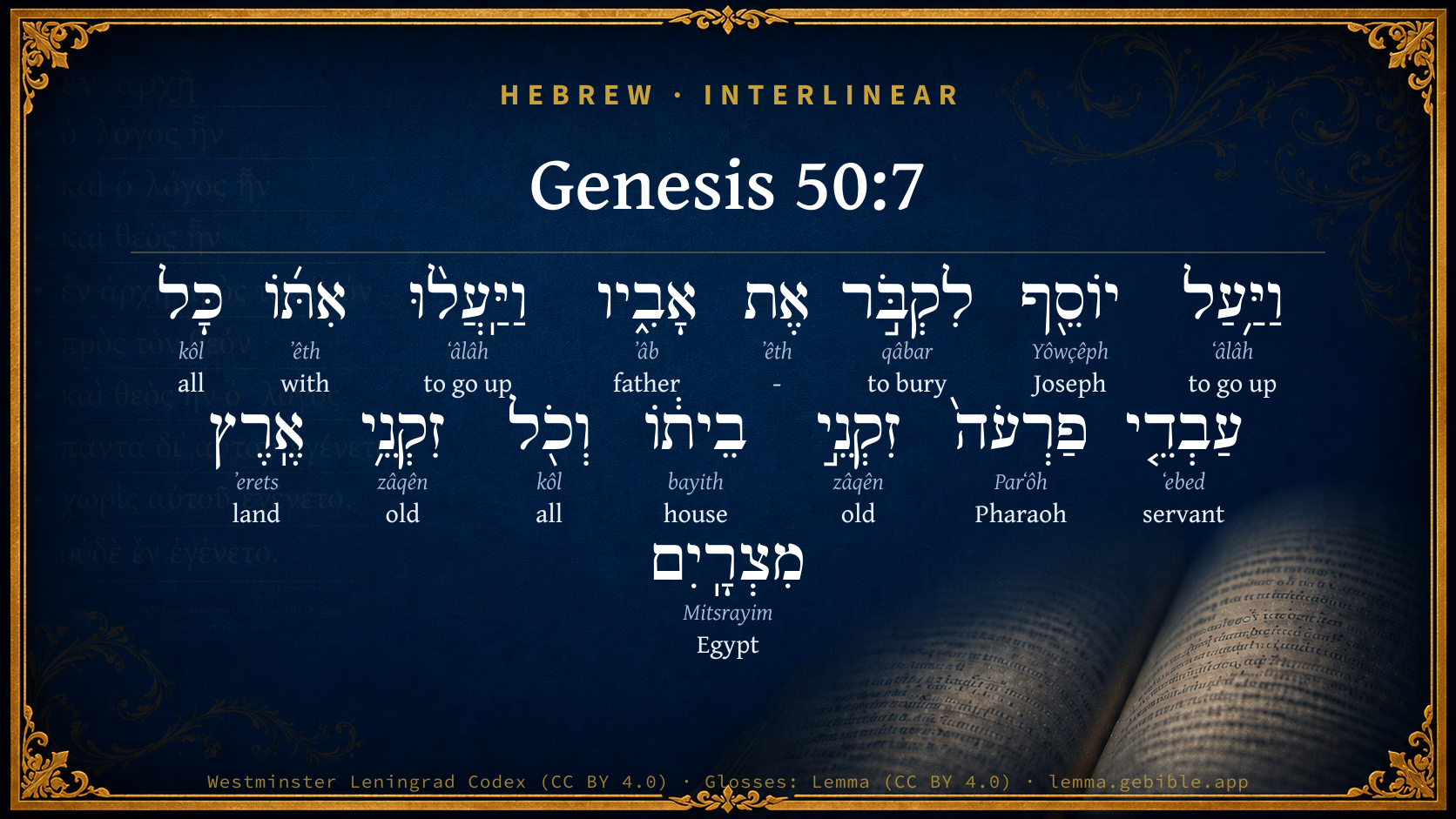
Hebrew (Westminster Leningrad Codex) Genesis 50:7 appears in the Hebrew Old Testament. The text above is from the Westminster Leningrad Codex. Each word links to its Strong’s number, a concise gloss, and parsing drawn from the Open Scriptures Hebrew Bible morphology. Click any word for its full Brown-Driver-Briggs (BDB) entry.
Download image
Cite this verse

Genesis 50:7 (World English Bible). Public Domain. Lemma interlinear Bible study tool, https://lemma.gebible.app/v/genesis/50/7.

Show BibTeX & RIS
BibTeX
RIS
English Translation
Joseph went up to bury his father; and with him went up all the servants of Pharaoh, the elders of his house, all the elders of the land of Egypt,
World English Bible · Public Domain
Download a study sheet

One document with this verse’s original text, its word-by-word gloss line, the meaning frame, cross-references with their text, attributed commentary, and full source and license credits — printable, and it pastes into notes with its structure intact.

This verse Autodidact and up

Study sheet (.html) Plain text (.txt)

A passage Seminary Student

Up to 50 verses in one chapter. A passage sheet keeps up to 6 commentary sources and 12 cross-references per verse, in the order this page ranks them, and says so on the sheet whenever that leaves anything out. Ask for a single verse and you get the Autodidact verse sheet above.

Everything on this page stays free to read, with no account — the sheet is a download of what is already on screen, not access to it.

Want to remove ads? Support Godless Engineer
Compare translations 3

The same verse in 3 English versions, stacked beneath the original-language interlinear above. Click any original word for its lexicon entry.

Each is an independent rendering of the whole verse — the interlinear is not word-aligned to these translations.

Highlighted words mark where these versions differ — a whole-verse word diff, not a word-by-word alignment.

  • World English Bible Public Domain
    Joseph went up to bury his father; and with him went up all the servants of Pharaoh, the elders of his house, all the elders of the land of Egypt,
  • King James Version Public Domain
    And Joseph went up to bury his father: and with him went up all the servants of Pharaoh, the elders of his house, and all the elders of the land of Egypt,
  • unfoldingWord Literal Text CC BY-SA 4.0
    So Joseph went up to bury his father, and with him went up all the servants of Pharaoh, the elders of his house and all elders of the land of Egypt

unfoldingWord Literal Text — © unfoldingWord, licensed CC BY-SA 4.0. Word-aligned USFM3 via Door43 (git.door43.org/unfoldingWord/en_ult).

Versions to compare (up to 4)

3 of 4 selected

Show all 18 translations

Every available English version of this verse, each an independent rendering of the whole verse.

  • World English Bible Public Domain
    Joseph went up to bury his father; and with him went up all the servants of Pharaoh, the elders of his house, all the elders of the land of Egypt,
  • Berean Standard Bible Public Domain
    Then Joseph went to bury his father, and all the servants of Pharaoh accompanied him—the elders of Pharaoh’s household and all the elders of the land of Egypt—
  • Majority Standard Bible Public Domain
    Then Joseph went to bury his father, and all the servants of Pharaoh accompanied him—the elders of Pharaoh’s household and all the elders of the land of Egypt—
  • King James Version Public Domain
    And Joseph went up to bury his father: and with him went up all the servants of Pharaoh, the elders of his house, and all the elders of the land of Egypt,
  • American Standard Version (1901) Public Domain
    And Joseph went up to bury his father; and with him went up all the servants of Pharaoh, the elders of his house, and all the elders of the land of Egypt,
  • Revised Version (1885) Public Domain
    And Joseph went up to bury his father: and with him went up all the servants of Pharaoh, the elders of his house, and all the elders of the land of Egypt,
  • Geneva Bible (1599) Public Domain
    So Ioseph went vp to bury his father, and with him went all the seruants of Pharaoh, both the elders of his house, and all the elders of the land of Egypt.
  • Douay-Rheims (1899) Public Domain
    So he went up, and there went with him all the ancients of Pharao's house, and all the elders of the land of Egypt,
  • Young's Literal Translation Public Domain
    And Joseph goeth up to bury his father, and go up with him do all the servants of Pharaoh, elders of his house, and all the elders of the land of Egypt,
  • Literal Standard Version CC BY-SA 4.0
    And Joseph goes up to bury his father, and all [the] servants of Pharaoh go up with him, [the] elderly of his house, and all [the] elderly of the land of Egypt,
  • Unlocked Literal Bible CC BY-SA 4.0
    Joseph went up to bury his father. All the officials of Pharaoh went with him—the elders of his household, all the senior officials of the land of Egypt,
  • unfoldingWord Literal Text CC BY-SA 4.0
    So Joseph went up to bury his father, and with him went up all the servants of Pharaoh, the elders of his house and all elders of the land of Egypt
  • Darby Bible Public Domain
    And Joseph went up to bury his father; and with him went up all the bondmen of Pharaoh, the elders of his house, and all the elders of the land of Egypt,
  • World Messianic Bible Public Domain
    Joseph went up to bury his father; and with him went up all the servants of Pharaoh, the elders of his house, all the elders of the land of Egypt,
  • Webster's Bible Public Domain
    And Joseph went up to bury his father: and with him went all the servants of Pharaoh, the elders of his house, and all the elders of the land of Egypt,
  • Free Bible Version CC BY-SA 4.0
    Joseph went to bury his father, and all Pharaoh's officials went with him—all Pharaoh's senior advisors and all the leaders of Egypt—
  • Bible in Basic English Public Domain
    So Joseph went up to put his father in his last resting-place; and with him went all the servants of Pharaoh, and the chief men of his house and all the chiefs of the land of Egypt,
  • JPS Tanakh (1917) Public Domain
    And Joseph went up to bury his father; and with him went up all the servants of Pharaoh, the elders of his house, and all the elders of the land of Egypt,

Literal Standard Version (2020), Covenant Press — licensed CC BY-SA 4.0. Text via the HelloAO Bible API (eBible.org). Unlocked Literal Bible (unfoldingWord) — licensed CC BY-SA 4.0. Text via the HelloAO Bible API (eBible.org). unfoldingWord Literal Text — © unfoldingWord, licensed CC BY-SA 4.0. Word-aligned USFM3 via Door43 (git.door43.org/unfoldingWord/en_ult). Free Bible Version, Dr. Jonathan Gallagher — licensed CC BY-SA 4.0. Text via the HelloAO Bible API (eBible.org).

Word by word

More ways to search: Search by grammar → Find every occurrence → Compare this word →

Practice this passage: Drill this verse → Learn its vocabulary →

לִקְבֹּ֣ר
qâbar
H6912
“to bury”
Preposition + Verb, Qal, Infinitive Construct
Part of Speech
Preposition + Verb
Stem
Qal
Form
Infinitive Construct
Full BDB Definition

Origin: a primitive root

TWOT: 1984

to bury - (Qal) to bury - (Niphal) to be buried - (Piel) to bury, bury (in masses) - (Pual) to be buried
  1. וַיַּ֥עַל ʻâlâh H5927 “and · to go up” Conjunction + Verb, Qal, Sequential Imperfect, 3rd Person, Masculine, Singular
  2. יוֹסֵ֖ף Yôwçêph H3130 “Joseph” Noun, Proper
  3. אֶת ʼêth H853 “-” Particle, Direct Object
  4. אָבִ֑יו ʼâb H1 “father · his” Noun, Common, Masculine, Singular, Construct + Suffix, Personal, 3rd Person, Masculine, Singular
  5. וַיַּֽעֲל֨וּ ʻâlâh H5927 “and · to go up” Conjunction + Verb, Qal, Sequential Imperfect, 3rd Person, Masculine, Plural
  6. אִתּ֜וֹ ʼêth H854 “with · him” Preposition + Suffix, Personal, 3rd Person, Masculine, Singular
  7. כָּל kôl H3605 “all of” Noun, Common, Masculine, Singular, Construct
  8. עַבְדֵ֤י ʻebed H5650 “servants of” Noun, Common, Masculine, Plural, Construct
  9. פַרְעֹה֙ Parʻôh H6547 “Pharaoh” Noun, Proper
  10. זִקְנֵ֣י zâqên H2205 “old of” Adjective, Adjective, Masculine, Plural, Construct
  11. בֵית֔וֹ bayith H1004 “house · his” Noun, Common, Masculine, Singular, Construct + Suffix, Personal, 3rd Person, Masculine, Singular
  12. וְכֹ֖ל kôl H3605 “and · all of” Conjunction + Noun, Common, Masculine, Singular, Construct
  13. זִקְנֵ֥י zâqên H2205 “old of” Adjective, Adjective, Masculine, Plural, Construct
  14. אֶֽרֶץ ʼerets H776 “land of” Noun, Common, Both, Singular, Construct
  15. מִצְרָֽיִם Mitsrayim H4714 “Egypt” Noun, Proper

About this verse

These counts appear in no published source. They are computed here, from the morphology-tagged text and Lemma’s own curated glosses. What Lemma adds →

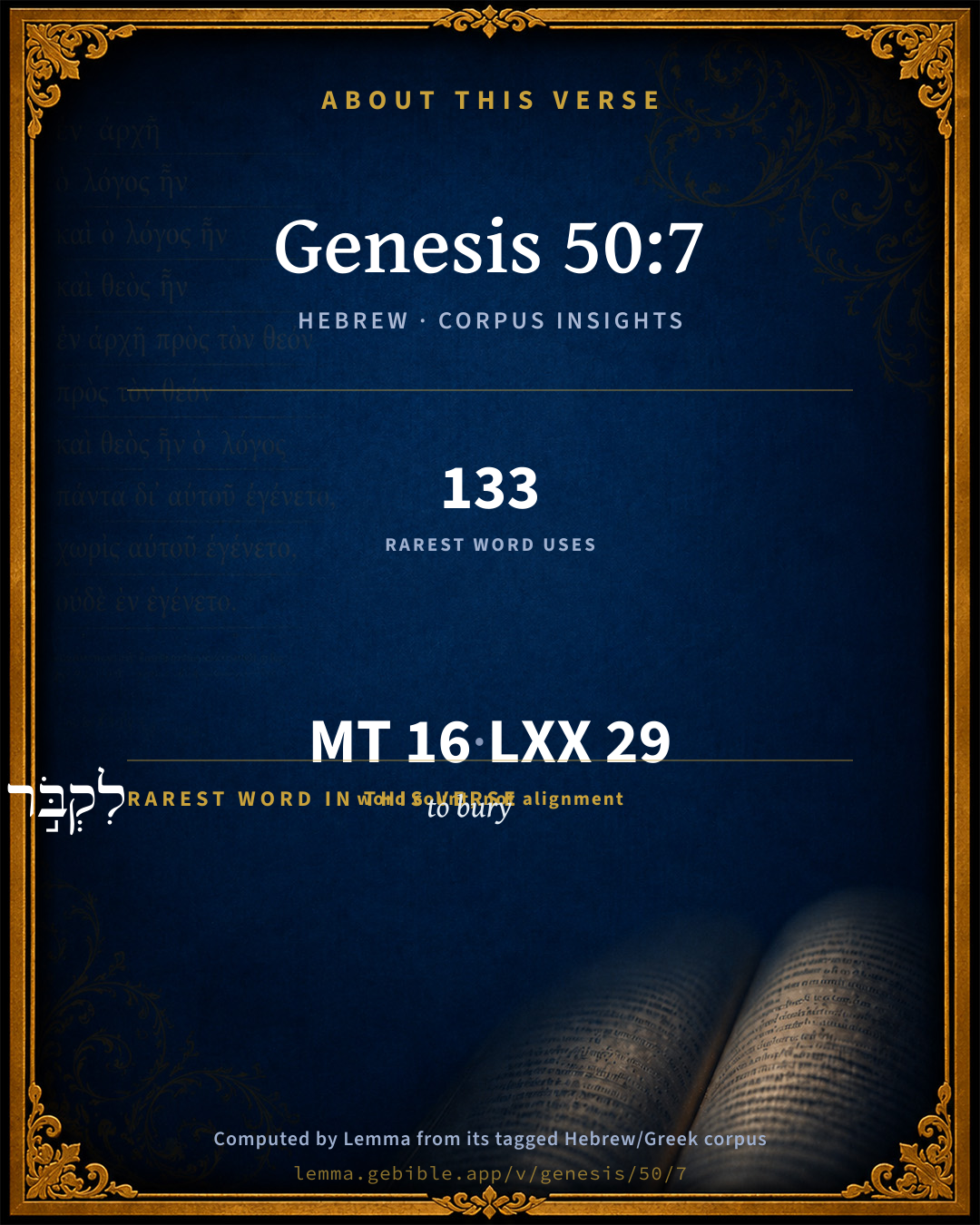
16
words
13
distinct lemmas
Pentateuch
section

Grammatical profile

  • 3 verbs
  • 9 nouns
  • 2 adjectives
  • 1 preposition
  • 1 particle

Verb forms

  • וַיַּ֥עַל Qal · Sequential Imperfect
  • לִקְבֹּ֣ר Qal · Infinitive Construct
  • וַיַּֽעֲל֨וּ Qal · Sequential Imperfect

Repetition

Words recur within this verse — often emphatic in Hebrew:

  • וַיַּ֥עַל to go up H5927 ×2
  • כָּל all H3605 ×2
  • זִקְנֵ֣י old H2205 ×2

Hebrew & Septuagint length

In English translation the verse runs 30 words from the Hebrew and 33 from the Septuagint (LXX English) — closely comparable.

A rough comparison of the two English renderings, which tokenize alike — not a word-level alignment.

Word counts can differ between the Hebrew and the Greek without any difference in meaning — e.g. the Hebrew direct-object marker אֵת has no separate Greek word, and Greek often adds the article ὁ.

In the original languages it is 16 Hebrew tokens and 29 Greek tokens — but the two are counted differently (Hebrew bundles its prefixes and suffixes into one token; the Greek is in lemma form), so that isn’t a like-for-like length.

Cross-references

1

Topical passages linked to Genesis 50:7 in the Treasury of Scripture Knowledge — connected by theme and wording, ordered by reader-vote popularity; previews shown in the World English Bible.

  • Genesis 14:16 He brought back all the goods, and also brought back his relative, Lot, and his goods, and the women also, and the people.

Cross-references courtesy of OpenBible.info (CC BY 4.0).

Hebrew and Greek witnesses Masoretic Hebrew ↔ Greek Septuagint

The same verse in the two great witnesses to the Old Testament, shown verse-for-verse.

These are two independent witnesses, not word-aligned to each other, and the Septuagint is shown in lemma (dictionary) form.

Hebrew Genesis 50:7 Masoretic · Westminster Leningrad Codex

וַיַּ֥עַל יוֹסֵ֖ף לִקְבֹּ֣ר אֶת אָבִ֑יו וַיַּֽעֲל֨וּ אִתּ֜וֹ כָּל עַבְדֵ֤י פַרְעֹה֙ זִקְנֵ֣י בֵית֔וֹ וְכֹ֖ל זִקְנֵ֥י אֶֽרֶץ מִצְרָֽיִם

Joseph went up to bury his father; and with him went up all the servants of Pharaoh, the elders of his house, all the elders of the land of Egypt,

World English Bible · Public Domain

Greek LXX Genesis 50:7 Septuagint · lemma form

καί ἀναβαίνω ιωσηφ θάπτω ὁ πατήρ αὐτός καί συν ἀναβαίνω μετά αὐτός πᾶς ὁ παῖς φαραώ καί ὁ πρεσβύτερος ὁ οἶκος αὐτός καί πᾶς ὁ πρεσβύτερος ὁ γῆ αἴγυπτος

So Joseph went up to bury his father; and all the servants of Pharao went up with him, and the elders of his house, and all the elders of the land of Egypt.

LXX2012 (modern English Septuagint) · Public Domain

Hebrew: Westminster Leningrad Codex (CC BY 4.0). Greek: Septuagint (public domain); English from LXX2012 (modern English Septuagint) (Public Domain). How the Septuagint differs from the Hebrew →

Targum (Aramaic paraphrase)

2

The Targum is the ancient Jewish Aramaic paraphrase of the Hebrew Scriptures — an interpretive translation, not the Hebrew text itself. Onkelos (literal) and Pseudo-Jonathan (expansive) render the Torah, and Jonathan the Prophets. Coverage is partial: where no permissively-licensed English translation exists for a verse, only the Aramaic is shown. This is verse-level text, not a word-by-word alignment to the Hebrew.

  1. Targum Onkelos Torah (Genesis–Deuteronomy)
    וּסְלֵיק יוֹסֵף לְמִקְבַּר יָת אָבוּהִי וּסְלִיקוּ עִמֵּהּ כָּל עַבְדֵי פַרְעֹה סָבֵי בֵיתֵהּ וְכֹל סָבֵי אַרְעָא דְמִצְרָיִם

    (no public-domain English translation for this verse)

    Targum Onkelos — Aramaic: “Onkelos Genesis” (public domain); “Onkelos Exodus” (public domain); “Onkelos Leviticus” (public domain); “Onkelos Numbers” (public domain); “Onkelos Deuteronomy” (public domain). English: “Sefaria Community Translation” (CC0 1.0 (public-domain dedication)); “J.W. Etheridge. The Targums of Onkelos and Jonathan Ben Uzziel on the Pentateuch. London: Longmans, Green, 1862” (public domain). Text via Sefaria.

  2. Targum Pseudo-Jonathan Torah (Genesis–Deuteronomy)
    וּסְלֵיק יוֹסֵף לְמִקְבַּר יַת אָבוּי וּסְלִיקוּ עִמֵיהּ כָּל עַבְדוֹי דְפַרְעה סָבֵי בַיְיתֵיהּ וְכָל סָבֵי אַרְעָא דְמִצְרָיִם

    And Joseph went up to bury his father; and all the servants of Pharoh, the elders of his house, and all the elders of the land of Mizraim, went up with him.

    Targum Pseudo-Jonathan — Aramaic: “Targum Jonathan on Genesis” (public domain); “Targum Jonathan on Exodus” (public domain); “Targum Jonathan on Leviticus” (public domain); “Targum Jonathan on Numbers” (public domain); “Targum Jonathan on Deuteronomy” (public domain). English: “The Targum of Jonathan ben Uzziel, trans. J. W. Etheridge, London, 1862” (public domain). Text via Sefaria.

Commentary

Notes on Genesis 50:7 from classic Christian and Jewish commentators (each source and its license shown beneath its notes). The classic Christian expositions comment on the surrounding passage and are grouped to its opening verse, so a note may address several verses; the Jewish commentaries on the Tanakh (Rashi and others) are per-verse, so they appear only where the commentator wrote on this verse.

Lemma curates 59 commentaries, every one of them public domain or Creative Commons licensed, each selected and text-cleaned for this edition rather than reprinted as found. About our sources →

Trapp's Complete Commentary

John Trapp

Gen 50:7 And Joseph went up to bury his father: and with him went up all the servants of Pharaoh, the elders of his house, and all the elders of the land of Egypt,

Ver. 7. And with him went up all the servants.] That is, most of them, as Mat 3:5. In doing the patriarch this honour, they stand renowned for thankful men; and such, saith one, are worth their weight in gold. "Blessed be he of the Lord, who leaveth not off his kindness to the living and to the dead." {Rth 2:20} But how base was Bonner, that railed so bitterly against his patron Cromwell, whose creature he had been, after his death; calling him the rankest heretic that ever lived, and that it had been good he had been despatched long ago! {a} And Cardinal Pool played the unworthy man, in having an intent to take up King Henry VIII’s body at Windsor, and to have burned it. {b} This the Papists did to Paulus Phagius, a learned German, that died at Cambridge, being sent for over by King Edward VI. And although they never heard him speak - for he died soon after his coming into the realm, having not time either to dispute or preach here - yet they unburied him, and burnt his bones. {c} Of all birds, we most hate and detest crows; and of all beasts, those called jackals, a kind of foxes in Barbary: because the one digs up the graves and devours the flesh; the other picks out the eyes of the dead. {d}

{a} Act. and Mon., 1089.

{b} Ibid., 1905.

{c} Ibid., 1789.

{d} Featly’s Transubstantion Exploded, 219.

John Trapp, A Commentary or Exposition upon All the Books of the Old and New Testament (1647–1656) — public domain. Text from a community e-Sword module.

Tyndale Open Study Notes

Tyndale Open Resources

50:7-9 This was Joseph’s first return to his homeland in thirty-nine years. The trip was temporary. Centuries later, the family of Israel would permanently leave Egypt, taking Joseph’s bones with them for burial in the land of promise (see 50:25).

Tyndale Open Study Notes — © Tyndale Open Resources, licensed CC BY-SA 4.0. Text via the HelloAO Bible API.

Matthew Henry's Commentary

We have here an account of Jacob's funeral. Of the funerals of the kings of Judah, usually, no more is said than this, They were buried with their fathers in the city of David: but the funeral of the patriarch Jacob is more largely and fully described, to show how much better God was to him than he expected (he had spoken more than once of dying for grief, and going to the grave bereaved of his children, but, behold, he dies in honour, and is followed to the grave by all his children), and also because his orders concerning his burial were given and observed in faith, and in expectation both of the earthly and of the heavenly Canaan. Now, 1. It was a stately funeral. He was attended to the grave, not only by his own family, but by the courtiers, and all the great men of the kingdom, who, in token of their gratitude to Joseph, showed this respect to his father for his sake, and did him honour at his death. Though the Egyptians had had an antipathy to the Hebrews, and had looked upon them with disdain (Gen 43:32), yet now, that they were better acquainted with them, they began to have a respect for them. Good old Jacob had conducted himself so well among them as to gain universal esteem. Note, Professors of religion should endeavour, by wisdom and love, to remove the prejudices which many may have conceived against them because they do not know them. There went abundance of chariots and horsemen, not only to attend them a little way, but to go through with them. Note, The decent solemnities of funerals, according to a man's situation, are very commendable; and we must not say of them, To what purpose is this waste? See Act 8:2; Luk 7:12. 2. It was a sorrowful funeral (Gen 50:10, Gen 50:11); standers-by took notice of it as a grievous mourning. Note, The death of good men is a great loss to any place, and ought to be greatly lamented. Stephen dies a martyr, and yet devout men make great lamentations for him. The solemn mourning for Jacob gave a name to the place, Abel-Mizraim, the mourning of the Egyptians, which served for a testimony against the next generation of the Egyptians, who oppressed the posterity of this Jacob to whom their ancestors showed such respect.

Matthew Henry's Commentary on the Whole Bible (1708–1710) — public domain (CC PDM 1.0). Text via the HelloAO Bible API.

Jamieson, Fausset & Brown

Robert Jamieson, A. R. Fausset & David Brown

Joseph went up to bury his father--a journey of three hundred miles. The funeral cavalcade, composed of the nobility and military, with their equipages, would exhibit an imposing appearance.

Jamieson, Fausset & Brown — Commentary Critical and Explanatory on the Whole Bible (1871) — public domain (CC PDM 1.0). Text via the HelloAO Bible API.

Adam Clarke's Commentary

Verse 7. The elders of his house] Persons who, by reason of their age, had acquired much experience; and who on this account were deemed the best qualified to conduct the affairs of the king's household. Similar to these were the [Anglo-Saxon] Eldermen, or Aldermen, among our Saxon ancestors, who were senators and peers of the realm.

The funeral procession of Jacob must have been truly grand. Joseph, his brethren and their descendants, the servants of Pharaoh, the elders of his house, and all the elders-all the principal men, of the land of Egypt, with chariots and horsemen, must have appeared a very great company indeed. We have seen LORDS, for their greater honour, buried at the public expense; and all the male branches of the royal family, as well as the most eminent men of the nation, join in the funeral procession, as in the case of the late Lord Nelson; but what was all this in comparison of the funeral solemnity now before us? Here was no conqueror, no mighty man of valour, no person of proud descent; here was only a plain man, who had dwelt almost all his life long in tents, without any other subjects than his cattle, and whose kingdom was not of this world. Behold this man honoured by a national mourning, and by a national funeral! It may be said indeed that "all this was done out of respect to Joseph." Be it so; why was Joseph thus respected? Was it because he had conquered nations, had made his sword drunk with blood, had triumphed over the enemies of Egypt? NO! But because he had saved men alive; because he was the king's faithful servant, the rich man's counsellor, and the poor man's friend. He was a national blessing; and the nation mourns in his affliction, and unites to do him honour.

Adam Clarke's Commentary on the Bible (1810–1826) — public domain. Text from a community e-Sword/MySword module.

John Calvin's Commentaries

7. And Joseph went up. Moses gives a full account of the burial. What he relates concerning the renewed mourning of Joseph and his brethren, as well as of the Egyptians, ought by no means to be established as a rule among ourselves. For we know, that since our flesh has no self government, men commonly exceed bounds both in sorrowing and in rejoicing. The tumultuous glamour, which the inhabitants of the place admired, cannot be excused. And although Joseph had a right end in view, when he fixed the mourning to last through seven successive days, yet this excess was not free from blame. Nevertheless, it was not without reason that the Lord caused this funeral to be thus honorably celebrated: for it was of great consequence that a kind of sublime trophy should be raised, which might transmit to posterity the memory of Jacob’s faith. If he had been buried privately, and in a common manner, his fame would soon have been extinguished; but now, unless men willfully blind themselves, they have continually before their eyes a noble example, which may cherish the hope of the promised inheritance: they perceive, as it were, the standard of that deliverance erected, Which shall take place in the fullness of time. Wherefore, we are not here to consider the honor of the deceased so much as the benefit of the living. Even the Egyptians, not knowing what they do, bear a torch before the Israelites, to teach them to keep the course of their divine calling: the Canaanites do the same, when they distinguish the place by a new name; for hence it came to pass that the knowledge of the covenant of the Lord flourished afresh.

John Calvin's Commentaries (1540-1563) — public domain. Text from the Calvin Translation Society English edition (1840s-50s) via the Christian Classics Ethereal Library (ccel.org). Calvin's coverage is partial (roughly two-thirds of the Bible); uncommented books and verses are honest gaps, never fabricated. The 19th-century editor's footnotes and remarks are omitted so the notes are faithfully Calvin's own voice.

The Cambridge Bible for Schools and Colleges

gen. ed. J. J. S. Perowne

7. all the servants of Pharaoh] The very ample description of the Egyptian attendants at the funeral of Jacob is evidently intended (cf. Gen_50:3) to impress the Israelite reader with the thought that Jacob, the father of their people, had been buried with royal honours by the Egyptians. “Went up,” cf. Gen_50:5-6; Gen_50:9. See Gen_12:6, Gen_42:38, “go down” to Egypt.

The Cambridge Bible for Schools and Colleges (gen. ed. J. J. S. Perowne; Cambridge University Press, 1878–1918) — public domain. Text from a community e-Sword module.

John Gill's Exposition

And Joseph went up to bury his father,.... According to his request; having obtained leave of Pharaoh, and being desirous of paying his last respects, and doing his last office to so dear a parent, with all the honour and decency this service could be done with:

and with him went up all the servants of Pharaoh; a great number of them, some must be left to wait upon him; who these were the next words explain:

the elders of his house: his senators and counsellors, his courtiers and principal officers of state:

and all the elders of the land of Egypt; governors of provinces and cities, the chief officers, civil and military; all which was done by the orders of Pharaoh, out of respect to Joseph and his family, and to make the funeral procession grand and honourable.

John Gill's Exposition of the Whole Bible (1746–1763) — public domain (CC PDM 1.0). Text via the HelloAO Bible API.

Haydock's Catholic Bible Commentary

Ancients; chief officers. (Calmet) --- This is a name of dignity; like our aldermen. (Haydock)

George Leo Haydock (1774–1849), Haydock's Catholic Family Bible and Commentary, 1859 edition — public domain. Excludes Psalms (Douay-Rheims chapter numbering differs from Protestant) and Deuterocanonical books (Catholic canon only).

Matthew Poole's English Annotations

All the servants, i.e. a great number of them, as that word is understood, Mat 3:5, and oft elsewhere. For many of them were aged and infirm, and many could not be spared from their attendance at court, or upon their employments, &c.

The servants of Pharaoh were courtiers of an inferior rank;

the elders of his house, the chief officers, and under him governors of his family and councils, who used to reside at or near the court;

and the elders of the land, the great officers civil and military, whose places of habitation and command were dispersed in the several parts of the land.

Matthew Poole's English Annotations on the Holy Bible (1683–1685) — public domain. Text from a community e-Sword/MySword module.

Whedon's Commentary on the Bible

Daniel D. Whedon

7. All the elders of the land — The writer dwells with emphasis on the magnificent funeral procession, composed of the various officers of the Egyptian court, and the entire house of Israel excepting the little children, (Gen_50:8,) probably the seventy whose names are given in chap. 46.

Daniel D. Whedon (gen. ed.), Commentary on the Old and New Testaments (1874–1909) — public domain. Text from a community e-Sword module.

The Pulpit Commentary

Vers. 7-9. And Joseph went up to bury his father: and with him went up all the servants of Pharaoh (i.e. the chief officers of the royal palace, as the next clause explains), the elders of his house ( i.e. of Pharaoh s house), and all the elders of the land of Egypt (i.e. the nobles and State officials), and all the house of Joseph, and his brethren, and his father"s house: only their little ones, and their flocks, and their herds, they left in the land of Goshen. And there went up with him (as an escort) both chariots and horsemen: and it was a very great company. Delineations of funeral processions, of a most elaborate character, may be seen on the monuments. A detailed and highly interesting account of the funeral procession of an Egyptian grandee, enabling us to picture to the mind"s eye the scene of Jacob s burial, will be found in Wilkinson"s "Manners and Customs of the Ancient Egyptians," vol. 3. p. 444, ed. 1878. First servants led the way, carrying tables laden with fruit, cakes, flowers, vases of ointment, wine and other liquids, with three young geese and a calf for sacrifice, chairs and wooden tablets, napkins, and other things. Then others followed bearing daggers, bows, fans, and the mummy cases in which the deceased and his ancestors had been kept previous to burial. Next came a table of offerings, fauteuils, couches, boxes, and a chariot. After these men appeared with gold vases and more offerings. To these succeeded the bearers of a sacred boat and the mysterious eye of Osiris, as the god of stability. Placed in the consecrated boat, the hearse containing the mummy of the deceased was drawn by four oxen and by seven men, under the direction of a superintendent who regulated the march of the funeral. Behind the hearse followed the male relations and friends of the deceased, who either beat their breasts, or gave token of their sorrow by their silence and solemn step as they walked, leaning on their long sticks; and with these the procession closed.

The Pulpit Commentary (1880–1919), ed. H.D.M. Spence-Jones & Joseph S. Exell — public domain. Text from a community e-Sword module.

Kretzmann's Popular Commentary

Paul E. Kretzmann

Jacob is Buried in Canaan

v. 7. And Joseph went up to bury his father; and with him went up all the servants of Pharaoh, the elders of his house, and all the elders of the land of Egypt, the most prominent court and state officials, in recognition of Joseph’s high position,

v. 8. and all the house of Joseph, all the relatives of Joseph and of Jacob, and his brethren, and his father’s house; only their little ones, and their flocks, and their herds they left in the land of Goshen.

v. 9. And there went up with him both chariots and horsemen; and it was a very great company, an immense caravan, under the protection of an armed escort.

v. 10. And they came to the threshing-floor of Atad, which is beyond Jordan, on the east side of the river, the caravan finding it advantageous to travel around the Dead Sea; and there they mourned with a great and very sore lamentation; and he made a mourning for his father seven days. As distinguished from the official period of mourning in Egypt, this was a week of weeping with the chanting of dirges.

v. 11. And when the inhabitants of the land, the Canaanites, saw the mourning in the floor of Atad, they said, This is a grievous mourning to the Egyptians; wherefore the name of it was called Abelmizraim (the mourning of the Egyptians), which is beyond Jordan.

v. 12. And his sons did unto him (Jacob)according as he commanded them, the Egyptians apparently remaining in camp during that time;

v. 13. for his sons carried him into the land of Canaan, and buried him in the cave of the field of Machpelah, which Abraham bought with the field for a possession of a burying-place of Ephron, the Hittite, before Mamre. Thus they performed their last duty of love toward their father, and incidentally confessed their belief in the fact that God will finally awaken His children unto life everlasting.

v. 14. And Joseph returned into Egypt, he, and his brethren, and all that went up with him to bury his father, after he had buried his father. The children of Israel were not to stay in Canaan at this time, but according to the will of God many years were yet to elapse before their deliverance from Egypt would come. In his hands are the destinies of all mankind.

Paul E. Kretzmann, Popular Commentary of the Bible (1921–1924) — public domain. Text from a community e-Sword module.

unfoldingWord translationNotes

Door43 World Missions Community

Joseph went up

It was common to use the phrase "went up" when speaking of traveling from Egypt to Canaan.

All the officials ... the elders ... the senior officials

All of Pharaoh's most important leaders attended the burial procession.

the elders of his household

Here "household" refers to Pharaoh's royal court.

land of Egypt, with all Joseph's household and his brothers, and his father's household

This can be translated as a new sentence: "land of Egypt. Joseph's household, his brothers, and his father's household also went with him" (See: Order of Events)

Chariots

Here this stands for the men riding in the chariots. (See: Metonymy)

It was a very large group of people

"It was a very large gathering"

translationWords

household

flocks

Goshen

chariot

horseman

unfoldingWord translationNotes — © Distant Shores Media and the Door43 World Missions Community, licensed CC BY-SA 4.0. Source: git.door43.org/Door43/en_tn.

Lesson kit

Teaching starters — assembled from the data on this page, not authored interpretation. Every prompt links to the verse data it draws on. Edit before teaching.

Genesis, in the Pentateuch, opens this verse with 16 words (13 distinct Hebrew lemmas). Its most distinctive word is qâbar (“to bury”). A historical commentator’s framing appears above. Read the whole chapter for the surrounding context.

Discussion questions

  1. How does “to bury” (qâbar) shape what this verse is saying?
  2. Genesis 14:16 shares this passage’s theme. How do the two illuminate each other?
  3. “to go up” occurs 2× in this one verse. What is the effect of the repetition?
  4. The verb «וַיַּ֥עַל» is Qal Sequential Imperfect. How does its form color the action?
  5. Reading how Trapp's Complete Commentary and Tyndale Open Study Notes read this verse, where do the two commentators agree and where do they part?

Things to notice

Reading settings

Reading text

Shown beneath each verse's original-language words.

Old Testament
Old Testament edition

Read the OT as the Masoretic Hebrew (MT) or the Greek Septuagint (LXX).

English shown for the Greek Septuagint (in the Hebrew ↔ Greek comparison).

Comparing translations? Open the Compare panel on any verse page to stack up to four side by side.