
Numbers 9:22

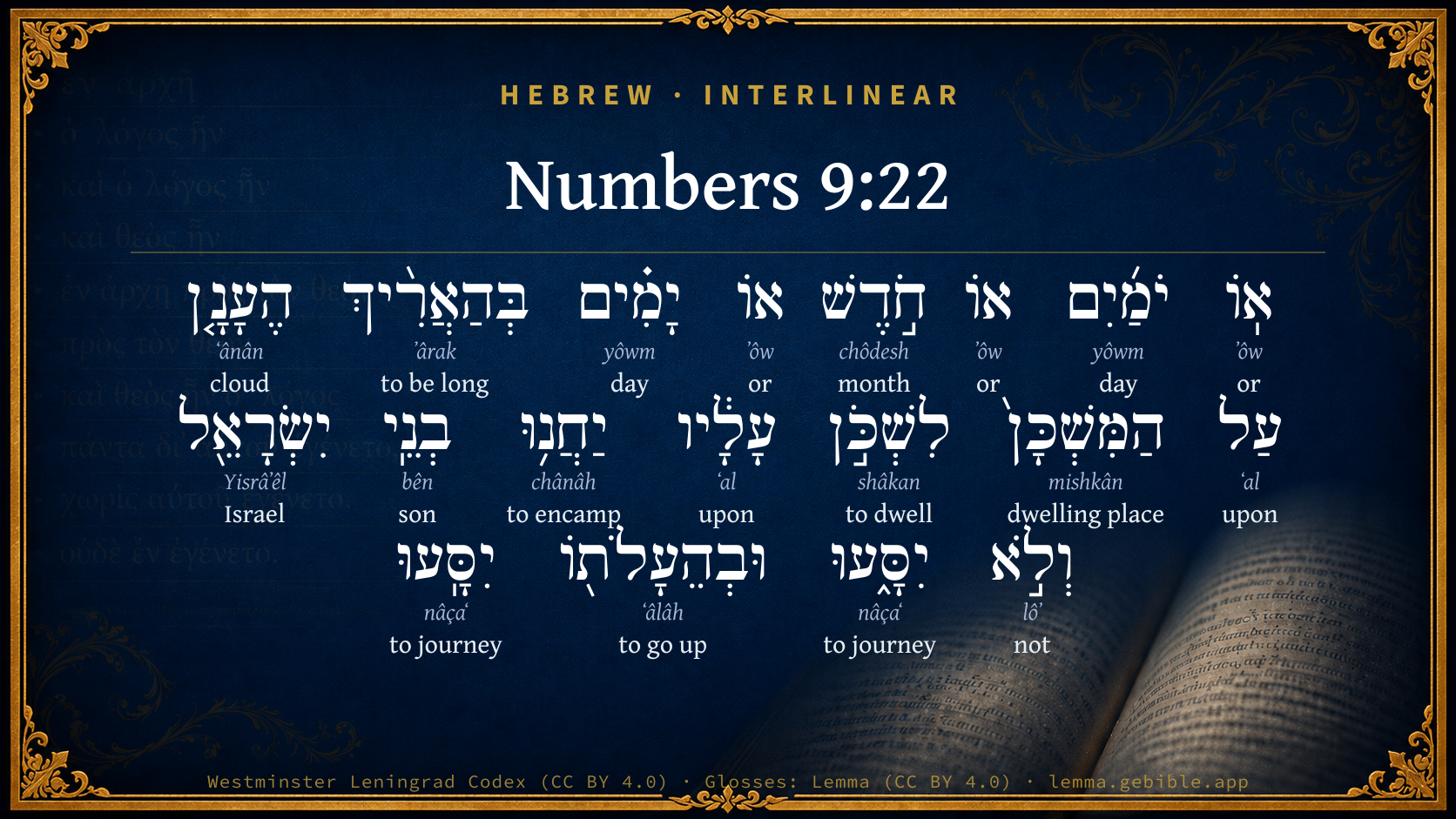
Hebrew (Westminster Leningrad Codex) Numbers 9:22 appears in the Hebrew Old Testament. The text above is from the Westminster Leningrad Codex. Each word links to its Strong’s number, a concise gloss, and parsing drawn from the Open Scriptures Hebrew Bible morphology. Click any word for its full Brown-Driver-Briggs (BDB) entry.
Download image
Cite this verse

Numbers 9:22 (World English Bible). Public Domain. Lemma interlinear Bible study tool, https://lemma.gebible.app/v/numbers/9/22.

Show BibTeX & RIS
BibTeX
RIS
English Translation
Whether it was two days, or a month, or a year that the cloud stayed on the tabernacle, remaining on it, the children of Israel remained encamped, and didn't travel; but when it was taken up, they traveled.
World English Bible · Public Domain
Download a study sheet

One document with this verse’s original text, its word-by-word gloss line, the meaning frame, cross-references with their text, attributed commentary, and full source and license credits — printable, and it pastes into notes with its structure intact.

This verse Autodidact and up

Study sheet (.html) Plain text (.txt)

A passage Seminary Student

Up to 50 verses in one chapter. A passage sheet keeps up to 6 commentary sources and 12 cross-references per verse, in the order this page ranks them, and says so on the sheet whenever that leaves anything out. Ask for a single verse and you get the Autodidact verse sheet above.

Everything on this page stays free to read, with no account — the sheet is a download of what is already on screen, not access to it.

Want to remove ads? Support Godless Engineer
Compare translations 3

The same verse in 3 English versions, stacked beneath the original-language interlinear above. Click any original word for its lexicon entry.

Each is an independent rendering of the whole verse — the interlinear is not word-aligned to these translations.

Highlighted words mark where these versions differ — a whole-verse word diff, not a word-by-word alignment.

  • World English Bible Public Domain
    Whether it was two days, or a month, or a year that the cloud stayed on the tabernacle, remaining on it, the children of Israel remained encamped, and didn't travel; but when it was taken up, they traveled.
  • King James Version Public Domain
    Or whether it were two days, or a month, or a year, that the cloud tarried upon the tabernacle, remaining thereon, the children of Israel abode in their tents, and journeyed not: but when it was taken up, they journeyed.
  • unfoldingWord Literal Text CC BY-SA 4.0
    Whether two days or a month or days, when the cloud prolongs upon the Dwelling to dwell upon it, the sons of Israel camp and do not set out. And when it is taken up, they set out.

unfoldingWord Literal Text — © unfoldingWord, licensed CC BY-SA 4.0. Word-aligned USFM3 via Door43 (git.door43.org/unfoldingWord/en_ult).

Versions to compare (up to 4)

3 of 4 selected

Show all 18 translations

Every available English version of this verse, each an independent rendering of the whole verse.

  • World English Bible Public Domain
    Whether it was two days, or a month, or a year that the cloud stayed on the tabernacle, remaining on it, the children of Israel remained encamped, and didn't travel; but when it was taken up, they traveled.
  • Berean Standard Bible Public Domain
    Whether the cloud lingered for two days, a month, or longer, the Israelites camped and did not set out as long as the cloud remained over the tabernacle; but when it was lifted, they would set out.
  • Majority Standard Bible Public Domain
    Whether the cloud lingered for two days, a month, or longer, the Israelites camped and did not set out as long as the cloud remained over the tabernacle; but when it was lifted, they would set out.
  • King James Version Public Domain
    Or whether it were two days, or a month, or a year, that the cloud tarried upon the tabernacle, remaining thereon, the children of Israel abode in their tents, and journeyed not: but when it was taken up, they journeyed.
  • American Standard Version (1901) Public Domain
    Whether it were two days, or a month, or a year, that the cloud tarried upon the tabernacle, abiding thereon, the children of Israel remained encamped, and journeyed not; but when it was taken up, they journeyed.
  • Revised Version (1885) Public Domain
    Whether it were two days, or a month, or a year, that the cloud tarried upon the tabernacle, abiding thereon, the children of Israel remained encamped, and journeyed not: but when it was taken up, they journeyed.
  • Geneva Bible (1599) Public Domain
    Or if the cloude taryed two dayes or a moneth, or a yeere vpon the Tabernacle, abiding thereon, the children of Israel abode still, and iourneyed not: but when it was taken vp, they iourneyed.
  • Douay-Rheims (1899) Public Domain
    But if it remained over the tabernacle for two days or a month or a longer time, the children of Israel remained in the same place, and marched not: but immediately as soon as it departed, they removed the camp.
  • Young's Literal Translation Public Domain
    Whether two days, or a month, or days, in the cloud prolonging itself over the tabernacle, to tabernacle over it, the sons of Israel encamp, and journey not; and in its being lifted up they journey;
  • Literal Standard Version CC BY-SA 4.0
    Whether two days, or a month, or days, in the cloud prolonging itself over the Dwelling Place, to dwell over it, the sons of Israel encamp and do not journey; and in its being lifted up they journey.
  • Unlocked Literal Bible CC BY-SA 4.0
    Whether the cloud stayed on the tabernacle for two days, a month, or a year, for as long as it stayed there, the people of Israel would stay in their camp and not travel. But whenever the cloud was taken up, they would set out on their journey.
  • unfoldingWord Literal Text CC BY-SA 4.0
    Whether two days or a month or days, when the cloud prolongs upon the Dwelling to dwell upon it, the sons of Israel camp and do not set out. And when it is taken up, they set out.
  • Darby Bible Public Domain
    or two days, or a month, or many days, when the cloud was long upon the tabernacle, dwelling upon it, the children of Israel [remained] encamped, and journeyed not; but when it was taken up, they journeyed.
  • World Messianic Bible Public Domain
    Whether it was two days, or a month, or a year that the cloud stayed on the tabernacle, remaining on it, the children of Israel remained encamped, and didn’t travel; but when it was taken up, they traveled.
  • Webster's Bible Public Domain
    Or whether it was two days, or a month, or a year, that the cloud tarried upon the tabernacle, remaining upon it, the children of Israel abode in their tents, and journeyed not: but when it was taken up, they journeyed.
  • Free Bible Version CC BY-SA 4.0
    If the cloud stayed in one place for two days, or a month, or longer, the Israelites stayed where they were and didn't leave as long as the cloud remained over the Tabernacle. However, once it rose, they would leave.
  • Bible in Basic English Public Domain
    Or if the cloud came to rest on the House for two days or a month or a year without moving, the children of Israel went on waiting there and did not go on; but whenever it was taken up they went forward on their journey.
  • JPS Tanakh (1917) Public Domain
    Whether it were two days, or a month, or a year, that the cloud tarried upon the tabernacle, abiding thereon, the children of Israel remained encamped, and journeyed not; but when it was taken up, they journeyed.

Literal Standard Version (2020), Covenant Press — licensed CC BY-SA 4.0. Text via the HelloAO Bible API (eBible.org). Unlocked Literal Bible (unfoldingWord) — licensed CC BY-SA 4.0. Text via the HelloAO Bible API (eBible.org). unfoldingWord Literal Text — © unfoldingWord, licensed CC BY-SA 4.0. Word-aligned USFM3 via Door43 (git.door43.org/unfoldingWord/en_ult). Free Bible Version, Dr. Jonathan Gallagher — licensed CC BY-SA 4.0. Text via the HelloAO Bible API (eBible.org).

Word by word

More ways to search: Search by grammar → Find every occurrence → Compare this word →

Practice this passage: Drill this verse → Learn its vocabulary →

בְּהַאֲרִ֨יךְ
ʼârak
H748
“in/at · to be long”
Preposition + Verb, Hiphil, Infinitive Construct
Part of Speech
Preposition + Verb
Stem
Hiphil
Form
Infinitive Construct
Full BDB Definition

Origin: a primitive root

TWOT: 162

to be long, prolong - (Qal) to be long - (Hiphil) - to prolong (days) - to make long (tent cords) - to grow long, continue long
  1. אֽוֹ ʼôw H176 “or” Conjunction
  2. יֹמַ֜יִם yôwm H3117 “days” Noun, Common, Masculine, Dual, Absolute
  3. אוֹ ʼôw H176 “or” Conjunction
  4. חֹ֣דֶשׁ chôdesh H2320 “month” Noun, Common, Masculine, Singular, Absolute
  5. אוֹ ʼôw H176 “or” Conjunction
  6. יָמִ֗ים yôwm H3117 “days” Noun, Common, Masculine, Plural, Absolute
  7. הֶעָנָ֤ן ʻânân H6051 “the · cloud” Particle, Definite Article + Noun, Common, Masculine, Singular, Absolute
  8. עַל ʻal H5921 “upon” Preposition
  9. הַמִּשְׁכָּן֙ mishkân H4908 “the · dwelling place” Particle, Definite Article + Noun, Common, Masculine, Singular, Absolute
  10. לִשְׁכֹּ֣ן shâkan H7931 “to dwell” Preposition + Verb, Qal, Infinitive Construct
  11. עָלָ֔יו ʻal H5921 “upon · him” Preposition + Suffix, Personal, 3rd Person, Masculine, Singular
  12. יַחֲנ֥וּ chânâh H2583 “to encamp” Verb, Qal, Imperfect, 3rd Person, Masculine, Plural
  13. בְנֵֽי bên H1121 “sons of” Noun, Common, Masculine, Plural, Construct
  14. יִשְׂרָאֵ֖ל Yisrâʼêl H3478 “Israel” Noun, Proper
  15. וְלֹ֣א lôʼ H3808 “and · not” Conjunction + Particle, Negative
  16. יִסָּ֑עוּ nâçaʻ H5265 “to journey” Verb, Qal, Imperfect, 3rd Person, Masculine, Plural
  17. וּבְהֵעָלֹת֖וֹ ʻâlâh H5927 “and · in/at · to go up · him” Conjunction + Preposition + Verb, Niphal, Infinitive Construct + Suffix, Personal, 3rd Person, Masculine, Singular
  18. יִסָּֽעוּ nâçaʻ H5265 “to journey” Verb, Qal, Imperfect, 3rd Person, Masculine, Plural

About this verse

These counts appear in no published source. They are computed here, from the morphology-tagged text and Lemma’s own curated glosses. What Lemma adds →

19
words
14
distinct lemmas
Pentateuch
section

Shared distinctive vocabulary

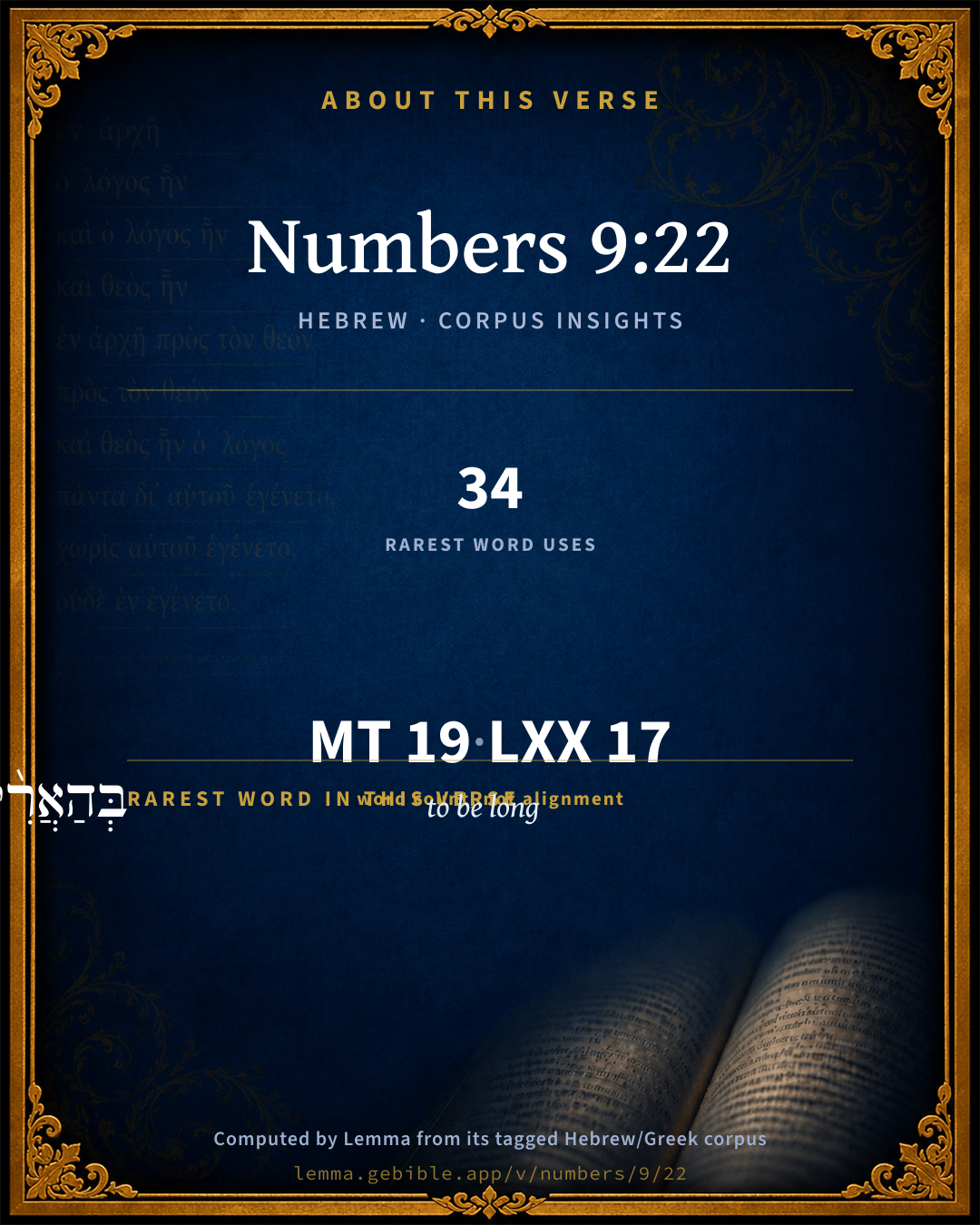
בְּהַאֲרִ֨יךְ to be long H748 occurs in 34 verses of the Hebrew Bible. Also found in:

Grammatical profile

  • 6 verbs
  • 7 nouns
  • 2 prepositions
  • 3 conjunctions
  • 1 particle

Verb forms

  • בְּהַאֲרִ֨יךְ Hiphil · Infinitive Construct
  • לִשְׁכֹּ֣ן Qal · Infinitive Construct
  • יַחֲנ֥וּ Qal · Imperfect
  • יִסָּ֑עוּ Qal · Imperfect
  • וּבְהֵעָלֹת֖וֹ Niphal · Infinitive Construct
  • יִסָּֽעוּ Qal · Imperfect

Repetition

Words recur within this verse — often emphatic in Hebrew:

  • יֹמַ֜יִם day H3117 ×2
  • עַל upon H5921 ×2
  • יִסָּ֑עוּ to journey H5265 ×2
  • אֽוֹ or H176 ×3

Hebrew & Septuagint length

In English translation the verse runs 38 words from the Hebrew and 29 from the Septuagint (LXX English) — closely comparable.

A rough comparison of the two English renderings, which tokenize alike — not a word-level alignment.

Word counts can differ between the Hebrew and the Greek without any difference in meaning — e.g. the Hebrew direct-object marker אֵת has no separate Greek word, and Greek often adds the article ὁ.

In the original languages it is 19 Hebrew tokens and 17 Greek tokens — but the two are counted differently (Hebrew bundles its prefixes and suffixes into one token; the Greek is in lemma form), so that isn’t a like-for-like length.

Cross-references

17

Topical passages linked to Numbers 9:22 in the Treasury of Scripture Knowledge — connected by theme and wording, ordered by reader-vote popularity; previews shown in the World English Bible.

  • Exodus 40:36–37 When the cloud was taken up from over the tent, the children of Israel went onward, throughout all their journeys;
  • Psalms 32:8 I will instruct you and teach you in the way which you shall go. I will counsel you with my eye on you.
  • Exodus 39:42 According to all that Yahweh commanded Moses, so the children of Israel did all the work.
  • Exodus 40:16 Thus did Moses: according to all that Yahweh commanded him, so he did.
  • Numbers 1:54 Thus the children of Israel did. According to all that Yahweh commanded Moses, so they did.
  • Numbers 8:20 Thus did Moses, and Aaron, and all the congregation of the children of Israel, to the Levites. According to all that Yahweh commanded Moses concerning the Levites, so the children of Israel did to them.
  • Numbers 9:17 Whenever the cloud was taken up from over the Tent, then after that the children of Israel traveled; and in the place where the cloud remained, there the children of Israel encamped.
  • Numbers 23:21–22 He has not saw iniquity in Jacob; Neither has he seen perverseness in Israel: Yahweh his God is with him, The shout of a king is among them.
  • Deuteronomy 1:6–7 Yahweh our God spoke to us in Horeb, saying, You have lived long enough in this mountain:
  • Deuteronomy 2:3–4 You have compassed this mountain long enough: turn you northward.
  • Psalms 48:14 For this God is our God forever and ever. He will be our guide even to death.
  • Psalms 73:24 You will guide me with your counsel, And afterward receive me to glory.
  • Psalms 77:20 You led your people like a flock, By the hand of Moses and Aaron.
  • Psalms 107:7 He led them also by a straight way, That they might go to a city to live in.
  • Psalms 143:10 Teach me to do your will, For you are my God. Your Spirit is good. Lead me in the land of uprightness.
  • Proverbs 3:5–6 Trust in Yahweh with all your heart, And don't lean on your own understanding.
  • Acts 1:4 Being assembled together with them, he charged them, "Don't depart from Jerusalem, but wait for the promise of the Father, which you heard from me.

Cross-references courtesy of OpenBible.info (CC BY 4.0).

Hebrew and Greek witnesses Masoretic Hebrew ↔ Greek Septuagint

The same verse in the two great witnesses to the Old Testament, shown verse-for-verse.

These are two independent witnesses, not word-aligned to each other, and the Septuagint is shown in lemma (dictionary) form.

Hebrew Numbers 9:22 Masoretic · Westminster Leningrad Codex

אֽוֹ יֹמַ֜יִם אוֹ חֹ֣דֶשׁ אוֹ יָמִ֗ים בְּהַאֲרִ֨יךְ הֶעָנָ֤ן עַל הַמִּשְׁכָּן֙ לִשְׁכֹּ֣ן עָלָ֔יו יַחֲנ֥וּ בְנֵֽי יִשְׂרָאֵ֖ל וְלֹ֣א יִסָּ֑עוּ וּבְהֵעָלֹת֖וֹ יִסָּֽעוּ

Whether it was two days, or a month, or a year that the cloud stayed on the tabernacle, remaining on it, the children of Israel remained encamped, and didn't travel; but when it was taken up, they traveled.

World English Bible · Public Domain

Greek LXX Numbers 9:22 Septuagint · lemma form

μήν ἡμέρα πλεονάζω ὁ νεφέλη σκιάζω ἐπί αὐτός παρα ἐνβάλλω ὁ υἱός ἰσραήλ καί οὐ μή ἀποαἴρω

For they shall depart by the command of the Lord: - they kept the charge of the Lord by the command of the Lord by the hand of Moses.

LXX2012 (modern English Septuagint) · Public Domain

Hebrew: Westminster Leningrad Codex (CC BY 4.0). Greek: Septuagint (public domain); English from LXX2012 (modern English Septuagint) (Public Domain). How the Septuagint differs from the Hebrew →

Targum (Aramaic paraphrase)

2

The Targum is the ancient Jewish Aramaic paraphrase of the Hebrew Scriptures — an interpretive translation, not the Hebrew text itself. Onkelos (literal) and Pseudo-Jonathan (expansive) render the Torah, and Jonathan the Prophets. Coverage is partial: where no permissively-licensed English translation exists for a verse, only the Aramaic is shown. This is verse-level text, not a word-by-word alignment to the Hebrew.

  1. Targum Onkelos Torah (Genesis–Deuteronomy)
    אוֹ תְרֵין יוֹמִין אוֹ יַרְחָא אוֹ עִדָן בְּעִדָן בְּאוֹרָכוּת עֲנָנָא עַל מַשְׁכְּנָא לְמִשְׁרֵי עֲלוֹהִי שָׁרָן בְּנֵי יִשְׂרָאֵל וְלָא נָטְלִין וּבְאִסְתַּלָקוּתֵהּ נָטְלִין

    (no public-domain English translation for this verse)

    Targum Onkelos — Aramaic: “Onkelos Genesis” (public domain); “Onkelos Exodus” (public domain); “Onkelos Leviticus” (public domain); “Onkelos Numbers” (public domain); “Onkelos Deuteronomy” (public domain). English: “Sefaria Community Translation” (CC0 1.0 (public-domain dedication)); “J.W. Etheridge. The Targums of Onkelos and Jonathan Ben Uzziel on the Pentateuch. London: Longmans, Green, 1862” (public domain). Text via Sefaria.

  2. Targum Pseudo-Jonathan Torah (Genesis–Deuteronomy)
    אוֹ תְּרֵין יוֹמִין אוֹ יַרְחָא אוֹ שַׁתָּא שְׁלֵימְתָּא בְּאוֹרְכוּת עֲנַן יְקָרָא עַל מַשְׁכְּנָא לְמֵישְׁרֵי עֲלוֹי שָׁרָן בְּנֵי יִשְרָאֵל וְלָא נַטְלִין וּבִזְמַן אִסְתַּלָקוּתֵיהּ נַטְלִין

    whether it was two days, or a month, or a year complete, while the Cloud of Glory made stay over the Tabernacle, abiding on it, the children of Israel abode, and journeyed not, and at the time of its uplifting they went forward.

    Targum Pseudo-Jonathan — Aramaic: “Targum Jonathan on Genesis” (public domain); “Targum Jonathan on Exodus” (public domain); “Targum Jonathan on Leviticus” (public domain); “Targum Jonathan on Numbers” (public domain); “Targum Jonathan on Deuteronomy” (public domain). English: “The Targum of Jonathan ben Uzziel, trans. J. W. Etheridge, London, 1862” (public domain). Text via Sefaria.

Commentary

Notes on Numbers 9:22 from classic Christian and Jewish commentators (each source and its license shown beneath its notes). The classic Christian expositions comment on the surrounding passage and are grouped to its opening verse, so a note may address several verses; the Jewish commentaries on the Tanakh (Rashi and others) are per-verse, so they appear only where the commentator wrote on this verse.

Lemma curates 59 commentaries, every one of them public domain or Creative Commons licensed, each selected and text-cleaned for this edition rather than reprinted as found. About our sources →

Trapp's Complete Commentary

John Trapp

Num 9:22 Or [whether it were] two days, or a month, or a year, that the cloud tarried upon the tabernacle, remaining thereon, the children of Israel abode in their tents, and journeyed not: but when it was taken up, they journeyed.

Ver. 22. When it was taken up they journeyed.] In that wilderness of Arabia there were no beaten paths, no footsteps of passengers appeared; wherefore travellers there used to steer their course, as mariners at sea do, by a mathematical chart. But these Israelites went by a better direction. So do all saints. {Heb 11:16}

John Trapp, A Commentary or Exposition upon All the Books of the Old and New Testament (1647–1656) — public domain. Text from a community e-Sword module.

Adam Clarke's Commentary

Verse 22. Two days - a month - a year] It was by the Divine counsel alone that they were directed in all their peregrinations: and from the above words we see that their times of tarrying at different stations were very unequal.

Adam Clarke's Commentary on the Bible (1810–1826) — public domain. Text from a community e-Sword/MySword module.

Ellicott's Commentary for English Readers

(22) Or a year.—Literally, days (comp. Gen_4:3; Gen_40:4, and Notes). If the rendering of the Authorised Version, “a year,” is correct, as it probably is, it will follow that these words could not have been written until after the first arrival at Kadesh (Num_13:26), and probably not until after the end of the wanderings in the wilderness. The elaborate manner in which the statement is made and repeated in almost identical terms shows the great importance which the writer ascribed to the Divine guardianship which was exercised over the Israelites, and to their submission to the miraculous guidance which was given to them.

A Bible Commentary for English Readers, edited by Charles John Ellicott (1878–1897) — public domain. Text from a community e-Sword module.

The Cambridge Bible for Schools and Colleges

gen. ed. J. J. S. Perowne

22. a year] Heb. ‘days.’ This sometimes means ‘a year’ (e.g. 1Sa_27:7); but here it perhaps denotes only an indefinite period longer than a month.

The Cambridge Bible for Schools and Colleges (gen. ed. J. J. S. Perowne; Cambridge University Press, 1878–1918) — public domain. Text from a community e-Sword module.

John Gill's Exposition

At the commandment of the Lord they rested in their tents,.... Though ever so disagreeable:

and at the commandment of the Lord they journeyed; though the circumstances might be such, that they could have liked a continuance; but whether agreeable or disagreeable, they were obedient to the divine will: this, or what is equivalent to it, is frequently observed in this paragraph, to show that the Israelites, though they were an obstinate and perverse people, and must in general be desirous of getting as soon as they could into the land of promise, yet in this case, in all their stations and journeys, were submissive and obedient to the divine will, as all good men should be with respect to happiness; and happy are they who have God to be their guide through it, even unto death:

they kept the charge of the Lord, at the commandment of the Lord by the hand of Moses; observed the rest or motion of the cloud, the order and command of God signified thereby, as it was made known unto them by the ministry and means of Moses.

Next: Numbers Chapter 10

John Gill's Exposition of the Whole Bible (1746–1763) — public domain (CC PDM 1.0). Text via the HelloAO Bible API.

Albert Barnes' Notes on the Bible

A year - literally, “days,” idiomatically a year Lev 25:29, an expression equivalent to “a full period,” though not necessarily the period of a year.

Albert Barnes' Notes on the Bible (1834–1885) — public domain. Text from a community e-Sword/MySword module.

Whedon's Commentary on the Bible

Daniel D. Whedon

22. Two days, or a month, or a year — The periods varied from a single night to eighteen years, the longest halt. The irregularities in the intervals of motion and rest kept the people always watchful for the signal and always in a state of readiness to obey. Thus they were in a school wherein were taught the important lessons of constant vigilance, implicit faith, unquestioning obedience, and perfect patience.

Daniel D. Whedon (gen. ed.), Commentary on the Old and New Testaments (1874–1909) — public domain. Text from a community e-Sword module.

The Pulpit Commentary

Or a year. Rather, "days" (yamin): an undefined period, (Gen_4:3 Gen_40:4) often equivalent to a year. (Lev_25:29) It is not known whether or on what occasion the Israelites actually remained in camp for a year. But it is evident that this passage must have been written after the wanderings were over, because it is a kind of retrospect of the whole period as regards one important feature of it. It may of course have been added here by the hand of Moses on the eve of entry upon the promised land: or it may have been added by a later hand, perhaps that of Ezra when he revised these books (see the Introduction).

HOMILIES BY E.S. PROUT Ver. 23. God"s ceaseless providence a motive to prompt obedience.

God"s presence with Israel was perpetual. (Exo_3:12 Exo_13:17-18) The sign of it in the cloud was given as soon, and was continued as long, as it was needed. (Exo_13:21, 22 40:38) God"s active, providential presence was

I A SOURCE OF SAFETY;

II A GROUND OF FAITH; and therefore,

III A MOTIVE TO OBEDIENCE.

I The cloud

(1) led them the safest way. (Exo_13:17)

(2) Ensured protection from foes when near at hand. (Exo_14:19, Exo_14:20, Exo_14:24)

(3) Gave light on the camp in moonless nights. (Neh_9:19)

(4) Was a pledge of safety to sinners, as it rested on the mercy-seat. (Lev_16:2) This visible cloud a symbol of protection by an invisible God. (Isa_4:5) Illustrations, bird and young. (Rth_2:12 Psa_17:8 Psa_91:4) Father carrying his child by day, (Deu_1:31) and watching by him at night (Psalm 121). There is safety for sinners not away from God but in God. (Psa_143:2, Psa_143:9)

II God showed himself in the cloud for the very purpose of guiding. He took the responsibility out of the hands of the people and Moses that they might have the privilege of trusting. (Exo_33:9-17 Deu_1:33) Such a guiding presence we may enjoy by the aid of God"s written counsels, providential acts, and inward monitions. (Psa_25:4, Psa_25:5, Psa_25:9, Psa_25:14) See how these three are combined in the narrative. (Act_8:26-35)

III Verse 23 is very emphatic. They obeyed even if at times the journey was very arduous, (Num_21:4) or the halt very tedious (verse 22), or the start was sudden, as when a midnight alarm of the trumpets was a sign that the cloud had begun to move (verse 21). Hence we learn

(1) not to take for granted that any place is our rest. (Job_29:18 Mic_2:10)

(2) To be willing to go to the wilderness with God, rather than to stay in the choicest paradise without God.

(3) To be willing to endure, at God"s bidding, protracted toil or enforced inactivity.

(4) To be ready at any time to strike our tent and go home. Thus waiting on God and waiting for God, we arc safely led, and have the rest of trustful obedience. P. (Psa_5:11, 12 48:14 84:11, 12)

The Pulpit Commentary (1880–1919), ed. H.D.M. Spence-Jones & Joseph S. Exell — public domain. Text from a community e-Sword module.

unfoldingWord translationNotes

Door43 World Missions Community

the cloud was taken up

This can be stated in active form. AT: "the cloud rose up" or "Yahweh took up the cloud" (See: Active or Passive)

at Yahweh's command

The word "command" can be expressed as a verb. AT: "what Yahweh commanded" (See: Abstract Nouns)

Yahweh's command given through Moses

This can be stated in active form. AT: "the command that Yahweh had given through Moses" (See: Active or Passive)

translationWords

tabernacle

people group

Israel

Moses

unfoldingWord translationNotes — © Distant Shores Media and the Door43 World Missions Community, licensed CC BY-SA 4.0. Source: git.door43.org/Door43/en_tn.

Rashi

Rabbi Shlomo Yitzchaki (Rashi)

או ימים means, [OR] A FULL YEAR, just as, (Leviticus 25:29) “A full year (ימים) shall he have the right of redemption”.

Rashi on the Tanakh — English translations: “The Judaica Press complete Tanach with Rashi, translated by A. J. Rosenberg” (CC BY 4.0); “Pentateuch with Rashi's commentary by M. Rosenbaum and A.M. Silbermann, 1929-1934” (public domain); “The Metsudah Tanach series, Lakewood, N.J” (CC BY 4.0); and “The Book of Joshua, Metsudah Publications, 1997” (CC BY 4.0). Text via Sefaria.

Lesson kit

Teaching starters — assembled from the data on this page, not authored interpretation. Every prompt links to the verse data it draws on. Edit before teaching.

Numbers, in the Pentateuch, opens this verse with 19 words (14 distinct Hebrew lemmas). Its most distinctive word is ʼârak (“to be long”). A historical commentator’s framing appears above. Read the whole chapter for the surrounding context.

Discussion questions

  1. How does “to be long” (ʼârak) shape what this verse is saying?
  2. How does Genesis 26:8, which shares the word «to be long», read alongside this verse?
  3. What does the repetition of “day” (2× in this one verse) do in this verse?
  4. The translations on this page render this verse differently — a whole-verse word diff, not a word-by-word alignment. What might account for the different wordings?
  5. «בְּהַאֲרִ֨יךְ» is a Hiphil Infinitive Construct verb. How does that grammatical form shape the action described?
  6. Compare how Trapp's Complete Commentary and Adam Clarke's Commentary read this verse. Where do they agree or differ?

Things to notice

Reading settings

Reading text

Shown beneath each verse's original-language words.

Old Testament
Old Testament edition

Read the OT as the Masoretic Hebrew (MT) or the Greek Septuagint (LXX).

English shown for the Greek Septuagint (in the Hebrew ↔ Greek comparison).

Comparing translations? Open the Compare panel on any verse page to stack up to four side by side.