
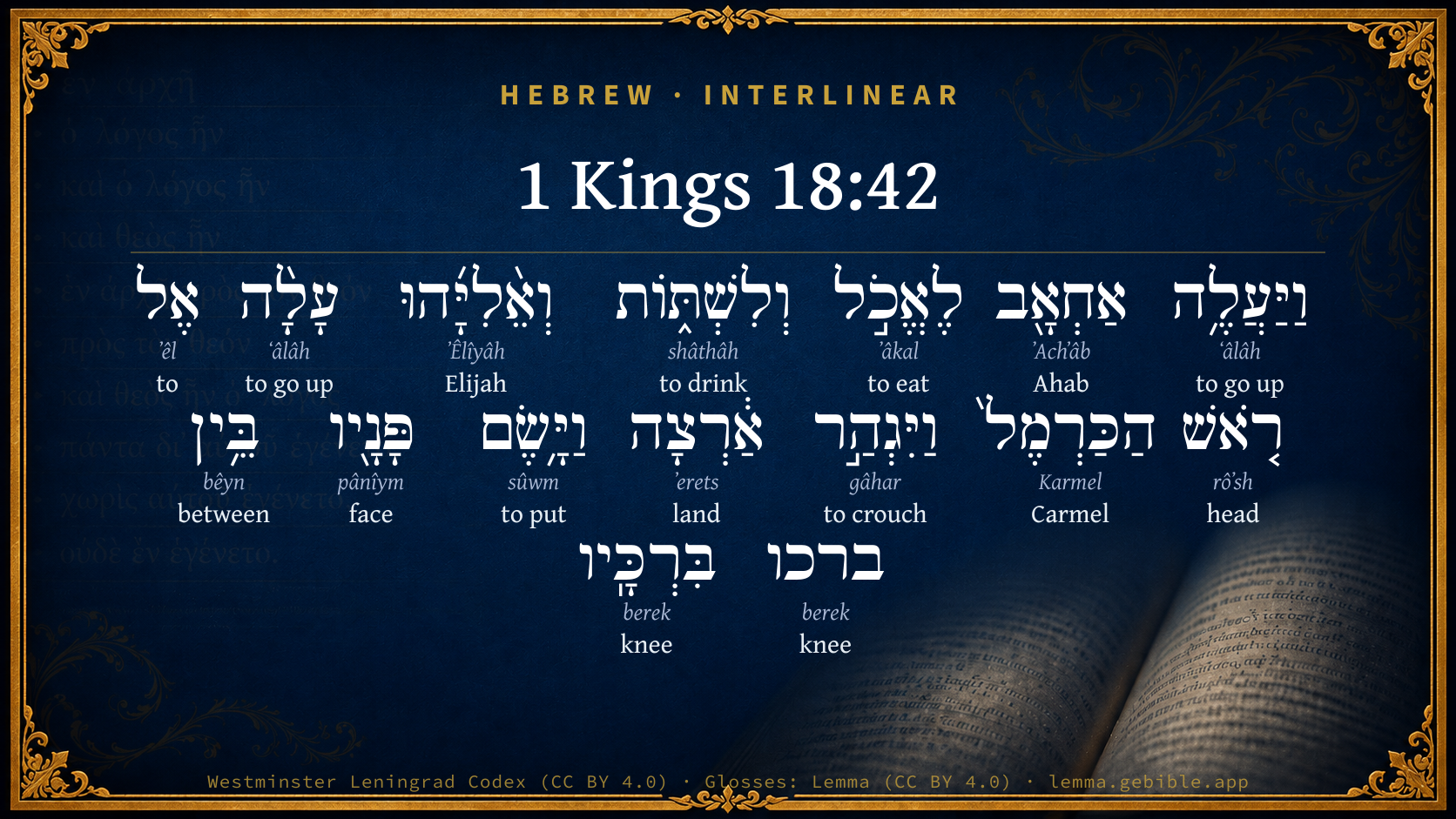
1 Kings 18:42

Hebrew (Westminster Leningrad Codex) 1 Kings 18:42 appears in the Hebrew Old Testament. The text above is from the Westminster Leningrad Codex. Each word links to its Strong’s number, a concise gloss, and parsing drawn from the Open Scriptures Hebrew Bible morphology. Click any word for its full Brown-Driver-Briggs (BDB) entry.
Download image
Cite this verse

1 Kings 18:42 (World English Bible). Public Domain. Lemma interlinear Bible study tool, https://lemma.gebible.app/v/1-kings/18/42.

Show BibTeX & RIS
BibTeX
RIS
English Translation
So Ahab went up to eat and to drink. Elijah went up to the top of Carmel; and he bowed himself down on the earth, and put his face between his knees.
World English Bible · Public Domain
Highlights
  • 1 first appearance in the Hebrew Bible
Full analysis ↓
Download a study sheet

One document with this verse’s original text, its word-by-word gloss line, the meaning frame, cross-references with their text, attributed commentary, and full source and license credits — printable, and it pastes into notes with its structure intact.

This verse Autodidact and up

Study sheet (.html) Plain text (.txt)

A passage Seminary Student

Up to 50 verses in one chapter. A passage sheet keeps up to 6 commentary sources and 12 cross-references per verse, in the order this page ranks them, and says so on the sheet whenever that leaves anything out. Ask for a single verse and you get the Autodidact verse sheet above.

Everything on this page stays free to read, with no account — the sheet is a download of what is already on screen, not access to it.

Want to remove ads? Support Godless Engineer
Compare translations 3

The same verse in 3 English versions, stacked beneath the original-language interlinear above. Click any original word for its lexicon entry.

Each is an independent rendering of the whole verse — the interlinear is not word-aligned to these translations.

Highlighted words mark where these versions differ — a whole-verse word diff, not a word-by-word alignment.

  • World English Bible Public Domain
    So Ahab went up to eat and to drink. Elijah went up to the top of Carmel; and he bowed himself down on the earth, and put his face between his knees.
  • King James Version Public Domain
    So Ahab went up to eat and to drink. And Elijah went up to the top of Carmel; and he cast himself down upon the earth, and put his face between his knees,
  • unfoldingWord Literal Text CC BY-SA 4.0
    So Ahab went up to eat and to drink. And Elijah went up to the head of Carmel, and he bowed down to the ground, and he put his face between his knees.

unfoldingWord Literal Text — © unfoldingWord, licensed CC BY-SA 4.0. Word-aligned USFM3 via Door43 (git.door43.org/unfoldingWord/en_ult).

Versions to compare (up to 4)

3 of 4 selected

Show all 18 translations

Every available English version of this verse, each an independent rendering of the whole verse.

  • World English Bible Public Domain
    So Ahab went up to eat and to drink. Elijah went up to the top of Carmel; and he bowed himself down on the earth, and put his face between his knees.
  • Berean Standard Bible Public Domain
    So Ahab went up to eat and drink. But Elijah climbed to the summit of Carmel, bent down on the ground, and put his face between his knees.
  • Majority Standard Bible Public Domain
    So Ahab went up to eat and drink. But Elijah climbed to the summit of Carmel, bent down on the ground, and put his face between his knees.
  • King James Version Public Domain
    So Ahab went up to eat and to drink. And Elijah went up to the top of Carmel; and he cast himself down upon the earth, and put his face between his knees,
  • American Standard Version (1901) Public Domain
    So Ahab went up to eat and to drink. And Elijah went up to the top of Carmel; and he bowed himself down upon the earth, and put his face between his knees.
  • Revised Version (1885) Public Domain
    So Ahab went up to eat and to drink. And Elijah went up to the top of Carmel; and he bowed himself down upon the earth, and put his face between his knees.
  • Geneva Bible (1599) Public Domain
    So Ahab went vp to eate and to drinke, and Eliiah went vp to the top of Carmel: and he crouched vnto the earth, and put his face betweene his knees,
  • Douay-Rheims (1899) Public Domain
    Achab went up to eat and drink: and Elias went up to the top of Carmel, and casting himself down upon the earth put his face between his knees,
  • Young's Literal Translation Public Domain
    And Ahab goeth up to eat, and to drink, and Elijah hath gone up unto the top of Carmel, and he stretcheth himself out on the earth, and he placeth his face between his knees,
  • Literal Standard Version CC BY-SA 4.0
    And Ahab goes up to eat, and to drink, and Elijah has gone up to the top of Carmel, and he stretches himself out on the earth, and he places his face between his knees,
  • Unlocked Literal Bible CC BY-SA 4.0
    So Ahab went up to eat and to drink. Then Elijah went up to the top of Carmel, bowed himself down on the earth and put his face between his knees.
  • unfoldingWord Literal Text CC BY-SA 4.0
    So Ahab went up to eat and to drink. And Elijah went up to the head of Carmel, and he bowed down to the ground, and he put his face between his knees.
  • Darby Bible Public Domain
    And Ahab went up to eat and to drink. And Elijah went up to the top of Carmel; and he bowed down on the earth, and put his face between his knees.
  • World Messianic Bible Public Domain
    So Ahab went up to eat and to drink. Elijah went up to the top of Carmel; and he bowed himself down on the earth, and put his face between his knees.
  • Webster's Bible Public Domain
    So Ahab went up to eat and to drink. And Elijah went up to the top of Carmel; and he cast himself down upon the earth, and put his face between his knees,
  • Free Bible Version CC BY-SA 4.0
    So Ahab went to eat and drink, but Elijah went to the top of Carmel. There he bent down to the ground, putting his face between his knees.
  • Bible in Basic English Public Domain
    So Ahab went up to have food and drink, while Elijah went up to the top of Carmel; and he went down on the earth, putting his face between his knees.
  • JPS Tanakh (1917) Public Domain
    So Ahab went up to eat and to drink. And Elijah went up to the top of Carmel; and he bowed himself down upon the earth, and put his face between his knees.

Literal Standard Version (2020), Covenant Press — licensed CC BY-SA 4.0. Text via the HelloAO Bible API (eBible.org). Unlocked Literal Bible (unfoldingWord) — licensed CC BY-SA 4.0. Text via the HelloAO Bible API (eBible.org). unfoldingWord Literal Text — © unfoldingWord, licensed CC BY-SA 4.0. Word-aligned USFM3 via Door43 (git.door43.org/unfoldingWord/en_ult). Free Bible Version, Dr. Jonathan Gallagher — licensed CC BY-SA 4.0. Text via the HelloAO Bible API (eBible.org).

Word by word

More ways to search: Search by grammar → Find every occurrence → Compare this word →

Practice this passage: Drill this verse → Learn its vocabulary →

וַיִּגְהַ֣ר
gâhar
H1457
“and · to crouch”
Conjunction + Verb, Qal, Sequential Imperfect, 3rd Person, Masculine, Singular
Part of Speech
Conjunction + Verb
Stem
Qal
Form
Sequential Imperfect
Person
3rd Person
Gender
Masculine
Number
Singular
Full BDB Definition

Origin: a primitive root

TWOT: 322

(Qal) to bend, crouch
  1. וַיַּעֲלֶ֥ה ʻâlâh H5927 “and · to go up” Conjunction + Verb, Qal, Sequential Imperfect, 3rd Person, Masculine, Singular
  2. אַחְאָ֖ב ʼAchʼâb H256 “Ahab” Noun, Proper
  3. לֶאֱכֹ֣ל ʼâkal H398 “to eat” Preposition + Verb, Qal, Infinitive Construct
  4. וְלִשְׁתּ֑וֹת shâthâh H8354 “and · to drink” Conjunction + Preposition + Verb, Qal, Infinitive Construct
  5. וְאֵ֨לִיָּ֜הוּ ʼÊlîyâh H452 “and · Elijah” Conjunction + Noun, Proper
  6. עָלָ֨ה ʻâlâh H5927 “to go up” Verb, Qal, Perfect, 3rd Person, Masculine, Singular
  7. אֶל ʼêl H413 “to” Preposition
  8. רֹ֤אשׁ rôʼsh H7218 “head of” Noun, Common, Masculine, Singular, Construct
  9. הַכַּרְמֶל֙ Karmel H3760 “the · Carmel” Particle, Definite Article + Noun, Proper
  10. אַ֔רְצָה ʼerets H776 “land · toward” Noun, Common, Both, Singular, Absolute + Suffix, Demonstrative
  11. וַיָּ֥שֶׂם sûwm H7760 “and · to put” Conjunction + Verb, Qal, Sequential Imperfect, 3rd Person, Masculine, Singular
  12. פָּנָ֖יו pânîym H6440 “face(s) · his” Noun, Common, Both, Plural, Construct + Suffix, Personal, 3rd Person, Masculine, Singular
  13. בֵּ֥ין bêyn H996 “between” Preposition
  14. ברכו berek H1290 “knees · his” Noun, Common, Feminine, Dual, Construct + Suffix, Personal, 3rd Person, Masculine, Singular
  15. בִּרְכָּֽיו berek H1290 “knees · his” Noun, Common, Feminine, Dual, Construct + Suffix, Personal, 3rd Person, Masculine, Singular

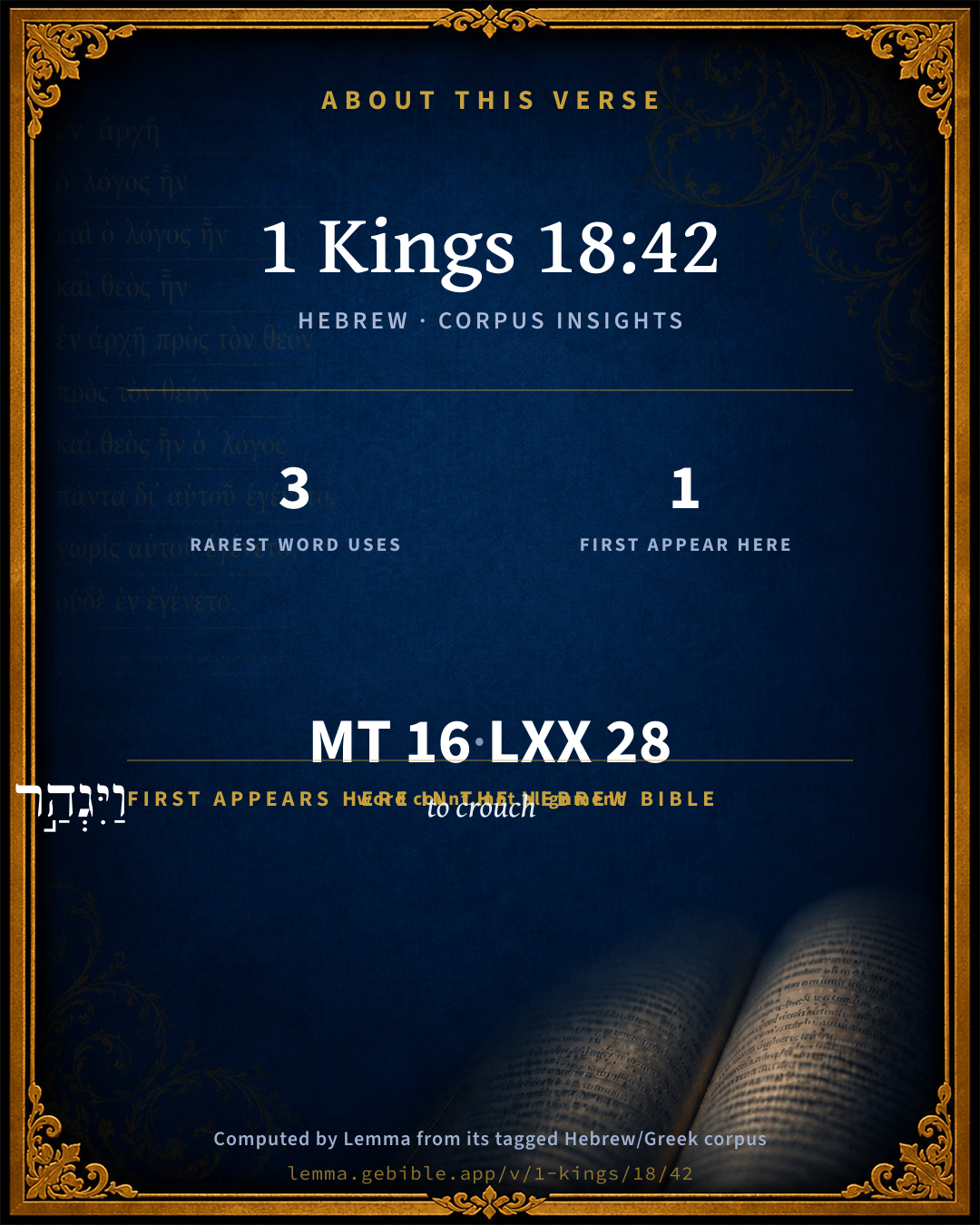
About this verse

These counts appear in no published source. They are computed here, from the morphology-tagged text and Lemma’s own curated glosses. What Lemma adds →

16
words
14
distinct lemmas
Historical
section

Notable vocabulary

The rarest word here is וַיִּגְהַ֣ר to crouch H1457 — appearing just 3 times in the whole Hebrew Bible.

First appearance in Scripture

This word makes its first canonical appearance in the Hebrew Bible here:

  • וַיִּגְהַ֣ר to crouch H1457

Shared distinctive vocabulary

וַיִּגְהַ֣ר to crouch H1457 occurs in 3 verses of the Hebrew Bible. Also found in:

Grammatical profile

  • 6 verbs
  • 8 nouns
  • 2 prepositions

Verb forms

  • וַיַּעֲלֶ֥ה Qal · Sequential Imperfect
  • לֶאֱכֹ֣ל Qal · Infinitive Construct
  • וְלִשְׁתּ֑וֹת Qal · Infinitive Construct
  • עָלָ֨ה Qal · Perfect
  • וַיִּגְהַ֣ר Qal · Sequential Imperfect
  • וַיָּ֥שֶׂם Qal · Sequential Imperfect

Repetition

Words recur within this verse — often emphatic in Hebrew:

  • וַיַּעֲלֶ֥ה to go up H5927 ×2
  • ברכו knee H1290 ×2

Hebrew & Septuagint length

In English translation the verse runs 32 words from the Hebrew and 27 from the Septuagint (LXX English) — closely comparable.

A rough comparison of the two English renderings, which tokenize alike — not a word-level alignment.

Word counts can differ between the Hebrew and the Greek without any difference in meaning — e.g. the Hebrew direct-object marker אֵת has no separate Greek word, and Greek often adds the article ὁ.

In the original languages it is 16 Hebrew tokens and 28 Greek tokens — but the two are counted differently (Hebrew bundles its prefixes and suffixes into one token; the Greek is in lemma form), so that isn’t a like-for-like length.

Cross-references

16

Topical passages linked to 1 Kings 18:42 in the Treasury of Scripture Knowledge — connected by theme and wording, ordered by reader-vote popularity; previews shown in the World English Bible.

  • Luke 6:12 It happened in these days, that he went out to the mountain to pray, and he continued all night in prayer to God.
  • Genesis 24:52 It happened that when Abraham's servant heard their words, he bowed himself down to the earth to Yahweh.
  • Joshua 7:6 Joshua tore his clothes, and fell to the earth on his face before the ark of Yahweh until the evening, he and the elders of Israel; and they put dust on their heads.
  • 2 Samuel 12:16 David therefore begged God for the child; and David fasted, and went in, and lay all night on the earth.
  • 1 Kings 18:19–20 Now therefore send, and gather to me all Israel to Mount Carmel, and the prophets of Baal four hundred fifty, and the prophets of the Asherah four hundred, who eat at Jezebel's table.
  • 1 Kings 19:13 It was so, when Elijah heard it, that he wrapped his face in his mantle, and went out, and stood in the entrance of the cave. Behold, there came a voice to him, and said, What are you doing here, Elijah?
  • Ezra 9:6 and I said, my God, I am ashamed and blush to lift up my face to you, my God; for our iniquities are increased over our head, and our guiltiness is grown up to the heavens.
  • Psalms 89:7 A very awesome God in the council of the holy ones, To be feared above all those who are around him?
  • Isaiah 38:2 Then Hezekiah turned his face to the wall, and prayed to Yahweh,
  • Daniel 9:3 I set my face to the Lord God, to seek by prayer and petitions, with fasting and sackcloth and ashes.
  • Daniel 9:7 Lord, righteousness belongs to you, but to us confusion of face, as at this day; to the men of Judah, and to the inhabitants of Jerusalem, and to all Israel, who are near, and who are far off, through all the countries where you have driven them, because of their trespass that they have trespassed against you.
  • Matthew 14:23 After he had sent the multitudes away, he went up into the mountain by himself to pray. When evening had come, he was there alone.
  • Mark 14:35 He went forward a little, and fell on the ground, and prayed that, if it were possible, the hour might pass away from him.
  • Acts 10:9 Now on the next day as they were on their journey, and got close to the city, Peter went up on the housetop to pray at about noon.
  • Isaiah 6:2 Above him stood the seraphim. Each one had six wings. With two he covered his face. With two he covered his feet. With two he flew.
  • James 5:16–18 Confess your offenses to one another, and pray one for another, that you may be healed. The effective, earnest prayer of a righteous man is powerfully effective.

Cross-references courtesy of OpenBible.info (CC BY 4.0).

Hebrew and Greek witnesses Masoretic Hebrew ↔ Greek Septuagint

The same verse in the two great witnesses to the Old Testament, shown verse-for-verse.

These are two independent witnesses, not word-aligned to each other, and the Septuagint is shown in lemma (dictionary) form.

Hebrew 1 Kings 18:42 Masoretic · Westminster Leningrad Codex

וַיַּעֲלֶ֥ה אַחְאָ֖ב לֶאֱכֹ֣ל וְלִשְׁתּ֑וֹת וְאֵ֨לִיָּ֜הוּ עָלָ֨ה אֶל רֹ֤אשׁ הַכַּרְמֶל֙ וַיִּגְהַ֣ר אַ֔רְצָה וַיָּ֥שֶׂם פָּנָ֖יו בֵּ֥ין ברכו בִּרְכָּֽיו

So Ahab went up to eat and to drink. Elijah went up to the top of Carmel; and he bowed himself down on the earth, and put his face between his knees.

World English Bible · Public Domain

Greek LXX 1 Kings 18:42 Septuagint · lemma form

καί ἀναβαίνω αχααβ ὁ ἐσθίω καί πίνω καί ηλιου ἀναβαίνω ἐπί ὁ κάρμηλον καί κύπτω ἐπί ὁ γῆ καί τίθημι ὁ πρόσωπον ἑαυτοῦ ἀνά μέσος ὁ γόνυ ἑαυτοῦ

And Achaab went up to eat and to drink; and Eliu went up to Carmel, and stooped to the ground, and put his face between his knees,

LXX2012 (modern English Septuagint) · Public Domain

Hebrew: Westminster Leningrad Codex (CC BY 4.0). Greek: Septuagint (public domain); English from LXX2012 (modern English Septuagint) (Public Domain). How the Septuagint differs from the Hebrew →

Targum (Aramaic paraphrase)

1

The Targum is the ancient Jewish Aramaic paraphrase of the Hebrew Scriptures — an interpretive translation, not the Hebrew text itself. Onkelos (literal) and Pseudo-Jonathan (expansive) render the Torah, and Jonathan the Prophets. Coverage is partial: where no permissively-licensed English translation exists for a verse, only the Aramaic is shown. This is verse-level text, not a word-by-word alignment to the Hebrew.

  1. Targum Jonathan Prophets (Joshua–Malachi)
    וּסְלֵיק אַחְאָב לְמֵיכַל וּלְמִשְׁתֵּי וְאֵלִיָהוּ סְלִיק לְרֵישׁ טוּרָא דְכַרְמֶלָא וּנְחִין לְאַרְעָא וְשַׁוֵי אַפּוֹהִי בֵּין בִּרְכוֹהִי:

    (no public-domain English translation for this verse)

    Targum Jonathan — Aramaic: “Mikraot Gedolot” (public domain). English: “Sefaria Community Translation” (CC0 1.0 (public-domain dedication)); “London "Chaldee Paraphrase," 1871” (public domain). Text via Sefaria.

Commentary

Notes on 1 Kings 18:42 from classic Christian and Jewish commentators (each source and its license shown beneath its notes). The classic Christian expositions comment on the surrounding passage and are grouped to its opening verse, so a note may address several verses; the Jewish commentaries on the Tanakh (Rashi and others) are per-verse, so they appear only where the commentator wrote on this verse.

Lemma curates 59 commentaries, every one of them public domain or Creative Commons licensed, each selected and text-cleaned for this edition rather than reprinted as found. About our sources →

Trapp's Complete Commentary

John Trapp

1Ki 18:42 So Ahab went up to eat and to drink. And Elijah went up to the top of Carmel; and he cast himself down upon the earth, and put his face between his knees,

Ver. 42. And Elijah went up to the top of Carmel.] There, as in his ordinary oratory, to pray out the promise of rain, to put it in suit, and this he did lustily, {Jas 5:17} straining, as it were, every vein in his heart: for,

He cast himself down upon the earth,] sc, Upon his knees.

And he put his face between his knees.] To show his great humility and fervency. His knees he bowed to God, his face he bowed down to his knees: by this humble posture both acknowledging his humble respects to that Majesty which he implored; and in addition so hiding his eyes from all distracting objects, that he might the more wholly attend the work which he went about. Some do here observe that the babe in the womb lieth in this sort, with his head between his knees; thereby tacitly setting forth his own misery, and imploring God’s mercy, to bring him into the light. Quo in statu sese composuit ter maximus Elias abiectissimae suae conditionis memor, ut caelum votis ira conceptis aperiret: quae certe conditio in utero mirabili, superbos ab arrogantia revocare deberet, saith Bodine. {a} The great prophet Elias prayed in this posture, as expressing and increasing thereby his devotion. Let proud men remember their mean beginnings, and pull their crests.

{a} Theatr. Naturae p. 428.

John Trapp, A Commentary or Exposition upon All the Books of the Old and New Testament (1647–1656) — public domain. Text from a community e-Sword module.

Joseph Benson's Commentary

1Ki 18:42. Elijah went up to the top of Carmel — Where he might pour out his prayers unto God; and whence he might look toward the sea. He had a large prospect of the sea from hence: the sailors at this day call it Cape Carmel. Between his knees — That is, bowed his head so low, that it touched his knees; thus abasing himself in the sense of his own meanness, now God had thus honoured him.

Joseph Benson's Commentary on the Old and New Testaments (1811–1818) — public domain. Text from a community e-Sword module.

Jamieson, Fausset & Brown

Robert Jamieson, A. R. Fausset & David Brown

ELIJAH, BY PRAYER, OBTAINS RAIN. (Kg1 18:41-46)

Ahab went up to eat and to drink--Ahab, kept in painful excitement by the agonizing scene, had eaten nothing all the day. He was recommended to refresh himself without a moment's delay; and, while the king was thus occupied, the prophet, far from taking rest, was absorbed in prayer for the fulfilment of the promise (Kg1 18:1).

put his face between his knees--a posture of earnest supplication still used.

Jamieson, Fausset & Brown — Commentary Critical and Explanatory on the Whole Bible (1871) — public domain (CC PDM 1.0). Text via the HelloAO Bible API.

Adam Clarke's Commentary

Verse 42. Put his face between his knees] He kneeled down, and then bowed his head to the earth, so that, while his face was between his knees, his forehead touched the ground.

Adam Clarke's Commentary on the Bible (1810–1826) — public domain. Text from a community e-Sword/MySword module.

Ellicott's Commentary for English Readers

(42) Put his face between his knees.—The attitude is, of course, one of prayer, but is a peculiar attitude—distinct from the ordinary postures of standing and kneeling—which has been noted as existing still among the modern dervishes. Possibly it is characteristic of the vehement excitement of the moment, and of the impulsive nature of Elijah.

A Bible Commentary for English Readers, edited by Charles John Ellicott (1878–1897) — public domain. Text from a community e-Sword module.

The Cambridge Bible for Schools and Colleges

gen. ed. J. J. S. Perowne

42. Elijah went up to the top of Carmel] To a different point from that to which Ahab had gone. This is clear from 1Ki_18:44, where the prophet despatches his servant with a message to the king.

and he cast [R.V. bowed] himself] The prophet’s attitude was that of prayer. Cf. Jas_5:18. The humble position is further indicated by the clause which follows, ‘he put his face between his knees.’

The Cambridge Bible for Schools and Colleges (gen. ed. J. J. S. Perowne; Cambridge University Press, 1878–1918) — public domain. Text from a community e-Sword module.

John Gill's Exposition

And it came to pass at the seventh time that he said, behold there ariseth a little cloud out of the sea, like a man's hand,.... Either about the size or in the form of it; rain water comes out of the sea, and, being strained through the clouds and air, becomes fresh:

and he said, go up: the meaning seems to be, that he should first go down from the mount, and then go up to that part of it where Ahab was:

say unto Ahab, prepare thy chariot; bind or fasten the horses to it, as the phrase seems to signify:

and get thee down; from the mountain where he was, to go to Jezreel, which lay low in a valley:

that the rain stop thee not; on the road, that might be made impassable by it, signifying that such abundance should fall as would make it so.

John Gill's Exposition of the Whole Bible (1746–1763) — public domain (CC PDM 1.0). Text via the HelloAO Bible API.

Albert Barnes' Notes on the Bible

Ahab could feast; Elijah could not, or would not. Ascending Carmel not quite to the highest elevation 1Ki 18:43, but to a point, a little below the highest, from where the sea was not visible, he proceeded to pray earnestly for rain, as he had prayed formerly that it might not rain.

Albert Barnes' Notes on the Bible (1834–1885) — public domain. Text from a community e-Sword/MySword module.

Haydock's Catholic Bible Commentary

Knees, in fervent and humble prayer. God made his servant wait some time before he granted his request, that he might not give way to vanity. The people were not present, so that there was no danger of their being scandalized. (Menochius)

George Leo Haydock (1774–1849), Haydock's Catholic Family Bible and Commentary, 1859 edition — public domain. Excludes Psalms (Douay-Rheims chapter numbering differs from Protestant) and Deuterocanonical books (Catholic canon only).

Matthew Poole's English Annotations

Elijah went up to the top of Carmel; where he might secretly and ardently pour out his prayers unto God; and whence he might look towards the sea, and discern when the rain was coming.

Put his face between his knees; he either sat, or rather kneeled upon his knees, and then cast down his face to the ground between his knees; either in token of profound reverence and humility, or out of fervency of spirit, which oft disposeth men to uncouth gestures, which at other times, or in other men, would be ridiculous; but in them, and in that case, are usual and allowed: or, that turning away his eyes from all outward objects, he might be more intent and earnest upon his work, or pray to God without distraction.

Matthew Poole's English Annotations on the Holy Bible (1683–1685) — public domain. Text from a community e-Sword/MySword module.

Whedon's Commentary on the Bible

Daniel D. Whedon

42. Cast himself down — Elijah’s attitude in prayer has been understood in two ways. Some maintain that he placed himself in a sitting posture, thus bringing his knees near his chin, and making it comparatively easy for him to put his face between his knees. Chardin and Shaw observed certain Orientals in this posture while engaged in devout meditation. This attitude, however, though suitable for meditation, would be less appropriate for prayer. Others therefore think that he first kneeled down, and then bowed his head forward, so that his face would have been brought near to the ground, and may have even touched it. This latter view is favoured by the word יגהר, here rendered cast himself down, which implies prostration, not sitting. The word occurs again only in 2Ki_4:34-35, where it is used of Elisha’s stretching himself upon the dead child of the Shunammite. This prostrate attitude of Elijah’s was in keeping with that earnestness in prayer of which St. James speaks. Jas_5:17. Both king and prophet returned to the top of Carmel, the one to feast, the other to pray. The prophet, “while he was praying, withdrew himself from the very highest point of the summit, leaving Ahab to take his meal at the place where the sacrifice had been consumed. Elijah needed to retire only a short distance to the west, and there, on the slope just below the summit, sequestered by bushes and trees, such as are still to be found there, poured out his petitions for rain.” — Mead.

Daniel D. Whedon (gen. ed.), Commentary on the Old and New Testaments (1874–1909) — public domain. Text from a community e-Sword module.

The Pulpit Commentary

So Ahab went up to eat and to drink. And Elijah went up to the top Heb. head of Carmel It is clear from Ver. 43 that this was not the actual summit, nor can it have been, as Bahr supposes, the outermost promontory towards the sea, unless he means the foot or slope of that ridge or promontory, for from this varo the sea was not visible. It also appears from the hle of ver. 44 that this point must have been at a lower elevation than the plateau where the altar had stood and where Ahab"s tent was; and he cast himself down upon the earth Same word 2Ki_4:34, 2Ki_4:35, of Elisha"s prostration upon the dead child. But if Elijah "stretched himself full length" upon the earth, as the Easterns constantly do in prayer (see Thomson, 1:26, 27) it was but for a moment, as we presently find him kneeling, and put his face between his knees. "The Oriental attitude of entire abstraction" (Stanley). The posture witnessed to the intensity of his supplication.

The Pulpit Commentary (1880–1919), ed. H.D.M. Spence-Jones & Joseph S. Exell — public domain. Text from a community e-Sword module.

John Wesley's Explanatory Notes

The top of Carmel - Where he might pour out his prayers unto God; and whence he might look towards the sea. He had a large prospect of the sea from hence. The sailors at this day call it cape Carmel. Between his knees - That is, bowed his head so low, that it touched his knees; thus abasing himself in the sense of his own meanness, now God had thus honoured him.

John Wesley, Explanatory Notes Upon the Whole Bible (1754–1765) — public domain. Text via the GEBible commentary corpus.

Rashi

Rabbi Shlomo Yitzchaki (Rashi)

He bowed to the ground. [Targum Yonoson rendered,] “and he crouched on the ground,” to pray for rain.

Rashi on the Tanakh — English translations: “The Judaica Press complete Tanach with Rashi, translated by A. J. Rosenberg” (CC BY 4.0); “Pentateuch with Rashi's commentary by M. Rosenbaum and A.M. Silbermann, 1929-1934” (public domain); “The Metsudah Tanach series, Lakewood, N.J” (CC BY 4.0); and “The Book of Joshua, Metsudah Publications, 1997” (CC BY 4.0). Text via Sefaria.

Lesson kit

Teaching starters — assembled from the data on this page, not authored interpretation. Every prompt links to the verse data it draws on. Edit before teaching.

1 Kings, in the Historical, opens this verse with 16 words (14 distinct Hebrew lemmas). Its most distinctive word is gâhar (“to crouch”). A historical commentator’s framing appears above. Read the whole chapter for the surrounding context.

Discussion questions

  1. The word gâhar carries the sense “to crouch.” How does it shape the verse?
  2. The word “to crouch” first appears here in Scripture. What is being introduced at this debut?
  3. 2 Kings 4:34 shares the word «to crouch» with this verse. How do the two illuminate each other?
  4. “to go up” occurs 2× in this one verse. What is the effect of the repetition?
  5. These translations render this verse differently. What is at stake in choosing one wording over another?
  6. The verb «וַיַּעֲלֶ֥ה» is Qal Sequential Imperfect. How does its form color the action?
  7. Reading how Trapp's Complete Commentary and Joseph Benson's Commentary read this verse, where do the two commentators agree and where do they part?

Things to notice

Reading settings

Reading text

Shown beneath each verse's original-language words.

Old Testament
Old Testament edition

Read the OT as the Masoretic Hebrew (MT) or the Greek Septuagint (LXX).

English shown for the Greek Septuagint (in the Hebrew ↔ Greek comparison).

Comparing translations? Open the Compare panel on any verse page to stack up to four side by side.