Deuteronomy 14:6

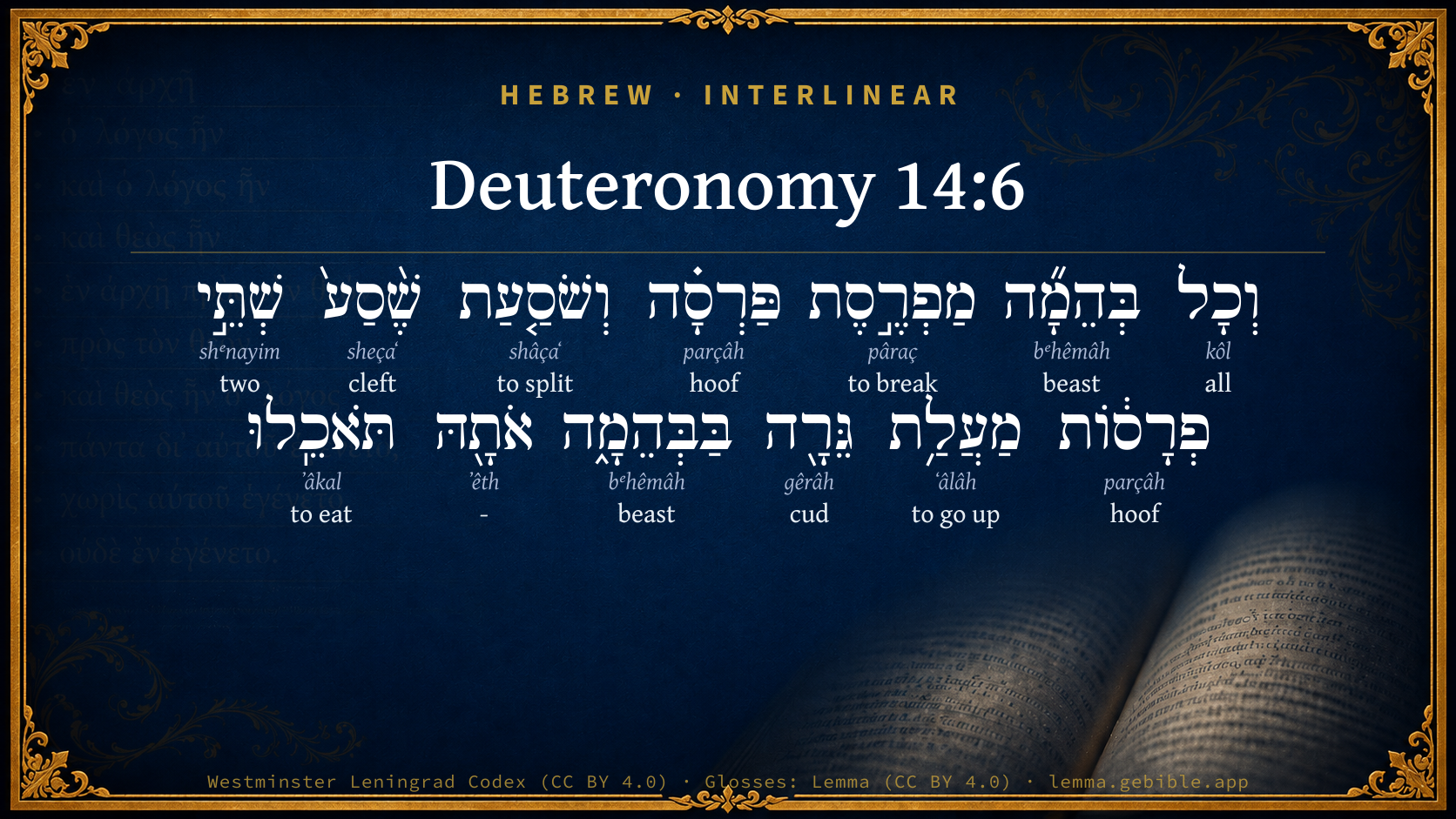
Hebrew (Westminster Leningrad Codex) Deuteronomy 14:6 appears in the Hebrew Old Testament. The text above is from the Westminster Leningrad Codex. Each word links to its Strong’s number, a concise gloss, and parsing drawn from the Open Scriptures Hebrew Bible morphology. Click any word for its full Brown-Driver-Briggs (BDB) entry.
Download image
Cite this verse

Deuteronomy 14:6 (World English Bible). Public Domain. Lemma interlinear Bible study tool, https://lemma.gebible.app/v/deuteronomy/14/6.

Show BibTeX & RIS
BibTeX
RIS
English Translation
Every animal that parts the hoof, and has the hoof cloven in two, [and] chews the cud, among the animals, that may you eat.
World English Bible · Public Domain
Download a study sheet

One document with this verse’s original text, its word-by-word gloss line, the meaning frame, cross-references with their text, attributed commentary, and full source and license credits — printable, and it pastes into notes with its structure intact.

This verse Autodidact and up

Study sheet (.html) Plain text (.txt)

A passage Seminary Student

Up to 50 verses in one chapter. A passage sheet keeps up to 6 commentary sources and 12 cross-references per verse, in the order this page ranks them, and says so on the sheet whenever that leaves anything out. Ask for a single verse and you get the Autodidact verse sheet above.

Everything on this page stays free to read, with no account — the sheet is a download of what is already on screen, not access to it.

Want to remove ads? Support Godless Engineer
Compare translations 3

The same verse in 3 English versions, stacked beneath the original-language interlinear above. Click any original word for its lexicon entry.

Each is an independent rendering of the whole verse — the interlinear is not word-aligned to these translations.

Highlighted words mark where these versions differ — a whole-verse word diff, not a word-by-word alignment.

  • World English Bible Public Domain
    Every animal that parts the hoof, and has the hoof cloven in two, [and] chews the cud, among the animals, that may you eat.
  • King James Version Public Domain
    And every beast that parteth the hoof, and cleaveth the cleft into two claws, and cheweth the cud among the beasts, that ye shall eat.
  • unfoldingWord Literal Text CC BY-SA 4.0
    And you may eat any animal among the animals parting the hoof or a cleft splitting two hooves, chewing the cud.

unfoldingWord Literal Text — © unfoldingWord, licensed CC BY-SA 4.0. Word-aligned USFM3 via Door43 (git.door43.org/unfoldingWord/en_ult).

Versions to compare (up to 4)

3 of 4 selected

Show all 18 translations

Every available English version of this verse, each an independent rendering of the whole verse.

  • World English Bible Public Domain
    Every animal that parts the hoof, and has the hoof cloven in two, [and] chews the cud, among the animals, that may you eat.
  • Berean Standard Bible Public Domain
    You may eat any animal that has a split hoof divided in two and that chews the cud.
  • Majority Standard Bible Public Domain
    You may eat any animal that has a split hoof divided in two and that chews the cud.
  • King James Version Public Domain
    And every beast that parteth the hoof, and cleaveth the cleft into two claws, and cheweth the cud among the beasts, that ye shall eat.
  • American Standard Version (1901) Public Domain
    And every beast that parteth the hoof, and hath the hoof cloven in two, `and' cheweth the cud, among the beasts, that may ye eat.
  • Revised Version (1885) Public Domain
    And every beast that parteth the hoof, and hath the hoof cloven in two, and cheweth the cud, among the beasts, that ye shall eat.
  • Geneva Bible (1599) Public Domain
    And euery beast that parteth ye hoofe, and cleaueth the clift into two clawes, and is of the beasts that cheweth the cudde, that shall ye eate.
  • Douay-Rheims (1899) Public Domain
    Every beast that divideth the hoof in two parts, and cheweth the cud, you shall eat.
  • Young's Literal Translation Public Domain
    and every beast dividing the hoof, and cleaving the cleft into two hoofs, bringing up the cud, among the beasts -- it ye do eat.
  • Literal Standard Version CC BY-SA 4.0
    and every beast dividing the hoof, and cleaving the cleft into two hooves, bringing up the cud, among the beasts—you eat it.
  • Unlocked Literal Bible CC BY-SA 4.0
    You may eat any animals that parts the hoof, that is, that has the hoof divided in two, and that chews the cud.
  • unfoldingWord Literal Text CC BY-SA 4.0
    And you may eat any animal among the animals parting the hoof or a cleft splitting two hooves, chewing the cud.
  • Darby Bible Public Domain
    And every beast that hath cloven hoofs, and the feet quite split open into double hoofs, [and] which cheweth the cud, among the beasts, that ye shall eat.
  • World Messianic Bible Public Domain
    Every animal that parts the hoof, and has the hoof split in two and chews the cud, among the animals, you may eat.
  • Webster's Bible Public Domain
    And every beast that parteth the hoof, and cleaveth the cleft into two claws, and cheweth the cud among the beasts, that ye shall eat.
  • Free Bible Version CC BY-SA 4.0
    You can eat any animal that both has a divided hoof and also chews the cud.
  • Bible in Basic English Public Domain
    Any beast which has a division in the horn of its foot and whose food comes back into its mouth to be crushed again, may be used for food.
  • JPS Tanakh (1917) Public Domain
    And every beast that parteth the hoof, and hath the hoof wholly cloven in two, and cheweth the cud, among the beasts, that ye may eat.

Literal Standard Version (2020), Covenant Press — licensed CC BY-SA 4.0. Text via the HelloAO Bible API (eBible.org). Unlocked Literal Bible (unfoldingWord) — licensed CC BY-SA 4.0. Text via the HelloAO Bible API (eBible.org). unfoldingWord Literal Text — © unfoldingWord, licensed CC BY-SA 4.0. Word-aligned USFM3 via Door43 (git.door43.org/unfoldingWord/en_ult). Free Bible Version, Dr. Jonathan Gallagher — licensed CC BY-SA 4.0. Text via the HelloAO Bible API (eBible.org).

Word by word

More ways to search: Search by grammar → Find every occurrence → Compare this word →

Practice this passage: Drill this verse → Learn its vocabulary →

שֶׁ֨סַע֙
sheçaʻ
H8157
“cleft”
Noun, Common, Masculine, Singular, Absolute
Part of Speech
Noun
Type
Common
Gender
Masculine
Number
Singular
State
Absolute
Full BDB Definition

Origin: from H8156

TWOT: 2427a

cleft, cloven, split
  1. וְכָל kôl H3605 “and · all of” Conjunction + Noun, Common, Masculine, Singular, Construct
  2. בְּהֵמָ֞ה bᵉhêmâh H929 “beast” Noun, Common, Feminine, Singular, Absolute
  3. מַפְרֶ֣סֶת pâraç H6536 “breaking” Verb, Hiphil, Participle Active, Feminine, Singular, Construct
  4. פַּרְסָ֗ה parçâh H6541 “hoof” Noun, Common, Feminine, Singular, Absolute
  5. וְשֹׁסַ֤עַת shâçaʻ H8156 “and · splitting” Conjunction + Verb, Qal, Participle Active, Feminine, Singular, Construct
  6. שְׁתֵּ֣י shᵉnayim H8147 “two” Adjective, Cardinal number, Feminine, Dual, Construct
  7. פְרָס֔וֹת parçâh H6541 “hooves” Noun, Common, Feminine, Plural, Absolute
  8. מַעֲלַ֥ת ʻâlâh H5927 “going up” Verb, Hiphil, Participle Active, Feminine, Singular, Construct
  9. גֵּרָ֖ה gêrâh H1625 “cud” Noun, Common, Feminine, Singular, Absolute
  10. בַּבְּהֵמָ֑ה bᵉhêmâh H929 “in/at the · beast” Preposition, Determined + Noun, Common, Feminine, Singular, Absolute
  11. אֹתָ֖הּ ʼêth H853 “- · her” Particle, Direct Object + Suffix, Personal, 3rd Person, Feminine, Singular
  12. תֹּאכֵֽלוּ ʼâkal H398 “to eat” Verb, Qal, Imperfect, 2nd Person, Masculine, Plural

About this verse

These counts appear in no published source. They are computed here, from the morphology-tagged text and Lemma’s own curated glosses. What Lemma adds →

13
words
11
distinct lemmas
Pentateuch
section

Notable vocabulary

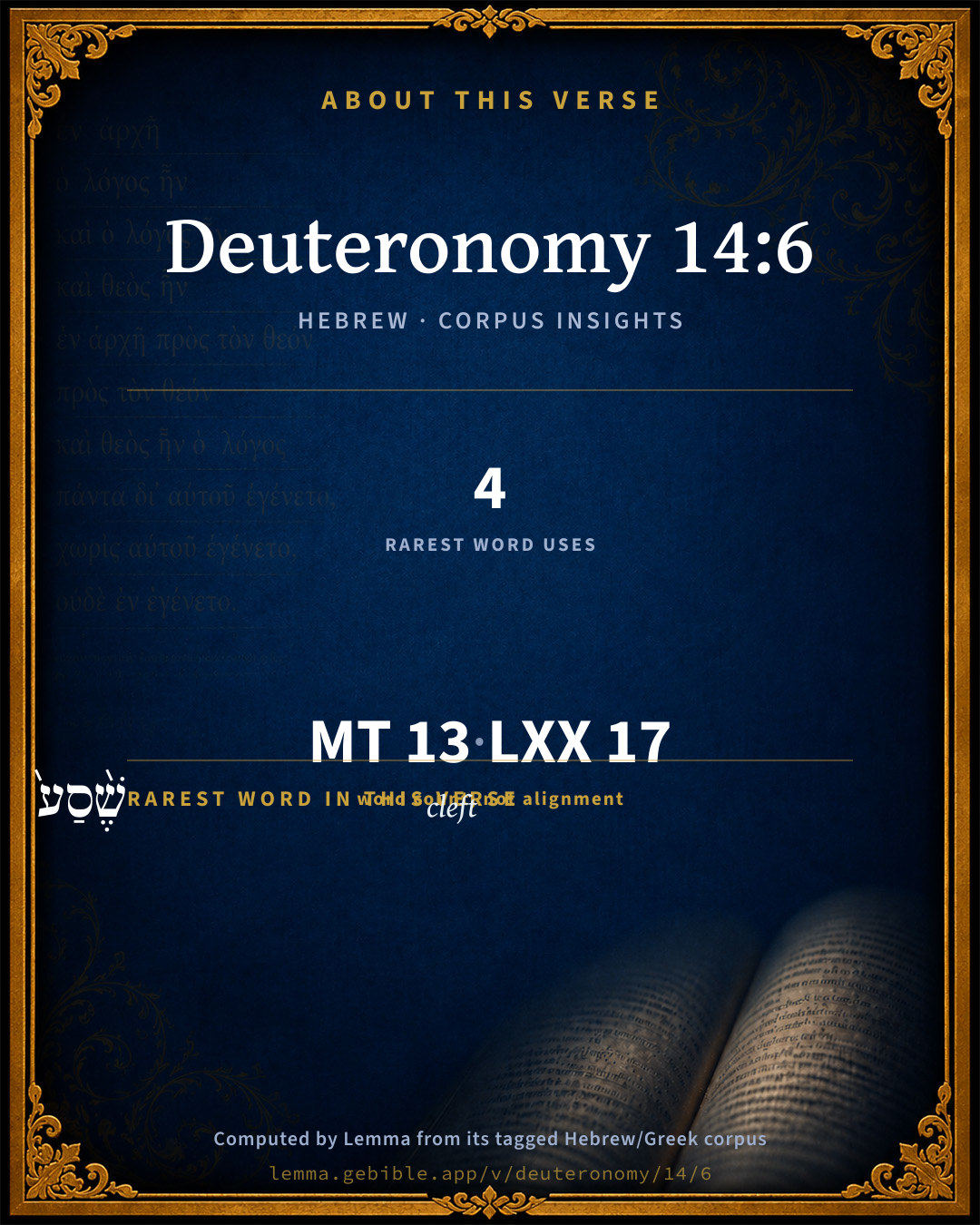
The rarest word here is שֶׁ֨סַע֙ cleft H8157 — appearing just 4 times in the whole Hebrew Bible.

Shared distinctive vocabulary

שֶׁ֨סַע֙ cleft H8157 occurs in 4 verses of the Hebrew Bible. Also found in:

Grammatical profile

  • 4 verbs
  • 7 nouns
  • 1 adjective
  • 1 particle

Verb forms

  • מַפְרֶ֣סֶת Hiphil · Participle Active
  • וְשֹׁסַ֤עַת Qal · Participle Active
  • מַעֲלַ֥ת Hiphil · Participle Active
  • תֹּאכֵֽלוּ Qal · Imperfect

Repetition

Words recur within this verse — often emphatic in Hebrew:

  • בְּהֵמָ֞ה beast H929 ×2
  • פַּרְסָ֗ה hoof H6541 ×2

Hebrew & Septuagint length

In English translation the verse runs 24 words from the Hebrew and 23 from the Septuagint (LXX English) — closely comparable.

A rough comparison of the two English renderings, which tokenize alike — not a word-level alignment.

Word counts can differ between the Hebrew and the Greek without any difference in meaning — e.g. the Hebrew direct-object marker אֵת has no separate Greek word, and Greek often adds the article ὁ.

In the original languages it is 13 Hebrew tokens and 17 Greek tokens — but the two are counted differently (Hebrew bundles its prefixes and suffixes into one token; the Greek is in lemma form), so that isn’t a like-for-like length.

Cross-references

3

Topical passages linked to Deuteronomy 14:6 in the Treasury of Scripture Knowledge — connected by theme and wording, ordered by reader-vote popularity; previews shown in the World English Bible.

  • Psalms 1:1–2 Blessed is the man who doesn't walk in the counsel of the wicked, Nor stand in the way of sinners, Nor sit in the seat of scoffers;
  • Proverbs 18:1 An unfriendly man pursues selfishness, And defies all sound judgment.
  • 2 Corinthians 6:17 Therefore, "'Come out from among them, And be separate,' says the Lord, 'Touch no unclean thing. I will receive you.

Cross-references courtesy of OpenBible.info (CC BY 4.0).

Hebrew and Greek witnesses Masoretic Hebrew ↔ Greek Septuagint

The same verse in the two great witnesses to the Old Testament, shown verse-for-verse.

These are two independent witnesses, not word-aligned to each other, and the Septuagint is shown in lemma (dictionary) form.

Hebrew Deuteronomy 14:6 Masoretic · Westminster Leningrad Codex

וְכָל בְּהֵמָ֞ה מַפְרֶ֣סֶת פַּרְסָ֗ה וְשֹׁסַ֤עַת שֶׁ֨סַע֙ שְׁתֵּ֣י פְרָס֔וֹת מַעֲלַ֥ת גֵּרָ֖ה בַּבְּהֵמָ֑ה אֹתָ֖הּ תֹּאכֵֽלוּ

Every animal that parts the hoof, and has the hoof cloven in two, [and] chews the cud, among the animals, that may you eat.

World English Bible · Public Domain

Greek LXX Deuteronomy 14:6 Septuagint · lemma form

πᾶς κτῆνος διχηλέω ὁπλή καί ὀνυχιστήρ ὀνυχίζω δύο χήλη καί ἀναἄγω μηρυκισμός ἐν ὁ κτῆνος οὗτος ἐσθίω

Every beast that divides the hoofs, and makes claws of two divisions, and that chews the cud among beasts, these you⌃ shall eat.

LXX2012 (modern English Septuagint) · Public Domain

Hebrew: Westminster Leningrad Codex (CC BY 4.0). Greek: Septuagint (public domain); English from LXX2012 (modern English Septuagint) (Public Domain). How the Septuagint differs from the Hebrew →

Targum (Aramaic paraphrase)

2

The Targum is the ancient Jewish Aramaic paraphrase of the Hebrew Scriptures — an interpretive translation, not the Hebrew text itself. Onkelos (literal) and Pseudo-Jonathan (expansive) render the Torah, and Jonathan the Prophets. Coverage is partial: where no permissively-licensed English translation exists for a verse, only the Aramaic is shown. This is verse-level text, not a word-by-word alignment to the Hebrew.

  1. Targum Onkelos Torah (Genesis–Deuteronomy)
    וְכָל בְּעִירָא דִסְדִיקָא פַרְסָתָא וּמַטִלְפָא טִלְפִין תַּרְתֵּין פַּרְסָתָא מַסְקָא פִשְׁרָא בִּבְעִירָא יָתַהּ תֵּיכְלוּן

    (no public-domain English translation for this verse)

    Targum Onkelos — Aramaic: “Onkelos Genesis” (public domain); “Onkelos Exodus” (public domain); “Onkelos Leviticus” (public domain); “Onkelos Numbers” (public domain); “Onkelos Deuteronomy” (public domain). English: “Sefaria Community Translation” (CC0 1.0 (public-domain dedication)); “J.W. Etheridge. The Targums of Onkelos and Jonathan Ben Uzziel on the Pentateuch. London: Longmans, Green, 1862” (public domain). Text via Sefaria.

  2. Targum Pseudo-Jonathan Torah (Genesis–Deuteronomy)
    וְכָל בְּעִירָא דִסְדִיקָא טַלְפַיָיא וְלָהּ קַרְנִין וּסְדִיק סִדְקָא מַסְקָא פִּישְׁרָא בִּבְעִירָא יָתָהּ תֵּיכְלוּן

    and every animal that hath the divided hoof, and horns, and that cleaveth the cleft, bringing up the cud among animals, that you may eat.

    Targum Pseudo-Jonathan — Aramaic: “Targum Jonathan on Genesis” (public domain); “Targum Jonathan on Exodus” (public domain); “Targum Jonathan on Leviticus” (public domain); “Targum Jonathan on Numbers” (public domain); “Targum Jonathan on Deuteronomy” (public domain). English: “The Targum of Jonathan ben Uzziel, trans. J. W. Etheridge, London, 1862” (public domain). Text via Sefaria.

Commentary

Notes on Deuteronomy 14:6 from classic Christian and Jewish commentators (each source and its license shown beneath its notes). The classic Christian expositions comment on the surrounding passage and are grouped to its opening verse, so a note may address several verses; the Jewish commentaries on the Tanakh (Rashi and others) are per-verse, so they appear only where the commentator wrote on this verse.

Lemma curates 59 commentaries, every one of them public domain or Creative Commons licensed, each selected and text-cleaned for this edition rather than reprinted as found. About our sources →

Trapp's Complete Commentary

John Trapp

Deu 14:6 And every beast that parteth the hoof, and cleaveth the cleft into two claws, [and] cheweth the cud among the beasts, that ye shall eat.

Ver. 6. That parteth the hoof.] {See Trapp on "Lev 11:3"}

John Trapp, A Commentary or Exposition upon All the Books of the Old and New Testament (1647–1656) — public domain. Text from a community e-Sword module.

Tyndale Open Study Notes

Tyndale Open Resources

14:6 split hooves and chews the cud: These criteria distinguished edible animals listed in 14:4-5 from those listed in 14:7-8. Although the people experienced health benefits from observing these restrictions, a thing was actually clean or unclean only because God declared it to be such.

Tyndale Open Study Notes — © Tyndale Open Resources, licensed CC BY-SA 4.0. Text via the HelloAO Bible API.

Ellicott's Commentary for English Readers

(6-8) These directions are the same given in Lev_11:3-8.

A Bible Commentary for English Readers, edited by Charles John Ellicott (1878–1897) — public domain. Text from a community e-Sword module.

The Cambridge Bible for Schools and Colleges

gen. ed. J. J. S. Perowne

6. There might also be eaten any beast with both of these marks:—

that parteth the hoof, and hath the hoof cloven in two] Lit. and cleaveth a cleft of two hoofs. The hoof must be entirely cloven (see below on camel);

and cheweth the cud] Heb. bringeth up the gerah, Ar. girrah, so called from either the straining or the gurgling of the process.

The Cambridge Bible for Schools and Colleges (gen. ed. J. J. S. Perowne; Cambridge University Press, 1878–1918) — public domain. Text from a community e-Sword module.

John Gill's Exposition

Of all clean birds ye shall eat. Which the Targum of Jonathan describes, everyone that has a craw, and whose crop is naked, and has a superfluous talon, and is not rapacious; but such as are unclean are expressed by name in the following verses, so that all except them might be reckoned clean and fit for food. Maimonides (p) observes, that only the number of the unclean are reckoned, so that all the rest are free.

(p) Hilchot. Maacolot Asurot, c. 1. sect. 14.

John Gill's Exposition of the Whole Bible (1746–1763) — public domain (CC PDM 1.0). Text via the HelloAO Bible API.

unfoldingWord translationNotes

Door43 World Missions Community

that parts the hoof

"that have split hooves." This is a hoof that is split into two parts instead of being one whole.

chews the cud

This means the animal brings its food up from its stomach and chews it again.

rabbit

This is a small animal with long ears that usually lives in holes in the ground. (See: Translate Unknowns)

rock badger

This is a small animal that lives in rocky places. (See: Translate Unknowns)

they are unclean to you

Something Yahweh says is unfit for his people to eat is spoken of as if it were physically unclean. (See: Metaphor)

translationWords

hoof

camel

clean

unfoldingWord translationNotes — © Distant Shores Media and the Door43 World Missions Community, licensed CC BY-SA 4.0. Source: git.door43.org/Door43/en_tn.

Rashi

Rabbi Shlomo Yitzchaki (Rashi)

מפרסת means split, as the Targum has it.

פרסה - plante in O. F. (English = hoof).

ושסעת AND HATH CLOVEN [HOOFS] — i.e. hoofs divided into two nails, for there are animals with hoofs split but not entirely divided into two nails (cf. Rashi on Leviticus 9:3), and such are unclean.

בבהמה [AND EVERY BEAST THAT PARTETH THE HOOF …] AMONG THE BEASTS [YE MAY EAT] — if one takes בבהמה to signify “within the animal”, it suggests: that which is found in the beast you may eat. From here, therefore, they (the Rabbis) derived the law that a שליל (a fully developed embryo) becomes permitted to be eaten through the slaughter of its mother without requiring ritual slaughtering itself (Chullin 69a; Chullin 74a).

Rashi on the Tanakh — English translations: “The Judaica Press complete Tanach with Rashi, translated by A. J. Rosenberg” (CC BY 4.0); “Pentateuch with Rashi's commentary by M. Rosenbaum and A.M. Silbermann, 1929-1934” (public domain); “The Metsudah Tanach series, Lakewood, N.J” (CC BY 4.0); and “The Book of Joshua, Metsudah Publications, 1997” (CC BY 4.0). Text via Sefaria.

Lesson kit

Teaching starters — assembled from the data on this page, not authored interpretation. Every prompt links to the verse data it draws on. Edit before teaching.

Deuteronomy, in the Pentateuch, opens this verse with 13 words (11 distinct Hebrew lemmas). Its most distinctive word is sheçaʻ (“cleft”). A historical commentator’s framing appears above. Read the whole chapter for the surrounding context.

Discussion questions

  1. The word sheçaʻ carries the sense “cleft.” How does it shape the verse?
  2. Leviticus 11:3 shares the word «cleft» with this verse. How do the two illuminate each other?
  3. “beast” occurs 2× in this one verse. What is the effect of the repetition?
  4. These translations render this verse differently. What is at stake in choosing one wording over another?
  5. The verb «מַפְרֶ֣סֶת» is Hiphil Participle Active. How does its form color the action?
  6. Reading how Trapp's Complete Commentary and Tyndale Open Study Notes read this verse, where do the two commentators agree and where do they part?

Things to notice

Reading settings

Reading text

Shown beneath each verse's original-language words.

Old Testament
Old Testament edition

Read the OT as the Masoretic Hebrew (MT) or the Greek Septuagint (LXX).

English shown for the Greek Septuagint (in the Hebrew ↔ Greek comparison).

Comparing translations? Open the Compare panel on any verse page to stack up to four side by side.