Genesis 24:16

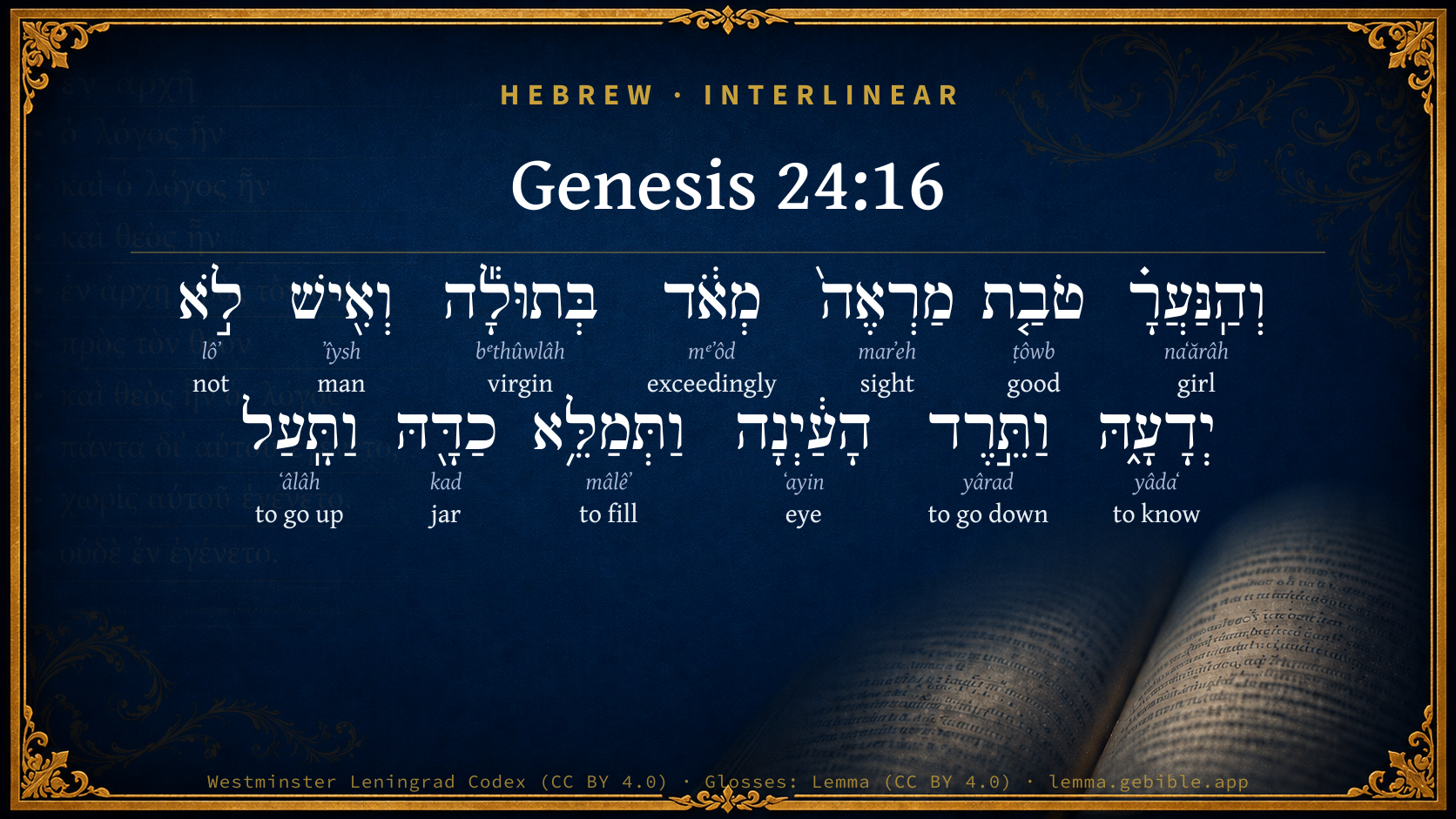
Hebrew (Westminster Leningrad Codex) Genesis 24:16 appears in the Hebrew Old Testament. The text above is from the Westminster Leningrad Codex. Each word links to its Strong’s number, a concise gloss, and parsing drawn from the Open Scriptures Hebrew Bible morphology. Click any word for its full Brown-Driver-Briggs (BDB) entry.
Download image
Cite this verse

Genesis 24:16 (World English Bible). Public Domain. Lemma interlinear Bible study tool, https://lemma.gebible.app/v/genesis/24/16.

Show BibTeX & RIS
BibTeX
RIS
English Translation
The young lady was very beautiful to look at, a virgin, neither had any man known her. She went down to the spring, filled her pitcher, and came up.
World English Bible · Public Domain
Highlights
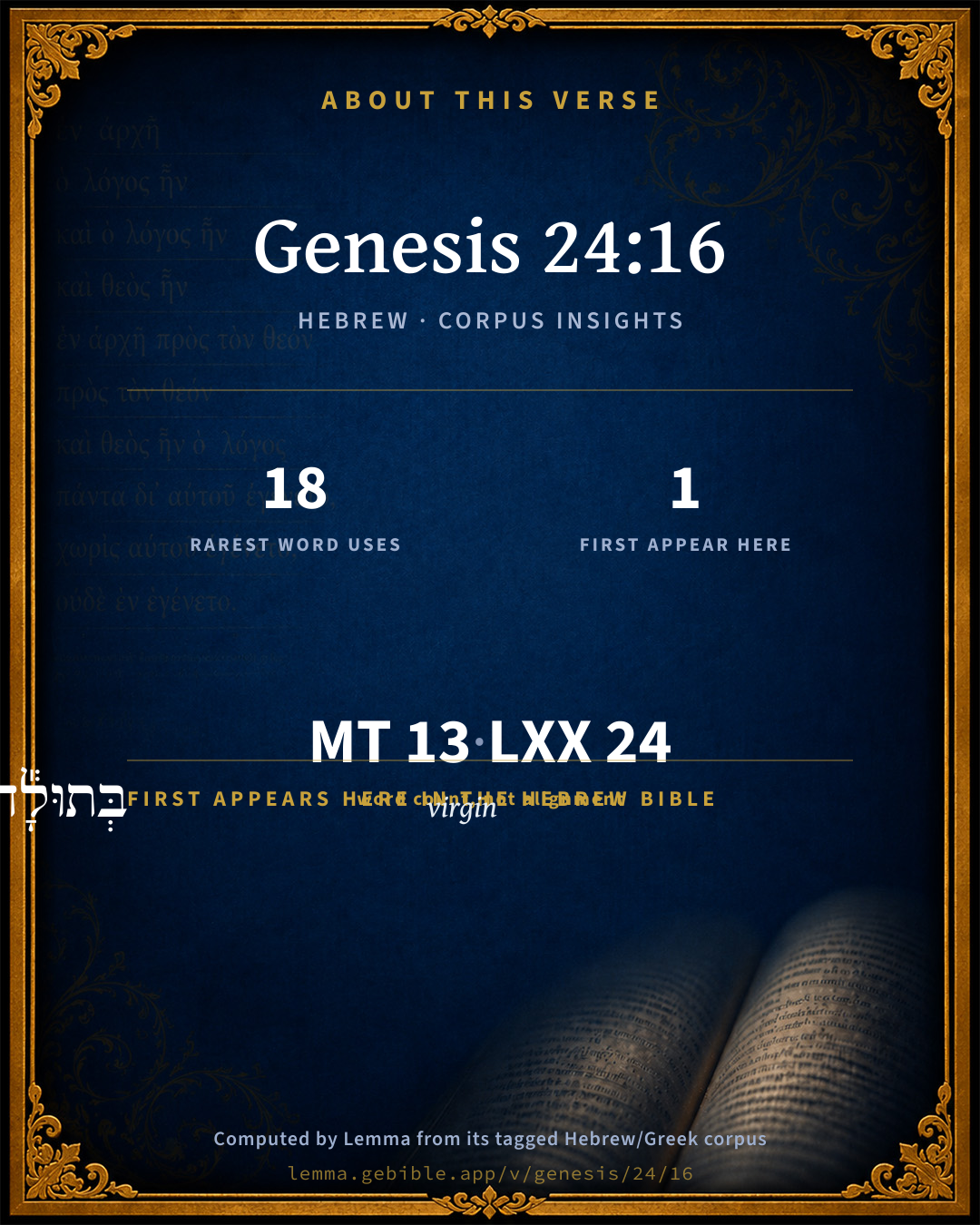
  • 1 first appearance in the Hebrew Bible
Full analysis ↓
Download a study sheet

One document with this verse’s original text, its word-by-word gloss line, the meaning frame, cross-references with their text, attributed commentary, and full source and license credits — printable, and it pastes into notes with its structure intact.

This verse Autodidact and up

Study sheet (.html) Plain text (.txt)

A passage Seminary Student

Up to 50 verses in one chapter. A passage sheet keeps up to 6 commentary sources and 12 cross-references per verse, in the order this page ranks them, and says so on the sheet whenever that leaves anything out. Ask for a single verse and you get the Autodidact verse sheet above.

Everything on this page stays free to read, with no account — the sheet is a download of what is already on screen, not access to it.

Want to remove ads? Support Godless Engineer
Compare translations 3

The same verse in 3 English versions, stacked beneath the original-language interlinear above. Click any original word for its lexicon entry.

Each is an independent rendering of the whole verse — the interlinear is not word-aligned to these translations.

Highlighted words mark where these versions differ — a whole-verse word diff, not a word-by-word alignment.

  • World English Bible Public Domain
    The young lady was very beautiful to look at, a virgin, neither had any man known her. She went down to the spring, filled her pitcher, and came up.
  • King James Version Public Domain
    And the damsel was very fair to look upon, a virgin, neither had any man known her: and she went down to the well, and filled her pitcher, and came up.
  • unfoldingWord Literal Text CC BY-SA 4.0
    And the young woman a very beautiful-looking virgin, and a man had not known her. And she went down to the spring and filled her jar and came up.

unfoldingWord Literal Text — © unfoldingWord, licensed CC BY-SA 4.0. Word-aligned USFM3 via Door43 (git.door43.org/unfoldingWord/en_ult).

Versions to compare (up to 4)

3 of 4 selected

Show all 18 translations

Every available English version of this verse, each an independent rendering of the whole verse.

  • World English Bible Public Domain
    The young lady was very beautiful to look at, a virgin, neither had any man known her. She went down to the spring, filled her pitcher, and came up.
  • Berean Standard Bible Public Domain
    Now the girl was very beautiful, a virgin who had not had relations with any man. She went down to the spring, filled her jar, and came up again.
  • Majority Standard Bible Public Domain
    Now the girl was very beautiful, a virgin who had not had relations with any man. She went down to the spring, filled her jar, and came up again.
  • King James Version Public Domain
    And the damsel was very fair to look upon, a virgin, neither had any man known her: and she went down to the well, and filled her pitcher, and came up.
  • American Standard Version (1901) Public Domain
    And the damsel was very fair to look upon, a virgin, neither had any man known her. And she went down to the fountain, and filled her pitcher, and came up.
  • Revised Version (1885) Public Domain
    And the damsel was very fair to look upon, a virgin, neither had any man known her: and she went down to the fountain, and filled her pitcher, and came up.
  • Geneva Bible (1599) Public Domain
    (And the maide was very faire to looke vpon, a virgine and vnknowen of man) and she went downe to the well, and filled her pitcher, and came vp.
  • Douay-Rheims (1899) Public Domain
    An exceedingly comely maid, and a most beautiful virgin, and not known to man: and she went down to the spring, and filled her pitcher and was coming back.
  • Young's Literal Translation Public Domain
    and the young person `is' of very good appearance, a virgin, and a man hath not known her; and she goeth down to the fountain, and filleth her pitcher, and cometh up.
  • Literal Standard Version CC BY-SA 4.0
    and the young person [is] of very good appearance, a virgin, and a man has not known her; and she goes down to the fountain, and fills her pitcher, and comes up.
  • Unlocked Literal Bible CC BY-SA 4.0
    The young woman was very beautiful and a virgin. No man had slept with her. She went down to the spring and filled her pitcher, and came up.
  • unfoldingWord Literal Text CC BY-SA 4.0
    And the young woman a very beautiful-looking virgin, and a man had not known her. And she went down to the spring and filled her jar and came up.
  • Darby Bible Public Domain
    And the maiden was very fair in countenance; a virgin, and no man had known her. And she went down to the well, and filled her pitcher, and came up.
  • World Messianic Bible Public Domain
    The young lady was very beautiful to look at, a virgin. No man had known her. She went down to the spring, filled her pitcher, and came up.
  • Webster's Bible Public Domain
    And the damsel was very fair to look upon, a virgin, neither had any man known her: and she went down to the well, and filled her pitcher, and came up.
  • Free Bible Version CC BY-SA 4.0
    She was very beautiful, a virgin—no one had slept with her. She went down to the spring, filled her jar, and came back up.
  • Bible in Basic English Public Domain
    She was a very beautiful girl, a virgin, who had never been touched by a man: and she went down to the spring to get water in her vessel.
  • JPS Tanakh (1917) Public Domain
    And the damsel was very fair to look upon, a virgin, neither had any man known her; and she went down to the fountain, and filled her pitcher, and came up.

Literal Standard Version (2020), Covenant Press — licensed CC BY-SA 4.0. Text via the HelloAO Bible API (eBible.org). Unlocked Literal Bible (unfoldingWord) — licensed CC BY-SA 4.0. Text via the HelloAO Bible API (eBible.org). unfoldingWord Literal Text — © unfoldingWord, licensed CC BY-SA 4.0. Word-aligned USFM3 via Door43 (git.door43.org/unfoldingWord/en_ult). Free Bible Version, Dr. Jonathan Gallagher — licensed CC BY-SA 4.0. Text via the HelloAO Bible API (eBible.org).

Word by word

More ways to search: Search by grammar → Find every occurrence → Compare this word →

Practice this passage: Drill this verse → Learn its vocabulary →

כַדָּ֖הּ
kad
H3537
“jar · her”
Noun, Common, Feminine, Singular, Construct + Suffix, Personal, 3rd Person, Feminine, Singular
Part of Speech
Noun
Type
Common
Gender
Feminine
Number
Singular
State
Construct
Full BDB Definition

Origin: from an unused root meaning to deepen

TWOT: 953a

jar, large jar (portable)
  1. וְהַֽנַּעֲרָ֗ naʻărâh H5291 “and · the · girl” Conjunction + Particle, Definite Article + Noun, Common, Feminine, Singular, Absolute
  2. טֹבַ֤ת ṭôwb H2896 “good of” Adjective, Adjective, Feminine, Singular, Construct
  3. מַרְאֶה֙ marʼeh H4758 “sight” Noun, Common, Masculine, Singular, Absolute
  4. מְאֹ֔ד mᵉʼôd H3966 “exceedingly” Adverb
  5. בְּתוּלָ֕ה bᵉthûwlâh H1330 “virgin” Noun, Common, Feminine, Singular, Absolute
  6. וְאִ֖ישׁ ʼîysh H376 “and · man” Conjunction + Noun, Common, Masculine, Singular, Absolute
  7. לֹ֣א lôʼ H3808 “not” Particle, Negative
  8. יְדָעָ֑הּ yâdaʻ H3045 “to know · her” Verb, Qal, Perfect, 3rd Person, Masculine, Singular + Suffix, Personal, 3rd Person, Feminine, Singular
  9. וַתֵּ֣רֶד yârad H3381 “and · to go down” Conjunction + Verb, Qal, Sequential Imperfect, 3rd Person, Feminine, Singular
  10. הָעַ֔יְנָה ʻayin H5869 “the · eye · toward” Particle, Definite Article + Noun, Common, Both, Singular, Absolute + Suffix, Demonstrative
  11. וַתְּמַלֵּ֥א mâlêʼ H4390 “and · to fill” Conjunction + Verb, Piel, Sequential Imperfect, 3rd Person, Feminine, Singular
  12. וַתָּֽעַל ʻâlâh H5927 “and · to go up” Conjunction + Verb, Qal, Sequential Imperfect, 3rd Person, Feminine, Singular

About this verse

These counts appear in no published source. They are computed here, from the morphology-tagged text and Lemma’s own curated glosses. What Lemma adds →

13
words
13
distinct lemmas
Pentateuch
section

Notable vocabulary

The rarest word here is כַדָּ֖הּ jar H3537 — appearing just 18 times in the whole Hebrew Bible.

First appearance in Scripture

This word makes its first canonical appearance in the Hebrew Bible here:

  • בְּתוּלָ֕ה virgin H1330

Shared distinctive vocabulary

כַדָּ֖הּ jar H3537 occurs in 17 verses of the Hebrew Bible. Also found in:

Grammatical profile

  • 4 verbs
  • 6 nouns
  • 1 adjective
  • 1 adverb
  • 1 particle

Verb forms

  • יְדָעָ֑הּ Qal · Perfect
  • וַתֵּ֣רֶד Qal · Sequential Imperfect
  • וַתְּמַלֵּ֥א Piel · Sequential Imperfect
  • וַתָּֽעַל Qal · Sequential Imperfect

Hebrew & Septuagint length

In English translation the verse runs 29 words from the Hebrew and 32 from the Septuagint (LXX English) — closely comparable.

A rough comparison of the two English renderings, which tokenize alike — not a word-level alignment.

Word counts can differ between the Hebrew and the Greek without any difference in meaning — e.g. the Hebrew direct-object marker אֵת has no separate Greek word, and Greek often adds the article ὁ.

In the original languages it is 13 Hebrew tokens and 24 Greek tokens — but the two are counted differently (Hebrew bundles its prefixes and suffixes into one token; the Greek is in lemma form), so that isn’t a like-for-like length.

Cross-references

4

Topical passages linked to Genesis 24:16 in the Treasury of Scripture Knowledge — connected by theme and wording, ordered by reader-vote popularity; previews shown in the World English Bible.

  • Genesis 26:7 The men of the place asked him about his wife. He said, "She is my sister," for he was afraid to say, "My wife," lest, he thought, the men of the place might kill me for Rebekah, because she was beautiful to look on.
  • Genesis 4:1 The man knew Eve his wife. She conceived, and gave birth to Cain, and said, "I have gotten a man with Yahweh's help."
  • Genesis 39:6 He left all that he had in Joseph's hand. He didn't concern himself with anything, except for the food which he ate. Joseph was well-built and handsome.
  • Numbers 31:17–18 Now therefore kill every male among the little ones, and kill every woman who has known man by lying with him.

Cross-references courtesy of OpenBible.info (CC BY 4.0).

Hebrew and Greek witnesses Masoretic Hebrew ↔ Greek Septuagint

The same verse in the two great witnesses to the Old Testament, shown verse-for-verse.

These are two independent witnesses, not word-aligned to each other, and the Septuagint is shown in lemma (dictionary) form.

Hebrew Genesis 24:16 Masoretic · Westminster Leningrad Codex

וְהַֽנַּעֲרָ֗ טֹבַ֤ת מַרְאֶה֙ מְאֹ֔ד בְּתוּלָ֕ה וְאִ֖ישׁ לֹ֣א יְדָעָ֑הּ וַתֵּ֣רֶד הָעַ֔יְנָה וַתְּמַלֵּ֥א כַדָּ֖הּ וַתָּֽעַל

The young lady was very beautiful to look at, a virgin, neither had any man known her. She went down to the spring, filled her pitcher, and came up.

World English Bible · Public Domain

Greek LXX Genesis 24:16 Septuagint · lemma form

ὁ δέ παρθένος εἰμί καλός ὁ ὄψις σφόδρα παρθένος εἰμί ἀνήρ οὐ γιγνώσκω αὐτός καταβαίνω δέ ἐπί ὁ πηγή πίμπλημι ὁ ὑδρία καί ἀναβαίνω

And the virgin was very beautiful in appearance, she was a virgin, a man had not known her; and she went down to the well, and filled her water-pot, and came up.

LXX2012 (modern English Septuagint) · Public Domain

Hebrew: Westminster Leningrad Codex (CC BY 4.0). Greek: Septuagint (public domain); English from LXX2012 (modern English Septuagint) (Public Domain). How the Septuagint differs from the Hebrew →

Targum (Aramaic paraphrase)

2

The Targum is the ancient Jewish Aramaic paraphrase of the Hebrew Scriptures — an interpretive translation, not the Hebrew text itself. Onkelos (literal) and Pseudo-Jonathan (expansive) render the Torah, and Jonathan the Prophets. Coverage is partial: where no permissively-licensed English translation exists for a verse, only the Aramaic is shown. This is verse-level text, not a word-by-word alignment to the Hebrew.

  1. Targum Onkelos Torah (Genesis–Deuteronomy)
    וְעוּלֶמְתָּא שַׁפִּירַת חֵיזוּ (נ''י שַׁפִּירָא לְמֶחֱזֵי) לַחֲדָא בְּתֻלְתָּא וּגְבַר לָא יַדְעָהּ וּנְחָתַת לְעֵינָא וּמְלַת קוּלְתַהּ וּסְלֵקָת

    (no public-domain English translation for this verse)

    Targum Onkelos — Aramaic: “Onkelos Genesis” (public domain); “Onkelos Exodus” (public domain); “Onkelos Leviticus” (public domain); “Onkelos Numbers” (public domain); “Onkelos Deuteronomy” (public domain). English: “Sefaria Community Translation” (CC0 1.0 (public-domain dedication)); “J.W. Etheridge. The Targums of Onkelos and Jonathan Ben Uzziel on the Pentateuch. London: Longmans, Green, 1862” (public domain). Text via Sefaria.

  2. Targum Pseudo-Jonathan Torah (Genesis–Deuteronomy)
    וְרִיבָא שַׁפִּירָא לְמֵיחֲמֵי לַחֲדָא בְּתוּלְתָּא וּגְבַר לָא יָדָעָהּ בְּמַשְׁכְּבָהּ וּנְחָתַת לְעַיְינָא וּמְלַת לְגִנְתָהּ וּסְלִיקַת

    And the damsel was a virgin, very beautiful to behold, and she descended to the fountain and filled her pitcher, and came up.

    Targum Pseudo-Jonathan — Aramaic: “Targum Jonathan on Genesis” (public domain); “Targum Jonathan on Exodus” (public domain); “Targum Jonathan on Leviticus” (public domain); “Targum Jonathan on Numbers” (public domain); “Targum Jonathan on Deuteronomy” (public domain). English: “The Targum of Jonathan ben Uzziel, trans. J. W. Etheridge, London, 1862” (public domain). Text via Sefaria.

Commentary

Notes on Genesis 24:16 from classic Christian and Jewish commentators (each source and its license shown beneath its notes). The classic Christian expositions comment on the surrounding passage and are grouped to its opening verse, so a note may address several verses; the Jewish commentaries on the Tanakh (Rashi and others) are per-verse, so they appear only where the commentator wrote on this verse.

Lemma curates 59 commentaries, every one of them public domain or Creative Commons licensed, each selected and text-cleaned for this edition rather than reprinted as found. About our sources →

Trapp's Complete Commentary

John Trapp

Gen 24:16 And the damsel [was] very fair to look upon, a virgin, neither had any man known her: and she went down to the well, and filled her pitcher, and came up.

Ver. 16. And the damsel was very fair.] Kαλη και σοφη, Fair and wise, as it was said of Aspasia Milesia. {a} Here beauty was not ill-bestowed, as a gold ring in a swine’s snout, but (as the history {b} reports of the Lady Jane Gray) adorned with all variety of moral virtues, as a clear sky with stars, as a princely diadem with jewels. Beauty is of itself very attractive, as the poet hath it. {c} For which cause, Heraclonas, the young emperor of Constantinople, being sent into banishment, together with Martina his mother, had his nose cut off, lest his beauty should move the people to pity. And Angli tanquam Angeli, said Gregory the Great, of the English boys presented to him. How much more when accompanied and accomplished with chastity, as in this damsel. {d}

A virgin, neither had any man known her.] This latter clause is added, because many pass for virgins that are not so; if that of the poet be true, especially

“Quae, quia non licuit, non facit, illa facit.” - Ovid.

And that of the orator, {e} Incesta est, et sine stupro, quae stuprum cupit. The Romans cashiered a vestal virgin for uttering this verse -

“Foelices nuptae! moriar, nisi nubere dulce est.”

The strumpet when she eats stolen bread, hath such dexterity in wiping her lips, that not the least crumb shall be seen to her shame. So that Solomon shows it to be as hard to find it out, "As the way of an eagle in the air, the way of a serpent upon a rock, the way of a ship in the sea, and the way of a man with a maid," {Pro 30:18-20} that is a close and chaste virgin; one that should be chaste at least, as being kept close from the access of strangers.

Filled her pitcher, and came up.] Here was no tarrying, gazing, gossiping. Not slothful in business. {Rom 12:11} She had not been delicately or wantonly bred, but inured to hard labour, and she followed it closely. Thucydides scribit Lacedaemoniis πατριος γεγονεναι εκ στων τονων τας αρετας κταθαι. {f}

{a} Aelian, Var. Hist., lib. xii., cap. 1.

{b} Life of Edward VI., p. 176.

{c} Oττι καλον φιλον εστι. - Bucholcer.

{d} Aγνεια ab αγνος, quod ab ανος veneratio. Sic castus quasi καστος, ornatus.

{e} Senec., in Declama.

{f} Thucyd., lib. ii.

John Trapp, A Commentary or Exposition upon All the Books of the Old and New Testament (1647–1656) — public domain. Text from a community e-Sword module.

Geneva Bible (1599)

Geneva Bible translators

Here is declared that God ever heareth the prayers of his, and granteth their requests.

Geneva Bible (1599) marginal notes — public domain. Text via Bolls.life.

Ellicott's Commentary for English Readers

(16) She went down to the well.—The water, therefore, was reached by a flight of steps, the usual rule wherever the well was fed by a natural spring. Cisterns, on the contrary, supplied from the rains were narrower at the top than at the bottom.

Mr. Malan (Philosophy or Truth, p. 93), in an interesting account of his visit to this well, says that on going out from Haran in the evening to examine it, he found “a group of women filling, no longer their pitchers, since the steps down which Rebekah went to fetch the water are now blocked up, but their water-skins by drawing water at the well’s mouth. Everything around that well bears signs of age and of the wear of time; for as it is the only well of drinkable water there, it is much resorted to. Other wells are only for watering the flocks. There we find the troughs of various height for camels, for sheep and for goats, for kids and for lambs; there the women wear nose-rings and bracelets on their arms, some of gold or of silver, and others of brass, or even of glass.”

A Bible Commentary for English Readers, edited by Charles John Ellicott (1878–1897) — public domain. Text from a community e-Sword module.

John Gill's Exposition

And the damsel was very fair to look upon,.... Of a good countenance and beautiful aspect: a virgin:

neither had any man known her; not only was reckoned a virgin, but was really one, pure and incorrupt:

and she went down to the well and filled her pitcher, and came up; by which it appears the well lay low, there was a descent unto it, and an ascent from it. Rebekah was very diligent and speedy in doing her work, she did not stay to look at strangers, or hold an idle conversation with other damsels that came thither on the same account; but, having filled her pitcher, was making the best of her way home.

John Gill's Exposition of the Whole Bible (1746–1763) — public domain (CC PDM 1.0). Text via the HelloAO Bible API.

Matthew Poole's English Annotations

She was a virgin not only in title and show, but in truth, for no man had known her, i.e. corrupted her.

Matthew Poole's English Annotations on the Holy Bible (1683–1685) — public domain. Text from a community e-Sword/MySword module.

Whedon's Commentary on the Bible

Daniel D. Whedon

16. Went down to the well — The water, perhaps, was reached, as is often the case, by a flight of steps. Hence the use of the terms going down and coming up.

Daniel D. Whedon (gen. ed.), Commentary on the Old and New Testaments (1874–1909) — public domain. Text from a community e-Sword module.

The Pulpit Commentary

And the damsel was very fair to look upon. Literally, good of countenance, like Sarah (Gen_12:11) and Rachel (Gen_29:17; cf. Gen_26:7 of Rebekah) A virgin. Bethulah, i.e. one separated and secluded from intercourse with men; from batik, to seclude (Deu_22:23, Deu_22:28; 2Sa_13:2, 2Sa_13:18) Neither had any man known her. A repetition for the sake of emphasis, rather than because bethulah sometimes applies to a married woman. (Joe_1:8) And she went down to the well, all wells in the East are in wadys, and have steps down to the water" (Thomson, "Land and Book," p. 592) and filled her pitcher, and came up probably wholly unconscious of the old man"s admiration, though by no means unprepared for his request, which immediately followed.

The Pulpit Commentary (1880–1919), ed. H.D.M. Spence-Jones & Joseph S. Exell — public domain. Text from a community e-Sword module.

Radak

Rabbi David Kimhi (Radak)

והנערה...ואיש לא ידעה, not even in an unconventional sexual embrace. [these words were added as additional to the statement that she was a virgin. Ed.]

ותמלא כדה, which she had drawn from the well, and which was filled with water. Seeing that the water from this well was only marginally below the surface of the earth the” well” is referred to as עין, “fountain,” although one did have to go down some steps to get at the water. Some scholars derive from allusions in the text that the water actually rose toward Rivkah, seeing that the text speaks only of ותמלא כדה, “she filled her jug,” instead of saying “she went down and drew water and filled her jug.” A similar formulation, without using the word “she drew water,” is used in 21,19 where Hagar was filling the hose with the newly discovered well. [one would have to say that when giving water to camels Rivkah did not enjoy this heavenly assist as in verse 20 she did have to “draw water.” Ed.]

Radak on the Tanakh — English translations: “Sefaria Community Translation” (CC0 1.0 (public-domain dedication)); “Eliyahu Munk, HaChut Hameshulash” (CC BY 4.0); “Rabbi Mike Feuer, Jerusalem Anthology” (CC BY 4.0); and “R. David Kimhi on the first book of Psalms, Translated by R.G. Finch, London, 1919” (public domain). Text via Sefaria.

Lesson kit

Teaching starters — assembled from the data on this page, not authored interpretation. Every prompt links to the verse data it draws on. Edit before teaching.

Genesis, in the Pentateuch, opens this verse with 13 words (13 distinct Hebrew lemmas). Its most distinctive word is kad (“jar”). A historical commentator’s framing appears above. Read the whole chapter for the surrounding context.

Discussion questions

  1. What does “jar” (kad) contribute to the verse as a whole?
  2. This is the first place “virgin” appears in Scripture (first appears here). What does its debut here establish?
  3. How does Genesis 24:14, which shares the word «jar», read alongside this verse?
  4. The translations on this page render this verse differently — a whole-verse word diff, not a word-by-word alignment. What might account for the different wordings?
  5. «יְדָעָ֑הּ» is a Qal Perfect verb. How does that grammatical form shape the action described?
  6. Compare how Trapp's Complete Commentary and Geneva Bible (1599) read this verse. Where do they agree or differ?

Things to notice

Reading settings

Reading text

Shown beneath each verse's original-language words.

Old Testament
Old Testament edition

Read the OT as the Masoretic Hebrew (MT) or the Greek Septuagint (LXX).

English shown for the Greek Septuagint (in the Hebrew ↔ Greek comparison).

Comparing translations? Open the Compare panel on any verse page to stack up to four side by side.