Judges 20:38

Hebrew (Westminster Leningrad Codex) Judges 20:38 appears in the Hebrew Old Testament. The text above is from the Westminster Leningrad Codex. Each word links to its Strong’s number, a concise gloss, and parsing drawn from the Open Scriptures Hebrew Bible morphology. Click any word for its full Brown-Driver-Briggs (BDB) entry.
Download image
Cite this verse

Judges 20:38 (World English Bible). Public Domain. Lemma interlinear Bible study tool, https://lemma.gebible.app/v/judges/20/38.

Show BibTeX & RIS
BibTeX
RIS
English Translation
Now the appointed sign between the men of Israel and the liers-in-wait was that they should make a great cloud of smoke rise up out of the city.
World English Bible · Public Domain
Download a study sheet

One document with this verse’s original text, its word-by-word gloss line, the meaning frame, cross-references with their text, attributed commentary, and full source and license credits — printable, and it pastes into notes with its structure intact.

This verse Autodidact and up

Study sheet (.html) Plain text (.txt)

A passage Seminary Student

Up to 50 verses in one chapter. A passage sheet keeps up to 6 commentary sources and 12 cross-references per verse, in the order this page ranks them, and says so on the sheet whenever that leaves anything out. Ask for a single verse and you get the Autodidact verse sheet above.

Everything on this page stays free to read, with no account — the sheet is a download of what is already on screen, not access to it.

Want to remove ads? Support Godless Engineer
Compare translations 3

The same verse in 3 English versions, stacked beneath the original-language interlinear above. Click any original word for its lexicon entry.

Each is an independent rendering of the whole verse — the interlinear is not word-aligned to these translations.

Highlighted words mark where these versions differ — a whole-verse word diff, not a word-by-word alignment.

  • World English Bible Public Domain
    Now the appointed sign between the men of Israel and the liers-in-wait was that they should make a great cloud of smoke rise up out of the city.
  • King James Version Public Domain
    Now there was an appointed sign between the men of Israel and the liers in wait, that they should make a great flame with smoke rise up out of the city.
  • unfoldingWord Literal Text CC BY-SA 4.0
    Now a sign was to the men of Israel with the ambush, “Make great” for them sending up a signal of smoke from the city

unfoldingWord Literal Text — © unfoldingWord, licensed CC BY-SA 4.0. Word-aligned USFM3 via Door43 (git.door43.org/unfoldingWord/en_ult).

Versions to compare (up to 4)

3 of 4 selected

Show all 18 translations

Every available English version of this verse, each an independent rendering of the whole verse.

  • World English Bible Public Domain
    Now the appointed sign between the men of Israel and the liers-in-wait was that they should make a great cloud of smoke rise up out of the city.
  • Berean Standard Bible Public Domain
    The men of Israel had arranged a signal with the men in ambush: When they sent up a great cloud of smoke from the city,
  • Majority Standard Bible Public Domain
    The men of Israel had arranged a signal with the men in ambush: When they sent up a great cloud of smoke from the city,
  • King James Version Public Domain
    Now there was an appointed sign between the men of Israel and the liers in wait, that they should make a great flame with smoke rise up out of the city.
  • American Standard Version (1901) Public Domain
    Now the appointed sign between the men of Israel and the liers-in-wait was, that they should make a great cloud of smoke rise up out of the city.
  • Revised Version (1885) Public Domain
    Now the appointed sign between the men of Israel and the liers in wait was, that they should make a great cloud of smoke rise up out of the city.
  • Geneva Bible (1599) Public Domain
    Also the men of Israel had appoynted a certaine time with the ambushmentes, that they should make a great flame and smoke rise vp out of the citie.
  • Douay-Rheims (1899) Public Domain
    Now the children of Israel had given a sign to them, whom they had laid in ambushes, that after they had taken the city, they should make a fire: that by the smoke rising on high, they might shew that the city was taken.
  • Young's Literal Translation Public Domain
    And there was the appointed sign to the men of Israel with the ambush -- their causing to go up a great volume of smoke from the city.
  • Literal Standard Version CC BY-SA 4.0
    And the appointed sign of the men of Israel with the ambush was their causing a great volume of smoke to go up from the city.
  • Unlocked Literal Bible CC BY-SA 4.0
    The arranged signal between the soldiers of Israel and the men hiding in secret would be that a great cloud of smoke would rise up out of the city.
  • unfoldingWord Literal Text CC BY-SA 4.0
    Now a sign was to the men of Israel with the ambush, “Make great” for them sending up a signal of smoke from the city
  • Darby Bible Public Domain
    Now the appointed signal between the men of Israel and the men in ambush was that when they made a great cloud of smoke rise up out of the city
  • World Messianic Bible Public Domain
    Now the appointed sign between the men of Israel and the ambushers was that they should make a great cloud of smoke rise up out of the city.
  • Webster's Bible Public Domain
    Now there was an appointed sign between the men of Israel and the liers in wait, that they should make a great flame with smoke to rise from the city.
  • Free Bible Version CC BY-SA 4.0
    The agreement was that they would send up a great cloud of smoke to show the town had fallen.
  • Bible in Basic English Public Domain
    Now the sign fixed between the men of Israel and those making the surprise attack was that when they made a pillar of smoke go up from the town,
  • JPS Tanakh (1917) Public Domain
    Now there was an appointed sign between the men of Israel and the liers-in-wait, that they should make a great beacon of smoke rise up out of the city. —

Literal Standard Version (2020), Covenant Press — licensed CC BY-SA 4.0. Text via the HelloAO Bible API (eBible.org). Unlocked Literal Bible (unfoldingWord) — licensed CC BY-SA 4.0. Text via the HelloAO Bible API (eBible.org). unfoldingWord Literal Text — © unfoldingWord, licensed CC BY-SA 4.0. Word-aligned USFM3 via Door43 (git.door43.org/unfoldingWord/en_ult). Free Bible Version, Dr. Jonathan Gallagher — licensed CC BY-SA 4.0. Text via the HelloAO Bible API (eBible.org).

Word by word

More ways to search: Search by grammar → Find every occurrence → Compare this word →

Practice this passage: Drill this verse → Learn its vocabulary →

מַשְׂאַ֥ת
masʼêth
H4864
“burden of”
Noun, Common, Feminine, Singular, Construct
Part of Speech
Noun
Type
Common
Gender
Feminine
Number
Singular
State
Construct
Full BDB Definition

Origin: from \H5375\\

TWOT: 1421h

uprising, utterance, burden, portion, uplifting - that which rises, uprising, uplifting, signal, rising - utterance, oracle - burden - portion, present, largesse, gift, contribution, offering, tribute
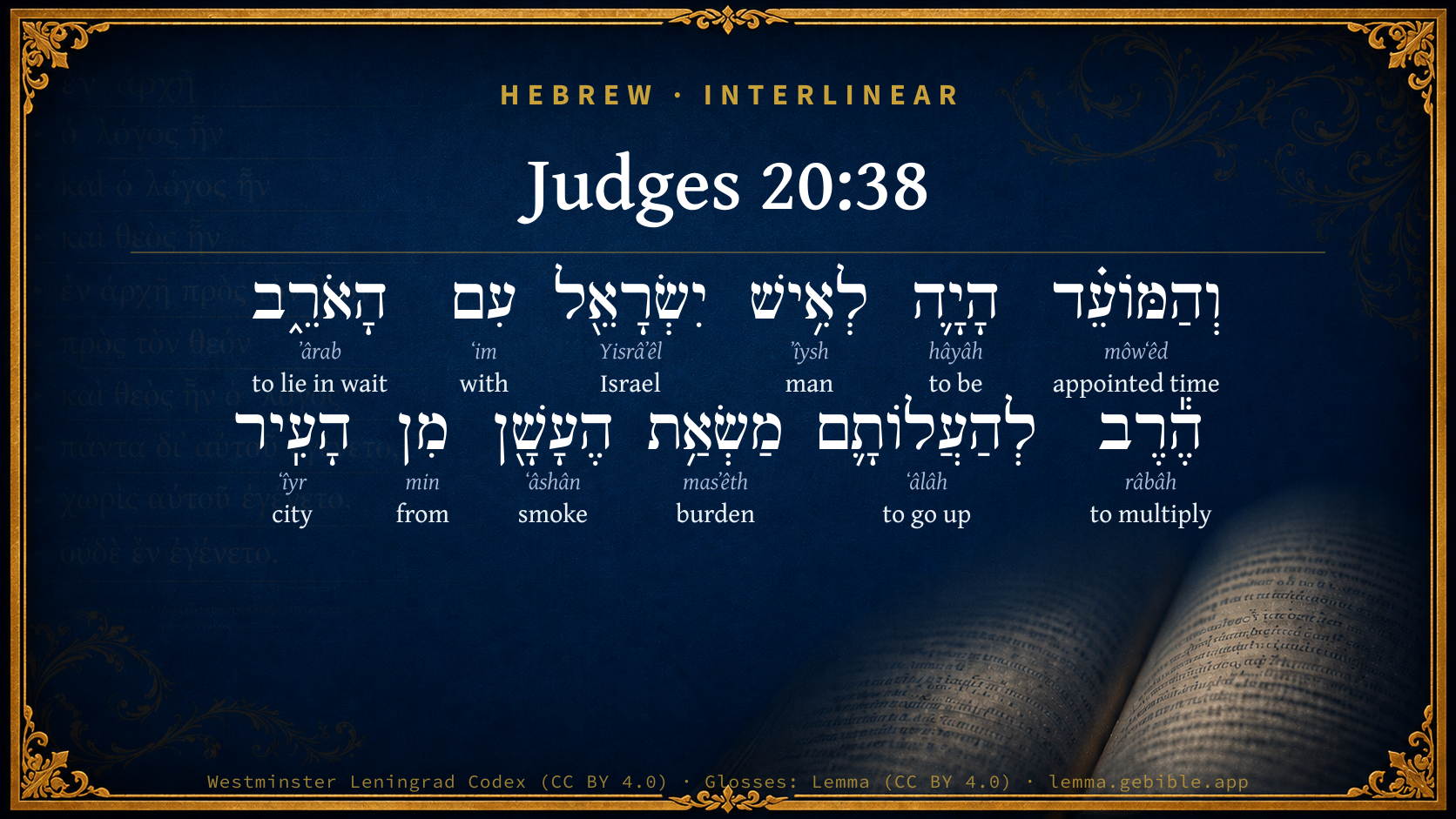
  1. וְהַמּוֹעֵ֗ד môwʻêd H4150 “and · the · appointed time” Conjunction + Particle, Definite Article + Noun, Common, Masculine, Singular, Absolute
  2. הָיָ֛ה hâyâh H1961 “to be” Verb, Qal, Perfect, 3rd Person, Masculine, Singular
  3. לְאִ֥ישׁ ʼîysh H376 “to/for · man of” Preposition + Noun, Common, Masculine, Singular, Construct
  4. יִשְׂרָאֵ֖ל Yisrâʼêl H3478 “Israel” Noun, Proper
  5. עִם ʻim H5973 “with” Preposition
  6. הָאֹרֵ֑ב ʼârab H693 “the · lying in wait” Particle, Definite Article + Verb, Qal, Participle Active, Masculine, Singular, Absolute
  7. הֶ֕רֶב râbâh H7235 “multiply” Verb, Hiphil, Imperative, 2nd Person, Masculine, Singular
  8. לְהַעֲלוֹתָ֛ם ʻâlâh H5927 “to go up · them” Preposition + Verb, Hiphil, Infinitive Construct + Suffix, Personal, 3rd Person, Masculine, Plural
  9. הֶעָשָׁ֖ן ʻâshân H6227 “the · smoke” Particle, Definite Article + Noun, Common, Masculine, Singular, Absolute
  10. מִן min H4480 “from” Preposition
  11. הָעִֽיר ʻîyr H5892 “the · city” Particle, Definite Article + Noun, Common, Feminine, Singular, Absolute

About this verse

These counts appear in no published source. They are computed here, from the morphology-tagged text and Lemma’s own curated glosses. What Lemma adds →

12
words
12
distinct lemmas
Historical
section

Notable vocabulary

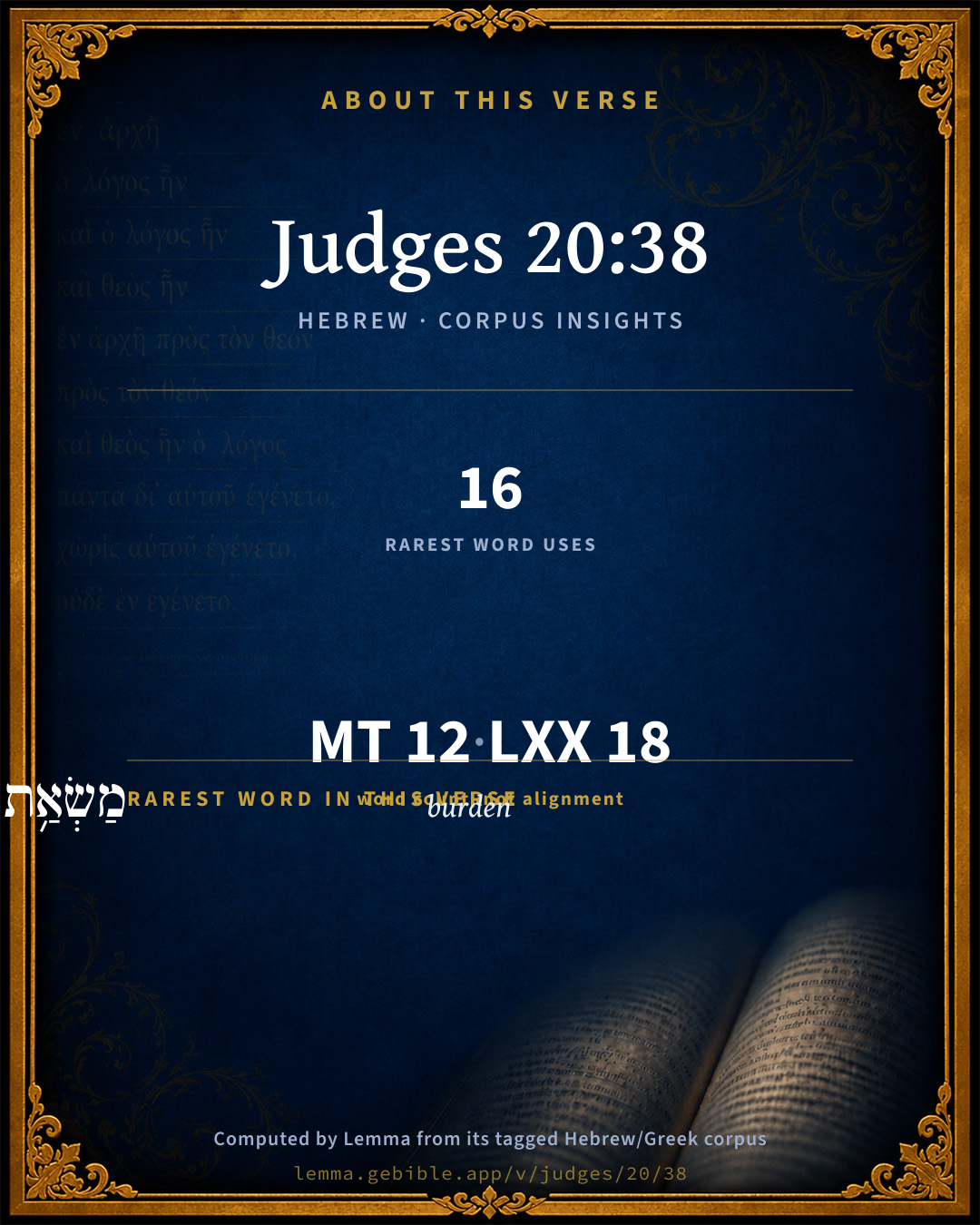
The rarest word here is מַשְׂאַ֥ת burden H4864 — appearing just 16 times in the whole Hebrew Bible.

Shared distinctive vocabulary

מַשְׂאַ֥ת burden H4864 occurs in 14 verses of the Hebrew Bible. Also found in:

Grammatical profile

  • 4 verbs
  • 6 nouns
  • 2 prepositions

Verb forms

  • הָיָ֛ה Qal · Perfect
  • הָאֹרֵ֑ב Qal · Participle Active
  • הֶ֕רֶב Hiphil · Imperative
  • לְהַעֲלוֹתָ֛ם Hiphil · Infinitive Construct

Hebrew & Septuagint length

In English translation the verse runs 28 words from the Hebrew and 27 from the Septuagint (LXX English) — closely comparable.

A rough comparison of the two English renderings, which tokenize alike — not a word-level alignment.

Word counts can differ between the Hebrew and the Greek without any difference in meaning — e.g. the Hebrew direct-object marker אֵת has no separate Greek word, and Greek often adds the article ὁ.

In the original languages it is 12 Hebrew tokens and 18 Greek tokens — but the two are counted differently (Hebrew bundles its prefixes and suffixes into one token; the Greek is in lemma form), so that isn’t a like-for-like length.

Cross-references

3

Topical passages linked to Judges 20:38 in the Treasury of Scripture Knowledge — connected by theme and wording, ordered by reader-vote popularity; previews shown in the World English Bible.

  • Genesis 17:21 But my covenant I establish with Isaac, whom Sarah will bear to you at this set time in the next year."
  • Joshua 8:20 When the men of Ai looked behind them, they saw, and, behold, the smoke of the city ascended up to heaven, and they had no power to flee this way or that way: and the people who fled to the wilderness turned back on the pursuers.
  • 2 Kings 4:16 He said, At this season, when the time comes round, you shall embrace a son. She said, No, my lord, you man of God, do not lie to your handmaid.

Cross-references courtesy of OpenBible.info (CC BY 4.0).

Hebrew and Greek witnesses Masoretic Hebrew ↔ Greek Septuagint

The same verse in the two great witnesses to the Old Testament, shown verse-for-verse.

These are two independent witnesses, not word-aligned to each other, and the Septuagint is shown in lemma (dictionary) form.

Hebrew Judges 20:38 Masoretic · Westminster Leningrad Codex

וְהַמּוֹעֵ֗ד הָיָ֛ה לְאִ֥ישׁ יִשְׂרָאֵ֖ל עִם הָאֹרֵ֑ב הֶ֕רֶב לְהַעֲלוֹתָ֛ם מַשְׂאַ֥ת הֶעָשָׁ֖ן מִן הָעִֽיר

Now the appointed sign between the men of Israel and the liers-in-wait was that they should make a great cloud of smoke rise up out of the city.

World English Bible · Public Domain

Greek LXX Judges 20:38 Septuagint · lemma form

καί σημεῖον εἰμί ὁ υἱός ἰσραήλ μετά ὁ ἔνεδρον ὁ μάχη ἀναφέρω αὐτός σύσσημον καπνός ἀπό ὁ πόλις

And the children of Israel had a signal of battle with the liers in wait, that they should send up a signal of smoke from the city.

LXX2012 (modern English Septuagint) · Public Domain

On this verse, Ellicott's Commentary for English Readers discusses the Septuagint’s reading. Read the note in Commentary ↓

Hebrew: Westminster Leningrad Codex (CC BY 4.0). Greek: Septuagint (public domain); English from LXX2012 (modern English Septuagint) (Public Domain). How the Septuagint differs from the Hebrew →

Targum (Aramaic paraphrase)

1

The Targum is the ancient Jewish Aramaic paraphrase of the Hebrew Scriptures — an interpretive translation, not the Hebrew text itself. Onkelos (literal) and Pseudo-Jonathan (expansive) render the Torah, and Jonathan the Prophets. Coverage is partial: where no permissively-licensed English translation exists for a verse, only the Aramaic is shown. This is verse-level text, not a word-by-word alignment to the Hebrew.

  1. Targum Jonathan Prophets (Joshua–Malachi)
    וְזִמְנָא הֲוָה מְתַקֵן לֶאֱנַשׁ יִשְׂרָאֵל עִם כְּמָנָא דְיִסְגוּן לְאַסָקוּתְהוֹן יְטוּר דִתְנָן מִן קַרְתָּא:

    (no public-domain English translation for this verse)

    Targum Jonathan — Aramaic: “Mikraot Gedolot” (public domain). English: “Sefaria Community Translation” (CC0 1.0 (public-domain dedication)); “London "Chaldee Paraphrase," 1871” (public domain). Text via Sefaria.

Commentary

Notes on Judges 20:38 from classic Christian and Jewish commentators (each source and its license shown beneath its notes). The classic Christian expositions comment on the surrounding passage and are grouped to its opening verse, so a note may address several verses; the Jewish commentaries on the Tanakh (Rashi and others) are per-verse, so they appear only where the commentator wrote on this verse.

Lemma curates 59 commentaries, every one of them public domain or Creative Commons licensed, each selected and text-cleaned for this edition rather than reprinted as found. About our sources →

Trapp's Complete Commentary

John Trapp

Jdg 20:38 Now there was an appointed sign between the men of Israel and the liers in wait, that they should make a great flame with smoke rise up out of the city.

Ver. 38. Between the men of Israel.] That they should turn head, and renew the battle.

“ Obruet hostiles ista ruina domos. ” - Ovid. Fast.

John Trapp, A Commentary or Exposition upon All the Books of the Old and New Testament (1647–1656) — public domain. Text from a community e-Sword module.

Adam Clarke's Commentary

Verse 38. Now there was an appointed sign] From this verse to the end of the chapter we have the details of the same operations which are mentioned, in a general way, in the preceding part of the chapter.

Adam Clarke's Commentary on the Bible (1810–1826) — public domain. Text from a community e-Sword/MySword module.

Ellicott's Commentary for English Readers

(38) signal which had been agreed upon.

That they should make.—Literally, multiply to cause to ascend. The actual words of the agreed on signal are quoted. For the word hereb (which is an imperative) some MSS. read chereb, “a sword,” and this is adopted by the LXX. (Cod. A). But the flash of a sword would not be seen at such a distance, and the word gives no good sense. Otherwise it would remind us of the shield, which was seen to flash in the sun as a traitorous signal from Athens to the Persians, just before the battle of Marathon.

A great flame with smoke.—The margin gives elevation for “flame.” It means a column of smoke, or “beacon.” (Comp. Jer_6:1 : “Set up a sign of fire in Beth-haccerem.”)

A Bible Commentary for English Readers, edited by Charles John Ellicott (1878–1897) — public domain. Text from a community e-Sword module.

The Cambridge Bible for Schools and Colleges

gen. ed. J. J. S. Perowne

38. a great cloud of smoke] Omit great (hereb, an ungrammatical form) with LXX. cod. A and mss., Syr., Vulgate, as an incorrect repetition of the preceding word (’ôrçb).

The Cambridge Bible for Schools and Colleges (gen. ed. J. J. S. Perowne; Cambridge University Press, 1878–1918) — public domain. Text from a community e-Sword module.

John Gill's Exposition

And when the men of Israel retired in the battle,.... Which is before expressed by their fleeing, and giving place to the Benjaminites, and was only an artifice of theirs, to draw them off from the city:

Benjamin began to smite and kill of the men of Israel about thirty persons; which was done in the highways leading to Shiloh and Gibeah in the field, Jdg 20:31.

for they said, surely they are smitten down before us as in the first battle; when the greater number of the Israelites were slain by them.

John Gill's Exposition of the Whole Bible (1746–1763) — public domain (CC PDM 1.0). Text via the HelloAO Bible API.

Whedon's Commentary on the Bible

Daniel D. Whedon

38. Make a great flame with smoke — More literally, Do greatly to make them raise an elevation of smoke from the city. הרבis a shortened Hiphil imperative, from רבה, and means to multiply, to increase, to do greatly. The reference of the suffix מ, them, is not clear, but it probably refers to the incendiaries who should be employed to raise the smoky signal.

Daniel D. Whedon (gen. ed.), Commentary on the Old and New Testaments (1874–1909) — public domain. Text from a community e-Sword module.

Rashi

Rabbi Shlomo Yitzchaki (Rashi)

A time frame was pre-arranged At the outset, a signal was arranged between the Yisroelites and the ambushers, whereby the ambushers would raise continuous smoke from the city. The Yisroelites would thus understand that the ambushers had conquered Givoh.

Clouds of smoke. High hanging smoke.

Rashi on the Tanakh — English translations: “The Judaica Press complete Tanach with Rashi, translated by A. J. Rosenberg” (CC BY 4.0); “Pentateuch with Rashi's commentary by M. Rosenbaum and A.M. Silbermann, 1929-1934” (public domain); “The Metsudah Tanach series, Lakewood, N.J” (CC BY 4.0); and “The Book of Joshua, Metsudah Publications, 1997” (CC BY 4.0). Text via Sefaria.

Lesson kit

Teaching starters — assembled from the data on this page, not authored interpretation. Every prompt links to the verse data it draws on. Edit before teaching.

Judges, in the Historical, opens this verse with 12 words (12 distinct Hebrew lemmas). Its most distinctive word is masʼêth (“burden”). A historical commentator’s framing appears above. Read the whole chapter for the surrounding context.

Discussion questions

  1. What does “burden” (masʼêth) contribute to the verse as a whole?
  2. How does Genesis 43:34, which shares the word «burden», read alongside this verse?
  3. These translations render this verse differently; the difference is in the English rendering, not the original. What questions does that raise?
  4. «הָיָ֛ה» is a Qal Perfect verb. How does that grammatical form shape the action described?
  5. Compare how Trapp's Complete Commentary and Adam Clarke's Commentary read this verse. Where do they agree or differ?

Things to notice

Reading settings

Reading text

Shown beneath each verse's original-language words.

Old Testament
Old Testament edition

Read the OT as the Masoretic Hebrew (MT) or the Greek Septuagint (LXX).

English shown for the Greek Septuagint (in the Hebrew ↔ Greek comparison).

Comparing translations? Open the Compare panel on any verse page to stack up to four side by side.