
Genesis 19:28

Hebrew (Westminster Leningrad Codex) Genesis 19:28 appears in the Hebrew Old Testament. The text above is from the Westminster Leningrad Codex. Each word links to its Strong’s number, a concise gloss, and parsing drawn from the Open Scriptures Hebrew Bible morphology. Click any word for its full Brown-Driver-Briggs (BDB) entry.
Download image
Cite this verse

Genesis 19:28 (World English Bible). Public Domain. Lemma interlinear Bible study tool, https://lemma.gebible.app/v/genesis/19/28.

Show BibTeX & RIS
BibTeX
RIS
English Translation
He looked toward Sodom and Gomorrah, and toward all the land of the plain, and looked, and saw that the smoke of the land went up as the smoke of a furnace.
World English Bible · Public Domain
Highlights
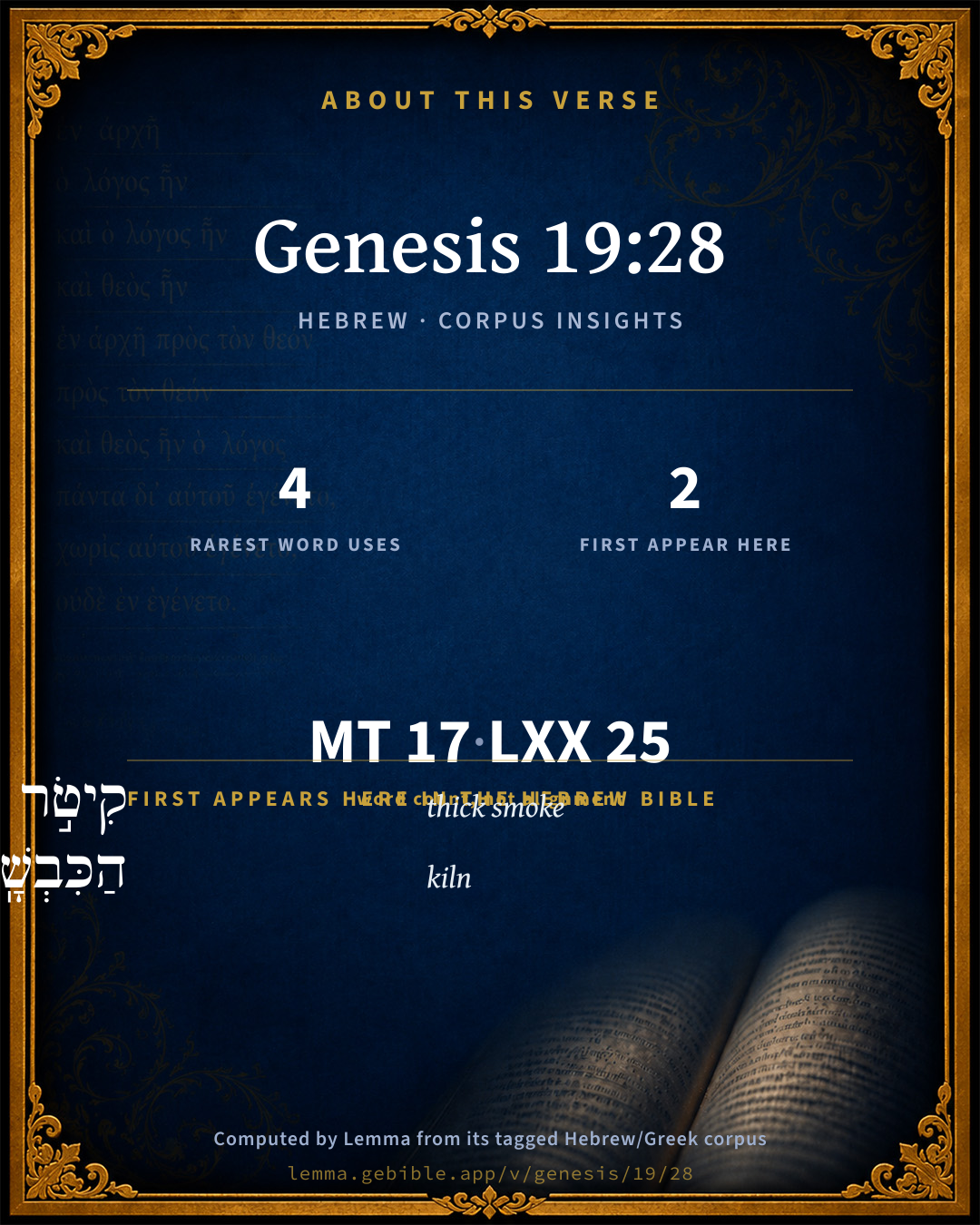
  • 2 first appearances in the Hebrew Bible
Full analysis ↓
Download a study sheet

One document with this verse’s original text, its word-by-word gloss line, the meaning frame, cross-references with their text, attributed commentary, and full source and license credits — printable, and it pastes into notes with its structure intact.

This verse Autodidact and up

Study sheet (.html) Plain text (.txt)

A passage Seminary Student

Up to 50 verses in one chapter. A passage sheet keeps up to 6 commentary sources and 12 cross-references per verse, in the order this page ranks them, and says so on the sheet whenever that leaves anything out. Ask for a single verse and you get the Autodidact verse sheet above.

Everything on this page stays free to read, with no account — the sheet is a download of what is already on screen, not access to it.

Want to remove ads? Support Godless Engineer
Compare translations 3

The same verse in 3 English versions, stacked beneath the original-language interlinear above. Click any original word for its lexicon entry.

Each is an independent rendering of the whole verse — the interlinear is not word-aligned to these translations.

Highlighted words mark where these versions differ — a whole-verse word diff, not a word-by-word alignment.

  • World English Bible Public Domain
    He looked toward Sodom and Gomorrah, and toward all the land of the plain, and looked, and saw that the smoke of the land went up as the smoke of a furnace.
  • King James Version Public Domain
    And he looked toward Sodom and Gomorrah, and toward all the land of the plain, and beheld, and, lo, the smoke of the country went up as the smoke of a furnace.
  • unfoldingWord Literal Text CC BY-SA 4.0
    and he looked down toward Sodom and Gomorrah and toward all the surface of the land of the plain. And he saw that, behold, smoke was rising from the land like smoke from a furnace.

unfoldingWord Literal Text — © unfoldingWord, licensed CC BY-SA 4.0. Word-aligned USFM3 via Door43 (git.door43.org/unfoldingWord/en_ult).

Versions to compare (up to 4)

3 of 4 selected

Show all 18 translations

Every available English version of this verse, each an independent rendering of the whole verse.

  • World English Bible Public Domain
    He looked toward Sodom and Gomorrah, and toward all the land of the plain, and looked, and saw that the smoke of the land went up as the smoke of a furnace.
  • Berean Standard Bible Public Domain
    He looked down toward Sodom and Gomorrah and all the land of the plain, and he saw the smoke rising from the land like smoke from a furnace.
  • Majority Standard Bible Public Domain
    He looked down toward Sodom and Gomorrah and all the land of the plain, and he saw the smoke rising from the land like smoke from a furnace.
  • King James Version Public Domain
    And he looked toward Sodom and Gomorrah, and toward all the land of the plain, and beheld, and, lo, the smoke of the country went up as the smoke of a furnace.
  • American Standard Version (1901) Public Domain
    and he looked toward Sodom and Gomorrah, and toward all the land of the Plain, and beheld, and, lo, the smoke of the land went up as the smoke of a furnace.
  • Revised Version (1885) Public Domain
    and he looked toward Sodom and Gomorrah, and toward all the land of the Plain, and beheld, and, lo, the smoke of the land went up as the smoke of a furnace.
  • Geneva Bible (1599) Public Domain
    And looking towarde Sodom and Gomorah and toward all the land of the plaine, behold, he sawe the smoke of the lande mounting vp as the smoke of a fornace.
  • Douay-Rheims (1899) Public Domain
    He looked towards Sodom and Gomorrha, and the whole land of that country: and he saw the ashes rise up from the earth as the smoke of a furnace.
  • Young's Literal Translation Public Domain
    and he looketh on the face of Sodom and Gomorrah, and on all the face of the land of the circuit, and seeth, and lo, the smoke of the land went up as smoke of the furnace.
  • Literal Standard Version CC BY-SA 4.0
    and he looks on the face of Sodom and Gomorrah, and on all the face of the land of the circuit, and sees, and behold, the smoke of the land went up as smoke of the furnace.
  • Unlocked Literal Bible CC BY-SA 4.0
    He looked down toward Sodom and Gomorrah and toward all the land of the plain. He looked and behold, smoke was rising from the land like the smoke of a furnace.
  • unfoldingWord Literal Text CC BY-SA 4.0
    and he looked down toward Sodom and Gomorrah and toward all the surface of the land of the plain. And he saw that, behold, smoke was rising from the land like smoke from a furnace.
  • Darby Bible Public Domain
    and he looked toward Sodom and Gomorrah, and toward all the land of the plain, and beheld, and lo, a smoke went up from the land as the smoke of a furnace.
  • World Messianic Bible Public Domain
    He looked toward Sodom and Gomorrah, and toward all the land of the plain, and saw that the smoke of the land went up as the smoke of a furnace.
  • Webster's Bible Public Domain
    And he looked towards Sodom and Gomorrah, and towards all the land of the plain, and beheld, and lo, the smoke of the country went up as the smoke of a furnace.
  • Free Bible Version CC BY-SA 4.0
    He looked down at Sodom and Gomorrah and the whole valley floor, and saw the land burning, sending up smoke like from a furnace.
  • Bible in Basic English Public Domain
    And looking in the direction of Sodom and Gomorrah and the lowland, he saw the smoke of the land going up like the smoke of an oven.
  • JPS Tanakh (1917) Public Domain
    And he looked out toward Sodom and Gomorrah, and toward all the land of the Plain, and beheld, and, lo, the smoke of the land went up as the smoke of a furnace.

Literal Standard Version (2020), Covenant Press — licensed CC BY-SA 4.0. Text via the HelloAO Bible API (eBible.org). Unlocked Literal Bible (unfoldingWord) — licensed CC BY-SA 4.0. Text via the HelloAO Bible API (eBible.org). unfoldingWord Literal Text — © unfoldingWord, licensed CC BY-SA 4.0. Word-aligned USFM3 via Door43 (git.door43.org/unfoldingWord/en_ult). Free Bible Version, Dr. Jonathan Gallagher — licensed CC BY-SA 4.0. Text via the HelloAO Bible API (eBible.org).

Word by word

More ways to search: Search by grammar → Find every occurrence → Compare this word →

Practice this passage: Drill this verse → Learn its vocabulary →

קִיטֹ֣ר
qîyṭôwr
H7008
“thick smoke of”
Noun, Common, Masculine, Singular, Construct
Part of Speech
Noun
Type
Common
Gender
Masculine
Number
Singular
State
Construct
Full BDB Definition

Origin: from H6999

TWOT: 2011b

thick smoke, smoke
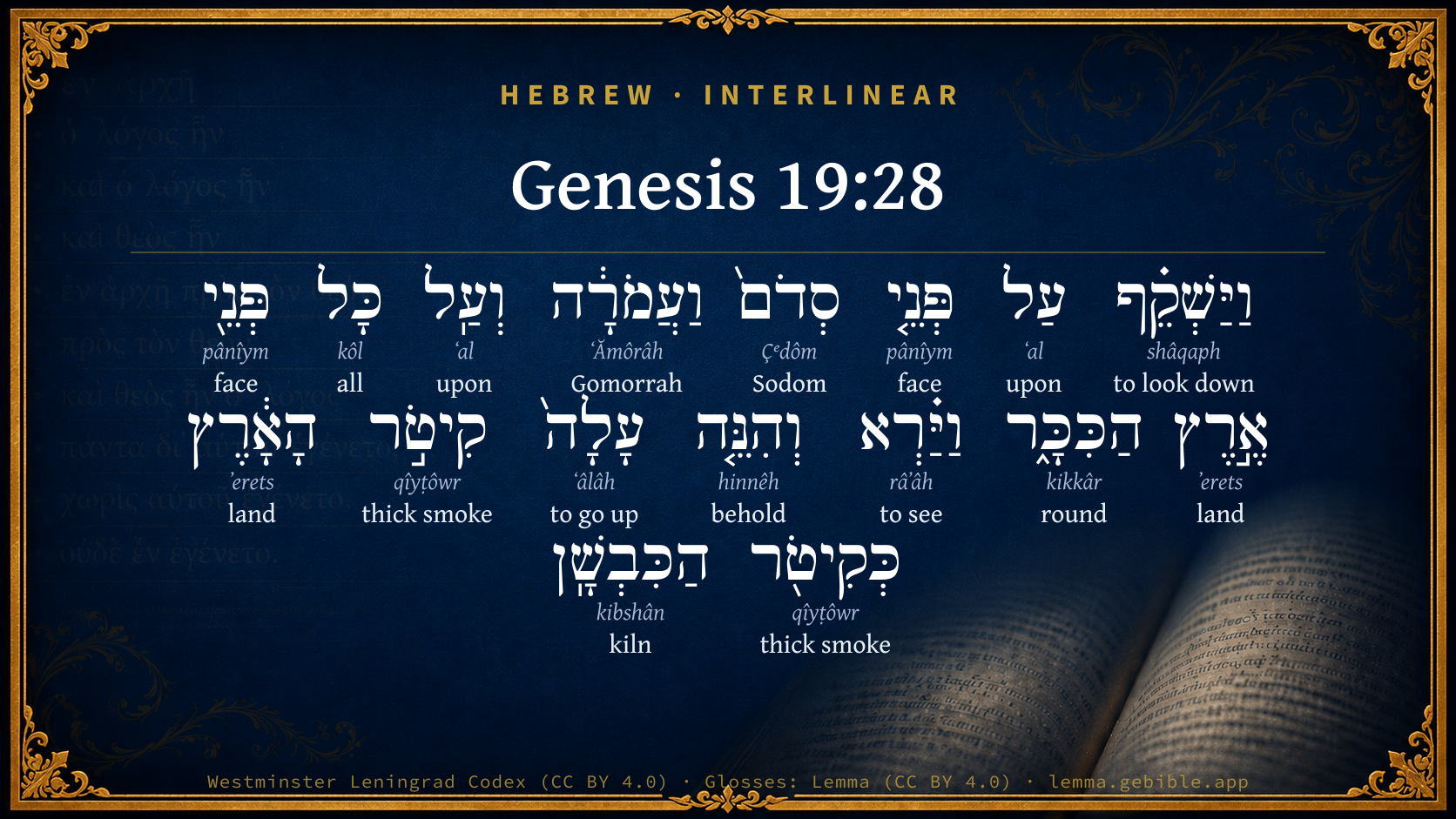
  1. וַיַּשְׁקֵ֗ף shâqaph H8259 “and · to look down” Conjunction + Verb, Hiphil, Sequential Imperfect, 3rd Person, Masculine, Singular
  2. עַל ʻal H5921 “upon” Preposition
  3. פְּנֵ֤י pânîym H6440 “face(s) of” Noun, Common, Both, Plural, Construct
  4. סְדֹם֙ Çᵉdôm H5467 “Sodom” Noun, Proper
  5. וַעֲמֹרָ֔ה ʻĂmôrâh H6017 “and · Gomorrah” Conjunction + Noun, Proper
  6. וְעַֽל ʻal H5921 “and · upon” Conjunction + Preposition
  7. כָּל kôl H3605 “all of” Noun, Common, Masculine, Singular, Construct
  8. פְּנֵ֖י pânîym H6440 “face(s) of” Noun, Common, Both, Plural, Construct
  9. אֶ֣רֶץ ʼerets H776 “land of” Noun, Common, Both, Singular, Construct
  10. הַכִּכָּ֑ר kikkâr H3603 “the · round” Particle, Definite Article + Noun, Common, Both, Singular, Absolute
  11. וַיַּ֗רְא râʼâh H7200 “and · to see” Conjunction + Verb, Qal, Sequential Imperfect, 3rd Person, Masculine, Singular
  12. וְהִנֵּ֤ה hinnêh H2009 “and · behold” Conjunction + Particle, Demonstrative
  13. עָלָה֙ ʻâlâh H5927 “to go up” Verb, Qal, Perfect, 3rd Person, Masculine, Singular
  14. הָאָ֔רֶץ ʼerets H776 “the · land” Particle, Definite Article + Noun, Common, Both, Singular, Absolute
  15. כְּקִיטֹ֖ר qîyṭôwr H7008 “like/as · thick smoke of” Preposition + Noun, Common, Masculine, Singular, Construct
  16. הַכִּבְשָֽׁן kibshân H3536 “the · kiln” Particle, Definite Article + Noun, Common, Masculine, Singular, Absolute

About this verse

These counts appear in no published source. They are computed here, from the morphology-tagged text and Lemma’s own curated glosses. What Lemma adds →

17
words
13
distinct lemmas
Pentateuch
section

Notable vocabulary

The rarest word here is קִיטֹ֣ר thick smoke H7008 — appearing just 4 times in the whole Hebrew Bible.

First appearance in Scripture

These words make their first canonical appearance in the Hebrew Bible here:

  • קִיטֹ֣ר thick smoke H7008
  • הַכִּבְשָֽׁן kiln H3536

Shared distinctive vocabulary

קִיטֹ֣ר thick smoke H7008 occurs in 3 verses of the Hebrew Bible. Also found in:

Grammatical profile

  • 3 verbs
  • 11 nouns
  • 2 prepositions
  • 1 particle

Verb forms

  • וַיַּשְׁקֵ֗ף Hiphil · Sequential Imperfect
  • וַיַּ֗רְא Qal · Sequential Imperfect
  • עָלָה֙ Qal · Perfect

Repetition

Words recur within this verse — often emphatic in Hebrew:

  • עַל upon H5921 ×2
  • פְּנֵ֤י face H6440 ×2
  • אֶ֣רֶץ land H776 ×2
  • קִיטֹ֣ר thick smoke H7008 ×2

Hebrew & Septuagint length

In English translation the verse runs 32 words from the Hebrew and 29 from the Septuagint (LXX English) — closely comparable.

A rough comparison of the two English renderings, which tokenize alike — not a word-level alignment.

Word counts can differ between the Hebrew and the Greek without any difference in meaning — e.g. the Hebrew direct-object marker אֵת has no separate Greek word, and Greek often adds the article ὁ.

In the original languages it is 17 Hebrew tokens and 25 Greek tokens — but the two are counted differently (Hebrew bundles its prefixes and suffixes into one token; the Greek is in lemma form), so that isn’t a like-for-like length.

Cross-references

9

Topical passages linked to Genesis 19:28 in the Treasury of Scripture Knowledge — connected by theme and wording, ordered by reader-vote popularity; previews shown in the World English Bible.

  • Revelation 18:9 The kings of the earth, who committed sexual immorality and lived wantonly with her, will weep and wail over her, when they look at the smoke of her burning,
  • Revelation 9:2 He opened the pit of the abyss, and smoke went up out of the pit, like the smoke from a burning furnace. The sun and the air were darkened because of the smoke from the pit.
  • Jude 1:7 Even as Sodom and Gomorrah, and the cities around them, having, in the same way as these, given themselves over to sexual immorality and gone after strange flesh, are set forth as an example, suffering the punishment of eternal fire.
  • Revelation 18:18 and cried out as they looked at the smoke of her burning, saying, 'What is like the great city?'
  • Revelation 21:8 But for the cowardly, unbelieving, sinners, abominable, murderers, sexually immoral, sorcerers, idolaters, and all liars, their part is in the lake that burns with fire and sulfur, which is the second death."
  • Psalms 107:34 And a fruitful land into a salt waste, For the wickedness of those who dwell in it.
  • 2 Peter 2:7 and delivered righteous Lot, who was very distressed by the lustful life of the wicked
  • Revelation 14:10–11 he also will drink of the wine of the wrath of God, which is prepared unmixed in the cup of his anger. He will be tormented with fire and sulfur in the presence of the holy angels, and in the presence of the Lamb.
  • Revelation 19:3 A second said, "Hallelujah! Her smoke goes up forever and ever."

Cross-references courtesy of OpenBible.info (CC BY 4.0).

Hebrew and Greek witnesses Masoretic Hebrew ↔ Greek Septuagint

The same verse in the two great witnesses to the Old Testament, shown verse-for-verse.

These are two independent witnesses, not word-aligned to each other, and the Septuagint is shown in lemma (dictionary) form.

Hebrew Genesis 19:28 Masoretic · Westminster Leningrad Codex

וַיַּשְׁקֵ֗ף עַל פְּנֵ֤י סְדֹם֙ וַעֲמֹרָ֔ה וְעַֽל כָּל פְּנֵ֖י אֶ֣רֶץ הַכִּכָּ֑ר וַיַּ֗רְא וְהִנֵּ֤ה עָלָה֙ קִיטֹ֣ר הָאָ֔רֶץ כְּקִיטֹ֖ר הַכִּבְשָֽׁן

He looked toward Sodom and Gomorrah, and toward all the land of the plain, and looked, and saw that the smoke of the land went up as the smoke of a furnace.

World English Bible · Public Domain

Greek LXX Genesis 19:28 Septuagint · lemma form

καί ἐπιβλέπω ἐπί πρόσωπον σοδομα καί γομορρα καί ἐπί πρόσωπον ὁ γῆ ὁ περίχωρος καί ὁράω καί ἰδού ἀναβαίνω φλόξ ὁ γῆ ὡσεί ἀτμίς κάμινος

And he looked towards Sodom and Gomorrha, and towards the surrounding country, and saw, and behold a flame went up from the earth, as the smoke of a furnace.

LXX2012 (modern English Septuagint) · Public Domain

Hebrew: Westminster Leningrad Codex (CC BY 4.0). Greek: Septuagint (public domain); English from LXX2012 (modern English Septuagint) (Public Domain). How the Septuagint differs from the Hebrew →

Targum (Aramaic paraphrase)

2

The Targum is the ancient Jewish Aramaic paraphrase of the Hebrew Scriptures — an interpretive translation, not the Hebrew text itself. Onkelos (literal) and Pseudo-Jonathan (expansive) render the Torah, and Jonathan the Prophets. Coverage is partial: where no permissively-licensed English translation exists for a verse, only the Aramaic is shown. This is verse-level text, not a word-by-word alignment to the Hebrew.

  1. Targum Onkelos Torah (Genesis–Deuteronomy)
    וְאִסְתְּכִי עַל אַפֵּי סְדוֹם וַעֲמוֹרָה וְעַל כָּל אַפֵּי אַרְעָא דְּמֵישְׁרָא וַחֲזָא וְהָא סְלִיק תְּנָנָא דְּאַרְעָא כִּתְנָנָא דְּאַתּוּנָא

    (no public-domain English translation for this verse)

    Targum Onkelos — Aramaic: “Onkelos Genesis” (public domain); “Onkelos Exodus” (public domain); “Onkelos Leviticus” (public domain); “Onkelos Numbers” (public domain); “Onkelos Deuteronomy” (public domain). English: “Sefaria Community Translation” (CC0 1.0 (public-domain dedication)); “J.W. Etheridge. The Targums of Onkelos and Jonathan Ben Uzziel on the Pentateuch. London: Longmans, Green, 1862” (public domain). Text via Sefaria.

  2. Targum Pseudo-Jonathan Torah (Genesis–Deuteronomy)
    וְאוֹדִיק עַל אַנְפֵּי סְדוֹם וַעֲמוֹרָה וְעַל כָּל אַנְפֵּי אֲרַע מֵישְׁרָא וַחֲמָא וְהָא סְלֵיק קוּטְרָא דְאַרְעָא הוּא כְּקוּטְרָא דְאַתּוּנָא

    And he looked towards Sedom and Amorah, and all the land of the plain, and saw, and, behold, the smoke of the land went up as the smoke of a furnace.

    Targum Pseudo-Jonathan — Aramaic: “Targum Jonathan on Genesis” (public domain); “Targum Jonathan on Exodus” (public domain); “Targum Jonathan on Leviticus” (public domain); “Targum Jonathan on Numbers” (public domain); “Targum Jonathan on Deuteronomy” (public domain). English: “The Targum of Jonathan ben Uzziel, trans. J. W. Etheridge, London, 1862” (public domain). Text via Sefaria.

Commentary

Notes on Genesis 19:28 from classic Christian and Jewish commentators (each source and its license shown beneath its notes). The classic Christian expositions comment on the surrounding passage and are grouped to its opening verse, so a note may address several verses; the Jewish commentaries on the Tanakh (Rashi and others) are per-verse, so they appear only where the commentator wrote on this verse.

Lemma curates 59 commentaries, every one of them public domain or Creative Commons licensed, each selected and text-cleaned for this edition rather than reprinted as found. About our sources →

Trapp's Complete Commentary

John Trapp

Gen 19:28 And he looked toward Sodom and Gomorrah, and toward all the land of the plain, and beheld, and, lo, the smoke of the country went up as the smoke of a furnace.

Ver. 28. And he looked.] Abraham might look upon the smoke of Sodom; Lot might not; because it would work more on Lot’s heart, than on Abraham’s, who had more grace.

The smoke of the country.] Nothing else was now to be seen of that fair and fruitful plain. Sic transit gloria mundi . When we most greedily grasp earthly things, we embrace nothing but smoke, which wrings tears from our eyes, and soon vanisheth into nothing.

John Trapp, A Commentary or Exposition upon All the Books of the Old and New Testament (1647–1656) — public domain. Text from a community e-Sword module.

Ellicott's Commentary for English Readers

(28) Lo, the smoke of the country (really, land) went up as the smoke of a furnace.—The substitution of the word country for land is confusing. It was the land of the Ciccar, just mentioned, which was in flames. As Abraham could see the Ciccar, it must have been at the northern end of the Dead Sea (see Note on Gen_18:16); and as a violent conflagration was raging throughout it, the site of the cities could not have been submerged (see Note on Gen_14:3). The violence of the fire is indicated by the last word, which is not the ordinary word for a furnace, but means a kiln, such as that used for burning chalk into lime, or for melting ores of metal.

A Bible Commentary for English Readers, edited by Charles John Ellicott (1878–1897) — public domain. Text from a community e-Sword module.

The Cambridge Bible for Schools and Colleges

gen. ed. J. J. S. Perowne

28. the smoke of the land] The word is one used especially in connexion with incense and sacrifice. It is not the usual word for smoke, but rather corresponds to our “reek” or, as Driver, “steam.” Travellers relate that, owing to rapid evaporation, there always appears a steamy mist rising up from the Dead Sea. Wis_10:6-7, “While the ungodly were perishing, wisdom delivered a righteous man, when he fled from the fire that descended out of heaven on Pentapolis. To whose wickedness a smoking waste still witnesseth … Yea and a disbelieving soul hath a memorial there, a pillar of salt still standing.”

a furnace] The word used in Exo_9:8; Exo_9:10; Exo_19:18, “a furnace,” or “kiln,” for burning lime, or making bricks.

29 (P). when God destroyed, &c.] This verse contains P’s brief summary of the whole event. This will explain the repetition of the narrative, and the sudden substitution of “God” (Elohim) for “the Lord” (Jehovah). The expression “God remembered Abraham” would otherwise seem strange after the narrative in 18; but, as a matter of fact, the sentence probably followed after Gen_13:12, with P’s account of the separation of Abram and Lot. For “destroyed” (shâḥath), cf. Gen_6:13; Gen_6:17, Gen_9:11; Gen_9:15 (P).

The Cambridge Bible for Schools and Colleges (gen. ed. J. J. S. Perowne; Cambridge University Press, 1878–1918) — public domain. Text from a community e-Sword module.

John Gill's Exposition

And it came to pass, when God destroyed the cities of the plain,.... Not when he had destroyed them, but when he was about to destroy them; for Lot was sent out from them, and delivered out of them, before they were destroyed; and therefore Noldius rightly renders the words, "before God destroyed" (m) them:

that God remembered Abraham; his promise to him, that he would bless them that blessed him, Gen 12:3; and his prayer to him for Lot in Gen 18:23; for, though he does not mention him by name, he bore him on his heart, and he was always in the number of the righteous ones, on whose account he interceded for the sparing of the cities; and, though God did not hear and answer him with regard to the cities, yet he did with respect to the righteous men in them:

and sent Lot out of the midst of the overthrow; by two angels, who took him by the hand and brought him out of Sodom, now overthrown:

when he overthrew the cities in which Lot dwelt; that is, in one of which Lot dwelt, namely, Sodom, as Aben Ezra rightly observes, comparing the passage with Jdg 12:7; unless it can be thought that Lot first dwelt in one of those cities and then in another, and first and last in them all, which is not very likely.

(m) "antequam perderet", Nold. Ebr. concord. partic. p. 144. No. 679.

John Gill's Exposition of the Whole Bible (1746–1763) — public domain (CC PDM 1.0). Text via the HelloAO Bible API.

Whedon's Commentary on the Bible

Daniel D. Whedon

28. Looked toward Sodom… smoke — The fearful sight shows him that there were not even ten righteous persons to be found in Sodom. But Abraham’s intercession had an answer in the salvation of Lot. See Gen_19:29.

As the smoke of a furnace — The rain of fire and brimstone left behind it a smoking ruin, and the deep depression from which the smoke ascended might well remind one of the mouth of a furnace.

Daniel D. Whedon (gen. ed.), Commentary on the Old and New Testaments (1874–1909) — public domain. Text from a community e-Sword module.

The Pulpit Commentary

And he looked toward literally, towards the face, or visible side (cf. Gen_18:16 where the same phrase is employed to describe the act of the angels on leaving Mamre) Sodom and Gomorrah , and toward all the land of the plain, or Jordan circle. The cities of the plain are commonly believed to have been situated at the southern extremity of the Dead Sea, The principal reasons assigned for this conclusion may be stated.

1. Josephus and Jerome, the one representing Jewish, and the other Christian, tradition, both speak of a Zoar as existing in that locality.

2. The difference of level between the northern and southern ends of the lake, the one according to Lynch being 1300 feet, and the other not more than 16 feet, seems to favor the idea that the latter is of recent formation, having been, in fact, submerged at the time of the overthrow of the cities.

3. A ridge of rock-salt on the west of the Yale of Salt is called by the name Jebel Usdum, in which a trace of the word Sodom is by some detected; and the pillars of salt that in that region have from time to time been detached from the salt cliffs have been designated by the name of Lot"s wife (Bint Sheikh Lot).

4. The statement of Gen_14:3 appears to imply that the Salt Sea now covers what was originally the vale of Siddim.

5. The expression "like the land of Egypt as thou comest to Zoar" (Gen_13:10) is suggestive rather of the southern than of the northern extremity of the lake as the site of the Pentapolis. It may be added that this opinion has received the sanction of Robinson, Stanley, Porter, Thomson (The Land and the Book), and other eminent geographers. On the other hand, there are reasons for believing that the true site of the cities was at the north, and not the south, of the Dead Sea.

1. The circle of the Jordan was visible from the Bethel plateau; (Gen_13:10) the southern extremity of the Dead Sea is not.

2. From the heights above Hebron or Mature, though the actual circle is not visible, "yet the depression between the nearer hills and those of Gilead can be perceived, and Abraham could at once identify the locality whence the smoke arose," after Sodom"s burning.

3. Chedorlaomer"s route (Gen_14:7-14) was from Kadesh to Hazezon-tamar, midway up the western shore of the Dead Sea, from Hazezon-tamar to the vale of Siddim, and from Siddim to Dan, the natural conclusion being that on reaching Hazezon-tamar he did not turn southward, but continued marching northwards.

4. Moses from Mount Nebo (Deu_34:3) beheld the south, and the plain of the valley of Jericho, the city of palm trees, unto Zoar," which was certainly possible if Zoar was in the line of vision with the plain and the city of Jericho, but as certainly impossible if it was at the southern extremity of the lake This view has been advocated by Grove (Smith"s "Biblical Dictionary," art. ZONE) and by Tristram ("Land of Israel," pp. 354-358, and "Land of Moab," pp. 330-334), and has been adopted by Drew ("Imp." "Bible Dict.," art. Sodom), Dykes ("Abraham, the Friend of God," p. 185), and Inglis ("Genesis, p. 168). And beheld, and, lo, the smoke of the country went up as the smoke of a (literally, of the) furnace. Thus the appalling catastrophe proclaimed its reality to Abraham; to subsequent ages it stamped a witness of its severity

(1) upon the region itself, in the bleak and desolate aspect it has ever since possessed;

(2) upon the page of inspiration, being by subsequent Scripture writers constantly referred to as a standing, warning against incurring the Almighty"s wrath (Deu_29:22; Isa_13:19; Jer_49:18; Lam_4:6; Amo_4:11; 2Pe_2:6 Jud_1:7) and

(3) upon the course of ancient tradition, which it powerfully affected. Cf. Tacitus, "Hist.," 5:7: "Hand procul inde eampi, quos ferunt olim uberes, magnisque urbibus habitatos, fulminum jaetu arsisse; et manere vestigia; terramque ipsam specie torridam vim frugiferam perdidisse; nam cuncta atra et inania velut in cinerem vanescunt. Ego, sicut inelitas quondam urbes igne celesti flagrasse concesserim." For traditional notices of this event by Diodorus Siculus, Strabo, Pliny, Ovid, &c. ;vide Rosenm (Scholia I Gen_19:25)

The Pulpit Commentary (1880–1919), ed. H.D.M. Spence-Jones & Joseph S. Exell — public domain. Text from a community e-Sword module.

John Wesley's Explanatory Notes

And he looked toward Sodom - Not as Lot's wife did, tacitly reflecting upon the divine severity, but humbly adoring it, and acquiescing in it. Here is God's favourable regard to Abraham, ver. 29. As before when Abraham prayed for Ishmael, God heard him for Isaac, so now when he prayed for Sodom, he heard for Lot.

John Wesley, Explanatory Notes Upon the Whole Bible (1754–1765) — public domain. Text via the GEBible commentary corpus.

Rashi

Rabbi Shlomo Yitzchaki (Rashi)

קיטר signifies a column of smoke. old French torche; English torch.

הכבשן A FURNACE — an excavation in which they burn stone to lime. This is the meaning of כבשן wherever it occurs in the Torah.

Rashi on the Tanakh — English translations: “The Judaica Press complete Tanach with Rashi, translated by A. J. Rosenberg” (CC BY 4.0); “Pentateuch with Rashi's commentary by M. Rosenbaum and A.M. Silbermann, 1929-1934” (public domain); “The Metsudah Tanach series, Lakewood, N.J” (CC BY 4.0); and “The Book of Joshua, Metsudah Publications, 1997” (CC BY 4.0). Text via Sefaria.

Radak

Rabbi David Kimhi (Radak)

וישקף...קיטור הארץ, smoke, from the fire which had burned the earth.

הכבשן, a sort of kiln in which one fires stones and loam into earthenware. Alternately, this kiln is used to wash earthenware vessels.

Radak on the Tanakh — English translations: “Sefaria Community Translation” (CC0 1.0 (public-domain dedication)); “Eliyahu Munk, HaChut Hameshulash” (CC BY 4.0); “Rabbi Mike Feuer, Jerusalem Anthology” (CC BY 4.0); and “R. David Kimhi on the first book of Psalms, Translated by R.G. Finch, London, 1919” (public domain). Text via Sefaria.

Lesson kit

Teaching starters — assembled from the data on this page, not authored interpretation. Every prompt links to the verse data it draws on. Edit before teaching.

Genesis, in the Pentateuch, opens this verse with 17 words (13 distinct Hebrew lemmas). Its most distinctive word is qîyṭôwr (“thick smoke”). A historical commentator’s framing appears above. Read the whole chapter for the surrounding context.

Discussion questions

  1. How does “thick smoke” (qîyṭôwr) shape what this verse is saying?
  2. 2 words here appear for the first time in Scripture. What is being introduced at this debut?
  3. Psalms 119:83 shares the word «thick smoke» with this verse. How do the two illuminate each other?
  4. “upon” occurs 2× in this one verse. What is the effect of the repetition?
  5. The translations on this page render this verse differently — a whole-verse word diff, not a word-by-word alignment. What might account for the different wordings?
  6. The verb «וַיַּשְׁקֵ֗ף» is Hiphil Sequential Imperfect. How does its form color the action?
  7. Reading how Trapp's Complete Commentary and Ellicott's Commentary for English Readers read this verse, where do the two commentators agree and where do they part?

Things to notice

Reading settings

Reading text

Shown beneath each verse's original-language words.

Old Testament
Old Testament edition

Read the OT as the Masoretic Hebrew (MT) or the Greek Septuagint (LXX).

English shown for the Greek Septuagint (in the Hebrew ↔ Greek comparison).

Comparing translations? Open the Compare panel on any verse page to stack up to four side by side.