
Exodus 19:23

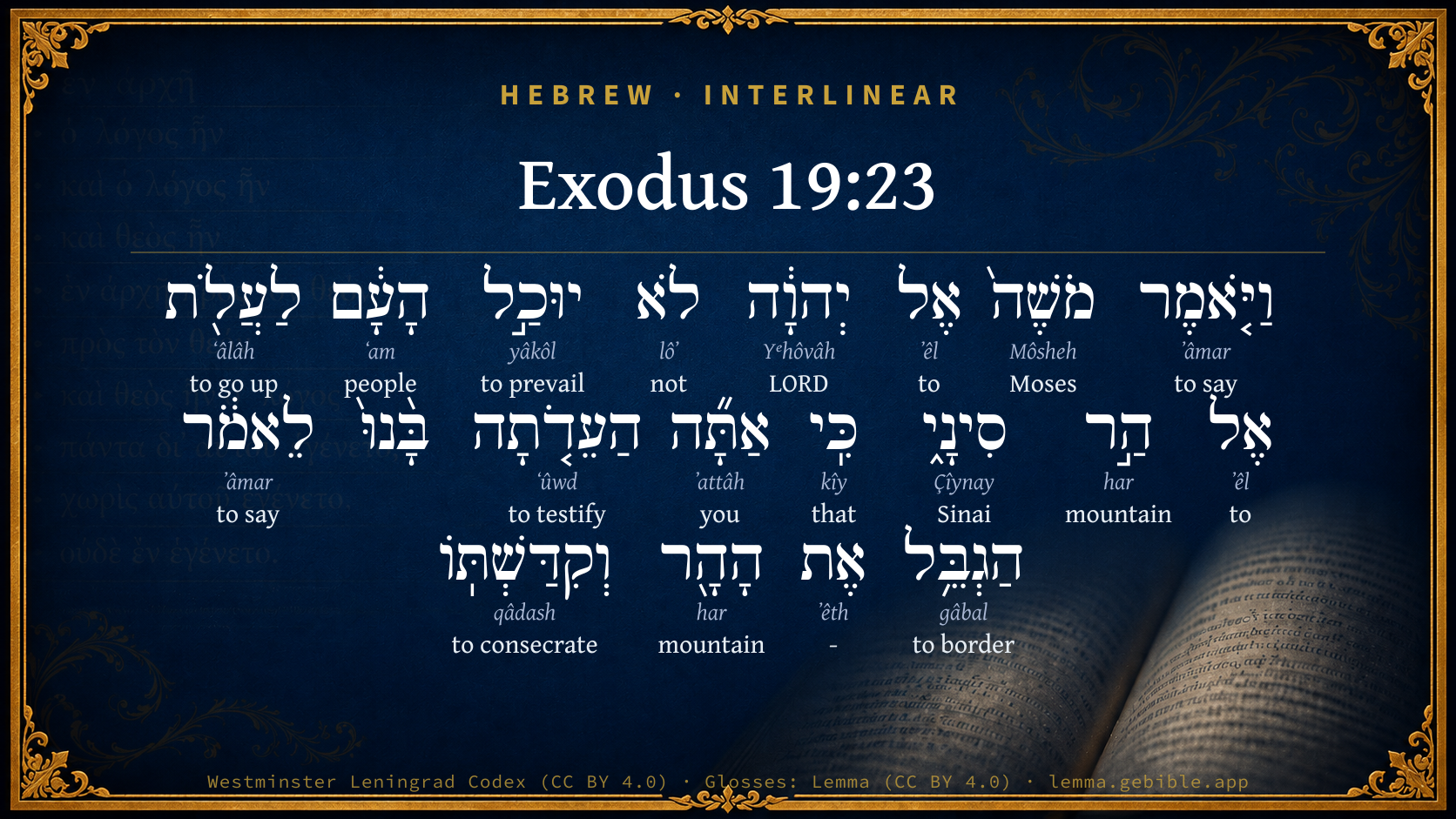
Hebrew (Westminster Leningrad Codex) Exodus 19:23 appears in the Hebrew Old Testament. The text above is from the Westminster Leningrad Codex. Each word links to its Strong’s number, a concise gloss, and parsing drawn from the Open Scriptures Hebrew Bible morphology. Click any word for its full Brown-Driver-Briggs (BDB) entry.
Download image
Cite this verse

Exodus 19:23 (World English Bible). Public Domain. Lemma interlinear Bible study tool, https://lemma.gebible.app/v/exodus/19/23.

Show BibTeX & RIS
BibTeX
RIS
English Translation
Moses said to Yahweh, "The people can't come up to Mount Sinai, for you charged us, saying, 'Set bounds around the mountain, and sanctify it.'"
World English Bible · Public Domain
Download a study sheet

One document with this verse’s original text, its word-by-word gloss line, the meaning frame, cross-references with their text, attributed commentary, and full source and license credits — printable, and it pastes into notes with its structure intact.

This verse Autodidact and up

Study sheet (.html) Plain text (.txt)

A passage Seminary Student

Up to 50 verses in one chapter. A passage sheet keeps up to 6 commentary sources and 12 cross-references per verse, in the order this page ranks them, and says so on the sheet whenever that leaves anything out. Ask for a single verse and you get the Autodidact verse sheet above.

Everything on this page stays free to read, with no account — the sheet is a download of what is already on screen, not access to it.

Want to remove ads? Support Godless Engineer
Compare translations 3

The same verse in 3 English versions, stacked beneath the original-language interlinear above. Click any original word for its lexicon entry.

Each is an independent rendering of the whole verse — the interlinear is not word-aligned to these translations.

Highlighted words mark where these versions differ — a whole-verse word diff, not a word-by-word alignment.

  • World English Bible Public Domain
    Moses said to Yahweh, "The people can't come up to Mount Sinai, for you charged us, saying, 'Set bounds around the mountain, and sanctify it.'"
  • King James Version Public Domain
    And Moses said unto the LORD, The people cannot come up to mount Sinai: for thou chargedst us, saying, Set bounds about the mount, and sanctify it.
  • unfoldingWord Literal Text CC BY-SA 4.0
    And Moses said to Yahweh, “The people are not able to come up on Mount Sinai, for you yourself warned us, saying: ‘Set boundaries on the mountain and set it apart.’”

unfoldingWord Literal Text — © unfoldingWord, licensed CC BY-SA 4.0. Word-aligned USFM3 via Door43 (git.door43.org/unfoldingWord/en_ult).

Versions to compare (up to 4)

3 of 4 selected

Show all 18 translations

Every available English version of this verse, each an independent rendering of the whole verse.

  • World English Bible Public Domain
    Moses said to Yahweh, "The people can't come up to Mount Sinai, for you charged us, saying, 'Set bounds around the mountain, and sanctify it.'"
  • Berean Standard Bible Public Domain
    But Moses said to the LORD, “The people cannot come up Mount Sinai, for You solemnly warned us, ‘Put a boundary around the mountain and set it apart as holy.’”
  • Majority Standard Bible Public Domain
    But Moses said to the LORD, “The people cannot come up Mount Sinai, for You solemnly warned us, ‘Put a boundary around the mountain and set it apart as holy.’”
  • King James Version Public Domain
    And Moses said unto the LORD, The people cannot come up to mount Sinai: for thou chargedst us, saying, Set bounds about the mount, and sanctify it.
  • American Standard Version (1901) Public Domain
    And Moses said unto Jehovah, The people cannot come up to mount Sinai: for thou didst charge us, saying, Set bounds about the mount, and sanctify it.
  • Revised Version (1885) Public Domain
    And Moses said unto the LORD, The people cannot come up to mount Sinai: for thou didst charge us, saying, Set bounds about the mount, and sanctify it.
  • Geneva Bible (1599) Public Domain
    And Moses sayde vnto the Lord, The people can not come vp into the mount Sinai: for thou hast charged vs, saying, Set markes on the mountaine, and sanctifie it.
  • Douay-Rheims (1899) Public Domain
    And Moses said to the Lord: The people cannot come up to mount Sinai: for thou did charge, and command, saying: Set limits about the mount, and sanctify it.
  • Young's Literal Translation Public Domain
    And Moses saith unto Jehovah, `The people `is' unable to come up unto mount Sinai, for Thou -- Thou hast protested to us, saying, Make a border `for' the mount, then thou hast sanctified it.'
  • Literal Standard Version CC BY-SA 4.0
    And Moses says to YHWH, “The people [are] unable to come up to Mount Sinai, for You have protested to us, saying, Make a border [for] the mountain, then you have sanctified it.”
  • Unlocked Literal Bible CC BY-SA 4.0
    Moses said to Yahweh, “The people cannot come up to Mount Sinai, for you commanded us: 'Set boundaries around the mountain and set it apart to Yahweh.'”
  • unfoldingWord Literal Text CC BY-SA 4.0
    And Moses said to Yahweh, “The people are not able to come up on Mount Sinai, for you yourself warned us, saying: ‘Set boundaries on the mountain and set it apart.’”
  • Darby Bible Public Domain
    And Moses said to Jehovah, The people cannot come up to mount Sinai; for thou hast testified to us, saying, Set bounds about the mountain, and hallow it.
  • World Messianic Bible Public Domain
    Moses said to the LORD, “The people can’t come up to Mount Sinai, for you warned us, saying, ‘Set bounds around the mountain, and sanctify it.’”
  • Webster's Bible Public Domain
    And Moses said to the LORD, The people cannot come up to mount Sinai: for thou chargedst us, saying, Set bounds about the mount, and sanctify it.
  • Free Bible Version CC BY-SA 4.0
    But Moses said to the Lord, “The people cannot come up Mount Sinai. You yourself warned us, ‘Set up a boundary around the mountain, and treat it as holy.’”
  • Bible in Basic English Public Domain
    And Moses said to the Lord, The people will not be able to come up the mountain, for you gave us orders to put limits round the mountain, marking it out and making it holy.
  • JPS Tanakh (1917) Public Domain
    And Moses said unto the LORD: 'The people cannot come up to mount Sinai; for thou didst charge us, saying: Set bounds about the mount, and sanctify it.'

Literal Standard Version (2020), Covenant Press — licensed CC BY-SA 4.0. Text via the HelloAO Bible API (eBible.org). Unlocked Literal Bible (unfoldingWord) — licensed CC BY-SA 4.0. Text via the HelloAO Bible API (eBible.org). unfoldingWord Literal Text — © unfoldingWord, licensed CC BY-SA 4.0. Word-aligned USFM3 via Door43 (git.door43.org/unfoldingWord/en_ult). Free Bible Version, Dr. Jonathan Gallagher — licensed CC BY-SA 4.0. Text via the HelloAO Bible API (eBible.org).

Word by word

More ways to search: Search by grammar → Find every occurrence → Compare this word →

Practice this passage: Drill this verse → Learn its vocabulary →

הַגְבֵּ֥ל
gâbal
H1379
“border”
Verb, Hiphil, Imperative, 2nd Person, Masculine, Singular
Part of Speech
Verb
Stem
Hiphil
Form
Imperative
Person
2nd Person
Gender
Masculine
Number
Singular
Full BDB Definition

Origin: a primitive root

TWOT: 307

to bound, border - (Qal) to bound, border - (Hiphil) to set bounds, set bounds for
  1. וַיֹּ֤אמֶר ʼâmar H559 “and · to say” Conjunction + Verb, Qal, Sequential Imperfect, 3rd Person, Masculine, Singular
  2. מֹשֶׁה֙ Môsheh H4872 “Moses” Noun, Proper
  3. אֶל ʼêl H413 “to” Preposition
  4. יְהוָ֔ה Yᵉhôvâh H3068 “LORD” Noun, Proper
  5. לֹא lôʼ H3808 “not” Particle, Negative
  6. יוּכַ֣ל yâkôl H3201 “to prevail” Verb, Qal, Imperfect, 3rd Person, Masculine, Singular
  7. הָעָ֔ם ʻam H5971 “the · people” Particle, Definite Article + Noun, Common, Masculine, Singular, Absolute
  8. לַעֲלֹ֖ת ʻâlâh H5927 “to go up” Preposition + Verb, Qal, Infinitive Construct
  9. אֶל ʼêl H413 “to” Preposition
  10. הַ֣ר har H2022 “mountain of” Noun, Common, Masculine, Singular, Construct
  11. סִינָ֑י Çîynay H5514 “Sinai” Noun, Proper
  12. כִּֽי kîy H3588 “that” Conjunction
  13. אַתָּ֞ה ʼattâh H859 “you” Pronoun, Personal, 2nd Person, Masculine, Singular
  14. הַעֵדֹ֤תָה ʻûwd H5749 “to testify” Verb, Hiphil, Perfect, 2nd Person, Masculine, Singular
  15. לֵאמֹ֔ר ʼâmar H559 “to say” Preposition + Verb, Qal, Infinitive Construct
  16. אֶת ʼêth H853 “-” Particle, Direct Object
  17. הָהָ֖ר har H2022 “the · mountain” Particle, Definite Article + Noun, Common, Masculine, Singular, Absolute
  18. וְקִדַּשְׁתּֽוֹ qâdash H6942 “and · to consecrate · him” Conjunction + Verb, Piel, Sequential Perfect, 2nd Person, Masculine, Singular + Suffix, Personal, 3rd Person, Masculine, Singular

About this verse

These counts appear in no published source. They are computed here, from the morphology-tagged text and Lemma’s own curated glosses. What Lemma adds →

20
words
16
distinct lemmas
Pentateuch
section

Notable vocabulary

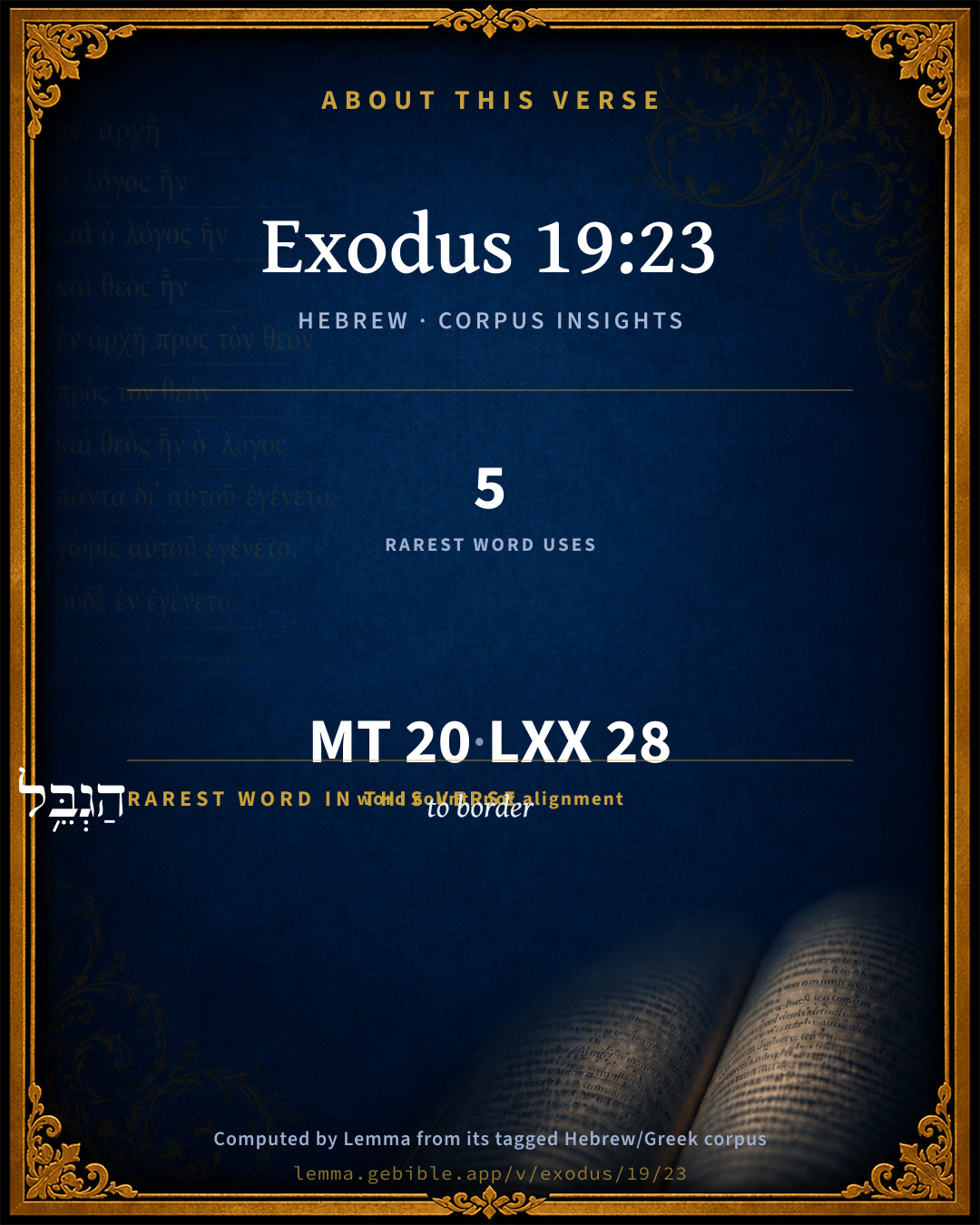
The rarest word here is הַגְבֵּ֥ל to border H1379 — appearing just 5 times in the whole Hebrew Bible.

Shared distinctive vocabulary

הַגְבֵּ֥ל to border H1379 occurs in 5 verses of the Hebrew Bible. Also found in:

Grammatical profile

  • 7 verbs
  • 6 nouns
  • 1 pronoun
  • 3 prepositions
  • 1 conjunction
  • 2 particles

Verb forms

  • וַיֹּ֤אמֶר Qal · Sequential Imperfect
  • יוּכַ֣ל Qal · Imperfect
  • לַעֲלֹ֖ת Qal · Infinitive Construct
  • הַעֵדֹ֤תָה Hiphil · Perfect
  • לֵאמֹ֔ר Qal · Infinitive Construct
  • הַגְבֵּ֥ל Hiphil · Imperative
  • וְקִדַּשְׁתּֽוֹ Piel · Sequential Perfect

Repetition

Words recur within this verse — often emphatic in Hebrew:

  • וַיֹּ֤אמֶר to say H559 ×2
  • הַ֣ר mountain H2022 ×2
  • אֶל to H413 ×2

Hebrew & Septuagint length

In English translation the verse runs 25 words from the Hebrew and 33 from the Septuagint (LXX English) — closely comparable.

A rough comparison of the two English renderings, which tokenize alike — not a word-level alignment.

Word counts can differ between the Hebrew and the Greek without any difference in meaning — e.g. the Hebrew direct-object marker אֵת has no separate Greek word, and Greek often adds the article ὁ.

In the original languages it is 20 Hebrew tokens and 28 Greek tokens — but the two are counted differently (Hebrew bundles its prefixes and suffixes into one token; the Greek is in lemma form), so that isn’t a like-for-like length.

Cross-references

2

Topical passages linked to Exodus 19:23 in the Treasury of Scripture Knowledge — connected by theme and wording, ordered by reader-vote popularity; previews shown in the World English Bible.

  • Exodus 19:12 You shall set bounds to the people round about, saying, 'Be careful that you don't go up onto the mountain, or touch its border. Whoever touches the mountain shall be surely put to death.
  • Joshua 3:4–5 Yet there shall be a space between you and it, about two thousand cubits by measure: don't come near to it, that you may know the way by which you must go; for you have not passed this way heretofore.

Cross-references courtesy of OpenBible.info (CC BY 4.0).

Hebrew and Greek witnesses Masoretic Hebrew ↔ Greek Septuagint

The same verse in the two great witnesses to the Old Testament, shown verse-for-verse.

These are two independent witnesses, not word-aligned to each other, and the Septuagint is shown in lemma (dictionary) form.

Hebrew Exodus 19:23 Masoretic · Westminster Leningrad Codex

וַיֹּ֤אמֶר מֹשֶׁה֙ אֶל יְהוָ֔ה לֹא יוּכַ֣ל הָעָ֔ם לַעֲלֹ֖ת אֶל הַ֣ר סִינָ֑י כִּֽי אַתָּ֞ה הַעֵדֹ֤תָה בָּ֨נוּ֙ לֵאמֹ֔ר הַגְבֵּ֥ל אֶת הָהָ֖ר וְקִדַּשְׁתּֽוֹ

Moses said to Yahweh, "The people can't come up to Mount Sinai, for you charged us, saying, 'Set bounds around the mountain, and sanctify it.'"

World English Bible · Public Domain

Greek LXX Exodus 19:23 Septuagint · lemma form

καί εἶπον μωυσῆς πρός ὁ θεός οὐ δύναμαι ὁ λαός προσ ἀναβαίνω πρός ὁ ὄρος ὁ σινα σύ γάρ διαμαρτυρέω ἐγώ λέγω ἀποὁρίζω ὁ ὄρος καί ἁγιάζω αὐτός

And Moses said to God, The people will not be able to approach to the mount of Sina, for you have solemnly charged us, saying, Set bounds to the mountain and sanctify it.

LXX2012 (modern English Septuagint) · Public Domain

Hebrew: Westminster Leningrad Codex (CC BY 4.0). Greek: Septuagint (public domain); English from LXX2012 (modern English Septuagint) (Public Domain). How the Septuagint differs from the Hebrew →

Targum (Aramaic paraphrase)

2

The Targum is the ancient Jewish Aramaic paraphrase of the Hebrew Scriptures — an interpretive translation, not the Hebrew text itself. Onkelos (literal) and Pseudo-Jonathan (expansive) render the Torah, and Jonathan the Prophets. Coverage is partial: where no permissively-licensed English translation exists for a verse, only the Aramaic is shown. This is verse-level text, not a word-by-word alignment to the Hebrew.

  1. Targum Onkelos Torah (Genesis–Deuteronomy)
    וַאֲמַר משֶׁה קֳדָם יְיָ לָא יִכּוֹל עַמָא לְמִסַק לְטוּרָא דְסִינַי אֲרֵי אַתְּ אַסְהֵדְתָּ בָּנָא לְמֵימַר תַּחִים יָת טוּרָא וְקַדְשֵׁהּ:

    (no public-domain English translation for this verse)

    Targum Onkelos — Aramaic: “Onkelos Genesis” (public domain); “Onkelos Exodus” (public domain); “Onkelos Leviticus” (public domain); “Onkelos Numbers” (public domain); “Onkelos Deuteronomy” (public domain). English: “Sefaria Community Translation” (CC0 1.0 (public-domain dedication)); “J.W. Etheridge. The Targums of Onkelos and Jonathan Ben Uzziel on the Pentateuch. London: Longmans, Green, 1862” (public domain). Text via Sefaria.

  2. Targum Pseudo-Jonathan Torah (Genesis–Deuteronomy)
    וַאֲמַר משֶׁה קֳדָם יְיָ לָא יִכְלוּן עַמָּא לְמֵיסַק לְטַוְורָא דְסִינַי אֲרוּם אַנְתְּ אַסְהֵידְתָּא בָּנָא לְמֵימָר תָּחִים יַת טַוְורָא וְקַדְשׁוֹהִי

    And Mosheh said before the Lord, The people cannot come up to mount Sinai, because Thou didst instruct us, saying, Make limits to the mount, and sanctify it.

    Targum Pseudo-Jonathan — Aramaic: “Targum Jonathan on Genesis” (public domain); “Targum Jonathan on Exodus” (public domain); “Targum Jonathan on Leviticus” (public domain); “Targum Jonathan on Numbers” (public domain); “Targum Jonathan on Deuteronomy” (public domain). English: “The Targum of Jonathan ben Uzziel, trans. J. W. Etheridge, London, 1862” (public domain). Text via Sefaria.

Commentary

Notes on Exodus 19:23 from classic Christian and Jewish commentators (each source and its license shown beneath its notes). The classic Christian expositions comment on the surrounding passage and are grouped to its opening verse, so a note may address several verses; the Jewish commentaries on the Tanakh (Rashi and others) are per-verse, so they appear only where the commentator wrote on this verse.

Lemma curates 59 commentaries, every one of them public domain or Creative Commons licensed, each selected and text-cleaned for this edition rather than reprinted as found. About our sources →

Trapp's Complete Commentary

John Trapp

Exo 19:23 And Moses said unto the LORD, The people cannot come up to mount Sinai: for thou chargedst us, saying, Set bounds about the mount, and sanctify it.

Ver. 23. The people cannot come up,] i.e., Siquid ego aut capio, aut sapio, they cannot: that which I know not teach thou me.

John Trapp, A Commentary or Exposition upon All the Books of the Old and New Testament (1647–1656) — public domain. Text from a community e-Sword module.

Adam Clarke's Commentary

Verse 23. The people cannot come up] Either because they had been so solemnly forbidden that they would not dare, with the penalty of instant death before their eyes, to transgress the Divine command; or the bounds which were set about the mount were such as rendered their passing them physically impossible.

And sanctify it.] וקדשהי vekiddashio. Here the word קדש kadash is taken in its proper literal sense, signifying the separating of a thing, person or place, from all profane or common uses, and devoting it to sacred purposes.

Adam Clarke's Commentary on the Bible (1810–1826) — public domain. Text from a community e-Sword/MySword module.

Ellicott's Commentary for English Readers

(23) The people cannot come up.—Moses probably means that they cannot do so unwittingly; he

Does not contemplate the case of an intentional trespass. But it was this which God knew to be contemplated, and was desirous of preventing.

A Bible Commentary for English Readers, edited by Charles John Ellicott (1878–1897) — public domain. Text from a community e-Sword module.

The Cambridge Bible for Schools and Colleges

gen. ed. J. J. S. Perowne

23. thou] the pron. is emphatic, thou thyself.

The Cambridge Bible for Schools and Colleges (gen. ed. J. J. S. Perowne; Cambridge University Press, 1878–1918) — public domain. Text from a community e-Sword module.

John Gill's Exposition

And Moses said unto the Lord,.... Upon his giving such strict orders both with respect to the people and the priests:

the people cannot come up to Mount Sinai; suggesting as if there was no need for him to go down on that account, to give them a charge not to break through and gaze; since, as he thought, there was no probability that they ever would attempt it, seeing such a solemn charge had been given, nor any possibility of it, since such a fence was made:

for thou chargedst us, saying, set bounds about the mount, and sanctify it; and accordingly bounds have been set, that the people may not go up it, and the place has been declared sacred, that so none will presume to do it, according to the solemn charge that has been given: some (a) read the preceding clause by way of interrogation, "may not the people come up to Mount Sinai?" may not any of them? or, if any of them, who may? and there was the greater reason for asking such a question, since the priests that drew near to God might not, and so the next words are conceived to be an answer to it.

(a) So some in Vatablus.

John Gill's Exposition of the Whole Bible (1746–1763) — public domain (CC PDM 1.0). Text via the HelloAO Bible API.

Haydock's Catholic Bible Commentary

The people. Glassius understands this with an interrogation, "Can no one?" God exempts Aaron from the common law, ver. 24. (Haydock)

George Leo Haydock (1774–1849), Haydock's Catholic Family Bible and Commentary, 1859 edition — public domain. Excludes Psalms (Douay-Rheims chapter numbering differs from Protestant) and Deuterocanonical books (Catholic canon only).

Matthew Poole's English Annotations

The people are sufficiently admonished in that particular, because as thou didst command this same thing before, Exo 19:12, so I have informed and warned them of it; so that it may seem superfluous for me to go down again to acquaint them herewith. But God, who better knew the dulness and the hardness of their hearts than Moses did, saw it necessary to repeat the same command again and again. Some read the words interrogatively, lo for halo, as it is 2Sa 13:26; 2Ki 5:26; Job 2:10; Mal 2:15; May not the people (i.e. some of the people, the priests at least, which, as thou hast now said, may come near to the Lord) go up? Is this a universal prohibition? To this answer is given by a distinction in the next verse, that he and Aaron might come up, but no other.

Matthew Poole's English Annotations on the Holy Bible (1683–1685) — public domain. Text from a community e-Sword/MySword module.

The Pulpit Commentary

The people cannot come up. Moses can only have meant, that the people could not approach the mount unwittingly, since the fence commanded (ver. 12) was made. But to scale the fence, or break through it, was of course possible. (See ver 13.)

The Pulpit Commentary (1880–1919), ed. H.D.M. Spence-Jones & Joseph S. Exell — public domain. Text from a community e-Sword module.

unfoldingWord translationNotes

Door43 World Missions Community

get down

"go down"

break through the barrier

God spoke about walking past the boundary as if they might break down a barrier and walk through it. See how you translated a similar phrase in Exodus 19:21. AT: "go beyond the boundary" or "go through the barrier" (See: Metaphor)

translationWords

command

set apart

Aaron

unfoldingWord translationNotes — © Distant Shores Media and the Door43 World Missions Community, licensed CC BY-SA 4.0. Source: git.door43.org/Door43/en_tn.

Rashi

Rabbi Shlomo Yitzchaki (Rashi)

לא יוכל העם THE PEOPLE CANNOT [COME UP TO MOUNT SINAI] — There is no need for me to warn them, for they have been standing under such a warning these three days, and they cannot go up for they have no permission so to do.

Rashi on the Tanakh — English translations: “The Judaica Press complete Tanach with Rashi, translated by A. J. Rosenberg” (CC BY 4.0); “Pentateuch with Rashi's commentary by M. Rosenbaum and A.M. Silbermann, 1929-1934” (public domain); “The Metsudah Tanach series, Lakewood, N.J” (CC BY 4.0); and “The Book of Joshua, Metsudah Publications, 1997” (CC BY 4.0). Text via Sefaria.

Lesson kit

Teaching starters — assembled from the data on this page, not authored interpretation. Every prompt links to the verse data it draws on. Edit before teaching.

Exodus, in the Pentateuch, opens this verse with 20 words (16 distinct Hebrew lemmas). Its most distinctive word is gâbal (“to border”). A historical commentator’s framing appears above. Read the whole chapter for the surrounding context.

Discussion questions

  1. What does “to border” (gâbal) contribute to the verse as a whole?
  2. How does Exodus 19:12, which shares the word «to border», read alongside this verse?
  3. What does the repetition of “to say” (2× in this one verse) do in this verse?
  4. The translations on this page render this verse differently — a whole-verse word diff, not a word-by-word alignment. What might account for the different wordings?
  5. «וַיֹּ֤אמֶר» is a Qal Sequential Imperfect verb. How does that grammatical form shape the action described?
  6. Compare how Trapp's Complete Commentary and Adam Clarke's Commentary read this verse. Where do they agree or differ?

Things to notice

Reading settings

Reading text

Shown beneath each verse's original-language words.

Old Testament
Old Testament edition

Read the OT as the Masoretic Hebrew (MT) or the Greek Septuagint (LXX).

English shown for the Greek Septuagint (in the Hebrew ↔ Greek comparison).

Comparing translations? Open the Compare panel on any verse page to stack up to four side by side.