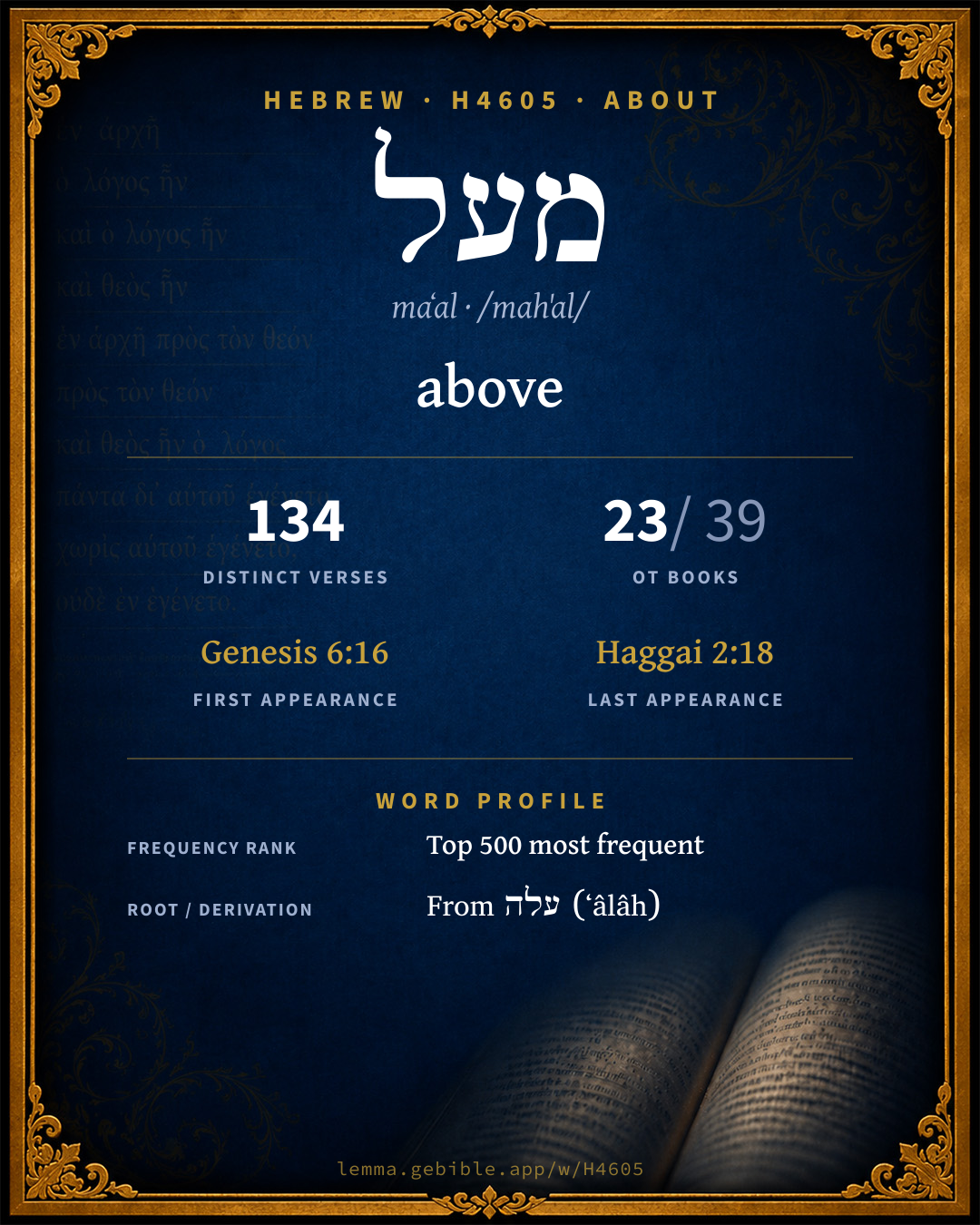
מַ֫עַל
above
‘above’ is one of 4 main senses fuller range ↓
Full lexicon entry — Brown-Driver-Briggs (BDB)
From Brown-Driver-Briggs (BDB)
Where this word appears
Grammar key — what these labels mean
Part of speech
- Adverb
- A word that modifies a verb, adjective, or other adverb.
Every verse where H4605 appears — 134 distinct verses across 23 books. Click any verse to open its interlinear word-by-word view. Verse text shown in the World English Bible for context — . Each verse’s Hebrew form is shown with its reference; the English is not keyword-highlighted, since the data carries no word-level English alignment. Use “Compare translations” on any verse to read it across multiple English versions. This concordance covers the Hebrew Bible; Septuagint (Greek Old Testament) occurrences are not indexed here.
Genesis 3 verses
- Genesis 6:16 מִ/לְ/מַ֔עְלָ/ה prep + prep + adv + sfx dem You shall make a roof in the ark, and to a cubit shall you finish it upward. You shall set the door of the ark in the side of it. You shall make it with lower, second, and third levels.
- Genesis 7:20 מִ/לְ/מַ֔עְלָ/ה prep + prep + adv + sfx dem The waters prevailed fifteen cubits upward, and the mountains were covered.
- Genesis 22:9 מִ/מַּ֖עַל prep + adv They came to the place which God had told him of. Abraham built the altar there, and laid the wood in order, bound Isaac his son, and laid him on the altar, on the wood.
Exodus 13 verses
- Exodus 20:4 מִ/מַּ֔עַל prep + adv "You shall not make for yourselves an idol, nor any image of anything that is in the heavens above, or that is in the earth beneath, or that is in the water under the earth:
- Exodus 25:20 לְ/מַ֗עְלָ/ה prep + adv + sfx dem The cherubim shall spread out their wings upward, covering the mercy seat with their wings, with their faces toward one another. The faces of the cherubim shall be toward the mercy seat.
- Exodus 25:21 מִ/לְ/מָ֑עְלָ/ה prep + prep + adv + sfx dem You shall put the mercy seat on top of the ark, and in the ark you shall put the testimony that I will give you.
- Exodus 26:14 מִ/לְ/מָֽעְלָ/ה prep + prep + adv + sfx dem You shall make a covering for the tent of rams' skins dyed red, and a covering of sea cow hides above.
- Exodus 28:27 מִ/מַּ֕עַל prep + adv You shall make two rings of gold, and shall put them on the two shoulder-pieces of the ephod underneath, in the forepart of it, close by the coupling of it, above the skillfully woven band of the ephod.
- Exodus 30:14 וָ/מָ֑עְלָ/ה conj + adv + sfx dem Everyone who passes over to those who are numbered, from twenty years old and upward, shall give the offering to Yahweh.
- Exodus 36:19 מִ/לְ/מָֽעְלָ/ה prep + prep + adv + sfx dem He made a covering for the tent of rams' skins dyed red, and a covering of sea cow hides above.
- Exodus 37:9 לְ/מַ֗עְלָ/ה prep + adv + sfx dem The cherubim spread out their wings on high, covering the mercy seat with their wings, with their faces toward one another. The faces of the cherubim were toward the mercy seat.
- Exodus 38:26 וָ/מַ֔עְלָ/ה conj + adv + sfx dem a beka a head, that is, half a shekel, after the shekel of the sanctuary, for everyone who passed over to those who were numbered, from twenty years old and upward, for six hundred three thousand five hundred fifty men.
- Exodus 39:20 מִ/מַּ֕עַל prep + adv They made two rings of gold, and put them on the two shoulder-pieces of the ephod underneath, in the front of it, close by its coupling, above the skillfully woven band of the ephod.
- Exodus 39:31 מִ/לְ/מָ֑עְלָ/ה prep + prep + adv + sfx dem They tied to it a lace of blue, to fasten it on the turban above, as Yahweh commanded Moses.
- Exodus 40:19 מִ/לְ/מָ֑עְלָ/ה prep + prep + adv + sfx dem He spread the covering over the tent, and put the roof of the tent above on it, as Yahweh commanded Moses.
- Exodus 40:20 מִ/לְ/מָֽעְלָ/ה prep + prep + adv + sfx dem He took and put the testimony into the ark, and set the poles on the ark, and put the mercy seat above on the ark.
Leviticus 2 verses
- Leviticus 11:21 מִ/מַּ֣עַל prep + adv Yet you may eat these: of all winged creeping things that go on all fours, which have legs above their feet, with which to hop on the earth.
- Leviticus 27:7 וָ/מַ֨עְלָ/ה֙ conj + adv + sfx dem If the person is from sixty years old and upward; if it is a male, then your valuation shall be fifteen shekels, and for a female ten shekels.
Numbers 37 verses
- Numbers 1:3 וָ/מַ֔עְלָ/ה conj + adv + sfx dem from twenty years old and upward, all who are able to go out to war in Israel. You and Aaron shall number them by their divisions.
- Numbers 1:18 וָ/מַ֖עְלָ/ה conj + adv + sfx dem They assembled all the congregation together on the first day of the second month; and they declared their ancestry by their families, by their fathers' houses, according to the number of the names, from twenty years old and upward, one by one.
- Numbers 1:20 וָ/מַ֔עְלָ/ה conj + adv + sfx dem The children of Reuben, Israel's firstborn, their generations, by their families, by their fathers' houses, according to the number of the names, one by one, every male from twenty years old and upward, all who were able to go out to war;
- Numbers 1:22 וָ/מַ֔עְלָ/ה conj + adv + sfx dem Of the children of Simeon, their generations, by their families, by their fathers' houses, those who were numbered of it, according to the number of the names, one by one, every male from twenty years old and upward, all who were able to go out to war;
- Numbers 1:24 וָ/מַ֔עְלָ/ה conj + adv + sfx dem Of the children of Gad, their generations, by their families, by their fathers' houses, according to the number of the names, from twenty years old and upward, all who were able to go out to war;
- Numbers 1:26 וָ/מַ֔עְלָ/ה conj + adv + sfx dem Of the children of Judah, their generations, by their families, by their fathers' houses, according to the number of the names, from twenty years old and upward, all who were able to go out to war;
- Numbers 1:28 וָ/מַ֔עְלָ/ה conj + adv + sfx dem Of the children of Issachar, their generations, by their families, by their fathers' houses, according to the number of the names, from twenty years old and upward, all who were able to go out to war;
- Numbers 1:30 וָ/מַ֔עְלָ/ה conj + adv + sfx dem Of the children of Zebulun, their generations, by their families, by their fathers' houses, according to the number of the names, from twenty years old and upward, all who were able to go out to war;
- Numbers 1:32 וָ/מַ֔עְלָ/ה conj + adv + sfx dem Of the children of Joseph, of the children of Ephraim, their generations, by thir families, by their fathers' houses, according to the number of the names, from twenty years old and upward, all who were able to go out to war;
- Numbers 1:34 וָ/מַ֔עְלָ/ה conj + adv + sfx dem Of the children of Manasseh, their generations, by their families, by their fathers' houses, according to the number of the names, from twenty years old and upward, all who were able to go out to war;
- Numbers 1:36 וָ/מַ֔עְלָ/ה conj + adv + sfx dem Of the children of Benjamin, their generations, by their families, by their fathers' houses, according to the number of the names, from twenty years old and upward, all who were able to go out to war;
- Numbers 1:38 וָ/מַ֔עְלָ/ה conj + adv + sfx dem Of the children of Dan, their generations, by their families, by their fathers' houses, according to the number of the names, from twenty years old and upward, all who were able to go forth to war;
- Numbers 1:40 וָ/מַ֔עְלָ/ה conj + adv + sfx dem Of the children of Asher, their generations, by their families, by their fathers' houses, according to the number of the names, from twenty years old and upward, all who were able to go forth to war;
- Numbers 1:42 וָ/מַ֔עְלָ/ה conj + adv + sfx dem Of the children of Naphtali, their generations, by their families, by their fathers' houses, according to the number of the names, from twenty years old and upward, all who were able to go forth to war;
- Numbers 1:45 וָ/מַ֔עְלָ/ה conj + adv + sfx dem So all those who were numbered of the children of Israel by their fathers' houses, from twenty years old and upward, all who were able to go out to war in Israel;
- Numbers 3:15 וָ/מַ֖עְלָ/ה conj + adv + sfx dem "Number the children of Levi by their fathers' houses, by their families: every male from a month old and upward shall you number."
- Numbers 3:22 וָ/מָ֑עְלָ/ה conj + adv + sfx dem Those who were numbered of them, according to the number of all the males, from a month old and upward, even those who were numbered of them were seven thousand five hundred.
- Numbers 3:28 וָ/מָ֑עְלָ/ה conj + adv + sfx dem According to the number of all the males, from a month old and upward, there were eight thousand six hundred, keeping the charge of the sanctuary.
- Numbers 3:34 וָ/מָ֑עְלָ/ה conj + adv + sfx dem Those who were numbered of them, according to the number of all the males, from a month old and upward, were six thousand two hundred.
- Numbers 3:39 וָ/מַ֔עְלָ/ה conj + adv + sfx dem All who were numbered of the Levites, whom Moses and Aaron numbered at the commandment of Yahweh, by their families, all the males from a month old and upward, were twenty-two thousand.
- Numbers 3:40 וָ/מָ֑עְלָ/ה conj + adv + sfx dem Yahweh said to Moses, "Number all the firstborn males of the children of Israel from a month old and upward, and take the number of their names.
- Numbers 3:43 וָ/מַ֖עְלָ/ה conj + adv + sfx dem All the firstborn males according to the number of names, from a month old and upward, of those who were numbered of them, were twenty-two thousand two hundred seventy-three.
- Numbers 4:3 וָ/מַ֔עְלָ/ה conj + adv + sfx dem from thirty years old and upward even until fifty years old, all who enter into the service, to do the work in the Tent of Meeting.
- Numbers 4:6 מִ/לְ/מָ֑עְלָ/ה prep + prep + adv + sfx dem and shall put a covering of sealskin on it, and shall spread over it a cloth all of blue, and shall put in its poles.
- Numbers 4:23 וָ/מַ֗עְלָ/ה conj + adv + sfx dem from thirty years old and upward until fifty years old shall you number them; all who enter in to wait on the service, to do the work in the Tent of Meeting.
- Numbers 4:25 מִ/לְ/מָ֑עְלָ/ה prep + prep + adv + sfx dem they shall carry the curtains of the tabernacle, and the Tent of Meeting, its covering, and the covering of sealskin that is above on it, and the screen for the door of the Tent of Meeting,
- Numbers 4:30 וָ/מַ֗עְלָ/ה conj + adv + sfx dem from thirty years old and upward even to fifty years old shall you number them, everyone who enters on the service, to do the work of the Tent of Meeting.
- Numbers 4:35 וָ/מַ֔עְלָ/ה conj + adv + sfx dem from thirty years old and upward even to fifty years old, everyone who entered into the service, for work in the Tent of Meeting.
- Numbers 4:39 וָ/מַ֔עְלָ/ה conj + adv + sfx dem from thirty years old and upward even to fifty years old, everyone who entered into the service, for work in the Tent of Meeting,
- Numbers 4:43 וָ/מַ֔עְלָ/ה conj + adv + sfx dem from thirty years old and upward even to fifty years old, everyone who entered into the service, for work in the Tent of Meeting,
- Numbers 4:47 וָ/מַ֔עְלָ/ה conj + adv + sfx dem from thirty years old and upward even to fifty years old, everyone who entered in to do the work of service, and the work of bearing burdens in the Tent of Meeting,
- Numbers 8:24 וָ/מַ֔עְלָ/ה conj + adv + sfx dem "This is that which belongs to the Levites: from twenty-five years old and upward they shall go in to wait on the service in the work of the Tent of Meeting;
- Numbers 14:29 וָ/מָ֑עְלָ/ה conj + adv + sfx dem your dead bodies shall fall in this wilderness; and all who were numbered of you, according to your whole number, from twenty years old and upward, who have murmured against me,
- Numbers 26:2 וָ/מַ֖עְלָ/ה conj + adv + sfx dem Take the sum of all the congregation of the children of Israel, from twenty years old and upward, by their fathers' houses, all who are able to go forth to war in Israel.
- Numbers 26:4 וָ/מָ֑עְלָ/ה conj + adv + sfx dem [Take the sum of the people], from twenty years old and upward; as Yahweh commanded Moses and the children of Israel, that came forth out of the land of Egypt.
- Numbers 26:62 וָ/מָ֑עְלָ/ה conj + adv + sfx dem Those who were numbered of them were twenty-three thousand, every male from a month old and upward: for they were not numbered among the children of Israel, because there was no inheritance given them among the children of Israel.
- Numbers 32:11 וָ/מַ֔עְלָ/ה conj + adv + sfx dem Surely none of the men who came up out of Egypt, from twenty years old and upward, shall see the land which I swore to Abraham, to Isaac, and to Jacob; because they have not wholly followed me:
Deuteronomy 4 verses
- Deuteronomy 4:39 מִ/מַּ֔עַל prep + adv Know therefore this day, and lay it to your heart, that Yahweh he is God in heaven above and on the earth beneath; there is none else.
- Deuteronomy 5:8 מִ/מַּ֔עַל prep + adv "You shall not make an engraved image for yourself, [nor] any likeness [of anything] that is in heaven above, or that is in the earth beneath, or that is in the water under the earth:
- Deuteronomy 28:13 לְ/מַ֔עְלָ/ה prep + adv + sfx dem Yahweh will make you the head, and not the tail; and you shall be above only, and you shall not be beneath; if you shall listen to the commandments of Yahweh your God, which I command you this day, to observe and to do [them],
- Deuteronomy 28:43 מַ֣עְלָ/ה מָּ֑עְלָ/ה adv + sfx dem adv + sfx dem The foreigner who is in the midst of you shall mount up above you higher and higher; and you shall come down lower and lower.
Joshua 3 verses
- Joshua 2:11 מִ/מַּ֔עַל prep + adv As soon as we had heard it, our hearts did melt, neither did there remain any more spirit in any man, because of you: for Yahweh your God, he is God in heaven above, and on earth beneath.
- Joshua 3:13 מִ/לְ/מָ֑עְלָ/ה prep + prep + adv + sfx dem It shall come to pass, when the soles of the feet of the priests who bear the ark of Yahweh, the Lord of all the earth, shall rest in the waters of the Jordan, that the waters of the Jordan shall be cut off, even the waters that come down from above; and they shall stand in one heap.
- Joshua 3:16 מִ/לְ/מַ֜עְלָ/ה prep + prep + adv + sfx dem that the waters which came down from above stood, and rose up in one heap, a great way off, at Adam, the city that is beside Zarethan; and those that went down toward the sea of the Arabah, even the Salt Sea, were wholly cut off: and the people passed over right against Jericho.
Judges 2 verses
- Judges 1:36 וָ/מָֽעְלָ/ה conj + adv + sfx dem The border of the Amorites was from the ascent of Akrabbim, from the rock, and upward.
- Judges 7:13 לְ/מַ֖עְלָ/ה prep + adv + sfx dem When Gideon had come, behold, there was a man telling a dream to his fellow; and he said, Behold, I dreamed a dream; and, behold, a cake of barley bread tumbled into the camp of Midian, and came to the tent, and struck it so that it fell, and turned it upside down, so that the tent lay flat.
1 Samuel 4 verses
- 1 Samuel 9:2 וָ/מַ֔עְלָ/ה conj + adv + sfx dem He had a son, whose name was Saul, an impressive young man; and there was not among the children of Israel a better person than he. From his shoulders and upward he was higher than any of the people.
- 1 Samuel 10:23 וָ/מָֽעְלָ/ה conj + adv + sfx dem They ran and fetched him there; and when he stood among the people, he was higher than any of the people from his shoulders and upward.
- 1 Samuel 16:13 וָ/מָ֑עְלָ/ה conj + adv + sfx dem Then Samuel took the horn of oil, and anointed him in the midst of his brothers: and the Spirit of Yahweh came mightily on David from that day forward. So Samuel rose up, and went to Ramah.
- 1 Samuel 30:25 וָ/מָ֑עְלָ/ה conj + adv + sfx dem It was so from that day forward, that he made it a statute and an ordinance for Israel to this day.
1 Kings 8 verses
- 1 Kings 7:3 מִ/מַּ֨עַל֙ prep + adv It was covered with cedar above over the forty-five beams, that were on the pillars; fifteen in a row.
- 1 Kings 7:11 וּ/מִ/לְ/מַ֗עְלָ/ה conj + prep + Preposition + adv + sfx dem Above were costly stones, even hewn stone, according to measure, and cedar-wood.
- 1 Kings 7:20 מִ/מַּ֨עַל֙ prep + adv There were capitals above also on the two pillars, close by the belly which was beside the network: and the pomegranates were two hundred, in rows round about on the other capital.
- 1 Kings 7:25 מִ/לְ/מָ֑עְלָ/ה prep + prep + adv + sfx dem It stood on twelve oxen, three looking toward the north, and three looking toward the west, and three looking toward the south, and three looking toward the east; and the sea was set on them above, and all their hinder parts were inward.
- 1 Kings 7:29 מִ/מָּ֑עַל prep + adv and on the panels that were between the ledges were lions, oxen, and cherubim; and on the ledges there was a pedestal above; and beneath the lions and oxen were wreaths of hanging work.
- 1 Kings 7:31 וָ/מַ֨עְלָ/ה֙ conj + adv + sfx dem The mouth of it within the capital and above was a cubit: and the mouth of it was round after the work of a pedestal, a cubit and a half; and also on the mouth of it were engravings, and their panels were foursquare, not round.
- 1 Kings 8:7 מִ/לְ/מָֽעְלָ/ה prep + prep + adv + sfx dem For the cherubim spread forth their wings over the place of the ark, and the cherubim covered the ark and the poles of it above.
- 1 Kings 8:23 מִ/מַּ֔עַל prep + adv and he said, Yahweh, the God of Israel, there is no God like you, in heaven above, or on earth beneath; who keep covenant and loving kindness with your servants, who walk before you with all their heart;
2 Kings 2 verses
- 2 Kings 3:21 וָ/מַ֔עְלָ/ה conj + adv + sfx dem Now when all the Moabites heard that the kings had come up to fight against them, they gathered themselves together, all who were able to put on armor, and upward, and stood on the border.
- 2 Kings 19:30 לְ/מָֽעְלָ/ה prep + adv + sfx dem The remnant that has escaped of the house of Judah shall again take root downward, and bear fruit upward.
1 Chronicles 8 verses
- 1 Chronicles 14:2 לְ/מַ֨עְלָ/ה֙ prep + adv + sfx dem David perceived that Yahweh had established him king over Israel; for his kingdom was exalted on high, for his people Israel's sake.
- 1 Chronicles 22:5 לְ/מַ֜עְלָ/ה prep + adv + sfx dem David said, Solomon my son is young and tender, and the house that is to be built for Yahweh must be exceedingly magnificent, of fame and of glory throughout all countries: I will therefore make preparation for it. So David prepared abundantly before his death.
- 1 Chronicles 23:3 וָ/מָ֑עְלָ/ה conj + adv + sfx dem The Levites were numbered from thirty years old and upward: and their number by their polls, man by man, was thirty-eight thousand.
- 1 Chronicles 23:17 לְ/מָֽעְלָ/ה prep + adv + sfx dem The sons of Eliezer were: Rehabiah the chief; and Eliezer had no other sons; but the sons of Rehabiah were very many.
- 1 Chronicles 23:24 וָ/מָֽעְלָ/ה conj + adv + sfx dem These were the sons of Levi after their fathers' houses, even the heads of the fathers' [houses] of those of those who were counted, in the number of names by their polls, who did the work for the service of the house of Yahweh, from twenty years old and upward.
- 1 Chronicles 23:27 וּ/לְ/מָֽעְלָ/ה conj + prep + adv + sfx dem For by the last words of David the sons of Levi were numbered, from twenty years old and upward.
- 1 Chronicles 29:3 לְ/מַ֔עְלָ/ה prep + adv + sfx dem In addition, because I have set my affection on the house of my God, seeing that I have a treasure of my own of gold and silver, I give it to the house of my God, over and above all that I have prepared for the holy house,
- 1 Chronicles 29:25 לְ/מַ֔עְלָ/ה prep + adv + sfx dem Yahweh magnified Solomon exceedingly in the sight of all Israel, and bestowed on him such royal majesty as had not been on any king before him in Israel.
2 Chronicles 11 verses
- 2 Chronicles 1:1 לְ/מָֽעְלָ/ה prep + adv + sfx dem Solomon the son of David was strengthened in his kingdom, and Yahweh his God was with him, and magnified him exceedingly.
- 2 Chronicles 4:4 מִ/לְ/מָ֑עְלָ/ה prep + prep + adv + sfx dem It stood on twelve oxen, three looking toward the north, and three looking toward the west, and three looking toward the south, and three looking toward the east: and the sea was set on them above, and all their hinder parts were inward.
- 2 Chronicles 5:8 מִ/לְ/מָֽעְלָ/ה prep + prep + adv + sfx dem For the cherubim spread forth their wings over the place of the ark, and the cherubim covered the ark and the poles of it above.
- 2 Chronicles 16:12 לְ/מַ֖עְלָ/ה prep + adv + sfx dem In the thirty-ninth year of his reign Asa was diseased in his feet; his disease was exceeding great: yet in his disease he didn't seek Yahweh, but to the physicians.
- 2 Chronicles 17:12 לְ/מָ֑עְלָ/ה prep + adv + sfx dem Jehoshaphat grew great exceedingly; and he built in Judah castles and cities of store.
- 2 Chronicles 20:19 לְ/מָֽעְלָ/ה prep + adv + sfx dem The Levites, of the children of the Kohathites and of the children of the Korahites, stood up to praise Yahweh, the God of Israel, with an exceeding loud voice.
- 2 Chronicles 25:5 וָ/מַ֔עְלָ/ה conj + adv + sfx dem Moreover Amaziah gathered Judah together, and ordered them according to their fathers' houses, under captains of thousands and captains of hundreds, even all Judah and Benjamin: and he numbered them from twenty years old and upward, and found them three hundred thousand chosen men, able to go forth to war, who could handle spear and shield.
- 2 Chronicles 26:8 לְ/מָֽעְלָ/ה prep + adv + sfx dem The Ammonites gave tribute to Uzziah: and his name spread abroad even to the entrance of Egypt; for he grew exceeding strong.
- 2 Chronicles 31:16 וּ/לְ/מַ֔עְלָ/ה conj + prep + adv + sfx dem besides those who were reckoned by genealogy of males, from three years old and upward, even everyone who entered into the house of Yahweh, as the duty of every day required, for their service in their offices according to their divisions;
- 2 Chronicles 31:17 וּ/לְ/מָ֑עְלָ/ה conj + prep + adv + sfx dem and those who were reckoned by genealogy of the priests by their fathers' houses, and the Levites from twenty years old and upward, in their offices by their divisions;
- 2 Chronicles 34:4 לְ/מַ֥עְלָ/ה prep + adv + sfx dem They broke down the altars of the Baals in his presence; and the sun-images that were on high above them he hewed down; and the Asherim, and the engraved images, and the molten images, he broke in pieces, and made dust of them, and strewed it on the graves [of those] who had sacrificed to them.
Ezra 2 verses
- Ezra 3:8 וָ/מַ֔עְלָ/ה conj + adv + sfx dem Now in the second year of their coming to the house of God at Jerusalem, in the second month, began Zerubbabel the son of Shealtiel, and Jeshua the son of Jozadak, and the rest of their brothers the priests and the Levites, and all those who were come out of the captivity to Jerusalem, and appointed the Levites, from twenty years old and upward, to have the oversight of the work of the house of Yahweh.
- Ezra 9:6 לְ/מַ֣עְלָ/ה prep + adv + sfx dem and I said, my God, I am ashamed and blush to lift up my face to you, my God; for our iniquities are increased over our head, and our guiltiness is grown up to the heavens.
Job 4 verses
- Job 3:4 מִ/מָּ֑עַל prep + adv Let that day be darkness; Don't let God from above seek for it, Neither let the light shine on it.
- Job 18:16 וּ֝/מִ/מַּ֗עַל conj + prep + adv His roots shall be dried up beneath, Above shall his branch be cut off.
- Job 31:2 מִ/מָּ֑עַל prep + adv For what is the portion from God above, And the heritage from the Almighty on high?
- Job 31:28 מִ/מָּֽעַל prep + adv This also would be an iniquity to be punished by the judges; For I should have denied the God who is above.
Psalms 2 verses
Proverbs 2 verses
Ecclesiastes 1 verse
Isaiah 6 verses
- Isaiah 6:2 מִ/מַּ֨עַל֙ prep + adv Above him stood the seraphim. Each one had six wings. With two he covered his face. With two he covered his feet. With two he flew.
- Isaiah 7:11 לְ/מָֽעְלָ/ה prep + adv + sfx dem "Ask a sign of Yahweh your God; ask it either in the depth, or in the height above."
- Isaiah 8:21 לְ/מָֽעְלָ/ה prep + adv + sfx dem They shall pass through it, sore distressed and hungry; and it shall happen that when they shall be hungry, they shall fret themselves, and curse by their king and by their God, and turn their faces upward:
- Isaiah 14:13 מִ/מַּ֥עַל prep + adv You said in your heart, I will ascend into heaven, I will exalt my throne above the stars of God; and I will sit on the mountain of congregation, in the uttermost parts of the north;
- Isaiah 37:31 לְ/מָֽעְלָ/ה prep + adv + sfx dem The remnant that is escaped of the house of Judah shall again take root downward, and bear fruit upward.
- Isaiah 45:8 מִ/מַּ֔עַל prep + adv Distil, you heavens, from above, and let the skies pour down righteousness: let the earth open, that it may bring forth salvation, and let it cause righteousness to spring up together; I, Yahweh, have created it.
Jeremiah 5 verses
- Jeremiah 4:28 מִ/מָּ֑עַל prep + adv For this shall the earth mourn, and the heavens above be black; because I have spoken it, I have purposed it, and I have not repented, neither will I turn back from it.
- Jeremiah 31:37 מִ/לְ/מַ֔עְלָ/ה prep + prep + adv + sfx dem Thus says Yahweh: If heaven above can be measured, and the foundations of the earth searched out beneath, then will I also cast off all the seed of Israel for all that they have done, says Yahweh.
- Jeremiah 35:4 מִ/מַּ֗עַל prep + adv and I brought them into the house of Yahweh, into the chamber of the sons of Hanan the son of Igdaliah, the man of God, which was by the chamber of the princes, which was above the chamber of Maaseiah the son of Shallum, the keeper of the threshold.
- Jeremiah 43:10 מִ/מַּ֛עַל prep + adv and tell them, Thus says Yahweh of Hosts, the God of Israel: Behold, I will send and take Nebuchadrezzar the king of Babylon, my servant, and will set his throne on these stones that I have hidden; and he shall spread his royal pavilion over them.
- Jeremiah 52:32 מִ/מַּ֗עַל prep + adv and he spoke kindly to him, and set his throne above the throne of the kings who were with him in Babylon,
Ezekiel 10 verses
- Ezekiel 1:11 מִ/לְ/מָ֑עְלָ/ה prep + prep + adv + sfx dem Their faces and their wings were separate above; two [wings] of everyone were joined one to another, and two covered their bodies.
- Ezekiel 1:22 מִ/לְ/מָֽעְלָ/ה prep + prep + adv + sfx dem Over the head of the living creature there was the likeness of an expanse, like the awesome crystal to look on, stretched forth over their heads above.
- Ezekiel 1:26 וּ/מִ/מַּ֗עַל מִ/לְ/מָֽעְלָ/ה conj + prep + adv prep + prep + adv + sfx dem Above the expanse that was over their heads was the likeness of a throne, as the appearance of a sapphire stone; and on the likeness of the throne was a likeness as the appearance of a man on it above.
- Ezekiel 1:27 וּ/לְ/מָ֑עְלָ/ה conj + prep + adv + sfx dem I saw as it were glowing metal, as the appearance of fire within it round about, from the appearance of his loins and upward; and from the appearance of his loins and downward I saw as it were the appearance of fire, and there was brightness round about him.
- Ezekiel 8:2 וּ/לְ/מַ֔עְלָ/ה conj + prep + adv + sfx dem Then I saw, and, behold, a likeness as the appearance of fire; from the appearance of his loins and downward, fire; and from his loins and upward, as the appearance of brightness, as it were glowing metal.
- Ezekiel 10:19 מִ/לְ/מָֽעְלָ/ה prep + prep + adv + sfx dem The cherubim lifted up their wings, and mounted up from the earth in my sight when they went forth, and the wheels beside them: and they stood at the door of the east gate of Yahweh's house; and the glory of the God of Israel was over them above.
- Ezekiel 11:22 מִ/לְ/מָֽעְלָ/ה prep + prep + adv + sfx dem Then did the cherubim lift up their wings, and the wheels were beside them; and the glory of the God of Israel was over them above.
- Ezekiel 37:8 מִ/לְ/מָ֑עְלָ/ה prep + prep + adv + sfx dem I saw, and, behold, there were sinews on them, and flesh came up, and skin covered them above; but there was no breath in them.
- Ezekiel 41:7 לְ/מַ֨עְלָ/ה לְ/מַ֜עְלָ/ה לְ/מַ֨עְלָ/ה לְ/מַ֜עְלָ/ה לְ/מָ֑עְלָ/ה prep + adv + sfx dem prep + adv + sfx dem prep + adv + sfx dem prep + adv + sfx dem prep + adv + sfx dem The side-chambers were broader as they encompassed [the house] higher and higher; for the encompassing of the house went higher and higher round about the house: therefore the breadth of the house [continued] upward; and so one went up [from] the lowest [chamber] to the highest by the middle [chamber].
- Ezekiel 43:15 וּ/לְ/מַ֔עְלָ/ה conj + prep + adv + sfx dem The upper altar shall be four cubits; and from the altar hearth and upward there shall be four horns.
Daniel 2 verses
- Daniel 12:6 מִ/מַּ֖עַל prep + adv One said to the man clothed in linen, who was above the waters of the river, How long shall it be to the end of these wonders?
- Daniel 12:7 מִ/מַּעַל֮ prep + adv I heard the man clothed in linen, who was above the waters of the river, when he held up his right hand and his left hand to heaven, and swore by him who lives forever that it shall be for a time, times, and a half; and when they have made an end of breaking in pieces the power of the holy people, all these things shall be finished.
Amos 1 verse
Haggai 2 verses
- Haggai 2:15 וָ/מָ֑עְלָ/ה conj + adv + sfx dem Now, please consider from this day and backward, before a stone was laid on a stone in the temple of Yahweh.
- Haggai 2:18 וָ/מָ֑עְלָ/ה conj + adv + sfx dem 'Consider, please, from this day and backward, from the twenty-fourth day of the ninth month, since the day that the foundation of Yahweh's temple was laid, consider it.
About this entry
At a glance — auto-summarized from this page’s data, not written by a person. Every figure links to its source below. This summary describes the numbers; it doesn’t interpret them.
מעל — transliterated maʻal — is a Hebrew word carrying the sense “above.” Where the King James Version says “upward,” newer translations reach for “or older” (Berean Standard Bible); the renderings breakdown has the detail. The Hebrew Bible uses it across 134 verses — common. More than a quarter of its appearances fall in Numbers. The lexicon spreads it across several senses; see its full sense range. Each statement above links to its evidence; the full detail follows below.
Gloss history
Strong's 1890 vs modern scholarship
About this word
Strong's H4605 catalogs a Hebrew word from the Hebrew Old Testament.
These counts are not copied from any lexicon or concordance. They are computed here, from the morphology-tagged Hebrew Old Testament. What Lemma adds →
- 134
- distinct verses
- The word appears in 134 distinct verses.
- 23 / 39
- OT books
- The word appears in 23 of 39 Old Testament books.
- #323
- by frequency
- Top 500 most frequent Hebrew words (rank 323 of 8,640 Hebrew words by occurrence).
View all 134 occurrences in the concordance →
Most concentrated in
- Numbers 37 verses 28%
- Exodus 13 verses 10%
- 2 Chronicles 11 verses 8%
By section of the Old Testament
By traditional corpus
Conventional, traditional groupings — biblical authorship is debated, so this is a traditional corpus grouping, not an authorship claim. Each share is this word’s portion of its verses in that division of the Hebrew canon. Each figure is a share of the word’s 134 distinct verses.
- Torah (Pentateuch) 59 verses · 44%
- Prophets (Nevi'im) 43 verses · 32%
- Writings (Ketuvim) 32 verses · 24%
How translations render this word
Counts come from each version’s own published word-to-Strong’s tagging or interlinear alignment — an approximate guide to how each version renders this word, not a word-level alignment the data otherwise carries. Because each total is that version’s own tagged count, the per-version totals vary from one another and need not match the appearance or distinct-verse counts above. These counts may also differ from a printed concordance because Lemma counts each distinctly tagged rendering and does not collapse phrase taggings into a single head-word total. This is a fixed set of word-tagged versions (KJV, ASV, BSB, ULT) and does not change with the reading translation you choose elsewhere. Each version’s license is shown beside its name below (and on Sources).
BDB lists this Strong’s number as 3 distinct words (homographs). Each count above pools all of them and is not split by sense — see the Senses section below. A low-frequency rendering may belong to a different one of those words, not the primary meaning.
- King James Version†: Upward 56×, Above 37×, High 6×
- American Standard Version†: Upward 52×, Above 35×, High 3×
- Berean Standard Bible†: Or older 30×, Above 23×, Or more 8×
- unfoldingWord Literal Text†: Upward 50×, Above 45×, Upwards 4×
King James Version Public Domain
Renders H4605 across 136† tagged occurrences — most commonly:
Plus 16 renderings that appear only once — usually multi-word phrases or single function words the recovered tagging swept in, not distinct renderings. Not rendered by a distinct English word in 2 further occurrences.
American Standard Version Public Domain
Renders H4605 across 135† tagged occurrences — most commonly:
Plus other, less common renderings. Plus 24 renderings that appear only once — usually multi-word phrases or single function words the recovered tagging swept in, not distinct renderings.
Berean Standard Bible Public Domain
Renders H4605 across 112† tagged occurrences — most commonly:
Plus other, less common renderings. Plus 24 renderings that appear only once — usually multi-word phrases or single function words the recovered tagging swept in, not distinct renderings. Not rendered by a distinct English word in 28 further occurrences.
unfoldingWord Literal Text CC BY-SA 4.0
Renders H4605 across 138† tagged occurrences — most commonly:
Plus other, less common renderings. Plus 18 renderings that appear only once — usually multi-word phrases or single function words the recovered tagging swept in, not distinct renderings.
10 senses and sub-senses in the full BDB
What do BDB’s symbols mean?
BDB uses these scholarly abbreviations:
| Symbol | Meaning |
|---|---|
| 𝔊 | the Septuagint (the ancient Greek translation, LXX) |
| 𝔙 | the Vulgate (the Latin translation) |
| 𝔖 | the Syriac version (the Peshitta) |
| 𝔗 | the Targum (the Aramaic translation) |
| ψ | the Psalms |
| √ | root (the underlying root or stem) |
| ‖ | parallel passage (a synonymous or contrasted parallel) |
| † | the dagger: every passage where the word occurs is cited |
The 10 senses and sub-senses the full Brown-Driver-Briggs lexicon distinguishes for this word, in lexicon order (not ranked by frequency), with BDB’s own verbatim wording and sub-sense lettering. Shown in Hebrew script with BDB’s own scholarly abbreviations. The condensed entry is in the Lexicon Entry tab. See also the Forms in the corpus table below.
מעל I Ezr 9
- 1. ag. man: נשׁאר מעל Jb 21:34 faithlessness remains (cf. Nu 5:12, 27 Pr 16:10 under מָעַל). e.g. Job 21:34
- 2. elsewhere ag. God, c. בְּ, Jos 22:22 (P); without בְּ, 1 Ch 9:1 2 Ch 29:19; 33:19 Ezr 9:2, 4; 10:6.—מַעַל elsewhere only c. מָעַל q.v. (1; all cited). e.g. Joshua 22:22
מעל II subst., higher part, only in adv. and prep. phrases
- 1. מִמַּ֫עַל = above (v. מִן 1 c):
- a. as adv. Am 2:9 וָאָשְׁמִיד פִּרְיוֹ מִמַּעַל his fruit above (opp. שָׁרָשָׁיו מִתָּ֑חַת), Jb 18:16; 1 K 7:3, 20, 29; often in the phr. הַשָּׁמַיִם מִמַּעַל Dt 4:39; 5:8 (= Ex 20:4), Jos 2:11; 1 K 8:23; Is 45:8; Je 4:28; cf. שְׁחַקִים מ׳ ψ 78:23; Pr 8:28, אֱלוֹהַּ מ׳ Jb 3:4; 31:2, אֵל מ׳ 31:28. e.g. Amos 2:9
- b. מִמַּעַל לְ, as prep. (מן 1 c), on the top of, above, Gn 22:9 ממעל לָעֵצִים above the wood, Ex 28:27 = 39:20, Lv 11:21 כְּרָעַיִם מִמַּעַל לְרַגְלָיו, Is 6:2 שְׂרָפִים עֹמדים מִמַּעַל לוֹ, 14:13; Je 43:10; Ez 1:26; Dn 12:6, 7; = on higher ground than, Je 35:4; fig. Je 52:32 (‖ 2 K 25:28 מֵעַל). e.g. Genesis 22:9
- 2. With ה—ָloc. מַ֫עְלָה, מָ֑עְלָה, upwards (opp. מַ֫טָּה p. 641):
- a. fig. Dt 28:43 יַעֲלֶה עָלֶיךָ מַ֫עְלָה מָ֑עְלָה upwards, upwards, i.e. higher and higher (opp. מַ֫טָּה מָֽטָּה). e.g. Deuteronomy 28:43
- b. וָמַ֫עְלָה (a) of direction in space, Ju 1:36 מֵהַסֶּלַע וָמַ֫עְלָה from the rock and upwards (cf. Bu), 1 K 7:31 (corrupt: v. Sta VB Benz), 1 S 9:2 = 10:23 מִשִּׁכְמוֹ וָמַ֫עְלָה from his shoulder and upwards: so וּלְמ׳, †Ez 1:27 מִמַּרְאֵה מָתְנָיו וּלְמָ֑עְלָה, 8:2; 43:15. (b) of direction in time, or age:—(α) מִבֶּן עֶשְׂרִים שָׁנָה וָמָ֑עְלָה Ex 30:14; Nu 1:3 + 19 times P, מִבֶּן חֹדֶשׁ וָמ׳ Nu 3:15, 22 + 6 times P, simil. 4:3; 8:24 + 7 times P; elsewhere only 1 Ch 23:3, 24; Ezr 3:8, and with וּלְמַעְלָה †1 Ch 23:17; 2 Ch 31:16, 17; לְמִבֶּן … וָמ׳ †2 Ch 25:5; and 2 K 3:21 מִכֹּל חֹגֵר חֲגֹרָה וָמ׳. †(β) מהיום ההוא וָמ׳ from that day and onwards, 1 S 16:13; 30:25. †(γ) מן היום הזה וָמ׳ from this day and upwards (i.e. and back), Hg 2:15, 18.* e.g. Judges 1:36
- c. לְמַ֫עְלָה upwards, more common than מ׳ alone (a): (α) Ex 25:20 (= 37:9) פֹּֽרְשֵׂי כְנָפַיִם למ׳, Ju 7:13 ויהפכהו למ׳ overthrew it upwards, i.e. turned it downside up, Is 7:11 אוֹ הַגְבֵּהַּ למ׳ or make it (the request) high upwards, 8:21 וּפָנָה למ׳, 37:31 (2 K 19:30) זעשׂה פרי למ׳ (cf. Am 2:9, 1 a), Ez 41:7 a β (v a α bis למ׳ למ׳ = higher and higher), ψ 74:5; fig. וְהָיִיתָ רַק למ׳ Dt 28:13 (cf. a), Pr 15:24 אֹרַח חַיִּים למ׳ (opp. שְׁאוֹל מָֽטָּה׃), cf. Ec 3:21; sq. a noun, Ezr 9:6 למ׳ רּאשׁ over the head, sq. מֵעַל (cf. Aboth 2:1 לְמַעְלָה מִן) = on high above, 2 Ch 34:4: v. ba, ba. (b) metaph. = exceedingly, only in Chr, 1 Ch 14:2; 22:5 the house must be built to J. לְהַגְדְּיל למ׳ so as to shew greatness exceedingly, 23:17 וּבְנֵי ר׳ רָבוּ למ׳, 29:3 (sq. מִן; = over and above …), v 25 2 Ch 1:1 וַיְגַדְּלֵהוּ למ׳, 20:19; עַד לְמַ֫עְלָה, 16:12; 17:12; 26:8. e.g. Exodus 25:20
- d. מִלְמַ֫עְלָה (v. מִן 9 a), adv., above (the more usual prose syn. of מִמַּעַל): Gn 6:16 אֶל־אַמָּה תְּכַלֶּנָּה מ׳, 7:20 15 cubits מ׳ (i.e. above the mountain-tops), Ex 25:21 (40:20) וְנָתַתָּ֫ה אֶת־הַכַּפֹּרֶת על הארון מ׳ upon the ark above, 26:14 (36:19; 40:19; Nu 4:25) a covering of skins on the tent מ׳ above, 39:31; Nu 4:6; 1 K 7:11; 7:25; 8:7 (2 Ch 4:4; 5:8), Je 31:37 אִם יִמַּדּוּ שָׁמַיִם מ׳ (cf. 1 a), Ez 1:11 פְּרֻדוֹת מ׳ separate above, v 22, 26; 10:19; 11:22; 37:3; from above, Jos 3:13, 16 הַמַּיִם הַיֹּרְדִים מ׳. e.g. Genesis 6:16
Senses from the full Brown-Driver-Briggs lexicon (Brown, Driver, Briggs; Oxford 1906 — public domain), digitized via Sefaria, supplemented by the OpenScriptures HebrewLexicon (CC BY 4.0). Full attribution on Sources.
Word origin
I. n.m. Ezr 9:2 unfaithful, treacherous act (NH מְעִילָה);—מ׳ Lv 5:15 + 16 times; מָ֑עַל Nu 5:12 + 2 times; sf. מַעֲלוֹ Ez 17:20 + 4 times; מַעֲלָם Ez 39:26 + 3 times;—
III. subst., higher part, only in adv. and prep. phrases; above, upwards (Ph. מעל, v. sub מַ֫טָּה p. 641: abbrev. from מַעֲלֶה; cf. מַ֫עַן in לְמַ֫עַן from עָנָה: Köii 116):—
— Brown-Driver-Briggs (Oxford 1906, public domain), digitized via Sefaria, supplemented by the OpenScriptures HebrewLexicon (CC BY 4.0). See Sources.
Derived from עלה (ʻâlâh) (H5927) — to go up.
Jastrow Dictionary
A second Hebrew/Aramaic lexicon for comparison, covering Aramaic and post-biblical (Talmudic, Targumic, Midrashic) usage that the biblical-Hebrew BDB does not. Matched by lemma rather than by Strong’s number, so a lemma may carry more than one Jastrow headword (shown separately below), and the entries cover usage well beyond the Bible.
מֵעַל
- (adopted fr. Deut. XXV, 9) [from on,] upper of the shoe. Yeb. 102ᵃ התודה אמרה מ׳ ולא מ׳ דמ׳ the text says ‘from on’ (his foot) but not the cover of a cover, i.e. the upper must be immediate to the skin of the foot, v. אַפַּנְתָּא. Ib. א"כ ליכתוב רחמנא במ׳ רגלו if it were so (that חלץ, Deut. l. c. meant ‘to fasten’), the text ought to have read ‘on the upper part of his foot’. e.g. Deuteronomy 25:9
מַעַל
- circumvention; fraud, adulteration, faithlessness. Yalk. Ex. 343, v. דֶּלֶם. Num. R. s. 7, v. next w.
מָעַל
- denom. of preced.) to circumvent, defraud. Sifré Num. 7 (ref. to Num. V, 12) ומָעֲלָה בו מ׳ על דבר ערוה וכ׳ does ‘she was faithless to him’ refer to marital betrayal or to money matters?; v. מְעִילָה.—Esp. to make inappropriate use of sacred property, to be guilty of transgressing, be amenable to, the law concerning מְעִילָה (Lev. V, 15, sq.). Meïl. I, 1 מוֹעֲלִים בהן in using them inadvertently one commits m’ʿilah (i.e. they retain their sacred character in spite of a mistake made at their slaughtering). Ib. אין מוֹעֲלִין בה it has no longer a sacred character. Ib. III, 2 לא נהנין ולא מועלין בהן you must not make use of them, but if you did, you are not amenable to &c.; a. v. fr.—[Yalk. Num. 765 מועל ומשקר, read מְעַוֵּל, v. עָוַל.] e.g. Numbers 5:12
מְעַל
- Meïl. 14ᵇ דקמָעֵיל בקודשא that he makes improper use of sacred property; ib. דקא מועיל בקדשים (corr. acc.).
A Dictionary of the Targumim, the Talmud Babli and Yerushalmi, and the Midrashic Literature (Marcus Jastrow; London, Luzac, 1903) — Public Domain. Digitized via Sefaria. Digitized via Sefaria. Full attribution on Sources.
Forms in the corpus
The 39 distinct written forms H4605 takes in the Hebrew Bible, most frequent first — each parse links to that state’s occurrences in the concordance. Hebrew forms include their vowel points and cantillation, so a single lemma takes many written forms.
| Form | Parsing | Example | Uses |
|---|---|---|---|
| וָ/מַ֔עְלָ/ה | Adverb | Exodus 38:26 | 27 |
| וָ/מָ֑עְלָ/ה | Adverb | Exodus 30:14 | 13 |
| מִ/לְ/מָ֑עְלָ/ה | Adverb | Exodus 25:21 | 10 |
| מִ/לְ/מָֽעְלָ/ה | Adverb | Exodus 26:14 | 9 |
| לְ/מָֽעְלָ/ה | Adverb | 1 Chronicles 23:17 | 8 |
| מִ/מַּ֔עַל | Adverb | Amos 2:9 | 7 |
| מִ/מָּ֑עַל | Adverb | 1 Kings 7:29 | 6 |
| וָ/מַ֖עְלָ/ה | Adverb | Numbers 1:18 | 4 |
| לְ/מָ֑עְלָ/ה | Adverb | Ecclesiastes 3:21 | 4 |
| וָ/מָֽעְלָ/ה | Adverb | 1 Chronicles 23:24 | 3 |
| וּ/לְ/מַ֔עְלָ/ה | Adverb | Ezekiel 8:2 | 3 |
| לְ/מַ֔עְלָ/ה | Adverb | Deuteronomy 28:13 | 3 |
| לְ/מַ֜עְלָ/ה | Adverb | Ezekiel 41:7 | 3 |
| מִ/לְ/מַ֔עְלָ/ה | Adverb | Genesis 6:16 | 3 |
| מִ/מַּ֨עַל֙ | Adverb | 1 Kings 7:3 | 3 |
| וָ/מַ֗עְלָ/ה | Adverb | Numbers 4:23 | 2 |
| וָ/מַ֨עְלָ/ה֙ | Adverb | 1 Kings 7:31 | 2 |
| וּ/לְ/מָ֑עְלָ/ה | Adverb | Ezekiel 1:27 | 2 |
| לְ/מַ֖עְלָ/ה | Adverb | 2 Chronicles 16:12 | 2 |
| לְ/מַ֗עְלָ/ה | Adverb | Exodus 25:20 | 2 |
| לְ/מַ֣עְלָ/ה | Adverb | Ezra 9:6 | 2 |
| לְ/מַ֨עְלָ/ה | Adverb | Ezekiel 41:7 | 2 |
| מִ/מַּ֕עַל | Adverb | Exodus 28:27 | 2 |
| מִ/מַּ֖עַל | Adverb | Daniel 12:6 | 2 |
| מִ/מַּ֗עַל | Adverb | Jeremiah 35:4 | 2 |
| וּ/לְ/מָֽעְלָ/ה | Adverb | 1 Chronicles 23:27 | 1 |
| וּ/מִ/לְ/מַ֗עְלָ/ה | Adverb | 1 Kings 7:11 | 1 |
| וּ/מִ/מַּ֗עַל | Adverb | Ezekiel 1:26 | 1 |
| וּ֝/מִ/מַּ֗עַל | Adverb | Job 18:16 | 1 |
| לְ/מַ֥עְלָ/ה | Adverb | 2 Chronicles 34:4 | 1 |
| לְ/מַ֨עְלָ/ה֙ | Adverb | 1 Chronicles 14:2 | 1 |
| מִ/לְ/מַ֜עְלָ/ה | Adverb | Joshua 3:16 | 1 |
| מִ/מַּ֛עַל | Adverb | Jeremiah 43:10 | 1 |
| מִ/מַּ֣עַל | Adverb | Leviticus 11:21 | 1 |
| מִ/מַּ֥עַל | Adverb | Isaiah 14:13 | 1 |
| מִ/מַּעַל֮ | Adverb | Daniel 12:7 | 1 |
| מִ/מָּֽעַל | Adverb | Job 31:28 | 1 |
| מַ֣עְלָ/ה | Adverb | Deuteronomy 28:43 | 1 |
| מָּ֑עְלָ/ה | Adverb | Deuteronomy 28:43 | 1 |
Same root — word family
Other BDB entries built from the same root as H4605, grouped by Strong’s listed origin. These share a root / origin per the lexicon — not necessarily a shared meaning. Each links to that word’s own entry.
Derives from
Shares the same root
- מעל môʻal H4607 lifting
- מעלה maʻăleh H4608 ascent
- על ʻal H5920 above
- עלה ʻâleh H5929 leaf
- עלה ʻôlâh H5930 burnt offering
- עלה ʻillâh H5931 matter
- עלי ʻĕlîy H5940 pestle
- עלי ʻillîy H5942 upper
- עליה ʻălîyâh H5944 roof chamber
- עלית ʻallîyth H5952 roof chamber
- תעלה tᵉʻâlâh H8585 conduit
Proper names from this root
People and places named from this root — a name, not an additional meaning of the word.
Compare all same-root words → Showing 4 of 17 — not the complete family. 4 of the same-root words are proper names (people or places). They share a root, not necessarily a meaning.
Septuagint verse parallels
This word appears in 131 verses that also exist in the Greek Old Testament (Septuagint), out of the 134 Hebrew verses it occurs in. You can read those verses in Greek by switching the Old Testament edition to the Septuagint.
Read these verses in the Septuagint
- Genesis 6:16
- Exodus 20:4
- Leviticus 11:21
- Numbers 1:3
- Deuteronomy 4:39
- Joshua 2:11
- Judges 1:36
- 1 Samuel 9:2
- 1 Kings 7:3
- 2 Kings 3:21
- 1 Chronicles 14:2
- 2 Chronicles 1:1
This is a verse-level parallel only — the same verses exist in both the Hebrew and Greek Old Testaments. No word-level Hebrew↔Greek correspondence is claimed: the data carries no such alignment, so no Greek word is shown as this Hebrew word’s translation. Coverage is not total — the Septuagint omits the deuterocanon and renumbers the Psalms, so some Hebrew verses have no direct Greek parallel.