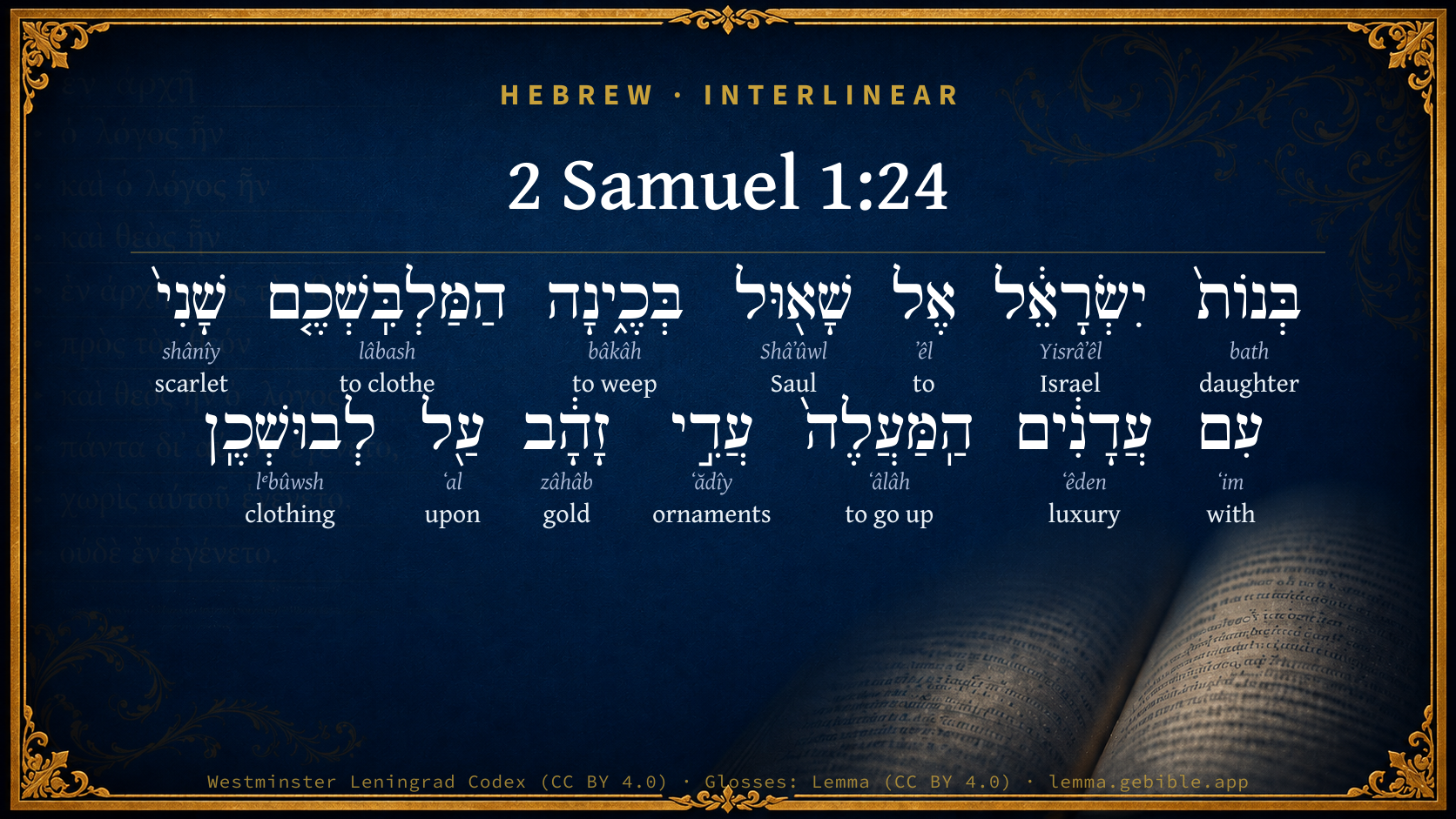
2 Samuel 1:24

Hebrew (Westminster Leningrad Codex) 2 Samuel 1:24 appears in the Hebrew Old Testament. The text above is from the Westminster Leningrad Codex. Each word links to its Strong’s number, a concise gloss, and parsing drawn from the Open Scriptures Hebrew Bible morphology. Click any word for its full Brown-Driver-Briggs (BDB) entry.
Download image
Cite this verse

2 Samuel 1:24 (World English Bible). Public Domain. Lemma interlinear Bible study tool, https://lemma.gebible.app/v/2-samuel/1/24.

Show BibTeX & RIS
BibTeX
RIS
English Translation
You daughters of Israel, weep over Saul, Who clothed you in scarlet delicately, Who put ornaments of gold on your clothing.
World English Bible · Public Domain
Download a study sheet

One document with this verse’s original text, its word-by-word gloss line, the meaning frame, cross-references with their text, attributed commentary, and full source and license credits — printable, and it pastes into notes with its structure intact.

This verse Autodidact and up

Study sheet (.html) Plain text (.txt)

A passage Seminary Student

Up to 50 verses in one chapter. A passage sheet keeps up to 6 commentary sources and 12 cross-references per verse, in the order this page ranks them, and says so on the sheet whenever that leaves anything out. Ask for a single verse and you get the Autodidact verse sheet above.

Everything on this page stays free to read, with no account — the sheet is a download of what is already on screen, not access to it.

Want to remove ads? Support Godless Engineer
Compare translations 3

The same verse in 3 English versions, stacked beneath the original-language interlinear above. Click any original word for its lexicon entry.

Each is an independent rendering of the whole verse — the interlinear is not word-aligned to these translations.

Highlighted words mark where these versions differ — a whole-verse word diff, not a word-by-word alignment.

  • World English Bible Public Domain
    You daughters of Israel, weep over Saul, Who clothed you in scarlet delicately, Who put ornaments of gold on your clothing.
  • King James Version Public Domain
    Ye daughters of Israel, weep over Saul, who clothed you in scarlet, with other delights, who put on ornaments of gold upon your apparel.
  • unfoldingWord Literal Text CC BY-SA 4.0
    Daughters of Israel, weep for Saul, the one having clothed you scarlet with delights, the one having put an ornament of gold on your clothing.

unfoldingWord Literal Text — © unfoldingWord, licensed CC BY-SA 4.0. Word-aligned USFM3 via Door43 (git.door43.org/unfoldingWord/en_ult).

Versions to compare (up to 4)

3 of 4 selected

Show all 18 translations

Every available English version of this verse, each an independent rendering of the whole verse.

  • World English Bible Public Domain
    You daughters of Israel, weep over Saul, Who clothed you in scarlet delicately, Who put ornaments of gold on your clothing.
  • Berean Standard Bible Public Domain
    O daughters of Israel, weep for Saul, who clothed you in scarlet and luxury, who decked your garments with ornaments of gold.
  • Majority Standard Bible Public Domain
    O daughters of Israel, weep for Saul, who clothed you in scarlet and luxury, who decked your garments with ornaments of gold.
  • King James Version Public Domain
    Ye daughters of Israel, weep over Saul, who clothed you in scarlet, with other delights, who put on ornaments of gold upon your apparel.
  • American Standard Version (1901) Public Domain
    Ye daughters of Israel, weep over Saul, Who clothed you in scarlet delicately, Who put ornaments of gold upon your apparel.
  • Revised Version (1885) Public Domain
    Ye daughters of Israel, weep over Saul, who clothed you in scarlet delicately, who put ornaments of gold upon your apparel.
  • Geneva Bible (1599) Public Domain
    Yee daughters of Israel, weepe for Saul, which clothed you in skarlet, with pleasures, and hanged ornaments of gold vpon your apparel.
  • Douay-Rheims (1899) Public Domain
    Ye daughters of Israel, weep over Saul, who clothed you with scarlet in delights, who gave ornaments of gold for your attire.
  • Young's Literal Translation Public Domain
    Daughters of Israel! for Saul weep ye, Who is clothing you `in' scarlet with delights. Who is lifting up ornaments of gold on your clothing.
  • Literal Standard Version CC BY-SA 4.0
    Daughters of Israel! Weep for Saul, || Who is clothing you [in] scarlet with delights. Who is lifting up ornaments of gold on your clothing.
  • Unlocked Literal Bible CC BY-SA 4.0
    You daughters of Israel, weep over Saul, who clothed you in scarlet as well as jewels, and who put ornaments of gold on your clothing.
  • unfoldingWord Literal Text CC BY-SA 4.0
    Daughters of Israel, weep for Saul, the one having clothed you scarlet with delights, the one having put an ornament of gold on your clothing.
  • Darby Bible Public Domain
    Ye daughters of Israel, weep over Saul, who clothed you in scarlet with splendour, Who put ornaments of gold upon your apparel.
  • World Messianic Bible Public Domain
    You daughters of Israel, weep over Saul, who clothed you delicately in scarlet, who put ornaments of gold on your clothing.
  • Webster's Bible Public Domain
    Ye daughters of Israel, weep over Saul, who clothed you in scarlet, with other delights, who put ornaments of gold upon your apparel.
  • Free Bible Version CC BY-SA 4.0
    Women of Israel, mourn for Saul, who gave you fine scarlet clothes decorated with gold ornaments.
  • Bible in Basic English Public Domain
    O daughters of Israel, have sorrow for Saul, by whom you were delicately clothed in robes of red, with ornaments of gold on your dresses.
  • JPS Tanakh (1917) Public Domain
    Ye daughters of Israel, weep over Saul, who clothed you in scarlet, with other delights, who put ornaments of gold upon your apparel.

Literal Standard Version (2020), Covenant Press — licensed CC BY-SA 4.0. Text via the HelloAO Bible API (eBible.org). Unlocked Literal Bible (unfoldingWord) — licensed CC BY-SA 4.0. Text via the HelloAO Bible API (eBible.org). unfoldingWord Literal Text — © unfoldingWord, licensed CC BY-SA 4.0. Word-aligned USFM3 via Door43 (git.door43.org/unfoldingWord/en_ult). Free Bible Version, Dr. Jonathan Gallagher — licensed CC BY-SA 4.0. Text via the HelloAO Bible API (eBible.org).

Word by word

More ways to search: Search by grammar → Find every occurrence → Compare this word →

Practice this passage: Drill this verse → Learn its vocabulary →

עֲדָנִ֔ים
ʻêden
H5730
“luxuries”
Noun, Common, Masculine, Plural, Absolute
Part of Speech
Noun
Type
Common
Gender
Masculine
Number
Plural
State
Absolute
Full BDB Definition

Origin: from H5727

TWOT: 1567a

luxury, dainty, delight, finery - delight
  1. בְּנוֹת֙ bath H1323 “daughters of” Noun, Common, Feminine, Plural, Construct
  2. יִשְׂרָאֵ֔ל Yisrâʼêl H3478 “Israel” Noun, Proper
  3. אֶל ʼêl H413 “to” Preposition
  4. שָׁא֖וּל Shâʼûwl H7586 “Saul” Noun, Proper
  5. בְּכֶ֑ינָה bâkâh H1058 “weep” Verb, Qal, Imperative, 2nd Person, Feminine, Plural
  6. הַמַּלְבִּֽשְׁכֶ֤ם lâbash H3847 “the · clothing · you” Particle, Definite Article + Verb, Hiphil, Participle Active, Masculine, Singular, Construct + Suffix, Personal, 2nd Person, Masculine, Plural
  7. שָׁנִי֙ shânîy H8144 “scarlet” Noun, Common, Masculine, Singular, Absolute
  8. עִם ʻim H5973 “with” Preposition
  9. הַֽמַּעֲלֶה֙ ʻâlâh H5927 “the · going up” Particle, Definite Article + Verb, Hiphil, Participle Active, Masculine, Singular, Absolute
  10. עֲדִ֣י ʻădîy H5716 “ornaments of” Noun, Common, Masculine, Singular, Construct
  11. זָהָ֔ב zâhâb H2091 “gold” Noun, Common, Masculine, Singular, Absolute
  12. עַ֖ל ʻal H5921 “upon” Preposition
  13. לְבוּשְׁכֶֽן lᵉbûwsh H3830 “clothing · your” Noun, Common, Masculine, Singular, Construct + Suffix, Personal, 2nd Person, Feminine, Plural

About this verse

These counts appear in no published source. They are computed here, from the morphology-tagged text and Lemma’s own curated glosses. What Lemma adds →

14
words
14
distinct lemmas
Historical
section

Notable vocabulary

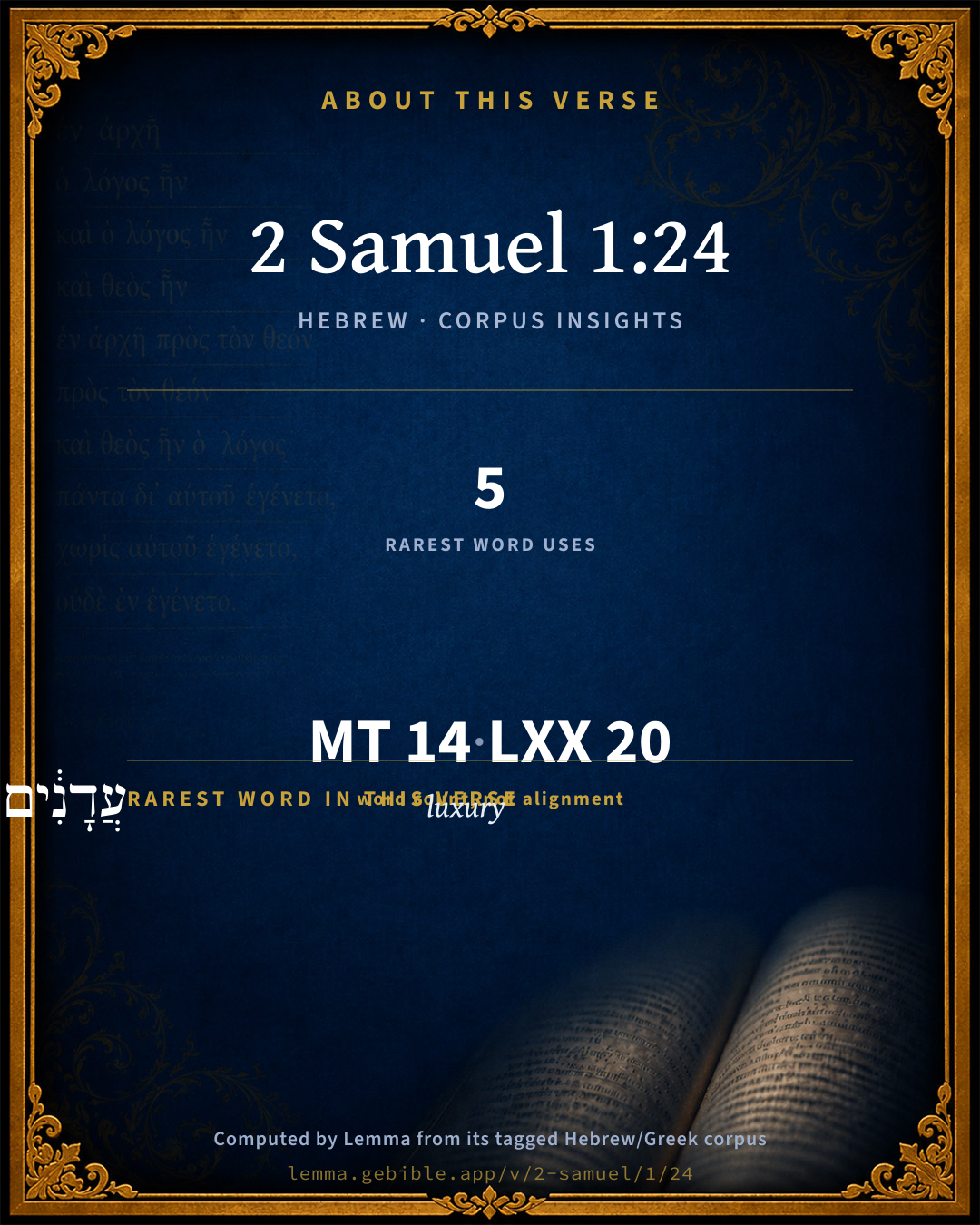
The rarest word here is עֲדָנִ֔ים luxury H5730 — appearing just 5 times in the whole Hebrew Bible.

Shared distinctive vocabulary

עֲדָנִ֔ים luxury H5730 occurs in 5 verses of the Hebrew Bible. Also found in:

Grammatical profile

  • 3 verbs
  • 8 nouns
  • 3 prepositions

Verb forms

  • בְּכֶ֑ינָה Qal · Imperative
  • הַמַּלְבִּֽשְׁכֶ֤ם Hiphil · Participle Active
  • הַֽמַּעֲלֶה֙ Hiphil · Participle Active

Hebrew & Septuagint length

In English translation the verse runs 21 words from the Hebrew and 22 from the Septuagint (LXX English) — closely comparable.

A rough comparison of the two English renderings, which tokenize alike — not a word-level alignment.

Word counts can differ between the Hebrew and the Greek without any difference in meaning — e.g. the Hebrew direct-object marker אֵת has no separate Greek word, and Greek often adds the article ὁ.

In the original languages it is 14 Hebrew tokens and 20 Greek tokens — but the two are counted differently (Hebrew bundles its prefixes and suffixes into one token; the Greek is in lemma form), so that isn’t a like-for-like length.

Cross-references

7

Topical passages linked to 2 Samuel 1:24 in the Treasury of Scripture Knowledge — connected by theme and wording, ordered by reader-vote popularity; previews shown in the World English Bible.

  • Judges 5:30 Have they not found, have they not divided the spoil? A lady, two ladies to every man; To Sisera a spoil of dyed garments, A spoil of dyed garments embroidered, Of dyed garments embroidered on both sides, on the necks of the spoil?
  • Isaiah 3:16–26 Moreover Yahweh said, "Because the daughters of Zion are haughty, And walk with outstretched necks and flirting eyes, Walking to trip as they go, Jingling ornaments on their feet;
  • Jeremiah 2:32 Can a virgin forget her ornaments, or a bride her attire? yet my people have forgotten me days without number.
  • 1 Timothy 2:9–10 In the same way, that women also adorn themselves in decent clothing, with modesty and propriety; not just with braided hair, gold, pearls, or expensive clothing;
  • 1 Peter 3:3–5 Let your beauty be not just the outward adorning of braiding the hair, and of wearing jewels of gold, or of putting on fine clothing;
  • Psalms 68:12 "Kings of armies flee! They flee!" She who waits at home divides the spoil,
  • Proverbs 31:21 She is not afraid of the snow for her household; For all her household are clothed with scarlet.

Cross-references courtesy of OpenBible.info (CC BY 4.0).

Hebrew and Greek witnesses Masoretic Hebrew ↔ Greek Septuagint

The same verse in the two great witnesses to the Old Testament, shown verse-for-verse.

These are two independent witnesses, not word-aligned to each other, and the Septuagint is shown in lemma (dictionary) form.

Hebrew 2 Samuel 1:24 Masoretic · Westminster Leningrad Codex

בְּנוֹת֙ יִשְׂרָאֵ֔ל אֶל שָׁא֖וּל בְּכֶ֑ינָה הַמַּלְבִּֽשְׁכֶ֤ם שָׁנִי֙ עִם עֲדָנִ֔ים הַֽמַּעֲלֶה֙ עֲדִ֣י זָהָ֔ב עַ֖ל לְבוּשְׁכֶֽן

You daughters of Israel, weep over Saul, Who clothed you in scarlet delicately, Who put ornaments of gold on your clothing.

World English Bible · Public Domain

Greek LXX 2 Samuel 1:24 Septuagint · lemma form

θυγάτηρ ἰσραήλ ἐπί σαούλ κλαίω ὁ ενδιδύσκω σύ κόκκινος μετά κόσμος σύ ὁ ἀναφέρω κόσμος χρυσοῦς ἐπί ὁ ἔνδυμα σύ

Daughters of Israel, weep for Saul, who clothed you with scarlet together with your adorning, who added golden ornaments to your apparel.

LXX2012 (modern English Septuagint) · Public Domain

Hebrew: Westminster Leningrad Codex (CC BY 4.0). Greek: Septuagint (public domain); English from LXX2012 (modern English Septuagint) (Public Domain). How the Septuagint differs from the Hebrew →

Targum (Aramaic paraphrase)

1

The Targum is the ancient Jewish Aramaic paraphrase of the Hebrew Scriptures — an interpretive translation, not the Hebrew text itself. Onkelos (literal) and Pseudo-Jonathan (expansive) render the Torah, and Jonathan the Prophets. Coverage is partial: where no permissively-licensed English translation exists for a verse, only the Aramaic is shown. This is verse-level text, not a word-by-word alignment to the Hebrew.

  1. Targum Jonathan Prophets (Joshua–Malachi)
    בְּנַת יִשְׂרָאֵל עַל שָׁאוּל בְּכָאָה דַהֲוָה מַלְבִּישׁ לְכוֹן לְבוּשֵׁי צִבְעוֹנִין וּמוֹבִיל לְכוֹן תַּפְנוּקִין וּמַסִיק תִּיקוּנֵי דַהֲבָא עַל לְבוּשְׁכוֹן:

    (no public-domain English translation for this verse)

    Targum Jonathan — Aramaic: “Mikraot Gedolot” (public domain). English: “Sefaria Community Translation” (CC0 1.0 (public-domain dedication)); “London "Chaldee Paraphrase," 1871” (public domain). Text via Sefaria.

Commentary

Notes on 2 Samuel 1:24 from classic Christian and Jewish commentators (each source and its license shown beneath its notes). The classic Christian expositions comment on the surrounding passage and are grouped to its opening verse, so a note may address several verses; the Jewish commentaries on the Tanakh (Rashi and others) are per-verse, so they appear only where the commentator wrote on this verse.

Lemma curates 59 commentaries, every one of them public domain or Creative Commons licensed, each selected and text-cleaned for this edition rather than reprinted as found. About our sources →

Trapp's Complete Commentary

John Trapp

2Sa 1:24 Ye daughters of Israel, weep over Saul, who clothed you in scarlet, with [other] delights, who put on ornaments of gold upon your apparel.

Ver. 24. Ye daughters of Israel.] Women love fine array: see Isa 3:18-26; and see their wardrobes rifled. Queen Elizabeth used to wear costly apparel always: and well she deserved it.

John Trapp, A Commentary or Exposition upon All the Books of the Old and New Testament (1647–1656) — public domain. Text from a community e-Sword module.

Joseph Benson's Commentary

2Sa 1:24. Ye daughters of Jerusalem, weep over Saul — “Nothing,” says Dr. Dodd, “can be more elegant than this verse: while the warriors of Israel lamented their chiefs, the divine poet calls upon the women of the land to shed their tears over the ashes of princes, whose warlike exploits had so often procured them those ornaments which are most pleasing to the sex, and had enriched them with the spoils of their enemies.” Who clothed you in scarlet, with other delights — The word other seems to be unnecessarily supplied here by our translators, there being nothing for it in the Hebrew, which, literally rendered, is, Who clothed you in scarlet with delights; that is, in scarlet, wherewith you are so much delighted. For this seems to have been the colour in which the Israelitish women delighted.

Joseph Benson's Commentary on the Old and New Testaments (1811–1818) — public domain. Text from a community e-Sword module.

Geneva Bible (1599)

Geneva Bible translators

As rich garments and costly jewels.

Geneva Bible (1599) marginal notes — public domain. Text via Bolls.life.

Jamieson, Fausset & Brown

Robert Jamieson, A. R. Fausset & David Brown

Ye daughters of Israel, weep over Saul, who clothed you in scarlet, with other delights, &c.--The fondness for dress, which anciently distinguished Oriental women, is their characteristic still. It appears in their love of bright, gay, and divers colors, in profuse display of ornaments, and in various other forms. The inmost depths of the poet's feeling are stirred, and his amiable disposition appears in the strong desire to celebrate the good qualities of Saul, as well as Jonathan. But the praises of the latter form the burden of the poem, which begins and ends with that excellent prince.

Next: 2 Samuel Chapter 2

Jamieson, Fausset & Brown — Commentary Critical and Explanatory on the Whole Bible (1871) — public domain (CC PDM 1.0). Text via the HelloAO Bible API.

Ellicott's Commentary for English Readers

(24) Clothed you in scarlet.—This refers to Saul’s division among the people of the spoil of his conquered foes, and to the prosperity resulting from his many successful campaigns. Notwithstanding that his light at last went out under the cloud of a crushing defeat, he had been on the whole a successful warrior. The Philistines, the Ammonites, the Amalekites, and others, had felt the power of his arm, and the relations of Israel to the surrounding nations had been wonderfully changed for the better during his reign.

A Bible Commentary for English Readers, edited by Charles John Ellicott (1878–1897) — public domain. Text from a community e-Sword module.

The Cambridge Bible for Schools and Colleges

gen. ed. J. J. S. Perowne

24. Ye daughters of Israel] The women who had once celebrated Saul’s triumphs, and shared the spoil of his victories, are summoned to lament his loss. This incidental mention indicates how much Saul’s successful wars, so briefly alluded to in the history of his reign (1Sa_14:47), had enriched the nation.

with other delights] A possible rendering: but with delights perhaps rather means delicately or richly.

The Cambridge Bible for Schools and Colleges (gen. ed. J. J. S. Perowne; Cambridge University Press, 1878–1918) — public domain. Text from a community e-Sword module.

John Gill's Exposition

Ye daughters of Israel, weep over Saul,.... In their mournful elegies:

who clothed you with scarlet, with other delights; not only with scarlet, but with other fine and delightful apparel, such as were very pleasing to the female sex, especially young people, who are delighted with gay apparel; this Saul was the means of, through the spoil he took from his enemies, and by other methods taken by him to the enriching of the nation, whereby husbands and parents were enabled to provide rich clothes for their wives and children:

who put on ornaments of gold upon your apparel; broidered work, jewels of gold, &c. See Isa 3:18.

John Gill's Exposition of the Whole Bible (1746–1763) — public domain (CC PDM 1.0). Text via the HelloAO Bible API.

Albert Barnes' Notes on the Bible

The women of Israel are most happily introduced. They who had come out to meet king Saul with tabrets, with joy, and with instruments of music” in the day of victory, are now called to weep over him.

Albert Barnes' Notes on the Bible (1834–1885) — public domain. Text from a community e-Sword/MySword module.

Matthew Poole's English Annotations

Ye daughters of Israel: these he mentions, partly because the women then used to make songs, both of triumph and of lamentation, as occasion required; and partly because they usually are most delighted with the ornaments of the body here following.

Who clotheth you in scarlet: this he did, partly because he procured them so much peace as gave them opportunity of enriching themselves; and partly because he took these things as spoils from the enemies, and clothed his own people with them. Compare Psa 68:12.

Matthew Poole's English Annotations on the Holy Bible (1683–1685) — public domain. Text from a community e-Sword/MySword module.

Whedon's Commentary on the Bible

Daniel D. Whedon

24. Daughters… who clothed you in scarlet — “The idea is, that under Saul the land had attained to such a degree of wealth that elegance and splendour of dress were within the reach of all. Scarlet was the favourite colour of the wealthy and noble. Pro_31:21; Lam_4:5; Dan_5:7; Dan_5:16; Dan_5:29. This appeal to the instinctive taste of the sex well comports with the general character of oriental females; Compare Jdg_5:28-30.” — Robinson.

With delights — With other delightful things of a similar nature to scarlet-coloured clothing.

Daniel D. Whedon (gen. ed.), Commentary on the Old and New Testaments (1874–1909) — public domain. Text from a community e-Sword module.

The Pulpit Commentary

Ye daughters of Israel. In old time, the women of Israel had celebrated Saul"s triumphs (ver. 20), but now it is their sad office to bewail his death. And a touching reason is given for their sorrow. During Saul"s reign the condition of the women.had greatly improved. When a nation is in the miserable plight described in 1Sa_13:19-22, there is neither safety nor comfort for the weak; but when the strong arm of Saul had won freedom for Israel, the women were the first to reap the benefit, and "their scarlet clothing with delights," that is, their delightful or delicate clothing of bright colours and their golden ornaments, prove that the nation had made a great advance in prosperity and culture during the happier years of Saul"s reign.

The Pulpit Commentary (1880–1919), ed. H.D.M. Spence-Jones & Joseph S. Exell — public domain. Text from a community e-Sword module.

John Wesley's Explanatory Notes

Daughters - These he mentions; because the women then used to make songs both of triumph, and of lamentation, and, because they usually are most delighted with the ornaments of the body here following. Clothed you - This he did, because he procured them so much peace as gave them opportunity of enriching themselves: and, because he took these things as spoils from the enemies, and clothed his own people with them.

John Wesley, Explanatory Notes Upon the Whole Bible (1754–1765) — public domain. Text via the GEBible commentary corpus.

Rashi

Rabbi Shlomo Yitzchaki (Rashi)

Who has clothed you in scarlet clothing together with other delights. That clothed you in coloured garments and loaded you with delights.

Rashi on the Tanakh — English translations: “The Judaica Press complete Tanach with Rashi, translated by A. J. Rosenberg” (CC BY 4.0); “Pentateuch with Rashi's commentary by M. Rosenbaum and A.M. Silbermann, 1929-1934” (public domain); “The Metsudah Tanach series, Lakewood, N.J” (CC BY 4.0); and “The Book of Joshua, Metsudah Publications, 1997” (CC BY 4.0). Text via Sefaria.

Lesson kit

Teaching starters — assembled from the data on this page, not authored interpretation. Every prompt links to the verse data it draws on. Edit before teaching.

2 Samuel, in the Historical, opens this verse with 14 words (14 distinct Hebrew lemmas). Its most distinctive word is ʻêden (“luxury”). A historical commentator’s framing appears above. Read the whole chapter for the surrounding context.

Discussion questions

  1. How does “luxury” (ʻêden) shape what this verse is saying?
  2. Genesis 18:12 shares the word «luxury» with this verse. How do the two illuminate each other?
  3. These translations render this verse differently. What is at stake in choosing one wording over another?
  4. The verb «בְּכֶ֑ינָה» is Qal Imperative. How does its form color the action?
  5. Reading how Trapp's Complete Commentary and Joseph Benson's Commentary read this verse, where do the two commentators agree and where do they part?

Things to notice

Reading settings

Reading text

Shown beneath each verse's original-language words.

Old Testament
Old Testament edition

Read the OT as the Masoretic Hebrew (MT) or the Greek Septuagint (LXX).

English shown for the Greek Septuagint (in the Hebrew ↔ Greek comparison).

Comparing translations? Open the Compare panel on any verse page to stack up to four side by side.