1 Samuel 6:20

Hebrew (Westminster Leningrad Codex) 1 Samuel 6:20 appears in the Hebrew Old Testament. The text above is from the Westminster Leningrad Codex. Each word links to its Strong’s number, a concise gloss, and parsing drawn from the Open Scriptures Hebrew Bible morphology. Click any word for its full Brown-Driver-Briggs (BDB) entry.
Download image
Cite this verse

1 Samuel 6:20 (World English Bible). Public Domain. Lemma interlinear Bible study tool, https://lemma.gebible.app/v/1-samuel/6/20.

Show BibTeX & RIS
BibTeX
RIS
English Translation
The men of Beth-shemesh said, Who is able to stand before Yahweh, this holy God? and to whom shall he go up from us?
World English Bible · Public Domain
Download a study sheet

One document with this verse’s original text, its word-by-word gloss line, the meaning frame, cross-references with their text, attributed commentary, and full source and license credits — printable, and it pastes into notes with its structure intact.

This verse Autodidact and up

Study sheet (.html) Plain text (.txt)

A passage Seminary Student

Up to 50 verses in one chapter. A passage sheet keeps up to 6 commentary sources and 12 cross-references per verse, in the order this page ranks them, and says so on the sheet whenever that leaves anything out. Ask for a single verse and you get the Autodidact verse sheet above.

Everything on this page stays free to read, with no account — the sheet is a download of what is already on screen, not access to it.

Want to remove ads? Support Godless Engineer
Compare translations 3

The same verse in 3 English versions, stacked beneath the original-language interlinear above. Click any original word for its lexicon entry.

Each is an independent rendering of the whole verse — the interlinear is not word-aligned to these translations.

Highlighted words mark where these versions differ — a whole-verse word diff, not a word-by-word alignment.

  • World English Bible Public Domain
    The men of Beth-shemesh said, Who is able to stand before Yahweh, this holy God? and to whom shall he go up from us?
  • King James Version Public Domain
    And the men of Bethshemesh said, Who is able to stand before this holy LORD God? and to whom shall he go up from us?
  • unfoldingWord Literal Text CC BY-SA 4.0
    And the men of Beth Shemesh said, “Who is able to stand to the face of Yahweh, this holy God? And to whom will he go up from upon us?”

unfoldingWord Literal Text — © unfoldingWord, licensed CC BY-SA 4.0. Word-aligned USFM3 via Door43 (git.door43.org/unfoldingWord/en_ult).

Versions to compare (up to 4)

3 of 4 selected

Show all 18 translations

Every available English version of this verse, each an independent rendering of the whole verse.

  • World English Bible Public Domain
    The men of Beth-shemesh said, Who is able to stand before Yahweh, this holy God? and to whom shall he go up from us?
  • Berean Standard Bible Public Domain
    The men of Beth-shemesh asked, “Who can stand in the presence of the LORD, this holy God? To whom should the ark go up from here?”
  • Majority Standard Bible Public Domain
    The men of Beth-shemesh asked, “Who can stand in the presence of the LORD, this holy God? To whom should the ark go up from here?”
  • King James Version Public Domain
    And the men of Bethshemesh said, Who is able to stand before this holy LORD God? and to whom shall he go up from us?
  • American Standard Version (1901) Public Domain
    And the men of Beth-shemesh said, Who is able to stand before Jehovah, this holy God? and to whom shall he go up from us?
  • Revised Version (1885) Public Domain
    And the men of Beth-shemesh said, Who is able to stand before the LORD, this holy God? and to whom shall he go up from us?
  • Geneva Bible (1599) Public Domain
    Wherefore the men of Beth-shemesh said, Who is able to stand before this holy Lord God? and to whom shall he go from vs?
  • Douay-Rheims (1899) Public Domain
    And the men of Bethsames said: Who shall be able to stand before the Lord this holy God? and to whom shall he go up from us?
  • Young's Literal Translation Public Domain
    And the men of Beth-Shemesh say, `Who is able to stand before Jehovah, this holy God? and unto whom doth He go up from us?'
  • Literal Standard Version CC BY-SA 4.0
    And the men of Beth-Shemesh say, “Who is able to stand before YHWH, this holy God? And to whom does He go up from us?”
  • Unlocked Literal Bible CC BY-SA 4.0
    The men of Beth Shemesh said, “Who is able to stand before Yahweh, this holy God? To whom will the ark go up from us?”
  • unfoldingWord Literal Text CC BY-SA 4.0
    And the men of Beth Shemesh said, “Who is able to stand to the face of Yahweh, this holy God? And to whom will he go up from upon us?”
  • Darby Bible Public Domain
    And the men of Beth-shemesh said, Who is able to stand before Jehovah, this holy God? and to whom shall he go up from us?
  • World Messianic Bible Public Domain
    The men of Beth Shemesh said, “Who is able to stand before the LORD, this holy God? To whom shall he go up from us?”
  • Webster's Bible Public Domain
    And the men of Beth-shemesh said, Who is able to stand before this holy LORD God? and to whom shall he go up from us?
  • Free Bible Version CC BY-SA 4.0
    The people of Beth-shemesh asked, “Who can stand before the Lord, this holy God? Where should the Ark go from here?”
  • Bible in Basic English Public Domain
    And the men of Beth-shemesh said, Who is able to keep his place before the Lord, this holy God? and to whom may he go from us?
  • JPS Tanakh (1917) Public Domain
    And the men of Beth-shemesh said: 'Who is able to stand before the LORD, this holy God? and to whom shall it go up from us?'

Literal Standard Version (2020), Covenant Press — licensed CC BY-SA 4.0. Text via the HelloAO Bible API (eBible.org). Unlocked Literal Bible (unfoldingWord) — licensed CC BY-SA 4.0. Text via the HelloAO Bible API (eBible.org). unfoldingWord Literal Text — © unfoldingWord, licensed CC BY-SA 4.0. Word-aligned USFM3 via Door43 (git.door43.org/unfoldingWord/en_ult). Free Bible Version, Dr. Jonathan Gallagher — licensed CC BY-SA 4.0. Text via the HelloAO Bible API (eBible.org).

Word by word

More ways to search: Search by grammar → Find every occurrence → Compare this word →

Practice this passage: Drill this verse → Learn its vocabulary →

בֵֽית
Bêyth Shemesh
H1053
“Beth-shemesh”
Noun, Proper
Part of Speech
Noun
Type
Proper
Full BDB Definition

Origin: from H1004 and H8121

TWOT: None

Beth-shemesh = "house of the sun" or " sun-temple" - a town in southwest Judah - a town in Naphtali - a town in Issachar - a town in Egypt
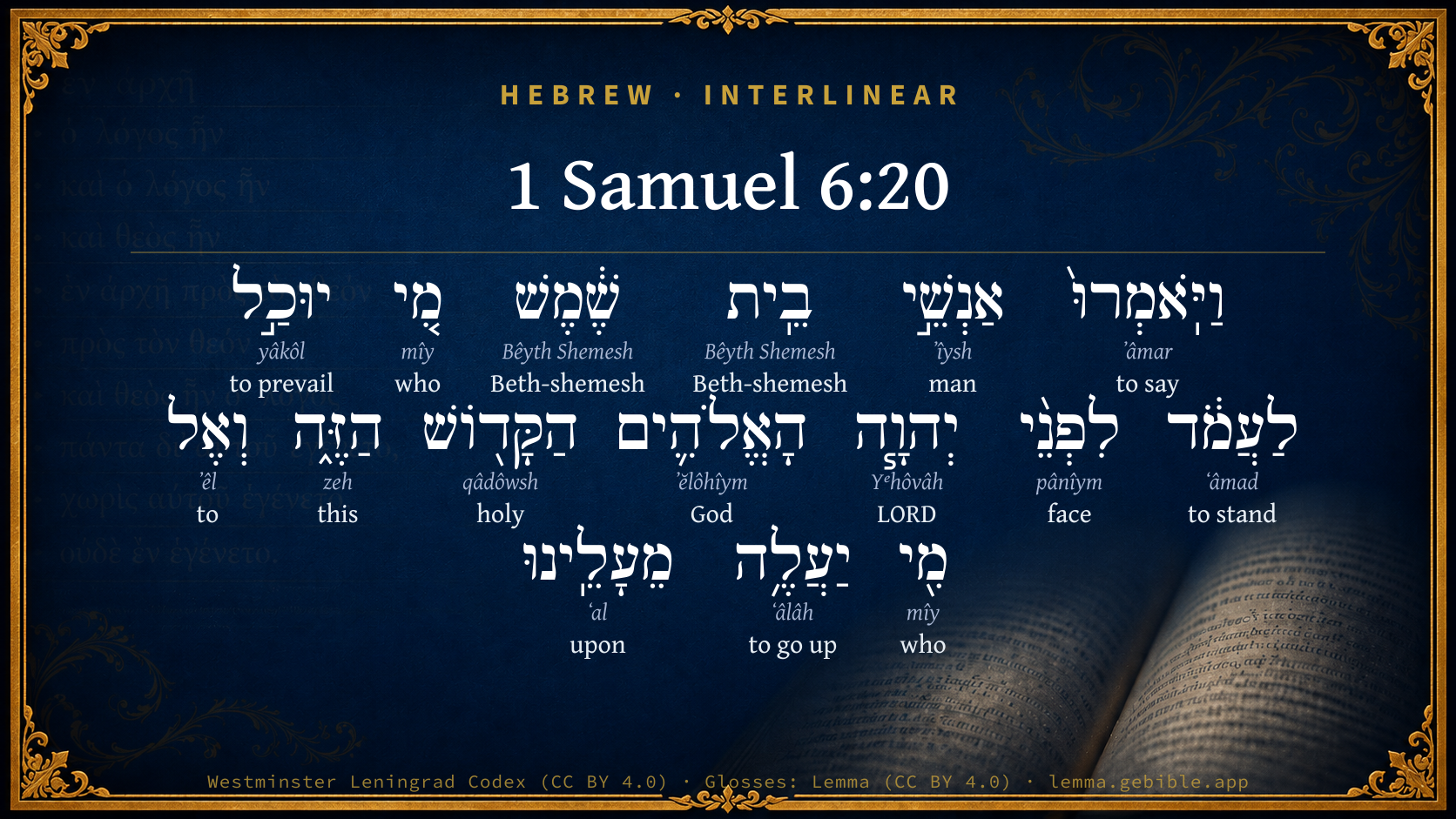
  1. וַיֹּֽאמְרוּ֙ ʼâmar H559 “and · to say” Conjunction + Verb, Qal, Sequential Imperfect, 3rd Person, Masculine, Plural
  2. אַנְשֵׁ֣י ʼîysh H376 “men of” Noun, Common, Masculine, Plural, Construct
  3. שֶׁ֔מֶשׁ Bêyth Shemesh H1053 “Beth-shemesh” Noun, Proper
  4. מִ֚י mîy H4310 “who” Particle, Interrogative
  5. יוּכַ֣ל yâkôl H3201 “to prevail” Verb, Qal, Imperfect, 3rd Person, Masculine, Singular
  6. לַעֲמֹ֔ד ʻâmad H5975 “to stand” Preposition + Verb, Qal, Infinitive Construct
  7. לִפְנֵ֨י pânîym H6440 “to/for · face(s) of” Preposition + Noun, Common, Both, Plural, Construct
  8. יְהוָ֧ה Yᵉhôvâh H3068 “LORD” Noun, Proper
  9. הָאֱלֹהִ֛ים ʼĕlôhîym H430 “the · God(s)” Particle, Definite Article + Noun, Common, Masculine, Plural, Absolute
  10. הַקָּד֖וֹשׁ qâdôwsh H6918 “the · holy” Particle, Definite Article + Adjective, Adjective, Masculine, Singular, Absolute
  11. הַזֶּ֑ה zeh H2088 “the · this” Particle, Definite Article + Pronoun, Demonstrative, Masculine, Singular
  12. וְאֶל ʼêl H413 “and · to” Conjunction + Preposition
  13. מִ֖י mîy H4310 “who” Particle, Interrogative
  14. יַעֲלֶ֥ה ʻâlâh H5927 “to go up” Verb, Qal, Imperfect, 3rd Person, Masculine, Singular
  15. מֵעָלֵֽינוּ ʻal H5921 “from · upon · us” Preposition + Preposition + Suffix, Personal, 1st Person, Common, Plural

About this verse

These counts appear in no published source. They are computed here, from the morphology-tagged text and Lemma’s own curated glosses. What Lemma adds →

16
words
14
distinct lemmas
Historical
section

Shared distinctive vocabulary

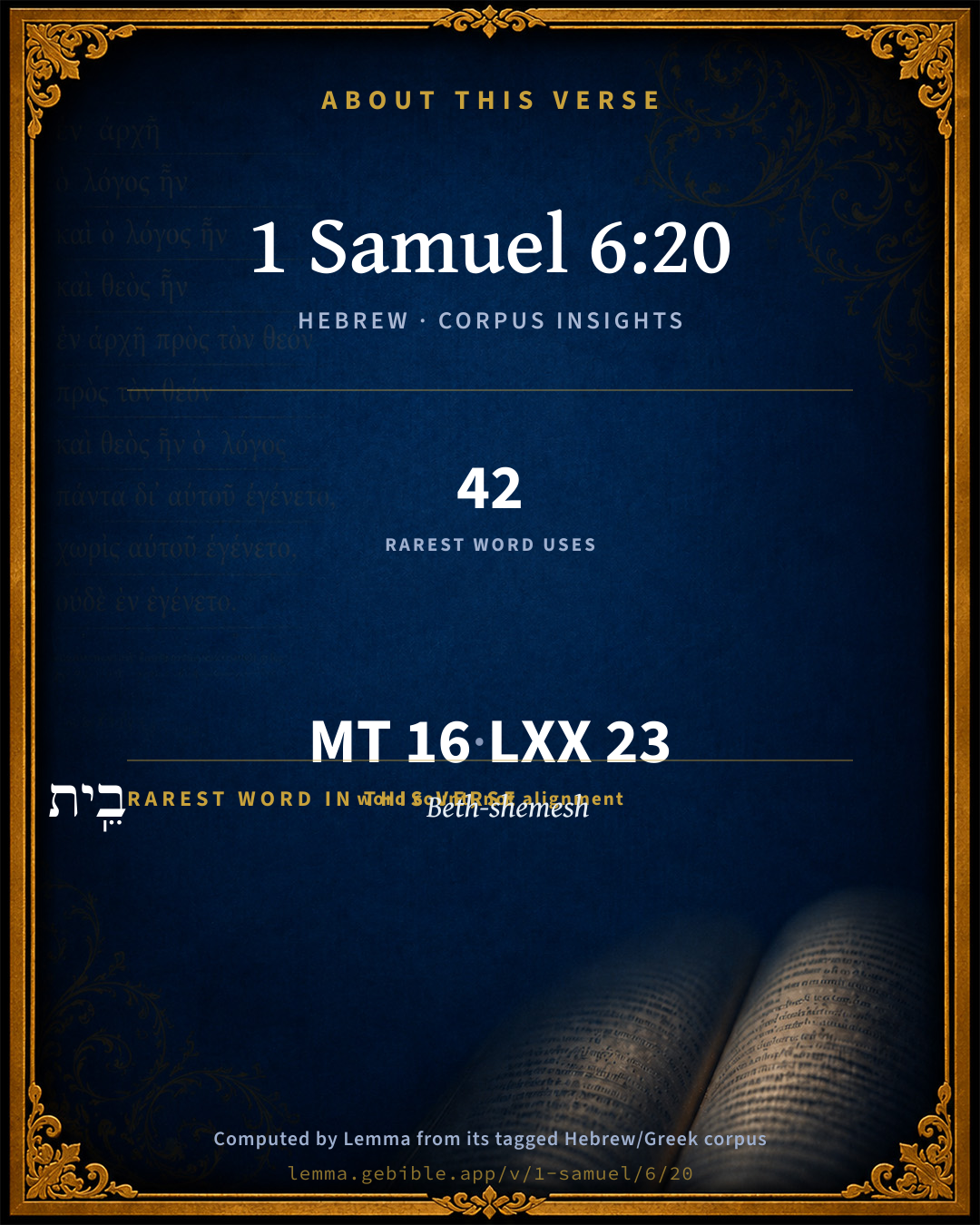
בֵֽית Beth-shemesh H1053 occurs in 19 verses of the Hebrew Bible. Also found in:

Grammatical profile

  • 4 verbs
  • 6 nouns
  • 1 adjective
  • 1 pronoun
  • 2 prepositions
  • 2 particles

Verb forms

  • וַיֹּֽאמְרוּ֙ Qal · Sequential Imperfect
  • יוּכַ֣ל Qal · Imperfect
  • לַעֲמֹ֔ד Qal · Infinitive Construct
  • יַעֲלֶ֥ה Qal · Imperfect

Repetition

Words recur within this verse — often emphatic in Hebrew:

  • בֵֽית Beth-shemesh H1053 ×2
  • מִ֚י who H4310 ×2

Hebrew & Septuagint length

In English translation the verse runs 24 words from the Hebrew and 30 from the Septuagint (LXX English) — closely comparable.

A rough comparison of the two English renderings, which tokenize alike — not a word-level alignment.

Word counts can differ between the Hebrew and the Greek without any difference in meaning — e.g. the Hebrew direct-object marker אֵת has no separate Greek word, and Greek often adds the article ὁ.

In the original languages it is 16 Hebrew tokens and 23 Greek tokens — but the two are counted differently (Hebrew bundles its prefixes and suffixes into one token; the Greek is in lemma form), so that isn’t a like-for-like length.

Cross-references

11

Topical passages linked to 1 Samuel 6:20 in the Treasury of Scripture Knowledge — connected by theme and wording, ordered by reader-vote popularity; previews shown in the World English Bible.

  • 2 Samuel 6:9 David was afraid of Yahweh that day; and he said, How shall the ark of Yahweh come to me?
  • Malachi 3:2 "But who can endure the day of his coming? And who will stand when he appears? For he is like a refiner's fire, and like launderer's soap;
  • Revelation 6:17 for the great day of his wrath has come; and who is able to stand?"
  • Leviticus 11:45 For I am Yahweh who brought you up out of the land of Egypt, to be your God. You shall therefore be holy, for I am holy.
  • Numbers 17:12–13 The children of Israel spoke to Moses, saying, Behold, we perish, we are undone, we are all undone.
  • 1 Samuel 5:8–12 They sent therefore and gathered all the lords of the Philistines to them, and said, What shall we do with the ark of the God of Israel? They answered, Let the ark of the God of Israel be carried about to Gath. They carried the ark of the God of Israel [there].
  • 2 Samuel 6:7 The anger of Yahweh was kindled against Uzzah; and God struck him there for his error; and there he died by the ark of God.
  • 1 Chronicles 13:11–13 David was displeased, because Yahweh had broken forth on Uzza; and he called that place Perez Uzza, to this day.
  • Psalms 76:7 You, even you, are to be feared. Who can stand in your sight when you are angry?
  • Luke 5:8 But Simon Peter, when he saw it, fell down at Jesus' knees, saying, "Depart from me, for I am a sinful man, Lord."
  • Luke 8:37 All the people of the surrounding country of the Gadarenes asked him to depart from them, for they were very much afraid. He entered into the boat, and returned.

Cross-references courtesy of OpenBible.info (CC BY 4.0).

Hebrew and Greek witnesses Masoretic Hebrew ↔ Greek Septuagint

The same verse in the two great witnesses to the Old Testament, shown verse-for-verse.

These are two independent witnesses, not word-aligned to each other, and the Septuagint is shown in lemma (dictionary) form.

Hebrew 1 Samuel 6:20 Masoretic · Westminster Leningrad Codex

וַיֹּֽאמְרוּ֙ אַנְשֵׁ֣י בֵֽית שֶׁ֔מֶשׁ מִ֚י יוּכַ֣ל לַעֲמֹ֔ד לִפְנֵ֨י יְהוָ֧ה הָאֱלֹהִ֛ים הַקָּד֖וֹשׁ הַזֶּ֑ה וְאֶל מִ֖י יַעֲלֶ֥ה מֵעָלֵֽינוּ

The men of Beth-shemesh said, Who is able to stand before Yahweh, this holy God? and to whom shall he go up from us?

World English Bible · Public Domain

Greek LXX 1 Samuel 6:20 Septuagint · lemma form

καί εἶπον ὁ ἀνήρ ὁ ἐκ βαιθσαμυς τίς δύναμαι διαἔρχομαι ἐνώπιον κύριος ὁ ἅγιος οὗτος καί πρός τίς ἀναβαίνω κιβωτός κύριος ἀπό ἐγώ

And the men of Baethsamys said, Who shall be able to pass before this holy Lord God? and to whom shall the ark of the Lord go up from us?

LXX2012 (modern English Septuagint) · Public Domain

Hebrew: Westminster Leningrad Codex (CC BY 4.0). Greek: Septuagint (public domain); English from LXX2012 (modern English Septuagint) (Public Domain). How the Septuagint differs from the Hebrew →

Targum (Aramaic paraphrase)

1

The Targum is the ancient Jewish Aramaic paraphrase of the Hebrew Scriptures — an interpretive translation, not the Hebrew text itself. Onkelos (literal) and Pseudo-Jonathan (expansive) render the Torah, and Jonathan the Prophets. Coverage is partial: where no permissively-licensed English translation exists for a verse, only the Aramaic is shown. This is verse-level text, not a word-by-word alignment to the Hebrew.

  1. Targum Jonathan Prophets (Joshua–Malachi)
    וַאֲמָרוּ גַבְרֵי בֵית שֶׁמֶשׁ מַן יָכִיל לְמֵיקַם קֳדָם אֲרוֹנָא דַייָ אֱלֹהִים קַדִישָׁא הָדֵין וּלְאֵידֵין אֲתַר יִסְתַּלֵק מִנָנָא:

    (no public-domain English translation for this verse)

    Targum Jonathan — Aramaic: “Mikraot Gedolot” (public domain). English: “Sefaria Community Translation” (CC0 1.0 (public-domain dedication)); “London "Chaldee Paraphrase," 1871” (public domain). Text via Sefaria.

Commentary

Notes on 1 Samuel 6:20 from classic Christian and Jewish commentators (each source and its license shown beneath its notes). The classic Christian expositions comment on the surrounding passage and are grouped to its opening verse, so a note may address several verses; the Jewish commentaries on the Tanakh (Rashi and others) are per-verse, so they appear only where the commentator wrote on this verse.

Lemma curates 59 commentaries, every one of them public domain or Creative Commons licensed, each selected and text-cleaned for this edition rather than reprinted as found. About our sources →

Trapp's Complete Commentary

John Trapp

1Sa 6:20 And the men of Bethshemesh said, Who is able to stand before this holy LORD God? and to whom shall he go up from us?

Ver. 20. This holy Lord God.] Here they seem peevishly to lay the blame of their sufferings upon God, as too holy and strict: of their sins, the true cause, they say nothing; but take care to rid their hands of the ark, which they should have retained reverently.

John Trapp, A Commentary or Exposition upon All the Books of the Old and New Testament (1647–1656) — public domain. Text from a community e-Sword module.

Joseph Benson's Commentary

1Sa 6:20. Who is able to stand? &c. — That is, to minister before the ark, where the Lord is present. Since God is so severe to mark what is amiss in his servants, who is sufficient to serve him? They seem by this to have been made sensible of their rashness, and brought to acknowledge the holiness of God to be such that they were not worthy of his divine presence among them, and therefore they desired that the ark might be placed elsewhere. And to whom shall he go up from us? — Who will dare to receive the ark with so much hazard to themselves? Thus when the word of God works with terror on men’s consciences, instead of taking the blame to themselves, they frequently quarrel with the word, and endeavour to put it from them.

Joseph Benson's Commentary on the Old and New Testaments (1811–1818) — public domain. Text from a community e-Sword module.

Tyndale Open Study Notes

Tyndale Open Resources

6:20 Who is able to stand? Even God’s people were not immune to his wrath when his holiness was violated. • Where can we send the Ark? When faced with God’s holiness, the Israelites echoed the distress of the pagan Philistines (6:2).

Tyndale Open Study Notes — © Tyndale Open Resources, licensed CC BY-SA 4.0. Text via the HelloAO Bible API.

Adam Clarke's Commentary

Verse 20. Who is able to stand] Why this exclamation? They knew that God had forbidden any to touch his ark but the priests and Levites; but they endeavoured to throw that blame on God, as a Being hard to be pleased, which belonged solely to themselves.

Adam Clarke's Commentary on the Bible (1810–1826) — public domain. Text from a community e-Sword/MySword module.

Ellicott's Commentary for English Readers

(20) Who is able to stand?—There is some superstition involved in this exclamation, “Whither shall we send this awful visitant?” The men of the priestly city of Beth-shemesh strangely connected their invisible King with that golden Ark, which, sacred though it was, was but a lifeless chest of wood and gold.

Yet through their superstition we can discern a deep consciousness of sin and shortcoming, which argued well for the future reformation of the religious life of the people—a grand work, which we shall soon sec Samuel the prophet labouring so faithfully and so successfully to bring about. These poor sinners, discerning the cause of the fatal stroke which had fallen upon their brethren, felt too surely that they were none of them any better really than those who had fallen victims to their impiety, and were fully sensible that sinners could not dwell in the presence of God. Carried away by this feeling of awe before the purity of the invisible King, they cried, “To whom shall He go up from us?”

These poor Hebrews felt the same fear as John was sensible of centuries later, when at the feet of the glorified Son of Man he fell as dead; but they, less blessed than John and the children of the kingdom, had no Redeemer there to raise them up with the loving whisper: “Fear not; I (whom thou dreadest) am He that liveth and was dead.” (Sec Rev_1:17-18.)

A Bible Commentary for English Readers, edited by Charles John Ellicott (1878–1897) — public domain. Text from a community e-Sword module.

The Cambridge Bible for Schools and Colleges

gen. ed. J. J. S. Perowne

20. Who is able to stand before this holy Lord God?] Before Jehovah this holy God. Holiness is an especial attribute of Jehovah, demanding a corresponding holiness on the part of the people among whom He promised to dwell (Exo_29:45-46; Lev_11:44-45). Chastisement was necessary to teach the men of Beth-shemesh that their sinfulness could not stand before the holiness of God (cp. Mal_3:2; Luk_5:8): but instead of fitting themselves for His Presence, they desired to free themselves from the harden of it. Cp. Mat_8:34.

We should compare the judgment upon Uzzah, after which David feared to bring the Ark into Jerusalem. (2Sa_6:7-9.)

to whom shall he go up from us?] They regard the Presence of Jehovah as inseparable from the Ark.

The Cambridge Bible for Schools and Colleges (gen. ed. J. J. S. Perowne; Cambridge University Press, 1878–1918) — public domain. Text from a community e-Sword module.

John Gill's Exposition

And the men of Bethshemesh said, who is able to stand before this holy Lord God?.... The Targum is,"before the ark of this holy Lord God;''which is said either by way of complaint of the severity of God, and the strictness of his justice; or in reverence of his holiness, acknowledging their imperfection, sin, and guilt, by reason of which they could not stand before him; nor can any, but on account of the mercy seat over the ark, or through Christ, his blood, righteousness, and sacrifice:

and to whom shall he go up from us? that is, the ark, the symbol of God's presence, which they seem to be desirous of parting with; being unworthy of it, and conscious of their impurity in comparison of God that dwelt in it; and of their weakness to give the honour and reverence that was due unto it; and yet they knew not who were fit for it, or would choose to receive it, because of the danger they were liable to through every inadvertency in them, and irreverence of that.

John Gill's Exposition of the Whole Bible (1746–1763) — public domain (CC PDM 1.0). Text via the HelloAO Bible API.

Haydock's Catholic Bible Commentary

Us. These words may denote that they thought God too severe, or else, that they judged themselves unworthy of his presence. There is no proportion between an offence of God, and what the creature can do to make him satisfaction. (Calmet)

George Leo Haydock (1774–1849), Haydock's Catholic Family Bible and Commentary, 1859 edition — public domain. Excludes Psalms (Douay-Rheims chapter numbering differs from Protestant) and Deuterocanonical books (Catholic canon only).

Matthew Poole's English Annotations

To stand before this holy Lord God, i.e. to minister before the ark where the Lord is present. Since God is so severe to mark whatsoever is amiss in his servants, who is sufficient and worthy to serve him? who dare presume to come into his presence? It seems to be a complaint, or expostulation with God, concerning this last and great instance of his severity.

To whom shall he go up from us? who will dare to receive the ark with so much hazard to themselves?

Matthew Poole's English Annotations on the Holy Bible (1683–1685) — public domain. Text from a community e-Sword/MySword module.

Whedon's Commentary on the Bible

Daniel D. Whedon

20. Who is able to stand — For Israelite as well as Philistine is smitten by the presence of the holy shrine.

To whom shall he go up from us — Who next will dare take charge of him?

Daniel D. Whedon (gen. ed.), Commentary on the Old and New Testaments (1874–1909) — public domain. Text from a community e-Sword module.

The Pulpit Commentary

Vers. 20, 21. Who is able, etc. Literally, "Who is able to stand before Jehovah, this holy God?" A punishment so severe following upon their unhallowed temerity made the inhabitants of this city of priests eager to pass the ark on to others. They therefore sent messengers to the inhabitants of Kirjath-jearim to request them to fetc.h it away. Kiryath-yarim for so it ought to be pronounced means the city of forests Woodtown, softened among us into Wooton. It was chosen apparently simply because it was the nearest town of any importance, and was therefore identified in early Christian times with the modern Kuriet-el-"anab, grapetown, the woods having given way to vines, and which is about ten miles off, on the road to Mizpah. Conder, however, doubts the correctness of this view, and places Kirjath-jearim at Soba (see "Tent Work," 1:18 22).

The Pulpit Commentary (1880–1919), ed. H.D.M. Spence-Jones & Joseph S. Exell — public domain. Text from a community e-Sword module.

John Wesley's Explanatory Notes

Who is able, &c. - That is, to minister before the ark where the Lord is present. Since God is so severe to mark what is amiss in his servants, who is sufficient to serve him? It seems to be a complaint, or expostulation with God, concerning this great instance of his severity. And to whom, &c. - Who will dare to receive the ark with so much hazard to themselves. Thus when the word of God works with terror on men's consciences, instead of taking the blame to themselves, they frequently quarrel with the word, and endeavour to put it from them.

John Wesley, Explanatory Notes Upon the Whole Bible (1754–1765) — public domain. Text via the GEBible commentary corpus.

Lesson kit

Teaching starters — assembled from the data on this page, not authored interpretation. Every prompt links to the verse data it draws on. Edit before teaching.

1 Samuel, in the Historical, opens this verse with 16 words (14 distinct Hebrew lemmas). Its most distinctive word is Bêyth Shemesh (“Beth-shemesh”). A historical commentator’s framing appears above. Read the whole chapter for the surrounding context.

Discussion questions

  1. What does “Beth-shemesh” (Bêyth Shemesh) contribute to the verse as a whole?
  2. Joshua 15:10 shares the word «Beth-shemesh» with this verse. How do the two illuminate each other?
  3. “Beth-shemesh” occurs 2× in this one verse. What is the effect of the repetition?
  4. These translations render this verse differently. What is at stake in choosing one wording over another?
  5. The verb «וַיֹּֽאמְרוּ֙» is Qal Sequential Imperfect. How does its form color the action?
  6. Reading how Trapp's Complete Commentary and Joseph Benson's Commentary read this verse, where do the two commentators agree and where do they part?

Things to notice

Reading settings

Reading text

Shown beneath each verse's original-language words.

Old Testament
Old Testament edition

Read the OT as the Masoretic Hebrew (MT) or the Greek Septuagint (LXX).

English shown for the Greek Septuagint (in the Hebrew ↔ Greek comparison).

Comparing translations? Open the Compare panel on any verse page to stack up to four side by side.