
1 Samuel 9:13

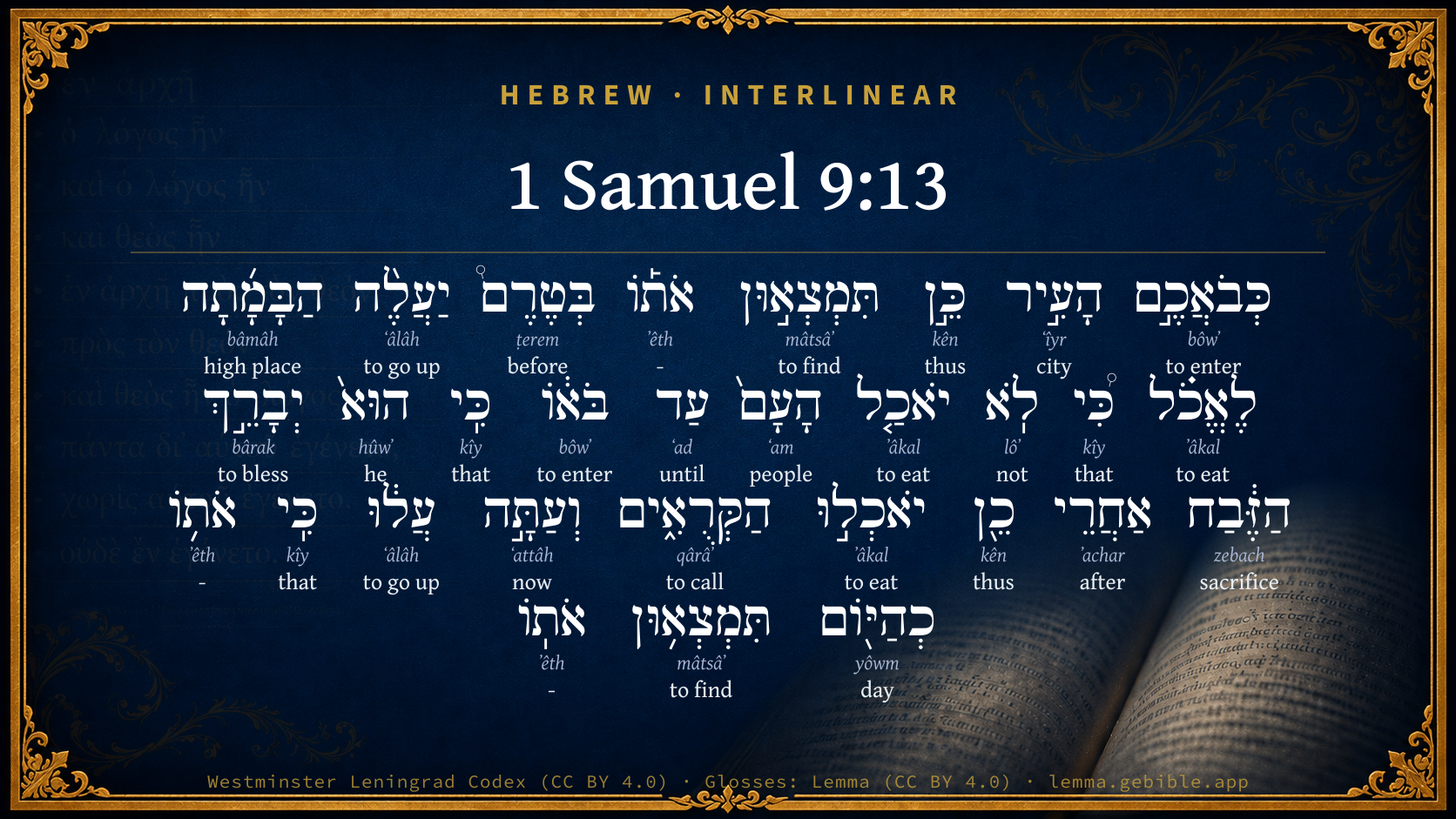
Hebrew (Westminster Leningrad Codex) 1 Samuel 9:13 appears in the Hebrew Old Testament. The text above is from the Westminster Leningrad Codex. Each word links to its Strong’s number, a concise gloss, and parsing drawn from the Open Scriptures Hebrew Bible morphology. Click any word for its full Brown-Driver-Briggs (BDB) entry.
Download image
Cite this verse

1 Samuel 9:13 (World English Bible). Public Domain. Lemma interlinear Bible study tool, https://lemma.gebible.app/v/1-samuel/9/13.

Show BibTeX & RIS
BibTeX
RIS
English Translation
as soon as you are come into the city, you shall immediately find him, before he goes up to the high place to eat; for the people will not eat until he come, because he does bless the sacrifice; [and] afterwards they eat who are invited. Now therefore get you up; for at this time you shall find him.
World English Bible · Public Domain
Download a study sheet

One document with this verse’s original text, its word-by-word gloss line, the meaning frame, cross-references with their text, attributed commentary, and full source and license credits — printable, and it pastes into notes with its structure intact.

This verse Autodidact and up

Study sheet (.html) Plain text (.txt)

A passage Seminary Student

Up to 50 verses in one chapter. A passage sheet keeps up to 6 commentary sources and 12 cross-references per verse, in the order this page ranks them, and says so on the sheet whenever that leaves anything out. Ask for a single verse and you get the Autodidact verse sheet above.

Everything on this page stays free to read, with no account — the sheet is a download of what is already on screen, not access to it.

Want to remove ads? Support Godless Engineer
Compare translations 3

The same verse in 3 English versions, stacked beneath the original-language interlinear above. Click any original word for its lexicon entry.

Each is an independent rendering of the whole verse — the interlinear is not word-aligned to these translations.

Highlighted words mark where these versions differ — a whole-verse word diff, not a word-by-word alignment.

  • World English Bible Public Domain
    as soon as you are come into the city, you shall immediately find him, before he goes up to the high place to eat; for the people will not eat until he come, because he does bless the sacrifice; [and] afterwards they eat who are invited. Now therefore get you up; for at this time you shall find him.
  • King James Version Public Domain
    As soon as ye be come into the city, ye shall straightway find him, before he go up to the high place to eat: for the people will not eat until he come, because he doth bless the sacrifice; and afterwards they eat that be bidden. Now therefore get you up; for about this time ye shall find him.
  • unfoldingWord Literal Text CC BY-SA 4.0
    In your entering the city, thus you will find him, before he goes up to the high place to eat. For the people will not eat until he comes, for he himself will bless the sacrifice; after this, the invited will eat. And now, go up, for him, according to today you will find him.”

unfoldingWord Literal Text — © unfoldingWord, licensed CC BY-SA 4.0. Word-aligned USFM3 via Door43 (git.door43.org/unfoldingWord/en_ult).

Versions to compare (up to 4)

3 of 4 selected

Show all 18 translations

Every available English version of this verse, each an independent rendering of the whole verse.

  • World English Bible Public Domain
    as soon as you are come into the city, you shall immediately find him, before he goes up to the high place to eat; for the people will not eat until he come, because he does bless the sacrifice; [and] afterwards they eat who are invited. Now therefore get you up; for at this time you shall find him.
  • Berean Standard Bible Public Domain
    As soon as you enter the city, you will find him before he goes up to the high place to eat. The people will not eat until he comes, because he must bless the sacrifice; after that, the guests will eat. Go up at once; you will find him.”
  • Majority Standard Bible Public Domain
    As soon as you enter the city, you will find him before he goes up to the high place to eat. The people will not eat until he comes, because he must bless the sacrifice; after that, the guests will eat. Go up at once; you will find him.”
  • King James Version Public Domain
    As soon as ye be come into the city, ye shall straightway find him, before he go up to the high place to eat: for the people will not eat until he come, because he doth bless the sacrifice; and afterwards they eat that be bidden. Now therefore get you up; for about this time ye shall find him.
  • American Standard Version (1901) Public Domain
    as soon as ye are come into the city, ye shall straightway find him, before he goeth up to the high place to eat; for the people will not eat until he come, because he doth bless the sacrifice; `and' afterwards they eat that are bidden. Now therefore get you up; for at this time ye shall find him.
  • Revised Version (1885) Public Domain
    as soon as ye be come into the city, ye shall straightway find him, before he go up to the high place to eat: for the people will not eat until he come, because he doth bless the sacrifice; and afterwards they eat that be bidden. Now therefore get you up; for at this time ye shall find him.
  • Geneva Bible (1599) Public Domain
    When ye shall come into the citie, ye shall finde him straightway yet he come vp to the hie place to eate: for the people will not eate vntill he come, because he will blesse the sacrifice: and then eate they that be bidden to the feast: nowe therefore goe vp: for euen now shall ye find him.
  • Douay-Rheims (1899) Public Domain
    As soon as you come into the city, you shall immediately find him, before he go up to the high place to eat: for the people will not eat till he come: because he blesseth the victim, and afterwards they eat that are invited. Now therefore go up, for to day you shall find him.
  • Young's Literal Translation Public Domain
    At your going in to the city so ye do find him, before he doth go up in to the high place to eat; for the people do not eat till his coming, for he doth bless the sacrifice; afterwards they eat, who are called, and now, go up, for at this time ye find him.'
  • Literal Standard Version CC BY-SA 4.0
    At your going into the city so you find him, before he goes up to the high place to eat; for the people do not eat until his coming, for he blesses the sacrifice; afterward, they who are called eat, and now, go up, for you should find him at this time.”
  • Unlocked Literal Bible CC BY-SA 4.0
    As soon as you enter the city you will find him, before he goes up to the high place to eat. The people will not eat until he comes, because he will bless the sacrifice; afterwards those who are invited will eat. Now go up, for you will find him immediately.”
  • unfoldingWord Literal Text CC BY-SA 4.0
    In your entering the city, thus you will find him, before he goes up to the high place to eat. For the people will not eat until he comes, for he himself will bless the sacrifice; after this, the invited will eat. And now, go up, for him, according to today you will find him.”
  • Darby Bible Public Domain
    As soon as ye come into the city, ye shall straightway find him, before he goes up to the high place to eat; for the people eat not until he has come, because he blesses the sacrifice; afterwards they eat that are invited. And now go up; for this very day shall ye find him.
  • World Messianic Bible Public Domain
    As soon as you have come into the city, you will immediately find him before he goes up to the high place to eat; for the people will not eat until he comes, because he blesses the sacrifice. Afterwards those who are invited eat. Now therefore go up; for at this time you will find him.”
  • Webster's Bible Public Domain
    As soon as ye shall enter the city, ye will straightway find him, before he goeth up to the high place to eat: for the people will not eat until he cometh, because he doth bless the sacrifice; and afterwards they eat that are invited. Now therefore go up: for about this time ye will find him.
  • Free Bible Version CC BY-SA 4.0
    When you enter the town you can find him before he goes up to eat at the high place. The people won't eat before he comes, because he has to bless the sacrifice. After that, those who've been invited will eat. If you leave now you'll catch him.”
  • Bible in Basic English Public Domain
    When you come into the town you will see him straight away, before he goes up to the high place for the feast: the people are waiting for his blessing before starting the feast, and after that the guests will take part in it. So go up now and you will see him.
  • JPS Tanakh (1917) Public Domain
    As soon as ye are come into the city, ye shall straightway find him, before he go up to the high place to eat; for the people will not eat until he come, because he doth bless the sacrifice; and afterwards they eat that are bidden. Now therefore get you up; for at this time ye shall find him.'

Literal Standard Version (2020), Covenant Press — licensed CC BY-SA 4.0. Text via the HelloAO Bible API (eBible.org). Unlocked Literal Bible (unfoldingWord) — licensed CC BY-SA 4.0. Text via the HelloAO Bible API (eBible.org). unfoldingWord Literal Text — © unfoldingWord, licensed CC BY-SA 4.0. Word-aligned USFM3 via Door43 (git.door43.org/unfoldingWord/en_ult). Free Bible Version, Dr. Jonathan Gallagher — licensed CC BY-SA 4.0. Text via the HelloAO Bible API (eBible.org).

Word by word

More ways to search: Search by grammar → Find every occurrence → Compare this word →

Practice this passage: Drill this verse → Learn its vocabulary →

בְּטֶרֶם֩
ṭerem
H2962
“in/at · before”
Preposition + Adverb
Part of Speech
Preposition + Adverb
Full BDB Definition

Origin: from an unused root apparently meaning to interrupt or suspend

TWOT: 826

before, not yet, before that
  1. כְּבֹאֲכֶ֣ם bôwʼ H935 “like/as · to enter · you” Preposition + Verb, Qal, Infinitive Construct + Suffix, Personal, 2nd Person, Masculine, Plural
  2. הָעִ֣יר ʻîyr H5892 “the · city” Particle, Definite Article + Noun, Common, Feminine, Singular, Absolute
  3. כֵּ֣ן kên H3651 “thus” Particle, Demonstrative
  4. תִּמְצְא֣וּן mâtsâʼ H4672 “to find” Verb, Qal, Imperfect, 2nd Person, Masculine, Plural + Suffix, n
  5. אֹת֡וֹ ʼêth H853 “- · him” Particle, Direct Object + Suffix, Personal, 3rd Person, Masculine, Singular
  6. יַעֲלֶ֨ה ʻâlâh H5927 “to go up” Verb, Qal, Imperfect, 3rd Person, Masculine, Singular
  7. הַבָּמָ֜תָה bâmâh H1116 “the · high place · toward” Particle, Definite Article + Noun, Common, Feminine, Singular, Absolute + Suffix, Demonstrative
  8. לֶאֱכֹ֗ל ʼâkal H398 “to eat” Preposition + Verb, Qal, Infinitive Construct
  9. כִּ֠י kîy H3588 “that” Conjunction
  10. לֹֽא lôʼ H3808 “not” Particle, Negative
  11. יֹאכַ֤ל ʼâkal H398 “to eat” Verb, Qal, Imperfect, 3rd Person, Masculine, Singular
  12. הָעָם֙ ʻam H5971 “the · people” Particle, Definite Article + Noun, Common, Masculine, Singular, Absolute
  13. עַד ʻad H5704 “until” Preposition
  14. בֹּא֔וֹ bôwʼ H935 “to enter · him” Verb, Qal, Infinitive Construct + Suffix, Personal, 3rd Person, Masculine, Singular
  15. כִּֽי kîy H3588 “that” Conjunction
  16. הוּא֙ hûwʼ H1931 “he” Pronoun, Personal, 3rd Person, Masculine, Singular
  17. יְבָרֵ֣ךְ bârak H1288 “to bless” Verb, Piel, Imperfect, 3rd Person, Masculine, Singular
  18. הַזֶּ֔בַח zebach H2077 “the · sacrifice” Particle, Definite Article + Noun, Common, Masculine, Singular, Absolute
  19. אַחֲרֵי ʼachar H310 “after” Preposition
  20. כֵ֖ן kên H3651 “thus” Adverb
  21. יֹאכְל֣וּ ʼâkal H398 “to eat” Verb, Qal, Imperfect, 3rd Person, Masculine, Plural
  22. הַקְּרֻאִ֑ים qârâʼ H7121 “the · called” Particle, Definite Article + Verb, Qal, Participle Passive, Masculine, Plural, Absolute
  23. וְעַתָּ֣ה ʻattâh H6258 “and · now” Conjunction + Adverb
  24. עֲל֔וּ ʻâlâh H5927 “go up” Verb, Qal, Imperative, 2nd Person, Masculine, Plural
  25. כִּֽי kîy H3588 “that” Conjunction
  26. אֹת֥וֹ ʼêth H853 “- · him” Particle, Direct Object + Suffix, Personal, 3rd Person, Masculine, Singular
  27. כְהַיּ֖וֹם yôwm H3117 “like/as · the · day” Preposition + Particle, Definite Article + Noun, Common, Masculine, Singular, Absolute
  28. תִּמְצְא֥וּן mâtsâʼ H4672 “to find” Verb, Qal, Imperfect, 2nd Person, Masculine, Plural + Suffix, n
  29. אֹתֽוֹ ʼêth H853 “- · him” Particle, Direct Object + Suffix, Personal, 3rd Person, Masculine, Singular

About this verse

These counts appear in no published source. They are computed here, from the morphology-tagged text and Lemma’s own curated glosses. What Lemma adds →

30
words
20
distinct lemmas
Historical
section

Shared distinctive vocabulary

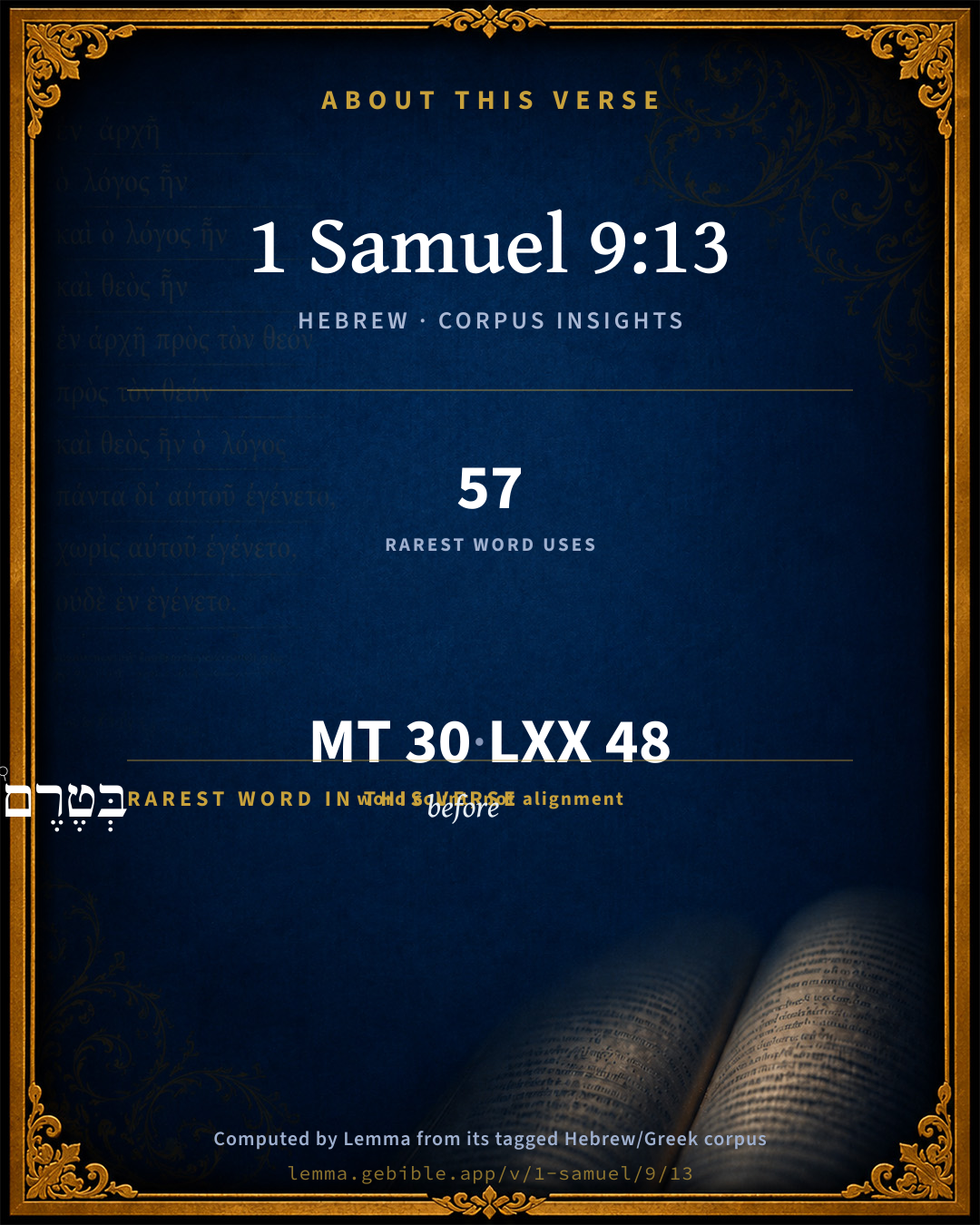
בְּטֶרֶם֩ before H2962 occurs in 50 verses of the Hebrew Bible. Also found in:

Grammatical profile

  • 11 verbs
  • 5 nouns
  • 1 pronoun
  • 2 prepositions
  • 3 conjunctions
  • 3 adverbs
  • 5 particles

Verb forms

  • כְּבֹאֲכֶ֣ם Qal · Infinitive Construct
  • תִּמְצְא֣וּן Qal · Imperfect
  • יַעֲלֶ֨ה Qal · Imperfect
  • לֶאֱכֹ֗ל Qal · Infinitive Construct
  • יֹאכַ֤ל Qal · Imperfect
  • בֹּא֔וֹ Qal · Infinitive Construct
  • יְבָרֵ֣ךְ Piel · Imperfect
  • יֹאכְל֣וּ Qal · Imperfect
  • הַקְּרֻאִ֑ים Qal · Participle Passive
  • עֲל֔וּ Qal · Imperative
  • תִּמְצְא֥וּן Qal · Imperfect

Repetition

Words recur within this verse — often emphatic in Hebrew:

  • לֶאֱכֹ֗ל to eat H398 ×3
  • כְּבֹאֲכֶ֣ם to enter H935 ×2
  • כֵּ֣ן thus H3651 ×2
  • תִּמְצְא֣וּן to find H4672 ×2
  • יַעֲלֶ֨ה to go up H5927 ×2
  • כִּ֠י that H3588 ×3

Hebrew & Septuagint length

In English translation the verse runs 59 words from the Hebrew and 58 from the Septuagint (LXX English) — closely comparable.

A rough comparison of the two English renderings, which tokenize alike — not a word-level alignment.

Word counts can differ between the Hebrew and the Greek without any difference in meaning — e.g. the Hebrew direct-object marker אֵת has no separate Greek word, and Greek often adds the article ὁ.

In the original languages it is 30 Hebrew tokens and 48 Greek tokens — but the two are counted differently (Hebrew bundles its prefixes and suffixes into one token; the Greek is in lemma form), so that isn’t a like-for-like length.

Cross-references

7

Topical passages linked to 1 Samuel 9:13 in the Treasury of Scripture Knowledge — connected by theme and wording, ordered by reader-vote popularity; previews shown in the World English Bible.

  • John 6:11 Jesus took the loaves; and having given thanks, he distributed to the disciples, and the disciples to those who were sitting down; likewise also of the fish as much as they desired.
  • Matthew 26:26 As they were eating, Jesus took bread, gave thanks for it, and broke it. He gave to the disciples, and said, "Take, eat; this is my body."
  • Mark 6:41 He took the five loaves and the two fish, and looking up to heaven, he blessed and broke the loaves, and he gave to his disciples to set before them, and he divided the two fish among them all.
  • Luke 24:30 It happened, that when he had sat down at the table with them, he took the bread and gave thanks. Breaking it, he gave to them.
  • John 6:23 However boats from Tiberias came near to the place where they ate the bread after the Lord had given thanks.
  • 1 Corinthians 10:30 If I partake with thankfulness, why am I denounced for that for which I give thanks?
  • 1 Timothy 4:4 For every creature of God is good, and nothing is to be rejected, if it is received with thanksgiving.

Cross-references courtesy of OpenBible.info (CC BY 4.0).

Hebrew and Greek witnesses Masoretic Hebrew ↔ Greek Septuagint

The same verse in the two great witnesses to the Old Testament, shown verse-for-verse.

These are two independent witnesses, not word-aligned to each other, and the Septuagint is shown in lemma (dictionary) form.

Hebrew 1 Samuel 9:13 Masoretic · Westminster Leningrad Codex

כְּבֹאֲכֶ֣ם הָעִ֣יר כֵּ֣ן תִּמְצְא֣וּן אֹת֡וֹ בְּטֶרֶם֩ יַעֲלֶ֨ה הַבָּמָ֜תָה לֶאֱכֹ֗ל כִּ֠י לֹֽא יֹאכַ֤ל הָעָם֙ עַד בֹּא֔וֹ כִּֽי הוּא֙ יְבָרֵ֣ךְ הַזֶּ֔בַח אַחֲרֵי כֵ֖ן יֹאכְל֣וּ הַקְּרֻאִ֑ים וְעַתָּ֣ה עֲל֔וּ כִּֽי אֹת֥וֹ כְהַיּ֖וֹם תִּמְצְא֥וּן אֹתֽוֹ

as soon as you are come into the city, you shall immediately find him, before he goes up to the high place to eat; for the people will not eat until he come, because he does bless the sacrifice; [and] afterwards they eat who are invited. Now therefore get you up; for at this time you shall find him.

World English Bible · Public Domain

Greek LXX 1 Samuel 9:13 Septuagint · lemma form

ὡς ἄν εἰςἔρχομαι ὁ πόλις οὕτως εὑρίσκω αὐτός ἐν ὁ πόλις πρίν ἀναβαίνω αὐτός εἰς βαμα ὁ ἐσθίω ὅτι οὐ μή ἐσθίω ὁ λαός ἕως ὁ εἰςἔρχομαι αὐτός ὅτι οὗτος εὐλογέω ὁ θυσία καί μετά οὗτος ἐσθίω ὁ ξένος καί νῦν ἀναβαίνω ὅτι διά ὁ ἡμέρα εὑρίσκω αὐτός

As soon as you⌃ shall enter into the city, so shall you⌃ find him in the city, before he goes up to Bama to eat; for the people will not eat until he comes in, for he blesses the sacrifice, and afterwards the guests eat; now then go up, for you⌃ shall find him because of the holiday.

LXX2012 (modern English Septuagint) · Public Domain

Hebrew: Westminster Leningrad Codex (CC BY 4.0). Greek: Septuagint (public domain); English from LXX2012 (modern English Septuagint) (Public Domain). How the Septuagint differs from the Hebrew →

Targum (Aramaic paraphrase)

1

The Targum is the ancient Jewish Aramaic paraphrase of the Hebrew Scriptures — an interpretive translation, not the Hebrew text itself. Onkelos (literal) and Pseudo-Jonathan (expansive) render the Torah, and Jonathan the Prophets. Coverage is partial: where no permissively-licensed English translation exists for a verse, only the Aramaic is shown. This is verse-level text, not a word-by-word alignment to the Hebrew.

  1. Targum Jonathan Prophets (Joshua–Malachi)
    כְּמֵיעַלְכוֹן לְקַרְתָּא כֵּן תִּשְׁכְּחוּן יָתֵיהּ עַד לָא יִסַק לְבֵית אַסְחֲרוּתָא לְמֵיכַל אֲרֵי לָא אָכִיל עַמָא עַד מֵיתוֹהִי אֲרֵי הוּא פָרִיס מְזוֹנָא בָּתַר כֵּן אָכְלִין זַמְנַיָא וּכְעַן סַקוּ אֲרֵי יָתֵיהּ כְּיוֹמָא דֵין תִשְׁכְּחוּן יָתֵיהּ:

    (no public-domain English translation for this verse)

    Targum Jonathan — Aramaic: “Mikraot Gedolot” (public domain). English: “Sefaria Community Translation” (CC0 1.0 (public-domain dedication)); “London "Chaldee Paraphrase," 1871” (public domain). Text via Sefaria.

Commentary

Notes on 1 Samuel 9:13 from classic Christian and Jewish commentators (each source and its license shown beneath its notes). The classic Christian expositions comment on the surrounding passage and are grouped to its opening verse, so a note may address several verses; the Jewish commentaries on the Tanakh (Rashi and others) are per-verse, so they appear only where the commentator wrote on this verse.

Lemma curates 59 commentaries, every one of them public domain or Creative Commons licensed, each selected and text-cleaned for this edition rather than reprinted as found. About our sources →

Trapp's Complete Commentary

John Trapp

1Sa 9:13 As soon as ye be come into the city, ye shall straightway find him, before he go up to the high place to eat: for the people will not eat until he come, because he doth bless the sacrifice; [and] afterwards they eat that be bidden. Now therefore get you up; for about this time ye shall find him.

Ver. 13. For the people will not eat until he come.] To bless and distribute the meat. A commendable custom, to crave God’s blessing on the creatures before we eat them; and to give thanks after meat; and not to sit down as an ox, and rise as an ass, not as vultures and kites, to seize upon our meat as a prey. The very heathens consecrated their cates before they tasted them, as appeareth by Homer and Virgil. And some think that the Greeks called a dinner αριστον, απο των αρων, from the prayers they premised.

John Trapp, A Commentary or Exposition upon All the Books of the Old and New Testament (1647–1656) — public domain. Text from a community e-Sword module.

Tyndale Open Study Notes

Tyndale Open Resources

9:13 to eat: Part of a sacrifice made during worship was burned on the altar, while the remainder was eaten in a ceremonial feast by the guests (see also 1:4). • to bless the food: As a Levite, Samuel’s priestly role included offering blessings (see Deut 10:8; 21:5).

Tyndale Open Study Notes — © Tyndale Open Resources, licensed CC BY-SA 4.0. Text via the HelloAO Bible API.

Geneva Bible (1599)

Geneva Bible translators

That is, give thanks and distribute the meat according to their custom.

Geneva Bible (1599) marginal notes — public domain. Text via Bolls.life.

Adam Clarke's Commentary

Verse 13. He doth bless the sacrifice] He alone can perform the religious rites which are used on this occasion.

Afterwards they eat that be bidden.] Among the Arabs, often a large feast is made of sacrificed camels, &c., and then the people of the vicinity are invited to come and partake of the sacrifice. This is the custom to which allusion is made here.

Adam Clarke's Commentary on the Bible (1810–1826) — public domain. Text from a community e-Sword/MySword module.

Ellicott's Commentary for English Readers

(13) He doth bless the sacrifice.—It has been well remarked that we have here, in this note of the people’s conduct at the sacrificial banquet of “Raman of the Watchers,” a very early instance of the devout practice among the Hebrews of asking a blessing on meals.

A Bible Commentary for English Readers, edited by Charles John Ellicott (1878–1897) — public domain. Text from a community e-Sword module.

The Cambridge Bible for Schools and Colleges

gen. ed. J. J. S. Perowne

13. he doth bless the sacrifice] Pronounces a blessing or thanksgiving over the sacrificial feast. Cp. Luk_9:16 with Joh_6:11; Mat_26:26.

for about this time] Lit. “For as for him—now shall ye find him.” The pronoun is repeated for emphasis.

The Cambridge Bible for Schools and Colleges (gen. ed. J. J. S. Perowne; Cambridge University Press, 1878–1918) — public domain. Text from a community e-Sword module.

John Gill's Exposition

As soon as ye come into the city, ye shall straightway find him,.... By which it seems that the house of Samuel was at that end of it at which they entered; and with which agrees what is observed in the preceding verse, that "he was before them", his house was in sight of them:

before he go up to the high place to eat; intimating they would, if they made haste, come up to him before he got thither to sit down and eat with the people; for if they did not, they would not be able to see him and speak with him for some time, if on that day:

for the people will not eat until he come; partly out of affection and veneration for him, being their chief magistrate, as well as seer or prophet, and partly for the reason following:

because he doth bless the sacrifice; ask a blessing upon it, upon the meat of the peace offerings before it was eaten; for as this was usually done at every common meal, then much more at such a solemn festival as this. Jarchi gives us the form of blessing used on such an occasion,"blessed art thou, O Lord our God, the King of the world, who hath sanctified us by his commandments, and hath commanded us to eat the sacrifice:''and "afterwards they eat that be bidden"; for when a man offered his peace offerings, he not only had his family with him, but invited his friends, and the poor, and the fatherless, the strangers, and the Levites, to partake with him, see Deu 12:18, the number of the guests at this time, see in Sa1 9:22.

Now therefore get ye up; ascend the hill as fast as ye can:

for about this time ye shall find him; that is, by the time they could get up the hill into the city they would find him coming out of his house to go to the sacrifice: or "as this day" (h); so sure as the day is, so sure shall ye find him.

(h) "invenietis cum tam certo quam certum est hunc diem esse", Drusius; so Jarchi.

John Gill's Exposition of the Whole Bible (1746–1763) — public domain (CC PDM 1.0). Text via the HelloAO Bible API.

Albert Barnes' Notes on the Bible

Before he go up - By this phrase we see that the high place was in the highest part of the city. Like the “house of the god Berith” Jdg 9:46, it was probably the citadel of Ramah. There was connected with the altar a room large enough for thirty people to dine in 1Sa 9:22.

Albert Barnes' Notes on the Bible (1834–1885) — public domain. Text from a community e-Sword/MySword module.

Haydock's Catholic Bible Commentary

The victim, begging the blessing, which was the office of the most honourable person at table, as he also gave thanks for all. (Calmet)

George Leo Haydock (1774–1849), Haydock's Catholic Family Bible and Commentary, 1859 edition — public domain. Excludes Psalms (Douay-Rheims chapter numbering differs from Protestant) and Deuterocanonical books (Catholic canon only).

Matthew Poole's English Annotations

Ye shall straightway find him, at home and at leisure. To eat the relics of the sacrifices, according to the manner.

He doth bless the sacrifice, i.e. either, first, The meat left of the sacrifice, which is the matter of the following feast; as this is commonly understood. Or rather, secondly, The sacrifice itself. For what reason is there to depart from the proper signification of the word? For that the sacrifices under the law were accompanied with confession, or petition, or thanksgiving, may be gathered from divers places of Scripture, as Lev 5:5; 16:21; Num 5:7; Luk 1:10. And who so proper to perform this work as Samuel, an eminent prophet? And the blessing of this sacrifice seems to have consisted both of thanksgiving, this being a thank-offering, and of prayer to God for his acceptance, Psa 20:3.

Now therefore get you up with speed, lest he be set down before you come.

Matthew Poole's English Annotations on the Holy Bible (1683–1685) — public domain. Text from a community e-Sword/MySword module.

Whedon's Commentary on the Bible

Daniel D. Whedon

13. He doth bless the sacrifice — We are not to suppose that Samuel offered the sacrifice himself, for he was not a priest, (see note on 1Sa_7:9,) but, as Scott well says, “he poured out fervent prayers to the Lord for acceptance, and for his blessing on the service as a religious ordinance to the good of the souls, as well as on the food for the refreshment of the bodies, of those present.”

Daniel D. Whedon (gen. ed.), Commentary on the Old and New Testaments (1874–1909) — public domain. Text from a community e-Sword module.

The Pulpit Commentary

As soon as straightway. This is too forcible a rendering of the Hebrew particles, and makes the talk of these water-carriers even more garrulous than it is in the original. The latter word should be omitted, as they simply say that on entering the city Saul and his servant would easily find Samuel; for he would not go up to the feast till all was ready, nor would the people begin till he had arrived, because it was his office to bless the sacrificial banquet. The pious custom of asking a blessing on meals, our Lord"s "giving of thanks," is inherited by us from the Jews.

(A SACRAMENTAL ADDRESS.)

Ver. 13. (RAMAH.)

Guests at a sacred feast.

the people will not eat until he come, because he cloth bless thesacrifice; and afterwards they eat that be bidden." This language refers to a feast provided on the high place of the city where Samuel dwelt.

1. It was a sacrificial feast. The victim (a thank offering) having been slain,and its blood sprinkled about the altar, a portion of it was burnt in the sacred fire, and the rest reserved for food. "The thank or praise offering was the expression of the worshipper"s feelings of adoring gratitude on account of having received some spontaneous tokens of the Lord"s goodness. This was the highest form (of the peace offering), as here the grace of God shone prominently forth" (Fairbairn, "Typology").

2. It was attended by numerous guests thirty persons distinguished insome way from others, and specially invited by Samuel. "The participation by the offerer and his friends this family feast upon the sacrifice may be regarded as the most distinctive characteristic of the peace offering. It denoted that the offerer was admitted to a state of near fellowship and enjoyment with God, shared part and part with Jehovah and his priests, had a standing in his house and a seat at his table. It was, therefore, the symbol of established friendship with God, and near communion with him in the blessings of his kingdom; and was associated in the minds of the worshippers with feelings of peculiar joy and gladness" (Fairbairn).

3. It required the presence of Samuel himself in order that the guests mightproperly partake thereof. "The blessing of the sacrifice must mean the asking of a blessing upon the food before the meal. This was done at every common meal, and much more at a solemn festival like this. The present, however, is the only recorded example of the custom" (Kitto). "It refers to the thanksgiving and prayer offered before the sacrificial meal" (Keil). Now this feast may be regarded as a foreshadowing of the Lord"s Supper. A greater than Samuel is the Master of the feast (Mat_26:18; Joh_13:13, Joh_13:14) Our Lord has provided it by the sacrifice of himself of which the ancient sacrifices were a type, and the Holy Supper is a memorial. And he himself comes to preside at his own table. As his guests

I WE AWAIT HIS PRESENCE. "The people will not eat until he come" His presence is

1. Necessary to the feast. The bread and wine are not simply memorials,they are also symbols; and in order to partake of them aright we must "discern the Lord"s body." "Without me ye can do nothing.

2. Promised by himself. "There am I in the midst of them". (Mat_18:20) "I will see you again, and your heart shall rejoice". (Joh_16:22) "Lo, I am with you alway". (Mat_28:20) The sacred ordinance itself is a permanent assurance of his presence.

3. Realised in the heart. We look not for his real presence in the material emblems, but in the believing heart. "I in them". (Joh_17:26 Joh_14:21 Eph_3:17) In a different spirit from that in which the words were originally spoken, we ask, "What think ye, that he will not come to the feast?". (Joh_11:56) We await his coming with reverence and humility, contrition, and faith, and ardent desire. O that he may appear to each of us, saying, "Peace be unto you," and be "known in breaking of bread." "Blessed are they that wait for him" (Isa_30:8; Joh_20:29)

II WE DESIRE HIS BLESSING. "He doth bless the sacrifice," and in doing so he also doth bless his guests.

1. As of old, when he often gave thanks before the meal (Mat_14:19 Mat_15:36; Mar_14:22; Luk_24:30; Joh_6:23; 1Co_11:24)

2. As the ever living Intercessor, representing his people, and renderingtheir prayers and praises acceptable to God. "I will declare thy name unto my brethren, in the midst of the Church will I sing praises unto thee". (Heb_2:12)

3. As when he went away, still stretc.hing forth his hands in benediction toward his disciples, and enabling them to be "continually praising and blessing God". (Luk_24:51-53) "Stretch forth, O Lord, in blessing toward us thy hands, that were nailed for our redemption to the bitter cross!

III WE PARTAKE OF HIS PROVISION. "And afterwards they eat that be bidden." We do not merely look upon the emblems of his body and blood, but we eat and drink, and thereby signify

1. Our participation in the benefits of his death forgiveness, peace, andrighteousness.

2. Our fellowship with him in his sufferings and death, his spirit and life, hisstrength and joy. (Joh_6:53) "And truly our fellowship is with theFather, and with his Son Jesus Christ". (1Jn_1:3)

3. And our union and communion with each other, through fellowship withhim, in love and gladness. "For we being many are one bread, and one. (1Co_10:17) Let us, then, "rejoice before the Lord." The cup is "a cup of blessing" (thanksgiving). The service is intended to be a service of joy joy in the Lord; in the contemplation of his glorious character, in the reception of his manifold benefits, and in the anticipation of "the marriage supper of the Lamb. D.

The Pulpit Commentary (1880–1919), ed. H.D.M. Spence-Jones & Joseph S. Exell — public domain. Text from a community e-Sword module.

John Wesley's Explanatory Notes

Find him - At home and at leisure. To eat - The relicks of the sacrifices. Doth bless - The blessing of this sacrifice seems to have consisted both of thanksgiving, this being a thank-offering, and of prayer to God for its acceptance.

John Wesley, Explanatory Notes Upon the Whole Bible (1754–1765) — public domain. Text via the GEBible commentary corpus.

Keil & Delitzsch

C. F. Keil & F. Delitzsch

"When ye come into the city, ye will find him directly before he goes up to the high place to eat." כּן not only introduces the apodosis, but corresponds to כּ, as, so: here, however, it is used with reference to time, in the sense of our "immediately." "For the people are not accustomed to eat till he comes, for he blesses the sacrifice," etc. בּרך, like εὐλογεῖν, refers to the thanksgiving prayer offered before the sacrificial meal. "Go now for him; yet will meet him even to-day." The first אתו is placed at the beginning for the sake of emphasis, and then repeated at the close. כּהיּום, "Even to-day."

Keil & Delitzsch — Biblical Commentary on the Old Testament (1861–1891) — public domain (CC PDM 1.0). Text via the HelloAO Bible API. (Old Testament only.)

Rashi

Rabbi Shlomo Yitzchaki (Rashi)

As you enter the city you… They prolonged their conversation in order to gaze upon Shaul's handsomeness.

The high place. Targum Yonoson renders, 'to the banquet hall.' When Shiloh was destroyed, it became permissible [to offer sacrifices on] the high places, and they would sacrifice peace-offerings on the high place and eat together.

Because he blesses the offering. Targum Yonoson renders, אֲרֵי הוּא פָּרִיס עַל מְזוֹנָא meaning, 'for he will break bread.' [Before] partaking of the peace-offering they recited: 'Blessed are You Adonoy, our God, King of the universe, Who has sanctified us with His commandments, and commanded us to eat the sacrifice."

As [surely as it is] day. Just as the day exists.

Rashi on the Tanakh — English translations: “The Judaica Press complete Tanach with Rashi, translated by A. J. Rosenberg” (CC BY 4.0); “Pentateuch with Rashi's commentary by M. Rosenbaum and A.M. Silbermann, 1929-1934” (public domain); “The Metsudah Tanach series, Lakewood, N.J” (CC BY 4.0); and “The Book of Joshua, Metsudah Publications, 1997” (CC BY 4.0). Text via Sefaria.

Lesson kit

Teaching starters — assembled from the data on this page, not authored interpretation. Every prompt links to the verse data it draws on. Edit before teaching.

1 Samuel, in the Historical, opens this verse with 30 words (20 distinct Hebrew lemmas). Its most distinctive word is ṭerem (“before”). A historical commentator’s framing appears above. Read the whole chapter for the surrounding context.

Discussion questions

  1. How does “before” (ṭerem) shape what this verse is saying?
  2. How does Genesis 2:5, which shares the word «before», read alongside this verse?
  3. What does the repetition of “to eat” (3× in this one verse) do in this verse?
  4. These translations render this verse differently; the difference is in the English rendering, not the original. What questions does that raise?
  5. «כְּבֹאֲכֶ֣ם» is a Qal Infinitive Construct verb. How does that grammatical form shape the action described?
  6. Compare how Trapp's Complete Commentary and Tyndale Open Study Notes read this verse. Where do they agree or differ?

Things to notice

Reading settings

Reading text

Shown beneath each verse's original-language words.

Old Testament
Old Testament edition

Read the OT as the Masoretic Hebrew (MT) or the Greek Septuagint (LXX).

English shown for the Greek Septuagint (in the Hebrew ↔ Greek comparison).

Comparing translations? Open the Compare panel on any verse page to stack up to four side by side.