
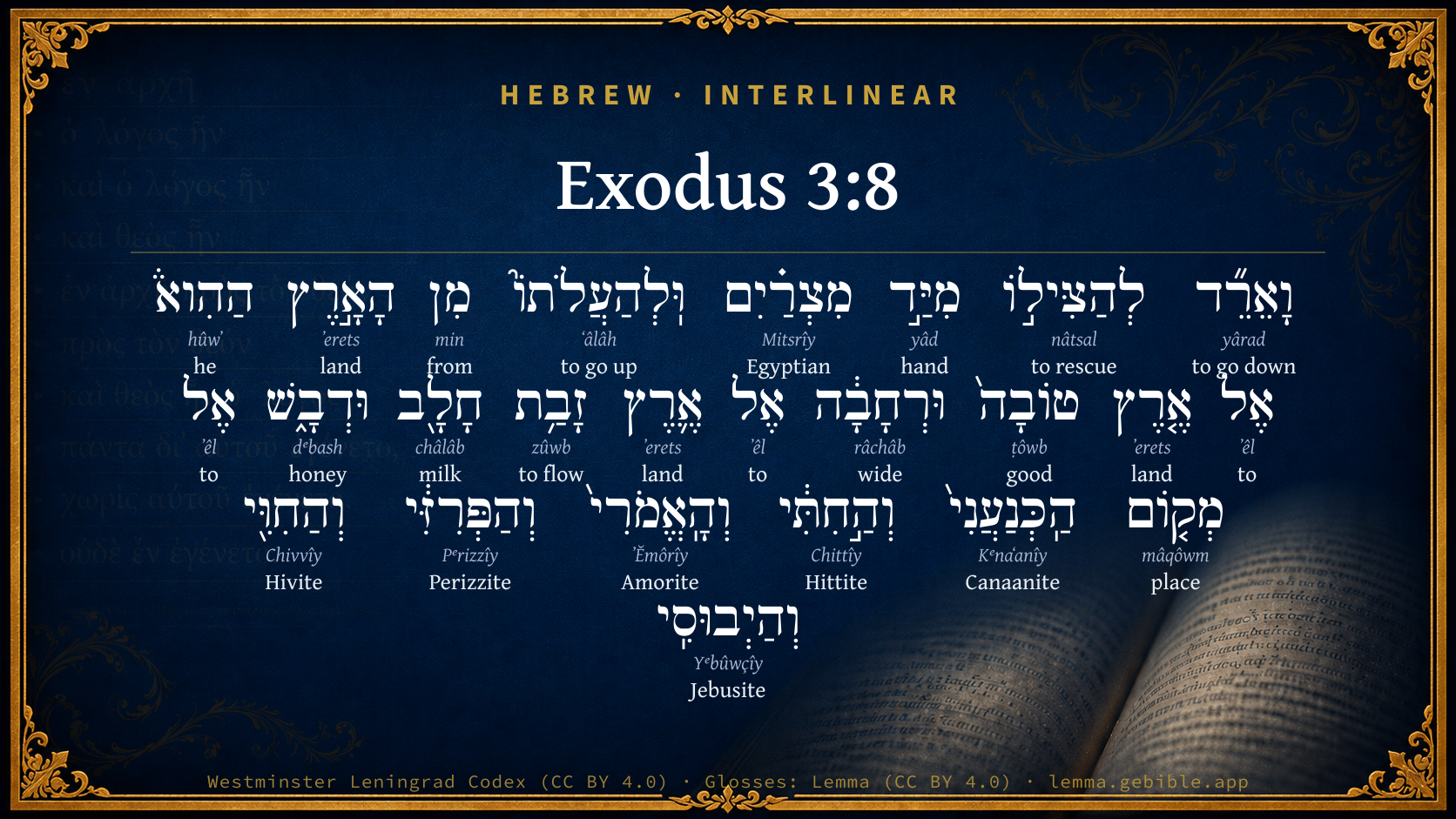
Exodus 3:8

Hebrew (Westminster Leningrad Codex) Exodus 3:8 appears in the Hebrew Old Testament. The text above is from the Westminster Leningrad Codex. Each word links to its Strong’s number, a concise gloss, and parsing drawn from the Open Scriptures Hebrew Bible morphology. Click any word for its full Brown-Driver-Briggs (BDB) entry.
Download image
Cite this verse

Exodus 3:8 (World English Bible). Public Domain. Lemma interlinear Bible study tool, https://lemma.gebible.app/v/exodus/3/8.

Show BibTeX & RIS
BibTeX
RIS
English Translation
I have come down to deliver them out of the hand of the Egyptians, and to bring them up out of that land to a good and large land, to a land flowing with milk and honey; to the place of the Canaanite, the Hittite, the Amorite, the Perizzite, the Hivite, and the Jebusite.
World English Bible · Public Domain
Highlights
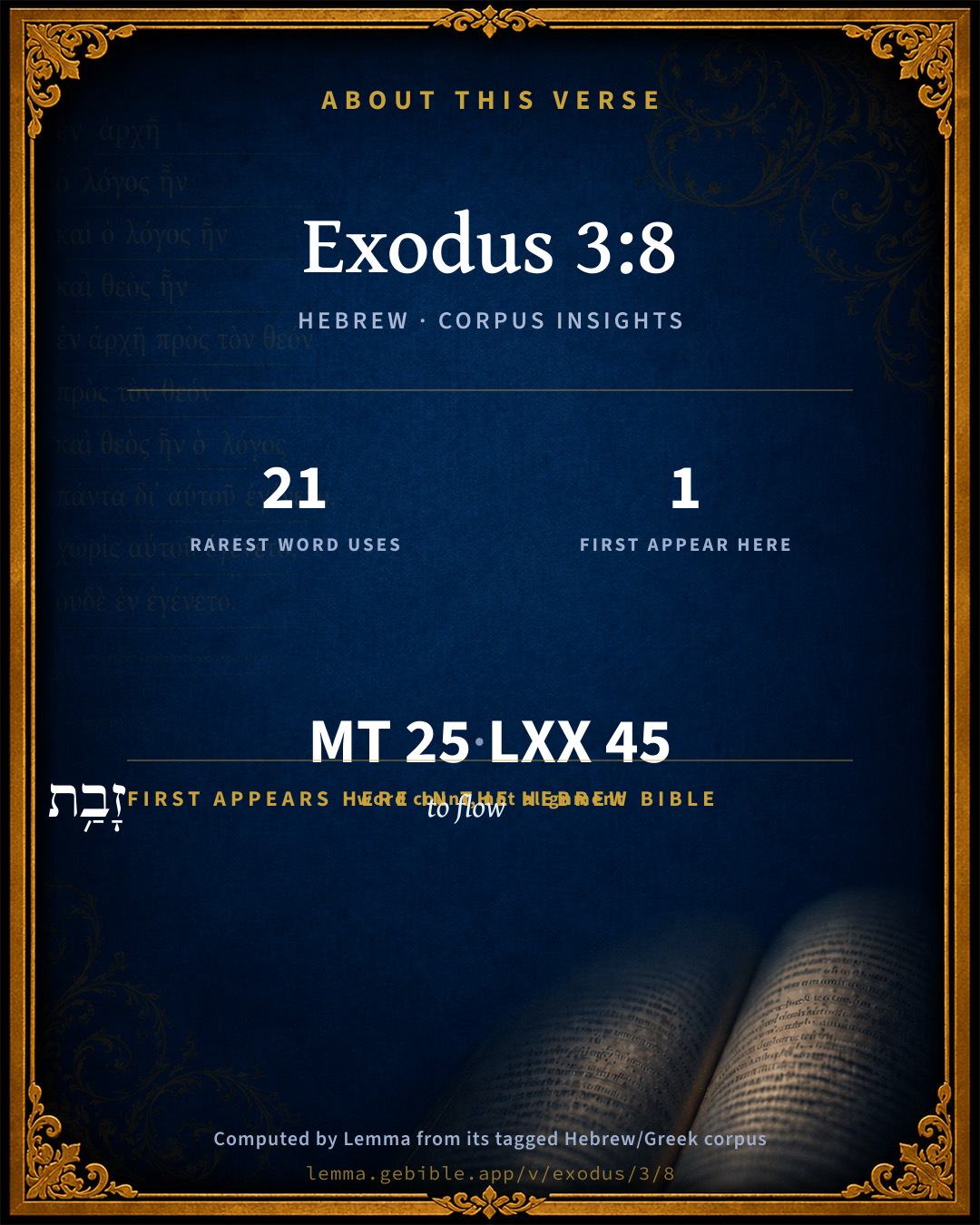
  • 1 first appearance in the Hebrew Bible
Full analysis ↓
Download a study sheet

One document with this verse’s original text, its word-by-word gloss line, the meaning frame, cross-references with their text, attributed commentary, and full source and license credits — printable, and it pastes into notes with its structure intact.

This verse Autodidact and up

Study sheet (.html) Plain text (.txt)

A passage Seminary Student

Up to 50 verses in one chapter. A passage sheet keeps up to 6 commentary sources and 12 cross-references per verse, in the order this page ranks them, and says so on the sheet whenever that leaves anything out. Ask for a single verse and you get the Autodidact verse sheet above.

Everything on this page stays free to read, with no account — the sheet is a download of what is already on screen, not access to it.

Want to remove ads? Support Godless Engineer
Compare translations 3

The same verse in 3 English versions, stacked beneath the original-language interlinear above. Click any original word for its lexicon entry.

Each is an independent rendering of the whole verse — the interlinear is not word-aligned to these translations.

Highlighted words mark where these versions differ — a whole-verse word diff, not a word-by-word alignment.

  • World English Bible Public Domain
    I have come down to deliver them out of the hand of the Egyptians, and to bring them up out of that land to a good and large land, to a land flowing with milk and honey; to the place of the Canaanite, the Hittite, the Amorite, the Perizzite, the Hivite, and the Jebusite.
  • King James Version Public Domain
    And I am come down to deliver them out of the hand of the Egyptians, and to bring them up out of that land unto a good land and a large, unto a land flowing with milk and honey; unto the place of the Canaanites, and the Hittites, and the Amorites, and the Perizzites, and the Hivites, and the Jebusites.
  • unfoldingWord Literal Text CC BY-SA 4.0
    And I have come down to deliver him from the hand of the Egyptians and to bring him up from that land to a good and wide land, to a land flowing with milk and honey; to the place of the Canaanites and the Hittites and the Amorites and the Perizzites and the Hivites and the Jebusites.

unfoldingWord Literal Text — © unfoldingWord, licensed CC BY-SA 4.0. Word-aligned USFM3 via Door43 (git.door43.org/unfoldingWord/en_ult).

Versions to compare (up to 4)

3 of 4 selected

Show all 18 translations

Every available English version of this verse, each an independent rendering of the whole verse.

  • World English Bible Public Domain
    I have come down to deliver them out of the hand of the Egyptians, and to bring them up out of that land to a good and large land, to a land flowing with milk and honey; to the place of the Canaanite, the Hittite, the Amorite, the Perizzite, the Hivite, and the Jebusite.
  • Berean Standard Bible Public Domain
    I have come down to rescue them from the hand of the Egyptians and to bring them up out of that land to a good and spacious land, a land flowing with milk and honey—the home of the Canaanites, Hittites, Amorites, Perizzites, Hivites, and Jebusites.
  • Majority Standard Bible Public Domain
    I have come down to rescue them from the hand of the Egyptians and to bring them up out of that land to a good and spacious land, a land flowing with milk and honey—the home of the Canaanites, Hittites, Amorites, Perizzites, Hivites, and Jebusites.
  • King James Version Public Domain
    And I am come down to deliver them out of the hand of the Egyptians, and to bring them up out of that land unto a good land and a large, unto a land flowing with milk and honey; unto the place of the Canaanites, and the Hittites, and the Amorites, and the Perizzites, and the Hivites, and the Jebusites.
  • American Standard Version (1901) Public Domain
    and I am come down to deliver them out of the hand of the Egyptians, and to bring them up out of that land unto a good land and a large, unto a land flowing with milk and honey; unto the place of the Canaanite, and the Hittite, and the Amorite, and the Perizzite, and the Hivite, and the Jebusite.
  • Revised Version (1885) Public Domain
    and I am come down to deliver them out of the hand of the Egyptians, and to bring them up out of that land unto a good land and a large, unto a land flowing with milk and honey; unto the place of the Canaanite, and the Hittite, and the Amorite, and the Perizzite, and the Hivite, and the Jebusite.
  • Geneva Bible (1599) Public Domain
    Therefore I am come downe to deliuer them out of the hande of the Egyptians, and to bring them out of that lande into a good lande and a large, into a lande that floweth with milke and honie, euen into the place of the Canaanites, and the Hittites, and the Amorites, and the Perizzites, and the Hiuites, and the Iebusites.
  • Douay-Rheims (1899) Public Domain
    And knowing their sorrow, I am come down to deliver them out of the hands of the Egyptians, and to bring them out of that land into a good and spacious land, into a land that floweth with milk and honey, to the places of the Chanaanite, and Hethite, and Amorrhite, and Pherezite, and Hevite, and Jebusite.
  • Young's Literal Translation Public Domain
    and I go down to deliver it out of the hand of the Egyptians, and to cause it to go up out of the land, unto a land good and broad, unto a land flowing with milk and honey -- unto the place of the Canaanite, and the Hittite, and the Amorite, and the Perizzite, and the Hivite, and the Jebusite.
  • Literal Standard Version CC BY-SA 4.0
    and I go down to deliver it out of the hand of the Egyptians, and to cause it to go up out of the land to a land good and broad, to a land flowing with milk and honey—to the place of the Canaanite, and the Hittite, and the Amorite, and the Perizzite, and the Hivite, and the Jebusite.
  • Unlocked Literal Bible CC BY-SA 4.0
    I have come down to free them from the Egyptians' power and to bring them up from that land to a good, large land, to a land flowing with milk and honey; to the region of the Canaanites, Hittites, Amorites, Perizzites, Hivites, and Jebusites.
  • unfoldingWord Literal Text CC BY-SA 4.0
    And I have come down to deliver him from the hand of the Egyptians and to bring him up from that land to a good and wide land, to a land flowing with milk and honey; to the place of the Canaanites and the Hittites and the Amorites and the Perizzites and the Hivites and the Jebusites.
  • Darby Bible Public Domain
    And I am come down to deliver them out of the hand of the Egyptians, and to bring them up out of that land unto a good and spacious land, unto a land flowing with milk and honey, unto the place of the Canaanites, and the Hittites, and the Amorites, and the Perizzites, and the Hivites, and the Jebusites.
  • World Messianic Bible Public Domain
    I have come down to deliver them out of the hand of the Egyptians, and to bring them up out of that land to a good and large land, to a land flowing with milk and honey; to the place of the Canaanite, the Hittite, the Amorite, the Perizzite, the Hivite, and the Jebusite.
  • Webster's Bible Public Domain
    And I am come down to deliver them from the hand of the Egyptians, and to bring them out of that land, to a good land, and a large, to a land flowing with milk and honey; to the place of the Canaanites, and the Hittites, and the Amorites, and the Perizzites, and the Hivites, and the Jebusites.
  • Free Bible Version CC BY-SA 4.0
    That's why I have come down to rescue them from Egyptian oppression and to take them up from that country to a productive, wide-open land—a land flowing with milk and honey—where currently the Canaanites, Hittites, Amorites, Perizzites, Hivites, and Jebusites are living.
  • Bible in Basic English Public Domain
    And I have come down to take them out of the hands of the Egyptians, guiding them out of that land into a good land and wide, into a land flowing with milk and honey; into the place of the Canaanite and the Hittite and the Amorite and the Perizzite and the Hivite and the Jebusite.
  • JPS Tanakh (1917) Public Domain
    and I am come down to deliver them out of the hand of the Egyptians, and to bring them up out of that land unto a good land and a large, unto a land flowing with milk and honey; unto the place of the Canaanite, and the Hittite, and the Amorite, and the Perizzite, and the Hivite, and the Jebusite.

Literal Standard Version (2020), Covenant Press — licensed CC BY-SA 4.0. Text via the HelloAO Bible API (eBible.org). Unlocked Literal Bible (unfoldingWord) — licensed CC BY-SA 4.0. Text via the HelloAO Bible API (eBible.org). unfoldingWord Literal Text — © unfoldingWord, licensed CC BY-SA 4.0. Word-aligned USFM3 via Door43 (git.door43.org/unfoldingWord/en_ult). Free Bible Version, Dr. Jonathan Gallagher — licensed CC BY-SA 4.0. Text via the HelloAO Bible API (eBible.org).

Word by word

More ways to search: Search by grammar → Find every occurrence → Compare this word →

Practice this passage: Drill this verse → Learn its vocabulary →

וּרְחָבָ֔ה
râchâb
H7342
“and · wide”
Conjunction + Adjective, Adjective, Feminine, Singular, Absolute
Part of Speech
Conjunction + Adjective
Type
Adjective
Gender
Feminine
Number
Singular
State
Absolute
Full BDB Definition

Origin: from H7337

TWOT: 2143c

broad, wide
  1. וָאֵרֵ֞ד yârad H3381 “and · to go down” Conjunction + Verb, Qal, Sequential Imperfect, 1st Person, Common, Singular
  2. לְהַצִּיל֣וֹ nâtsal H5337 “to rescue · him” Preposition + Verb, Hiphil, Infinitive Construct + Suffix, Personal, 3rd Person, Masculine, Singular
  3. מִיַּ֣ד yâd H3027 “from · hand of” Preposition + Noun, Common, Both, Singular, Construct
  4. מִצְרַ֗יִם Mitsrîy H4713 “Egyptian” Noun, Proper
  5. וּֽלְהַעֲלֹתוֹ֮ ʻâlâh H5927 “and · to go up · him” Conjunction + Preposition + Verb, Hiphil, Infinitive Construct + Suffix, Personal, 3rd Person, Masculine, Singular
  6. מִן min H4480 “from” Preposition
  7. הָאָ֣רֶץ ʼerets H776 “the · land” Particle, Definite Article + Noun, Common, Both, Singular, Absolute
  8. הַהִוא֒ hûwʼ H1931 “the · he” Particle, Definite Article + Pronoun, Personal, 3rd Person, Feminine, Singular
  9. אֶל ʼêl H413 “to” Preposition
  10. אֶ֤רֶץ ʼerets H776 “land” Noun, Common, Both, Singular, Absolute
  11. טוֹבָה֙ ṭôwb H2896 “good” Adjective, Adjective, Feminine, Singular, Absolute
  12. אֶל ʼêl H413 “to” Preposition
  13. אֶ֛רֶץ ʼerets H776 “land” Noun, Common, Both, Singular, Absolute
  14. זָבַ֥ת zûwb H2100 “flowing” Verb, Qal, Participle Active, Feminine, Singular, Construct
  15. חָלָ֖ב châlâb H2461 “milk” Noun, Common, Masculine, Singular, Absolute
  16. וּדְבָ֑שׁ dᵉbash H1706 “and · honey” Conjunction + Noun, Common, Masculine, Singular, Absolute
  17. אֶל ʼêl H413 “to” Preposition
  18. מְק֤וֹם mâqôwm H4725 “place of” Noun, Common, Masculine, Singular, Construct
  19. הַֽכְּנַעֲנִי֙ Kᵉnaʻanîy H3669 “the · Canaanite” Particle, Definite Article + Noun, Gentilic, Masculine, Singular, Absolute
  20. וְהַ֣חִתִּ֔י Chittîy H2850 “and · the · Hittite” Conjunction + Particle, Definite Article + Noun, Gentilic, Masculine, Singular, Absolute
  21. וְהָֽאֱמֹרִי֙ ʼĔmôrîy H567 “and · the · Amorite” Conjunction + Particle, Definite Article + Noun, Gentilic, Masculine, Singular, Absolute
  22. וְהַפְּרִזִּ֔י Pᵉrizzîy H6522 “and · the · Perizzite” Conjunction + Particle, Definite Article + Noun, Gentilic, Masculine, Singular, Absolute
  23. וְהַחִוִּ֖י Chivvîy H2340 “and · the · Hivite” Conjunction + Particle, Definite Article + Noun, Gentilic, Masculine, Singular, Absolute
  24. וְהַיְבוּסִֽי Yᵉbûwçîy H2983 “and · the · Jebusite” Conjunction + Particle, Definite Article + Noun, Gentilic, Masculine, Singular, Absolute

About this verse

These counts appear in no published source. They are computed here, from the morphology-tagged text and Lemma’s own curated glosses. What Lemma adds →

25
words
21
distinct lemmas
Pentateuch
section

Notable vocabulary

The rarest word here is וּרְחָבָ֔ה wide H7342 — appearing just 21 times in the whole Hebrew Bible.

First appearance in Scripture

This word makes its first canonical appearance in the Hebrew Bible here:

  • זָבַ֥ת to flow H2100

Shared distinctive vocabulary

וּרְחָבָ֔ה wide H7342 occurs in 21 verses of the Hebrew Bible. Also found in:

Grammatical profile

  • 4 verbs
  • 14 nouns
  • 2 adjectives
  • 1 pronoun
  • 4 prepositions

Verb forms

  • וָאֵרֵ֞ד Qal · Sequential Imperfect
  • לְהַצִּיל֣וֹ Hiphil · Infinitive Construct
  • וּֽלְהַעֲלֹתוֹ֮ Hiphil · Infinitive Construct
  • זָבַ֥ת Qal · Participle Active

Repetition

Words recur within this verse — often emphatic in Hebrew:

  • הָאָ֣רֶץ land H776 ×3
  • אֶל to H413 ×3

Hebrew & Septuagint length

In English translation the verse runs 54 words from the Hebrew and 60 from the Septuagint (LXX English) — closely comparable.

A rough comparison of the two English renderings, which tokenize alike — not a word-level alignment.

Word counts can differ between the Hebrew and the Greek without any difference in meaning — e.g. the Hebrew direct-object marker אֵת has no separate Greek word, and Greek often adds the article ὁ.

In the original languages it is 25 Hebrew tokens and 45 Greek tokens — but the two are counted differently (Hebrew bundles its prefixes and suffixes into one token; the Greek is in lemma form), so that isn’t a like-for-like length.

Cross-references

40

Topical passages linked to Exodus 3:8 in the Treasury of Scripture Knowledge — connected by theme and wording, ordered by reader-vote popularity; previews shown in the World English Bible.

  • Genesis 50:24 Joseph said to his brothers, "I am dying, but God will surely visit you, and bring you up out of this land to the land which he swore to Abraham, to Isaac, and to Jacob."
  • Genesis 15:18–21 In that day Yahweh made a covenant with Abram, saying, "To your seed have I given this land, from the river of Egypt to the great river, the river Euphrates:
  • Exodus 3:17 and I have said, I will bring you up out of the affliction of Egypt to the land of the Canaanite, the Hittite, the Amorite, the Perizzite, the Hivite, and the Jebusite, to a land flowing with milk and honey."'
  • Exodus 13:5 It shall be, when Yahweh shall bring you into the land of the Canaanite, and the Hittite, and the Amorite, and the Hivite, and the Jebusite, which he swore to your fathers to give you, a land flowing with milk and honey, that you shall keep this service in this month.
  • Deuteronomy 1:25 They took of the fruit of the land in their hands, and brought it down to us, and brought us word again, and said, It is a good land which Yahweh our God gives to us.
  • Deuteronomy 8:7–9 For Yahweh your God brings you into a good land, a land of brooks of water, of springs and springs, flowing forth in valleys and hills;
  • Jeremiah 11:5 that I may establish the oath which I swore to your fathers, to give them a land flowing with milk and honey, as at this day. Then answered I, and said, Amen, Yahweh.
  • Numbers 13:27 They told him, and said, We came to the land where you sent us; and surely it flows with milk and honey; and this is the fruit of it.
  • Ezekiel 20:6 in that day I swore to them, to bring them forth out of the land of Egypt into a land that I had searched out for them, flowing with milk and honey, which is the glory of all lands.
  • Psalms 91:15 He will call on me, and I will answer him. I will be with him in trouble. I will deliver him, and honor him.
  • John 6:38 For I have come down from heaven, not to do my own will, but the will of him who sent me.
  • Exodus 6:6–8 Therefore tell the children of Israel, 'I am Yahweh, and I will bring you out from under the burdens of the Egyptians, and I will rid you out of their bondage, and I will redeem you with an outstretched arm, and with great judgments:
  • Exodus 12:51 It happened the same day, that Yahweh brought the children of Israel out of the land of Egypt by their hosts.
  • Psalms 34:8 Oh taste and see that Yahweh is good. Blessed is the man who takes refuge in him.
  • Genesis 11:5 Yahweh came down to see the city and the tower, which the children of men built.
  • Deuteronomy 7:1 When Yahweh your God shall bring you into the land where you go to possess it, and shall cast out many nations before you, the Hittite, and the Girgashite, and the Amorite, and the Canaanite, and the Perizzite, and the Hivite, and the Jebusite, seven nations greater and mightier than you;
  • Deuteronomy 11:9–24 and that you may prolong your days in the land, which Yahweh swore to your fathers to give to them and to their seed, a land flowing with milk and honey.
  • Deuteronomy 27:3 and you shall write on them all the words of this law, when you are passed over; that you may go in to the land which Yahweh your God gives you, a land flowing with milk and honey, as Yahweh, the God of your fathers, has promised you.
  • Psalms 12:5 "Because of the oppression of the weak and because of the groaning of the needy, I will now arise," says Yahweh; "I will set him in safety from those who malign him."
  • Jeremiah 32:22 and gave them this land, which you did swear to their fathers to give them, a land flowing with milk and honey;
  • Isaiah 64:1 Oh that you would tear the heavens, that you would come down, that the mountains might quake at your presence,
  • John 3:13 No one has ascended into heaven, but he who descended out of heaven, the Son of Man, who is in heaven.
  • Exodus 33:2–3 I will send an angel before you; and I will drive out the Canaanite, the Amorite, and the Hittite, and the Perizzite, the Hivite, and the Jebusite:
  • Exodus 34:11 Observe that which I command you this day. Behold, I drive out before you the Amorite, the Canaanite, the Hittite, the Perizzite, the Hivite, and the Jebusite.
  • Numbers 14:7–8 and they spoke to all the congregation of the children of Israel, saying, The land, which we passed through to spy it out, is an exceeding good land.
  • Nehemiah 9:22–25 Moreover you gave them kingdoms and peoples, which you did allot after their portions: so they possessed the land of Sihon, even the land of the king of Heshbon, and the land of Og king of Bashan.
  • Psalms 22:4–5 Our fathers trusted in you. They trusted, and you delivered them.
  • Genesis 15:14 I will also judge that nation, whom they will serve. Afterward they will come out with great substance.
  • Genesis 18:21 I will go down now, and see whether they have done altogether according to the cry of it, which is come to me. If not, I will know."
  • Exodus 22:23–31 If you take advantage of them at all, and they cry at all to me, I will surely hear their cry;
  • Genesis 11:7 Come, let's go down, and there confuse their language, that they may not understand one another's speech."
  • Genesis 13:14–15 Yahweh said to Abram, after Lot was separated from him, "Now, lift up your eyes, and look from the place where you are, northward and southward and eastward and westward,
  • Deuteronomy 26:9–15 and he has brought us into this place, and has given us this land, a land flowing with milk and honey.
  • Deuteronomy 28:11 Yahweh will make you plenteous for good, in the fruit of your body, and in the fruit of your cattle, and in the fruit of your ground, in the land which Yahweh swore to your fathers to give you.
  • Nehemiah 9:8 and found his heart faithful before you, and made a covenant with him to give the land of the Canaanite, the Hittite, the Amorite, and the Perizzite, and the Jebusite, and the Girgashite, to give it to his seed, and have performed your words; for you are righteous.
  • Psalms 18:9–19 He bowed the heavens also, and came down. Thick darkness was under his feet.
  • Jeremiah 2:7 I brought you into a plentiful land, to eat the fruit of it and the goodness of it; but when you entered, you defiled my land, and made my heritage an abomination.
  • Numbers 13:19 and what the land is that they dwell in, whether it is good or bad; and what cities they are that they dwell in, whether in camps, or in strongholds;
  • Deuteronomy 1:7 turn you, and take your journey, and go to the hill-country of the Amorites, and to all [the places] near thereunto, in the Arabah, in the hill-country, and in the lowland, and in the South, and by the sea-shore, the land of the Canaanites, and Lebanon, as far as the great river, the river Euphrates.
  • Joshua 9:1 It happened, when all the kings who were beyond the Jordan, in the hill-country, and in the lowland, and on all the shore of the great sea in front of Lebanon, the Hittite, and the Amorite, the Canaanite, the Perizzite, the Hivite, and the Jebusite, heard of it;

Cross-references courtesy of OpenBible.info (CC BY 4.0).

Hebrew and Greek witnesses Masoretic Hebrew ↔ Greek Septuagint

The same verse in the two great witnesses to the Old Testament, shown verse-for-verse.

These are two independent witnesses, not word-aligned to each other, and the Septuagint is shown in lemma (dictionary) form.

Hebrew Exodus 3:8 Masoretic · Westminster Leningrad Codex

וָאֵרֵ֞ד לְהַצִּיל֣וֹ מִיַּ֣ד מִצְרַ֗יִם וּֽלְהַעֲלֹתוֹ֮ מִן הָאָ֣רֶץ הַהִוא֒ אֶל אֶ֤רֶץ טוֹבָה֙ וּרְחָבָ֔ה אֶל אֶ֛רֶץ זָבַ֥ת חָלָ֖ב וּדְבָ֑שׁ אֶל מְק֤וֹם הַֽכְּנַעֲנִי֙ וְהַ֣חִתִּ֔י וְהָֽאֱמֹרִי֙ וְהַפְּרִזִּ֔י וְהַחִוִּ֖י וְהַיְבוּסִֽי

I have come down to deliver them out of the hand of the Egyptians, and to bring them up out of that land to a good and large land, to a land flowing with milk and honey; to the place of the Canaanite, the Hittite, the Amorite, the Perizzite, the Hivite, and the Jebusite.

World English Bible · Public Domain

Greek LXX Exodus 3:8 Septuagint · lemma form

καί καταβαίνω ἐκαἱρέω αὐτός ἐκ χείρ αἰγύπτιος καί ἐκἄγω αὐτός ἐκ ὁ γῆ ἐκεῖνος καί εἰςἄγω αὐτός εἰς γῆ ἀγαθός καί πολύς εἰς γῆ ῥέω γάλα καί μέλι εἰς ὁ τόπος ὁ χαναναῖος καί χετταῖος καί ἀμορραῖος καί φερεζαῖος καί γεργεσαῖος καί ευαῖος καί ιεβουσαῖος

And I have come down to deliver them out of the hand of the Egyptians, and to bring them out of that land, and to bring them into a good and wide land, into a land flowing with milk and honey, into the place of the Chananites, and the Chettites, and Amorites, and Pherezites, and Gergesites, and Evites, and Jebusites.

LXX2012 (modern English Septuagint) · Public Domain

On this verse, The Cambridge Bible for Schools and Colleges discusses the Septuagint’s reading. Read the note in Commentary ↓

Hebrew: Westminster Leningrad Codex (CC BY 4.0). Greek: Septuagint (public domain); English from LXX2012 (modern English Septuagint) (Public Domain). How the Septuagint differs from the Hebrew →

Targum (Aramaic paraphrase)

2

The Targum is the ancient Jewish Aramaic paraphrase of the Hebrew Scriptures — an interpretive translation, not the Hebrew text itself. Onkelos (literal) and Pseudo-Jonathan (expansive) render the Torah, and Jonathan the Prophets. Coverage is partial: where no permissively-licensed English translation exists for a verse, only the Aramaic is shown. This is verse-level text, not a word-by-word alignment to the Hebrew.

  1. Targum Onkelos Torah (Genesis–Deuteronomy)
    וְאִתְגְלֵיתִי לְשֵׁזָבוּתְהוֹן מִידָא דְמִצְרָאֵי וּלְאַסָקוּתְהוֹן מִן אַרְעָא הַהִיא לְאַרְעָא טָבָא וּפַתְיָא לְאַרְעָא עָבְדָא חֲלָב וּדְבָשׁ לַאֲתַר כְּנַעֲנָאֵי וְחִתָּאֵי וֶאֱמוֹרָאֵי וּפְרִזָאֵי וְחִוָאֵי וִיבוּסָאֵי:

    (no public-domain English translation for this verse)

    Targum Onkelos — Aramaic: “Onkelos Genesis” (public domain); “Onkelos Exodus” (public domain); “Onkelos Leviticus” (public domain); “Onkelos Numbers” (public domain); “Onkelos Deuteronomy” (public domain). English: “Sefaria Community Translation” (CC0 1.0 (public-domain dedication)); “J.W. Etheridge. The Targums of Onkelos and Jonathan Ben Uzziel on the Pentateuch. London: Longmans, Green, 1862” (public domain). Text via Sefaria.

  2. Targum Pseudo-Jonathan Torah (Genesis–Deuteronomy)
    וְאִיתְגְלֵיתִי יוֹמָא דֵין עֲלָךְ בְּגִין דִי בְמֵימְרִי לְשֵׁיזְבוּתְהוֹן מִן יְדָא דְמִצְרָאֵי וּלְאַסָקוּתְהוֹן מִן אַרְעָא הַהִיא מְסָאֲבָתָא לְאַרְעָא טַבְתָא וּפִתְיָא בִּתְחוּמִין לְאַרְעָא עַבְדָא חֲלַב וּדְבָשׁ לַאֲתַר דְדַיְירִין תַמָן כְּנַעֲנָאֵי וְחִיתָּאֵי וֶאֱמוֹרָאֵי וּפְרִיזָאֵי וְחִיוָואֵי וִיבוּסָאֵי

    And I have revealed Myself to thee this day, that by My Word they may be delivered from the hand of the Mizraee, to bring them up out of the unclean land, unto a good land, and large in its boundaries, a land yielding milk and honey, unto the place where dwell the Kenaanaee, and the Hittaee, and the Amoraee, and the Pherizaee, and the Hivaee, and the Jebusaee.

    Targum Pseudo-Jonathan — Aramaic: “Targum Jonathan on Genesis” (public domain); “Targum Jonathan on Exodus” (public domain); “Targum Jonathan on Leviticus” (public domain); “Targum Jonathan on Numbers” (public domain); “Targum Jonathan on Deuteronomy” (public domain). English: “The Targum of Jonathan ben Uzziel, trans. J. W. Etheridge, London, 1862” (public domain). Text via Sefaria.

Commentary

Notes on Exodus 3:8 from classic Christian and Jewish commentators (each source and its license shown beneath its notes). The classic Christian expositions comment on the surrounding passage and are grouped to its opening verse, so a note may address several verses; the Jewish commentaries on the Tanakh (Rashi and others) are per-verse, so they appear only where the commentator wrote on this verse.

Lemma curates 59 commentaries, every one of them public domain or Creative Commons licensed, each selected and text-cleaned for this edition rather than reprinted as found. About our sources →

Trapp's Complete Commentary

John Trapp

Exo 3:8 And I am come down to deliver them out of the hand of the Egyptians, and to bring them up out of that land unto a good land and a large, unto a land flowing with milk and honey; unto the place of the Canaanites, and the Hittites, and the Amorites, and the Perizzites, and the Hivites, and the Jebusites.

Ver. 8. I am come down.] Humanitus dictum, as in Gen 11:7; Gen 18:21. {See Trapp on "Gen 11:7"} {See Trapp on "Gen 18:21"}

Milk and honey.] Plenty and dainties; all things both for necessity and delight.

John Trapp, A Commentary or Exposition upon All the Books of the Old and New Testament (1647–1656) — public domain. Text from a community e-Sword module.

The Biblical Illustrator

Joseph S. Exell

Exo_3:8

I am come down to deliver them.

The worlds sorrow and Christs redemption

1. Christ came down from heaven.

2. Christ came at the call of the worlds sorrow.

3. Christ came to achieve the worlds moral freedom.

4. Christ came to destroy the kingship of sin..

5. Christ came to lead men into happiness.

6. Christ came to awaken holy agencies for the spiritual welfare of the race. (J. S. Exell, M. A.)

Jehovah resents the oppression of the Church

1. Surely.

2. Speedily.

3. Continually.

4. Retributively. (J. S. Exell, M. A.)

I am come down

God is said to descend.

1. In accommodation to a human form of speech.

2. To show judgment on the wicked (Gen_18:1-33.).

3. Perhaps to indicate the situation of Egypt, which was a low country.

4. To indicate some notable event about to follow. Babel. (J. S. Exell, M. A.)

To bring them up out of that land

1. Of bad rulership.

2. Of wicked companionship.

3. Of hostile religious influences.

4. Of servile bondage.

5. There are many countries in the world where it is dangerous for Gods people to reside. (J. S. Exell, M. A.)

Unto a good land, and a large

1. Canaan was large compared with Goshen.

2. God exchanges the situations of His people for their good.

3. God does not intend His people to remain long the slaves of any earthly power.

4. The spiritual Israel will in eternity enter into the fulness of these words. (J. S. Exell, M. A.)

The Canaanites and the Hittites

A disinherited people:--

1. Disinherited by God, as the Supreme Disposer of all territory.

2. As under a special (J. S. Exell, M. A.)

The Divine resolution

Here the absolute, free, unconditional grace of the God of Abraham, and the God of Abrahams seed, shines forth in all its native brightness, unhindered by the ifs and buts, the vows, resolutions, and conditions of mans legal spirit. God had come down to display Himself, in sovereign grace, to do the whole work of salvation, to accomplish His promise made to Abraham, and repeated to Isaac and Jacob. He had not come down to see if, indeed, the subjects of His promise were in such a condition as to merit His salvation. It was sufficient for Him that they needed it. He was not attracted by their excellencies or their virtues. It was not on the ground of aught that was good in them, either seen or foreseen, that He was about to visit them, for He knew what was in them. In one word, we have the true ground of His gracious acting set before us in the words, I am the God of Abraham, and I have seen the affliction of My people. These words reveal a great fundamental principle in the ways of God. It is on the ground of what He is, that He ever acts. i am, secures all for my people. Assuredly He was not going to leave His people amid the brick-kilns of Egypt, and under the lash of Pharaohs taskmasters. They were His people, and He would act toward them in a manner worthy of Himself. Nothing should hinder the public display of His relationship with those for whom His eternal purpose had secured the land of Canaan. He had come down to deliver them; and the combined power of earth and hell could not hold them in captivity one hour beyond His appointed time. He might and did use Egypt as a school, and Pharaoh as a schoolmaster; but when the needed work was accomplished, both the school and the schoolmaster were set aside, and His people were brought forth with a high hand and an outstretched arm. (C. H. Mackintosh.)

The Biblical Illustrator, edited by Joseph S. Exell (c. 1880s–1900s) — public domain. Text from a community e-Sword module.

Joseph Benson's Commentary

Exo 3:8. I am come down to deliver them — When God doth something very extraordinary, he is said to come down to do it, as Isa 64:1. This deliverance was typical of our redemption by Christ, and in that the eternal Word did indeed come down from heaven to deliver us. A large land — So it was, according to its true and ancient bounds, as they are described, (Gen 15:18,) and not according to those narrow limits, to which they were afterward confined for their unbelief and impiety. A land flowing with milk and honey — A proverbial expression: abounding with the choicest fruits, both for necessity and delight.

Joseph Benson's Commentary on the Old and New Testaments (1811–1818) — public domain. Text from a community e-Sword module.

Tyndale Open Study Notes

Tyndale Open Resources

3:8 God would not only rescue them but would take them to their own . . . land that he had promised to Abraham (Gen 13:14-18). • flowing with milk and honey: The land was agriculturally rich, with pasturage for cattle and crops with blooms from which bees could make honey. • Canaanites . . . Jebusites: The list of peoples who lived in Canaan indicates the importance of this strip of land between the Mediterranean Sea and the Arabian Desert. As a vital crossroads for trade and communication between Egypt and the rest of the ancient Near East, it was a hotly contested prize. That Israel could end up in sole possession of it seemed an impossibility.

Tyndale Open Study Notes — © Tyndale Open Resources, licensed CC BY-SA 4.0. Text via the HelloAO Bible API.

Geneva Bible (1599)

Geneva Bible translators

Most plentiful of all things.

Geneva Bible (1599) marginal notes — public domain. Text via Bolls.life.

Adam Clarke's Commentary

Verse 8. And I am come down to deliver them] This is the very purpose for which I am now come down upon this mountain, and for which I manifest myself to thee.

Large - land] Canaan, when compared with the small tract of Goshen, in which they were now situated, and where, we learn, from Ex 1:7, they were straitened for room, might be well called a large land. See a fine description of this land De 8:7.

A land flowing with milk and honey] Excellent for pasturage, because abounding in the most wholesome herbage and flowers; and from the latter an abundance of wild honey was collected by the bees. Though cultivation is now almost entirely neglected in this land, because of the badness of the government and the scantiness of the inhabitants, yet it is still good for pasturage, and yields an abundance of honey. The terms used in the text to express the fertility of this land, are commonly used by ancient authors on similar subjects. It is a metaphor taken from a breast producing copious streams of milk. Homer calls Argos ουθαρ αρουρης, the breast of the country, as affording streams of milk and honey, Il. ix., ver. 141. So Virgil: -

Prima tulit tellus, eadem vos ubere laeto

Accipiet. AEn., lib. iii., ver. 95.

"The land that first produced you shall receive

you again into its joyous bosom."

The poets feign that Bacchus, the fable of whom they have taken from the history of Moses, produced rivers of milk and honey, of water and wine: -

Ῥει δε γαλακτι πεδον,

Ῥει δ' οινῳ, ῥει δε μελισσαν

Νεκταρι. EURIP. Bacch., Εποδ., ver. 8.

"The land flows with milk; it flows also with wine; it flows also with the nectar of bees, (honey.)" This seems to be a mere poetical copy from the Pentateuch, where the sameness of the metaphor and the correspondence of the descriptions are obvious.

Place of the Canaanites, &c.] See Ge 15:18, &c.

Adam Clarke's Commentary on the Bible (1810–1826) — public domain. Text from a community e-Sword/MySword module.

Ellicott's Commentary for English Readers

(8) I am come down.—By condescension to human infirmity, which conceives of all things under the limitations of time and space, God is spoken of as dwelling ordinarily in heaven, or “the heaven of heavens,” whence sometimes He “comes down” to manifest Himself to men. That this was not understood literally, even by the Jews, appears from such passages as 1Ki_8:27; Psa_137:7-9; Pro_15:3, &c.

A good land and a large.—The land promised to Abraham (Gen_15:18) well deserves this description. Besides Philistia, and Palestine on both sides of the Jordan, it included almost the whole of Syria from Galilee on the south, to Amanus, Taurus, and the Euphrates on the north and north-east. This tract of country is 450 miles long, and from sixty to a hundred and twenty miles broad. Its area is not much less than 50,000 square miles. Although some parts are unproductive, it is, on the whole, a region of great fertility, quite capable of forming the seat of a powerful empire.

A land flowing with milk and honey.—This expression, here used for the first time, was already, it is probable, a proverbial one, denoting generally, richness and fertility. (See Num_13:27.)

The Canaanites. . . . —See the comment on Gen. (Exo_10:15-17; Exo_13:7).

A Bible Commentary for English Readers, edited by Charles John Ellicott (1878–1897) — public domain. Text from a community e-Sword module.

The Cambridge Bible for Schools and Colleges

gen. ed. J. J. S. Perowne

8. am come down] from heaven. A frequent anthropomorphism in J: cf. Gen_11:5; Gen_11:7; also Exo_19:11; Exo_19:18; Exo_19:20; Exo_34:5.

a land flowing with milk and honey] a frequent designation of Canaan in the Pent.: in J (here, v. 17, Exo_13:5, Exo_33:3, Num_13:27; Num_14:8; Num_16:13 [of Egypt], 14): the compiler of H (Lev_20:24); Deu_6:3; Deu_11:9; Deu_26:9; Deu_26:15; Deu_27:3; Deu_31:20; also Jos_5:6 (D2[103]); Jer_11:5; Jer_32:22; Eze_20:6; Eze_20:15†. Milk is an essential article of diet in the East, especially among an agricultural people: ‘honey’ includes probably not only the honey of bees, but also what is now called by the corresponding name in Arabic dibs, i.e. grape juice, boiled down to a dark golden-brown syrup, intensely sweet, and much used in Palestine as a condiment to food (cf. DB. ii. 32b; EB. ii. 2015).

[103] Deuteronomic passages in Josh., Jud., Kings.

of the Canaanite, &c.] Such rhetorical lists of the nations of Canaan whom the Israelites were to dispossess are frequent, esp. in the Hexateuch, in JE and Deuteronomic writers; see (in JE) Gen_15:19-21 (where ten are named); Exo_3:17; Exo_13:5; Exo_23:23; Exo_23:28; Exo_33:2; Exo_34:11; Deu_7:1 (seven), Exo_20:17; Jos_3:10; Jos_9:1; Jos_11:3; Jos_12:8; Jos_24:11 (all D2[104]); Jdg_3:5; 1Ki_9:20.

[104] Deuteronomic passages in Josh., Jud., Kings.

the Canaanite] more particularly, it seems (see Num_13:29), the inhabitants of the sea-coast, and of the Jordan-valley: but the term is often used, esp. by J (e.g. Gen_12:6), in a wider sense, of the pre-Israelitish population of Canaan generally (see further the writer’s note on Deu_1:6, p. 11 f., and Canaan in EB.).

the Hittite] The ‘Hittites,’1[105] as inscriptions now abundantly shew, were a great nation, whose home was N. of Phoenicia and Lebanon, Kadesh on the Orontes being one of their principal cities (see Hittites in EB. and DB.; or, more briefly, the writer’s note on Gen_10:15; and cf. 1Ki_10:29; 1Ki_11:1, 2Ki_7:6): but these Hittites were never conquered by the Israelites, and so cannot be referred to here. The reference may be to an offshoot settled in the far N. of Canaan (Jdg_1:26; Jdg_3:3 [read Hittite for Hivite]; Jos_11:3 [interchange, with LXX., Hittite and Hivite]); but a belief appears gradually to have sprung up,—though how far it is grounded on fact is difficult to say (see the writer’s Book of Genesis, pp. 228–30),—that there were once Hittites in the more southerly hill-country of Canaan (Num_13:29 in JE), and even in Hebron (Genesis 23 [P]); and it is possible that this is the view expressed in these enumerations.

[105] See now most fully Garstang’s Land of the Hittites (1910).

the Amorite] in the Tel el-Amarna letters (c. 1400 b.c.), the ‘land of Amurri’ is mentioned in such a way as to shew that it was the name of a canton, or district, N. of Canaan, behind Phoenicia2[106]. By the time of the Hebrew occupation, the Amorites appear to have extended themselves southwards; and so, in the OT., the term is used in two connexions: (1) Num_21:13 and often, of the people ruled by Sihon on the E. and NE. of the Dead Sea; (2) as a general designation of the pre-Israelitish population of the country W. of Jordan (so esp. in E and Dt., as Gen_15:6, Deu_1:7, cf. Amo_2:9-10),—in Num_13:29 said specially to have inhabited the hill-country.

[106] See Hogarth’s Authority and Archaeology, p. 73 f.; or the writer’s Genesis, p. 125. It appears now that the Amurri extended eastwards much further than was once supposed: see the writer’s Schweich Lectures (1909), p. 36.

the Perizzite] named alone in Jos_17:15; by the side of the ‘Canaanite’ only, Gen_13:7; Gen_34:30, Jdg_1:4-5; and found also in many of the lists cited above. To judge from the first-cited passages, apparently a people of Central Palestine; but more is not definitely known of them. It is thought by some that the word is not a proper name at all, but that it is connected with perâzî, ‘country-folk,’ ‘peasantry’ (Deu_3:5 ‘besides the towns of the peasantry’; 1Sa_6:18 ‘the villages of the peasantry’), and denoted the village population of Canaan, the fellaḥin (or ‘labourers’ of the soil), as they are now called.

the Hivite] a petty people of Central Palestine: Gen_34:2 (in Shechem); Jos_9:7; Jos_11:19 (in Gibeon).

the Jebusite] the tribe which occupied the stronghold of Jerusalem, and maintained themselves there until expelled by David (Jos_15:8; Jos_15:63, 2Sa_5:6-9).

The Cambridge Bible for Schools and Colleges (gen. ed. J. J. S. Perowne; Cambridge University Press, 1878–1918) — public domain. Text from a community e-Sword module.

John Gill's Exposition

And I am come down to deliver them out of the hand of the Egyptians,.... Which must be understood consistent with the omnipresence of God, who is everywhere, and strictly speaking cannot be said to remove from place to place, or to descend; but such a way of speaking is used, when he gives some eminent display of his power or goodness, as here in a wonderful manner he appeared in a burning bush, and manifested himself in a way of grace and kindness to his people, signifying that he would shortly save them: so Christ in our nature came down from heaven to earth, to save his spiritual Israel out of the hands of all their enemies:

and to bring them out of that land; the land of Egypt, where they were in bondage, and greatly oppressed:

unto a good land, and a large; the land of Canaan, which was not only a good land, but a large one in comparison of Goshen, where the Israelites were pent up and straitened for room through their great increase; and though it was but a small country in itself, and when compared with some others, being but one hundred and sixty miles from Dan to Beersheba, and but forty six from Joppa to Bethlehem, and but sixty from Joppa to Jordan, yet, for so small a country, it had a great deal of good land in it; for Hecataeus (t) an Heathen writer, says it had in it three hundred myriads of acres of the best and most fruitful land:

unto a land flowing with milk and honey; which is not to be restrained merely to the abundance of cattle fed he

John Gill's Exposition of the Whole Bible (1746–1763) — public domain (CC PDM 1.0). Text via the HelloAO Bible API.

Albert Barnes' Notes on the Bible

The natural richness of Palestine, the variety and excellence of its productions, are attested by sacred (compare Jer 32:22; Eze 20:6) and ancient writers, whose descriptions are strongly in contrast with those of later travelers. The expression “flowing with milk and honey” is used proverbially by Greek poets.

The Canaanites ... - This is the first passage in this book where the enumeration, so often repeated, of the nations then in possession of Palestine, is given. Moses was to learn at once the extent of the promise, and the greatness of the enterprise. In Egypt, the forces, situation, and character of these nations were then well known. Aahmes I had invaded the south of Palestine in his pursuit of the Shasous; Tothmosis I had traversed the whole land on his campaign in Syria and Mesopotamia; representations of Canaanites, and of the Cheta, identified by most Egyptologers with the Hittites, are common on monuments of the 18th and 19th Dynasties, and give a strong impression of their civilization, riches, and especially of their knowledge of the arts of war. In this passage, the more general designations come first - Canaanites probably includes all the races; the Hittites, who had great numbers of chariots (892 were taken from them by Tothmosis III in one battle), occupied the plains; the Amorites were chiefly mountaineers, and, in Egyptian inscriptions, gave their name to the whole country; the name Perizzites probably denotes the dwellers in scattered villages, the half-nomad population; the Hivites, a comparatively unwarlike but influential people, held 4 cities in Palestine proper, but their main body dwelt in the northwestern district, from Hermon to Hamath (see Jos 11:3; Jdg 3:3); the Jebusites at that time appear to have occupied Jerusalem and the adjoining district. Soon after their expulsion by Joshua, they seem to have recovered possession of part of Jerusalem, probably Mount Zion, and to have retained it until the time of David.

Albert Barnes' Notes on the Bible (1834–1885) — public domain. Text from a community e-Sword/MySword module.

Haydock's Catholic Bible Commentary

Spacious, compared with that of Gessen. Chanaan was not above 210 miles long, and 70 broad. (Brocard.) St. Jerome does not allow so much. Hecateus says that the Jews had three million acres of excellent land. --- Milk and honey are still very plentiful in Palestine, (Calmet) though the country has lost much of its ancient beauty and luxuriance, for want of cultivation. The Samaritan and Septuagint number the Gergesites among the rest of the Chanaanites.

George Leo Haydock (1774–1849), Haydock's Catholic Family Bible and Commentary, 1859 edition — public domain. Excludes Psalms (Douay-Rheims chapter numbering differs from Protestant) and Deuterocanonical books (Catholic canon only).

Matthew Poole's English Annotations

I am come down: this word notes God’s manifestation of himself and his favour, and giving help from heaven. See Gen 18:21.

It was

a good land and a large, not only comparatively to Goshen, where they now dwelt, and to the number of the Israelites at that time; but absolutely, if you take the Land of Promise according to its true, and first, and ancient bounds of it, as you have them described, Gen 15:18; Deu 1:7; 11:24, and not according to those narrow limits to which they were afterwards confined for their unbelief, sloth, cowardice, and impiety.

Flowing with milk and honey, i.e. abounding with the choicest fruits, both for necessity and for delight. The excellency and singular fruitfulness of.this land, howsoever denied or disputed by some ill-minded persons, is sufficiently evident,

1. From express testimony, not only of Moses, Deu 8:7-9, but also of the spies who were sent to view it, and, though prejudiced against it, yet acknowledged it, Num 13:27; and of the holy prophets that lived long in it, as David, Psa 106:24; Joe 2:3; and Ezekiel, who calls it the glory of all lands, Eze 20:15. Which if it had not been true, it is ridiculous to think that they durst have said and writ so, when the people with whom they contested, and thousands of other persons there and then living, were able to confute them. After them Josephus, and St. Hierom, and others since, who lived long in that land, have highly commended it. And whereas Strabo speaks of the barrenness of the soil about Jerusalem, that is true, but by himself it is limited to the compass of sixty furlongs from Jerusalem. And if at this day the land be now grown barren in a great measure, it is not strange, considering both the great neglect and sloth of the people as to the improvement of it, and the great wickedness of its inhabitants, for which God hath threatened to turn a fruitful land into barrenness, Psa 107:34.

These people are diversely numbered, there are ten sorts reckoned, Gen 15:19-21, and seven, Deu 7:1, and here but six, because some of them were either destroyed or driven out of their land by others; or did by choice and design remove to some other place, as many in those times did, though it be not mentioned in Scripture; or by cohabitation and marriage with some of the other people, did make a coalition, and were incorporated with them, and so their name was swallowed up in the other; or because the names of some of these people, as particularly the Canaanites and the Amorites, were used sometimes more strictly, and sometimes more largely, so as to comprehend under them the other people, as the Girgashites, &c., whence it comes to pass that all the rest go under the names of the Canaanites, Gen 13:7, and of the Amorites in some places of Scripture, as hath been showed.

Matthew Poole's English Annotations on the Holy Bible (1683–1685) — public domain. Text from a community e-Sword/MySword module.

The Pulpit Commentary

I am come down. Another anthropomorphism, and one very common in Scripture (Gen_11:5, 7 18:21; Psa_18:9 Psa_144:5, etc.) connected of course with the idea that God has a special dwellingplace, which is above the earth. To bring them up. Literally correct. Palestine is at a much higher level than Egypt. (Compare Gen_12:10 Gen_13:1 Gen_37:25 Gen_39:1 Gen_42:2 Gen_46:3, 4 50:25) A good land and a large. The fertility of Palestine, though not equal to that of Egypt, was still very great. Eastward of Jordan, the soil is rich and productive, the country in places wooded with fine trees, and the herbage luxuriant. Vast tracts in the spring produce enormous crops of grain, and throughout the year pasturage of every kind is abundant. "Still the countless flocks and herds may be seen, droves of cattle moving on like troops of soldiers, descending at sunset to drink of the springs-literally, in the language of; the prophet, "rams, and lambs, and goats, and bullocks, all of them fatlings of Bashan (Stanley, Jewish Church, pp. 217, 218). The western region is less productive, but by careful cultivation in terraces may be made to bear excellent crops of corn, olives, and figs. Palestine proper to a modern European seems small, being about the size of Belgium, less than Holland or Hanover, and not much larger than Wales. It contains about 11, 000 square miles. To an Israelite of the age of Moses such a land would appear sufficiently "large;" for it was considerably larger than the entire Delta of Egypt, whereof his nation occupied the smaller half; and it fell but little short of the entire cultivable area of the whole land of Egypt, which was the greatest and most powerful country known to him. It may be added that the land included in the covenant which God made with Abraham, (Gen_15:18-21) and actually possessed by David and Solomon, (1Ki_4:21) was a "good land and a large," according even to modern notions, including (as it did) besides Palestine the whole of Syria, and thus containing an area of from 50, 000 to 60, 000 square miles. The phrase flowing with milk and honey, first used here, and so common in the later books (Num_13:27; Deu_26:9, 15 31:20; Jer_11:5 Jer_32:22; Eze_20:6, etc.) was probably a proverbial expression for "a land of plenty," and not intended literally. See what the spies say, Num_13:27.

The enumeration of the nations of Palestine here made is incomplete, five only of the ten whose land was promised to Abraham (Gen_15:19-21) being expressly mentioned. One, however, that of the Hivites, is added. We may suppose that they had succeeded to the Kenizzites or the Kadmonites of Abraham"s time. The only important omission is that of the Girgashites, who hold their place in most other enumerations (Gen_10:16 Gen_15:21; Deu_7:1; Jos_3:10 Jos_24:11, etc.) but seem to have been the least important of the "seven nations,"and are omitted in Jud_1:3:5. ("Girgashites" is introduced in the Samaritan version and the Sept.)

The Pulpit Commentary (1880–1919), ed. H.D.M. Spence-Jones & Joseph S. Exell — public domain. Text from a community e-Sword module.

John Wesley's Explanatory Notes

I am come down to deliver them - When God doth something very extraordinary, he is said to come down to do it, as Isaiah lxiv, 1. This deliverance was typical of our redemption by Christ, and in that the eternal Word did indeed come down from heaven to deliver us. A large land - So it was, according to its true and ancient bounds, as they are described, Gen. xv, 18, and not according to those narrow limits, to which they were afterwards confined for their unbelief and impiety. A land flowing with milk and honey - A proverbial expression, abounding with the choicest fruits, both for necessity and delight.

John Wesley, Explanatory Notes Upon the Whole Bible (1754–1765) — public domain. Text via the GEBible commentary corpus.

Ramban (Nachmanides)

Rabbi Moshe ben Nachman (Ramban / Nachmanides)

AND I AM COME DOWN TO DELIVER THEM. That is, “for I have revealed Myself in fire on this mountain.” This has the same meaning as in the verses: And the Eternal came down upon Mount Sinai; Because the Eternal descended upon it in fire., Verse 18. It may be that [the expression come down has the same meaning here] as in the verse, I will go down now, and see whether they have done altogether according to the cry of it, which is come unto Me. I have already explained its secret there.

UNTO A GOOD AND LARGE LAND, UNTO A LAND FLOWING WITH MILK AND HONEY; UNTO THE PLACE OF THE CANAANITE, AND THE HITTITE, AND THE AMORITE, AND THE PERIZZITE, AND THE HIVITE, AND THE JEBUSITE. He mentions here six nations and omits the seventh. Perhaps this was because his land was not flowing with milk and honey as were these [lands of the six nations mentioned]. Similarly, He mentions these six only in the verse, For Mine angel shall go before thee.. It may be because He alluded here [to a future event], i.e., that they will conquer these six nations first, for it is these six nations who assembled to fight Joshua, and G-d gave them into his hand. Our Rabbis have said that the Girgashite arose and emigrated of his own accord. This is why he is not mentioned together with those destined for destruction, as it is said concerning them, and I will cut them off.. I will discuss this matter further, with the help of G-d.The sense of the expression, a land flowing with milk and honey, is that He first praised the land as a good land, meaning that its climate is good and beautiful for people and that all that is good is found in it, and as a large land, meaning that it will afford all Israel to be established in a broad place. It may be that r’chavah (large) means spaciousness, referring to [the extensive lands of] the lowland, the valley and the plain, large and small, and is not confined mostly to mountains and valleys. He then began to praise the land as being a land for cattle, having good pasture and good water which cause the cattle to have abundant milk, for healthy and good cattle with abundant milk are to be found only where the climate is good, with plenty of vegetation and good water. But since these are found only in the marsh-lands,. See Ramban, Genesis 41:2 (Vol. I, p. 495) for his explanation of that term. while on the height of the mountains fruits are not very fat and good, He further states that this land is so fat that its fruits [all over] are fat and sweet, even to the extent that it all flows with the honey that comes from them. Thus He has praised the land for all its goodness of the Eternal, for the corn, and for the wine, and for the oil, and for the young of the flock and of the herd. This is the meaning of the verse, It is the beauty of all lands. The reason that He said, unto the ‘place’ of the Canaanite, and not “unto the ‘land’ of the Canaanite” as He said in all other places, is to allude to the fact that they will inherit [the Canaanite, etc.], and will destroy them and settle in their places, and not dwell among them as their fathers had done.

Ramban (Nachmanides) on the Tanakh — English translation: “Commentary on the Torah by Ramban (Nachmanides). Translated and annotated by Charles B. Chavel. New York, Shilo Pub. House, 1971-1976” (CC BY 4.0). Text via Sefaria.

Lesson kit

Teaching starters — assembled from the data on this page, not authored interpretation. Every prompt links to the verse data it draws on. Edit before teaching.

Exodus, in the Pentateuch, opens this verse with 25 words (21 distinct Hebrew lemmas). Its most distinctive word is râchâb (“wide”). A historical commentator’s framing appears above. Read the whole chapter for the surrounding context.

Discussion questions

  1. How does “wide” (râchâb) shape what this verse is saying?
  2. This is the first place “to flow” appears in Scripture (first appears here). What does its debut here establish?
  3. How does Genesis 34:21, which shares the word «wide», read alongside this verse?
  4. What does the repetition of “land” (3× in this one verse) do in this verse?
  5. These translations render this verse differently; the difference is in the English rendering, not the original. What questions does that raise?
  6. «וָאֵרֵ֞ד» is a Qal Sequential Imperfect verb. How does that grammatical form shape the action described?
  7. Compare how Trapp's Complete Commentary and The Biblical Illustrator read this verse. Where do they agree or differ?

Things to notice

Reading settings

Reading text

Shown beneath each verse's original-language words.

Old Testament
Old Testament edition

Read the OT as the Masoretic Hebrew (MT) or the Greek Septuagint (LXX).

English shown for the Greek Septuagint (in the Hebrew ↔ Greek comparison).

Comparing translations? Open the Compare panel on any verse page to stack up to four side by side.