
Numbers 13:22

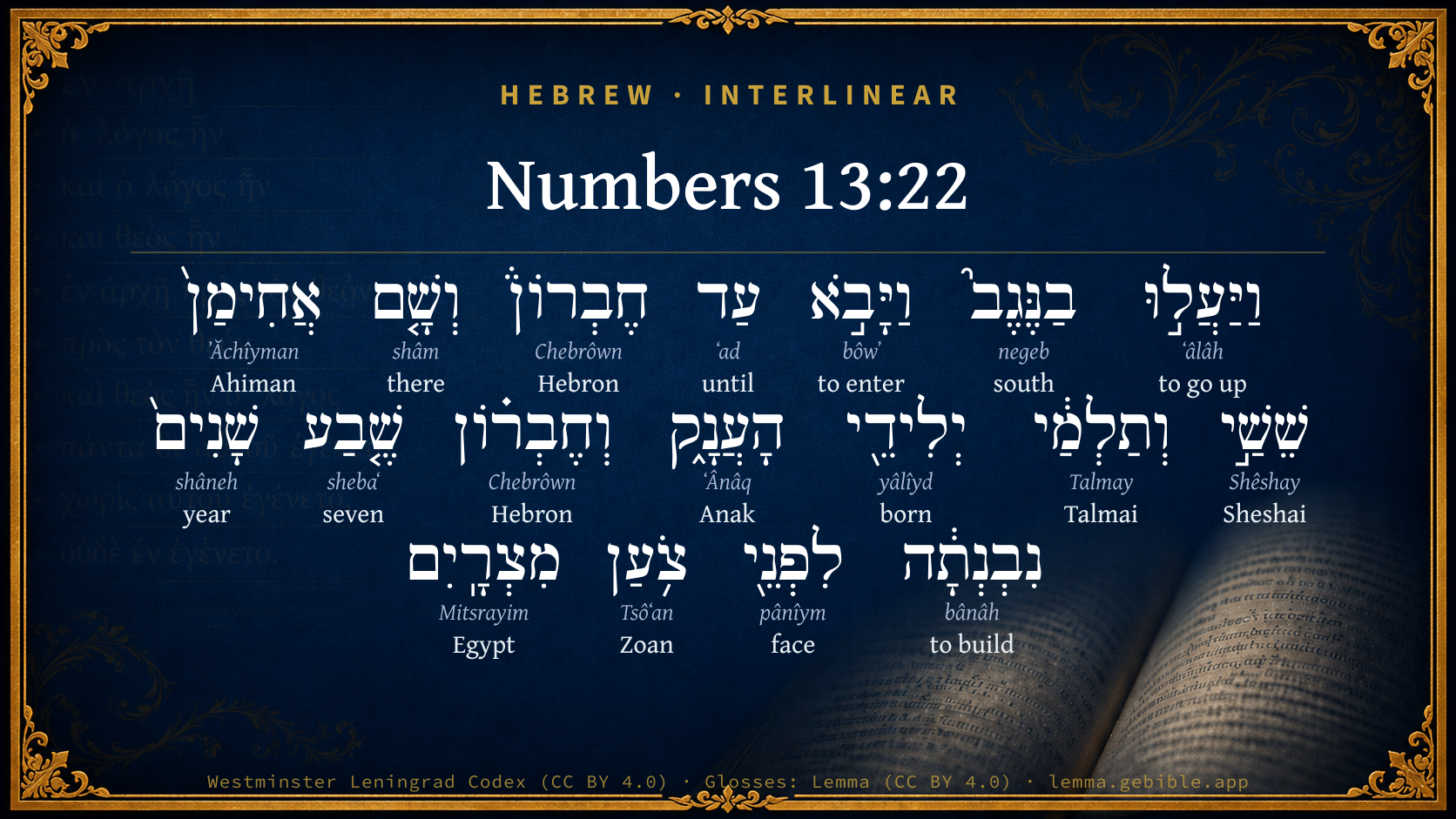
Hebrew (Westminster Leningrad Codex) Numbers 13:22 appears in the Hebrew Old Testament. The text above is from the Westminster Leningrad Codex. Each word links to its Strong’s number, a concise gloss, and parsing drawn from the Open Scriptures Hebrew Bible morphology. Click any word for its full Brown-Driver-Briggs (BDB) entry.
Download image
Cite this verse

Numbers 13:22 (World English Bible). Public Domain. Lemma interlinear Bible study tool, https://lemma.gebible.app/v/numbers/13/22.

Show BibTeX & RIS
BibTeX
RIS
English Translation
They went up by the South, and came to Hebron; and Ahiman, Sheshai, and Talmai, the children of Anak, were there. (Now Hebron was built seven years before Zoan in Egypt.)
World English Bible · Public Domain
Highlights Full analysis ↓
Download a study sheet

One document with this verse’s original text, its word-by-word gloss line, the meaning frame, cross-references with their text, attributed commentary, and full source and license credits — printable, and it pastes into notes with its structure intact.

This verse Autodidact and up

Study sheet (.html) Plain text (.txt)

A passage Seminary Student

Up to 50 verses in one chapter. A passage sheet keeps up to 6 commentary sources and 12 cross-references per verse, in the order this page ranks them, and says so on the sheet whenever that leaves anything out. Ask for a single verse and you get the Autodidact verse sheet above.

Everything on this page stays free to read, with no account — the sheet is a download of what is already on screen, not access to it.

Want to remove ads? Support Godless Engineer
Compare translations 3

The same verse in 3 English versions, stacked beneath the original-language interlinear above. Click any original word for its lexicon entry.

Each is an independent rendering of the whole verse — the interlinear is not word-aligned to these translations.

Highlighted words mark where these versions differ — a whole-verse word diff, not a word-by-word alignment.

  • World English Bible Public Domain
    They went up by the South, and came to Hebron; and Ahiman, Sheshai, and Talmai, the children of Anak, were there. (Now Hebron was built seven years before Zoan in Egypt.)
  • King James Version Public Domain
    And they ascended by the south, and came unto Hebron; where Ahiman, Sheshai, and Talmai, the children of Anak, were. (Now Hebron was built seven years before Zoan in Egypt.)
  • unfoldingWord Literal Text CC BY-SA 4.0
    And they went up in the Negev, and they came as far as Hebron. And there Ahiman, Sheshai, and Talmai, those born of the Anak. (And Hebron was built seven years to the face of Zoan, Egypt.)

unfoldingWord Literal Text — © unfoldingWord, licensed CC BY-SA 4.0. Word-aligned USFM3 via Door43 (git.door43.org/unfoldingWord/en_ult).

Versions to compare (up to 4)

3 of 4 selected

Show all 18 translations

Every available English version of this verse, each an independent rendering of the whole verse.

  • World English Bible Public Domain
    They went up by the South, and came to Hebron; and Ahiman, Sheshai, and Talmai, the children of Anak, were there. (Now Hebron was built seven years before Zoan in Egypt.)
  • Berean Standard Bible Public Domain
    They went up through the Negev and came to Hebron, where Ahiman, Sheshai, and Talmai, the descendants of Anak, dwelled. It had been built seven years before Zoan in Egypt.
  • Majority Standard Bible Public Domain
    They went up through the Negev and came to Hebron, where Ahiman, Sheshai, and Talmai, the descendants of Anak, dwelled. It had been built seven years before Zoan in Egypt.
  • King James Version Public Domain
    And they ascended by the south, and came unto Hebron; where Ahiman, Sheshai, and Talmai, the children of Anak, were. (Now Hebron was built seven years before Zoan in Egypt.)
  • American Standard Version (1901) Public Domain
    And they went up by the South, and came unto Hebron; and Ahiman, Sheshai, and Talmai, the children of Anak, were there. (Now Hebron was built seven years before Zoan in Egypt.)
  • Revised Version (1885) Public Domain
    And they went up by the South, and came unto Hebron; and Ahiman, Sheshai, and Talmai, the children of Anak, were there. (Now Hebron was built seven years before Zoan in Egypt.)
  • Geneva Bible (1599) Public Domain
    So they went vp, and searched out the lande, from the wildernesse of Zin vnto Rehob, to go to Hamath,
  • Douay-Rheims (1899) Public Domain
    And when they were gone up, they viewed the land from the desert of Sin, unto Rohob as you enter into Emath.
  • Young's Literal Translation Public Domain
    and they go up by the south, and come in unto Hebron, and there `are' Ahiman, Sheshai, and Talmai, children of Anak (and Hebron was built seven years before Zoan in Egypt),
  • Literal Standard Version CC BY-SA 4.0
    and they go up by the south, and come to Hebron, and there [are] Ahiman, Sheshai, and Talmai, children of Anak (and Hebron was built seven years before Zoan in Egypt),
  • Unlocked Literal Bible CC BY-SA 4.0
    They went up from the Negev and arrived at Hebron. Ahiman, Sheshai, and Talmai, clans descended from Anak, were there. Now Hebron had been built seven years before Zoan in Egypt.
  • unfoldingWord Literal Text CC BY-SA 4.0
    And they went up in the Negev, and they came as far as Hebron. And there Ahiman, Sheshai, and Talmai, those born of the Anak. (And Hebron was built seven years to the face of Zoan, Egypt.)
  • Darby Bible Public Domain
    And they went up by the south, and came to Hebron; and Ahiman, Sheshai, and Talmai, the children of Anak, were there. Now Hebron had been built seven years before Zoan in Egypt.
  • World Messianic Bible Public Domain
    They went up by the South, and came to Hebron; and Ahiman, Sheshai, and Talmai, the children of Anak, were there. (Now Hebron was built seven years before Zoan in Egypt.)
  • Webster's Bible Public Domain
    And they ascended by the south, and came to Hebron; where Ahiman, Sheshai, and Talmai, the children of Anak, were. (Now Hebron was built seven years before Zoan in Egypt.)
  • Free Bible Version CC BY-SA 4.0
    They went through the Negev and arrived in Hebron where Ahiman, Sheshai, and Talmai, the descendants of Anak, lived. This town was built seven years before the Egyptian town of Zoan.
  • Bible in Basic English Public Domain
    They went up into the South and came to Hebron; and Ahiman and Sheshai and Talmai, the children of Anak, were living there. (Now the building of Hebron took place seven years before that of Zoan in Egypt.)
  • JPS Tanakh (1917) Public Domain
    And they went up into the South, and came unto Hebron; and Ahiman, Sheshai, and Talmai, the children of Anak, were there. — Now Hebron was built seven years before Zoan in Egypt. —

Literal Standard Version (2020), Covenant Press — licensed CC BY-SA 4.0. Text via the HelloAO Bible API (eBible.org). Unlocked Literal Bible (unfoldingWord) — licensed CC BY-SA 4.0. Text via the HelloAO Bible API (eBible.org). unfoldingWord Literal Text — © unfoldingWord, licensed CC BY-SA 4.0. Word-aligned USFM3 via Door43 (git.door43.org/unfoldingWord/en_ult). Free Bible Version, Dr. Jonathan Gallagher — licensed CC BY-SA 4.0. Text via the HelloAO Bible API (eBible.org).

Word by word

More ways to search: Search by grammar → Find every occurrence → Compare this word →

Practice this passage: Drill this verse → Learn its vocabulary →

שֵׁשַׁ֣י
Shêshay
H8344
“Sheshai”
Noun, Proper
Part of Speech
Noun
Type
Proper
Full BDB Definition

Origin: probably for H8343

TWOT: None

Sheshai = "noble" - son of Anak, one of the giants in the land of Canaan
  1. וַיַּעֲל֣וּ ʻâlâh H5927 “and · to go up” Conjunction + Verb, Qal, Sequential Imperfect, 3rd Person, Masculine, Plural
  2. בַנֶּגֶב֮ negeb H5045 “in/at the · south” Preposition, Determined + Noun, Common, Masculine, Singular, Absolute
  3. וַיָּבֹ֣א bôwʼ H935 “and · to enter” Conjunction + Verb, Qal, Sequential Imperfect, 3rd Person, Masculine, Singular
  4. עַד ʻad H5704 “until” Preposition
  5. חֶבְרוֹן֒ Chebrôwn H2275 “Hebron” Noun, Proper
  6. וְשָׁ֤ם shâm H8033 “and · there” Conjunction + Adverb
  7. אֲחִימַן֙ ʼĂchîyman H289 “Ahiman” Noun, Proper
  8. וְתַלְמַ֔י Talmay H8526 “and · Talmai” Conjunction + Noun, Proper
  9. יְלִידֵ֖י yâlîyd H3211 “those born of” Noun, Common, Masculine, Plural, Construct
  10. הָעֲנָ֑ק ʻÂnâq H6061 “the · Anak” Particle, Definite Article + Noun, Gentilic, Masculine, Singular, Absolute
  11. וְחֶבְר֗וֹן Chebrôwn H2275 “and · Hebron” Conjunction + Noun, Proper
  12. שֶׁ֤בַע shebaʻ H7651 “seven” Adjective, Cardinal number, Feminine, Singular, Absolute
  13. שָׁנִים֙ shâneh H8141 “years” Noun, Common, Feminine, Plural, Absolute
  14. נִבְנְתָ֔ה bânâh H1129 “to build” Verb, Niphal, Perfect, 3rd Person, Feminine, Singular
  15. לִפְנֵ֖י pânîym H6440 “to/for · face(s) of” Preposition + Noun, Common, Both, Plural, Construct
  16. צֹ֥עַן Tsôʻan H6814 “Zoan” Noun, Proper
  17. מִצְרָֽיִם Mitsrayim H4714 “Egypt” Noun, Proper

About this verse

These counts appear in no published source. They are computed here, from the morphology-tagged text and Lemma’s own curated glosses. What Lemma adds →

18
words
17
distinct lemmas
Pentateuch
section

Notable vocabulary

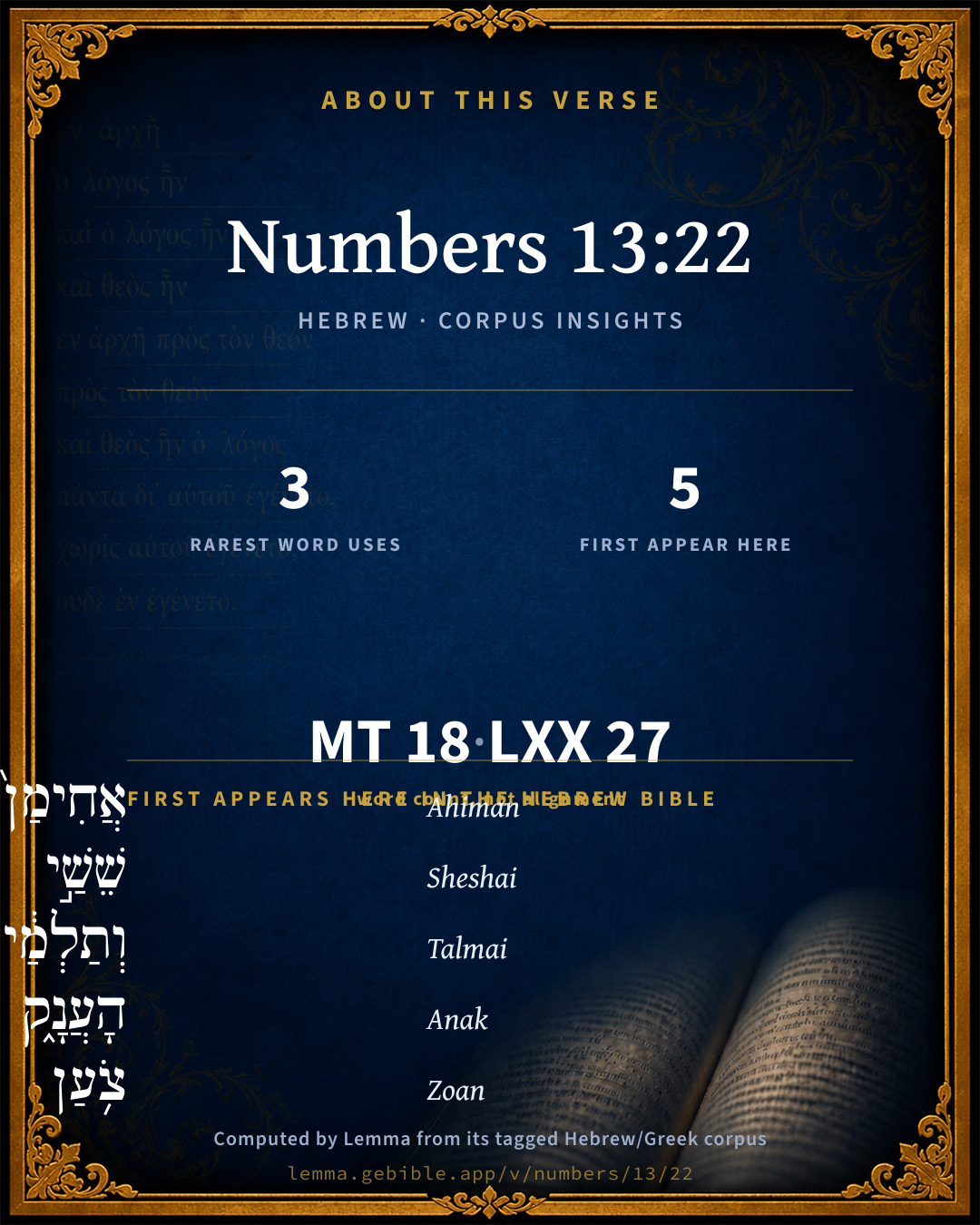
The rarest word here is שֵׁשַׁ֣י Sheshai H8344 — appearing just 3 times in the whole Hebrew Bible.

First appearance in Scripture

These words make their first canonical appearance in the Hebrew Bible here:

  • אֲחִימַן֙ Ahiman H289
  • שֵׁשַׁ֣י Sheshai H8344
  • וְתַלְמַ֔י Talmai H8526
  • הָעֲנָ֑ק Anak H6061
  • צֹ֥עַן Zoan H6814

Shared distinctive vocabulary

שֵׁשַׁ֣י Sheshai H8344 occurs in 3 verses of the Hebrew Bible. Also found in:

Grammatical profile

  • 3 verbs
  • 12 nouns
  • 1 adjective
  • 1 preposition
  • 1 adverb

Verb forms

  • וַיַּעֲל֣וּ Qal · Sequential Imperfect
  • וַיָּבֹ֣א Qal · Sequential Imperfect
  • נִבְנְתָ֔ה Niphal · Perfect

Repetition

A word recurs within this verse — often emphatic in Hebrew:

  • חֶבְרוֹן֒ Hebron H2275 ×2

Hebrew & Septuagint length

In English translation the verse runs 31 words from the Hebrew and 21 from the Septuagint (LXX English) — the Septuagint runs noticeably shorter here. See the side-by-side →

A rough comparison of the two English renderings, which tokenize alike — not a word-level alignment.

Word counts can differ between the Hebrew and the Greek without any difference in meaning — e.g. the Hebrew direct-object marker אֵת has no separate Greek word, and Greek often adds the article ὁ.

In the original languages it is 18 Hebrew tokens and 27 Greek tokens — but the two are counted differently (Hebrew bundles its prefixes and suffixes into one token; the Greek is in lemma form), so that isn’t a like-for-like length.

Cross-references

16

Topical passages linked to Numbers 13:22 in the Treasury of Scripture Knowledge — connected by theme and wording, ordered by reader-vote popularity; previews shown in the World English Bible.

  • Psalms 78:12 He did marvelous things in the sight of their fathers, In the land of Egypt, in the field of Zoan.
  • Psalms 78:43 How he set his signs in Egypt, His wonders in the field of Zoan,
  • Joshua 15:13–14 To Caleb the son of Jephunneh he gave a portion among the children of Judah, according to the commandment of Yahweh to Joshua, even Kiriath Arba, [which Arba was] the father of Anak (the same is Hebron).
  • Isaiah 19:11 The princes of Zoan are utterly foolish; the counsel of the wisest counselors of Pharaoh is become brutish: how do you say to Pharaoh, I am the son of the wise, the son of ancient kings?
  • Joshua 11:21–22 Joshua came at that time, and cut off the Anakim from the hill-country, from Hebron, from Debir, from Anab, and from all the hill-country of Judah, and from all the hill-country of Israel: Joshua utterly destroyed them with their cities.
  • Judges 1:10 Judah went against the Canaanites who lived in Hebron (now the name of Hebron before was Kiriath Arba); and they struck Sheshai, and Ahiman, and Talmai.
  • Isaiah 30:4 For their princes are at Zoan, and their ambassadors are come to Hanes.
  • Genesis 13:18 Abram moved his tent, and came and lived by the oaks of Mamre, which are in Hebron, and built an altar there to Yahweh.
  • Genesis 23:2 Sarah died in Kiriath Arba (the same is Hebron), in the land of Canaan. Abraham came to mourn for Sarah, and to weep for her.
  • Numbers 13:17 Moses sent them to spy out the land of Canaan, and said to them, Go up this way by the South, and go up into the hill-country:
  • Numbers 13:33 There we saw the Nephilim, the sons of Anak, who come of the Nephilim: and we were in our own sight as grasshoppers, and so we were in their sight.
  • Joshua 14:13–15 Joshua blessed him; and he gave Hebron to Caleb the son of Jephunneh for an inheritance.
  • Joshua 21:13 To the children of Aaron the priest they gave Hebron with its suburbs, the city of refuge for the manslayer, and Libnah with its suburbs,
  • 2 Samuel 2:1 It happened after this, that David inquired of Yahweh, saying, Shall I go up into any of the cities of Judah? Yahweh said to him, Go up. David said, Where shall I go up? He said, To Hebron.
  • 2 Samuel 2:11 The time that David was king in Hebron over the house of Judah was seven years and six months.
  • Isaiah 19:13 The princes of Zoan are become fools, the princes of Memphis are deceived; they have caused Egypt to go astray, who are the corner-stone of her tribes.

Cross-references courtesy of OpenBible.info (CC BY 4.0).

Hebrew and Greek witnesses Masoretic Hebrew ↔ Greek Septuagint

The same verse in the two great witnesses to the Old Testament, shown verse-for-verse.

Here the Septuagint runs noticeably shorter than the Hebrew — LXX2012 (modern English Septuagint) 21 words vs World English Bible 31. A rough length comparison of the two English translations, not a word-level alignment — read both below.

These are two independent witnesses, not word-aligned to each other, and the Septuagint is shown in lemma (dictionary) form.

Hebrew Numbers 13:22 Masoretic · Westminster Leningrad Codex

וַיַּעֲל֣וּ בַנֶּגֶב֮ וַיָּבֹ֣א עַד חֶבְרוֹן֒ וְשָׁ֤ם אֲחִימַן֙ שֵׁשַׁ֣י וְתַלְמַ֔י יְלִידֵ֖י הָעֲנָ֑ק וְחֶבְר֗וֹן שֶׁ֤בַע שָׁנִים֙ נִבְנְתָ֔ה לִפְנֵ֖י צֹ֥עַן מִצְרָֽיִם

They went up by the South, and came to Hebron; and Ahiman, Sheshai, and Talmai, the children of Anak, were there. (Now Hebron was built seven years before Zoan in Egypt.)

World English Bible · Public Domain

Greek LXX Numbers 13:22 Septuagint · lemma form

καί ἀναβαίνω κατά ὁ ἔρημος καί ἔρχομαι ἕως χεβρων καί ἐκεῖ αχιμαν καί σεσσι καί θελαμιν γενεά εναχ καί χεβρων ἑπτά ἔτος οἰκοδομέω πρό ὁ τάνιν αἴγυπτος

And they went up and surveyed the land from the wilderness of Sin to Rhoob, as men go in to Aemath.

LXX2012 (modern English Septuagint) · Public Domain

On this verse, The Pulpit Commentary discusses the Septuagint’s reading. Read the note in Commentary ↓

Hebrew: Westminster Leningrad Codex (CC BY 4.0). Greek: Septuagint (public domain); English from LXX2012 (modern English Septuagint) (Public Domain). How the Septuagint differs from the Hebrew →

Targum (Aramaic paraphrase)

2

The Targum is the ancient Jewish Aramaic paraphrase of the Hebrew Scriptures — an interpretive translation, not the Hebrew text itself. Onkelos (literal) and Pseudo-Jonathan (expansive) render the Torah, and Jonathan the Prophets. Coverage is partial: where no permissively-licensed English translation exists for a verse, only the Aramaic is shown. This is verse-level text, not a word-by-word alignment to the Hebrew.

  1. Targum Onkelos Torah (Genesis–Deuteronomy)
    וּסְלִיקוּ בְדָרוֹמָא וַאֲתָא עַד חֶבְרוֹן וְתַמָן אֲחִימָן שֵׁשַׁי וְתַלְמַי בְּנֵי גִבָּרַיָא וְחֶבְרוֹן שְׁבַע שְׁנִין אִתְבְּנִיאַת קֳדָם טָנֵס דְמִצְרָיִם

    (no public-domain English translation for this verse)

    Targum Onkelos — Aramaic: “Onkelos Genesis” (public domain); “Onkelos Exodus” (public domain); “Onkelos Leviticus” (public domain); “Onkelos Numbers” (public domain); “Onkelos Deuteronomy” (public domain). English: “Sefaria Community Translation” (CC0 1.0 (public-domain dedication)); “J.W. Etheridge. The Targums of Onkelos and Jonathan Ben Uzziel on the Pentateuch. London: Longmans, Green, 1862” (public domain). Text via Sefaria.

  2. Targum Pseudo-Jonathan Torah (Genesis–Deuteronomy)
    וּסְלִיקוּ מִן צְטַר דָרוֹמָא וְאָתוֹ עַד חֶבְרוֹן וְתַמָן אֲחִימָן שֵׁשַׁי וְתַלְמַי מַרְבְּיָנֵי דַעֲנָק גִבָּרָא וְחֶבְרוֹן שְׁבַע שְׁנִין אִתְבַּנְיַת קֳדָם עַד לָא תִתְבְּנֵי טָאנֵיס דְמִצְרַיִם

    They went up from the side of the south and came to Hebron, where were Achiman, Sheshai, and Talmai, sons of Anak the giant Now Hebron was built seven years before Tanis in Mizraim.

    Targum Pseudo-Jonathan — Aramaic: “Targum Jonathan on Genesis” (public domain); “Targum Jonathan on Exodus” (public domain); “Targum Jonathan on Leviticus” (public domain); “Targum Jonathan on Numbers” (public domain); “Targum Jonathan on Deuteronomy” (public domain). English: “The Targum of Jonathan ben Uzziel, trans. J. W. Etheridge, London, 1862” (public domain). Text via Sefaria.

Commentary

Notes on Numbers 13:22 from classic Christian and Jewish commentators (each source and its license shown beneath its notes). The classic Christian expositions comment on the surrounding passage and are grouped to its opening verse, so a note may address several verses; the Jewish commentaries on the Tanakh (Rashi and others) are per-verse, so they appear only where the commentator wrote on this verse.

Lemma curates 59 commentaries, every one of them public domain or Creative Commons licensed, each selected and text-cleaned for this edition rather than reprinted as found. About our sources →

John Gill's Exposition

Nevertheless the people be strong that dwell in the land,.... Though so plentiful and fruitful and desirable to enjoy, yet this objection lay against all hopes and even attempts to possess it, as they thought; the strength of the people, its present inhabitants, both in body and mind, being persons of a large, and some of a prodigious stature, and to all appearance men of valour and courage:

and the cities are walled and very great; and so inaccessible, and able to hold out a long siege, and repel what force may be brought against them; so that to attack them would be to little purpose:

and moreover we saw the children of Anak there: whom they had heard of before, and so had the congregation of Israel, and many terrible and frightful stories were told of them, and these they now saw with their eyes, and very formidable they appeared to them; this seems to prove that others beside Caleb and Joshua were at Hebron, where the sons of Anak lived, Num 13:22; and so they might, and yet not be together with them.

John Gill's Exposition of the Whole Bible (1746–1763) — public domain (CC PDM 1.0). Text via the HelloAO Bible API.

Trapp's Complete Commentary

John Trapp

Num 13:22 And they ascended by the south, and came unto Hebron; where Ahiman, Sheshai, and Talmai, the children of Anak, [were]. (Now Hebron was built seven years before Zoan in Egypt.)

Ver. 22. Was built seven years before Zoan.] And so was one of the ancientest cities of the world, seeing it did contend with the ancientest and chiefest city of Egypt. {Isa 19:11} Hebron signifies an association: there lay buried those three reverend couples, Abraham and Sarah, Isaac and Rebecca, Jacob and Leah. {Gen 23:19; Gen 35:27-29} Here David began his reign over Israel, {2Sa 2:1} and hither came Mary to visit Elizabeth. {Luk 1:39}

John Trapp, A Commentary or Exposition upon All the Books of the Old and New Testament (1647–1656) — public domain. Text from a community e-Sword module.

Joseph Benson's Commentary

Num 13:22. By the south — Moses having described their progress from south to north, more particularly relates some memorable places and passages. They came — Hebrew, He came; namely, Caleb, as appears from Jos 14:9; Jos 14:12; Jos 14:14. For the spies distributed their work among them, and went either severally, or by pairs; and it seems the survey of this part was left to Caleb. Anak — A famous giant, whose children these are called, either more generally, as all giants sometimes were, or rather more specially because Arbah, from whom Hebron was called Kiriath-arbah, was the father of Anak, Jos 15:13. And this circumstance is mentioned as an evidence of the goodness of that land, because the giants chose it for their habitation. Before Zoan — This seems to be noted to confront the Egyptians, who vainly boasted of the antiquity of their city Zoan above all places.

Joseph Benson's Commentary on the Old and New Testaments (1811–1818) — public domain. Text from a community e-Sword module.

Tyndale Open Study Notes

Tyndale Open Resources

13:22 Israel’s spies made their way into Canaan’s hill country via the Negev, the dry southland next to the wilderness of Zin. In the southern part of Canaan’s central hill country, they came to Hebron, where Israel’s ancestors had lived (Gen 13:18; 23:19; 35:27; 37:14). • The descendants of Anak were famous for their size and strength (e.g., Deut 9:2). • Zoan (later called Tanis by the Greeks) was a famous city in Egypt’s eastern delta (see also Pss 78:12, 43; Isa 19:11-13; 30:3-5).

Tyndale Open Study Notes — © Tyndale Open Resources, licensed CC BY-SA 4.0. Text via the HelloAO Bible API.

Geneva Bible (1599)

Geneva Bible translators

Which was in the wilderness of Paran.

Geneva Bible (1599) marginal notes — public domain. Text via Bolls.life.

Jamieson, Fausset & Brown

Robert Jamieson, A. R. Fausset & David Brown

unto Hebron--situated in the heart of the mountains of Judah, in the southern extremity of Palestine. The town or "cities of Hebron," as it is expressed in the Hebrew, consists of a number of sheikdoms distinct from each other, standing at the foot of one of those hills that form a bowl round and enclose it. "The children of Anak" mentioned in this verse seem to have been also chiefs of townships; and this coincidence of polity, existing in ages so distant from each other, is remarkable [VERE MONRO]. Hebron (Kirjath Arba, Gen 23:2) was one of the oldest cities in the world.

Zoan--(the Tanis of the Greeks) was situated on one of the eastern branches of the Nile, near the lake Menzala, and was the early royal residence of the Pharaohs. It boasted a higher antiquity than any other city in Egypt. Its name, which signifies flat and level, is descriptive of its situation in the low grounds of the Delta.

Jamieson, Fausset & Brown — Commentary Critical and Explanatory on the Whole Bible (1871) — public domain (CC PDM 1.0). Text via the HelloAO Bible API.

Adam Clarke's Commentary

Verse 22. Hebron was built seven years before Zoan in Egypt.] The Zoan of the Scriptures is allowed to be the Tanis of the heathen historians, which was the capital of Lower Egypt. Some think it was to humble the pride of the Egyptians, who boasted the highest antiquity, that this note concerning the higher antiquity of Hebron was introduced by Moses. Some have supposed that it is more likely to have been originally a marginal note, which in process of time crept into the text; but all the versions and all the MSS. that have as yet been collated, acknowledge it.

Adam Clarke's Commentary on the Bible (1810–1826) — public domain. Text from a community e-Sword/MySword module.

Ellicott's Commentary for English Readers

(22) And they ascended by the south, and came.—The latter verb is in the singular number in the Hebrew text: he came. It is quite possible that the twelve spies may not always have been together, and that one only may have gone to Hebron.

Animan, Sheshai, and Talmai.—Some suppose these to be the names of tribes, not of individuals. It is quite possible, however, that the same individuals may have been still alive when the city of Hebron was assigned to Caleb, about fifty years later, and when he drove out these three sons of Anak (Jos_15:14).

The children of Anak.—Better, the children of the Anakim. (Comp. Deu_1:28; Deu_9:2.) When Anak, as an individual, is mentioned, as in Num_13:33, the article is omitted.

Before Zoan in Egypt.—Zoan, or Tanis, on the eastern bank of the Tanitic arm of the Nile, appears to have been the residence of Pharaoh in the days of Moses (Psa_78:12). Hebron was in existence in the days of Abraham (Gen_13:18; Gen_23:2, &c.).

A Bible Commentary for English Readers, edited by Charles John Ellicott (1878–1897) — public domain. Text from a community e-Sword module.

The Cambridge Bible for Schools and Colleges

gen. ed. J. J. S. Perowne

22. the children of Anak] lit. ‘the sons of neck,’ a Heb. idiom for the long-necked people. The natives of the Negeb were very tall and lanky. It is very improbable that Anak was thought of as a proper name of an individual. In Deut. the expression is mostly ‘sons of Anakim’ (plural). The tradition of a race of giants would easily grow up if the natives, as a whole, were taller than the Israelites. Ahiman, Sheshai and Talmai are probably the names of three clans.

Now Hebron &c.] The date of the first building of Zoan (Tanis) is unknown, but was earlier than 2000 b.c. Perhaps the reference is to the re-building of it, which took place at the beginning of the 19th dynasty, i.e. shortly before the Exodus.

The Cambridge Bible for Schools and Colleges (gen. ed. J. J. S. Perowne; Cambridge University Press, 1878–1918) — public domain. Text from a community e-Sword module.

Albert Barnes' Notes on the Bible

The progenitor of the Anakim was Arba “the father of Anak” Jos 15:13, from whom the city of Hebron took its name of Kirjath-Arba. Ahiman, Sheshai, and Talmai were probably not individual warriors, but names of three tribes of the Anakim. Hence, we find them still in existence half a century later, when Caleb, who now brought tidings of them, became their eventual destroyer Jos 15:14.

Now Hebron ... - This parenthesis explains that these two cities had a common founder, and were built, or perhaps, at least in the case of Zoan (Tanis, see Exo 1:8, note; Exo 2:5, note) rebuilt, by the Hyksos, to which nations, once the conquerors of Egypt, the Anakim perhaps belonged. The Hyksos fortified and garrisoned Zoan as a defense of their Eastern frontier.

Albert Barnes' Notes on the Bible (1834–1885) — public domain. Text from a community e-Sword/MySword module.

Haydock's Catholic Bible Commentary

Sin. The desert of Pharan was contiguous to that of Sin. They departed from Cades-barne, and went along the Jordan to Rohob, at the foot of Mount Libanus, and on the road to Emath; then they returned by the confines of the Sidonians and Philistines, through Hebron, to the camp at Cades.

George Leo Haydock (1774–1849), Haydock's Catholic Family Bible and Commentary, 1859 edition — public domain. Excludes Psalms (Douay-Rheims chapter numbering differs from Protestant) and Deuterocanonical books (Catholic canon only).

Matthew Poole's English Annotations

Here Moses having generally described their process and course from south to north, now returns more particularly to relate some memorable places and passages, as that having entered the land in the southern parts, they travelled then till they came to

Hebron. Came, Heb. he came, to wit, Caleb, as appears from Jos 14:9,12,14; for, as was now intimated, the spies distributed their work among them, and went either severally, or by pairs: and, it seems, the survey of this part was left to Caleb.

Anak; a famous giant so called, whose children these are called, either more generally, as all giants sometimes were, or rather more specially, because Arba, from whom Hebron was called Kirjath-arba, was the father of Anak, Jos 15:13. And this circumstance is mentioned as an evidence of the goodness of that land and soil, because the giants chose it for their habitation.

Before Zoan in Egypt: this seems to be noted to confront the Egyptians, who vainly boasted of the antiquity of their city Zoan above all places.

Matthew Poole's English Annotations on the Holy Bible (1683–1685) — public domain. Text from a community e-Sword/MySword module.

Whedon's Commentary on the Bible

Daniel D. Whedon

22. By the south — See Num_13:17, note. They descended by Hebron and explored the route into the Negeb, or South, (properly capitalized by the R.V.,) by the western edge of the mountains. In one of these extensive valleys — perhaps in Wady Hanein, where miles of grape mounds even now meet the eye — they cut the gigantic cluster of grapes.

Hebron — An ancient city twenty miles south of Jerusalem, described in Jos_10:3, note. “It is plausibly conjectured that on leaving the wilderness of Paran they first entered the Negeb, or South-Country, and passed up the eastern side of the land ‘unto Rehob, as men come to Hamath,’ in the extreme north, and then descended along the central and western slopes, and from the valley of Eshcol (Hebron) bore the grapes, pomegranates, and figs, and so brought verbal and tangible report of the country. This is the most satisfactory way of explaining the seeming contradiction in the account as given in Num_13:21-22.” — Ridgaway.

The children of Anak — A race of giants in stature (Anak literally signifying long-necked) and strength. Anak is regarded as the name of a race rather than that of an individual. Of this race there were near Hebron three tribes, whose chiefs were Ahiman, Sheshai, and Talmai. “That there were in times past men of extraordinary size is a tradition wonderfully prevalent to this day all over the East. It not only runs through legendary lore, but is embodied in numerous monuments of a more substantial character. The truth appears to be that there were amongst the governing races of primitive times certain families of great stature. This peculiarity was carefully perpetuated and increased by such marriage restrictions as tended to that result, and something similar has been found amongst the inhabitants of the Pacific islands.” — W.M. Thomson. Notwithstanding their terrific aspect they were dispossessed by Joshua and utterly driven from the land, except a small remnant of refugees to Philistia, who were, perhaps, the ancestors of Goliath of Gath. Jos_11:21-22. Their chief city, Hebron, fell to the lot of Caleb, who drove out the three tribes of the Anakim. Jos_15:14. Zoan in Egypt was situated on the eastern border of the Nile delta. Its classical name was Tanis, and its Egyptian name Avaris, “departure,” the point of departure for caravans going north and east. It is supposed to have been seized by the shepherd kings about 2080 B.C., and to have been made the seat of their dynasty in Lower Egypt. Here, according to the Egyptian records, they built a temple to Set, the Egyptian Baal, and reigned 511 years. The past few years have been rich in discoveries of historical value in San, the site of ancient Zoan. Obelisks, sphinxes, sculptures, and historical tablets attest its former magnificence. The connexion here of Hebron with Zoan suggests that the founders of both cities were of the same race. It is evident that the writer was well versed in Egyptian history.

Daniel D. Whedon (gen. ed.), Commentary on the Old and New Testaments (1874–1909) — public domain. Text from a community e-Sword module.

The Pulpit Commentary

And came unto Hebron. This and the following details of their journey are appended to the general statement of verse 21 in that inartificial style of narrative still common in the East. On the name Hebron, and the perplexities which it causes, see on Gen_13:18 Gen_23:2.

Where Amman, Sheshai, and Talmai, the children of Anak, were. qnh ydeyliy "Anak"s progeny." Septuagint, geneai Enac , (as in verse 28 and Jos_15:14) means simply "descendants of Anak." The Beni-Anak (Beni-Anakim in Deu_1:28; Anakim in Deu_2:10, &c.); were a tribe whose remote and perhaps legendary ancestor was Anak son of Arba (see on Jos_14:15). These three chiefs of the Beni-Anak are said to have been expelled from Hebron fifty years later by Caleb. (Jos_15:14 Jud_1:20) The gigantic size which the Anakim shared with the Emim and Rephaim, other remnants of the aboriginal inhabitants, may have been accompanied by remarkable longevity; or they may have been quite young at the time of this visit; or, finally, they may not have been individuals at all, but families or clans. Now Hebron was built seven years before Zean in Egypt. Hebron was in existence at the time of Abraham. Zoan was Tanis, near the mouth of the eastern branch of the Nile. (see on Psa_78:12, Psa_78:43) If it be true that the Pharaoh of the exodus had his royal residence at Zoan, Moses may have had access to the archives of the city, or he may have learnt the date of its foundation from the priests who gave him his Egyptian education. That there was any real connection between the two places is extremely problematical, nor is it possible to give any reason for the abrupt insertion here of a fragment of history so minute and in itself so unimportant. There is, however, no one but Moses to whom the statement can with any sort of likelihood be traced; a later writer could have had no authority for making the statement, and no possible reason for inventing it.

Vers. 22, 23. A priceless privilege offered, refused, lost.

The lessons from the narrative of chapters 13 and 14 may be summed up as follows. We see here a priceless privilege

I OFFERED. It is Canaan, "the glory of all lands," the gift of the God of their fathers, who redeemed them from Egypt that he might bring them to a land of liberty and rest. The first report of the spies (Num_13:27-29) is true in itself, but its style suggests faithless fears which infect the congregation. (Num_13:30) The exaggerated or false reports that are now given (Num_13:31-33) increase the panic, but God"s offer is still before them. (2Ti_2:12)

II REFUSED. The shades of evening were gathering when the report of the spies was delivered. (Sketch the spread of the panic during the night, Num_14:1) In the morning the murmurings take a definite form (verses 2-4). The cogent reasonings of Caleb and Joshua are in vain (verses 6-9). They threaten to depose Moses, and to stone the faithful witnesses, and they deliberately reject the offer of God. Thus are sinners wont to believe lies and distrust true witnesses; to assent to fallacies and resist the soundest arguments; to neglect or persecute their best friends, and distrust and rebel against their Redeemer, God.

III LOST. God interposes to protect his servants and sentence the rebels. Moses intercession saves them from immediate destruction, but not from irremediable loss. There are limits to the power of intercessory prayer. (Jer_15:1 1Jn_5:16) A new panic, another night of weeping (verse 39). On the morrow a reaction, a revulsion of feeling, but not a repentance of heart. (cf. 1Sa_15:30) What was impossible yesterday is practicable today (verse 40). But they go without the prayer of Moses (Num_10:35) or the presence of God (verse 44). The mountain pass is impregnable. It is too late. The offer is lost to that generation. Their opportunity has been sinned away. Defeat and death await them. (Isa_42:24, Isa_42:25) These truths applicable

1. To the offer of spiritual conquests to the Church. The Church of Christ often on the borders of a land promised to our conquests. Unbelief suggests fears, our enemies" strength, our own weakness, &c. Gradually faith in our own power may depart, because faith in God is lost. While others are useful we may be ciphers in the Church. Special excitement, or the pricks of conscience, may incite us to make spasmodic efforts; but the faculty for Christian service may be well-nigh extirpated by disuse. (Mat_25:29)

2. To the offer of a present salvation to the sinner. Christian Calebs bring a good report of God"s promised land of rest; but indecision or unbelief may forfeit it. P. (Heb_3:19)

The Pulpit Commentary (1880–1919), ed. H.D.M. Spence-Jones & Joseph S. Exell — public domain. Text from a community e-Sword module.

John Wesley's Explanatory Notes

By the south - Moses having described their progress from south to north, more particularly relates some memorable places and passages. They came - Hebrew. He came, namely, Caleb, as appears from Josh. xiv, 9, 12, 14. For the spies distributed their work among them, and went either severally, or by pairs; and it seems the survey of this part was left to Caleb. Anak - A famous giant, whole children these are called, either more generally, as all giants sometimes were, or rather more specially because Arbah, from whom Hebron was called Kiriath-arbah, was the father of Anak, Josh. xv, 13. And this circumstance is mentioned as an evidence of the goodness of that land, because the giants chose it for their habitation. Before Zoan - This seems to be noted to confront the Egyptians, who vainly boasted of the antiquity of their city Zoan above all places.

John Wesley, Explanatory Notes Upon the Whole Bible (1754–1765) — public domain. Text via the GEBible commentary corpus.

Rashi

Rabbi Shlomo Yitzchaki (Rashi)

ויבא עד חברון [AND THEY WENT UP BY THE SOUTH] AND HE CAME UNTO HEBRON — Caleb alone went there and prostrated himself on the graves of the Patriarchs, offering prayer that he might be helped not to give way to the enticement of his colleagues and join them in their counsel. You may see that it was Caleb who went there, for so indeed it (Scripture) states, (Deuteronomy 1:36) “[Save Caleb the son of Jephunnch, he shall see it] and unto him will I give the land upon which he hath trodden!” and it is written, (Judges 1:20) “And they gave Hebron unto Caleb” (Sotah 34b)

שבע שנים נבנתה [NOW HEBRON] WAS BUILT SEVEN YEARS [BEFORE ZOAN IN EGYPT] — Is it possible that Ham (who was the father of both Canaan and Mizraim; cf. Genesis 10:6) would have built Hebron for Canaan, his younger son, before he built Zoan for Mizraim, his elder son? But the meaning is that it was furnished (lit., built up) with all excellencies seven times better than Zoan. It (Scripture), by mentioning this, means to tell you the excellency of the Land of Israel. For you have no rockier ground in the Land of Israel than Hebron, — for this reason, indeed, they set it apart for a place of burial — and there is, on the other hand, no soil in any country as good as that of Egypt, for it states, (Genesis 13:10) “like the garden of the Lord, viz., like the Land of Egypt”. Now Zoan must have been the best part in the land Egypt since the residence of the kings was there, as it is said, (Jes. 30:4) “For in Zoan were its princes”, and yet Hebron was seven times better than it (Sotah 34b; Ketuvot 112a).

Rashi on the Tanakh — English translations: “The Judaica Press complete Tanach with Rashi, translated by A. J. Rosenberg” (CC BY 4.0); “Pentateuch with Rashi's commentary by M. Rosenbaum and A.M. Silbermann, 1929-1934” (public domain); “The Metsudah Tanach series, Lakewood, N.J” (CC BY 4.0); and “The Book of Joshua, Metsudah Publications, 1997” (CC BY 4.0). Text via Sefaria.

Ramban (Nachmanides)

Rabbi Moshe ben Nachman (Ramban / Nachmanides)

AND HEBRON ‘NIVNETHAH’ (WAS BUILT) SEVEN YEARS BEFORE ZOAN IN EGYPT. “Is it possible that Ham [Noah’s son, the father of both Canaan and Mitzraim], built Hebron for Canaan, his younger son, before he built Zoan for Mitzraim, his elder son? Rather, you must say that [the meaning of the word nivnethah] is m’vunah (“built up” — i.e., furnished, supplied) with all excellent qualities, seven times more than Zoan [in Egypt]. The verse thus comes to tell you of the wonderful quality of the Land of Israel.” This is Rashi’s language.It appears to me according to the plain meaning [of Scripture] that Hebron is Kiryath-arba, the greatest man of the Anakim having the name Arba, and it was he who built it [Hebron], therefore it was called by his name; just as it is said, Now the name of Hebron beforetime was Kiryath-arba, which Arba was the greatest man among the Anakim. This man begot a son whom he named Anak, and it was after him that they [the inhabitants of Hebron] were called Anakim. Therefore Scripture states [here in our verse] that there in Hebron were Ahiman, Sheshai, and Talmai, the children of Anak, and Hebron was built seven years before Zoan in Egypt, meaning to say that Arba built it for his son Anak seven years before the building of Zoan in Egypt, which was an ancient city. [Scripture thereby] tells of the longevity of these people, for just as they were exceptional in their height so also they lived longer than other peoples; since Hebron was built [by Arba] for their father [i.e., Anak, the father of these giants Ahiman, Sheshai, and Talmai] before Zoan in Egypt, and many generations had elapsed since then [the founding of Zoan] until now.It is possible that [in saying that Hebron was built seven years before Zoan Scripture] is alluding to that which it said, whether it is fat or lean, [implying] that Hebron was very ancient and nonetheless still produced fat and large fruits, as Scripture tells about the bunch of grapes, and how much more so the newer [parts of the] Land, which was more fertile.It may be that Arba [and not, as explained above, a son of his, called Anak], was the father of Ahiman, Sheshai, and Talmai, and he was called Arba [literally “four”] because there were [altogether] four Anakim [“giants” — the three sons, Ahiman, Sheshai, and Talmai, and their father. According to this we would not have to postulate, as explained above, the existence of a son of Arba whom he named Anak, and who was the ancestor of the people called Anakim]. And the verse which states even Kiryath-arba, which Arba was the father of ‘Anak’ — the same is Hebron [from which you might deduce that Arba indeed had a son, called Anak, uses the singular as a generic term and] means “the father of Anakim.” Therefore Scripture speaks of [Ahiman, Sheshai and Talmai as the sons of] Anak and as the children ‘ha’anak’ (of Anak), ] Anak, and in Verse 22 here [also in Joshua 15:14] of the children of ‘ha’anak.’ that is, the children of the greatest [giant] of them all [Arba], just as it says, which Arba was the greatest man among the Anakim; and therefore [since it refers to the greatest giant, called Arba, and not to an individual called Anak] Scripture mentions the name with the definite article. ] cannot be prefixed to a proper name of a person. Thus, e.g., you cannot say ‘ha’Reuben’ (the Reuben). But if it is not a proper name the hei can be used. Thus we find “ha’Reubeini” (the Reubenites) — further 26:7, etc. Here too, if “Anak” were the proper name of a person, Scripture could not have said the children of ‘ha’anak,’ but since it means here “the [greatest] giant,” it may properly be so used. They [giants] are called Anakim [literally “necklaces”] because of their beautiful stature, for they are like necklaces on the necks of the people [i.e., they were the pride of the people], just as [certain people] were called bnei ha’elohim in the section of Bereshith, as I have explained there. This is the meaning of the verse, And Hebron ‘nivnethah’ (was built) by this ‘anak’ [mentioned in the beginning of the verse], seven years before Zoan in Egypt, for since the builder of Hebron [Arba] was well-known and famous, because the name of the city was Kiryath-arba (“the city of Arba”), Scripture says “it was built,” [and does not say that Arba built it]. Or its meaning might be [to emphasize] that it was built for these [very people whom the spies now found in it], their father Arba having built it for them, and thus very many years had passed since the day it was founded even until now.

Ramban (Nachmanides) on the Tanakh — English translation: “Commentary on the Torah by Ramban (Nachmanides). Translated and annotated by Charles B. Chavel. New York, Shilo Pub. House, 1971-1976” (CC BY 4.0). Text via Sefaria.

Lesson kit

Teaching starters — assembled from the data on this page, not authored interpretation. Every prompt links to the verse data it draws on. Edit before teaching.

Numbers, in the Pentateuch, opens this verse with 18 words (17 distinct Hebrew lemmas). Its most distinctive word is Shêshay (“Sheshai”). The Greek Septuagint runs shorter here. A historical commentator’s framing appears above. Read the whole chapter for the surrounding context.

Discussion questions

  1. How does “Sheshai” (Shêshay) shape what this verse is saying?
  2. 5 words here appear for the first time in Scripture. What is being introduced at this debut?
  3. Joshua 15:14 shares the word «Sheshai» with this verse. How do the two illuminate each other?
  4. “Hebron” occurs 2× in this one verse. What is the effect of the repetition?
  5. Compared with the Hebrew, the Septuagint runs shorter here. What questions does that raise?
  6. These translations render this verse differently; the difference is in the English rendering, not the original. What questions does that raise?
  7. The verb «וַיַּעֲל֣וּ» is Qal Sequential Imperfect. How does its form color the action?
  8. Reading how John Gill's Exposition and Trapp's Complete Commentary read this verse, where do the two commentators agree and where do they part?

Things to notice

Reading settings

Reading text

Shown beneath each verse's original-language words.

Old Testament
Old Testament edition

Read the OT as the Masoretic Hebrew (MT) or the Greek Septuagint (LXX).

English shown for the Greek Septuagint (in the Hebrew ↔ Greek comparison).

Comparing translations? Open the Compare panel on any verse page to stack up to four side by side.