Genesis 41:18

Hebrew (Westminster Leningrad Codex) Genesis 41:18 appears in the Hebrew Old Testament. The text above is from the Westminster Leningrad Codex. Each word links to its Strong’s number, a concise gloss, and parsing drawn from the Open Scriptures Hebrew Bible morphology. Click any word for its full Brown-Driver-Briggs (BDB) entry.
Download image
Cite this verse

Genesis 41:18 (World English Bible). Public Domain. Lemma interlinear Bible study tool, https://lemma.gebible.app/v/genesis/41/18.

Show BibTeX & RIS
BibTeX
RIS
English Translation
and, behold, there came up out of the river seven cattle, fat-fleshed and well-favored. They fed in the reed-grass,
World English Bible · Public Domain
Download a study sheet

One document with this verse’s original text, its word-by-word gloss line, the meaning frame, cross-references with their text, attributed commentary, and full source and license credits — printable, and it pastes into notes with its structure intact.

This verse Autodidact and up

Study sheet (.html) Plain text (.txt)

A passage Seminary Student

Up to 50 verses in one chapter. A passage sheet keeps up to 6 commentary sources and 12 cross-references per verse, in the order this page ranks them, and says so on the sheet whenever that leaves anything out. Ask for a single verse and you get the Autodidact verse sheet above.

Everything on this page stays free to read, with no account — the sheet is a download of what is already on screen, not access to it.

Want to remove ads? Support Godless Engineer
Compare translations 3

The same verse in 3 English versions, stacked beneath the original-language interlinear above. Click any original word for its lexicon entry.

Each is an independent rendering of the whole verse — the interlinear is not word-aligned to these translations.

Highlighted words mark where these versions differ — a whole-verse word diff, not a word-by-word alignment.

  • World English Bible Public Domain
    and, behold, there came up out of the river seven cattle, fat-fleshed and well-favored. They fed in the reed-grass,
  • King James Version Public Domain
    And, behold, there came up out of the river seven kine, fatfleshed and well favored; and they fed in a meadow:
  • unfoldingWord Literal Text CC BY-SA 4.0
    Then behold, from the river came up seven cows, fat-fleshed and of fine form, and they grazed among the reeds.

unfoldingWord Literal Text — © unfoldingWord, licensed CC BY-SA 4.0. Word-aligned USFM3 via Door43 (git.door43.org/unfoldingWord/en_ult).

Versions to compare (up to 4)

3 of 4 selected

Show all 18 translations

Every available English version of this verse, each an independent rendering of the whole verse.

  • World English Bible Public Domain
    and, behold, there came up out of the river seven cattle, fat-fleshed and well-favored. They fed in the reed-grass,
  • Berean Standard Bible Public Domain
    when seven cows, well-fed and sleek, came up from the river and began to graze among the reeds.
  • Majority Standard Bible Public Domain
    when seven cows, well-fed and sleek, came up from the river and began to graze among the reeds.
  • King James Version Public Domain
    And, behold, there came up out of the river seven kine, fatfleshed and well favored; and they fed in a meadow:
  • American Standard Version (1901) Public Domain
    and, behold, there came up out of the river seven kine, fat-fleshed and well-favored: and they fed in the reed-grass:
  • Revised Version (1885) Public Domain
    and, behold, there came up out of the river seven kine, fatfleshed and well favoured; and they fed in the reed-grass:
  • Geneva Bible (1599) Public Domain
    And lo, there came vp out of the riuer seuen fat fleshed, and welfauoured kine, and they fedde in the medowe.
  • Douay-Rheims (1899) Public Domain
    Joseph answered: Without me, God shall give Pharao a prosperous answer.
  • Young's Literal Translation Public Domain
    and lo, out of the River coming up are seven kine, fat `in' flesh, and of fair form, and they feed among the reeds;
  • Literal Standard Version CC BY-SA 4.0
    and behold, out of the River coming up are seven cows, fat [in] flesh, and of beautiful form, and they feed among the reeds;
  • Unlocked Literal Bible CC BY-SA 4.0
    Behold, seven cows came up out of the Nile, fat and desirable, and they grazed among the reeds.
  • unfoldingWord Literal Text CC BY-SA 4.0
    Then behold, from the river came up seven cows, fat-fleshed and of fine form, and they grazed among the reeds.
  • Darby Bible Public Domain
    And behold, there came up out of the river seven kine, fat-fleshed and of fine form, and they fed in the reed-grass.
  • World Messianic Bible Public Domain
    and behold, seven fat and sleek cattle came up out of the river. They fed in the marsh grass;
  • Webster's Bible Public Domain
    And behold, there came out of the river seven cows, fat-fleshed, and well-favored; and they fed in a meadow:
  • Free Bible Version CC BY-SA 4.0
    I saw seven cows coming up from the river. They looked well-fed and healthy as they grazed among the reeds.
  • Bible in Basic English Public Domain
    And out of the Nile came seven cows, fat and good-looking, and their food was the river-grass;
  • JPS Tanakh (1917) Public Domain
    And, behold, there came up out of the river seven kine, fat-fleshed and well-favoured; and they fed in the reed-grass.

Literal Standard Version (2020), Covenant Press — licensed CC BY-SA 4.0. Text via the HelloAO Bible API (eBible.org). Unlocked Literal Bible (unfoldingWord) — licensed CC BY-SA 4.0. Text via the HelloAO Bible API (eBible.org). unfoldingWord Literal Text — © unfoldingWord, licensed CC BY-SA 4.0. Word-aligned USFM3 via Door43 (git.door43.org/unfoldingWord/en_ult). Free Bible Version, Dr. Jonathan Gallagher — licensed CC BY-SA 4.0. Text via the HelloAO Bible API (eBible.org).

Word by word

More ways to search: Search by grammar → Find every occurrence → Compare this word →

Practice this passage: Drill this verse → Learn its vocabulary →

בָּאָֽחוּ
ʼâchûw
H260
“in/at the · reeds”
Preposition, Determined + Noun, Common, Masculine, Singular, Absolute
Part of Speech
Preposition + Noun
Type
Common
Gender
Masculine
Number
Singular
State
Absolute
Full BDB Definition

Origin: of uncertain (perhaps Egyptian) derivation

TWOT: 63

reeds, marsh plants, rushes
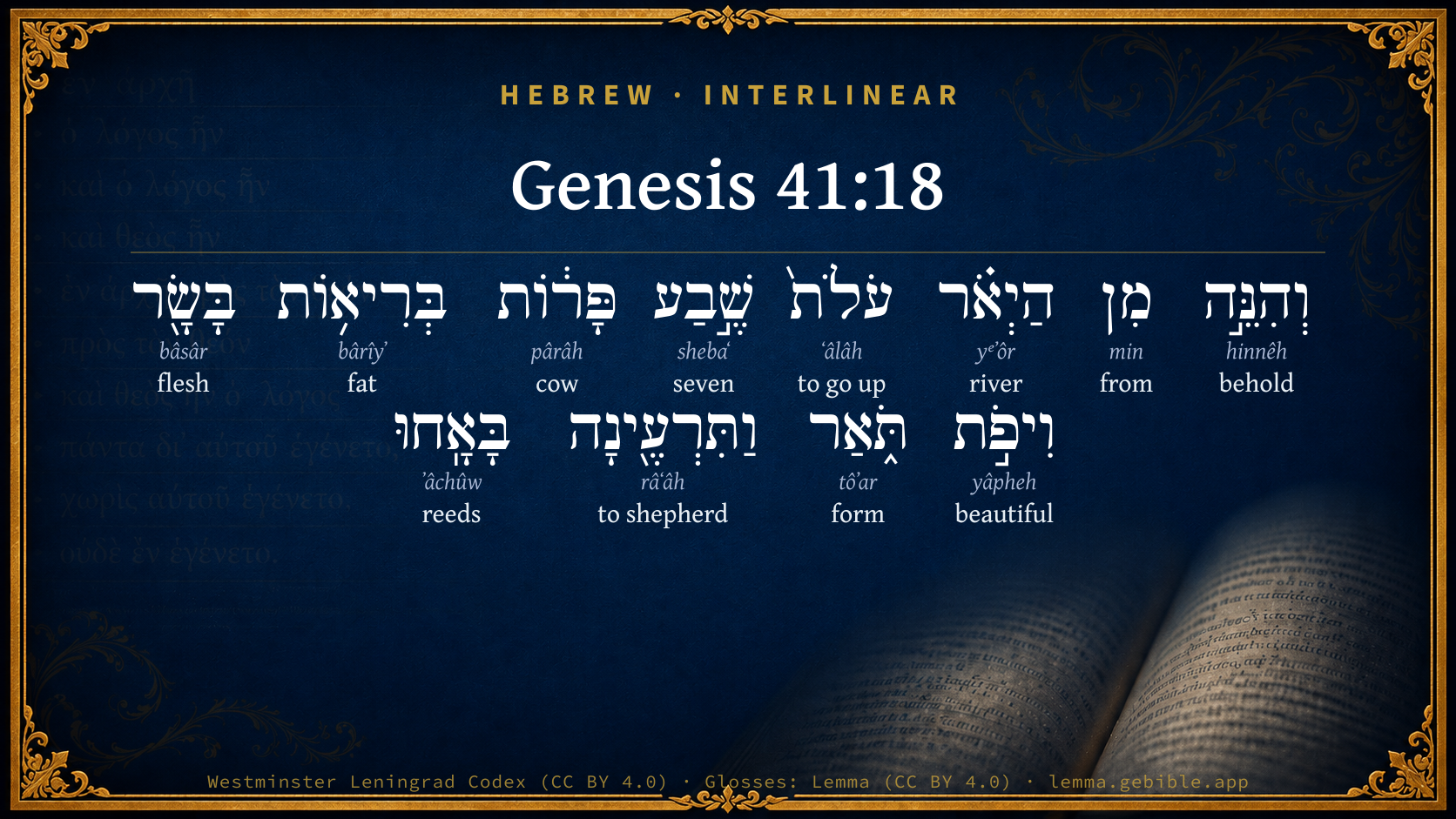
  1. וְהִנֵּ֣ה hinnêh H2009 “and · behold” Conjunction + Particle, Demonstrative
  2. מִן min H4480 “from” Preposition
  3. הַיְאֹ֗ר yᵉʼôr H2975 “the · river” Particle, Definite Article + Noun, Proper
  4. עֹלֹת֙ ʻâlâh H5927 “going up” Verb, Qal, Participle Active, Feminine, Plural, Absolute
  5. שֶׁ֣בַע shebaʻ H7651 “seven” Adjective, Cardinal number, Feminine, Singular, Absolute
  6. פָּר֔וֹת pârâh H6510 “cows” Noun, Common, Feminine, Plural, Absolute
  7. בְּרִיא֥וֹת bârîyʼ H1277 “fat of” Adjective, Adjective, Feminine, Plural, Construct
  8. בָּשָׂ֖ר bâsâr H1320 “flesh” Noun, Common, Masculine, Singular, Absolute
  9. וִיפֹ֣ת yâpheh H3303 “and · beautiful of” Conjunction + Adjective, Adjective, Feminine, Plural, Construct
  10. תֹּ֑אַר tôʼar H8389 “form” Noun, Common, Masculine, Singular, Absolute
  11. וַתִּרְעֶ֖ינָה râʻâh H7462 “and · to shepherd” Conjunction + Verb, Qal, Sequential Imperfect, 3rd Person, Feminine, Plural

About this verse

These counts appear in no published source. They are computed here, from the morphology-tagged text and Lemma’s own curated glosses. What Lemma adds →

12
words
12
distinct lemmas
Pentateuch
section

Notable vocabulary

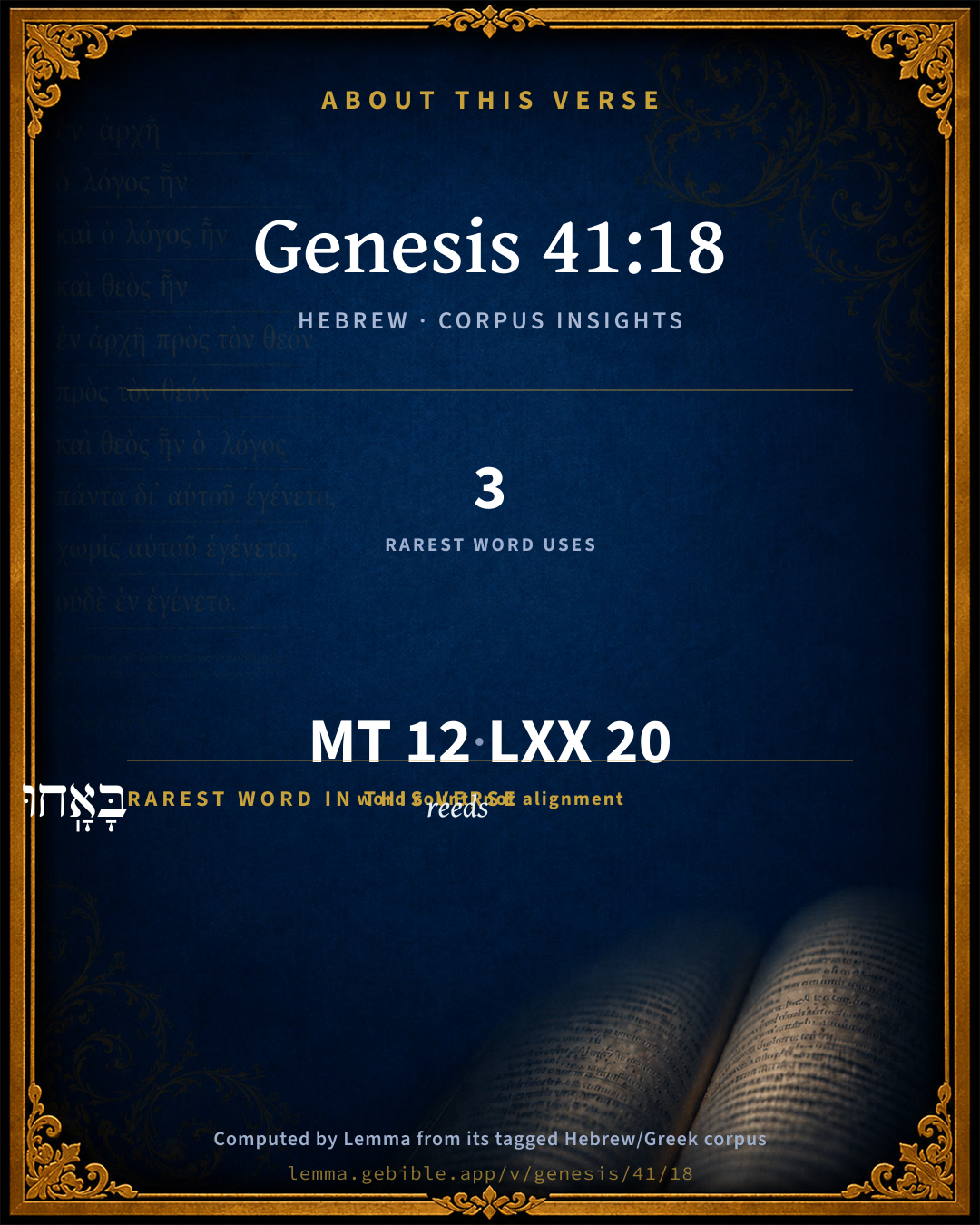
The rarest word here is בָּאָֽחוּ reeds H260 — appearing just 3 times in the whole Hebrew Bible.

Shared distinctive vocabulary

בָּאָֽחוּ reeds H260 occurs in 3 verses of the Hebrew Bible. Also found in:

Grammatical profile

  • 2 verbs
  • 5 nouns
  • 3 adjectives
  • 1 preposition
  • 1 particle

Verb forms

  • עֹלֹת֙ Qal · Participle Active
  • וַתִּרְעֶ֖ינָה Qal · Sequential Imperfect

Hebrew & Septuagint length

In English translation the verse runs 19 words from the Hebrew and 22 from the Septuagint (LXX English) — closely comparable.

A rough comparison of the two English renderings, which tokenize alike — not a word-level alignment.

Word counts can differ between the Hebrew and the Greek without any difference in meaning — e.g. the Hebrew direct-object marker אֵת has no separate Greek word, and Greek often adds the article ὁ.

In the original languages it is 12 Hebrew tokens and 20 Greek tokens — but the two are counted differently (Hebrew bundles its prefixes and suffixes into one token; the Greek is in lemma form), so that isn’t a like-for-like length.

Cross-references

3

Topical passages linked to Genesis 41:18 in the Treasury of Scripture Knowledge — connected by theme and wording, ordered by reader-vote popularity; previews shown in the World English Bible.

  • Jeremiah 24:1–3 Yahweh shown me, and, behold, two baskets of figs set before the temple of Yahweh, after that Nebuchadrezzar king of Babylon had carried away captive Jeconiah the son of Jehoiakim, king of Judah, and the princes of Judah, with the craftsmen and smiths, from Jerusalem, and had brought them to Babylon.
  • Jeremiah 24:5 Thus says Yahweh, the God of Israel: Like these good figs, so will I regard the captives of Judah, whom I have sent out of this place into the land of the Chaldeans, for good.
  • Jeremiah 24:8 As the bad figs, which can't be eaten, they are so bad, surely thus says Yahweh, So will I give up Zedekiah the king of Judah, and his princes, and the residue of Jerusalem, who remain in this land, and those who dwell in the land of Egypt,

Cross-references courtesy of OpenBible.info (CC BY 4.0).

Hebrew and Greek witnesses Masoretic Hebrew ↔ Greek Septuagint

The same verse in the two great witnesses to the Old Testament, shown verse-for-verse.

These are two independent witnesses, not word-aligned to each other, and the Septuagint is shown in lemma (dictionary) form.

Hebrew Genesis 41:18 Masoretic · Westminster Leningrad Codex

וְהִנֵּ֣ה מִן הַיְאֹ֗ר עֹלֹת֙ שֶׁ֣בַע פָּר֔וֹת בְּרִיא֥וֹת בָּשָׂ֖ר וִיפֹ֣ת תֹּ֑אַר וַתִּרְעֶ֖ינָה בָּאָֽחוּ

and, behold, there came up out of the river seven cattle, fat-fleshed and well-favored. They fed in the reed-grass,

World English Bible · Public Domain

Greek LXX Genesis 41:18 Septuagint · lemma form

καί ὥσπερ ἐκ ὁ ποταμός ἀναβαίνω ἑπτά βοῦς καλός ὁ εἶδος καί ἐκλεκτός ὁ σάρξ καί νέμω ἐν ὁ ἄχι

and there came up as it were out of the river, seven cows well-favoured and choice-fleshed, and they fed on the sedge.

LXX2012 (modern English Septuagint) · Public Domain

Hebrew: Westminster Leningrad Codex (CC BY 4.0). Greek: Septuagint (public domain); English from LXX2012 (modern English Septuagint) (Public Domain). How the Septuagint differs from the Hebrew →

Targum (Aramaic paraphrase)

2

The Targum is the ancient Jewish Aramaic paraphrase of the Hebrew Scriptures — an interpretive translation, not the Hebrew text itself. Onkelos (literal) and Pseudo-Jonathan (expansive) render the Torah, and Jonathan the Prophets. Coverage is partial: where no permissively-licensed English translation exists for a verse, only the Aramaic is shown. This is verse-level text, not a word-by-word alignment to the Hebrew.

  1. Targum Onkelos Torah (Genesis–Deuteronomy)
    וְהָא מִן נַהֲרָא סָלְקָן שְׁבַע תּוֹרָן פַּטִּימָן בְּשַׂר וְשַׁפִּירָן לְמֶחֱזֵי וְרַעְיָן בְּאַחֲוָה

    (no public-domain English translation for this verse)

    Targum Onkelos — Aramaic: “Onkelos Genesis” (public domain); “Onkelos Exodus” (public domain); “Onkelos Leviticus” (public domain); “Onkelos Numbers” (public domain); “Onkelos Deuteronomy” (public domain). English: “Sefaria Community Translation” (CC0 1.0 (public-domain dedication)); “J.W. Etheridge. The Targums of Onkelos and Jonathan Ben Uzziel on the Pentateuch. London: Longmans, Green, 1862” (public domain). Text via Sefaria.

  2. Targum Pseudo-Jonathan Torah (Genesis–Deuteronomy)
    וְהִנֵה מִן נַהֲרָא סַלְקַן שְׁבַע תּוֹרָתֵי פַּטִימָן בְּשַר וְשַׁפִּירָן לְמֶחְמֵי וְרַעֲיָין בְּגוֹ גוּמַיָא

    And, behold, from the river came up seven oxen, fat-fleshed and goodjlooking, and they grazed in the midst of the sedges.

    Targum Pseudo-Jonathan — Aramaic: “Targum Jonathan on Genesis” (public domain); “Targum Jonathan on Exodus” (public domain); “Targum Jonathan on Leviticus” (public domain); “Targum Jonathan on Numbers” (public domain); “Targum Jonathan on Deuteronomy” (public domain). English: “The Targum of Jonathan ben Uzziel, trans. J. W. Etheridge, London, 1862” (public domain). Text via Sefaria.

Commentary

Notes on Genesis 41:18 from classic Christian and Jewish commentators (each source and its license shown beneath its notes). The classic Christian expositions comment on the surrounding passage and are grouped to its opening verse, so a note may address several verses; the Jewish commentaries on the Tanakh (Rashi and others) are per-verse, so they appear only where the commentator wrote on this verse.

Lemma curates 59 commentaries, every one of them public domain or Creative Commons licensed, each selected and text-cleaned for this edition rather than reprinted as found. About our sources →

Trapp's Complete Commentary

John Trapp

Gen 41:18 And, behold, there came up out of the river seven kine, fatfleshed and well favoured; and they fed in a meadow:

Ver. 18. {See Trapp on "Gen 41:2"} {See Trapp on "Gen 41:3"} {See Trapp on "Gen 41:4"}

John Trapp, A Commentary or Exposition upon All the Books of the Old and New Testament (1647–1656) — public domain. Text from a community e-Sword module.

Jamieson, Fausset & Brown

Robert Jamieson, A. R. Fausset & David Brown

there came up out of the river seven kine--Cows now, of the buffalo kind, are seen daily plunging into the Nile; when their huge form is gradually emerging, they seem as if rising "out of the river."

and they fed in a meadow--Nile grass, the aquatic plants that grow on the marshy banks of that river, particularly the lotus kind, on which cattle were usually fattened.

Jamieson, Fausset & Brown — Commentary Critical and Explanatory on the Whole Bible (1871) — public domain (CC PDM 1.0). Text via the HelloAO Bible API.

Adam Clarke's Commentary

Verse 18. Seven kine, fat-fleshed] See Clarke on Ge 41:2. And observe farther, that the seven fat and the seven lean kine coming out of the same river plainly show, at once, the cause both of the plenty and the dearth. It is well known that there is scarcely any rain in Egypt; and that the country depends for its fertility on the overflowing of the Nile; and that the fertility is in proportion to the duration and quantity of the overflow. We may therefore safely conclude that the seven years of plenty were owing to an extraordinary overflowing of the Nile; and that the seven years of dearth were occasioned by a very partial, or total want of this essentially necessary inundation. Thus then the two sorts of cattle, signifying years of plenty and want, might be said to come out of the same river, as the inundation was either complete, partial, or wholly restrained. See Clarke on Ge 41:31.

Adam Clarke's Commentary on the Bible (1810–1826) — public domain. Text from a community e-Sword/MySword module.

Ellicott's Commentary for English Readers

(18) In a meadow.—Heb., in the marsh-grass, as in Gen_41:2.

A Bible Commentary for English Readers, edited by Charles John Ellicott (1878–1897) — public domain. Text from a community e-Sword module.

John Gill's Exposition

And, behold, there came up out of the river seven kine,.... Cows or heifers; see Gill on Gen 41:2; the account of them is the same here as there, and of the place where they fed, only the words are transposed.

; the account of them is the same here as there, and of the place where they fed, only the words are transposed.

Genesis 41:19

gen 41:19

gen 41:19

gen 41:19And, behold, seven other kine,.... Here some addition is made: these are said not only to be

very ill favoured, and leanfleshed; see Gill on Gen 41:3, but

poor, thin, meagre, exhausted of their flesh and strength through some disease upon them, or want of food: and it follows, what was not before expressed:

such as I never saw in all the land of Egypt, for badness; so poor, so lean, and so ill favoured; for whatever might be seen in other countries, never were such seen in Egypt, which was famous for good cattle.

John Gill's Exposition of the Whole Bible (1746–1763) — public domain (CC PDM 1.0). Text via the HelloAO Bible API.

Lesson kit

Teaching starters — assembled from the data on this page, not authored interpretation. Every prompt links to the verse data it draws on. Edit before teaching.

Genesis, in the Pentateuch, opens this verse with 12 words (12 distinct Hebrew lemmas). Its most distinctive word is ʼâchûw (“reeds”). A historical commentator’s framing appears above. Read the whole chapter for the surrounding context.

Discussion questions

  1. What does “reeds” (ʼâchûw) contribute to the verse as a whole?
  2. Genesis 41:2 shares the word «reeds» with this verse. How do the two illuminate each other?
  3. The translations on this page render this verse differently — a whole-verse word diff, not a word-by-word alignment. What might account for the different wordings?
  4. The verb «עֹלֹת֙» is Qal Participle Active. How does its form color the action?
  5. Reading how Trapp's Complete Commentary and Jamieson, Fausset & Brown read this verse, where do the two commentators agree and where do they part?

Things to notice

Reading settings

Reading text

Shown beneath each verse's original-language words.

Old Testament
Old Testament edition

Read the OT as the Masoretic Hebrew (MT) or the Greek Septuagint (LXX).

English shown for the Greek Septuagint (in the Hebrew ↔ Greek comparison).

Comparing translations? Open the Compare panel on any verse page to stack up to four side by side.