
Exodus 33:12

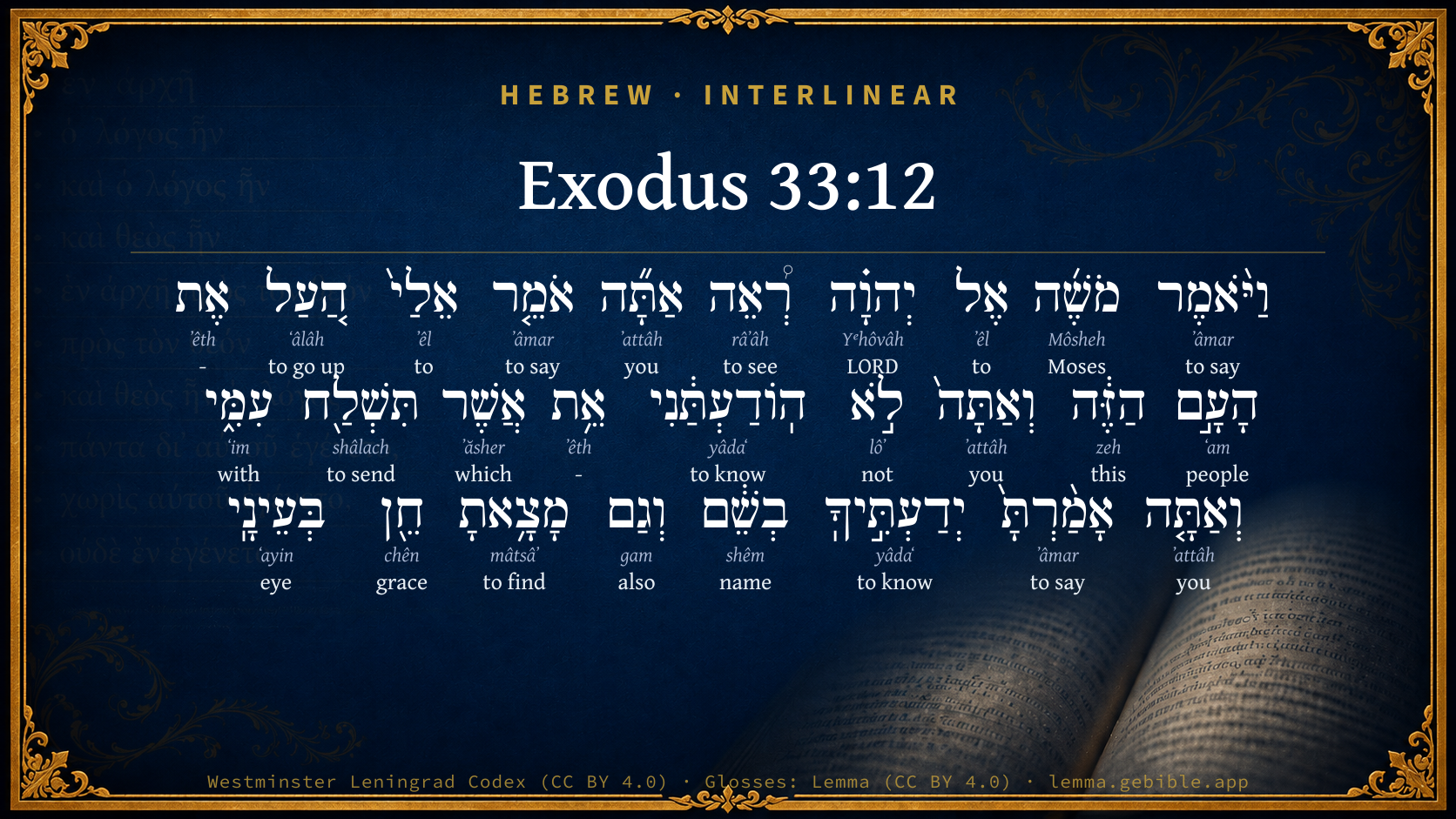
Hebrew (Westminster Leningrad Codex) Exodus 33:12 appears in the Hebrew Old Testament. The text above is from the Westminster Leningrad Codex. Each word links to its Strong’s number, a concise gloss, and parsing drawn from the Open Scriptures Hebrew Bible morphology. Click any word for its full Brown-Driver-Briggs (BDB) entry.
Download image
Cite this verse

Exodus 33:12 (World English Bible). Public Domain. Lemma interlinear Bible study tool, https://lemma.gebible.app/v/exodus/33/12.

Show BibTeX & RIS
BibTeX
RIS
English Translation
Moses said to Yahweh, "Behold, you tell me, 'Bring up this people:' and you haven't let me know whom you will send with me. Yet you have said, 'I know you by name, and you have also found favor in my sight.'
World English Bible · Public Domain
Download a study sheet

One document with this verse’s original text, its word-by-word gloss line, the meaning frame, cross-references with their text, attributed commentary, and full source and license credits — printable, and it pastes into notes with its structure intact.

This verse Autodidact and up

Study sheet (.html) Plain text (.txt)

A passage Seminary Student

Up to 50 verses in one chapter. A passage sheet keeps up to 6 commentary sources and 12 cross-references per verse, in the order this page ranks them, and says so on the sheet whenever that leaves anything out. Ask for a single verse and you get the Autodidact verse sheet above.

Everything on this page stays free to read, with no account — the sheet is a download of what is already on screen, not access to it.

Want to remove ads? Support Godless Engineer
Compare translations 3

The same verse in 3 English versions, stacked beneath the original-language interlinear above. Click any original word for its lexicon entry.

Each is an independent rendering of the whole verse — the interlinear is not word-aligned to these translations.

Highlighted words mark where these versions differ — a whole-verse word diff, not a word-by-word alignment.

  • World English Bible Public Domain
    Moses said to Yahweh, "Behold, you tell me, 'Bring up this people:' and you haven't let me know whom you will send with me. Yet you have said, 'I know you by name, and you have also found favor in my sight.'
  • King James Version Public Domain
    And Moses said unto the LORD, See, thou sayest unto me, Bring up this people: and thou hast not let me know whom thou wilt send with me. Yet thou hast said, I know thee by name, and thou hast also found grace in my sight.
  • unfoldingWord Literal Text CC BY-SA 4.0
    And Moses said to Yahweh, “See, you saying to me, ‘Take this people up,’ but you have not caused me to know whom you will send with me. And you have said, ‘I know you by name, and you have also found favor in my eyes.’

unfoldingWord Literal Text — © unfoldingWord, licensed CC BY-SA 4.0. Word-aligned USFM3 via Door43 (git.door43.org/unfoldingWord/en_ult).

Versions to compare (up to 4)

3 of 4 selected

Show all 18 translations

Every available English version of this verse, each an independent rendering of the whole verse.

  • World English Bible Public Domain
    Moses said to Yahweh, "Behold, you tell me, 'Bring up this people:' and you haven't let me know whom you will send with me. Yet you have said, 'I know you by name, and you have also found favor in my sight.'
  • Berean Standard Bible Public Domain
    Then Moses said to the LORD, “Look, You have been telling me, ‘Lead this people up,’ but You have not let me know whom You will send with me. Yet You have said, ‘I know you by name, and you have found favor in My sight.’
  • Majority Standard Bible Public Domain
    Then Moses said to the LORD, “Look, You have been telling me, ‘Lead this people up,’ but You have not let me know whom You will send with me. Yet You have said, ‘I know you by name, and you have found favor in My sight.’
  • King James Version Public Domain
    And Moses said unto the LORD, See, thou sayest unto me, Bring up this people: and thou hast not let me know whom thou wilt send with me. Yet thou hast said, I know thee by name, and thou hast also found grace in my sight.
  • American Standard Version (1901) Public Domain
    And Moses said unto Jehovah, See, thou sayest unto me, Bring up this people: and thou hast not let me know whom thou wilt send with me. Yet thou hast said, I know thee by name, and thou hast also found favor in my sight.
  • Revised Version (1885) Public Domain
    And Moses said unto the LORD, See, thou sayest unto me, Bring up this people: and thou hast not let me know whom thou wilt send with me. Yet thou hast said, I know thee by name, and thou hast also found grace in my sight.
  • Geneva Bible (1599) Public Domain
    Then Moses sayde vnto the Lord, See, thou sayest vnto me, Leade this people forth, and thou hast not shewed me whom thou wilt sende with mee: thou hast sayde moreouer, I knowe thee by name, and thou hast also found grace in my sight.
  • Douay-Rheims (1899) Public Domain
    And Moses said to the Lord; Thou commandest me to lead forth this people: and thou dost not let me know whom thou wilt send with me, especially whereas thou hast said: I know thee by name, and thou hast found favour in my sight.
  • Young's Literal Translation Public Domain
    And Moses saith unto Jehovah, `See, Thou art saying unto me, Bring up this people, and Thou hast not caused me to know whom Thou dost send with me; and Thou hast said, I have known thee by name, and also thou hast found grace in Mine eyes.
  • Literal Standard Version CC BY-SA 4.0
    And Moses says to YHWH, “See, You are saying to me, Bring up this people, and You have not caused me to know whom You send with me; and You have said, I have known you by name, and you have also found grace in My eyes.
  • Unlocked Literal Bible CC BY-SA 4.0
    Moses said to Yahweh, “See, you have been saying to me, 'Take this people on their journey,' but you have not let me know whom you will send with me. You have said, 'I know you by name, and you have also found favor in my eyes.'
  • unfoldingWord Literal Text CC BY-SA 4.0
    And Moses said to Yahweh, “See, you saying to me, ‘Take this people up,’ but you have not caused me to know whom you will send with me. And you have said, ‘I know you by name, and you have also found favor in my eyes.’
  • Darby Bible Public Domain
    And Moses said to Jehovah, Behold, thou sayest unto me, Bring up this people; but thou dost not let me know whom thou wilt send with me; and thou hast said, I know thee by name, and thou hast also found grace in mine eyes.
  • World Messianic Bible Public Domain
    Moses said to the LORD, “Behold, you tell me, ‘Bring up this people;’ and you haven’t let me know whom you will send with me. Yet you have said, ‘I know you by name, and you have also found favor in my sight.’
  • Webster's Bible Public Domain
    And Moses said to the LORD, See, thou sayest to me, Bring up this people: and thou hast not let me know whom thou wilt send with me. Yet thou hast said, I know thee by name, and thou hast also found grace in my sight.
  • Free Bible Version CC BY-SA 4.0
    Moses said to the Lord, “Look, you've been telling me, ‘Go and lead these people,’ but you haven't let me know who you're going to send with me. And yet you have stated, ‘I know you personally, and I'm happy with you.’
  • Bible in Basic English Public Domain
    And Moses said to the Lord, See, you say to me, Be this people's guide on their journey, but you have not made clear to me whom you will send with me. But you have said, I have knowledge of you by name, and you have grace in my eyes.
  • JPS Tanakh (1917) Public Domain
    And Moses said unto the LORD: 'See, Thou sayest unto me: Bring up this people; and Thou hast not let me know whom Thou wilt send with me. Yet Thou hast said: I know thee by name, and thou hast also found grace in My sight.

Literal Standard Version (2020), Covenant Press — licensed CC BY-SA 4.0. Text via the HelloAO Bible API (eBible.org). Unlocked Literal Bible (unfoldingWord) — licensed CC BY-SA 4.0. Text via the HelloAO Bible API (eBible.org). unfoldingWord Literal Text — © unfoldingWord, licensed CC BY-SA 4.0. Word-aligned USFM3 via Door43 (git.door43.org/unfoldingWord/en_ult). Free Bible Version, Dr. Jonathan Gallagher — licensed CC BY-SA 4.0. Text via the HelloAO Bible API (eBible.org).

Word by word

More ways to search: Search by grammar → Find every occurrence → Compare this word →

Practice this passage: Drill this verse → Learn its vocabulary →

חֵ֖ן
chên
H2580
“grace”
Noun, Common, Masculine, Singular, Absolute
Part of Speech
Noun
Type
Common
Gender
Masculine
Number
Singular
State
Absolute
Full BDB Definition

Origin: from H2603

TWOT: TWOT- 694a

favour, grace, charm - favour, grace, elegance - favour, acceptance
  1. וַיֹּ֨אמֶר ʼâmar H559 “and · to say” Conjunction + Verb, Qal, Sequential Imperfect, 3rd Person, Masculine, Singular
  2. מֹשֶׁ֜ה Môsheh H4872 “Moses” Noun, Proper
  3. אֶל ʼêl H413 “to” Preposition
  4. יְהוָ֗ה Yᵉhôvâh H3068 “LORD” Noun, Proper
  5. רְ֠אֵה râʼâh H7200 “see” Verb, Qal, Imperative, 2nd Person, Masculine, Singular
  6. אַתָּ֞ה ʼattâh H859 “you” Pronoun, Personal, 2nd Person, Masculine, Singular
  7. אֹמֵ֤ר ʼâmar H559 “saying” Verb, Qal, Participle Active, Masculine, Singular, Absolute
  8. אֵלַי֙ ʼêl H413 “to · me” Preposition + Suffix, Personal, 1st Person, Common, Singular
  9. הַ֚עַל ʻâlâh H5927 “go up” Verb, Hiphil, Imperative, 2nd Person, Masculine, Singular
  10. אֶת ʼêth H853 “-” Particle, Direct Object
  11. הָעָ֣ם ʻam H5971 “the · people” Particle, Definite Article + Noun, Common, Masculine, Singular, Absolute
  12. הַזֶּ֔ה zeh H2088 “the · this” Particle, Definite Article + Pronoun, Demonstrative, Masculine, Singular
  13. וְאַתָּה֙ ʼattâh H859 “and · you” Conjunction + Pronoun, Personal, 2nd Person, Masculine, Singular
  14. לֹ֣א lôʼ H3808 “not” Particle, Negative
  15. הֽוֹדַעְתַּ֔נִי yâdaʻ H3045 “to know · me” Verb, Hiphil, Perfect, 2nd Person, Masculine, Singular + Suffix, Personal, 1st Person, Common, Singular
  16. אֵ֥ת ʼêth H853 “-” Particle, Direct Object
  17. אֲשֶׁר ʼăsher H834 “which” Particle, Relative
  18. תִּשְׁלַ֖ח shâlach H7971 “to send” Verb, Qal, Imperfect, 2nd Person, Masculine, Singular
  19. עִמִּ֑י ʻim H5973 “with · me” Preposition + Suffix, Personal, 1st Person, Common, Singular
  20. וְאַתָּ֤ה ʼattâh H859 “and · you” Conjunction + Pronoun, Personal, 2nd Person, Masculine, Singular
  21. אָמַ֨רְתָּ֙ ʼâmar H559 “to say” Verb, Qal, Perfect, 2nd Person, Masculine, Singular
  22. יְדַעְתִּ֣יךָֽ yâdaʻ H3045 “to know · you” Verb, Qal, Perfect, 1st Person, Common, Singular + Suffix, Personal, 2nd Person, Masculine, Singular
  23. בְשֵׁ֔ם shêm H8034 “in/at · name” Preposition + Noun, Common, Masculine, Singular, Absolute
  24. וְגַם gam H1571 “and · also” Conjunction + Particle, Accusative
  25. מָצָ֥אתָ mâtsâʼ H4672 “to find” Verb, Qal, Perfect, 2nd Person, Masculine, Singular
  26. בְּעֵינָֽי ʻayin H5869 “in/at · eyes · my” Preposition + Noun, Common, Both, Dual, Construct + Suffix, Personal, 1st Person, Common, Singular

About this verse

These counts appear in no published source. They are computed here, from the morphology-tagged text and Lemma’s own curated glosses. What Lemma adds →

27
words
20
distinct lemmas
Pentateuch
section

Grammatical profile

  • 9 verbs
  • 6 nouns
  • 4 pronouns
  • 3 prepositions
  • 5 particles

Verb forms

  • וַיֹּ֨אמֶר Qal · Sequential Imperfect
  • רְ֠אֵה Qal · Imperative
  • אֹמֵ֤ר Qal · Participle Active
  • הַ֚עַל Hiphil · Imperative
  • הֽוֹדַעְתַּ֔נִי Hiphil · Perfect
  • תִּשְׁלַ֖ח Qal · Imperfect
  • אָמַ֨רְתָּ֙ Qal · Perfect
  • יְדַעְתִּ֣יךָֽ Qal · Perfect
  • מָצָ֥אתָ Qal · Perfect

Repetition

Words recur within this verse — often emphatic in Hebrew:

  • וַיֹּ֨אמֶר to say H559 ×3
  • הֽוֹדַעְתַּ֔נִי to know H3045 ×2
  • אַתָּ֞ה you H859 ×3
  • אֶל to H413 ×2

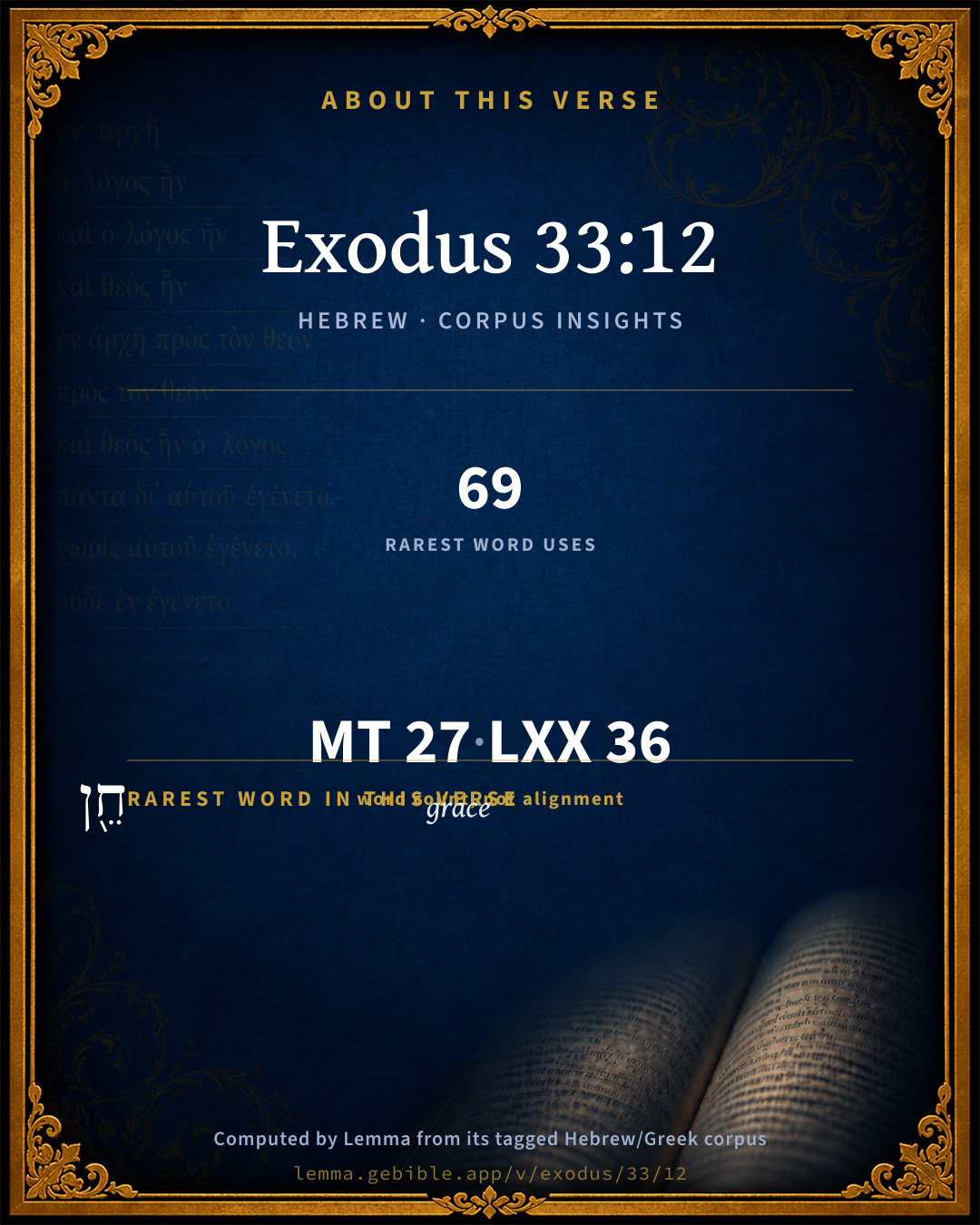
Hebrew & Septuagint length

In English translation the verse runs 42 words from the Hebrew and 44 from the Septuagint (LXX English) — closely comparable.

A rough comparison of the two English renderings, which tokenize alike — not a word-level alignment.

Word counts can differ between the Hebrew and the Greek without any difference in meaning — e.g. the Hebrew direct-object marker אֵת has no separate Greek word, and Greek often adds the article ὁ.

In the original languages it is 27 Hebrew tokens and 36 Greek tokens — but the two are counted differently (Hebrew bundles its prefixes and suffixes into one token; the Greek is in lemma form), so that isn’t a like-for-like length.

Cross-references

10

Topical passages linked to Exodus 33:12 in the Treasury of Scripture Knowledge — connected by theme and wording, ordered by reader-vote popularity; previews shown in the World English Bible.

  • Exodus 33:17 Yahweh said to Moses, "I will do this thing also that you have spoken; for you have found favor in my sight, and I know you by name."
  • Jeremiah 1:5 Before I formed you in the belly I knew you, and before you came forth out of the womb I sanctified you; I have appointed you a prophet to the nations.
  • John 10:14–15 I am the good shepherd. I know my own, and I'm known by my own;
  • Exodus 32:34 Now go, lead the people to the place of which I have spoken to you. Behold, my angel shall go before you. Nevertheless in the day when I punish, I will punish them for their sin."
  • 2 Timothy 2:19 However God's firm foundation stands, having this seal, "The Lord knows those who are his," and, "Let every one who names the name of the Lord depart from unrighteousness."
  • Genesis 18:19 For I have known him, to the end that he may command his children and his household after him, that they may keep the way of Yahweh, to do righteousness and justice; to the end that Yahweh may bring on Abraham that which he has spoken of him."
  • Isaiah 43:1 But now thus says Yahweh who created you, Jacob, and he who formed you, Israel: Don't be afraid, for I have redeemed you; I have called you by your name, you are mine.
  • Exodus 3:10 Come now therefore, and I will send you to Pharaoh, that you may bring forth my people, the children of Israel, out of Egypt."
  • Exodus 33:1 Yahweh spoke to Moses, "Depart, go up from here, you and the people that you have brought up out of the land of Egypt, to the land of which I swore to Abraham, to Isaac, and to Jacob, saying, 'I will give it to your seed.'
  • Psalms 1:6 For Yahweh knows the way of the righteous, But the way of the wicked shall perish.

Cross-references courtesy of OpenBible.info (CC BY 4.0).

Hebrew and Greek witnesses Masoretic Hebrew ↔ Greek Septuagint

The same verse in the two great witnesses to the Old Testament, shown verse-for-verse.

These are two independent witnesses, not word-aligned to each other, and the Septuagint is shown in lemma (dictionary) form.

Hebrew Exodus 33:12 Masoretic · Westminster Leningrad Codex

וַיֹּ֨אמֶר מֹשֶׁ֜ה אֶל יְהוָ֗ה רְ֠אֵה אַתָּ֞ה אֹמֵ֤ר אֵלַי֙ הַ֚עַל אֶת הָעָ֣ם הַזֶּ֔ה וְאַתָּה֙ לֹ֣א הֽוֹדַעְתַּ֔נִי אֵ֥ת אֲשֶׁר תִּשְׁלַ֖ח עִמִּ֑י וְאַתָּ֤ה אָמַ֨רְתָּ֙ יְדַעְתִּ֣יךָֽ בְשֵׁ֔ם וְגַם מָצָ֥אתָ חֵ֖ן בְּעֵינָֽי

Moses said to Yahweh, "Behold, you tell me, 'Bring up this people:' and you haven't let me know whom you will send with me. Yet you have said, 'I know you by name, and you have also found favor in my sight.'

World English Bible · Public Domain

Greek LXX Exodus 33:12 Septuagint · lemma form

καί εἶπον μωυσῆς πρός κύριος ἰδού σύ ἐγώ λέγω ἀναἄγω ὁ λαός οὗτος σύ δέ οὐ δηλόω ἐγώ ὅς συν ἀποστέλλω μετά ἐγώ σύ δέ ἐγώ εἶπον οἶδα σύ παρά πᾶς καί χάρις ἔχω παρά ἐγώ

And Moses said to the Lord, Behold! you say to me, Lead on this people; but you have not showed me whom you will send with me, but you have said to me, I know you above all, and you have favor with me.

LXX2012 (modern English Septuagint) · Public Domain

Hebrew: Westminster Leningrad Codex (CC BY 4.0). Greek: Septuagint (public domain); English from LXX2012 (modern English Septuagint) (Public Domain). How the Septuagint differs from the Hebrew →

Targum (Aramaic paraphrase)

2

The Targum is the ancient Jewish Aramaic paraphrase of the Hebrew Scriptures — an interpretive translation, not the Hebrew text itself. Onkelos (literal) and Pseudo-Jonathan (expansive) render the Torah, and Jonathan the Prophets. Coverage is partial: where no permissively-licensed English translation exists for a verse, only the Aramaic is shown. This is verse-level text, not a word-by-word alignment to the Hebrew.

  1. Targum Onkelos Torah (Genesis–Deuteronomy)
    וַאֲמַר משֶׁה קֳדָם יְיָ חֲזֵי דְאַתְּ אָמַר לִי אַסֵיק יָת עַמָא הָדֵין וְאַתְּ לֹא הוֹדַעְתַּנִי יָת דִי תִשְׁלַח עִמִי וְאַתְּ אָמַרְתְּ רַבִּיתָךְ בְּשׁוּם וְאַף אַשְׁכַּחְתָּא רַחֲמִין קֳדָמָי:

    (no public-domain English translation for this verse)

    Targum Onkelos — Aramaic: “Onkelos Genesis” (public domain); “Onkelos Exodus” (public domain); “Onkelos Leviticus” (public domain); “Onkelos Numbers” (public domain); “Onkelos Deuteronomy” (public domain). English: “Sefaria Community Translation” (CC0 1.0 (public-domain dedication)); “J.W. Etheridge. The Targums of Onkelos and Jonathan Ben Uzziel on the Pentateuch. London: Longmans, Green, 1862” (public domain). Text via Sefaria.

  2. Targum Pseudo-Jonathan Torah (Genesis–Deuteronomy)
    וַאֲמַר משֶׁה קֳדָם יְיָ חָמֵי מַה דְּאַנְתְּ אָמַר לִי סַלֵיק יַת עַמָּא הָדֵין וְאַנְתְּ לָא אוֹדַעְתָּנִי יַת מַאן דְּאַנְתְּ שְׁלַח עִמִּי וְאַנְתְּ בְּמֵימְרָךְ אָמַרְתְּ מַנֵית יָתָךְ בְּשׁוּם טַב וְאוּף אַשְׁכַּחְתְּ רַחֲמִין קֳדָמָי

    And Mosheh said before the Lord, Lo, what hast Thou said to me, Take this people up? but Thou hast not made me to know whom Thou wilt send with me. By Thy Word Thou hast said, I have ordained thee with a goodly name, and thou hast found favour before Me.

    Targum Pseudo-Jonathan — Aramaic: “Targum Jonathan on Genesis” (public domain); “Targum Jonathan on Exodus” (public domain); “Targum Jonathan on Leviticus” (public domain); “Targum Jonathan on Numbers” (public domain); “Targum Jonathan on Deuteronomy” (public domain). English: “The Targum of Jonathan ben Uzziel, trans. J. W. Etheridge, London, 1862” (public domain). Text via Sefaria.

Commentary

Notes on Exodus 33:12 from classic Christian and Jewish commentators (each source and its license shown beneath its notes). The classic Christian expositions comment on the surrounding passage and are grouped to its opening verse, so a note may address several verses; the Jewish commentaries on the Tanakh (Rashi and others) are per-verse, so they appear only where the commentator wrote on this verse.

Lemma curates 59 commentaries, every one of them public domain or Creative Commons licensed, each selected and text-cleaned for this edition rather than reprinted as found. About our sources →

Matthew Henry's Commentary

Moses, having returned to the door of the tabernacle, becomes a humble and importunate supplicant there for two very great favours, and as a prince he has power with God, and prevails for both: herein he was a type of Christ the great intercessor, whom the Father heareth always.

I. He is very earnest with God for a grant of his presence with Israel in the rest of their march to Canaan, notwithstanding their provocations. The people had by their sin deserved the wrath of God, and for the turning away of that Moses had already prevailed, Exo 32:14. But they had likewise forfeited God's favourable presence, and all the benefit and comfort of that, and this Moses is here begging for the return of. Thus, by the intercession of Christ, we obtain not only the removal of the curse, but an assurance of the blessing; we are not only saved from ruin, but become entitled to everlasting happiness. Observe how admirably Moses orders this cause before God, and fills his mouth with arguments. What a value he expresses for God's favour, what a concern for God's glory and the welfare of Israel. How he pleads, and how he speeds.

1. How he pleads. (1.) He insists upon the commission God had given him to bring up this people, Exo 33:12. This he begins with: "Lord, it is thou thyself that employest me; and wilt thou not own me? I am in the way of my duty; and shall I not have thy presence with me in that way?" Whom God calls out to any service he will be sure to furnish with necessary assistances. "Now, Lord, thou hast ordered me a great work, and yet left me at a loss how to go about it, and to through with it." Note, Those that sincerely design and endeavour to do their duty may in faith beg of God direction and strength for the doing of it. (2.) He improves the interest he himself had with God, and pleads God's gracious expressions of kindness to him: Thou hast said, I know thee by name, as a particular friend and confidant, and thou hast also found grace in my sight, above any other. Now, therefore, says Moses, if it be indeed so, that I have found grace in thy sight, show me the way, Exo 33:13. What favour God had expressed to the people they had forfeited the benefit of, there was no insisting upon that; and therefore Moses lays the stress of his plea upon what God had said to him, which, though he owns himself unworthy of, yet he hopes he has not thrown himself out of the benefit of. By this therefore he takes hold on God: "Lord, if ever thou wilt do any thing for me, do this for the people." Thus our Lord Jesus, in his intercession, presents himself to the Father, as one in whom he is always well pleased, and so obtains mercy for us with whom he is justly displeased; and we are accepted in the beloved. Thus also men of public spirit love to improve their interest both with God and man for the public good. Observe what it is he is thus earnest for: Show me thy way, that I may know that I find grace in thy sight. Note, Divine direction is one of the best evidences of divine favour. By this we may know that we find grace in God's sight, if we find grace in our hearts to guide and quicken us in the way of our duty. God's good work in us is the surest discovery of his good-will towards us. (3.) He insinuates that the people also, though most unworthy, yet were in some relation to God: "Consider that this nation is thy people, a people that thou hast done great things for, redeemed to thyself, and taken into covenant with thyself; Lord, they are thy own, do not leave them." The offended father considers this, "My child is foolish and froward, but he is my child, and I cannot abandon him." (4.) He expresses the great value he had for the presence of God. When God said, My presence shall go with thee, he caught at that word, as that which he could not live and move without: "If thy presence go not with me, carry us not up hence," Exo 33:15. He speaks as one that dreaded the thought of going forward without God's presence, knowing that their marches could not be safe, nor their encampments easy, if they had not God with them. "Better lie down and die here in the wilderness than go forward to Canaan without God's presence." Note, Those who know how to value God's favours are best prepared to receive them. Observe how earnest Moses is in this matter; he begs as one that would take no denial. "Here we will stay till we obtain thy favour; like Jacob, I will not let thee go except thou bless me." And observe how he advances upon God's concessions; the kind intimations given him make him yet more importunate. Thus God's gracious promises, and the advances of mercy towards us, should not only encourage our faith, but excite our fervency in prayer. (5.) He concludes with an argument taken from God's glory (Exo 33:16): "Wherein shall it be known to the nations that have their eyes upon us that I and thy people (with whom my interests are all blended) have found grace in thy sight, distinguishing favour, so as to be separated from all people on earth? How will it appear that we are indeed thus honoured? Is it not in that thou goest with us? Nothing short of this can answer these characters. Let it never be said that we are a peculiar people, and highly favoured, for we stand but upon a level with the rest of our neighbours unless thou go with us; sending an angel with us will not serve." He lays a stress upon the place - "here in this wilderness, whither thou hast led us, and where we shall be certainly lost if thou leave us." Note, God's special presence with us in this wilderness, by his Spirit and grace, to direct, defend, and comfort us, is the surest pledge of his special love to us and will redound to his glory as well as our benefit.

2. Observe how he speeds. He obtained an assurance of God's favour, (1.) To himself (Exo 33:14): "I will give thee rest, I will take care to make thee easy in this matter; however it be, thou shalt have satisfaction." Moses never entered Canaan, and yet God made good his word that he would give him rest, Dan 12:13. (2.) To the people for his sake. Moses was not content with that answer which bespoke favour to himself only, he must gain a promise, an express promise, for the people too, or he is not at rest; gracious generous souls think it not enough to get to heaven themselves, but would have all their friends go thither too. And in this also Moses prevailed: I will do this thing also that thou hast spoken, Exo 33:17. Moses is not checked as an unreasonable beggar, whom no saying would serve, but he is encouraged. God grants as long as he asks, gives liberally, and does not upbraid him. See the power of prayer, and be quickened hereby to ask, and seek, and knock, and to continue instant in prayer, to pray always and not to faint. See the riches of God's goodness. When he has done much, yet he is willing to do more: I will do this also - above what we are able to ask or think. See, in type, the prevalency of Christ's intercession, which he ever lives to make for all those that come to God by him, and the ground of that prevalency. It is purely his own merit, not any thing in those for whom he intercedes; it is because thou hast found grace in my sight. And now the matter is settled, God is perfectly reconciled to them, his presence in the pillar of cloud returns to them and shall continue with them; all is well again, and henceforth we hear no more of the golden calf. Lord, who is a God like unto thee, pardoning iniquity?

II. Having gained this point, he next begs a sight of God's glory, and is heard in this matter also. Observe,

1. The humble request Moses makes: I beseech thee, show me thy glory, Exo 33:18. Moses had lately been in the mount with God, had continued there a great while, and had enjoyed as intimate a communion with God as ever any man had on this side heaven; and yet he is still desiring a further acquaintance. All that are effectually called to the knowledge of God and fellowship with him, though they desire nothing more than God, are nevertheless still coveting more and more of him, till they come to see as they are seen. Moses had wonderfully prevailed with God for one favour after another, and the success of his prayers emboldened him to go on still to seek God; the more he had the more he asked: when we are in a good frame at the throne of grace, we should endeavour to preserve and improve it, and strike while the iron is hot: "Show me thy glory; make me to see it" (so the word is); "make it some way or other visible, and enable me to bear the sight of it." Not that he was so ignorant as to think God's essence could be seen with bodily eyes; but, having hitherto only heard a voice out of a pillar of cloud or fire, he desired to see some representation of the divine glory, such as God saw fit to gratify him with. It was not fit that the people should see any similitude when the Lord spoke unto them, lest they should corrupt themselves; but he hoped that there was not that danger in his seeing some similitude. Something it was more than he had yet seen that Moses desired. If it was purely for the assisting of his faith and devotion, the desire was commendable; but perhaps there was in it a mixture of human infirmity. God will have us walk by faith, not by sight, in this world; and faith comes by hearing. Some think that Moses desired a sight of God's glory as a token of his reconciliation, and an earnest of that presence which he had promised them; but he knew not what he asked.

2. The gracious reply God made to this request. (1.) He denied that which was not fit to be granted, and which Moses could not bear: Thou canst not see my face, Exo 33:20. A full discovery of the glory of God would quite overpower the faculties of any mortal man in this present state, and overwhelm him, even Moses himself. Man is mean and unworthy of it, weak and could not bear it, guilty and could not but dread it. It is in compassion to our infirmity that God holdeth back the face of his throne, and spreadeth a cloud upon it, Job 26:9. God has said that here (that is, in this world) his face shall not be seen (Exo 33:23); that is an honour reserved for the future state, to be the eternal bliss of holy souls: should men in this state know what it is, they would not be content to live short of it. There is a knowledge and enjoyment of God which must be waited for in another world, when we shall see him as he is, Jo1 3:2. In the mean time let us adore the height of what we do know of God, and the depth of what we do not. Long before this, Jacob had spoken of it with wonder that he had seen God face to face, and yet his life was preserved, Gen 32:30. Sinful man dreads the sight of God his Judge; but holy souls, being by the Spirit of the Lord changed into the same image, behold with open face the glory of the Lord. Co2 3:18. (2.) He granted that which would be abundantly satisfying. [1.] He should hear what would please him (Exo 33:19): I will make all my goodness pass before thee. He had given him wonderful instances of his goodness in being reconciled to Israel: but that was only goodness in the stream; he would show him goodness in the spring - all his goodness. This was a sufficient answer to his request. "Show me thy glory," says Moses. "I will show thee my goodness," says God. Note, God's goodness is his glory; and he will have us to know him by the glory of his mercy more than by the glory of his majesty; for we must fear even the Lord and his goodness, Hos 3:5. That especially which is the glory of God's goodness is the sovereignty of it, that he will be gracious to whom he will be gracious, that, as an absolute proprietor, he makes what difference he pleases in bestowing his gifts, and is not debtor to any, nor accountable to any (may he not do what he will with his own?); also that all his reasons of mercy are fetched from within himself, not from any merit in his creatures: as he has mercy on whom he will, so, because he will. Even so, Father, because it seemed good in thy sight. It is never said, "I will be angry at whom I will be angry," for his wrath is always just and holy; but I will show mercy on whom I will show mercy, for his grace is always free. He never damns by prerogative, but by prerogative he saves. The apostle quotes this (Rom 9:15) in answer to those who charged God with unrighteousness in giving that grace freely to some which he withholds justly from others. [2.] He should see what he could bear, and what would suffice him. The matter is concerted so as that Moses might be safe and yet satisfied. First, Save in a cleft of the rock, Exo 33:21, Exo 33:22. In this he was to be sheltered from the dazzling light and devouring fire of God's glory. This was the rock in Horeb out of which water was brought, of which it is said, That rock was Christ, Co1 10:4. It is in the clefts of this rock that we are secured from the wrath of God, which otherwise would consume us; God himself will protect those that are thus hid. And it is only through Christ that we have the knowledge of the glory of God. None can see his glory to their comfort but those who stand upon this rock, and take shelter in it. Secondly, He was satisfied with a sight of his back-parts, Exo 33:23. He should see more of God than any ever saw on earth, but not so much as those see who are in heaven. The face, in man, is the seat of majesty, and men are known by their faces; in them we take a full view of men. That sight of God Moses might not have, but such a sight as we have of a man who has gone past us, so that we only see his back, and have (as we say) a blush of him. We cannot be said to look at God, but rather to look after him (Gen 16:13); for we see through a glass darkly. When we see what God has done in his works, observe the goings of our God, our King, we see (as it were) his back-parts. The best thus know but in part, and we cannot order our speech concerning God, by reason of darkness, any more than we can describe a man whose face we never saw. Now Moses was allowed to see only the back-parts; but long afterwards, when he was a witness to Christ's transfiguration, he saw his face shine as the sun. If we faithfully improve the discoveries God gives us of himself while we are here, a brighter and more glorious scene will shortly be opened to us; for to him that hath shall be given.

Matthew Henry's Commentary on the Whole Bible (1708–1710) — public domain (CC PDM 1.0). Text via the HelloAO Bible API.

Trapp's Complete Commentary

John Trapp

Exo 33:12 And Moses said unto the LORD, See, thou sayest unto me, Bring up this people: and thou hast not let me know whom thou wilt send with me. Yet thou hast said, I know thee by name, and thou hast also found grace in my sight.

Ver. 12. See, thou sayest unto me.] See, saith one, {a} how Moses here encroacheth upon God. God had done much for him, he must have more. {Exo 33:13} "Show me now thy way," &c. This God grants him. {Exo 33:14} This serves not the turn; he must have more yet. {Exo 33:16} Well, he hath it. {Exo 33:17} Is he satisfied? No, he must yet have more. {Exo 33:18} "I beseech thee show me thy glory." It is done. {Exo 33:19} Is he satisfied yet? No. {Exo 34:9} God must pardon the sin of his people too; and take them and him for his inheritance: this fruit of his favour he must needs be entreated to add to the rest.

{a} Mr Bur. [?Burroughs.]

John Trapp, A Commentary or Exposition upon All the Books of the Old and New Testament (1647–1656) — public domain. Text from a community e-Sword module.

Joseph Benson's Commentary

Exo 33:12. And Moses said unto the Lord — It is likely that Moses, being satisfied with the penitence of the people, returned to the tabernacle, and there had this communication with God, in which he is an importunate supplicant for two favours, and prevails for both. In this he was a type of Christ, the great Intercessor, whom the Father heareth always. He is earnest with God for a grant of his presence with Israel in the rest of their march to Canaan. Thou sayest, Bring up this people — Lord, it is thou thyself that employest me, and wilt thou not own me? I am in the way of my duty, and shall I not have thy presence with me in that way? Thou hast not let me know whom thou wilt send with me — Thou hast only said, thou wilt send an angel before me, (Exo 33:2,) but holdest me in suspense whether thou wilt guide us in the pillar of cloud as thou hast hitherto done. For the Lord had left him at an uncertainty what he would do in case the people did repent, Exo 33:5. Yet thou hast said, I know thee by name — In a special and particular manner. Thou hast vouchsafed to me peculiar marks and testimonies of thy love and favour. The expression is borrowed from the manner of kings, who, of all their subjects, know few by name but their favourites, and those who have access to their persons.

Joseph Benson's Commentary on the Old and New Testaments (1811–1818) — public domain. Text from a community e-Sword module.

MacLaren's Expositions of Holy Scripture

Alexander MacLaren

Exodus

THE MEDIATOR’S THREEFOLD PRAYER

Exo 33:12 - - Exo 33:23.

The calf worship broke the bond between God and Israel. Instead of His presence, ‘an angel’ is to lead them, for His presence could only be destruction. Mourning spreads through the camp, in token of which all ornaments are laid aside. The fate of the nation is in suspense, and the people wait, in sad attire, till God knows ‘what to do unto’ them. The Tabernacle is carried beyond the precincts of the camp, in witness of the breach, and all the future is doubtful. The preceding context describes {Exo 33:7 - - Exo 33:11} not one event, but the standing order of these dark days, when the camp had to be left if God was to be found, and when Moses alone received tokens of God’s friendship, and the people stood wistfully and tremblingly gazing from afar, while the cloudy pillar wavered down to the Tabernacle door. Duty brought Moses back from such communion; but Joshua did not need to come near the tents of the evil-doers, and, in the constancy of devout desire, made his home in the Tabernacle. In one of these interviews, so close and familiar, the wonderful dialogue here recorded occurred. It turns round three petitions, to each of which the Lord answers.

I. We have the leader’s prayer for himself, with the over-abundant answer of God. In the former chapter, we had the very sublimity of intercession, in which the stern avenger of idolatry poured out his self-sacrificing love for the stiff-necked nation whom he had had to smite, and offered himself a victim for them. Here his first prayer is mainly for himself, but it is not therefore a selfish prayer. Rather he prays for gifts to himself, to fit him for his service to them. We may note separately the prayer, and the pleas on which it is urged. ‘Show me now Thy way {or ways}, that I may know Thee.’ The desire immediately refers to the then condition of things. As we have pointed out, it was a time of suspense. In the strong metaphor of the context, God was making up His mind on His course, and Israel was waiting with hushed breath for the dénouement. It was not the entrance of the nation into the promised land which was in doubt, but the manner of their guidance, and the penalties of their idolatry. These things Moses asked to know, and especially, as Exo 33:12 shows, to receive some more definite communication as to their leader than the vague ‘an angel.’ But the specific knowledge of God’s ‘way’ was yearned for by him, mainly, as leading on to a deeper and fuller and more blessed knowledge of God Himself, and that again as leading to a fuller possession of God’s favour, which, as already in some measure possessed, lay at the foundation of the whole prayer. The connection of thought here goes far beyond the mere immediate blessing, which Moses needed at the moment. That cry for insight into the purposes and methods of Him whom the soul trusts, amid darkness and suspense, is the true voice of sonship. The more deeply it sees into these, the more does the devout soul feel the contrast between the spot of light in which it lives and the encircling obscurity, and the more does it yearn for the further setting back of the boundaries. Prayer does more than effort, for satisfying that desire. Nor is it mere curiosity or the desire for intellectual clearness that moves the longing. For the end of knowing God’s ways is, for the devout man, a deeper, more blessed knowledge of God Himself, who is best known in His deeds; and the highest, most blessed issue of the God-given knowledge of God, is the conscious sunshine of His favour shining ever on His servant. That is not a selfish religion which, beginning with the assurance that we have found grace in His sight, seeks to climb, by happy paths of growing knowledge of Him as manifested in His ways, to a consciousness of that favour which is made stable and profound by clear insight into the depths of His purposes and acts.

The pleas on which this prayer is urged are two: the suppliant’s heavy tasks, and God’s great assurances to him. He boldly reminds God of what He has set him to do, and claims that he should be furnished with what is needful for discharging his commission. How can he lead if he is kept in the dark? When we are as sure as Moses was of God’s charge to us, we may be as bold as he in asking the needful equipment for it. God does not send His servants out to sow without seed, or to fight without a sword. His command is His pledge. He smiles approval when His servants’ confidence assumes even bold forms, which sound like remonstrance and a suspicion that He was forgetting, for He discerns the underlying eagerness to do His will, and the trust in Him. The second plea is built on God’s assurances of intimate and distinguishing knowledge and favour. He had said that He knew Moses ‘by name,’ by all these calls and familiar interviews which gave him the certainty of his individual relation to, and his special appointment from, the Lord. Such prerogative was inconsistent with reserve. The test of friendship is confidence. So pleads Moses, and God recognises the plea. ‘I call you not servants; for the servant knoweth not what his lord doeth; but I have called you friends; for all things that I have heard of my Father I have made known unto you.’

The plea based upon the relation of the people to God is subordinate in this first prayer. It is thrown in at the end almost as an afterthought; it boldly casts responsibility off Moses on to God, and does so to enforce the prayer that he should be equipped with all requisites for his work, as if he had said, ‘It is more Thy concern than mine, that I should be able to lead them.’ The divine answer is a promise to go not with the people, but with Moses. It is therefore not yet a full resolving of the doubtful matter, nor directly a reply to Moses’ prayer. In one aspect it is less, and in another more, than had been asked. It seals to the man and to the leader the assurance that for himself he shall have the continual presence of God, in his soul and in his work, and that, in all the weary march, he will have rest, and will come to a fuller rest at its end. Thus God ever answers the true hearts that seek to know Him, and to be fitted for their tasks. Whether the precise form of desire be fulfilled or no, the issue of such bold and trustful pleading is always the inward certainty of God’s face shining on us, and the experience of repose, deep and untroubled in the midst of toil, so that we may be at once pilgrims towards, and dwellers in, ‘the house of the Lord,’

II. We have the intercessor’s prayer for the people, with the answer {Exo 33:15 - - Exo 33:17}. If the promise of Exo 33:14 is taken as referring to the people, there is nothing additional asked in this second stage, and the words of Exo 33:17, ‘this thing also,’ are inexplicable. Observe that ‘with me’ in Exo 33:15 is a supplement, and that the ‘us’ of the next clause, as well as the whole cast of Exo 33:16, suggests that we should rather supply ‘with us,’ The substance, then, of the second petition, is the extension of the promise, already given to Moses for himself, to the entire nation. Observe how he identifies himself with them, making them ‘partakers’ in his grace, and reiterating ‘I and Thy people,’ as if he would have no blessing which was not shared by them. He seeks that the withdrawal of God’s presence, which had been the consequence of Israel’s withdrawal from God, should be reversed, and that not he alone, but all the rebels, might still possess His presence.

The plea for this prayer is God’s honour, which was concerned in making it plain even in the remote wilderness, to the wandering tribes there, that His hand was upon Israel. Moses expands the argument which he had just touched before. The thought of His own glory as the motive of God’s acts, may easily be so put at to be repulsive; but at bottom it is the same as to say that His motive is love-for the glory which He seeks is the communication of true thoughts concerning His character, that men may be made glad and like Himself thereby. Moses has learned that God’s heart must long to reveal its depth of mercy, and therefore he pleads that even sinful Israel should not be left by God, in order that some light from His face may strike into a dark world. There is wide benevolence, as well as deep insight into the desires of God, in the plea.

The divine answer yields unconditionally to the request, and rests the reason for so doing wholly on the relation between God and Moses. The plea which he had urged in lowly boldness as the foundation of both his prayers is endorsed, and, for his sake, the divine presence is again granted to the people.

Can we look at this scene without seeing in it the operation on a lower field of the same great principle of intercession, which reaches its unique example in Jesus Christ? It is not arbitrary forcing of the gospel into the history, but simply the recognition of the essence of the history, when we see in it a foreshadowing of our great High-priest. He, too, knits Himself so closely with us, both by the assumption of our manhood and by the identity of loving sympathy, that He accepts nothing from the Father’s hand for Himself alone. He, too, presents Himself before God, and says ‘I and Thy people.’ The great seal of proof for the world that He is the beloved of God, lies in the divine guardianship and guidance of His servants. His prayer for them prevails, and the reason for its prevalence is God’s delight in Him. The very sublime of self-sacrificing love was in the lawgiver, but the height of his love, measured against the immeasurable altitude of Christ’s, is as a mole-hill to the Andes.

III. We have the last soaring desire which rises above the limits of the present. These three petitions teach the insatiableness, if we may use the word, of devout desires. Each request granted brings on a greater. ‘The gift doth stretch itself as ‘tis received.’ Enjoyment increases capacity, and increase of capacity is increase of desire. God being infinite, and man capable of indefinite growth, neither the widening capacity nor the infinite supply can have limits. This is not the least of the blessings of a devout life, that the appetite grows with what it feeds on, and that, while there is always satisfaction, there is never satiety.

Moses’ prayer sounds presumptuous, but it was heard unblamed, and granted in so far as possible. It was a venial error-if error it may be called-that a soul, touched with the flame of divine love, should aspire beyond the possibilities of mortality. At all events, it was a fault in which he has had few imitators. Our desires keep but too well within the limits of the possible. The precise meaning of the petition must be left undetermined. Only this is clear, that it was something far beyond even that face-to-face intercourse which he had had, as well as beyond that vision granted to the elders. If we are to take ‘glory’ in its usual sense, it would mean the material symbol of God’s presence, which shone at the heart of the pillar, and dwelt afterwards between the cherubim, but probably we must attach a loftier meaning to it here, and rather think of what we should call the uncreated and infinite divine essence. Only do not let us make Moses talk like a metaphysician or a theological professor. Rather we should hear in his cry the voice of a soul thrilled through and through with the astounding consciousness of God’s favour, blessed with love-gifts in answered prayers, and yearning for more of that light which it feels to be life.

And if the petition be dark, the answer is yet more obscure ‘with excess of light.’ Mark how it begins with granting, not with refusing. It tells how much the loving desire has power to bring, before it speaks of what in it must be denied. There is infinite tenderness in that order of response. It speaks of a heart that does not love to say ‘no,’ and grants our wishes up to the very edge of the possible, and wraps the bitterness of any refusal in the sweet envelope of granted requests. A broad distinction is drawn between that in God which can be revealed, and that which cannot. The one is ‘glory,’ the other ‘goodness,’ corresponding, we might almost say, to the distinction between the ‘moral’ and the ‘natural’ attributes of God. But, whatever mysterious revelation under the guise of vision may be concealed in these words, and in the fulfilment of them in the next chapter, they belong to the ‘things which it is impossible for a man to utter,’ even if he has received them. We are on more intelligible ground in the next clause of the promise, the proclamation of ‘the Name.’ That expression is, in Scripture, always used as meaning the manifested character of God. It is a revelation addressed to the spirit, not to the sense. It is the translation, so far as it is capable of translation, of the vision which it accompanied; it is the treasure which Moses bore away from Sinai, and has shared among us all. The reason for his prayer was probably his desire to have his mediatorial office confirmed and perfected; and it was so, by that proclamation of the Name. The reason for this marvellous gift is next set forth as being God’s own unconditional grace and mercy. He is His own motive, His own reason. Just as the independent and absolute fullness of His being is expressed by the name ‘I am that I am,’ so the independent and absolute freeness of His mercy, whether in granting Moses’ prayer or in pardoning the people, is expressed by ‘I will shew mercy on whom I will shew mercy.’ Not till all this exuberance of gracious answer has smoothed the way does the denial of the impossible request come; and even then it is so worded as to lay all the emphasis on what is granted, and to show that the refusal is but another phase of love. The impossibility of beholding the Face is reiterated, and then the careful provisions which God will make for the fulfilment of the possible part of the bold wish are minutely detailed. The distinction between the revealable and unrevealable, which has been already expressed by the contrast of ‘glory’ and ‘grace,’ now appears in the distinction between the ‘face’ which cannot be looked on, and the ‘back’ which may be.

Human language and thought are out of their depth here. We must be content to see a dim splendour shining through the cloudy words, to know that there was granted to one man a realisation of God’s presence, and a revelation of His character, so far transcending ordinary experiences as that it was fitly called sight, but yet as far beneath the glory of His being as the comparatively imperfect knowledge of a man’s form, when seen only from behind, is beneath that derived from looking him in the face.

But whatever was the singular prerogative of the lawgiver, as he gazed from the cleft of the rock at the receding glory, we see more than he ever did; and the Christian child, who looks upon the ‘glory of God in the face of Jesus Christ,’ has a vision which outshines the flashing radiance that shone round Moses. It deepened his convictions, confirmed his faith, added to his assurance of his divine commission, but only added to his knowledge of God by the proclamation of the Name, and that Name is more fully proclaimed in our ears. Sinai, with all its thunders, is silent before Calvary. And he who has Jesus Christ to declare God’s Name to him need not envy the lawgiver on the mountain, nor even the saints in heaven.

Alexander MacLaren, Expositions of Holy Scripture (1904–1910) — public domain. Text from a community e-Sword module.

Tyndale Open Study Notes

Tyndale Open Resources

33:12-23 Moses begged for God to go with him and the people to the Promised Land. In these verses the word personally (33:14-15) usually reflects a Hebrew term literally rendered face. Moses wanted to continue experiencing the “face to face” relationship he had begun to have (33:11). He also wanted the people to have that experience in some sense.

33:12 I know you by name: Moses had been appointed by God himself.

Tyndale Open Study Notes — © Tyndale Open Resources, licensed CC BY-SA 4.0. Text via the HelloAO Bible API.

Geneva Bible (1599)

Geneva Bible translators

I care for thee and will preserve thee in this thy vocation.

Geneva Bible (1599) marginal notes — public domain. Text via Bolls.life.

Adam Clarke's Commentary

Verse 12. Moses said unto the Lord] We may suppose that after Moses had quitted the tabernacle he went to the camp, and gave the people some general information relative to the conversation he lately had with the Lord; after which he returned to the tabernacle or tent, and began to plead with God, as we find in this and the following verses.

Thou hast not let me know, &c.] As God had said he would not go up with this people, Moses wished to know whom he would send with him, as he had only said, in general terms, that he would send an angel.

Adam Clarke's Commentary on the Bible (1810–1826) — public domain. Text from a community e-Sword/MySword module.

Ellicott's Commentary for English Readers

(12) Thou hast not let me know whom thou wilt send.—Moses finds the promises of Exo_32:34; Exo_33:2 ambiguous. What is meant by “mine angel” and “an angel?” Is it the “Angel” of Exo_23:20-23, or no? If not, who is it?

I know thee by name.—God had shown this knowledge when He called on Moses out of the burning bush (Exo_3:4), and again, probably, when he “called unto him out of the midst of the cloud” (Exo_24:16); but the exact phrase had not been used previously. It implies a very high degree of Divine favour. God “knows by name” only those whom He greatly regards. (See Note on Exo_31:2.)

MOSES OBTAINS A RENEWAL OF GOD’S PROMISE TO GO UP WITH THE PEOPLE.

(12-17) The self-humiliation of the people (Exo_33:4-6) had appeased God’s anger. He was now ready to be entreated. Moses therefore renews his supplications on their behalf, and especially prays for a revocation of the threatened withdrawal of the Divine Presence, and substitution for it of a mere angel. Taking advantage of his privilege to speak to God as friend with friend (Exo_33:11), he ventures to expostulate, uses familiar terms, and persists until he at last obtains a distinct declaration that his request is granted (Exo_33:17).

A Bible Commentary for English Readers, edited by Charles John Ellicott (1878–1897) — public domain. Text from a community e-Sword module.

The Cambridge Bible for Schools and Colleges

gen. ed. J. J. S. Perowne

12. Moses complains to Jehovah that He has not treated him with the confidence that He had given him reason to expect.

Bring up] viz. into Canaan, like ‘go up,’ v. 1. So carry up, v. 15.

whom thou wilt send with me] An angel has been promised in Exo_32:34, Exo_33:2 : so that, unless these verses are later insertions in the original context of J, the meaning would seem to be, which of the many angels that He has, He intends to be our guide (Di.).

Yet thou hast said, &c.] Neither of the two statements which follow has been made before, though the first may be said to be implied in the privileged position towards God which Moses is everywhere represented as enjoying, and the second in the promise of Exo_32:10 b, and in the acceptance of Moses’ intercession in Exo_32:14; Exo_32:34. In Exo_33:17 the same words are used by Jehovah Himself.

I know thee by name] i.e. know thee individually, more intimately than the other Israelites, like a king who knows the names of only such of his servants as he is on intimate terms with (Kn.). Cf. Isa_43:1; Isa_45:3-4.

12–23. Moses resumes the intercession broken off at v. 3; and starting from the command given him in Exo_32:34 a, Exo_33:1 a obtains from Jehovah (vv. 14–16, as the text stands; see, however, on v. 14) the promise that He will not carry out the threat of v. 3, but will Himself accompany the people on their way to Canaan, and also (vv. 17–23) that He will vouchsafe Moses himself a glimpse of His glory.

The Cambridge Bible for Schools and Colleges (gen. ed. J. J. S. Perowne; Cambridge University Press, 1878–1918) — public domain. Text from a community e-Sword module.

John Gill's Exposition

And Moses said unto the Lord,.... Having returned from the camp to the tabernacle again:

see, thou sayest unto me, bring up this people: from hence to the land of Canaan, as in Exo 33:1.

and thou hast not let me know whom thou wilt send with me; to guide and direct him, help and assist him, protect and defend him, and the people with him; he had signified something of this kind, but by some expressions, and by his present conduct, he was at a loss to know who was to go with him: he had told him that the uncreated Angel, in whom his name and he himself were, should go with them; but now it had been declared that he would not go up in the midst of them himself, but send an angel, a created one, but who that was he knew not; he thought he had reason to expect the pillar of the cloud and fire by day and night; but that had had so many motions that he could not be assured of the continuance of it:

yet thou hast said, I know thee by name; have a particular and special knowledge of thee, and distinguished thee from others, and have a personal affection for thee:

and thou hast also found grace in my sight: had an interest in his special favour and good will, was acceptable unto him, had received an abundance of spiritual grace, and many very extraordinary gifts from him, and had had many benefits bestowed on him, which were proofs of his being grateful and well pleasing to him.

John Gill's Exposition of the Whole Bible (1746–1763) — public domain (CC PDM 1.0). Text via the HelloAO Bible API.

Haydock's Catholic Bible Commentary

To the Lord. This conversation probably took place on Mount Horeb, (ver. 22,) after God had threatened that he would not go up with the people, chap. xxxii. 34. And here (ver. 3,) Moses, considering that God would thus withdraw his special providence from his people, begins to expostulate with him; and first, having mentioned with gratitude, the repeated kindnesses of God towards himself, he begs to be informed what angel shall accompany him, and then proceeds to beg that God would still shew his wonted favour to the penitent Hebrews, and conduct them himself, as he had done before the transgression. We do not read before, that God said to Moses, I know thee by name; (St. Augustine, q. 193,) but he had used that expression in some conversation with him, as he did afterwards, ver. 17. (Haydock)

George Leo Haydock (1774–1849), Haydock's Catholic Family Bible and Commentary, 1859 edition — public domain. Excludes Psalms (Douay-Rheims chapter numbering differs from Protestant) and Deuterocanonical books (Catholic canon only).

Matthew Poole's English Annotations

Whom thou wilt send with me, i.e. what angel it is, whether it be a created angel, for then I profess I am unsatisfied with him, Exo 33:15; or the same uncreated Angel Christ, who hath hitherto accompanied us, and then I am content. But I am at a great loss by thy withdrawing thy cloudy pillar from the people to whom it is to be a guide.

I know thee by name, i.e. distinctly and familiarly, as one whom I have much converse with, and great kindness for; thy name is written in my book. Compare Exo 32:32,33; Psa 87:5,6; Php 4:3. And

knowing here notes approbation and affection, as Psa 1:6; Mat 7:23 compare Jer 1:5.

Matthew Poole's English Annotations on the Holy Bible (1683–1685) — public domain. Text from a community e-Sword/MySword module.

Whedon's Commentary on the Bible

Daniel D. Whedon

12-23. In these verses we have the prevailing prayer, in view of which Jehovah’s wrath is turned away, and he again renews the covenant with Israel. The persistent intercession appears to have been carried on in the tent without the camp, and for this special purpose it had been pitched, as if in some measure to realize what was promised in Exo_29:43.

12. Thou sayest unto me — Allusion to what Jehovah had said in Exo_33:1 above.

Whom thou wilt send — Jehovah had assured him of the presence of an Angel, (Exo_32:34; Exo_33:2,) but to Moses his nature and way are so wrapped in mystery that he cannot be satisfied without further revelation.

I know thee by name — When Jehovah said this to Moses is not recorded, but in chapter iii he called him by his name Moses, and showed him great grace and honour.

Daniel D. Whedon (gen. ed.), Commentary on the Old and New Testaments (1874–1909) — public domain. Text from a community e-Sword module.

The Pulpit Commentary

Vers. 12-17. THE REVOCATION OF THE THREAT OF WITHDRAWAL. After some days" "wrestling with God" in the "tent of meeting," Moses prayed to know definitely what God had determined on. "Show me thy way," he said (ver. 13) wilt thou send with me?" To this demand, God made the gracious reply presence shall go with thee, and I will give thee rest" (ver. 14). This was satisfactory, except that it did not distinctly include the conduct of the people it might be merely a promise to himself. So Moses (vers. 15, 16) requires a more explicit assurance, and, closely associating the people with himself, declares that he will not move a step further, unless God allows the people to find grace in his sight, and consents to "distinguish" them by "going up" with them. Then at length God yields and gives the assurance" I will do this thing also that thou hast spoken" (ver. 17)i.e. "I will go up visibly with the people and distinguish them." (See the comment on ver. 16.)

Vers. 12, 13. See, thou sayest. Moses takes advantage of his privilege of speaking as friend with friend, and uses familiar terms he says, "thou hast told me to conduct the people to Canaan, yet thou hast not made it clear whom thou wilt send with me. If it is to be an angel, what angel? Why not the angel of the original promise? (Exo_23:20-23) Thou hast distinguished me with thy favourConsider that this nation is thy people, and extend thy favour to them. At any rate shew me thy way tell me plainly what thou wilt do.

Vers. 12-17. Effectual importunity.

Our Lord Jesus Christ spake a parable to show "that men ought always to pray and not to faint". (Luk_18:1) The present record is, we may be sure, inserted in the Old Testament for the same purpose. God wills to be importuned. Not, however, for his own sake, but for ours. He would have us fervent and persistent in prayer, for the improvement of our characters, the increase of our faith by exercise, the intensifying of our sense of dependence upon him. Especially he would have us persistent in intercessory prayer, because we are then exercising, not only faith, but love; and by increasing in love, we advance in resemblance to himself. For "God is Love." Note, that, to be importuned effectively, God must be importuned

I WITH FERVOUR. Mere repetition will not do. Cold prayers, repeated day after day for blessings on ourselves or others, are a mere battologia, no more effectual than the involuntary repetitions of a stammering tongue. God grants nothing to coldness, nothing to mere words, nothing unless it be earnestly desired by a fervid heart. The Buddhists, in many parts of Asia, erect praying-machines, which are turned by a small windmill, believing that in every revolution of the machine a prayer is offered, and that, after so many turns, Buddha is bound to grant it. As well expect God to respect the requests of a praying-machine, as the utterances of many who languidly repeat the prayers of the Church after the clergyman, or say a set form, with small thought and no heart, morning and evening. It is "the fervent prayer of a righteous man nay, even of a sinner that is "effectual.

II UNSELFISHLY. Moses postponed his now earnest desire to behold for his own satisfaction God"s glory, until he had obtained the restitution of the people to favour. His importunity was for them. Let us importune God for the conversion of ore" relatives and friends, the forgiveness of their sins, the awakening of their consciences, their perseverance in well-doing, and their final entrance into his glory, and we may feel confident of prevailing with him. But, if we importune him for our own worldly advancement, or even if we ask increase of grace for our own sakes solely or mainly, we must not be surprised if our prayers remain unanswered. "Ye ask and obtain not, because ye ask amiss." The spirit of sacrifice is required to sanctify prayer. Those who in a spirit of self-seeking asked to sit on the right hand and left hand of Christ in his kingdom obtained no promise. Our prayers even for our spiritual advancement will scarcely be answered, unless we desire it to promote God"s glory, or to help forward the salvation of our fellow-men.

HOMILIES BY J. ORR

Vers. 12-18. The third intercession. Moses on this occasion pleads with God to restore his presence to the people. Very noteworthy are the steps in his entreaty.

1. He veils his request under the form of a desire to know the divineintentions (ver. 12). Will God go up with them or not? God has not yet told him will he tell him now? What, underneath this form of expression, the heart of Moses really presses for, is, of course, the assurance that God will go with them.

2. He urges the friendship God has shown him as a reason for granting hisrequest hast said, I know thee by name," etc. (ver. 12).

3. He entreats God to consider that Israel is his own people (ver. 13). Hehas chosen them; he has redeemed them; he has declared his love for them; can he bring himself now to cast them off?

4. When God at length reading in his servant"s heart the thought whichhe has not as yet dared openly to express says, "My presence shall go with thee, and I will give thee rest" (ver. 14); Moses eagerly seizes on the promise thus given him, and pleads with God to make it good. "If thy presence go not with me, carry us not up hence" (ver. 15). This, in Moses" view, is the greatest distinction of Israel, that it has God in its midst, and if this distinction is withdrawn, he cares not what else remains (ver. 16). The earnestness of his entreaty secures for him a confirmation of the promise, this time given without reserve. For in the utterance of ver. 14, perhaps, a certain tone of distance is still to be detected. This disappears in ver. 17. View the passage as illustrating

I THE PRIVILEGES OF FRIENDSHIP WITH GOD (vers. 12, 13).

1. Friendship with God gives boldness of approach to him. It casts out fear. (1Jn_4:18)

1. Friendship with God admits to intimacy with his secrets (ver. 13). "The secret of the Lord is with them that fear him". (Psa_25:14) Cf. God"s words concerning Abraham I hide from Abraham that thing which I do, seeing that Abraham shall surely become a great and mighty nation," etc.; (Gen_18:17) and Christ"s words to his disciples" I call you not servants; for the servant knoweth not what his Lord doeth: but I have called you friends; for all things that I have heard of my Father I have made known unto you". (Joh_15:15)

2. The best use we can make of friendship with God is to intercede for others. So Abraham for Sodom. (Gen_18:23-33) So Moses here. So Daniel. (Da 9) So Christ for his disciples. (Joh 17)

II THE BLESSING OF GOD"S PRESENCE (vers. 14, 15).

1. God"s presence is the highest blessing. Nought else can be compared with it. (Psa_73:25, Psa_73:26)

2. It is the blessing which enriches all other blessings. It is that which makes earthly blessings truly worth having. They are not the same to us without it as with it.

3. God"s presence, going with us, invariably conducts to rest.

III THE POWER OF PERSEVERING PRAYER (vers. 16, 17). J.O.

Vers. 12-23. Intercession and its reward.

I THE INTERCESSOR"S POWER.

1. God, who had disowned Israel, and refused to go with them, consents togo with him: presence shall go with thee, and I will give thee rest." The first step in successful intercession for others is the receiving of power to serve God among them. This is the dropping which foretells the shower.

2. God is brought back by persistent asking into the midst of Israel: do this thing also that thou hast spoken" (ver. 17). We must not be content till our whole desire is given us. He can make not only our words a power to others, but also his own presence felt by them.

II THE INTERCESSOR"S PLEAS.

1. God"s love to himself: hast said I know thee by name," etc.The realisation of our personal interest in God"s love is the basis of intercession for others. It gives confidence that God will hear us. It gives hope. He who has blessed us can also bless them.

2. God"s relation to them for whom he entreats: that thisnation is thy people." We can urge on behalf of the vilest that God created them, and gave Christ to die for them.

3. That God"s presence and favour are needful to make himself and thepeople what God desires them to become: shall we be separated." They can be consecrated only by the might of God"s revealed love.

III THE INTERCESSOR"S REWARD: THE VISION OF GOD"S GLORY.

1. "And he said, Show me thy glory." The lifting up of availing prayer forothers quickens our desire to know more of him with whom we speak.

2. The full vision of God is for the sinless life. The splendour of the Divinepurity would slay us. John fell at Christ"s feet as one dead.

1. How the fuller vision granted in the present may be had.

2. By listening to the proclamation of the Lord"s name in his word.

3. We can see the glory which has passed us. God"s deeds reveal him.

2. The place of vision: rock," "by me." Taking our stand uponChrist, the glory of God"s words and deeds breaks upon us.

3. The place of safety, "in a clift of the rock." Only in the riven side of Jesus the vision of God is not to condemnation and death, but to justification and life. U.

The Pulpit Commentary (1880–1919), ed. H.D.M. Spence-Jones & Joseph S. Exell — public domain. Text from a community e-Sword module.

John Wesley's Explanatory Notes

Moses now returned to the door of the tabernacle, as an important supplicant for two favours, and prevails for both: herein he was a type of Christ the great intercessor, whom the Father heareth always. He is earnest with God for a grant of his presence with Israel in the rest of their march to Canaan. Thou sayst, bring up this people - Lord, it is thou thyself that employest me, and wilt thou not own me? I am in the way of my duty, and shall I not have thy presence with me in that way? Yet, Thou hast said, I know thee by name, as a particular friend, and thou hast also found grace in my sight, above any other.

John Wesley, Explanatory Notes Upon the Whole Bible (1754–1765) — public domain. Text via the GEBible commentary corpus.

Keil & Delitzsch

C. F. Keil & F. Delitzsch

Jehovah had commanded Moses to lead the people to Canaan, and promised him the guidance of an angel; but He had expressly distinguished this angel from His own personal presence (Exo 33:1-3). Moreover, though it has not been mentioned before, Jehovah had said to Moses, "I have known thee by name," - i.e., I have recognised thee as Mine, and chosen and called thee to execute My will (cf. Isa 43:1; Isa 49:1), or put thee into "a specifically personal relation to God, which was peculiar to Moses, and therefore was associated with his name" (Oehler); - "and thou hast also found grace in My eyes," inasmuch as God had granted a hearing to his former intercession. Moses now reminded the Lord of this divine assurance with such courage as can only be produced by faith, which wrestles with God and will not let Him go without a blessing (Gen 32:27); and upon the strength of this he presented the petition (Exo 33:13), "Let me know Thy way (the way which Thou wilt take with me and with this people), that I may know Thee, in order that I may find grace in Thine eyes, and see that this people is Thy people." The meaning is this: If I have found grace in Thy sight, and Thou hast recognised me as Thy servant, and called me to be the leader of this people, do not leave me in uncertainty as to Thine intentions concerning the people, or as to the angel whom Thou wilt give as a guide to me and the nation, that I may know Thee, that is to say, that my finding grace in Thine eyes may become a reality;

(Note: Domine fac ut verbis tuis respondeat eventus. Calvin.)

and if Thou wilt lead the people up to Canaan, consider that it is Thine own people, to whom Thou must acknowledge Thyself as its God. Such boldness of undoubting faith presses to the heart of God, and brings away the blessing. Jehovah replied (Exo 33:14), "My face will go, and I shall give thee rest," - that is to say, shall bring thee and all this people into the land, where ye will find rest (Deu 3:20). The "face" of Jehovah is Jehovah in His own personal presence, and is identical with the "angel" in whom the name of Jehovah was (Exo 23:20-21), and who is therefore called in Isa 63:9 "the angel of His face."

With this assurance on the part of God, the covenant bond was completely restored. But to make more sure of it. Moses replied (Exo 33:15, Exo 33:16), "If Thy face is not going (with us), lead us not up hence. And whereby shall it be known that I have found grace in thine eyes, I and Thy people, if not (lit., is it not known) in Thy going with us, that we, I and Thy people, are distinguished (see at Exo 8:18) before every nation upon the face of the earth?" These words do not express any doubt as to the truth of the divine assurance, "but a certain feeling of the insufficiency of the assurance," inasmuch as even with the restoration of the former condition of things there still remained "the fear lest the evil root of the people's rebellion, which had once manifested itself, should bread forth again at any moment" (Baumgarten). For this reason Jehovah assured him that this request also should be granted (Exo 33:17). "There was nothing extraordinary in the fact that Moses desired for himself and his people that they might be distinguished before every nation upon the face of the earth; this was merely the firm hold of faith upon the calling and election of God (Exo 19:5-6)."

Keil & Delitzsch — Biblical Commentary on the Old Testament (1861–1891) — public domain (CC PDM 1.0). Text via the HelloAO Bible API. (Old Testament only.)

Kretzmann's Popular Commentary

Paul E. Kretzmann

The Lord Promises his Gracious Presence

v. 12. And Moses said unto the Lord, See, Thou sayest unto me, Bring up this people; and Thou hast not let me know whom Thou wilt send with me. The people having given such unmistakable evidences of a real change of heart, Moses thought the time opportune to intercede once more and, if possible, to have the mercy of the Lord turn back to His people, as of old. Yet Thou hast said, I know thee by name, and thou hast also found grace in My sight. Upon this promise Moses bases his assurance in making his plea, just as we Christians come before Him with all boldness, trusting in the grace belonging to us in Christ Jesus.

v. 13. Now, therefore, I pray Thee, if I have found grace in Thy sight, show me now Thy way that I may know Thee, that I may find grace in Thy sight; and consider that this nation is Thy people. Moses wanted to know how the Lord intended to lead His people, what intentions He had with regard to their further journey, just in what way the Angel of the Lord would assume the leadership, incidentally reminding the Lord that the children of Israel were His people, His commonwealth. By the granting of this prayer the fact of his having found mercy in God’s sight would be confirmed.

v. 14. And he said, My presence shall go with thee, and I will give thee rest. The face of Jehovah, the Angel of the Presence, the Son of God Himself, was to be the Leader of the people. Under His leadership the people were to reach the Land of Promise and there settle down to a life of peace and plenty, Deu 3:20. Thus the Lord heard the prayer of His servant.

v. 15. And he said unto Him, If Thy presence go not with me, carry us not up hence. It would be better to remain in the wilderness, to die in the desert, than to attempt a continuance of the journey without the presence of Jehovah.

v. 16. For wherein shall it be known here that I and Thy people have found grace in Thy sight? Is it not in that Thou goest with us? The presence of the Lord would be a sign, a guarantee, to Moses and the people that the Lord had really forgiven their great sin and turned back to them in mercy. So shall we be separated, I and Thy people, from all the people that are upon the face of the earth. The visible guidance of God would be a sign to all men that Israel was the nation of God’s choice.

v. 17. And the Lord said unto Moses, I will do this thing also that thou hast spoken; for thou hast found grace in My sight, and I know thee by name. The boldness of faith shown by Moses vanquished even the Lord, and He yielded to this request, because He cherished Moses with an extraordinary love.

v. 18. And he said, I beseech Thee, show me Thy glory. The success of Moses made him so bold that he desired to see the revelation of God in the totality of His attributes, as Isaiah saw it in the vision, Exodus 6.

v. 19. And he said, I will make all My goodness pass before thee, He would reveal Himself in the greatness of His excellence, and I will proclaim the name of the Lord before thee, He would call out, explain to Him, Jehovah’s name; and will be gracious to whom I will be gracious, and will show mercy on whom I will show mercy. The entire revelation, as promised to Moses, was an act of God’s free grace and mercy, upon which no man, not even Moses, could lay claim.

v. 20. And He said, Thou canst not see My face, Moses could not endure to look upon the full revelation of God’s glory; for there shall no man see Me and live. No mortal, sinful man could survive a glance into the face of the holy God. It is only after we have become partakers of the divine nature, 2Pe 1:4, and have entered into the state of glorification, Php 3:21, that we shall see Him face to face, as He is, 1Jn 3:2.

v. 21. And the Lord said, Behold, there is a place by Me, and thou shalt stand upon a rock;

v. 22. and it shall come to pass, while My glory passeth by, that I will put thee in a clift of the rock, and will cover thee with My hand while I pass by;

v. 23. and I will take away Mine hand, and thou shalt see My back parts; but My face shall not be seen. While standing in the cave or in the cleft of the rock, under the protecting power of the Lord, Moses was to see the afterglow, the reflection, of the Lord’s glory, which would enable him to form some conception of the surpassing beauty and excellence of the divine majesty, as he would see it later, in the life of glorification. For us Christians it is a matter of great comfort that the Son of God, our Savior Jesus Christ, protects us from wrath and judgment, and will finally bring us to the home above, where we shall see His glory, world without end.

Paul E. Kretzmann, Popular Commentary of the Bible (1921–1924) — public domain. Text from a community e-Sword module.

unfoldingWord translationNotes

Door43 World Missions Community

See

"Look!" or "Listen!" or "Pay attention to what I am about to tell you"

I know you by name

To know someone by name is to know them well. AT: "I know you well" (See: Idiom)

you have also found favor in my eyes

Here "found favor" is an idiom that means be approved of or that God is pleased with Moses. Here "eyes" are a metonym for sight, and sight is a metaphor representing God's evaluation. AT: "I have evaluated you and approve" or "I am pleased with you" (See: Idiom and Metonymy and Metaphor)

Now if I have found favor in your eyes

Here "found favor" is an idiom that means be approved of or that God is pleased with Moses. Here "eyes" are a metonym for sight, and sight is a metaphor representing God's evaluation. AT: "Now If you are pleased with me" or "Now if you approve of me" (See: Idiom and Metonymy and Metaphor)

show me your ways

Possible meanings: 1) "show me what you are going to do in the future" or 2) "show me how people can do what pleases you."

translationWords

Moses

Yahweh

people group

know

send

name

favor

nation

unfoldingWord translationNotes — © Distant Shores Media and the Door43 World Missions Community, licensed CC BY-SA 4.0. Source: git.door43.org/Door43/en_tn.

Rashi

Rabbi Shlomo Yitzchaki (Rashi)

ראה אתה אמר אלי SEE. THOU SAYEST UNTO ME — Set Thy eyes and Thy heart to Thy own words (Think for a moment of what Thou, Thyself, hast told me)

אתה אמר אלי וגו׳ ואתה לא הודעתני וגו׳ THOU SAYEST UNTO ME [BRING UP THIS PEOPLE] AND NEVERTHELESS THOU HAST NOT LET ME KNOW [WHOM THOU WILT SEND WITH ME] — for what You have said to me (Exodus 23:20) “And I will send an angel before thee” is not “letting me know”, for I am not satisfied with it.

ואתה אמרת ידעתיך בשם YET THOU HAST SAID, I HAVE KNOWN THEE BY NAME — I have distinguished you from all other human beings by a characteristic (שם) which shows my importance in Thy eyes, for, see, Thou hast said to me, (Exodus 19:9) “Behold, I come unto thee in a thick cloud etc.… and also in thee they shall believe for ever”.

Rashi on the Tanakh — English translations: “The Judaica Press complete Tanach with Rashi, translated by A. J. Rosenberg” (CC BY 4.0); “Pentateuch with Rashi's commentary by M. Rosenbaum and A.M. Silbermann, 1929-1934” (public domain); “The Metsudah Tanach series, Lakewood, N.J” (CC BY 4.0); and “The Book of Joshua, Metsudah Publications, 1997” (CC BY 4.0). Text via Sefaria.

Ramban (Nachmanides)

Rabbi Moshe ben Nachman (Ramban / Nachmanides)

AND MOSES SAID UNTO THE ETERNAL: ‘SEE, THOU SAYEST UNTO ME: BRING UP THIS PEOPLE.’ This happened on Mount Sinai, when Moses went up there on the nineteenth of Tammuz. It was not necessary though for Scripture to say, “and Moses went up to G-d, and he said to him, ‘See, Thou sayest unto me, etc.,’” for it is known that as long as the Glory dwelled upon Mount Sinai, all communications [to Moses] took place there. Similarly Moses said, and now I will go up unto the Eternal, and it is also said, And Moses returned unto the Eternal, Verse 31. meaning that he returned to the place where he had stood before the Eternal.

AND THOU HAST NOT LET ME KNOW WHOM THOU WILT SEND WITH ME. “And that which You said to me, Behold, I send an angel before thee, — that is not ‘letting me know,’ for I am not satisfied with it.” This is Rashi’s language. But it is not correct to fit this thought into the language of the verse. Besides, why should Moses have said this only now [that he was not satisfied with the angel], and when the matter was communicated to him he remained quiet? Did Moses think to gain because of the incident of the calf? Instead, the purport thereof is as follows: The Holy One, blessed be He, had told Moses here, and I will send an angel before thee, and Moses told Him, Thou has not let me know who is that angel whom Thou wilt send with me, and whether it is that first angel in whom is Thy Name., 23:21. This is the sense of the expression, Yet Thou hast said: I know thee by Name, meaning that You have known me and exalted me by [the knowledge of] Your Name. And so also did Rabbi Abraham ibn Ezra explain the verse here. In his opinion the angel he [i.e., Moses] wanted was Michael. With his good sense [Ibn Ezra] understood the verses to imply that the first angel was pleasing to Moses and to Israel. He could not, however, know the truth, since he neither heard it [from others] nor did he prophesy it [on his own].

Ramban (Nachmanides) on the Tanakh — English translation: “Commentary on the Torah by Ramban (Nachmanides). Translated and annotated by Charles B. Chavel. New York, Shilo Pub. House, 1971-1976” (CC BY 4.0). Text via Sefaria.

Lesson kit

Teaching starters — assembled from the data on this page, not authored interpretation. Every prompt links to the verse data it draws on. Edit before teaching.

Exodus, in the Pentateuch, opens this verse with 27 words (20 distinct Hebrew lemmas). Its most distinctive word is chên (“grace”). A historical commentator’s framing appears above. Read the whole chapter for the surrounding context.

Discussion questions

  1. The word chên carries the sense “grace.” How does it shape the verse?
  2. How does Exodus 33:17, which shares this passage’s theme, read alongside this verse?
  3. What does the repetition of “to say” (3× in this one verse) do in this verse?
  4. These translations render this verse differently. What is at stake in choosing one wording over another?
  5. «וַיֹּ֨אמֶר» is a Qal Sequential Imperfect verb. How does that grammatical form shape the action described?
  6. Compare how Matthew Henry's Commentary and Trapp's Complete Commentary read this verse. Where do they agree or differ?

Things to notice

Reading settings

Reading text

Shown beneath each verse's original-language words.

Old Testament
Old Testament edition

Read the OT as the Masoretic Hebrew (MT) or the Greek Septuagint (LXX).

English shown for the Greek Septuagint (in the Hebrew ↔ Greek comparison).

Comparing translations? Open the Compare panel on any verse page to stack up to four side by side.