
Joshua 7:3

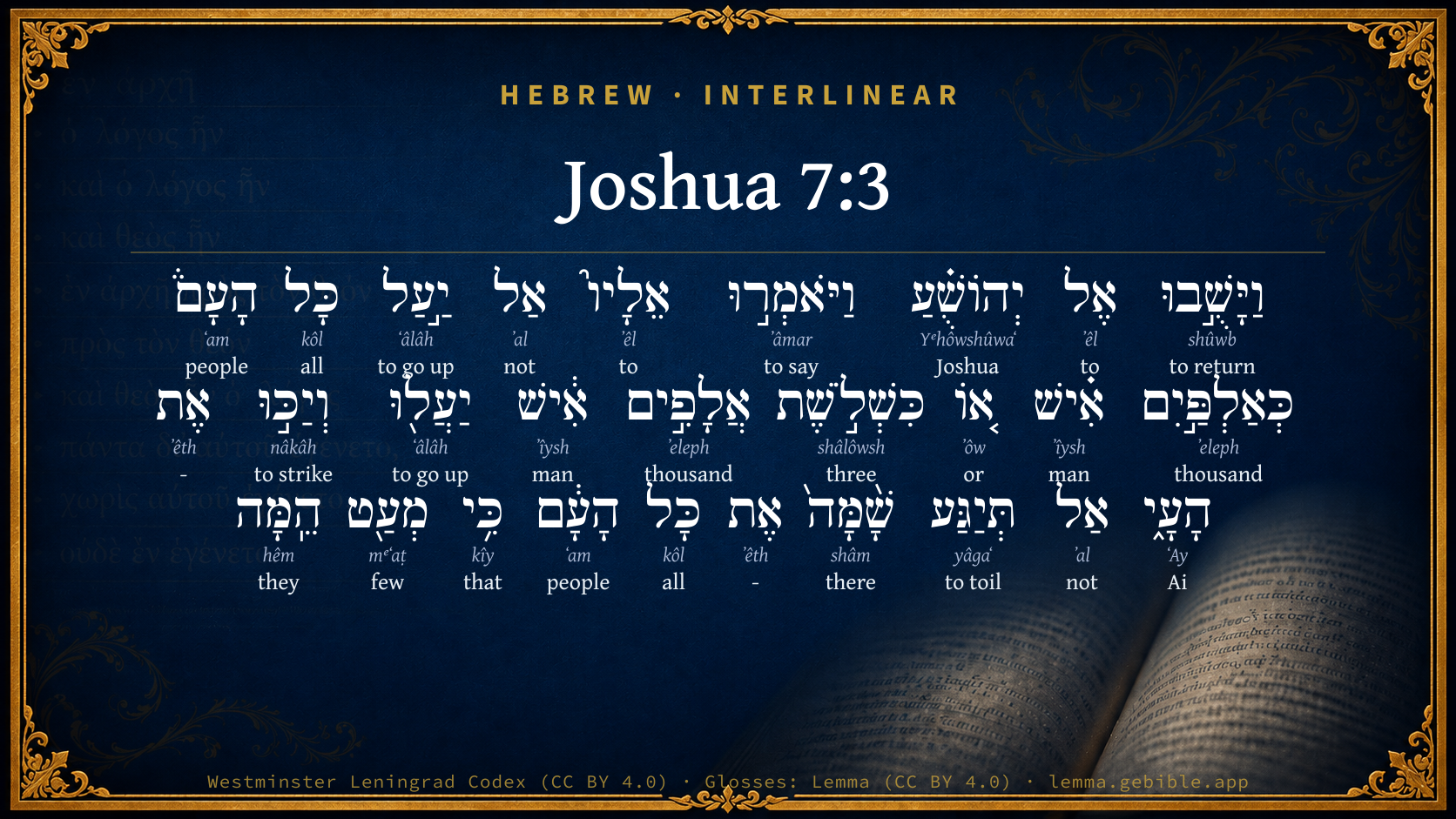
Hebrew (Westminster Leningrad Codex) Joshua 7:3 appears in the Hebrew Old Testament. The text above is from the Westminster Leningrad Codex. Each word links to its Strong’s number, a concise gloss, and parsing drawn from the Open Scriptures Hebrew Bible morphology. Click any word for its full Brown-Driver-Briggs (BDB) entry.
Download image
Cite this verse

Joshua 7:3 (World English Bible). Public Domain. Lemma interlinear Bible study tool, https://lemma.gebible.app/v/joshua/7/3.

Show BibTeX & RIS
BibTeX
RIS
English Translation
They returned to Joshua, and said to him, Don't let all the people go up; but let about two or three thousand men go up and strike Ai; don't make all the people to toil there; for they are but few.
World English Bible · Public Domain
Highlights
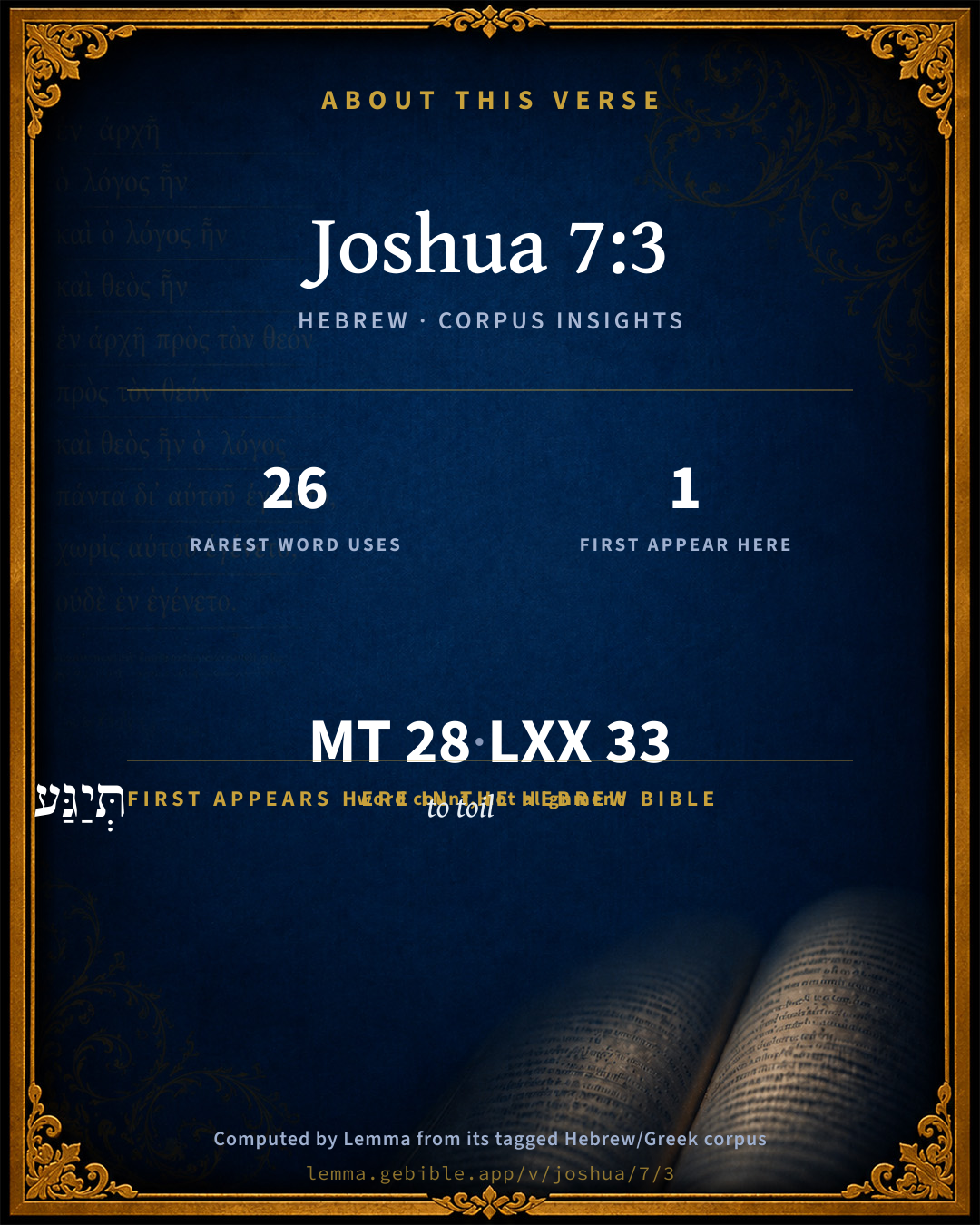
  • 1 first appearance in the Hebrew Bible
Full analysis ↓
Download a study sheet

One document with this verse’s original text, its word-by-word gloss line, the meaning frame, cross-references with their text, attributed commentary, and full source and license credits — printable, and it pastes into notes with its structure intact.

This verse Autodidact and up

Study sheet (.html) Plain text (.txt)

A passage Seminary Student

Up to 50 verses in one chapter. A passage sheet keeps up to 6 commentary sources and 12 cross-references per verse, in the order this page ranks them, and says so on the sheet whenever that leaves anything out. Ask for a single verse and you get the Autodidact verse sheet above.

Everything on this page stays free to read, with no account — the sheet is a download of what is already on screen, not access to it.

Want to remove ads? Support Godless Engineer
Compare translations 3

The same verse in 3 English versions, stacked beneath the original-language interlinear above. Click any original word for its lexicon entry.

Each is an independent rendering of the whole verse — the interlinear is not word-aligned to these translations.

Highlighted words mark where these versions differ — a whole-verse word diff, not a word-by-word alignment.

  • World English Bible Public Domain
    They returned to Joshua, and said to him, Don't let all the people go up; but let about two or three thousand men go up and strike Ai; don't make all the people to toil there; for they are but few.
  • King James Version Public Domain
    And they returned to Joshua, and said unto him, Let not all the people go up; but let about two or three thousand men go up and smite Ai; and make not all the people to labor thither; for they are but few.
  • unfoldingWord Literal Text CC BY-SA 4.0
    And they returned to Joshua and said to him, “Do not let all the people go up. About 2, 000 men or about 3, 000 men should go up and strike Ai. Do not make all the people weary there, because they are few.”

unfoldingWord Literal Text — © unfoldingWord, licensed CC BY-SA 4.0. Word-aligned USFM3 via Door43 (git.door43.org/unfoldingWord/en_ult).

Versions to compare (up to 4)

3 of 4 selected

Show all 18 translations

Every available English version of this verse, each an independent rendering of the whole verse.

  • World English Bible Public Domain
    They returned to Joshua, and said to him, Don't let all the people go up; but let about two or three thousand men go up and strike Ai; don't make all the people to toil there; for they are but few.
  • Berean Standard Bible Public Domain
    On returning to Joshua, they reported, “There is no need to send all the people; two or three thousand men are enough to go up and attack Ai. Since the people of Ai are so few, you need not wear out all our people there.”
  • Majority Standard Bible Public Domain
    On returning to Joshua, they reported, “There is no need to send all the people; two or three thousand men are enough to go up and attack Ai. Since the people of Ai are so few, you need not wear out all our people there.”
  • King James Version Public Domain
    And they returned to Joshua, and said unto him, Let not all the people go up; but let about two or three thousand men go up and smite Ai; and make not all the people to labor thither; for they are but few.
  • American Standard Version (1901) Public Domain
    And they returned to Joshua, and said unto him, Let not all the people go up; but let about two or three thousand men go up and smite Ai; make not all the people to toil thither; for they are but few.
  • Revised Version (1885) Public Domain
    And they returned to Joshua, and said unto him, Let not all the people go up; but let about two or three thousand men go up and smite Ai; make not all the people to toil thither; for they are but few.
  • Geneva Bible (1599) Public Domain
    And returned to Ioshua, and saide vnto him, Let not al the people go vp, but let as it were two or three thousand men go vp, and smite Ai, and make not al the people to labour thither, for they are fewe.
  • Douay-Rheims (1899) Public Domain
    And returning they said to him: Let not all the people go up, but let two or three thousand men go and destroy the city: why should all the people be troubled in vain against enemies that are very few?
  • Young's Literal Translation Public Domain
    and they turn back unto Joshua, and say unto him, `Let not all the people go up; let about two thousand men, or about three thousand men, go up, and they smite Ai; cause not all the people to labour thither; for they `are' few.'
  • Literal Standard Version CC BY-SA 4.0
    and they return to Joshua, and say to him, “Do not let all the people go up; let about two thousand men, or about three thousand men, go up, and they strike Ai; do not cause all the people to labor there; for they [are] few.”
  • Unlocked Literal Bible CC BY-SA 4.0
    When they returned to Joshua, they said to him, “Do not send all the people up to Ai. Send only two or three thousand men to go up and attack Ai. Do not make all the people labor in battle, for they are few in number.”
  • unfoldingWord Literal Text CC BY-SA 4.0
    And they returned to Joshua and said to him, “Do not let all the people go up. About 2, 000 men or about 3, 000 men should go up and strike Ai. Do not make all the people weary there, because they are few.”
  • Darby Bible Public Domain
    And they returned to Joshua, and said to him, Let not all the people go up; let about two or three thousand men go up and smite Ai; make not all the people to toil thither, for they are few.
  • World Messianic Bible Public Domain
    They returned to Joshua, and said to him, “Don’t let all the people go up, but let about two or three thousand men go up and strike Ai. Don’t make all the people to toil there, for there are only a few of them.”
  • Webster's Bible Public Domain
    And they returned to Joshua, and said to him, Let not all the people go up; but let about two or three thousand men go up and smite Ai; and make not all the people to labor thither; for they are but few.
  • Free Bible Version CC BY-SA 4.0
    When they returned they told Joshua, “The whole army isn't needed. Two or three thousand men is enough to go and attack Ai. Don't bother sending everyone—there's only a few of them.”
  • Bible in Basic English Public Domain
    Then they came back to Joshua and said to him, Do not send all the people up, but let about two or three thousand men go up and make an attack on Ai; there is no need for all the people to be tired with the journey there, for it is only a small town.
  • JPS Tanakh (1917) Public Domain
    And they returned to Joshua, and said unto him: 'Let not all the people go up; but let about two or three thousand men go up and smite Ai; make not all the people to toil thither; for they are but few.'

Literal Standard Version (2020), Covenant Press — licensed CC BY-SA 4.0. Text via the HelloAO Bible API (eBible.org). Unlocked Literal Bible (unfoldingWord) — licensed CC BY-SA 4.0. Text via the HelloAO Bible API (eBible.org). unfoldingWord Literal Text — © unfoldingWord, licensed CC BY-SA 4.0. Word-aligned USFM3 via Door43 (git.door43.org/unfoldingWord/en_ult). Free Bible Version, Dr. Jonathan Gallagher — licensed CC BY-SA 4.0. Text via the HelloAO Bible API (eBible.org).

Word by word

More ways to search: Search by grammar → Find every occurrence → Compare this word →

Practice this passage: Drill this verse → Learn its vocabulary →

תְּיַגַּע
yâgaʻ
H3021
“to toil”
Verb, Piel, Jussive, 2nd Person, Masculine, Singular
Part of Speech
Verb
Stem
Piel
Form
Jussive
Person
2nd Person
Gender
Masculine
Number
Singular
Full BDB Definition

Origin: a primitive root

TWOT: 842

to toil, labour, grow weary, be weary - (Qal) - to toil, labour - to grow weary, be weary - (Piel) to weary, make weary, cause to go toilsomely - (Hiphil) to make to toil, make weary, cause to be weary
  1. וַיָּשֻׁ֣בוּ shûwb H7725 “and · to return” Conjunction + Verb, Qal, Sequential Imperfect, 3rd Person, Masculine, Plural
  2. אֶל ʼêl H413 “to” Preposition
  3. יְהוֹשֻׁ֗עַ Yᵉhôwshûwaʻ H3091 “Joshua” Noun, Proper
  4. וַיֹּאמְר֣וּ ʼâmar H559 “and · to say” Conjunction + Verb, Qal, Sequential Imperfect, 3rd Person, Masculine, Plural
  5. אֵלָיו֮ ʼêl H413 “to · him” Preposition + Suffix, Personal, 3rd Person, Masculine, Singular
  6. אַל ʼal H408 “not” Particle, Negative
  7. יַ֣עַל ʻâlâh H5927 “to go up” Verb, Qal, Jussive, 3rd Person, Masculine, Singular
  8. כָּל kôl H3605 “all of” Noun, Common, Masculine, Singular, Construct
  9. הָעָם֒ ʻam H5971 “the · people” Particle, Definite Article + Noun, Common, Masculine, Singular, Absolute
  10. כְּאַלְפַּ֣יִם ʼeleph H505 “like/as · thousand” Preposition + Adjective, Cardinal number, Both, Plural, Absolute
  11. אִ֗ישׁ ʼîysh H376 “man” Noun, Common, Masculine, Singular, Absolute
  12. א֚וֹ ʼôw H176 “or” Conjunction
  13. כִּשְׁלֹ֣שֶׁת shâlôwsh H7969 “like/as · three” Preposition + Adjective, Cardinal number, Masculine, Singular, Construct
  14. אֲלָפִ֣ים ʼeleph H505 “thousand” Adjective, Cardinal number, Both, Plural, Absolute
  15. אִ֔ישׁ ʼîysh H376 “man” Noun, Common, Masculine, Singular, Absolute
  16. יַעֲל֖וּ ʻâlâh H5927 “to go up” Verb, Qal, Jussive, 3rd Person, Masculine, Plural
  17. וְיַכּ֣וּ nâkâh H5221 “and · to strike” Conjunction + Verb, Hiphil, Jussive, 3rd Person, Masculine, Plural
  18. אֶת ʼêth H853 “-” Particle, Direct Object
  19. הָעָ֑י ʻAy H5857 “the · Ai” Particle, Definite Article + Noun, Proper
  20. אַל ʼal H408 “not” Particle, Negative
  21. שָׁ֨מָּה֙ shâm H8033 “there · toward” Adverb + Suffix, Demonstrative
  22. אֶת ʼêth H853 “-” Particle, Direct Object
  23. כָּל kôl H3605 “all of” Noun, Common, Masculine, Singular, Construct
  24. הָעָ֔ם ʻam H5971 “the · people” Particle, Definite Article + Noun, Common, Masculine, Singular, Absolute
  25. כִּ֥י kîy H3588 “that” Conjunction
  26. מְעַ֖ט mᵉʻaṭ H4592 “few” Noun, Common, Masculine, Singular, Absolute
  27. הֵֽמָּה hêm H1992 “they” Pronoun, Personal, 3rd Person, Masculine, Plural

About this verse

These counts appear in no published source. They are computed here, from the morphology-tagged text and Lemma’s own curated glosses. What Lemma adds →

28
words
20
distinct lemmas
Historical
section

First appearance in Scripture

This word makes its first canonical appearance in the Hebrew Bible here:

  • תְּיַגַּע to toil H3021

Shared distinctive vocabulary

תְּיַגַּע to toil H3021 occurs in 25 verses of the Hebrew Bible. Also found in:

Grammatical profile

  • 6 verbs
  • 9 nouns
  • 3 adjectives
  • 1 pronoun
  • 2 prepositions
  • 2 conjunctions
  • 1 adverb
  • 4 particles

Verb forms

  • וַיָּשֻׁ֣בוּ Qal · Sequential Imperfect
  • וַיֹּאמְר֣וּ Qal · Sequential Imperfect
  • יַ֣עַל Qal · Jussive
  • יַעֲל֖וּ Qal · Jussive
  • וְיַכּ֣וּ Hiphil · Jussive
  • תְּיַגַּע Piel · Jussive

Repetition

Words recur within this verse — often emphatic in Hebrew:

  • יַ֣עַל to go up H5927 ×2
  • כָּל all H3605 ×2
  • הָעָם֒ people H5971 ×2
  • כְּאַלְפַּ֣יִם thousand H505 ×2
  • אִ֗ישׁ man H376 ×2
  • אֶל to H413 ×2
  • אַל not H408 ×2

Hebrew & Septuagint length

In English translation the verse runs 41 words from the Hebrew and 44 from the Septuagint (LXX English) — closely comparable.

A rough comparison of the two English renderings, which tokenize alike — not a word-level alignment.

Word counts can differ between the Hebrew and the Greek without any difference in meaning — e.g. the Hebrew direct-object marker אֵת has no separate Greek word, and Greek often adds the article ὁ.

In the original languages it is 28 Hebrew tokens and 33 Greek tokens — but the two are counted differently (Hebrew bundles its prefixes and suffixes into one token; the Greek is in lemma form), so that isn’t a like-for-like length.

Cross-references

7

Topical passages linked to Joshua 7:3 in the Treasury of Scripture Knowledge — connected by theme and wording, ordered by reader-vote popularity; previews shown in the World English Bible.

  • Hebrews 6:11–12 We desire that each one of you may show the same diligence to the fullness of hope even to the end,
  • Proverbs 13:4 The soul of the sluggard desires, and has nothing, But the desire of the diligent shall be fully satisfied.
  • Proverbs 21:25 The desire of the sluggard kills him, For his hands refuse to labor.
  • Luke 13:24 "Strive to enter in by the narrow door, for many, I tell you, will seek to enter in, and will not be able.
  • Hebrews 4:11 Let us therefore give diligence to enter into that rest, lest anyone fall after the same example of disobedience.
  • 2 Peter 1:5 Yes, and for this very cause adding on your part all diligence, in your faith supply moral excellence; and in moral excellence, knowledge;
  • 2 Peter 1:10 Therefore, brothers, be more diligent to make your calling and election sure. For if you do these things, you will never stumble.

Cross-references courtesy of OpenBible.info (CC BY 4.0).

Hebrew and Greek witnesses Masoretic Hebrew ↔ Greek Septuagint

The same verse in the two great witnesses to the Old Testament, shown verse-for-verse.

These are two independent witnesses, not word-aligned to each other, and the Septuagint is shown in lemma (dictionary) form.

Hebrew Joshua 7:3 Masoretic · Westminster Leningrad Codex

וַיָּשֻׁ֣בוּ אֶל יְהוֹשֻׁ֗עַ וַיֹּאמְר֣וּ אֵלָיו֮ אַל יַ֣עַל כָּל הָעָם֒ כְּאַלְפַּ֣יִם אִ֗ישׁ א֚וֹ כִּשְׁלֹ֣שֶׁת אֲלָפִ֣ים אִ֔ישׁ יַעֲל֖וּ וְיַכּ֣וּ אֶת הָעָ֑י אַל תְּיַגַּע שָׁ֨מָּה֙ אֶת כָּל הָעָ֔ם כִּ֥י מְעַ֖ט הֵֽמָּה

They returned to Joshua, and said to him, Don't let all the people go up; but let about two or three thousand men go up and strike Ai; don't make all the people to toil there; for they are but few.

World English Bible · Public Domain

Greek LXX Joshua 7:3 Septuagint · lemma form

καί ἀναστρέφω πρός ἰησοῦς καί εἶπον πρός αὐτός μή ἀναβαίνω πᾶς ὁ λαός ἀλλά ὡς δισχίλιοι ἤ τρισχίλιοι ἀνήρ ἀναβαίνω καί ἐκπολιορκέω ὁ πόλις μή ἀναἄγω ἐκεῖ ὁ λαός πᾶς ὀλίγος γάρ εἰμί

And they returned to Joshua, and said to him, Let not all the people go up, but let about two or three thousand men go up and take the city by siege: carry not up there the whole people, for the enemy are few.

LXX2012 (modern English Septuagint) · Public Domain

Hebrew: Westminster Leningrad Codex (CC BY 4.0). Greek: Septuagint (public domain); English from LXX2012 (modern English Septuagint) (Public Domain). How the Septuagint differs from the Hebrew →

Targum (Aramaic paraphrase)

1

The Targum is the ancient Jewish Aramaic paraphrase of the Hebrew Scriptures — an interpretive translation, not the Hebrew text itself. Onkelos (literal) and Pseudo-Jonathan (expansive) render the Torah, and Jonathan the Prophets. Coverage is partial: where no permissively-licensed English translation exists for a verse, only the Aramaic is shown. This is verse-level text, not a word-by-word alignment to the Hebrew.

  1. Targum Jonathan Prophets (Joshua–Malachi)
    וְתָבוּ לְוַת יְהוֹשֻׁעַ וַאֲמַרוּ לֵיהּ לָא יִסַק כָּל עַמָא כִּתְרֵין אַלְפִין גַבְרָא אוֹ כִּתְלָתָא אַלְפִין גַבְרָא יִסְקוּן וְיִמְחוּן יַת עָי לָא תַרְגִישׁ לְתַמָן יַת כָּל עַמָא אֲרֵי זְעִירִין אִינוּן:

    (no public-domain English translation for this verse)

    Targum Jonathan — Aramaic: “Mikraot Gedolot” (public domain). English: “Sefaria Community Translation” (CC0 1.0 (public-domain dedication)); “London "Chaldee Paraphrase," 1871” (public domain). Text via Sefaria.

Commentary

Notes on Joshua 7:3 from classic Christian and Jewish commentators (each source and its license shown beneath its notes). The classic Christian expositions comment on the surrounding passage and are grouped to its opening verse, so a note may address several verses; the Jewish commentaries on the Tanakh (Rashi and others) are per-verse, so they appear only where the commentator wrote on this verse.

Lemma curates 59 commentaries, every one of them public domain or Creative Commons licensed, each selected and text-cleaned for this edition rather than reprinted as found. About our sources →

Trapp's Complete Commentary

John Trapp

Jos 7:3 And they returned to Joshua, and said unto him, Let not all the people go up; but let about two or three thousand men go up and smite Ai; [and] make not all the people to labour thither; for they [are but] few.

Ver. 3. Let not all the people go up.] But better they had, as it happened, in some respects. God’s holy hand was in it, and his holy will must be done and suffered.

John Trapp, A Commentary or Exposition upon All the Books of the Old and New Testament (1647–1656) — public domain. Text from a community e-Sword module.

Tyndale Open Study Notes

Tyndale Open Resources

7:3-4 God’s provision of victory at Jericho apparently bred complacency and overconfidence; Joshua did not even consult with God before sending a small contingent of troops to Ai.

Tyndale Open Study Notes — © Tyndale Open Resources, licensed CC BY-SA 4.0. Text via the HelloAO Bible API.

Jamieson, Fausset & Brown

Robert Jamieson, A. R. Fausset & David Brown

Let not all the people go up, . . . for they are but few--As the population of Ai amounted to twelve thousand (Jos 8:25), it was a considerable town; though in the hasty and distant reconnoitre made by the spies, it probably appeared small in comparison to Jericho; and this may have been the reason for their proposing so small a detachment to capture it.

Jamieson, Fausset & Brown — Commentary Critical and Explanatory on the Whole Bible (1871) — public domain (CC PDM 1.0). Text via the HelloAO Bible API.

Ellicott's Commentary for English Readers

(3) Make not all the people to labour thither.—In these words we see, by a sort of side-glance, the (not unnatural) comment of Israel on the seven days’ march round Jericho. They thought it useless labour, and were unable to appreciate the lesson which it taught. Again our attention is directed to the peculiar character of the warfare. It was not that kind of war which men would naturally have been disposed to wage. But the narrative is consistent throughout. (See Note on Jos_2:1.)

A Bible Commentary for English Readers, edited by Charles John Ellicott (1878–1897) — public domain. Text from a community e-Sword module.

John Gill's Exposition

And they returned unto Joshua, and said unto him, let not all the people go up,.... After they had reconnoitred the place, they came back to their general, and gave it as their opinion, that there was no need for the whole army to go up against the city:

but let about two or three thousand men go up and smite Ai; such a number they judged were sufficient to take it:

and make not all the people to labour thither; carrying their tents, bearing their armour, and going up hill:

for they are but few; the inhabitants of Ai, men and women making but twelve thousand; Jos 8:25.

John Gill's Exposition of the Whole Bible (1746–1763) — public domain (CC PDM 1.0). Text via the HelloAO Bible API.

Albert Barnes' Notes on the Bible

The total population of Ai was about twelve thousand Jos 8:25. It could therefore hardly muster three thousand warriors.

Albert Barnes' Notes on the Bible (1834–1885) — public domain. Text from a community e-Sword/MySword module.

Haydock's Catholic Bible Commentary

Few. It appears, however, that the city contained 12,000 fighting men; so that these spies must have formed a false notion of its strength, chap. viii. 25.

George Leo Haydock (1774–1849), Haydock's Catholic Family Bible and Commentary, 1859 edition — public domain. Excludes Psalms (Douay-Rheims chapter numbering differs from Protestant) and Deuterocanonical books (Catholic canon only).

Matthew Poole's English Annotations

This was done by the wise contrivance of Divine Providence, that their sin might be punished, and they awakened and reformed, with as little hazard, and mischief, and reproach as might be; for if the defeat of these caused so great a consternation in Joshua, it is easy to guess what dread, and confusion, and despair it would have caused in the people, if a great host had been defeated.

Matthew Poole's English Annotations on the Holy Bible (1683–1685) — public domain. Text from a community e-Sword/MySword module.

Whedon's Commentary on the Bible

Daniel D. Whedon

3. Let not all the people go up — The spies set a very low estimate upon the military strength of the city. Disasters often happen to armies from this cause.

For they are but few — That is, comparatively. But the character of the few, and their excellent position for defence, were left out of the account. Their numbers were probably underrated also, for after the conquest of the city the slain numbered twelve thousand. Jos_8:25.

Daniel D. Whedon (gen. ed.), Commentary on the Old and New Testaments (1874–1909) — public domain. Text from a community e-Sword module.

The Pulpit Commentary

Make not all the people to labour thither; or, weary not the people with the journey thither. "Good success lifts up the heart with too much confidence" (Bp. Hall).

The Pulpit Commentary (1880–1919), ed. H.D.M. Spence-Jones & Joseph S. Exell — public domain. Text from a community e-Sword module.

John Wesley's Explanatory Notes

Go up - Which was done by the wise contrivance of Divine providence, that their sin might be punished, and they awaked and reformed with as little mischief and reproach, as might be: for if the defeat of these caused so great a consternation in Joshua, it is easy to guess what dread it would have caused in the people if a host had been defeated.

John Wesley, Explanatory Notes Upon the Whole Bible (1754–1765) — public domain. Text via the GEBible commentary corpus.

Lesson kit

Teaching starters — assembled from the data on this page, not authored interpretation. Every prompt links to the verse data it draws on. Edit before teaching.

Joshua, in the Historical, opens this verse with 28 words (20 distinct Hebrew lemmas). Its most distinctive word is yâgaʻ (“to toil”). A historical commentator’s framing appears above. Read the whole chapter for the surrounding context.

Discussion questions

  1. What does “to toil” (yâgaʻ) contribute to the verse as a whole?
  2. The word “to toil” first appears here in Scripture. What is being introduced at this debut?
  3. Joshua 24:13 shares the word «to toil» with this verse. How do the two illuminate each other?
  4. “to go up” occurs 2× in this one verse. What is the effect of the repetition?
  5. The translations on this page render this verse differently — a whole-verse word diff, not a word-by-word alignment. What might account for the different wordings?
  6. The verb «וַיָּשֻׁ֣בוּ» is Qal Sequential Imperfect. How does its form color the action?
  7. Reading how Trapp's Complete Commentary and Tyndale Open Study Notes read this verse, where do the two commentators agree and where do they part?

Things to notice

Reading settings

Reading text

Shown beneath each verse's original-language words.

Old Testament
Old Testament edition

Read the OT as the Masoretic Hebrew (MT) or the Greek Septuagint (LXX).

English shown for the Greek Septuagint (in the Hebrew ↔ Greek comparison).

Comparing translations? Open the Compare panel on any verse page to stack up to four side by side.