Numbers 14:44

Hebrew (Westminster Leningrad Codex) Numbers 14:44 appears in the Hebrew Old Testament. The text above is from the Westminster Leningrad Codex. Each word links to its Strong’s number, a concise gloss, and parsing drawn from the Open Scriptures Hebrew Bible morphology. Click any word for its full Brown-Driver-Briggs (BDB) entry.
Download image
Cite this verse

Numbers 14:44 (World English Bible). Public Domain. Lemma interlinear Bible study tool, https://lemma.gebible.app/v/numbers/14/44.

Show BibTeX & RIS
BibTeX
RIS
English Translation
But they presumed to go up to the top of the mountain: nevertheless the ark of the covenant of Yahweh, and Moses, didn't depart out of the camp.
World English Bible · Public Domain
Highlights
  • 1 first appearance in the Hebrew Bible
Full analysis ↓
Download a study sheet

One document with this verse’s original text, its word-by-word gloss line, the meaning frame, cross-references with their text, attributed commentary, and full source and license credits — printable, and it pastes into notes with its structure intact.

This verse Autodidact and up

Study sheet (.html) Plain text (.txt)

A passage Seminary Student

Up to 50 verses in one chapter. A passage sheet keeps up to 6 commentary sources and 12 cross-references per verse, in the order this page ranks them, and says so on the sheet whenever that leaves anything out. Ask for a single verse and you get the Autodidact verse sheet above.

Everything on this page stays free to read, with no account — the sheet is a download of what is already on screen, not access to it.

Want to remove ads? Support Godless Engineer
Compare translations 3

The same verse in 3 English versions, stacked beneath the original-language interlinear above. Click any original word for its lexicon entry.

Each is an independent rendering of the whole verse — the interlinear is not word-aligned to these translations.

Highlighted words mark where these versions differ — a whole-verse word diff, not a word-by-word alignment.

  • World English Bible Public Domain
    But they presumed to go up to the top of the mountain: nevertheless the ark of the covenant of Yahweh, and Moses, didn't depart out of the camp.
  • King James Version Public Domain
    But they presumed to go up unto the hill top: nevertheless the ark of the covenant of the LORD, and Moses, departed not out of the camp.
  • unfoldingWord Literal Text CC BY-SA 4.0
    And they presumed to go up to the head of the hill country, but the box of the covenant of Yahweh and Moses did not depart from the midst of the camp.

unfoldingWord Literal Text — © unfoldingWord, licensed CC BY-SA 4.0. Word-aligned USFM3 via Door43 (git.door43.org/unfoldingWord/en_ult).

Versions to compare (up to 4)

3 of 4 selected

Show all 18 translations

Every available English version of this verse, each an independent rendering of the whole verse.

  • World English Bible Public Domain
    But they presumed to go up to the top of the mountain: nevertheless the ark of the covenant of Yahweh, and Moses, didn't depart out of the camp.
  • Berean Standard Bible Public Domain
    But they dared to go up to the ridge of the hill country, though neither Moses nor the ark of the covenant of the LORD moved from the camp.
  • Majority Standard Bible Public Domain
    But they dared to go up to the ridge of the hill country, though neither Moses nor the ark of the covenant of the LORD moved from the camp.
  • King James Version Public Domain
    But they presumed to go up unto the hill top: nevertheless the ark of the covenant of the LORD, and Moses, departed not out of the camp.
  • American Standard Version (1901) Public Domain
    But they presumed to go up to the top of the mountain: nevertheless the ark of the covenant of Jehovah, and Moses, departed not out of the camp.
  • Revised Version (1885) Public Domain
    But they presumed to go up to the top of the mountain: nevertheless the ark of the covenant of the LORD, and Moses, departed not out of the camp.
  • Geneva Bible (1599) Public Domain
    Yet they presumed obstinately to goe vp to the top of the mountaine: but the Arke of the couenant of the Lord, and Moses departed not out of the campe.
  • Douay-Rheims (1899) Public Domain
    But they being blinded went up to the top of the mountain. But the ark of the testament of the Lord and Moses departed not from the camp.
  • Young's Literal Translation Public Domain
    And they presume to go up unto the top of the mountain, and the ark of the covenant of Jehovah and Moses have not departed out of the midst of the camp.
  • Literal Standard Version CC BY-SA 4.0
    And they presume to go up to the top of the mountain, but the Ark of the Covenant of YHWH, and Moses, have not departed out of the midst of the camp.
  • Unlocked Literal Bible CC BY-SA 4.0
    But they presumed to go up into the hill country; however, neither Moses nor the ark of the covenant of Yahweh left the camp.
  • unfoldingWord Literal Text CC BY-SA 4.0
    And they presumed to go up to the head of the hill country, but the box of the covenant of Yahweh and Moses did not depart from the midst of the camp.
  • Darby Bible Public Domain
    Yet they presumed to go up to the hill-top; but the ark of the covenant of Jehovah, and Moses, did not depart from the midst of the camp.
  • World Messianic Bible Public Domain
    But they presumed to go up to the top of the mountain. Nevertheless, the ark of the LORD’s covenant and Moses didn’t depart out of the camp.
  • Webster's Bible Public Domain
    But they presumed to go up to the hill-top: nevertheless the ark of the covenant of the LORD, and Moses, departed not out of the camp.
  • Free Bible Version CC BY-SA 4.0
    But they were arrogant and went up into the hill country, even though Moses and the Ark of the Lord's Agreement didn't move from the camp.
  • Bible in Basic English Public Domain
    But they gave no attention to his words and went to the top of the mountain, though Moses and the ark of the Lord's agreement did not go out of the tent-circle.
  • JPS Tanakh (1917) Public Domain
    But they presumed to go up to the top of the mountain; nevertheless the ark of the covenant of the LORD, and Moses, departed not out of the camp.

Literal Standard Version (2020), Covenant Press — licensed CC BY-SA 4.0. Text via the HelloAO Bible API (eBible.org). Unlocked Literal Bible (unfoldingWord) — licensed CC BY-SA 4.0. Text via the HelloAO Bible API (eBible.org). unfoldingWord Literal Text — © unfoldingWord, licensed CC BY-SA 4.0. Word-aligned USFM3 via Door43 (git.door43.org/unfoldingWord/en_ult). Free Bible Version, Dr. Jonathan Gallagher — licensed CC BY-SA 4.0. Text via the HelloAO Bible API (eBible.org).

Word by word

More ways to search: Search by grammar → Find every occurrence → Compare this word →

Practice this passage: Drill this verse → Learn its vocabulary →

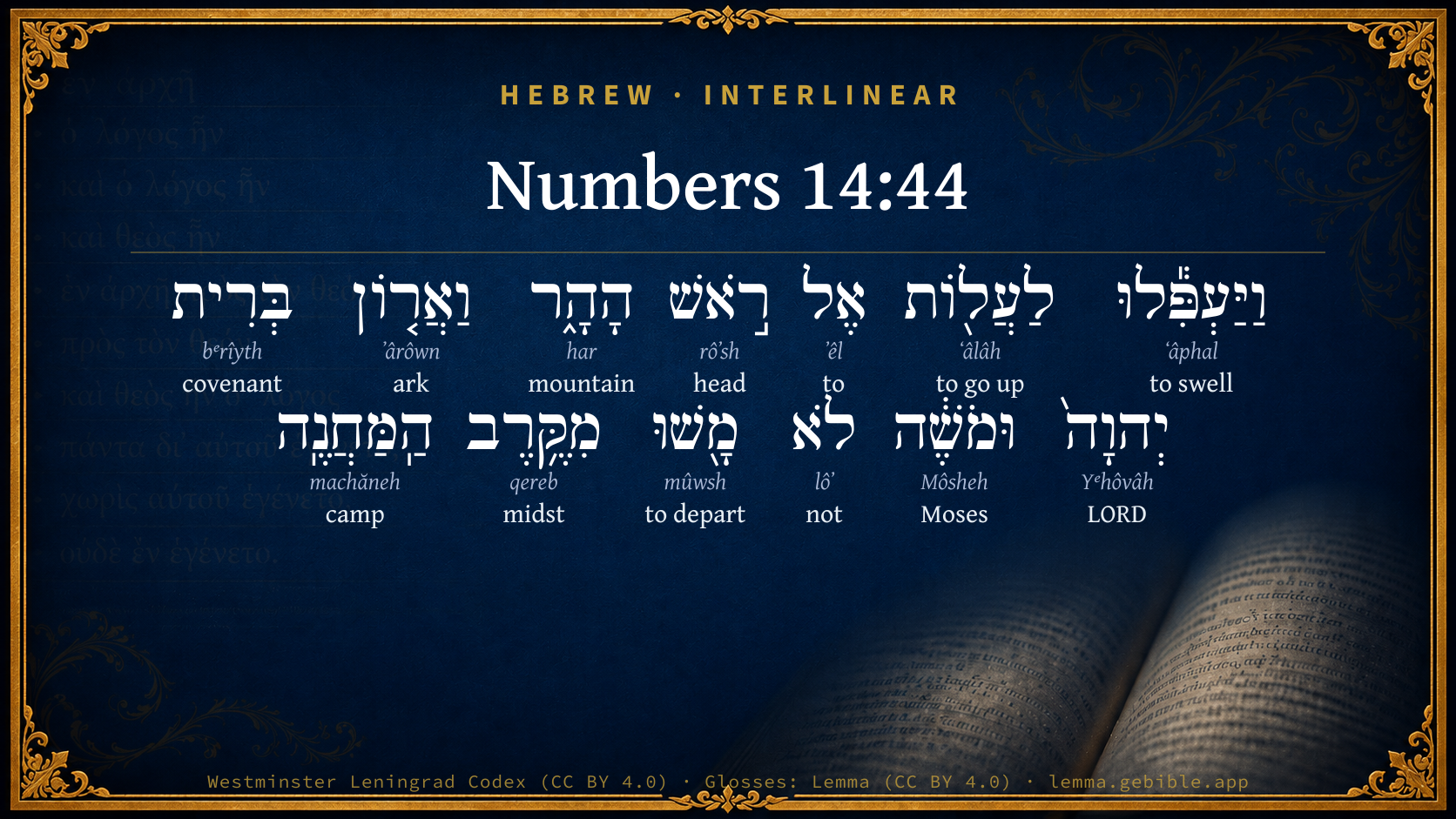
וַיַּעְפִּ֕לוּ
ʻâphal
H6075
“and · to swell”
Conjunction + Verb, Hiphil, Sequential Imperfect, 3rd Person, Masculine, Plural
Part of Speech
Conjunction + Verb
Stem
Hiphil
Form
Sequential Imperfect
Person
3rd Person
Gender
Masculine
Number
Plural
Full BDB Definition

Origin: a primitive root

TWOT: 1662 , 1663

to lift up, swell, be lifted up - (Pual) to swell - (Hiphil) to be bold, be swelled - to presume, be heedless - (Hiphil) to be heedless, show heedlessness
  1. לַעֲל֖וֹת ʻâlâh H5927 “to go up” Preposition + Verb, Qal, Infinitive Construct
  2. אֶל ʼêl H413 “to” Preposition
  3. רֹ֣אשׁ rôʼsh H7218 “head of” Noun, Common, Masculine, Singular, Construct
  4. הָהָ֑ר har H2022 “the · mountain” Particle, Definite Article + Noun, Common, Masculine, Singular, Absolute
  5. וַאֲר֤וֹן ʼârôwn H727 “and · ark of” Conjunction + Noun, Common, Both, Singular, Construct
  6. בְּרִית bᵉrîyth H1285 “covenant of” Noun, Common, Feminine, Singular, Construct
  7. יְהוָה֙ Yᵉhôvâh H3068 “LORD” Noun, Proper
  8. וּמֹשֶׁ֔ה Môsheh H4872 “and · Moses” Conjunction + Noun, Proper
  9. לֹא lôʼ H3808 “not” Particle, Negative
  10. מָ֖שׁוּ mûwsh H4185 “to depart” Verb, Qal, Perfect, 3rd Person, Common, Plural
  11. מִקֶּ֥רֶב qereb H7130 “from · midst of” Preposition + Noun, Common, Masculine, Singular, Construct
  12. הַֽמַּחֲנֶֽה machăneh H4264 “the · camp” Particle, Definite Article + Noun, Common, Both, Singular, Absolute

About this verse

These counts appear in no published source. They are computed here, from the morphology-tagged text and Lemma’s own curated glosses. What Lemma adds →

13
words
13
distinct lemmas
Pentateuch
section

Notable vocabulary

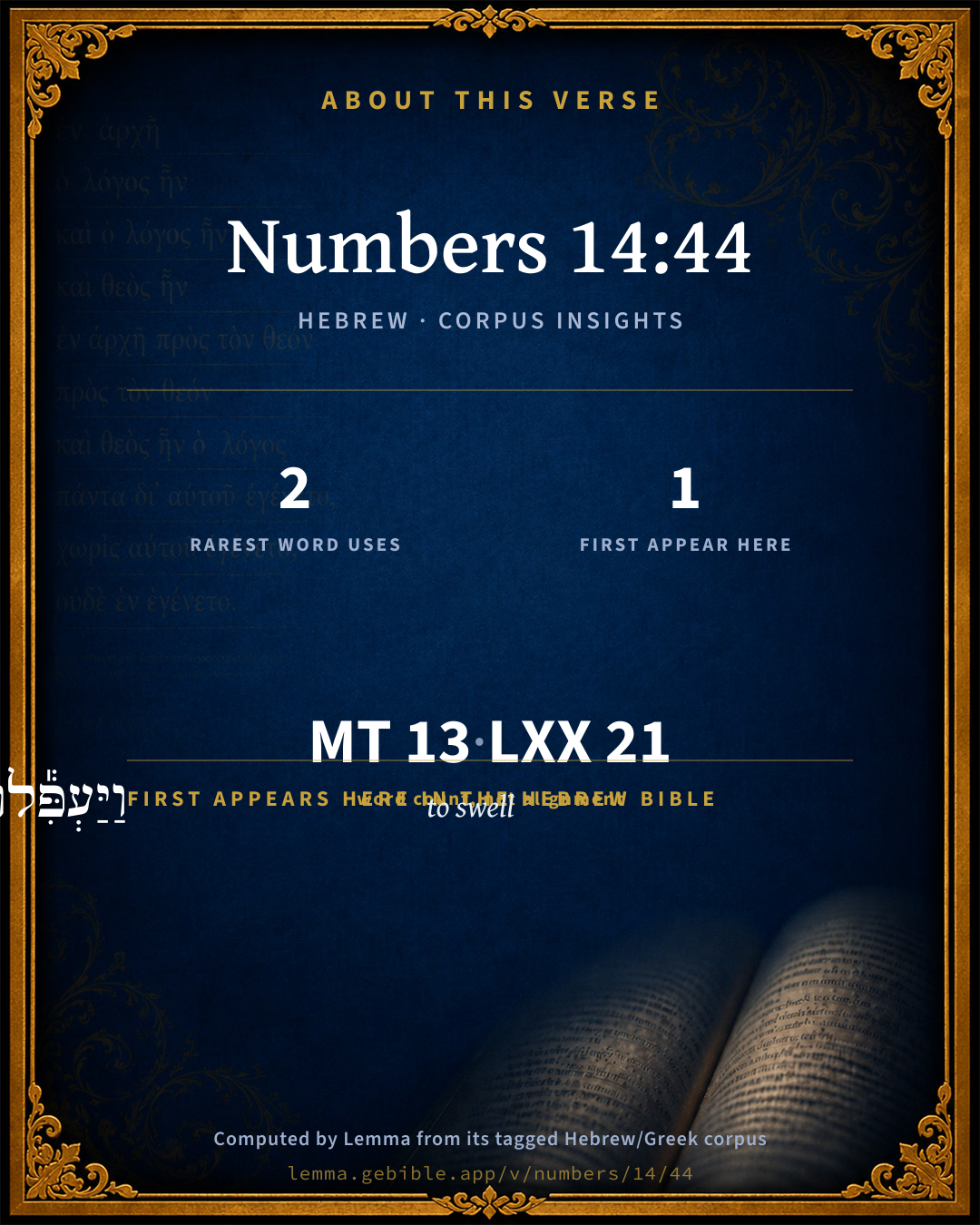
The rarest word here is וַיַּעְפִּ֕לוּ to swell H6075 — appearing just 2 times in the whole Hebrew Bible.

First appearance in Scripture

This word makes its first canonical appearance in the Hebrew Bible here:

  • וַיַּעְפִּ֕לוּ to swell H6075

Shared distinctive vocabulary

וַיַּעְפִּ֕לוּ to swell H6075 occurs in 2 verses of the Hebrew Bible. Also found in:

Grammatical profile

  • 3 verbs
  • 8 nouns
  • 1 preposition
  • 1 particle

Verb forms

  • וַיַּעְפִּ֕לוּ Hiphil · Sequential Imperfect
  • לַעֲל֖וֹת Qal · Infinitive Construct
  • מָ֖שׁוּ Qal · Perfect

Hebrew & Septuagint length

In English translation the verse runs 28 words from the Hebrew and 31 from the Septuagint (LXX English) — closely comparable.

A rough comparison of the two English renderings, which tokenize alike — not a word-level alignment.

Word counts can differ between the Hebrew and the Greek without any difference in meaning — e.g. the Hebrew direct-object marker אֵת has no separate Greek word, and Greek often adds the article ὁ.

In the original languages it is 13 Hebrew tokens and 21 Greek tokens — but the two are counted differently (Hebrew bundles its prefixes and suffixes into one token; the Greek is in lemma form), so that isn’t a like-for-like length.

Cross-references

5

Topical passages linked to Numbers 14:44 in the Treasury of Scripture Knowledge — connected by theme and wording, ordered by reader-vote popularity; previews shown in the World English Bible.

  • Deuteronomy 1:43 So I spoke to you, and you didn't listen; but you rebelled against the commandment of Yahweh, and were presumptuous, and went up into the hill-country.
  • 1 Samuel 4:3–11 When the people were come into the camp, the elders of Israel said, Why has Yahweh struck us today before the Philistines? Let us get the ark of the covenant of Yahweh out of Shiloh to us, that it may come among us, and save us out of the hand of our enemies.
  • Numbers 10:33 They set forward from the Mount of Yahweh three days' journey; and the ark of the covenant of Yahweh went before them three days' journey, to seek out a resting-place for them.
  • Numbers 15:30 But the soul who does anything with a high hand, whether he is home-born or a foreigner, the same blasphemes Yahweh; and that soul shall be cut off from among his people.
  • Numbers 31:6 Moses sent them, one thousand of every tribe, to the war, them and Phinehas the son of Eleazar the priest, to the war, with the vessels of the sanctuary and the trumpets for the alarm in his hand.

Cross-references courtesy of OpenBible.info (CC BY 4.0).

Hebrew and Greek witnesses Masoretic Hebrew ↔ Greek Septuagint

The same verse in the two great witnesses to the Old Testament, shown verse-for-verse.

These are two independent witnesses, not word-aligned to each other, and the Septuagint is shown in lemma (dictionary) form.

Hebrew Numbers 14:44 Masoretic · Westminster Leningrad Codex

וַיַּעְפִּ֕לוּ לַעֲל֖וֹת אֶל רֹ֣אשׁ הָהָ֑ר וַאֲר֤וֹן בְּרִית יְהוָה֙ וּמֹשֶׁ֔ה לֹא מָ֖שׁוּ מִקֶּ֥רֶב הַֽמַּחֲנֶֽה

But they presumed to go up to the top of the mountain: nevertheless the ark of the covenant of Yahweh, and Moses, didn't depart out of the camp.

World English Bible · Public Domain

Greek LXX Numbers 14:44 Septuagint · lemma form

καί διαβιάζομαι ἀναβαίνω ἐπί ὁ κορυφή ὁ ὄρος ὁ δέ κιβωτός ὁ διαθήκη κύριος καί μωυσῆς οὐ κινέω ἐκ ὁ παρεμβολή

And having forced their passage, they went up to the top of the mountain; but the ark of the covenant of the Lord and Moses stirred not out of the camp.

LXX2012 (modern English Septuagint) · Public Domain

On this verse, Haydock's Catholic Bible Commentary discusses the Septuagint’s reading. Read the note in Commentary ↓

Hebrew: Westminster Leningrad Codex (CC BY 4.0). Greek: Septuagint (public domain); English from LXX2012 (modern English Septuagint) (Public Domain). How the Septuagint differs from the Hebrew →

Targum (Aramaic paraphrase)

2

The Targum is the ancient Jewish Aramaic paraphrase of the Hebrew Scriptures — an interpretive translation, not the Hebrew text itself. Onkelos (literal) and Pseudo-Jonathan (expansive) render the Torah, and Jonathan the Prophets. Coverage is partial: where no permissively-licensed English translation exists for a verse, only the Aramaic is shown. This is verse-level text, not a word-by-word alignment to the Hebrew.

  1. Targum Onkelos Torah (Genesis–Deuteronomy)
    וְאַרְשָׁעוּ לְמִסַק לְרֵישׁ טוּרָא וַאֲרוֹן קְיָמָא דַיְיָ וּמשֶׁה לָא עֲדוֹ מִגוֹ מַשְׁרִיתָא

    (no public-domain English translation for this verse)

    Targum Onkelos — Aramaic: “Onkelos Genesis” (public domain); “Onkelos Exodus” (public domain); “Onkelos Leviticus” (public domain); “Onkelos Numbers” (public domain); “Onkelos Deuteronomy” (public domain). English: “Sefaria Community Translation” (CC0 1.0 (public-domain dedication)); “J.W. Etheridge. The Targums of Onkelos and Jonathan Ben Uzziel on the Pentateuch. London: Longmans, Green, 1862” (public domain). Text via Sefaria.

  2. Targum Pseudo-Jonathan Torah (Genesis–Deuteronomy)
    וְאִזְדְרָזוּ בַּחֲשֵׁיכָא קֳדָם קְרִיצְתָּא לְמֵיסוֹק לְרֵישׁ טוּרָא בְּרַם אֲרוֹנָא דְבֵיהּ קְיָימָא דַיְיָ וּמשֶׁה לָא זָזוּ מִגוֹ מַשְׁרִיתָא

    But they armed themselves in the dark before the morning to go up to the height of the mountain: but the ark, in which was the covenant of the Lord, and Mosheh, stirred not from the midst of the camp.

    Targum Pseudo-Jonathan — Aramaic: “Targum Jonathan on Genesis” (public domain); “Targum Jonathan on Exodus” (public domain); “Targum Jonathan on Leviticus” (public domain); “Targum Jonathan on Numbers” (public domain); “Targum Jonathan on Deuteronomy” (public domain). English: “The Targum of Jonathan ben Uzziel, trans. J. W. Etheridge, London, 1862” (public domain). Text via Sefaria.

Commentary

Notes on Numbers 14:44 from classic Christian and Jewish commentators (each source and its license shown beneath its notes). The classic Christian expositions comment on the surrounding passage and are grouped to its opening verse, so a note may address several verses; the Jewish commentaries on the Tanakh (Rashi and others) are per-verse, so they appear only where the commentator wrote on this verse.

Lemma curates 59 commentaries, every one of them public domain or Creative Commons licensed, each selected and text-cleaned for this edition rather than reprinted as found. About our sources →

Tyndale Open Study Notes

Tyndale Open Resources

14:44 The Ark symbolized God’s presence and blessings (cp. 1 Sam 4:1-11).

Tyndale Open Study Notes — © Tyndale Open Resources, licensed CC BY-SA 4.0. Text via the HelloAO Bible API.

Geneva Bible (1599)

Geneva Bible translators

They could not be stayed by any means.

Geneva Bible (1599) marginal notes — public domain. Text via Bolls.life.

Ellicott's Commentary for English Readers

(44) They presumed to go up.—i.e., they made a bold attempt to ascend the mountain. Their enemies appear to have encountered and discomfited them before they had actually gained the summit.

A Bible Commentary for English Readers, edited by Charles John Ellicott (1878–1897) — public domain. Text from a community e-Sword module.

The Cambridge Bible for Schools and Colleges

gen. ed. J. J. S. Perowne

44. the ark of the covenant of Jehovah] The words ‘of the covenant’ are probably a gloss by a Dt. writer. There is no evidence in J or E that the tablets of the Covenant laws were placed in the ark. See on Num_10:33 b.

and Moses] Moses was the guardian of the ark.

out of the midst of the camp] In E the sacred tent, in which the ark was presumably housed, stood outside the camp (cf. Num_12:4, Exo_33:7-11). The position, here implied by J , afterwards formed an important factor in P’s description of the Tabernacle (Num_1:50; Num_1:53).

The Cambridge Bible for Schools and Colleges (gen. ed. J. J. S. Perowne; Cambridge University Press, 1878–1918) — public domain. Text from a community e-Sword module.

John Gill's Exposition

Then the Amalekites came down,.... The hill; met the Israelites as they ascended: and the Canaanites which dwelt in that hill; the same with the Amorites, one of the seven nations of Canaan, Num 13:29,

and smote them; with the sword, having the advantage of them in coming down the hill upon them:

and discomfited them even unto Hormah; the name of a place, so called from what happened there; as Jarchi says; either from this destruction of the Israelites at this time by these their enemies, or from the destruction of the Canaanites by Israel, Num 21:4; and so here has its name by anticipation; or it may be from both these events, and seems to be confirmed by a third of the like kind, having been in former times called Zephath, Jdg 1:17; see Jos 15:30; though some take it to be an appellative here, and not the proper name of a place, and render it even unto destruction, as the Targum of Jonathan, denoting the very great destruction and havoc that were made among them: how many were destroyed is not certain; the judgment threatened them of God soon began to take place, that their carcasses should fall in that wilderness.

Next: Numbers Chapter 15

John Gill's Exposition of the Whole Bible (1746–1763) — public domain (CC PDM 1.0). Text via the HelloAO Bible API.

Haydock's Catholic Bible Commentary

Blinded, with presumption, as the Hebrew yahpilu, insinuates. "Their heart was puffed up with pride, and they ascended," Deuteronomy i. 43. (Calmet) --- The enemy was ready to receive them, and easily routed this rabble, abandoned by God, and by Moses, Aaron and his sons, Josue, and other men of virtue and sense. They who before lay lurking in the valleys, (ver. 25,) assume fresh courage, when they become the executioners of God’s vengeance, and come pouring down from their mountains, with irresistible fury; nor do they stop till they had made a dreadful carnage of the Hebrews. The same place was again deluged with blood, (chap. xxi. 3,) and was called Horma, or "the Curse." The Samaritan and Septuagint add, and they returned into the camp, Thus, by their own woeful experience, they began to feel that God would keep his word in punishing the common people, as well as the leaders, ver. 37. (Haydock)

George Leo Haydock (1774–1849), Haydock's Catholic Family Bible and Commentary, 1859 edition — public domain. Excludes Psalms (Douay-Rheims chapter numbering differs from Protestant) and Deuterocanonical books (Catholic canon only).

Matthew Poole's English Annotations

They presumed; guilty both of rashness and rebellion; thus running from one extreme to another.

Matthew Poole's English Annotations on the Holy Bible (1683–1685) — public domain. Text from a community e-Sword/MySword module.

Whedon's Commentary on the Bible

Daniel D. Whedon

44. But they presumed — Presumption and despair are two opposite phases of unbelief. Within less than one day the Israelites despaired of conquering Canaan with the assured alliance of Jehovah, and then presumed to enter upon its conquest though he had announced the withdrawal of his aid. The natural man, when exhorted to religious effort, first avers that he can do nothing, even with God’s aid, and soon asserts that by his own good works he can save himself without God. The ark was both the symbol and seat of Jehovah in the camp of Israel. In subsequent history, in the estimation of the Jews, the life of the nation depended on the presence of the ark. Joshua vi; 1Sa_4:4-18, note.

This confidence in part grew out of their present bitter experience of defeat when facing their foes with no pillar of cloud over their heads.

And Moses, departed not — The moral sublimity of this scene is worthy the brush of the historical painter: Moses, not like Achilles sulking in his tent while the Greeks went out to battle, but calmly standing alone with God, while his people madly rush to danger and to death.

Daniel D. Whedon (gen. ed.), Commentary on the Old and New Testaments (1874–1909) — public domain. Text from a community e-Sword module.

The Pulpit Commentary

They presumed to go up. This gives the sense very well: they were deaf to all persuasion or command to stay. Septuagint, diabiasamenoi anebhsan . Thus they added to an evil distrust in the power of God an almost more evil trust in their own power. It does not seem correct to say that "unbelief" was the real cause of both errors unbelief, firstly in God"s promises, and secondly in his threats. It was rather one of those many cases in which men seek to atone for a fault on one side by rushing into as great a fault on the other side. They spoke brave words about the "place which the Lord hath promised," as though it were indeed obedience and trust which spurred them on, instead of presumption and selfishness. The ark of the covenant of the Lord, and Moses, departed not out of the comp. The plainest possible token that the Lord was not with them. With Moses remained no doubt all the Levites, and the silver trumpets, and Joshua, and perhaps the bulk of the people.

The Pulpit Commentary (1880–1919), ed. H.D.M. Spence-Jones & Joseph S. Exell — public domain. Text from a community e-Sword module.

unfoldingWord translationNotes

Door43 World Missions Community

they presumed to go up into the hill country

"they dared to go up into the hill country even though God did not approve"

into the hill country

Much of the land of Israel is elevated. When the Israelites crossed the Jordan River valley to attack the Canaanites, there were hills that they had to climb in order to go farther into the land of Canaan.

translationWords

Moses

ark of the covenant

unfoldingWord translationNotes — © Distant Shores Media and the Door43 World Missions Community, licensed CC BY-SA 4.0. Source: git.door43.org/Door43/en_tn.

Rashi

Rabbi Shlomo Yitzchaki (Rashi)

ויעפלו is an expression for “strength” (doing a thing by insolent force). Similar is, (Habakkuk 2:4) “Behold it is insolent (עפלה)”, engres in O. F., an expression for insolent force. Similar also is, (Micah 4:8), “stronghold (עפל) of the daughter of Zion”; (Jes. 32:14) “the forts (עפל) and towers”. The Midrash Tanchuma 4:4:19, however, explains it (ויעפלו) to be of the same meaning as אופל, darkness, i.e. they went in darkness — without permission.

Rashi on the Tanakh — English translations: “The Judaica Press complete Tanach with Rashi, translated by A. J. Rosenberg” (CC BY 4.0); “Pentateuch with Rashi's commentary by M. Rosenbaum and A.M. Silbermann, 1929-1934” (public domain); “The Metsudah Tanach series, Lakewood, N.J” (CC BY 4.0); and “The Book of Joshua, Metsudah Publications, 1997” (CC BY 4.0). Text via Sefaria.

Lesson kit

Teaching starters — assembled from the data on this page, not authored interpretation. Every prompt links to the verse data it draws on. Edit before teaching.

Numbers, in the Pentateuch, opens this verse with 13 words (13 distinct Hebrew lemmas). Its most distinctive word is ʻâphal (“to swell”). A historical commentator’s framing appears above. Read the whole chapter for the surrounding context.

Discussion questions

  1. How does “to swell” (ʻâphal) shape what this verse is saying?
  2. This is the first place “to swell” appears in Scripture (first appears here). What does its debut here establish?
  3. How does Habakkuk 2:4, which shares the word «to swell», read alongside this verse?
  4. These translations render this verse differently; the difference is in the English rendering, not the original. What questions does that raise?
  5. «וַיַּעְפִּ֕לוּ» is a Hiphil Sequential Imperfect verb. How does that grammatical form shape the action described?
  6. Compare how Tyndale Open Study Notes and Geneva Bible (1599) read this verse. Where do they agree or differ?

Things to notice

Reading settings

Reading text

Shown beneath each verse's original-language words.

Old Testament
Old Testament edition

Read the OT as the Masoretic Hebrew (MT) or the Greek Septuagint (LXX).

English shown for the Greek Septuagint (in the Hebrew ↔ Greek comparison).

Comparing translations? Open the Compare panel on any verse page to stack up to four side by side.