
Numbers 33:38

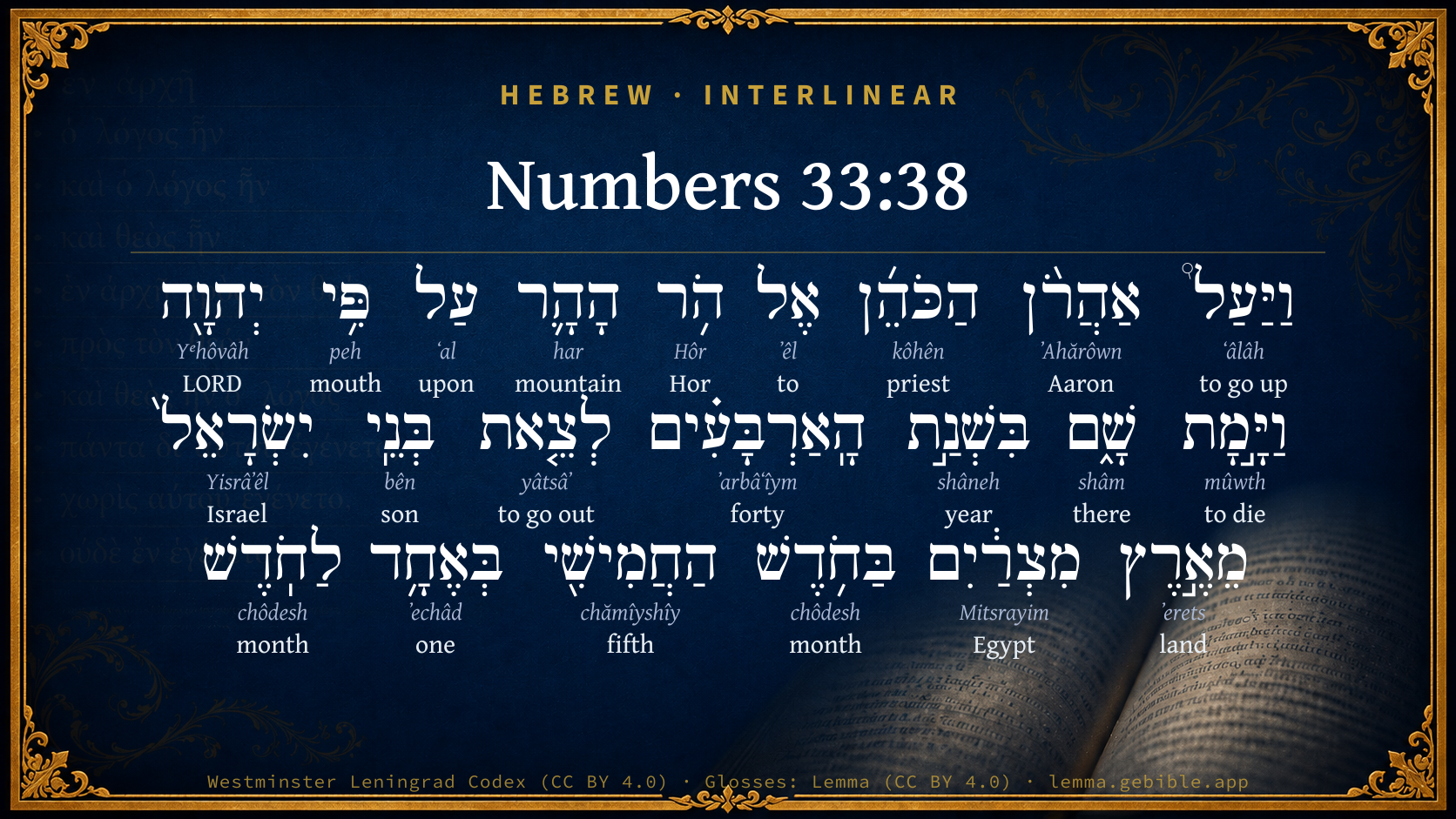
Hebrew (Westminster Leningrad Codex) Numbers 33:38 appears in the Hebrew Old Testament. The text above is from the Westminster Leningrad Codex. Each word links to its Strong’s number, a concise gloss, and parsing drawn from the Open Scriptures Hebrew Bible morphology. Click any word for its full Brown-Driver-Briggs (BDB) entry.
Download image
Cite this verse

Numbers 33:38 (World English Bible). Public Domain. Lemma interlinear Bible study tool, https://lemma.gebible.app/v/numbers/33/38.

Show BibTeX & RIS
BibTeX
RIS
English Translation
Aaron the priest went up into Mount Hor at the commandment of Yahweh, and died there, in the fortieth year after the children of Israel were come out of the land of Egypt, in the fifth month, on the first day of the month.
World English Bible · Public Domain
Download a study sheet

One document with this verse’s original text, its word-by-word gloss line, the meaning frame, cross-references with their text, attributed commentary, and full source and license credits — printable, and it pastes into notes with its structure intact.

This verse Autodidact and up

Study sheet (.html) Plain text (.txt)

A passage Seminary Student

Up to 50 verses in one chapter. A passage sheet keeps up to 6 commentary sources and 12 cross-references per verse, in the order this page ranks them, and says so on the sheet whenever that leaves anything out. Ask for a single verse and you get the Autodidact verse sheet above.

Everything on this page stays free to read, with no account — the sheet is a download of what is already on screen, not access to it.

Want to remove ads? Support Godless Engineer
Compare translations 3

The same verse in 3 English versions, stacked beneath the original-language interlinear above. Click any original word for its lexicon entry.

Each is an independent rendering of the whole verse — the interlinear is not word-aligned to these translations.

Highlighted words mark where these versions differ — a whole-verse word diff, not a word-by-word alignment.

  • World English Bible Public Domain
    Aaron the priest went up into Mount Hor at the commandment of Yahweh, and died there, in the fortieth year after the children of Israel were come out of the land of Egypt, in the fifth month, on the first day of the month.
  • King James Version Public Domain
    And Aaron the priest went up into mount Hor at the commandment of the LORD, and died there, in the fortieth year after the children of Israel were come out of the land of Egypt, in the first day of the fifth month.
  • unfoldingWord Literal Text CC BY-SA 4.0
    And Aaron the priest went up to Mount Hor in accordance with the mouth of Yahweh and died there in the fortieth year of the going out of the sons of Israel from the land of Egypt, in the fifth month, on 1 of the month.

unfoldingWord Literal Text — © unfoldingWord, licensed CC BY-SA 4.0. Word-aligned USFM3 via Door43 (git.door43.org/unfoldingWord/en_ult).

Versions to compare (up to 4)

3 of 4 selected

Show all 18 translations

Every available English version of this verse, each an independent rendering of the whole verse.

  • World English Bible Public Domain
    Aaron the priest went up into Mount Hor at the commandment of Yahweh, and died there, in the fortieth year after the children of Israel were come out of the land of Egypt, in the fifth month, on the first day of the month.
  • Berean Standard Bible Public Domain
    At the LORD’s command, Aaron the priest climbed Mount Hor and died there on the first day of the fifth month, in the fortieth year after the Israelites had come out of the land of Egypt.
  • Majority Standard Bible Public Domain
    At the LORD’s command, Aaron the priest climbed Mount Hor and died there on the first day of the fifth month, in the fortieth year after the Israelites had come out of the land of Egypt.
  • King James Version Public Domain
    And Aaron the priest went up into mount Hor at the commandment of the LORD, and died there, in the fortieth year after the children of Israel were come out of the land of Egypt, in the first day of the fifth month.
  • American Standard Version (1901) Public Domain
    And Aaron the priest went up into mount Hor at the commandment of Jehovah, and died there, in the fortieth year after the children of Israel were come out of the land of Egypt, in the fifth month, on the first day of the month.
  • Revised Version (1885) Public Domain
    And Aaron the priest went up into mount Hor at the commandment of the LORD, and died there, in the fortieth year after the children of Israel were come out of the land of Egypt, in the fifth month, on the first day of the month.
  • Geneva Bible (1599) Public Domain
    (And Aaron the Priest went vp into mount Hor, at the commandement of the Lord, and died there, in the fourtieth yeere after the children of Israel were come out of the lande of Egypt, in the first day of the fifth moneth.
  • Douay-Rheims (1899) Public Domain
    And Aaron the priest went up into mount Hor at the commandment of the Lord: and there he died in the fortieth year of the coming forth of the children of Israel out of Egypt, W the fifth month, the first day of the month,
  • Young's Literal Translation Public Domain
    And Aaron the priest goeth up unto mount Hor, by the command of Jehovah, and dieth there, in the fortieth year of the going out of the sons of Israel from the land of Egypt, in the fifth month, on the first of the month;
  • Literal Standard Version CC BY-SA 4.0
    And Aaron the priest goes up to Mount Hor by the command of YHWH, and dies there in the fortieth year of the going out of the sons of Israel from the land of Egypt, in the fifth month, on the first of the month;
  • Unlocked Literal Bible CC BY-SA 4.0
    Aaron the priest went up Mount Hor at Yahweh's command and died there in the fortieth year after the people of Israel had come out of the land of Egypt, in the fifth month, on the first day of the month.
  • unfoldingWord Literal Text CC BY-SA 4.0
    And Aaron the priest went up to Mount Hor in accordance with the mouth of Yahweh and died there in the fortieth year of the going out of the sons of Israel from the land of Egypt, in the fifth month, on 1 of the month.
  • Darby Bible Public Domain
    And Aaron the priest went up mount Hor by the commandment of Jehovah, and died there, in the fortieth year after the children of Israel came out of the land of Egypt, in the fifth month, on the first of the month.
  • World Messianic Bible Public Domain
    Aaron the priest went up into Mount Hor at the commandment of the LORD and died there, in the fortieth year after the children of Israel had come out of the land of Egypt, in the fifth month, on the first day of the month.
  • Webster's Bible Public Domain
    And Aaron the priest ascended mount Hor at the commandment of the LORD, and died there, in the fortieth year after the children of Israel departed from the land of Egypt, in the first day of the fifth month.
  • Free Bible Version CC BY-SA 4.0
    Aaron the priest climbed Mount Hor as the Lord had directed, and he died there on the first day of the fifth month, in the fortieth year after the Israelites had left Egypt.
  • Bible in Basic English Public Domain
    And Aaron the priest went up into the mountain at the order of the Lord, and came to his death there, in the fortieth year after the children of Israel had come out of the land of Egypt, in the fifth month, on the first day of the month.
  • JPS Tanakh (1917) Public Domain
    And Aaron the priest went up into mount Hor at the commandment of the LORD, and died there, in the fortieth year after the children of Israel were come out of the land of Egypt, in the fifth month, on the first day of the month.

Literal Standard Version (2020), Covenant Press — licensed CC BY-SA 4.0. Text via the HelloAO Bible API (eBible.org). Unlocked Literal Bible (unfoldingWord) — licensed CC BY-SA 4.0. Text via the HelloAO Bible API (eBible.org). unfoldingWord Literal Text — © unfoldingWord, licensed CC BY-SA 4.0. Word-aligned USFM3 via Door43 (git.door43.org/unfoldingWord/en_ult). Free Bible Version, Dr. Jonathan Gallagher — licensed CC BY-SA 4.0. Text via the HelloAO Bible API (eBible.org).

Word by word

More ways to search: Search by grammar → Find every occurrence → Compare this word →

Practice this passage: Drill this verse → Learn its vocabulary →

הֹ֥ר
Hôr
H2023
“Hor”
Noun, Proper
Part of Speech
Noun
Type
Proper
Full BDB Definition

Origin: another form of H2022

TWOT: None

Hor = "mountain" - the mountain on which Aaron died; situated on the eastern side of the valley of Arabah, the highest of the whole range of sandstone mountains in Edom; on the eastern side is the ancient city of Petra - the mountain named as one of the marks of the northern boundary of the land which the children of Israel were about to conquer; located in Lebanon
  1. וַיַּעַל֩ ʻâlâh H5927 “and · to go up” Conjunction + Verb, Qal, Sequential Imperfect, 3rd Person, Masculine, Singular
  2. אַהֲרֹ֨ן ʼAhărôwn H175 “Aaron” Noun, Proper
  3. הַכֹּהֵ֜ן kôhên H3548 “the · priest” Particle, Definite Article + Noun, Common, Masculine, Singular, Absolute
  4. אֶל ʼêl H413 “to” Preposition
  5. הָהָ֛ר har H2022 “the · mountain” Particle, Definite Article + Noun, Common, Masculine, Singular, Absolute
  6. עַל ʻal H5921 “upon” Preposition
  7. פִּ֥י peh H6310 “mouth of” Noun, Common, Masculine, Singular, Construct
  8. יְהוָ֖ה Yᵉhôvâh H3068 “LORD” Noun, Proper
  9. וַיָּ֣מָת mûwth H4191 “and · to die” Conjunction + Verb, Qal, Sequential Imperfect, 3rd Person, Masculine, Singular
  10. שָׁ֑ם shâm H8033 “there” Adverb
  11. בִּשְׁנַ֣ת shâneh H8141 “in/at · year of” Preposition + Noun, Common, Feminine, Singular, Construct
  12. הָֽאַרְבָּעִ֗ים ʼarbâʻîym H705 “the · forty” Particle, Definite Article + Adjective, Cardinal number, Both, Plural, Absolute
  13. לְצֵ֤את yâtsâʼ H3318 “to go out” Preposition + Verb, Qal, Infinitive Construct
  14. בְּנֵֽי bên H1121 “sons of” Noun, Common, Masculine, Plural, Construct
  15. יִשְׂרָאֵל֙ Yisrâʼêl H3478 “Israel” Noun, Proper
  16. מֵאֶ֣רֶץ ʼerets H776 “from · land of” Preposition + Noun, Common, Both, Singular, Construct
  17. מִצְרַ֔יִם Mitsrayim H4714 “Egypt” Noun, Proper
  18. בַּחֹ֥דֶשׁ chôdesh H2320 “in/at the · month” Preposition, Determined + Noun, Common, Masculine, Singular, Absolute
  19. הַחֲמִישִׁ֖י chămîyshîy H2549 “the · fifth” Particle, Definite Article + Adjective, Ordinal number, Masculine, Singular, Absolute
  20. בְּאֶחָ֥ד ʼechâd H259 “in/at · one” Preposition + Adjective, Cardinal number, Masculine, Singular, Absolute
  21. לַחֹֽדֶשׁ chôdesh H2320 “to/for the · month” Preposition, Determined + Noun, Common, Masculine, Singular, Absolute

About this verse

These counts appear in no published source. They are computed here, from the morphology-tagged text and Lemma’s own curated glosses. What Lemma adds →

22
words
21
distinct lemmas
Pentateuch
section

Notable vocabulary

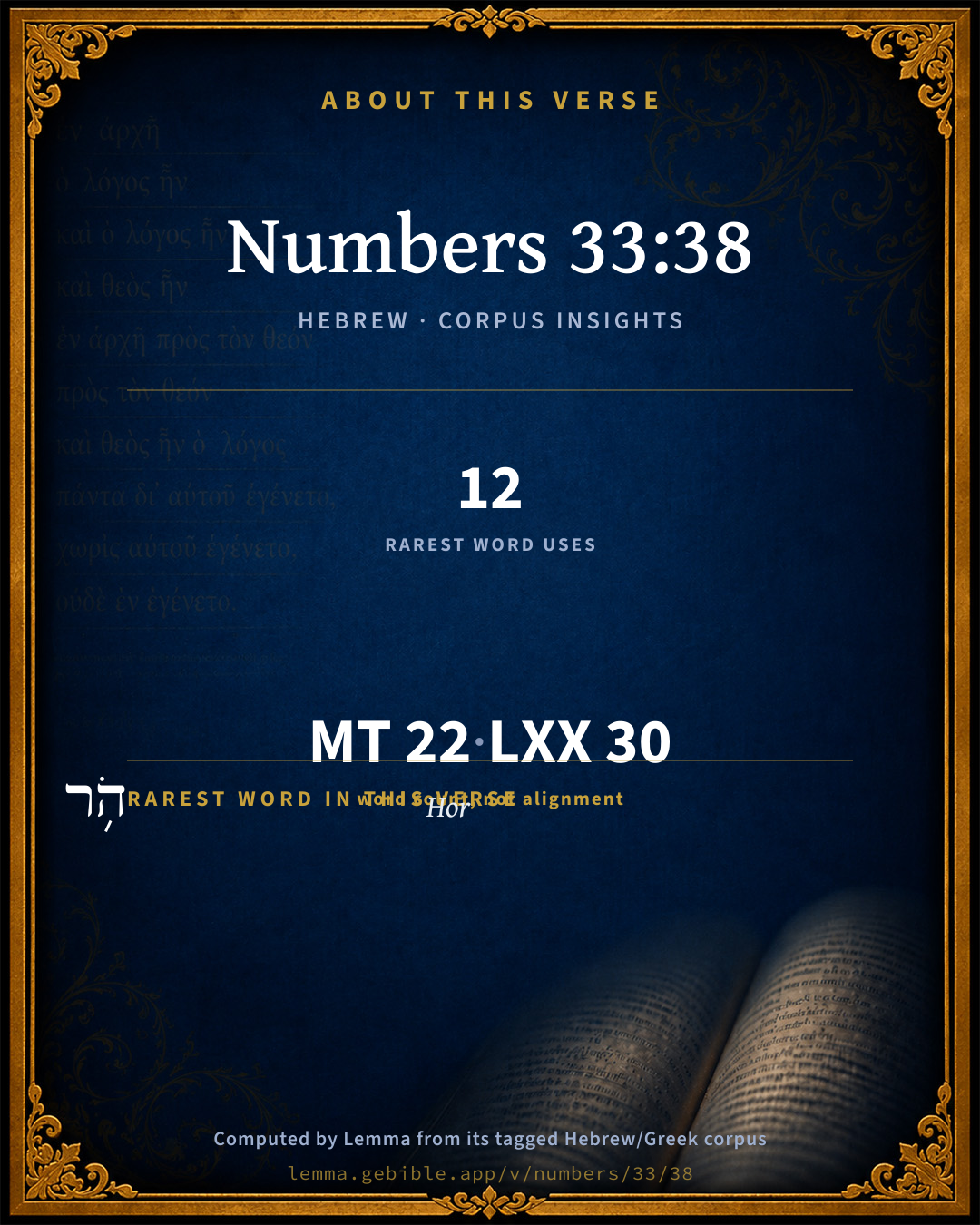
The rarest word here is הֹ֥ר Hor H2023 — appearing just 12 times in the whole Hebrew Bible.

Shared distinctive vocabulary

הֹ֥ר Hor H2023 occurs in 12 verses of the Hebrew Bible. Also found in:

Grammatical profile

  • 3 verbs
  • 13 nouns
  • 3 adjectives
  • 2 prepositions
  • 1 adverb

Verb forms

  • וַיַּעַל֩ Qal · Sequential Imperfect
  • וַיָּ֣מָת Qal · Sequential Imperfect
  • לְצֵ֤את Qal · Infinitive Construct

Repetition

A word recurs within this verse — often emphatic in Hebrew:

  • בַּחֹ֥דֶשׁ month H2320 ×2

Hebrew & Septuagint length

In English translation the verse runs 44 words from the Hebrew and 43 from the Septuagint (LXX English) — closely comparable.

A rough comparison of the two English renderings, which tokenize alike — not a word-level alignment.

Word counts can differ between the Hebrew and the Greek without any difference in meaning — e.g. the Hebrew direct-object marker אֵת has no separate Greek word, and Greek often adds the article ὁ.

In the original languages it is 22 Hebrew tokens and 30 Greek tokens — but the two are counted differently (Hebrew bundles its prefixes and suffixes into one token; the Greek is in lemma form), so that isn’t a like-for-like length.

Cross-references

3

Topical passages linked to Numbers 33:38 in the Treasury of Scripture Knowledge — connected by theme and wording, ordered by reader-vote popularity; previews shown in the World English Bible.

  • Deuteronomy 10:6 (The children of Israel traveled from Beeroth Bene Jaakan to Moserah. There Aaron died, and there he was buried; and Eleazar his son ministered in the priest's office in his place.
  • Deuteronomy 32:50 and die on the mountain where you go up, and be gathered to your people, as Aaron your brother died on Mount Hor, and was gathered to his people:
  • Numbers 20:24–28 Aaron shall be gathered to his people; for he shall not enter into the land which I have given to the children of Israel, because you rebelled against my word at the waters of Meribah.

Cross-references courtesy of OpenBible.info (CC BY 4.0).

Hebrew and Greek witnesses Masoretic Hebrew ↔ Greek Septuagint

The same verse in the two great witnesses to the Old Testament, shown verse-for-verse.

These are two independent witnesses, not word-aligned to each other, and the Septuagint is shown in lemma (dictionary) form.

Hebrew Numbers 33:38 Masoretic · Westminster Leningrad Codex

וַיַּעַל֩ אַהֲרֹ֨ן הַכֹּהֵ֜ן אֶל הֹ֥ר הָהָ֛ר עַל פִּ֥י יְהוָ֖ה וַיָּ֣מָת שָׁ֑ם בִּשְׁנַ֣ת הָֽאַרְבָּעִ֗ים לְצֵ֤את בְּנֵֽי יִשְׂרָאֵל֙ מֵאֶ֣רֶץ מִצְרַ֔יִם בַּחֹ֥דֶשׁ הַחֲמִישִׁ֖י בְּאֶחָ֥ד לַחֹֽדֶשׁ

Aaron the priest went up into Mount Hor at the commandment of Yahweh, and died there, in the fortieth year after the children of Israel were come out of the land of Egypt, in the fifth month, on the first day of the month.

World English Bible · Public Domain

Greek LXX Numbers 33:38 Septuagint · lemma form

καί ἀναβαίνω ἀαρών ὁ ἱερεύς διά πρόσταγμα κύριος καί ἀποθνήσκω ἐκεῖ ἐν ὁ τεσσαρακοστός ἔτος ὁ ἔξοδος ὁ υἱός ἰσραήλ ἐκ γῆ αἴγυπτος ὁ μήν ὁ πέμπτος εἷς ὁ μήν

And Aaron the priest went up by the command of the Lord, and died there in the fortieth year of the departure of the children of Israel from the land of Egypt, in the fifth month, on the first day of the month.

LXX2012 (modern English Septuagint) · Public Domain

Hebrew: Westminster Leningrad Codex (CC BY 4.0). Greek: Septuagint (public domain); English from LXX2012 (modern English Septuagint) (Public Domain). How the Septuagint differs from the Hebrew →

Targum (Aramaic paraphrase)

2

The Targum is the ancient Jewish Aramaic paraphrase of the Hebrew Scriptures — an interpretive translation, not the Hebrew text itself. Onkelos (literal) and Pseudo-Jonathan (expansive) render the Torah, and Jonathan the Prophets. Coverage is partial: where no permissively-licensed English translation exists for a verse, only the Aramaic is shown. This is verse-level text, not a word-by-word alignment to the Hebrew.

  1. Targum Onkelos Torah (Genesis–Deuteronomy)
    וּסְלֵק אַהֲרֹן כַּהֲנָא לְהוֹר טּוּרָא עַל מֵימְרָא דַיְיָ וּמִית תַּמָן בִּשְׁנַת אַרְבְּעִין לְמֵפַּק בְּנֵי יִשְׂרָאֵל מֵאַרְעָא דְמִצְרַיִם בְּיַרְחָא חֲמִשָׁאָה בּחַד לְיַרְחָא

    (no public-domain English translation for this verse)

    Targum Onkelos — Aramaic: “Onkelos Genesis” (public domain); “Onkelos Exodus” (public domain); “Onkelos Leviticus” (public domain); “Onkelos Numbers” (public domain); “Onkelos Deuteronomy” (public domain). English: “Sefaria Community Translation” (CC0 1.0 (public-domain dedication)); “J.W. Etheridge. The Targums of Onkelos and Jonathan Ben Uzziel on the Pentateuch. London: Longmans, Green, 1862” (public domain). Text via Sefaria.

  2. Targum Pseudo-Jonathan Torah (Genesis–Deuteronomy)
    וּסְלֵיק אַהֲרן כַּהֲנָא לְטַוְורוֹס אוּמָנוֹס עַל מֵימְרָא דַיְיָ וּמִית תַּמָן בִּשְׁנַת אַרְבְּעִין לְמֵיפַּק בְּנֵי יִשְרָאֵל מִמִצְרַיִם בְּיַרְחָא חֲמִישָׁאָה בְּחַד לְיַרְחָא

    And Aharon the priest went up to Mount Umano by the Word of the Lord, and died there, in the fortieth year from the going out of the children of Israel from Mizraim, in the fifth month, on the first of the month.

    Targum Pseudo-Jonathan — Aramaic: “Targum Jonathan on Genesis” (public domain); “Targum Jonathan on Exodus” (public domain); “Targum Jonathan on Leviticus” (public domain); “Targum Jonathan on Numbers” (public domain); “Targum Jonathan on Deuteronomy” (public domain). English: “The Targum of Jonathan ben Uzziel, trans. J. W. Etheridge, London, 1862” (public domain). Text via Sefaria.

Commentary

Notes on Numbers 33:38 from classic Christian and Jewish commentators (each source and its license shown beneath its notes). The classic Christian expositions comment on the surrounding passage and are grouped to its opening verse, so a note may address several verses; the Jewish commentaries on the Tanakh (Rashi and others) are per-verse, so they appear only where the commentator wrote on this verse.

Lemma curates 59 commentaries, every one of them public domain or Creative Commons licensed, each selected and text-cleaned for this edition rather than reprinted as found. About our sources →

Trapp's Complete Commentary

John Trapp

Num 33:38 And Aaron the priest went up into mount Hor at the commandment of the LORD, and died there, in the fortieth year after the children of Israel were come out of the land of Egypt, in the first [day] of the fifth month.

Ver. 38. And died there in the fortieth year.]

“ Nec te tua plurima Pentheu

Labentem texit pietas. ”

The righteous die as well as the wicked, yea, the righteous oft before the wicked: Wκυμοροι οι θεοφιλεις. God sends his servants to bed when they have done their work, as here he did Aaron; and as within these few days he hath done, to mine unspeakable loss and grief, my dearest brother and most faithful friend, Mr Thomas Jackson, that able and active instrument of God’s glory, while he lived, in the work of the ministry at Gloucester; the sad report of whose death, received whilst I was writing these things, made the pen, almost, fall out of my fingers, not for my own sake so much as for my country, whereof he was, I may truly say, the bulwark and the beauty, as Ambrose is said to have been "the walls of Italy": {a} Aμβροσιον οιδα μονον Eπισκοπον αξιως καλουμενον, said Theodosius; Ambrose, whilst alive, was the only minister, to speak of, that I knew in the whole country. And dilexi virum, qui cum corpore solveretur, magis de ecclesiarum statu, quam de suis periculis angebatur, said the same emperor of the same Ambrose; I could not but love the man, for that when he died, his care was more for the churches’ welfare than for his own. I can safely say the same of the man in speech, without offence to any be it spoken; and I greatly fear lest, as the death of Ambrose forebode the ruin of Italy, so that it bodes no good to us, that God pulls such props and pillars out of our building. But this by way of digression, to satisfy my great grief for so dear a friend deceased, as David did for his brother Jonathan, and made him an epitaph. {2Sa 1:17}

{a} Paulin. Nolan., in Vita Ambros.

John Trapp, A Commentary or Exposition upon All the Books of the Old and New Testament (1647–1656) — public domain. Text from a community e-Sword module.

Joseph Benson's Commentary

Num 33:38. Aaron went up at the commandment of the Lord, and died — Good men’s goings are ordered of the Lord, and a peculiar providence, watching over all their concerns, appoints the time and place of their death. Let us go on in the way of duty, and leave it to him to call us hence, when, and where, and how he pleases.

Joseph Benson's Commentary on the Old and New Testaments (1811–1818) — public domain. Text from a community e-Sword module.

Tyndale Open Study Notes

Tyndale Open Resources

33:38-39 These details about Aaron’s death (cp. 20:22-29) and his age show that he was about three years older than Moses (cp. Deut 31:1-2; 34:7).

Tyndale Open Study Notes — © Tyndale Open Resources, licensed CC BY-SA 4.0. Text via the HelloAO Bible API.

Geneva Bible (1599)

Geneva Bible translators

Which the Hebrews call Ab, and answereth to part of July and part of August.

Geneva Bible (1599) marginal notes — public domain. Text via Bolls.life.

The Cambridge Bible for Schools and Colleges

gen. ed. J. J. S. Perowne

38. See on Num_20:22.

The Cambridge Bible for Schools and Colleges (gen. ed. J. J. S. Perowne; Cambridge University Press, 1878–1918) — public domain. Text from a community e-Sword module.

John Gill's Exposition

And they departed from the mountains of Abarim, and pitched in the plains of Moab,.... Sixteen miles from Abarim, where all those things were transacted, which make the history of Balak and Balaam, Num 22:1 and where the Israelites now were by Jordan near Jericho; not on that side Jordan where Jericho stood, but on the other; Jericho, according to Eusebius, was ten miles from Bethjesimoth, where Israel now were, as follows.

and where the Israelites now were by Jordan near Jericho; not on that side Jordan where Jericho stood, but on the other; Jericho, according to Eusebius, was ten miles from Bethjesimoth, where Israel now were, as follows.

Numbers 33:49

num 33:49

num 33:49

num 33:49And they pitched by Jordan from Bethjesimoth, even unto Abelshittim, in the plains of Moab. Their camp reached twelve miles, as the Jews commonly say, which we may suppose was the distance of these two places, which were both in the plains of Moab; and the Jerusalem Targum is express for it, for mentioning Israel's encampment from Bethjesimoth to Abelshittim, it asks, how far is that? twelve miles: the latter is sometimes called Shittim, from the shittim wood which grew there, Num 25:1 and here it has the addition of Abel to it, to signify mourning, from the mourning of the children of Israel on account of the plague, in which 24,000 persons died, Num 25:1.

John Gill's Exposition of the Whole Bible (1746–1763) — public domain (CC PDM 1.0). Text via the HelloAO Bible API.

Whedon's Commentary on the Bible

Daniel D. Whedon

38. Aaron… died there — Num_20:23-29, notes.

In the fortieth year — An important note of time. See Introduction, (4.)

Daniel D. Whedon (gen. ed.), Commentary on the Old and New Testaments (1874–1909) — public domain. Text from a community e-Sword module.

The Pulpit Commentary

In the fortieth year...in the first day of the fifth month. This is the only place where the date of Aaron"s death is given. It is in strict accordance with the Divine intimation that Israel was to wander forty years in the wilderness, (Num_14:33, Num_14:34) that period being understood, according to the usual mercy of God, which shortens the days of evil, to include the time already spent in the wilderness.

The Pulpit Commentary (1880–1919), ed. H.D.M. Spence-Jones & Joseph S. Exell — public domain. Text from a community e-Sword module.

Scofield Reference Notes

C. I. Scofield

fifth month

i.e. August.

The Scofield Reference Bible (1917 edition), notes by C. I. Scofield — public domain. Text from a community e-Sword module.

unfoldingWord translationNotes

Door43 World Missions Community

in the fortieth year after

Here "fortieth" is the ordinal number for forty. AT: "40 years after" (See: Ordinal Numbers)

in the fifth month, on the first day of the month

This "fifth" is the ordinal number for five. This "first" is the ordinal number for one. This is the fifth month of the Hebrew calendar. The first day is near the middle of July on Western calendars. (See: Hebrew Months and Ordinal Numbers)

123 years old

"one hundred and twenty-three years old" (See: Numbers)

translationWords

Aaron

priest

Yahweh

command

die

year

Israel

Egypt

day

unfoldingWord translationNotes — © Distant Shores Media and the Door43 World Missions Community, licensed CC BY-SA 4.0. Source: git.door43.org/Door43/en_tn.

Rashi

Rabbi Shlomo Yitzchaki (Rashi)

'על פי ה [AND AARON THE PRIEST WENT UP TO MOUNT HOR] BY THE WORD (lit., BY THE MOUTH) OF THE LORD— This phrase tells us that he died by the Divine Kiss (Bava Batra 17a; cf. Rashi on Numbers 20:26).

Rashi on the Tanakh — English translations: “The Judaica Press complete Tanach with Rashi, translated by A. J. Rosenberg” (CC BY 4.0); “Pentateuch with Rashi's commentary by M. Rosenbaum and A.M. Silbermann, 1929-1934” (public domain); “The Metsudah Tanach series, Lakewood, N.J” (CC BY 4.0); and “The Book of Joshua, Metsudah Publications, 1997” (CC BY 4.0). Text via Sefaria.

Lesson kit

Teaching starters — assembled from the data on this page, not authored interpretation. Every prompt links to the verse data it draws on. Edit before teaching.

Numbers, in the Pentateuch, opens this verse with 22 words (21 distinct Hebrew lemmas). Its most distinctive word is Hôr (“Hor”). A historical commentator’s framing appears above. Read the whole chapter for the surrounding context.

Discussion questions

  1. How does “Hor” (Hôr) shape what this verse is saying?
  2. How does Numbers 20:22, which shares the word «Hor», read alongside this verse?
  3. What does the repetition of “month” (2× in this one verse) do in this verse?
  4. These translations render this verse differently; the difference is in the English rendering, not the original. What questions does that raise?
  5. «וַיַּעַל֩» is a Qal Sequential Imperfect verb. How does that grammatical form shape the action described?
  6. Compare how Trapp's Complete Commentary and Joseph Benson's Commentary read this verse. Where do they agree or differ?

Things to notice

Reading settings

Reading text

Shown beneath each verse's original-language words.

Old Testament
Old Testament edition

Read the OT as the Masoretic Hebrew (MT) or the Greek Septuagint (LXX).

English shown for the Greek Septuagint (in the Hebrew ↔ Greek comparison).

Comparing translations? Open the Compare panel on any verse page to stack up to four side by side.