
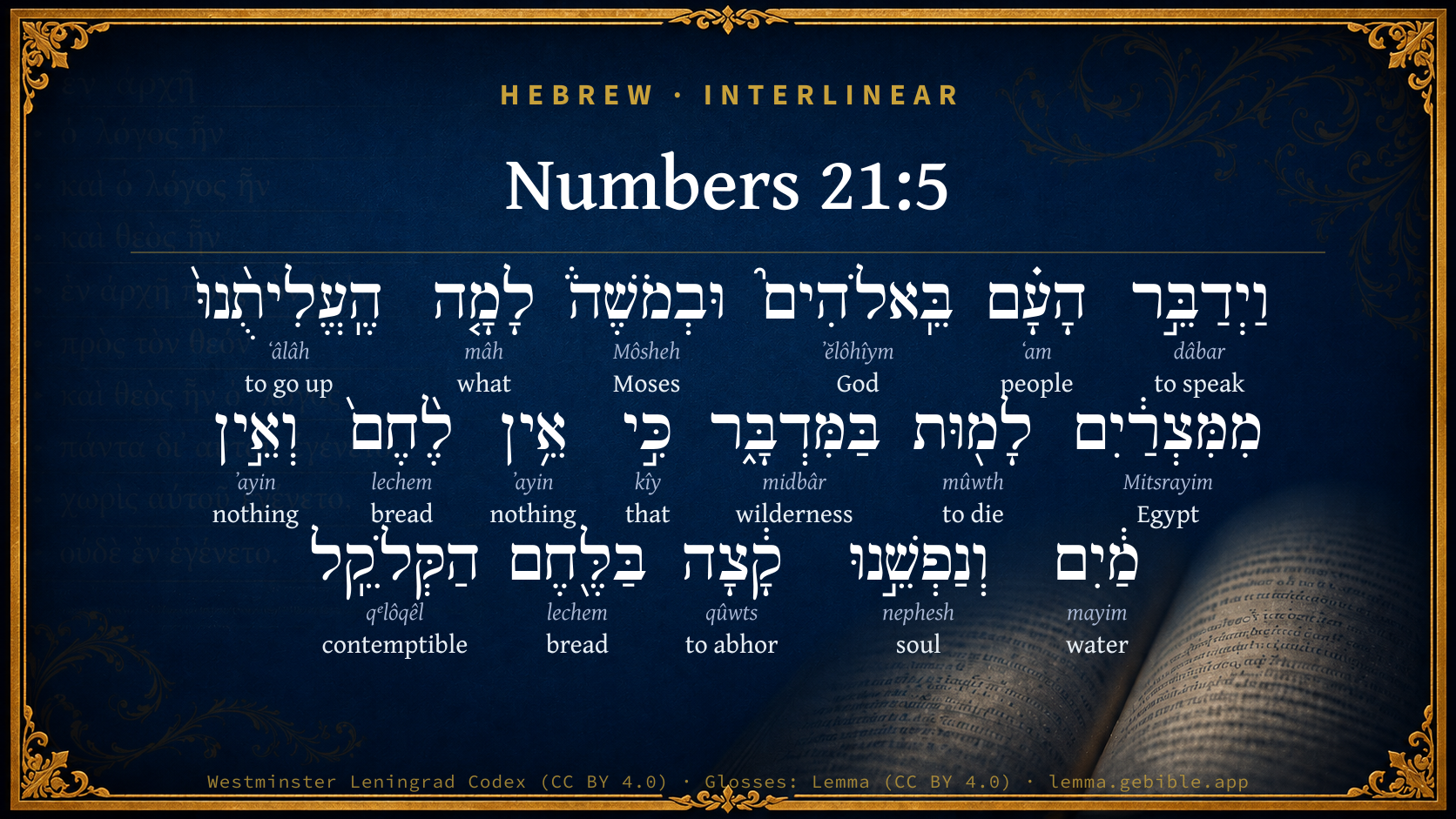
Numbers 21:5

Hebrew (Westminster Leningrad Codex) Numbers 21:5 appears in the Hebrew Old Testament. The text above is from the Westminster Leningrad Codex. Each word links to its Strong’s number, a concise gloss, and parsing drawn from the Open Scriptures Hebrew Bible morphology. Click any word for its full Brown-Driver-Briggs (BDB) entry.
Download image
Cite this verse

Numbers 21:5 (World English Bible). Public Domain. Lemma interlinear Bible study tool, https://lemma.gebible.app/v/numbers/21/5.

Show BibTeX & RIS
BibTeX
RIS
English Translation
The people spoke against God, and against Moses, Why have you brought us up out of Egypt to die in the wilderness? for there is no bread, and there is no water; and our soul loathes this light bread.
World English Bible · Public Domain
Highlights
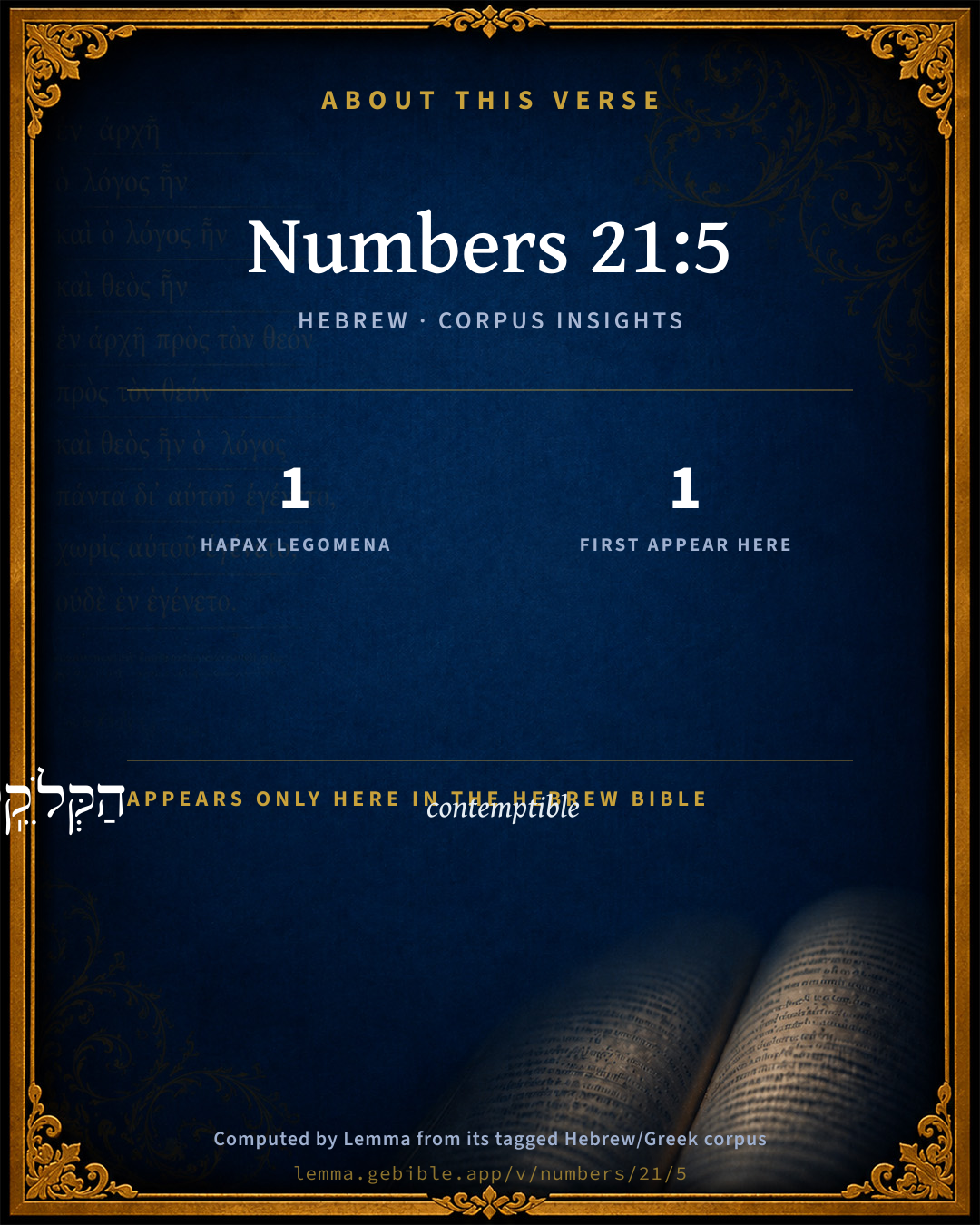
  • 1 hapax legomenon — only here in the Hebrew Bible
  • 1 first appearance in the Hebrew Bible
Full analysis ↓
Download a study sheet

One document with this verse’s original text, its word-by-word gloss line, the meaning frame, cross-references with their text, attributed commentary, and full source and license credits — printable, and it pastes into notes with its structure intact.

This verse Autodidact and up

Study sheet (.html) Plain text (.txt)

A passage Seminary Student

Up to 50 verses in one chapter. A passage sheet keeps up to 6 commentary sources and 12 cross-references per verse, in the order this page ranks them, and says so on the sheet whenever that leaves anything out. Ask for a single verse and you get the Autodidact verse sheet above.

Everything on this page stays free to read, with no account — the sheet is a download of what is already on screen, not access to it.

Want to remove ads? Support Godless Engineer
Compare translations 3

The same verse in 3 English versions, stacked beneath the original-language interlinear above. Click any original word for its lexicon entry.

Each is an independent rendering of the whole verse — the interlinear is not word-aligned to these translations.

Highlighted words mark where these versions differ — a whole-verse word diff, not a word-by-word alignment.

  • World English Bible Public Domain
    The people spoke against God, and against Moses, Why have you brought us up out of Egypt to die in the wilderness? for there is no bread, and there is no water; and our soul loathes this light bread.
  • King James Version Public Domain
    And the people spake against God, and against Moses, Wherefore have ye brought us up out of Egypt to die in the wilderness? for there is no bread, neither is there any water; and our soul loatheth this light bread.
  • unfoldingWord Literal Text CC BY-SA 4.0
    and the people spoke against God and against Moses, “Why have you brought us up from Egypt to die in the wilderness? For there is no bread and there is no water, and our soul loathes the worthless bread.”

unfoldingWord Literal Text — © unfoldingWord, licensed CC BY-SA 4.0. Word-aligned USFM3 via Door43 (git.door43.org/unfoldingWord/en_ult).

Versions to compare (up to 4)

3 of 4 selected

Show all 18 translations

Every available English version of this verse, each an independent rendering of the whole verse.

  • World English Bible Public Domain
    The people spoke against God, and against Moses, Why have you brought us up out of Egypt to die in the wilderness? for there is no bread, and there is no water; and our soul loathes this light bread.
  • Berean Standard Bible Public Domain
    and spoke against God and against Moses: “Why have you led us up out of Egypt to die in the wilderness? There is no bread or water, and we detest this wretched food!”
  • Majority Standard Bible Public Domain
    and spoke against God and against Moses: “Why have you led us up out of Egypt to die in the wilderness? There is no bread or water, and we detest this wretched food!”
  • King James Version Public Domain
    And the people spake against God, and against Moses, Wherefore have ye brought us up out of Egypt to die in the wilderness? for there is no bread, neither is there any water; and our soul loatheth this light bread.
  • American Standard Version (1901) Public Domain
    And the people spake against God, and against Moses, Wherefore have ye brought us up out of Egypt to die in the wilderness? for there is no bread, and there is no water; and our soul loatheth this light bread.
  • Revised Version (1885) Public Domain
    And the people spake against God, and against Moses, Wherefore have ye brought us up out of Egypt to die in the wilderness? for there is no bread, and there is no water; and our soul loatheth this light bread.
  • Geneva Bible (1599) Public Domain
    And the people spake against God and against Moses, saying, Wherefore haue ye brought vs out of Egypt, to die in the wildernesse? for here is neither bread nor water, and our soule lotheth this light bread.
  • Douay-Rheims (1899) Public Domain
    And speaking against God end Moses, they said: Why didst thou bring us out of Egypt, to die in the wilderness? There is no bread, nor have we any waters: our soul now loatheth this very light food.
  • Young's Literal Translation Public Domain
    and the people speak against God, and against Moses, `Why hast thou brought us up out of Egypt to die in a wilderness? for there is no bread, and there is no water, and our soul hath been weary of this light bread.'
  • Literal Standard Version CC BY-SA 4.0
    and the people speak against God and against Moses, “Why have you brought us up out of Egypt to die in a wilderness? For there is no bread, and there is no water, and our soul has been weary of this light bread.”
  • Unlocked Literal Bible CC BY-SA 4.0
    The people spoke against God and Moses: “Why have you brought us up out of Egypt to die in the wilderness? There is no bread, no water, and we hate this miserable food.”
  • unfoldingWord Literal Text CC BY-SA 4.0
    and the people spoke against God and against Moses, “Why have you brought us up from Egypt to die in the wilderness? For there is no bread and there is no water, and our soul loathes the worthless bread.”
  • Darby Bible Public Domain
    and the people spoke against God, and against Moses, Why have ye brought us up out of Egypt that we should die in the wilderness? for there is no bread, and no water, and our soul loathes this light bread.
  • World Messianic Bible Public Domain
    The people spoke against God and against Moses: “Why have you brought us up out of Egypt to die in the wilderness? For there is no bread, there is no water, and our soul loathes this disgusting food!”
  • Webster's Bible Public Domain
    And the people spoke against God, and against Moses, Why have ye brought us out of Egypt to die in the wilderness? for there is no bread, neither is there any water; and our soul lotheth this light bread.
  • Free Bible Version CC BY-SA 4.0
    and made complaints against God and against Moses, saying, “Why did you lead us out of Egypt to die in the desert? We don't have bread or water, and we hate this awful food!”
  • Bible in Basic English Public Domain
    And crying out against God and against Moses, they said, Why have you taken us out of Egypt to come to our death in the waste land? For there is no bread and no water, and this poor bread is disgusting to us.
  • JPS Tanakh (1917) Public Domain
    And the people spoke against God, and against Moses: 'Wherefore have ye brought us up out of Egypt to die in the wilderness? for there is no bread, and there is no water; and our soul loatheth this light bread.'

Literal Standard Version (2020), Covenant Press — licensed CC BY-SA 4.0. Text via the HelloAO Bible API (eBible.org). Unlocked Literal Bible (unfoldingWord) — licensed CC BY-SA 4.0. Text via the HelloAO Bible API (eBible.org). unfoldingWord Literal Text — © unfoldingWord, licensed CC BY-SA 4.0. Word-aligned USFM3 via Door43 (git.door43.org/unfoldingWord/en_ult). Free Bible Version, Dr. Jonathan Gallagher — licensed CC BY-SA 4.0. Text via the HelloAO Bible API (eBible.org).

Word by word

More ways to search: Search by grammar → Find every occurrence → Compare this word →

Practice this passage: Drill this verse → Learn its vocabulary →

הַקְּלֹקֵֽל
qᵉlôqêl
H7052
“the · contemptible”
Particle, Definite Article + Adjective, Adjective, Masculine, Singular, Absolute
Part of Speech
Particle + Adjective
Type
Adjective
Gender
Masculine
Number
Singular
State
Absolute
Full BDB Definition

Origin: from H7043

TWOT: 2028e

contemptible, worthless
  1. וַיְדַבֵּ֣ר dâbar H1696 “and · to speak” Conjunction + Verb, Piel, Sequential Imperfect, 3rd Person, Masculine, Singular
  2. הָעָ֗ם ʻam H5971 “the · people” Particle, Definite Article + Noun, Common, Masculine, Singular, Absolute
  3. בֵּֽאלֹהִים֮ ʼĕlôhîym H430 “in/at · God(s)” Preposition + Noun, Common, Masculine, Plural, Absolute
  4. וּבְמֹשֶׁה֒ Môsheh H4872 “and · in/at · Moses” Conjunction + Preposition + Noun, Proper
  5. לָמָ֤ה mâh H4100 “to/for · what” Preposition + Particle, Interrogative
  6. הֶֽעֱלִיתֻ֨נוּ֙ ʻâlâh H5927 “to go up · us” Verb, Hiphil, Perfect, 2nd Person, Masculine, Plural + Suffix, Personal, 1st Person, Common, Plural
  7. מִמִּצְרַ֔יִם Mitsrayim H4714 “from · Egypt” Preposition + Noun, Proper
  8. לָמ֖וּת mûwth H4191 “to die” Preposition + Verb, Qal, Infinitive Construct
  9. בַּמִּדְבָּ֑ר midbâr H4057 “in/at the · wilderness” Preposition, Determined + Noun, Common, Masculine, Singular, Absolute
  10. כִּ֣י kîy H3588 “that” Conjunction
  11. אֵ֥ין ʼayin H369 “nothing” Particle, Negative
  12. לֶ֨חֶם֙ lechem H3899 “bread” Noun, Common, Both, Singular, Absolute
  13. וְאֵ֣ין ʼayin H369 “and · nothing” Conjunction + Particle, Negative
  14. מַ֔יִם mayim H4325 “water(s)” Noun, Common, Masculine, Plural, Absolute
  15. וְנַפְשֵׁ֣נוּ nephesh H5315 “and · soul · our” Conjunction + Noun, Common, Both, Singular, Construct + Suffix, Personal, 1st Person, Common, Plural
  16. קָ֔צָה qûwts H6973 “to abhor” Verb, Qal, Perfect, 3rd Person, Feminine, Singular
  17. בַּלֶּ֖חֶם lechem H3899 “in/at the · bread” Preposition, Determined + Noun, Common, Both, Singular, Absolute

About this verse

These counts appear in no published source. They are computed here, from the morphology-tagged text and Lemma’s own curated glosses. What Lemma adds →

18
words
16
distinct lemmas
Pentateuch
section

Notable vocabulary

1 hapax legomenon — a word that appears only here in the entire Hebrew Bible:

  • הַקְּלֹקֵֽל contemptible H7052

First appearance in Scripture

This word makes its first canonical appearance in the Hebrew Bible here:

  • הַקְּלֹקֵֽל contemptible H7052

Shared distinctive vocabulary

קָ֔צָה to abhor H6973 occurs in 9 verses of the Hebrew Bible. Also found in:

Grammatical profile

  • 4 verbs
  • 9 nouns
  • 1 adjective
  • 1 conjunction
  • 3 particles

Verb forms

  • וַיְדַבֵּ֣ר Piel · Sequential Imperfect
  • הֶֽעֱלִיתֻ֨נוּ֙ Hiphil · Perfect
  • לָמ֖וּת Qal · Infinitive Construct
  • קָ֔צָה Qal · Perfect

Repetition

Words recur within this verse — often emphatic in Hebrew:

  • אֵ֥ין nothing H369 ×2
  • לֶ֨חֶם֙ bread H3899 ×2

Hebrew & Septuagint length

In English translation the verse runs 39 words from the Hebrew and 40 from the Septuagint (LXX English) — closely comparable.

A rough comparison of the two English renderings, which tokenize alike — not a word-level alignment.

Word counts can differ between the Hebrew and the Greek without any difference in meaning — e.g. the Hebrew direct-object marker אֵת has no separate Greek word, and Greek often adds the article ὁ.

Cross-references

16

Topical passages linked to Numbers 21:5 in the Treasury of Scripture Knowledge — connected by theme and wording, ordered by reader-vote popularity; previews shown in the World English Bible.

  • Psalms 78:19 Yes, they spoke against God. They said, "Can God prepare a table in the wilderness?
  • Exodus 17:2–3 Therefore the people quarreled with Moses, and said, "Give us water to drink." Moses said to them, "Why do you quarrel with me? Why do you test Yahweh?"
  • Numbers 16:13–14 is it a small thing that you have brought us up out of a land flowing with milk and honey, to kill us in the wilderness, but you must needs make yourself also a prince over us?
  • Numbers 16:41 But on the next day all the congregation of the children of Israel murmured against Moses and against Aaron, saying, You have killed the people of Yahweh.
  • Exodus 14:11 They said to Moses, "Because there were no graves in Egypt, have you taken us away to die in the wilderness? Why have you treated us this way, to bring us forth out of Egypt?
  • Exodus 16:2–3 The whole congregation of the children of Israel murmured against Moses and against Aaron in the wilderness;
  • Numbers 11:1–9 The people were as murmurers, [speaking] evil in the ears of Yahweh: and when Yahweh heard it, his anger was kindled; and the fire of Yahweh burnt among them, and devoured in the uttermost part of the camp.
  • Numbers 14:1–4 All the congregation lifted up their voice, and cried; and the people wept that night.
  • Numbers 17:12 The children of Israel spoke to Moses, saying, Behold, we perish, we are undone, we are all undone.
  • Exodus 15:24 The people murmured against Moses, saying, "What shall we drink?"
  • Exodus 16:7–8 and in the morning, then you shall see the glory of Yahweh; because he hears your murmurings against Yahweh. Who are we, that you murmur against us?"
  • Exodus 16:15 When the children of Israel saw it, they said one to another, "What is it?" For they didn't know what it was. Moses said to them, "It is the bread which Yahweh has given you to eat."
  • Exodus 16:31 The house of Israel called the name of it Manna, and it was like coriander seed, white; and its taste was like wafers with honey.
  • Psalms 68:6 God sets the lonely in families. He brings out the prisoners with singing, But the rebellious dwell in a sun-scorched land.
  • Psalms 78:24–25 He rained down manna on them to eat, And gave them food from the sky.
  • Proverbs 27:7 A full soul loathes a honeycomb; But to a hungry soul, every bitter thing is sweet.

Cross-references courtesy of OpenBible.info (CC BY 4.0).

Hebrew and Greek witnesses Masoretic Hebrew ↔ Greek Septuagint

The same verse in the two great witnesses to the Old Testament, shown verse-for-verse.

These are two independent witnesses, not word-aligned to each other, and the Septuagint is shown in lemma (dictionary) form.

Hebrew Numbers 21:5 Masoretic · Westminster Leningrad Codex

וַיְדַבֵּ֣ר הָעָ֗ם בֵּֽאלֹהִים֮ וּבְמֹשֶׁה֒ לָמָ֤ה הֶֽעֱלִיתֻ֨נוּ֙ מִמִּצְרַ֔יִם לָמ֖וּת בַּמִּדְבָּ֑ר כִּ֣י אֵ֥ין לֶ֨חֶם֙ וְאֵ֣ין מַ֔יִם וְנַפְשֵׁ֣נוּ קָ֔צָה בַּלֶּ֖חֶם הַקְּלֹקֵֽל

The people spoke against God, and against Moses, Why have you brought us up out of Egypt to die in the wilderness? for there is no bread, and there is no water; and our soul loathes this light bread.

World English Bible · Public Domain

Greek LXX Numbers 21:5 Septuagint · lemma form

καί καταλαλέω ὁ λαός πρός ὁ θεός καί κατά μωυσῆς λέγω ἵνα τίς ἐκἄγω ἐγώ ἐκ αἴγυπτος ἀποκτείνω ἐγώ ἐν ὁ ἔρημος ὅτι οὐ εἰμί ἄρτος οὐδέ ὕδωρ ὁ δέ ψυχή ἐγώ προςὀχθίζω ἐν ὁ ἄρτος ὁ διάκενος

And the people spoke against God and against Moses, saying, Why is this? Have you brought us ought of Egypt to kill us in the wilderness? for there is not bread nor water; and our soul loathes this light bread.

LXX2012 (modern English Septuagint) · Public Domain

On this verse, Haydock's Catholic Bible Commentary discusses the Septuagint’s reading. Read the note in Commentary ↓

Hebrew: Westminster Leningrad Codex (CC BY 4.0). Greek: Septuagint (public domain); English from LXX2012 (modern English Septuagint) (Public Domain). How the Septuagint differs from the Hebrew →

Targum (Aramaic paraphrase)

2

The Targum is the ancient Jewish Aramaic paraphrase of the Hebrew Scriptures — an interpretive translation, not the Hebrew text itself. Onkelos (literal) and Pseudo-Jonathan (expansive) render the Torah, and Jonathan the Prophets. Coverage is partial: where no permissively-licensed English translation exists for a verse, only the Aramaic is shown. This is verse-level text, not a word-by-word alignment to the Hebrew.

  1. Targum Onkelos Torah (Genesis–Deuteronomy)
    וְאִתְרַעַם עַמָא בְּמֵימְרָא דַיְיָ וְעִם משֶׁה נְצוֹ לְמָא אַסֵקְתּוּנָא מִמִצְרַיִם לִמְמָת בְּמַדְבְּרָא אֲרֵי לֵית לַחְמָא וְלֵית מַיָא וְנַפְשָׁנָא עָקַת בְּמַנָא הָדֵין דְמֵיכְלֵיהּ קָלֵיל

    (no public-domain English translation for this verse)

    Targum Onkelos — Aramaic: “Onkelos Genesis” (public domain); “Onkelos Exodus” (public domain); “Onkelos Leviticus” (public domain); “Onkelos Numbers” (public domain); “Onkelos Deuteronomy” (public domain). English: “Sefaria Community Translation” (CC0 1.0 (public-domain dedication)); “J.W. Etheridge. The Targums of Onkelos and Jonathan Ben Uzziel on the Pentateuch. London: Longmans, Green, 1862” (public domain). Text via Sefaria.

  2. Targum Pseudo-Jonathan Torah (Genesis–Deuteronomy)
    וְהִרְהֲרוּ עַמָא בִּלְבָבֵיהוֹן וְאִשְׁתָּעִיאוּ עַל מֵימְרָא דַיְיָ וּבְמשֶׁה נָצוּ לְמָא אַסֵיקְתָּנָא מִמִצְרַיִם לִמְמַת בְּמַדְבְּרָא אֲרוּם לֵית לַחֲמָא וְלֵית מַיָא וְנַפְשָׁתָנָא קַנְטַת בְּמַנָא הָדֵין דִמְזוֹנֵיהּ קָלִיל

    And the people thought (wickedly) in their heart, and talked against the Word of the Lord, and contended with Mosheh, saying: Why didst thou bring us up from Mizraim to die in the wilderness; for there is neither bread nor water, and our soul is weary of manna, this light food?

    Targum Pseudo-Jonathan — Aramaic: “Targum Jonathan on Genesis” (public domain); “Targum Jonathan on Exodus” (public domain); “Targum Jonathan on Leviticus” (public domain); “Targum Jonathan on Numbers” (public domain); “Targum Jonathan on Deuteronomy” (public domain). English: “The Targum of Jonathan ben Uzziel, trans. J. W. Etheridge, London, 1862” (public domain). Text via Sefaria.

Commentary

Notes on Numbers 21:5 from classic Christian and Jewish commentators (each source and its license shown beneath its notes). The classic Christian expositions comment on the surrounding passage and are grouped to its opening verse, so a note may address several verses; the Jewish commentaries on the Tanakh (Rashi and others) are per-verse, so they appear only where the commentator wrote on this verse.

Lemma curates 59 commentaries, every one of them public domain or Creative Commons licensed, each selected and text-cleaned for this edition rather than reprinted as found. About our sources →

Trapp's Complete Commentary

John Trapp

Num 21:5 And the people spake against God, and against Moses, Wherefore have ye brought us up out of Egypt to die in the wilderness? for [there is] no bread, neither [is there any] water; and our soul loatheth this light bread.

Ver. 5. This light bread.] {See Trapp on "Num 11:6"}

John Trapp, A Commentary or Exposition upon All the Books of the Old and New Testament (1647–1656) — public domain. Text from a community e-Sword module.

Joseph Benson's Commentary

Num 21:5. The people spake against God — Against Christ, their chief conductor, whom they tempted. Our soul loatheth this light bread — Thus contemptuously did they speak of manna, whereas it appears it yielded excellent nourishment, because in the strength of it they were able to go so many and such tedious journeys.

Joseph Benson's Commentary on the Old and New Testaments (1811–1818) — public domain. Text from a community e-Sword module.

Geneva Bible (1599)

Geneva Bible translators

Meaning, Manna, which they thought did not nourish.

Geneva Bible (1599) marginal notes — public domain. Text via Bolls.life.

Jamieson, Fausset & Brown

Robert Jamieson, A. R. Fausset & David Brown

our soul loatheth this light bread--that is, bread without substance or nutritious quality. The refutation of this calumny appears in the fact, that on the strength of this food they performed for forty years so many and toilsome journeys. But they had been indulging a hope of the better and more varied fare enjoyed by a settled people; and disappointment, always the more bitter as the hope of enjoyment seems near, drove them to speak against God and against Moses (Co1 10:9).

Jamieson, Fausset & Brown — Commentary Critical and Explanatory on the Whole Bible (1871) — public domain (CC PDM 1.0). Text via the HelloAO Bible API.

Adam Clarke's Commentary

Verse 5. This light bread.] הקלקל hakkelokel, a word of excessive scorn; as if they had said, This innutritive, unsubstantial, cheat - stomach stuff.

Adam Clarke's Commentary on the Bible (1810–1826) — public domain. Text from a community e-Sword/MySword module.

Ellicott's Commentary for English Readers

(5) This light bread.—The word rendered light denotes something vile or worthless. It was thus that the Israelites regarded the manna which was given to them from heaven; even as the “spiritual meat” which is given to Christ’s Church in His word and ordinances is too commonly regarded amongst ourselves.

A Bible Commentary for English Readers, edited by Charles John Ellicott (1878–1897) — public domain. Text from a community e-Sword module.

The Cambridge Bible for Schools and Colleges

gen. ed. J. J. S. Perowne

5. our soul [i.e. appetite] loatheth this worthless bread] They despised the manna, declaring that it was useless for satisfying hunger.

The Cambridge Bible for Schools and Colleges (gen. ed. J. J. S. Perowne; Cambridge University Press, 1878–1918) — public domain. Text from a community e-Sword module.

John Gill's Exposition

And the people spake against God,.... Who went before them in the pillar of cloud and fire, for leading them in such a way; that is, against Christ, as the apostle has taught us to interpret it, Co1 10:9, and is no inconsiderable proof of the deity of Christ; and so the Targum of Jonathan paraphrases it,"and the people thought in their heart, and spake against the Word of the Lord,''the essential Word and Son of God:

and against Moses; his servant, for obeying the orders of the Lord, and leading and guiding the people as he directed him:

wherefore have ye brought us up out of Egypt to die in the wilderness? ascribing this equally to God and to Moses; using a strange word, as Aben Ezra calls it, being in a great passion, and not considering well what they said; showing great ingratitude for such a mercy, and representing it in a wrong light, as if the intent of bringing them from thence was to slay them in the wilderness:

for there is no bread; no bread corn, nothing in the wilderness to make bread of; nothing that they called and accounted bread, otherwise they had manna, as is presently owned:

neither is there any water; any fresh water fit to drink, otherwise they were near the sea; what they had from the rock, lately, perhaps was now spent, and it did not follow them as the other rock had:

and our soul loatheth this light bread; the manna; this very light, this exceeding light bread, the radicals of the word (q) used being doubled, which increases the signification: if to be understood of light and easy digestion, it was the more to be valued; but perhaps they meant, it had but little substance and virtue in it, and was not filling and satisfying; or rather that it was exceeding vile, mean, and despicable; so they called the bread of heaven, angel's food, this wonderful gift of Providence; in like manner is Christ, the hidden manna, treated, and his Gospel, and the precious truths of it, by unregenerate men and carnal professors, Co1 1:23.

(q) "levissime", V. L. Pagninus, Montanus, Fagius, Vatablus; "vilissimi", Junius & Tremellius, Piscator.

John Gill's Exposition of the Whole Bible (1746–1763) — public domain (CC PDM 1.0). Text via the HelloAO Bible API.

Albert Barnes' Notes on the Bible

This light bread - i. e. “this vile, contemptible bread.”

Albert Barnes' Notes on the Bible (1834–1885) — public domain. Text from a community e-Sword/MySword module.

Haydock's Catholic Bible Commentary

God. They had before often directed their complaints against the two brothers. Now, Aaron being no more, they attack God himself, who had always resented the injury done to his ministers. --- Food. So they call the heavenly manna: thus worldlings loathe the things of heaven, for which they have no relish. (Challoner) --- Septuagint, "our soul is indignant at this most empty bread," which has no solidity in it, nor support. Many translate the Hebrew, "most vile bread." Thus, in the blessed eucharist, the substance of bread is removed, and the accidents only appear; so that to the worldly receiver, it seems very empty and light, though in reality it be supersubstantial; containing Christ himself, who fills the worthy communicant with grace and comfort, and enables him to go forward on the road to heaven, without fainting. (Haydock)

George Leo Haydock (1774–1849), Haydock's Catholic Family Bible and Commentary, 1859 edition — public domain. Excludes Psalms (Douay-Rheims chapter numbering differs from Protestant) and Deuterocanonical books (Catholic canon only).

Matthew Poole's English Annotations

Against God; against Christ, their chief Conductor, whom they tempted, 1Co 10:9.

This light bread, i.e. of small substance and virtue. Thus contemptuously do they speak of manna, whereas it appears it yielded excellent nourishment, because in the strength of it they were able to go so many and such tedious journeys.

Matthew Poole's English Annotations on the Holy Bible (1683–1685) — public domain. Text from a community e-Sword/MySword module.

The Pulpit Commentary

There is no bread, neither is there any water. The one of these statements was no doubt as much and as little true as the other. There was no ordinary supply of either; but as they had bread given to them from heaven, so they had water from the rock, otherwise they could not possibly have existed. Our soul loatheth this light bread. lqelq, a stronger form than lq from llq. Septuagint, diakenw . They meant to say, as their fathers had, (Num_11:6) that it was unsavory and unsubstantial in comparison with the heavy and succulent diet of Egypt. (see note on Num_20:3)

The Pulpit Commentary (1880–1919), ed. H.D.M. Spence-Jones & Joseph S. Exell — public domain. Text from a community e-Sword module.

John Wesley's Explanatory Notes

Against God - Against Christ, their chief conductor, whom they tempted, 1 Cor. x, 19. Thus contemptuously did they speak of Manna, whereas it appears it yielded excellent nourishment, because in the strength of it they were able to go so many and such tedious journeys.

John Wesley, Explanatory Notes Upon the Whole Bible (1754–1765) — public domain. Text via the GEBible commentary corpus.

Rashi

Rabbi Shlomo Yitzchaki (Rashi)

באלהים ובמשה [AND THE PEOPLE SPAKE] AGAINST GOD AND AGAINST MOSES — They placed the servant on a par with his Master (Midrash Tanchuma, Chukat 19).

למה העליתנו WHEREFORE HAVE YE BROUGHT US UP — “ye”: they (God and Moses) were both on a par to them.

ונפשנו קצה AND OUR SOUL LOATHETH — This, too, is an expression for “the shortening of soul” and “rejecting” (not being able to bear the trouble).

בלחם הקלקל THIS LIGHT BREAD — because the manna was miraculously absorbed into their limbs (and was not execrated) they derisively called it “light”. They said: this manna will at some time or other swell up in our stomachs, for is there any mortal (lit., anyone born of woman) who takes in food and does not eject it? (Yoma 75b; cf. Rashi on Avodah Zarah 5b).

Rashi on the Tanakh — English translations: “The Judaica Press complete Tanach with Rashi, translated by A. J. Rosenberg” (CC BY 4.0); “Pentateuch with Rashi's commentary by M. Rosenbaum and A.M. Silbermann, 1929-1934” (public domain); “The Metsudah Tanach series, Lakewood, N.J” (CC BY 4.0); and “The Book of Joshua, Metsudah Publications, 1997” (CC BY 4.0). Text via Sefaria.

Lesson kit

Teaching starters — assembled from the data on this page, not authored interpretation. Every prompt links to the verse data it draws on. Edit before teaching.

Numbers, in the Pentateuch, opens this verse with 18 words (16 distinct Hebrew lemmas). Its most distinctive word is qᵉlôqêl (“contemptible”). A historical commentator’s framing appears above. Read the whole chapter for the surrounding context.

Discussion questions

  1. The word qᵉlôqêl carries the sense “contemptible.” How does it shape the verse?
  2. This verse holds 1 word here found nowhere else in the Hebrew Bible. What might the rare word draw attention to?
  3. The word “contemptible” first appears here in Scripture. What is being introduced at this debut?
  4. Genesis 27:46 shares the word «to abhor» with this verse. How do the two illuminate each other?
  5. “nothing” occurs 2× in this one verse. What is the effect of the repetition?
  6. These translations render this verse differently; the difference is in the English rendering, not the original. What questions does that raise?
  7. The verb «וַיְדַבֵּ֣ר» is Piel Sequential Imperfect. How does its form color the action?
  8. Reading how Trapp's Complete Commentary and Joseph Benson's Commentary read this verse, where do the two commentators agree and where do they part?

Things to notice

  • 1 word in this verse appears nowhere else in the Hebrew Bible.
  • 1 word makes its first canonical appearance in Scripture here.
  • These translations choose different wording for 12 words in this verse.
  • “nothing” occurs 2× in this single verse.
  • 16 distinct Hebrew lemmas span 18 words in this verse.

Reading settings

Reading text

Shown beneath each verse's original-language words.

Old Testament
Old Testament edition

Read the OT as the Masoretic Hebrew (MT) or the Greek Septuagint (LXX).

English shown for the Greek Septuagint (in the Hebrew ↔ Greek comparison).

Comparing translations? Open the Compare panel on any verse page to stack up to four side by side.