Deuteronomy 28:61

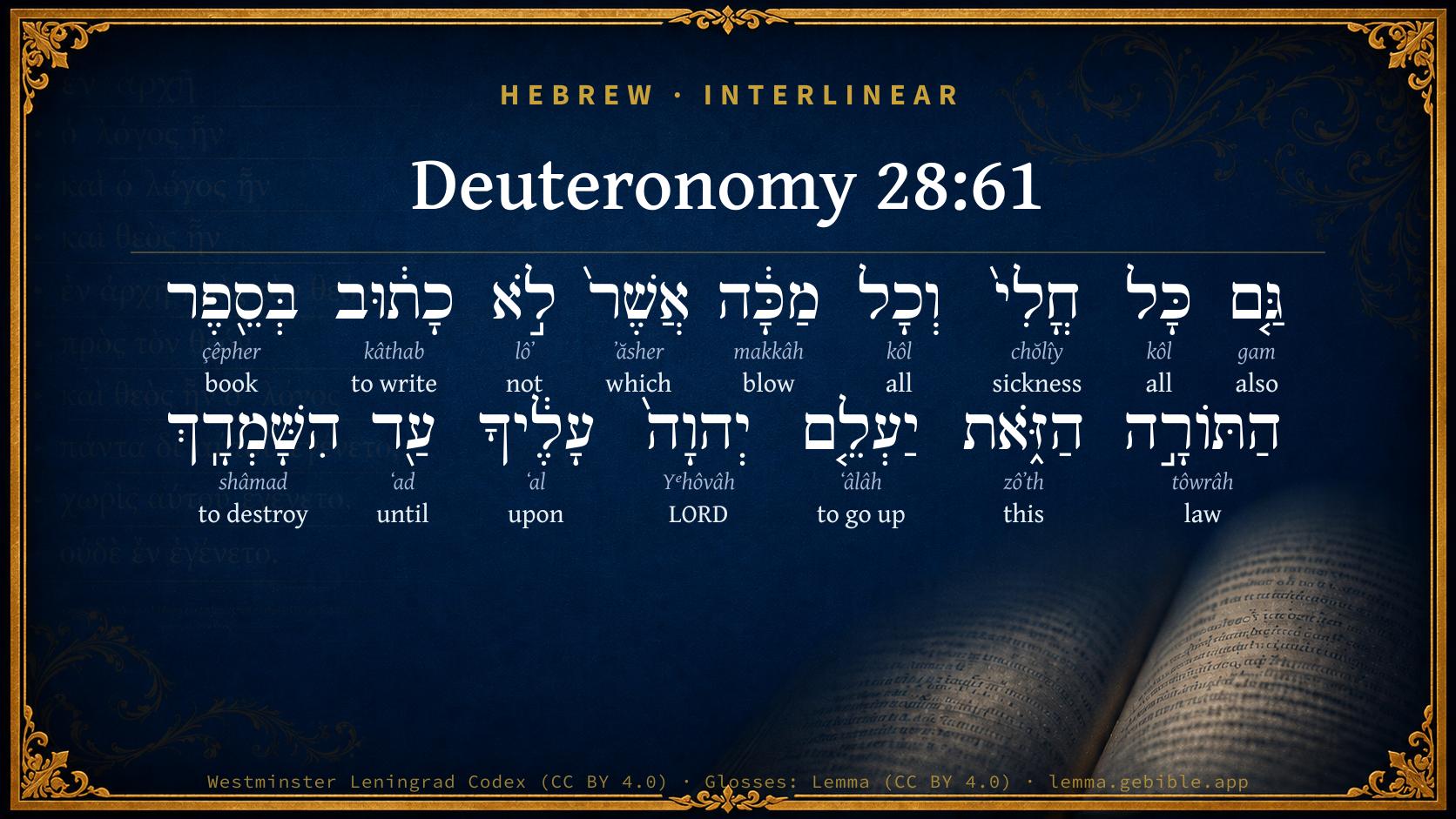
Hebrew (Westminster Leningrad Codex) Deuteronomy 28:61 appears in the Hebrew Old Testament. The text above is from the Westminster Leningrad Codex. Each word links to its Strong’s number, a concise gloss, and parsing drawn from the Open Scriptures Hebrew Bible morphology. Click any word for its full Brown-Driver-Briggs (BDB) entry.
Download image
Cite this verse

Deuteronomy 28:61 (World English Bible). Public Domain. Lemma interlinear Bible study tool, https://lemma.gebible.app/v/deuteronomy/28/61.

Show BibTeX & RIS
BibTeX
RIS
English Translation
Also every sickness, and every plague, which is not written in the book of this law, them will Yahweh bring on you, until you are destroyed.
World English Bible · Public Domain
Download a study sheet

One document with this verse’s original text, its word-by-word gloss line, the meaning frame, cross-references with their text, attributed commentary, and full source and license credits — printable, and it pastes into notes with its structure intact.

This verse Autodidact and up

Study sheet (.html) Plain text (.txt)

A passage Seminary Student

Up to 50 verses in one chapter. A passage sheet keeps up to 6 commentary sources and 12 cross-references per verse, in the order this page ranks them, and says so on the sheet whenever that leaves anything out. Ask for a single verse and you get the Autodidact verse sheet above.

Everything on this page stays free to read, with no account — the sheet is a download of what is already on screen, not access to it.

Want to remove ads? Support Godless Engineer
Compare translations 3

The same verse in 3 English versions, stacked beneath the original-language interlinear above. Click any original word for its lexicon entry.

Each is an independent rendering of the whole verse — the interlinear is not word-aligned to these translations.

Highlighted words mark where these versions differ — a whole-verse word diff, not a word-by-word alignment.

  • World English Bible Public Domain
    Also every sickness, and every plague, which is not written in the book of this law, them will Yahweh bring on you, until you are destroyed.
  • King James Version Public Domain
    Also every sickness, and every plague, which is not written in the book of this law, them will the LORD bring upon thee, until thou be destroyed.
  • unfoldingWord Literal Text CC BY-SA 4.0
    Also every sickness and every plague that not written in the scroll of this law, Yahweh will cause them to rise against you until you are destroyed.

unfoldingWord Literal Text — © unfoldingWord, licensed CC BY-SA 4.0. Word-aligned USFM3 via Door43 (git.door43.org/unfoldingWord/en_ult).

Versions to compare (up to 4)

3 of 4 selected

Show all 18 translations

Every available English version of this verse, each an independent rendering of the whole verse.

  • World English Bible Public Domain
    Also every sickness, and every plague, which is not written in the book of this law, them will Yahweh bring on you, until you are destroyed.
  • Berean Standard Bible Public Domain
    The LORD will also bring upon you every sickness and plague not recorded in this Book of the Law, until you are destroyed.
  • Majority Standard Bible Public Domain
    The LORD will also bring upon you every sickness and plague not recorded in this Book of the Law, until you are destroyed.
  • King James Version Public Domain
    Also every sickness, and every plague, which is not written in the book of this law, them will the LORD bring upon thee, until thou be destroyed.
  • American Standard Version (1901) Public Domain
    Also every sickness, and every plague, which is not written in the book of this law, them will Jehovah bring upon thee, until thou be destroyed.
  • Revised Version (1885) Public Domain
    Also every sickness, and every plague, which is not written in the book of this law, them will the LORD bring upon thee, until thou be destroyed.
  • Geneva Bible (1599) Public Domain
    And euery sickenesse, and euery plague, which is not written in the booke of this Lawe, will the Lord heape vpon thee, vntill thou be destroyed.
  • Douay-Rheims (1899) Public Domain
    Moreover the Lord will bring upon thee all the diseases, and plagues, that are not written in the volume of this law till he consume thee:
  • Young's Literal Translation Public Domain
    also every sickness and every stroke which is not written in the book of this law; Jehovah doth cause them to go up upon thee till thou art destroyed,
  • Literal Standard Version CC BY-SA 4.0
    Also every sickness and every stroke which is not written in the scroll of this law—YHWH causes them to go up on you until you are destroyed,
  • Unlocked Literal Bible CC BY-SA 4.0
    Also every sickness and plague that is not written in the book of this law, those also Yahweh will bring on you until you are destroyed.
  • unfoldingWord Literal Text CC BY-SA 4.0
    Also every sickness and every plague that not written in the scroll of this law, Yahweh will cause them to rise against you until you are destroyed.
  • Darby Bible Public Domain
    Also every sickness and every plague which is not written in the book of this law, them will Jehovah bring upon thee, until thou be destroyed.
  • World Messianic Bible Public Domain
    Also every sickness and every plague which is not written in the book of this law, the LORD will bring them on you until you are destroyed.
  • Webster's Bible Public Domain
    Also every sickness, and every plague which is not written in the book of this law, them will the LORD bring upon thee, until thou art destroyed.
  • Free Bible Version CC BY-SA 4.0
    The Lord will also give you every sickness and disease, even those not recorded in this Book of the Law, until you are destroyed.
  • Bible in Basic English Public Domain
    And all the diseases and the pains not recorded in the book of this law will the Lord send on you till your destruction is complete.
  • JPS Tanakh (1917) Public Domain
    Also every sickness, and every plague, which is not written in the book of this law, them will the LORD bring upon thee, until thou be destroyed.

Literal Standard Version (2020), Covenant Press — licensed CC BY-SA 4.0. Text via the HelloAO Bible API (eBible.org). Unlocked Literal Bible (unfoldingWord) — licensed CC BY-SA 4.0. Text via the HelloAO Bible API (eBible.org). unfoldingWord Literal Text — © unfoldingWord, licensed CC BY-SA 4.0. Word-aligned USFM3 via Door43 (git.door43.org/unfoldingWord/en_ult). Free Bible Version, Dr. Jonathan Gallagher — licensed CC BY-SA 4.0. Text via the HelloAO Bible API (eBible.org).

Word by word

More ways to search: Search by grammar → Find every occurrence → Compare this word →

Practice this passage: Drill this verse → Learn its vocabulary →

חֳלִי֙
chŏlîy
H2483
“sickness”
Noun, Common, Masculine, Singular, Absolute
Part of Speech
Noun
Type
Common
Gender
Masculine
Number
Singular
State
Absolute
Full BDB Definition

Origin: from H2470

TWOT: 655a

sickness
  1. גַּ֤ם gam H1571 “also” Particle, Accusative
  2. כָּל kôl H3605 “all of” Noun, Common, Masculine, Singular, Construct
  3. וְכָל kôl H3605 “and · all of” Conjunction + Noun, Common, Masculine, Singular, Construct
  4. מַכָּ֔ה makkâh H4347 “blow” Noun, Common, Feminine, Singular, Absolute
  5. אֲשֶׁר֙ ʼăsher H834 “which” Particle, Relative
  6. לֹ֣א lôʼ H3808 “not” Particle, Negative
  7. כָת֔וּב kâthab H3789 “written” Verb, Qal, Participle Passive, Masculine, Singular, Absolute
  8. בְּסֵ֖פֶר çêpher H5612 “in/at · book of” Preposition + Noun, Common, Masculine, Singular, Construct
  9. הַתּוֹרָ֣ה tôwrâh H8451 “the · law” Particle, Definite Article + Noun, Common, Feminine, Singular, Absolute
  10. הַזֹּ֑את zôʼth H2063 “the · this” Particle, Definite Article + Pronoun, Demonstrative, Feminine, Singular
  11. יַעְלֵ֤ם ʻâlâh H5927 “to go up · them” Verb, Hiphil, Imperfect, 3rd Person, Masculine, Singular + Suffix, Personal, 3rd Person, Masculine, Plural
  12. יְהוָה֙ Yᵉhôvâh H3068 “LORD” Noun, Proper
  13. עָלֶ֔יךָ ʻal H5921 “upon · you” Preposition + Suffix, Personal, 2nd Person, Masculine, Singular
  14. עַ֖ד ʻad H5704 “until” Preposition
  15. הִשָּׁמְדָֽךְ shâmad H8045 “to destroy · you” Verb, Niphal, Infinitive Construct + Suffix, Personal, 2nd Person, Feminine, Singular

About this verse

These counts appear in no published source. They are computed here, from the morphology-tagged text and Lemma’s own curated glosses. What Lemma adds →

16
words
15
distinct lemmas
Pentateuch
section

Notable vocabulary

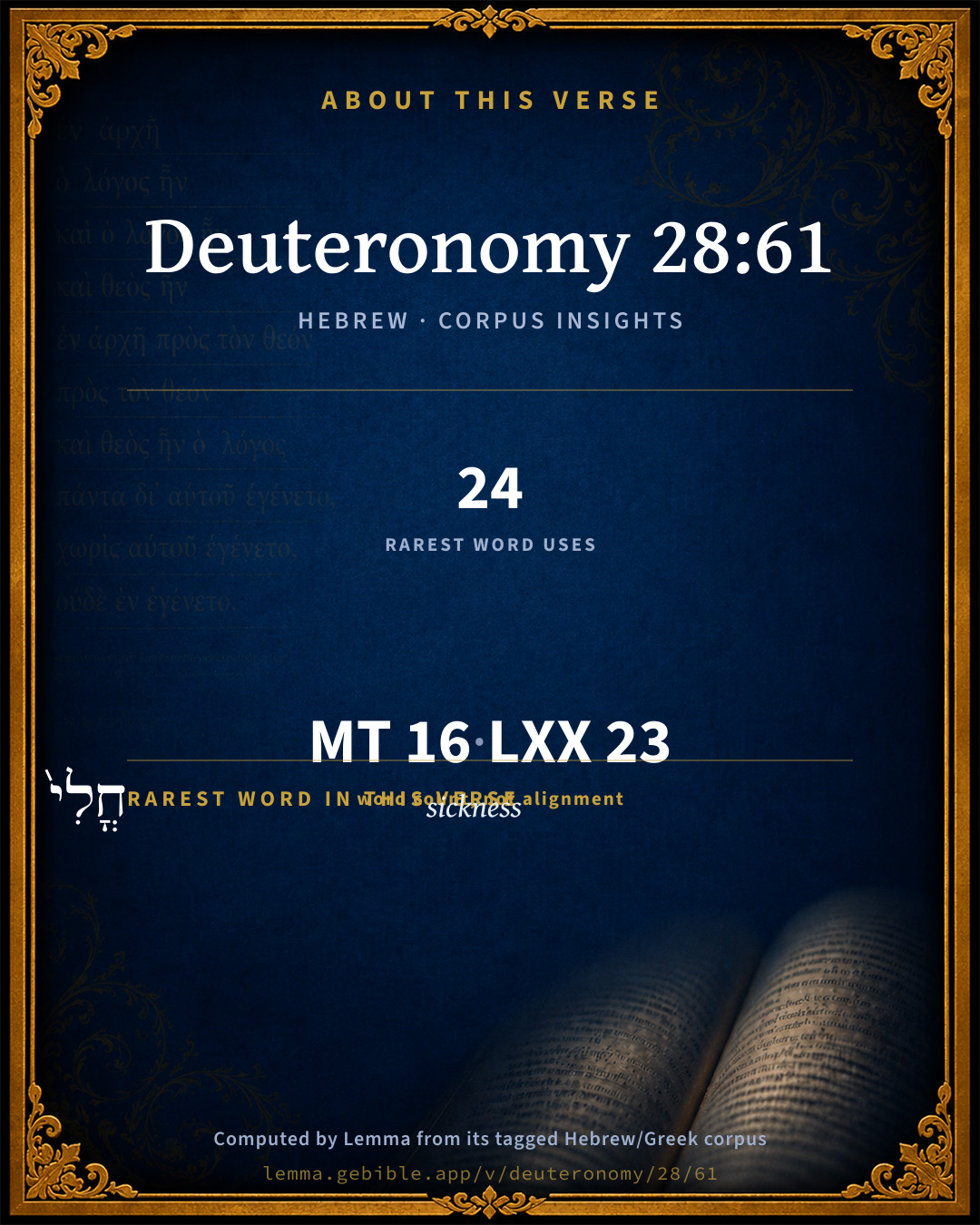
The rarest word here is חֳלִי֙ sickness H2483 — appearing just 24 times in the whole Hebrew Bible.

Shared distinctive vocabulary

חֳלִי֙ sickness H2483 occurs in 22 verses of the Hebrew Bible. Also found in:

Grammatical profile

  • 3 verbs
  • 7 nouns
  • 1 pronoun
  • 2 prepositions
  • 3 particles

Verb forms

  • כָת֔וּב Qal · Participle Passive
  • יַעְלֵ֤ם Hiphil · Imperfect
  • הִשָּׁמְדָֽךְ Niphal · Infinitive Construct

Repetition

A word recurs within this verse — often emphatic in Hebrew:

Hebrew & Septuagint length

In English translation the verse runs 26 words from the Hebrew and 34 from the Septuagint (LXX English) — closely comparable.

A rough comparison of the two English renderings, which tokenize alike — not a word-level alignment.

Word counts can differ between the Hebrew and the Greek without any difference in meaning — e.g. the Hebrew direct-object marker אֵת has no separate Greek word, and Greek often adds the article ὁ.

In the original languages it is 16 Hebrew tokens and 23 Greek tokens — but the two are counted differently (Hebrew bundles its prefixes and suffixes into one token; the Greek is in lemma form), so that isn’t a like-for-like length.

Cross-references

1

Topical passages linked to Deuteronomy 28:61 in the Treasury of Scripture Knowledge — connected by theme and wording, ordered by reader-vote popularity; previews shown in the World English Bible.

  • Deuteronomy 4:25–26 When you shall father children, and children's children, and you shall have been long in the land, and shall corrupt yourselves, and make an engraved image in the form of anything, and shall do that which is evil in the sight of Yahweh your God, to provoke him to anger;

Cross-references courtesy of OpenBible.info (CC BY 4.0).

Hebrew and Greek witnesses Masoretic Hebrew ↔ Greek Septuagint

The same verse in the two great witnesses to the Old Testament, shown verse-for-verse.

These are two independent witnesses, not word-aligned to each other, and the Septuagint is shown in lemma (dictionary) form.

Hebrew Deuteronomy 28:61 Masoretic · Westminster Leningrad Codex

גַּ֤ם כָּל חֳלִי֙ וְכָל מַכָּ֔ה אֲשֶׁר֙ לֹ֣א כָת֔וּב בְּסֵ֖פֶר הַתּוֹרָ֣ה הַזֹּ֑את יַעְלֵ֤ם יְהוָה֙ עָלֶ֔יךָ עַ֖ד הִשָּׁמְדָֽךְ

Also every sickness, and every plague, which is not written in the book of this law, them will Yahweh bring on you, until you are destroyed.

World English Bible · Public Domain

Greek LXX Deuteronomy 28:61 Septuagint · lemma form

καί πᾶς μαλακία καί πᾶς πληγή ὁ μή γράφω ἐν ὁ βιβλίον ὁ νόμος οὗτος ἐπιἄγω κύριος ἐπί σύ ἕως ἄν ἐκὀλεθρεύω σύ

And the Lord shall bring upon you every sickness, and every plague that is not written, and every one that is written in the book of this law, until he shall have destroyed you.

LXX2012 (modern English Septuagint) · Public Domain

Hebrew: Westminster Leningrad Codex (CC BY 4.0). Greek: Septuagint (public domain); English from LXX2012 (modern English Septuagint) (Public Domain). How the Septuagint differs from the Hebrew →

Targum (Aramaic paraphrase)

2

The Targum is the ancient Jewish Aramaic paraphrase of the Hebrew Scriptures — an interpretive translation, not the Hebrew text itself. Onkelos (literal) and Pseudo-Jonathan (expansive) render the Torah, and Jonathan the Prophets. Coverage is partial: where no permissively-licensed English translation exists for a verse, only the Aramaic is shown. This is verse-level text, not a word-by-word alignment to the Hebrew.

  1. Targum Onkelos Torah (Genesis–Deuteronomy)
    אַף כָּל מְרַע וְכָל מָחָא דִי לָא כְתִיבִין בְּסִפְרָא דְאוֹרַיְתָא הָדָא יַיְתִנוּן יְיָ עֲלָךְ עַד דְיִשְׁתֵּצָךְ

    (no public-domain English translation for this verse)

    Targum Onkelos — Aramaic: “Onkelos Genesis” (public domain); “Onkelos Exodus” (public domain); “Onkelos Leviticus” (public domain); “Onkelos Numbers” (public domain); “Onkelos Deuteronomy” (public domain). English: “Sefaria Community Translation” (CC0 1.0 (public-domain dedication)); “J.W. Etheridge. The Targums of Onkelos and Jonathan Ben Uzziel on the Pentateuch. London: Longmans, Green, 1862” (public domain). Text via Sefaria.

  2. Targum Pseudo-Jonathan Torah (Genesis–Deuteronomy)
    לְחוֹד כָּל מְרָא וְכָל מְחָא דְלָא כְּתִיבִין בְּסֵפֶר אוֹרַיְיתָא הָדֵין יַסְקִינוּן מֵימְרָא דַיְיָ עֲלֵיכוֹן עַד דְתִשְׁתֵּיצוּן

    and evils also that are not written in the book of this law will the Word of the Lord stir up against you until you are consumed.

    Targum Pseudo-Jonathan — Aramaic: “Targum Jonathan on Genesis” (public domain); “Targum Jonathan on Exodus” (public domain); “Targum Jonathan on Leviticus” (public domain); “Targum Jonathan on Numbers” (public domain); “Targum Jonathan on Deuteronomy” (public domain). English: “The Targum of Jonathan ben Uzziel, trans. J. W. Etheridge, London, 1862” (public domain). Text via Sefaria.

Commentary

Notes on Deuteronomy 28:61 from classic Christian and Jewish commentators (each source and its license shown beneath its notes). The classic Christian expositions comment on the surrounding passage and are grouped to its opening verse, so a note may address several verses; the Jewish commentaries on the Tanakh (Rashi and others) are per-verse, so they appear only where the commentator wrote on this verse.

Lemma curates 59 commentaries, every one of them public domain or Creative Commons licensed, each selected and text-cleaned for this edition rather than reprinted as found. About our sources →

Trapp's Complete Commentary

John Trapp

Deu 28:61 Also every sickness, and every plague, which [is] not written in the book of this law, them will the LORD bring upon thee, until thou be destroyed.

Ver. 61. Which is not written.] God hath treasuries of plagues, such as were never yet read of. Few years but bring forth new diseases, such as puzzle the best physicians.

John Trapp, A Commentary or Exposition upon All the Books of the Old and New Testament (1647–1656) — public domain. Text from a community e-Sword module.

Geneva Bible (1599)

Geneva Bible translators

Declaring, that God hath infinite means to plague the wicked, besides them that are ordinary or written.

Geneva Bible (1599) marginal notes — public domain. Text via Bolls.life.

Ellicott's Commentary for English Readers

(61) Every sickness and every plague (or “smiting;” Heb., Makkah) which is not written.—Well might the Apostle write, “It is a fearful thing to fall into the hands of the living God.”

A Bible Commentary for English Readers, edited by Charles John Ellicott (1878–1897) — public domain. Text from a community e-Sword module.

The Cambridge Bible for Schools and Colleges

gen. ed. J. J. S. Perowne

61. every sickness, etc.] Cp. Jer_6:7.

the book of this law] Heb. this Tôrah (see Deu_1:5, Deu_31:9) Elsewhere (Deu_29:21 (20), Deu_30:10, Deu_31:26, Jos_1:8) this book of the law.

until thou be destroyed] Deu_28:20; Deu_28:24; Deu_28:45; Deu_28:51.

The Cambridge Bible for Schools and Colleges (gen. ed. J. J. S. Perowne; Cambridge University Press, 1878–1918) — public domain. Text from a community e-Sword module.

John Gill's Exposition

And among these nations shalt thou find no ease, neither shall the sole of thy foot have rest,.... No quiet settlement, nor certain dwelling, being obliged to move from place to place through cruel edicts, heavy fines and mulcts, exorbitant taxes and impositions, and diligent search made after them by the courts of the inquisition, especially where any substance was to be gotten. The Jews themselves (t) own that this passage is now fulfilled in them:

but the Lord shall give thee there a trembling heart; being always in fear lest their persons should be seized on, their children taken from them, and their goods confiscated; hence the poet (u) gives them the epithet of "trembling":

and failing of eyes: in looking for a vainly expected Messiah, to deliver them from all their fears and troubles:

and sorrow of mind; under their present afflictions and calamities.

(t) Shebet Judah, p. 108, 109. Manasseh Ben Israel de Termino Vitae, l. 3. sect. 3. p. 132. (u) "----Judea tremens----". Juvenal, Satyr 6. v. 543.

John Gill's Exposition of the Whole Bible (1746–1763) — public domain (CC PDM 1.0). Text via the HelloAO Bible API.

Rashi

Rabbi Shlomo Yitzchaki (Rashi)

יעלם is a form from the root עלה (not from עלם).

Rashi on the Tanakh — English translations: “The Judaica Press complete Tanach with Rashi, translated by A. J. Rosenberg” (CC BY 4.0); “Pentateuch with Rashi's commentary by M. Rosenbaum and A.M. Silbermann, 1929-1934” (public domain); “The Metsudah Tanach series, Lakewood, N.J” (CC BY 4.0); and “The Book of Joshua, Metsudah Publications, 1997” (CC BY 4.0). Text via Sefaria.

Lesson kit

Teaching starters — assembled from the data on this page, not authored interpretation. Every prompt links to the verse data it draws on. Edit before teaching.

Deuteronomy, in the Pentateuch, opens this verse with 16 words (15 distinct Hebrew lemmas). Its most distinctive word is chŏlîy (“sickness”). A historical commentator’s framing appears above. Read the whole chapter for the surrounding context.

Discussion questions

  1. The word chŏlîy carries the sense “sickness.” How does it shape the verse?
  2. Deuteronomy 7:15 shares the word «sickness» with this verse. How do the two illuminate each other?
  3. “all” occurs 2× in this one verse. What is the effect of the repetition?
  4. These translations render this verse differently. What is at stake in choosing one wording over another?
  5. The verb «כָת֔וּב» is Qal Participle Passive. How does its form color the action?
  6. Reading how Trapp's Complete Commentary and Geneva Bible (1599) read this verse, where do the two commentators agree and where do they part?

Things to notice

Reading settings

Reading text

Shown beneath each verse's original-language words.

Old Testament
Old Testament edition

Read the OT as the Masoretic Hebrew (MT) or the Greek Septuagint (LXX).

English shown for the Greek Septuagint (in the Hebrew ↔ Greek comparison).

Comparing translations? Open the Compare panel on any verse page to stack up to four side by side.