
Exodus 33:15

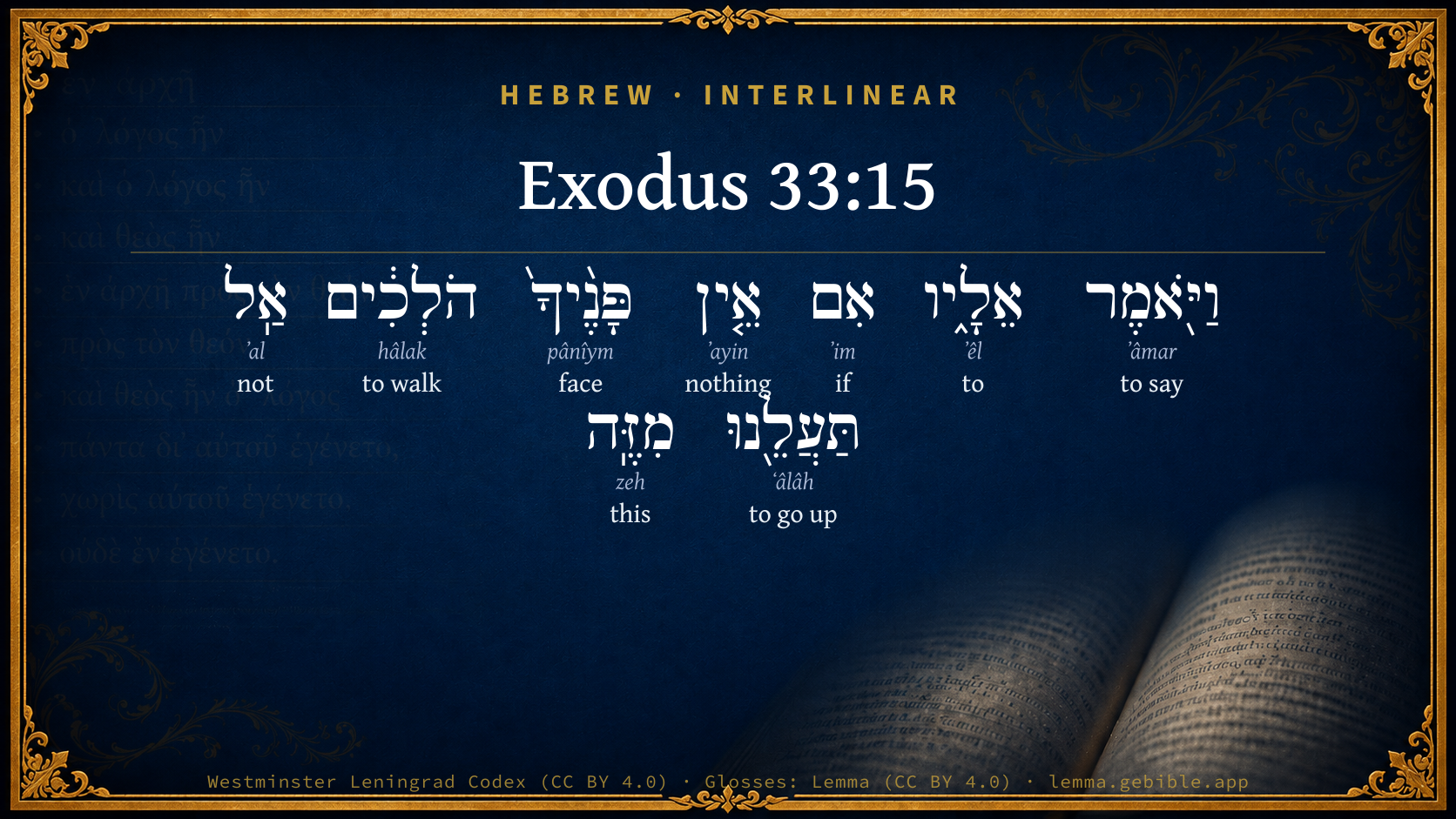
Hebrew (Westminster Leningrad Codex) Exodus 33:15 appears in the Hebrew Old Testament. The text above is from the Westminster Leningrad Codex. Each word links to its Strong’s number, a concise gloss, and parsing drawn from the Open Scriptures Hebrew Bible morphology. Click any word for its full Brown-Driver-Briggs (BDB) entry.
Download image
Cite this verse

Exodus 33:15 (World English Bible). Public Domain. Lemma interlinear Bible study tool, https://lemma.gebible.app/v/exodus/33/15.

Show BibTeX & RIS
BibTeX
RIS
English Translation
He said to him, "If your presence doesn't go with me, don't carry us up from here.
World English Bible · Public Domain
Download a study sheet

One document with this verse’s original text, its word-by-word gloss line, the meaning frame, cross-references with their text, attributed commentary, and full source and license credits — printable, and it pastes into notes with its structure intact.

This verse Autodidact and up

Study sheet (.html) Plain text (.txt)

A passage Seminary Student

Up to 50 verses in one chapter. A passage sheet keeps up to 6 commentary sources and 12 cross-references per verse, in the order this page ranks them, and says so on the sheet whenever that leaves anything out. Ask for a single verse and you get the Autodidact verse sheet above.

Everything on this page stays free to read, with no account — the sheet is a download of what is already on screen, not access to it.

Want to remove ads? Support Godless Engineer
Compare translations 3

The same verse in 3 English versions, stacked beneath the original-language interlinear above. Click any original word for its lexicon entry.

Each is an independent rendering of the whole verse — the interlinear is not word-aligned to these translations.

Highlighted words mark where these versions differ — a whole-verse word diff, not a word-by-word alignment.

  • World English Bible Public Domain
    He said to him, "If your presence doesn't go with me, don't carry us up from here.
  • King James Version Public Domain
    And he said unto him, If thy presence go not with me, carry us not up hence.
  • unfoldingWord Literal Text CC BY-SA 4.0
    And he said to him, “If your face not going, do not take us up from here.

unfoldingWord Literal Text — © unfoldingWord, licensed CC BY-SA 4.0. Word-aligned USFM3 via Door43 (git.door43.org/unfoldingWord/en_ult).

Versions to compare (up to 4)

3 of 4 selected

Show all 18 translations

Every available English version of this verse, each an independent rendering of the whole verse.

  • World English Bible Public Domain
    He said to him, "If your presence doesn't go with me, don't carry us up from here.
  • Berean Standard Bible Public Domain
    “If Your Presence does not go with us,” Moses replied, “do not lead us up from here.
  • Majority Standard Bible Public Domain
    “If Your Presence does not go with us,” Moses replied, “do not lead us up from here.
  • King James Version Public Domain
    And he said unto him, If thy presence go not with me, carry us not up hence.
  • American Standard Version (1901) Public Domain
    And he said unto him, If thy presence go not `with me', carry us not up hence.
  • Revised Version (1885) Public Domain
    And he said unto him, If thy presence go not with me, carry us not up hence.
  • Geneva Bible (1599) Public Domain
    Then he sayd vnto him, If thy presence go not with vs, cary vs not hence.
  • Douay-Rheims (1899) Public Domain
    And Moses said: If thou thyself dost not go before, bring us not out of this place.
  • Young's Literal Translation Public Domain
    And he saith unto Him, `If Thy presence is not going -- take us not up from this `place';
  • Literal Standard Version CC BY-SA 4.0
    And he says to Him, “If Your presence is not going—do not take us up from this [place];
  • Unlocked Literal Bible CC BY-SA 4.0
    Moses said to him, “If your presence does not go with us, do not take us up from here.
  • unfoldingWord Literal Text CC BY-SA 4.0
    And he said to him, “If your face not going, do not take us up from here.
  • Darby Bible Public Domain
    And he said to him, If thy presence do not go, bring us not up hence.
  • World Messianic Bible Public Domain
    Moses said to him, “If your presence doesn’t go with me, don’t carry us up from here.
  • Webster's Bible Public Domain
    And he said to him, If thy presence shall not attend me, conduct us not hence.
  • Free Bible Version CC BY-SA 4.0
    “If you don't go with us yourself, then please don't take us away from here,” Moses responded.
  • Bible in Basic English Public Domain
    And Moses said, If you yourself are not going with us, do not send us on from here.
  • JPS Tanakh (1917) Public Domain
    And he said unto Him: 'If Thy presence go not with me, carry us not up hence.

Literal Standard Version (2020), Covenant Press — licensed CC BY-SA 4.0. Text via the HelloAO Bible API (eBible.org). Unlocked Literal Bible (unfoldingWord) — licensed CC BY-SA 4.0. Text via the HelloAO Bible API (eBible.org). unfoldingWord Literal Text — © unfoldingWord, licensed CC BY-SA 4.0. Word-aligned USFM3 via Door43 (git.door43.org/unfoldingWord/en_ult). Free Bible Version, Dr. Jonathan Gallagher — licensed CC BY-SA 4.0. Text via the HelloAO Bible API (eBible.org).

Word by word

More ways to search: Search by grammar → Find every occurrence → Compare this word →

Practice this passage: Drill this verse → Learn its vocabulary →

הֹלְכִ֔ים
hâlak
H1980
“walking”
Verb, Qal, Participle Active, Masculine, Plural, Absolute
Part of Speech
Verb
Stem
Qal
Form
Participle Active
Gender
Masculine
Number
Plural
State
Absolute
Full BDB Definition

Origin: akin to H3212 , a primitive root

TWOT: 498

to go, walk, come - (Qal) - to go, walk, come, depart, proceed, move, go away - to die, live, manner of life (figuratively) - (Piel) - to walk - to walk (figuratively) - (Hithpael) - to traverse - to walk about - (Niphal) to lead, bring, lead away, carry, cause to walk
  1. וַיֹּ֖אמֶר ʼâmar H559 “and · to say” Conjunction + Verb, Qal, Sequential Imperfect, 3rd Person, Masculine, Singular
  2. אֵלָ֑יו ʼêl H413 “to · him” Preposition + Suffix, Personal, 3rd Person, Masculine, Singular
  3. אִם ʼim H518 “if” Conjunction
  4. אֵ֤ין ʼayin H369 “nothing” Particle, Negative
  5. פָּנֶ֨יךָ֙ pânîym H6440 “face(s) · your” Noun, Common, Both, Plural, Construct + Suffix, Personal, 2nd Person, Masculine, Singular
  6. אַֽל ʼal H408 “not” Particle, Negative
  7. תַּעֲלֵ֖נוּ ʻâlâh H5927 “to go up · us” Verb, Hiphil, Jussive, 2nd Person, Masculine, Singular + Suffix, Personal, 1st Person, Common, Plural
  8. מִזֶּֽה zeh H2088 “from · this” Preposition + Pronoun, Demonstrative, Masculine, Singular

About this verse

These counts appear in no published source. They are computed here, from the morphology-tagged text and Lemma’s own curated glosses. What Lemma adds →

9
words
9
distinct lemmas
Pentateuch
section

Grammatical profile

  • 3 verbs
  • 1 noun
  • 1 pronoun
  • 1 preposition
  • 1 conjunction
  • 2 particles

Verb forms

  • וַיֹּ֖אמֶר Qal · Sequential Imperfect
  • הֹלְכִ֔ים Qal · Participle Active
  • תַּעֲלֵ֖נוּ Hiphil · Jussive

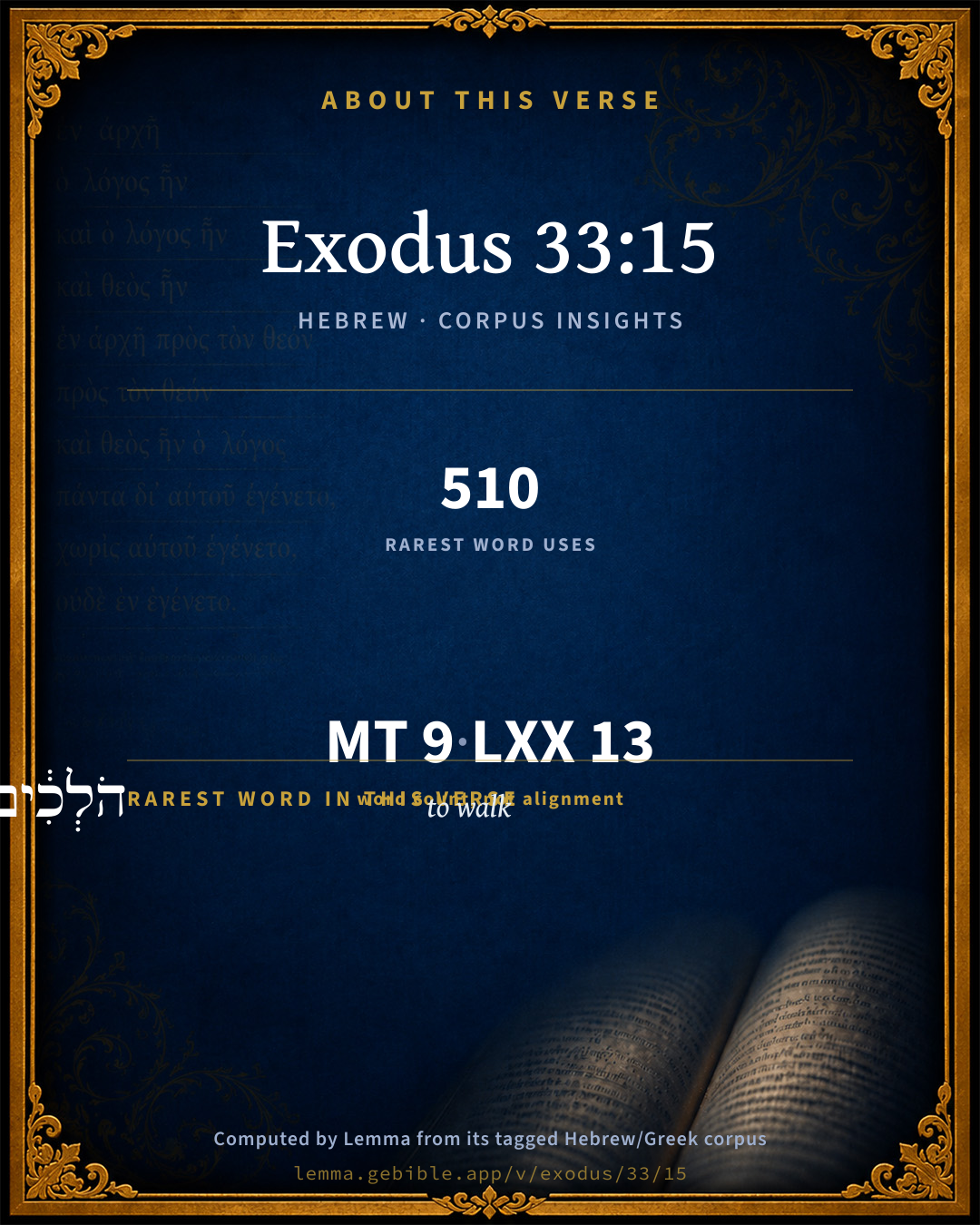
Hebrew & Septuagint length

In English translation the verse runs 17 words from the Hebrew and 18 from the Septuagint (LXX English) — closely comparable.

A rough comparison of the two English renderings, which tokenize alike — not a word-level alignment.

Word counts can differ between the Hebrew and the Greek without any difference in meaning — e.g. the Hebrew direct-object marker אֵת has no separate Greek word, and Greek often adds the article ὁ.

In the original languages it is 9 Hebrew tokens and 13 Greek tokens — but the two are counted differently (Hebrew bundles its prefixes and suffixes into one token; the Greek is in lemma form), so that isn’t a like-for-like length.

Cross-references

3

Topical passages linked to Exodus 33:15 in the Treasury of Scripture Knowledge — connected by theme and wording, ordered by reader-vote popularity; previews shown in the World English Bible.

  • Exodus 34:9 He said, "If now I have found favor in your sight, Lord, please let the Lord go in the midst of us; although this is a stiff-necked people; pardon our iniquity and our sin, and take us for your inheritance."
  • Psalms 4:6 Many say, "Who will show us any good?" Yahweh, let the light of your face shine on us.
  • Exodus 33:3 to a land flowing with milk and honey: for I will not go up in the midst of you, for you are a stiff-necked people, lest I consume you in the way."

Cross-references courtesy of OpenBible.info (CC BY 4.0).

Hebrew and Greek witnesses Masoretic Hebrew ↔ Greek Septuagint

The same verse in the two great witnesses to the Old Testament, shown verse-for-verse.

These are two independent witnesses, not word-aligned to each other, and the Septuagint is shown in lemma (dictionary) form.

Hebrew Exodus 33:15 Masoretic · Westminster Leningrad Codex

וַיֹּ֖אמֶר אֵלָ֑יו אִם אֵ֤ין פָּנֶ֨יךָ֙ הֹלְכִ֔ים אַֽל תַּעֲלֵ֖נוּ מִזֶּֽה

He said to him, "If your presence doesn't go with me, don't carry us up from here.

World English Bible · Public Domain

Greek LXX Exodus 33:15 Septuagint · lemma form

καί λέγω πρός αὐτός εἰ μή αὐτός σύ πορεύομαι μή ἐγώ ἀναἄγω ἐντεῦθεν

And he says to him, If you go not up with us yourself, bring me not up hence.

LXX2012 (modern English Septuagint) · Public Domain

Hebrew: Westminster Leningrad Codex (CC BY 4.0). Greek: Septuagint (public domain); English from LXX2012 (modern English Septuagint) (Public Domain). How the Septuagint differs from the Hebrew →

Targum (Aramaic paraphrase)

2

The Targum is the ancient Jewish Aramaic paraphrase of the Hebrew Scriptures — an interpretive translation, not the Hebrew text itself. Onkelos (literal) and Pseudo-Jonathan (expansive) render the Torah, and Jonathan the Prophets. Coverage is partial: where no permissively-licensed English translation exists for a verse, only the Aramaic is shown. This is verse-level text, not a word-by-word alignment to the Hebrew.

  1. Targum Onkelos Torah (Genesis–Deuteronomy)
    וַאֲמַר קֳדָמוֹהִי אִם לֵית שְׁכִנְתָּךְ מֵהַלְכָא בֵינָנָא לָא תַסְקִינָנָא מִכָּא:

    (no public-domain English translation for this verse)

    Targum Onkelos — Aramaic: “Onkelos Genesis” (public domain); “Onkelos Exodus” (public domain); “Onkelos Leviticus” (public domain); “Onkelos Numbers” (public domain); “Onkelos Deuteronomy” (public domain). English: “Sefaria Community Translation” (CC0 1.0 (public-domain dedication)); “J.W. Etheridge. The Targums of Onkelos and Jonathan Ben Uzziel on the Pentateuch. London: Longmans, Green, 1862” (public domain). Text via Sefaria.

  2. Targum Pseudo-Jonathan Torah (Genesis–Deuteronomy)
    וַאֲמַר לֵיהּ אִין לֵית אַפִּין מְהַלְכָא מִינָנָא לָא תְסַלְקִינָנָא מִיכָּא בִּסְבַר אַפִּין דְּרוּגְזָא

    And he said to Him, If Thy wrath go not from us, suffer us not to go up from hence under the frown of Thy displeasure.

    Targum Pseudo-Jonathan — Aramaic: “Targum Jonathan on Genesis” (public domain); “Targum Jonathan on Exodus” (public domain); “Targum Jonathan on Leviticus” (public domain); “Targum Jonathan on Numbers” (public domain); “Targum Jonathan on Deuteronomy” (public domain). English: “The Targum of Jonathan ben Uzziel, trans. J. W. Etheridge, London, 1862” (public domain). Text via Sefaria.

Commentary

Notes on Exodus 33:15 from classic Christian and Jewish commentators (each source and its license shown beneath its notes). The classic Christian expositions comment on the surrounding passage and are grouped to its opening verse, so a note may address several verses; the Jewish commentaries on the Tanakh (Rashi and others) are per-verse, so they appear only where the commentator wrote on this verse.

Lemma curates 59 commentaries, every one of them public domain or Creative Commons licensed, each selected and text-cleaned for this edition rather than reprinted as found. About our sources →

Trapp's Complete Commentary

John Trapp

Exo 33:15 And he said unto him, If thy presence go not [with me], carry us not up hence.

Ver. 15. If thy presence go not with me.] What is it to have the air without light? What was all Mordecai’s honour to him when the king frowned upon him?

John Trapp, A Commentary or Exposition upon All the Books of the Old and New Testament (1647–1656) — public domain. Text from a community e-Sword module.

The Biblical Illustrator

Joseph S. Exell

Exo_33:15-17

If Thy presence go not with me, carry us not up hence.

The withdrawal of Gods presence deprecated

What was the special grace desired by Moses in these memorable words? What withdrawal of honour and privilege was threatened? If we had only this chapter, we might infer that the difference in Gods future dealings with Israel would be, that He would henceforth commit them to the care of an angel--some messenger of His providence less holy than Himself--and that the honour and privilege which His personal presence implied would be withdrawn (Exo_33:1-3). Apart, however, from the fact that it is difficult to conceive of any real difference between Gods personal and instrumental superintendence, we no sooner turn our attention to the account of His proposed dealings with Israel before they fell into the idolatry of the golden calf, than we find that the handing over of the command of their hosts to an angel could not have been the change of treatment that filled Moses with such dismay. There is no warrant for the supposition that the angel of this chapter is an inferior being to the angel of the Divine presence spoken of in chap. 33. Indeed, there can be no reasonable doubt that when God says, Must My presence (literally, My face) go with thee, that I may give thee rest? the reference is to the angel in whom Gods name was, and whose visible symbol was the pillar of cloud and of fire. And of course the reference will be the same in Moses reply: If Thy presence go not, etc. What, then, was the grace which God proposed to withdraw from Israel? By their shameful apostasy after the manifestation of the Divine glory at Sinai, they had shown that the grandest and most awful signs of the Divine Majesty could easily be forgotten; and it really seemed that the presence of the pillar of cloud and of fire in their midst would not, when once it should become familiar, deter them from rebellion. It would be better not to give them the opportunity of openly insulting the Divine Majesty. A grace which failed to inspire awe would inevitably harden. God intimated, therefore, that the angel of His face, instead of having His holy tent in the midst of the tents of the congregation, should simply go before them to prepare their way. If, now, we look at Exo_29:42-45, we shall see of what they would be deprived by the threatened change in Gods dealings. Evidently they would lose the sanctuary which was to be their peculiar glory. To the nations they would appear a people that not only had no visible God, but no public religious rites. Moses, their leader, instead of being able to commune with God and ask counsel of Him, would be left to the guidance of his own sagacity. The Children of Israel could not come to inquire of God; no atonement could be carried into the presence of His mercy-seat; and no blessing could be spoken by the priests, conveying peace to the hearts of the thousands of Israel. They were to be left to follow their own desires and the counsels of their own hearts. God would fill them with their own ways. Only His providence engaged to direct their path and prepare their way to enter the Promised Land. The effect of this terrible reservation in the conditions on which God pardoned their apostasy, would have resembled the effect of a papal interdict in mediaeval times, when nations were denied the public offices of religion and shut up to a life almost without God in the world. It was this terrible prospect that called forth Moses passionate entreaty, If Thy presence go not with us, carry us not up hence. Better that we should remain in the wilderness, better that we should die where we are, than live under such perpetual discouragement, so manifestly forsaken of God! The lesson God desired to teach was conveyed by the mere threatening, and, in answer to the intercession of Moses, He consents to the construction and erection of the Sanctuary. When completed, He solemnly took possession of it, and Jehovahs sacred tent became the visible centre of the camp of Israel (Exo_40:34-38). The application of this incident is obvious, though, since we live under a new and better covenant, we are in a somewhat different case from the children of Israel. The Shekinah has been set up in the family of man, and can never be removed. Immanuel, God with us, is the imperishable possession of the human family. Atonement for the sins of mankind has been made; Divine forgiveness has been pronounced; God and man are reconciled. The question for us is, Are we content to live without a personal sense of the Divine presence, without tasting for ourselves that the Lord is gracious, without seeking counsel and guidance from the oracles of God and obtaining answers of peace to our prayers? Does a life of practical atheism seem to us something too terrible to be endured? Would an interdict of our sanctuary services, a prohibition laid upon private prayer, a withdrawal of Divine promises, fill us with heart-felt dismay? (E. W. Shalders, B.A.)

The Biblical Illustrator, edited by Joseph S. Exell (c. 1880s–1900s) — public domain. Text from a community e-Sword module.

Joseph Benson's Commentary

Exo 33:15-16. If thy presence go not with me, carry us not up hence — Let us rather live and die in the wilderness, with thy presence and favour, than go into Canaan without it; for even that promise of rest I regard not unless thou be with us, and accept us. Thus he shows how highly he valued the special presence of God. He dreaded the very thought of going forward without it. For wherein shall it be known — To the nations that have their eyes upon us, and to future ages: by what other token shall it be manifest to them; that I and thy people have found grace in thy sight? — That we really are thy people, and under thy peculiar protection and care? Is it not that thou goest with us? — Can any thing short of this answer this end? So shall we be separated, I and thy people — Distinguished by thy peculiar kindness, and the privileges vouchsafed to us; or shall be made wonderful, eminent, and glorious, (as the word נפלינו, niphlinu, rather means,) above all other people.

Joseph Benson's Commentary on the Old and New Testaments (1811–1818) — public domain. Text from a community e-Sword module.

Tyndale Open Study Notes

Tyndale Open Resources

33:15-16 Moses made his request even more direct. Again he showed his understanding of what God was doing. The Exodus was not merely about getting the Israelites out of Egypt so they could go to Canaan. It was about a personal experience of God that would change how they lived. If that was not possible, then they might just as well have stayed at Sinai. Going on to Canaan would be disastrous without the Lord.

Tyndale Open Study Notes — © Tyndale Open Resources, licensed CC BY-SA 4.0. Text via the HelloAO Bible API.

Adam Clarke's Commentary

Verse 15. If thy presence go not] אם אין פניך הלכים im ein pancycha holechim, if thy faces do not go - if we have not manifestations of thy peculiar providence and grace, carry us not up hence. Without supernatural assistance, and a most particular providence, he knew that it would be impossible either to govern such a people, or support them in the desert; and therefore he wishes to be well assured on this head, that he may lead them up with confidence, and be able to give them the most explicit assurances of support and protection. But by what means should these manifestations take place? This question seems to be answered by the Prophet Isaiah, Isa 63:9: In all their affliction he was afflicted, and the Angel of his presence (פניו panaiv, of his faces) saved them. So we find that the goodness and mercy of God were to be manifested by the Angel of the Covenant, the Lord Jesus, the Messiah; and this is the interpretation which the Jews themselves give of this place. Can any person lead men to the typical Canaan, who is not himself influenced and directed by the Lord? And of what use are all the means of grace, if not crowned with the presence and blessing of the God of Israel? It is on this ground that Jesus Christ hath said, Where two or three are gathered together in my name, I am in the midst of them, Mt 18:20; without which, what would preachings, prayers, and even SACRAMENTS avail?

Adam Clarke's Commentary on the Bible (1810–1826) — public domain. Text from a community e-Sword/MySword module.

The Cambridge Bible for Schools and Colleges

gen. ed. J. J. S. Perowne

15. Moses replies that if Jehovah will not go with them, they prefer to remain where they are, in the neighbourhood of their God (Exo_19:4), at Sinai.

The Cambridge Bible for Schools and Colleges (gen. ed. J. J. S. Perowne; Cambridge University Press, 1878–1918) — public domain. Text from a community e-Sword module.

John Gill's Exposition

And he said unto him,.... Moses said unto the Lord:

if thy presence go not with me; or with us, as it may be as well supplied, and which agrees with what follows:

carry us not up hence; from the mount to the land of Canaan; though God had promised his presence, which was the thing requested, Moses could not forbear expressing himself after this manner, to show the high esteem he had of this blessing, and how worthless and insignificant everything else was without it; that even Canaan, the land of rest promised, was nothing in comparison of it: it is not much matter where we are, or what we have, if God is not with us; but if he grants his presence, the greatest hardships in a wilderness are made easy, and difficulties are got through with pleasure; though some read the words in the preceding verse by way of interrogation, "should my face" or "presence go", and "should it give thee rest" (z)? as carrying in it a kind of denial, which makes Moses here more urgent for it, and such a version those words seem to require.

(z) "An facies mea iret et quietem daret tibi?" Noldius, p. 243. so Junius & Tremellius, Piscator.

John Gill's Exposition of the Whole Bible (1746–1763) — public domain (CC PDM 1.0). Text via the HelloAO Bible API.

Haydock's Catholic Bible Commentary

Thyself. Moses desires a farther explanation, or a positive assurance that God would conduct them. --- By all, ab omnibus, distinguished in glory from all others. (Chaldean)

George Leo Haydock (1774–1849), Haydock's Catholic Family Bible and Commentary, 1859 edition — public domain. Excludes Psalms (Douay-Rheims chapter numbering differs from Protestant) and Deuterocanonical books (Catholic canon only).

Matthew Poole's English Annotations

Let us rather live and die in the wilderness with thy presence and favour, than go into Canaan without it; for even that promise of rest I value not without thy presence. So he echoes back God’s words to himself, and turns God’s promise into a prayer.

Matthew Poole's English Annotations on the Holy Bible (1683–1685) — public domain. Text from a community e-Sword/MySword module.

The Pulpit Commentary

Vers. 15, 16And he said. Still Moses is not quite satisfied. God had said will give thee rest not "I will give you rest." Moses must see distinctly that the people are associated with him before he desists. So he replies thy presence go not up, carry us not up hence. For wherein shall it be known that I and thy people have found grace in thy sight? Is it not in that thou goest with us?" The reply in ver. 17 sets his doubt finally at rest.

The Pulpit Commentary (1880–1919), ed. H.D.M. Spence-Jones & Joseph S. Exell — public domain. Text from a community e-Sword module.

John Wesley's Explanatory Notes

And he said, If thy presence go not with me, carry us not up hence - He speaks as one that dreaded the thought of going forward without God's presence.

John Wesley, Explanatory Notes Upon the Whole Bible (1754–1765) — public domain. Text via the GEBible commentary corpus.

Rashi

Rabbi Shlomo Yitzchaki (Rashi)

‎ויאמר אליו AND HE SAID UNTO HIM — This is what I desired: for if it is to be by an angel rather do not bring us up from here.

Rashi on the Tanakh — English translations: “The Judaica Press complete Tanach with Rashi, translated by A. J. Rosenberg” (CC BY 4.0); “Pentateuch with Rashi's commentary by M. Rosenbaum and A.M. Silbermann, 1929-1934” (public domain); “The Metsudah Tanach series, Lakewood, N.J” (CC BY 4.0); and “The Book of Joshua, Metsudah Publications, 1997” (CC BY 4.0). Text via Sefaria.

Ramban (Nachmanides)

Rabbi Moshe ben Nachman (Ramban / Nachmanides)

AND HE [Moses] SAID UNTO HIM: IF ‘PANECHA’ (THY PRESENCE) GO NOT WITH ME, CARRY US NOT UP HENCE. The meaning thereof according to Rashi is as follows: “This is what I desired, for if it be by an angel, rather do not carry us up from here.” But G-d forbid! that Moses should say, If Thy presence go not, after he had already been promised, My presence shall go!And Rabbi Abraham ibn Ezra explained that G-d said to Moses: “I Myself will go, and only you will I give rest, for only with you will I go [but I will not dwell in the midst of the people].” But Moses replied: “If Your presence does not go with the whole nation, carry us not up hence.” This is why Moses used the plural, “carry us up.” But this interpretation too, does not fit the verses properly. For Moses said at first, Thou hast not let me know whom Thou wilt send with me — in the singular. Now even at the time of G-d’s good-will, before the sin [with the golden calf occurred], He also said, Behold, I send an angel before thee, to keep thee by the way, and to bring thee into the place which I have prepared, [and yet this promise too is expressed in the singular — to Moses]! And if you will say that the singular there [before ‘thee’, to keep ‘thee’ etc.] refers to Israel [as one unit], then here also it could be explained to refer to all Israel! Besides, if it is so [as Ibn Ezra interpreted], that Moses requested of G-d that He inform him who is the angel He would send with him, then we see that Moses was satisfied with the angel, concerning whom it is said, for My Name is in him, 23:21. and G-d answered him with a double, and redoubled, beneficence, over and above that which he had asked for — that He Himself would go!But this section of Scripture cannot possibly be grasped by one who has not heard the secrets of the Torah. The following is its meaning by way of the Truth. Moses said, and Thou hast not let me know who is the angel Thou wilt send with me, and he requested that He fulfill two things He had said to him: firstly, that I know thee by Name, meaning [G-d said to Moses] that “I will be known to you by My [Great] Name, for your sake” [and this was now Moses’ request, that he be not divested of this highest degree of prophecy on account of the incident of the calf]. It is possible that the phrase, yet Thou hast said, [I know thee by Name], is based upon what He had said to Moses [with reference to the patriarchs], but by My Name the Eternal I made Me not known to them, as I have explained [there]. And secondly Moses had been told: and thou hast also found grace in My sight, meaning that he will find grace, which is the cleaving of knowledge. (Abusaula). And Moses continued, Now therefore, I pray Thee, if I have found grace in Thy sight, in the attribute of justice, show me now the paths of the ways even as Thou art known by Thy Name, that I may know Thee to declare Thy Unity, to the end that I may find the great grace; and consider that this nation is Thy people — Thou art their Father, and they are Thy children. It is this that Onkelos intended in translating the verse thus: “make me then know the path of Thy goodness to the end that I may know Thy mercy.” Then the Holy One, blessed be He, answered him, My presence shall go — the messenger of the covenant, whom ye delight in, for in him My presence will be seen, since it is with reference to him that it is said, in an acceptable time have I answered thee; for My Name is in him., 23:21. ‘Vahanichothi lach’ (and I will give thee rest) through him, that he should not conduct himself towards you with the stringent attribute of justice but with the measure which is inclusive of the attribute of mercy, the usage [of the word vahanichothi] being associated with the expression, Therefore it shall be ‘b’haniyach’ (when) the Eternal thy G-d (hath given thee rest) from all thine enemies. This is similar to that which is said, Thus shall Mine anger spend itself, ‘vahanichothi’ (and I will satisfy) My fury upon them. Then Moses answered, If Thy presence — Thou Thyself and in Thy Glory — go not, carry us not up hence, for Thou art to be with us face to face, for such were the conditions [as mentioned] in the section of Va’eira. Likewise Moses mentioned above, with great power and with a mighty hand, 32:11. and so now too he asked that He bring them to the Land with great power and with a mighty hand, just as He took them out with them from Egypt.

Ramban (Nachmanides) on the Tanakh — English translation: “Commentary on the Torah by Ramban (Nachmanides). Translated and annotated by Charles B. Chavel. New York, Shilo Pub. House, 1971-1976” (CC BY 4.0). Text via Sefaria.

Sforno

Rabbi Ovadia Sforno

To this Moshe protested, “If your Presence does not go with us”—i.e. if it does not dwell in our midst—

“do not make us leave this place.” We would rather remain in the desert than enter the Holy Land unaccompanied by Your Shechinah, for without it we would undoubtedly incur exile in just a short while.

Sforno on the Tanakh — English translation: “Yalkut, Sifsei Chachomim Chumash, Metsudah Publications, 2009” (CC BY 4.0). Text via Sefaria.

Lesson kit

Teaching starters — assembled from the data on this page, not authored interpretation. Every prompt links to the verse data it draws on. Edit before teaching.

Exodus, in the Pentateuch, opens this verse with 9 words (9 distinct Hebrew lemmas). Its most distinctive word is hâlak (“to walk”). A historical commentator’s framing appears above. Read the whole chapter for the surrounding context.

Discussion questions

  1. How does “to walk” (hâlak) shape what this verse is saying?
  2. Exodus 34:9 shares this passage’s theme. How do the two illuminate each other?
  3. The translations on this page render this verse differently — a whole-verse word diff, not a word-by-word alignment. What might account for the different wordings?
  4. The verb «וַיֹּ֖אמֶר» is Qal Sequential Imperfect. How does its form color the action?
  5. Reading how Trapp's Complete Commentary and The Biblical Illustrator read this verse, where do the two commentators agree and where do they part?

Things to notice

Reading settings

Reading text

Shown beneath each verse's original-language words.

Old Testament
Old Testament edition

Read the OT as the Masoretic Hebrew (MT) or the Greek Septuagint (LXX).

English shown for the Greek Septuagint (in the Hebrew ↔ Greek comparison).

Comparing translations? Open the Compare panel on any verse page to stack up to four side by side.