
Judges 15:13

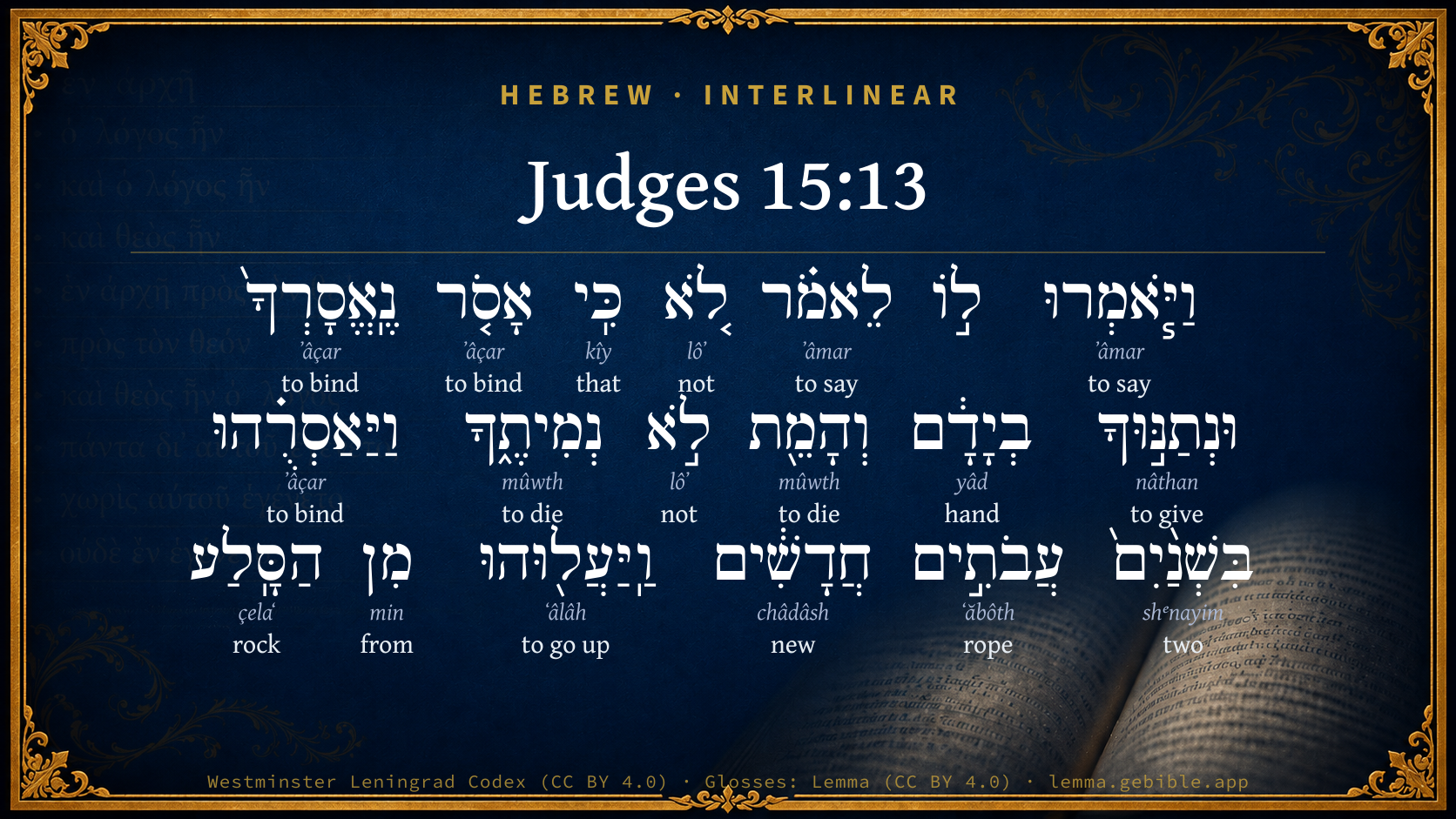
Hebrew (Westminster Leningrad Codex) Judges 15:13 appears in the Hebrew Old Testament. The text above is from the Westminster Leningrad Codex. Each word links to its Strong’s number, a concise gloss, and parsing drawn from the Open Scriptures Hebrew Bible morphology. Click any word for its full Brown-Driver-Briggs (BDB) entry.
Download image
Cite this verse

Judges 15:13 (World English Bible). Public Domain. Lemma interlinear Bible study tool, https://lemma.gebible.app/v/judges/15/13.

Show BibTeX & RIS
BibTeX
RIS
English Translation
They spoke to him, saying, No; but we will bind you fast, and deliver you into their hand: but surely we will not kill you. They bound him with two new ropes, and brought him up from the rock.
World English Bible · Public Domain
Download a study sheet

One document with this verse’s original text, its word-by-word gloss line, the meaning frame, cross-references with their text, attributed commentary, and full source and license credits — printable, and it pastes into notes with its structure intact.

This verse Autodidact and up

Study sheet (.html) Plain text (.txt)

A passage Seminary Student

Up to 50 verses in one chapter. A passage sheet keeps up to 6 commentary sources and 12 cross-references per verse, in the order this page ranks them, and says so on the sheet whenever that leaves anything out. Ask for a single verse and you get the Autodidact verse sheet above.

Everything on this page stays free to read, with no account — the sheet is a download of what is already on screen, not access to it.

Want to remove ads? Support Godless Engineer
Compare translations 3

The same verse in 3 English versions, stacked beneath the original-language interlinear above. Click any original word for its lexicon entry.

Each is an independent rendering of the whole verse — the interlinear is not word-aligned to these translations.

Highlighted words mark where these versions differ — a whole-verse word diff, not a word-by-word alignment.

  • World English Bible Public Domain
    They spoke to him, saying, No; but we will bind you fast, and deliver you into their hand: but surely we will not kill you. They bound him with two new ropes, and brought him up from the rock.
  • King James Version Public Domain
    And they spake unto him, saying, No; but we will bind thee fast, and deliver thee into their hand: but surely we will not kill thee. And they bound him with two new cords, and brought him up from the rock.
  • unfoldingWord Literal Text CC BY-SA 4.0
    And they spoke to him, saying, “No, but binding, we will bind you and we will give you into their hand, but putting to death, we will not put you to death.” Then they bound him with two new ropes and brought him up from the rock.

unfoldingWord Literal Text — © unfoldingWord, licensed CC BY-SA 4.0. Word-aligned USFM3 via Door43 (git.door43.org/unfoldingWord/en_ult).

Versions to compare (up to 4)

3 of 4 selected

Show all 18 translations

Every available English version of this verse, each an independent rendering of the whole verse.

  • World English Bible Public Domain
    They spoke to him, saying, No; but we will bind you fast, and deliver you into their hand: but surely we will not kill you. They bound him with two new ropes, and brought him up from the rock.
  • Berean Standard Bible Public Domain
    “No,” they answered, “we will not kill you, but we will tie you up securely and hand you over to them.” So they bound him with two new ropes and led him up from the rock.
  • Majority Standard Bible Public Domain
    “No,” they answered, “we will not kill you, but we will tie you up securely and hand you over to them.” So they bound him with two new ropes and led him up from the rock.
  • King James Version Public Domain
    And they spake unto him, saying, No; but we will bind thee fast, and deliver thee into their hand: but surely we will not kill thee. And they bound him with two new cords, and brought him up from the rock.
  • American Standard Version (1901) Public Domain
    And they spake unto him, saying, No; but we will bind thee fast, and deliver thee into their hand: but surely we will not kill thee. And they bound him with two new ropes, and brought him up from the rock.
  • Revised Version (1885) Public Domain
    And they spake unto him, saying, No; but we will bind thee fast, and deliver thee into their hand: but surely we will not kill thee. And they bound him with two new ropes, and brought him up from the rock.
  • Geneva Bible (1599) Public Domain
    And they answered him, saying, No, but we will bynde thee and deliuer thee vnto their hande, but we will not kill thee. And they bound him with two newe cordes, and brought him from the rocke.
  • Douay-Rheims (1899) Public Domain
    They said: We will not kill thee: but we will deliver thee up bound. And they bound him with two new cords, and brought him from the rock Etam.
  • Young's Literal Translation Public Domain
    And they speak to him, saying, No, but we certainly bind thee, and have given thee into their hand, and we certainly do not put thee to death;' and they bind him with two thick bands, new ones, and bring him up from the rock.
  • Literal Standard Version CC BY-SA 4.0
    And they speak to him, saying, “No, but we certainly bind you, and have given you into their hand, and we certainly do not put you to death”; and they bind him with two thick bands, new ones, and bring him up from the rock.
  • Unlocked Literal Bible CC BY-SA 4.0
    They said to him, “No, we will only tie you with ropes and hand you over to them. We promise we will not kill you.” Then they tied him up with two new ropes and brought him up from the rock.
  • unfoldingWord Literal Text CC BY-SA 4.0
    And they spoke to him, saying, “No, but binding, we will bind you and we will give you into their hand, but putting to death, we will not put you to death.” Then they bound him with two new ropes and brought him up from the rock.
  • Darby Bible Public Domain
    They said to him, "No; we will only bind you and give you into their hands; we will not kill you." So they bound him with two new ropes, and brought him up from the rock.
  • World Messianic Bible Public Domain
    They spoke to him, saying, “No, but we will bind you securely and deliver you into their hands; but surely we will not kill you.” They bound him with two new ropes, and brought him up from the rock.
  • Webster's Bible Public Domain
    And they spoke to him, saying, No; but we will bind thee fast, and deliver thee into their hand: but surely we will not kill thee. And they bound him with two new cords, and brought him up from the rock.
  • Free Bible Version CC BY-SA 4.0
    “No, we won't,” they assured him. “We'll only tie you up and hand you over to the Philistines. We certainly aren't going to kill you!” They tied him using two new ropes and led him up from the rock.
  • Bible in Basic English Public Domain
    And they said, No; we will take you and give you up into their hands, but truly we will not put you to death. So knotting two new cords round him they took him up from the rock.
  • JPS Tanakh (1917) Public Domain
    And they spoke unto him, saying: 'No; but we will bind thee fast, and deliver thee into their hand; but surely we will not kill thee.' And they bound him with two new ropes, and brought him up from the rock.

Literal Standard Version (2020), Covenant Press — licensed CC BY-SA 4.0. Text via the HelloAO Bible API (eBible.org). Unlocked Literal Bible (unfoldingWord) — licensed CC BY-SA 4.0. Text via the HelloAO Bible API (eBible.org). unfoldingWord Literal Text — © unfoldingWord, licensed CC BY-SA 4.0. Word-aligned USFM3 via Door43 (git.door43.org/unfoldingWord/en_ult). Free Bible Version, Dr. Jonathan Gallagher — licensed CC BY-SA 4.0. Text via the HelloAO Bible API (eBible.org).

Word by word

More ways to search: Search by grammar → Find every occurrence → Compare this word →

Practice this passage: Drill this verse → Learn its vocabulary →

עֲבֹתִ֣ים
ʻăbôth
H5688
“ropes”
Noun, Common, Both, Plural, Absolute
Part of Speech
Noun
Type
Common
Gender
Both
Number
Plural
State
Absolute
Full BDB Definition

Origin: the same as H5687

TWOT: 1558b

cord, rope, cordage, foliage, interwoven foliage - cord, rope, cordage, chain - interwoven foliage
  1. וַיֹּ֧אמְרוּ ʼâmar H559 “and · to say” Conjunction + Verb, Qal, Sequential Imperfect, 3rd Person, Masculine, Plural
  2. לֵאמֹ֗ר ʼâmar H559 “to say” Preposition + Verb, Qal, Infinitive Construct
  3. לֹ֚א lôʼ H3808 “not” Particle, Negative
  4. כִּֽי kîy H3588 “that” Conjunction
  5. אָסֹ֤ר ʼâçar H631 “to bind” Verb, Qal, Infinitive Absolute
  6. נֶֽאֱסָרְךָ֙ ʼâçar H631 “to bind · you” Verb, Qal, Imperfect, 1st Person, Common, Plural + Suffix, Personal, 2nd Person, Masculine, Singular
  7. וּנְתַנּ֣וּךָ nâthan H5414 “and · to give · you” Conjunction + Verb, Qal, Perfect, 1st Person, Common, Plural + Suffix, Personal, 2nd Person, Masculine, Singular
  8. בְיָדָ֔ם yâd H3027 “in/at · hand · their” Preposition + Noun, Common, Both, Singular, Construct + Suffix, Personal, 3rd Person, Masculine, Plural
  9. וְהָמֵ֖ת mûwth H4191 “and · to die” Conjunction + Verb, Hiphil, Infinitive Absolute
  10. לֹ֣א lôʼ H3808 “not” Particle, Negative
  11. נְמִיתֶ֑ךָ mûwth H4191 “to die · you” Verb, Hiphil, Imperfect, 1st Person, Common, Plural + Suffix, Personal, 2nd Person, Masculine, Singular
  12. וַיַּאַסְרֻ֗הוּ ʼâçar H631 “and · to bind · him” Conjunction + Verb, Qal, Sequential Imperfect, 3rd Person, Masculine, Plural + Suffix, Personal, 3rd Person, Masculine, Singular
  13. בִּשְׁנַ֨יִם֙ shᵉnayim H8147 “in/at · two” Preposition + Adjective, Cardinal number, Masculine, Dual, Absolute
  14. חֲדָשִׁ֔ים châdâsh H2319 “new” Adjective, Adjective, Masculine, Plural, Absolute
  15. וַֽיַּעֲל֖וּהוּ ʻâlâh H5927 “and · to go up · him” Conjunction + Verb, Hiphil, Sequential Imperfect, 3rd Person, Masculine, Plural + Suffix, Personal, 3rd Person, Masculine, Singular
  16. מִן min H4480 “from” Preposition
  17. הַסָּֽלַע çelaʻ H5553 “the · rock” Particle, Definite Article + Noun, Common, Masculine, Singular, Absolute

About this verse

These counts appear in no published source. They are computed here, from the morphology-tagged text and Lemma’s own curated glosses. What Lemma adds →

19
words
13
distinct lemmas
Historical
section

Notable vocabulary

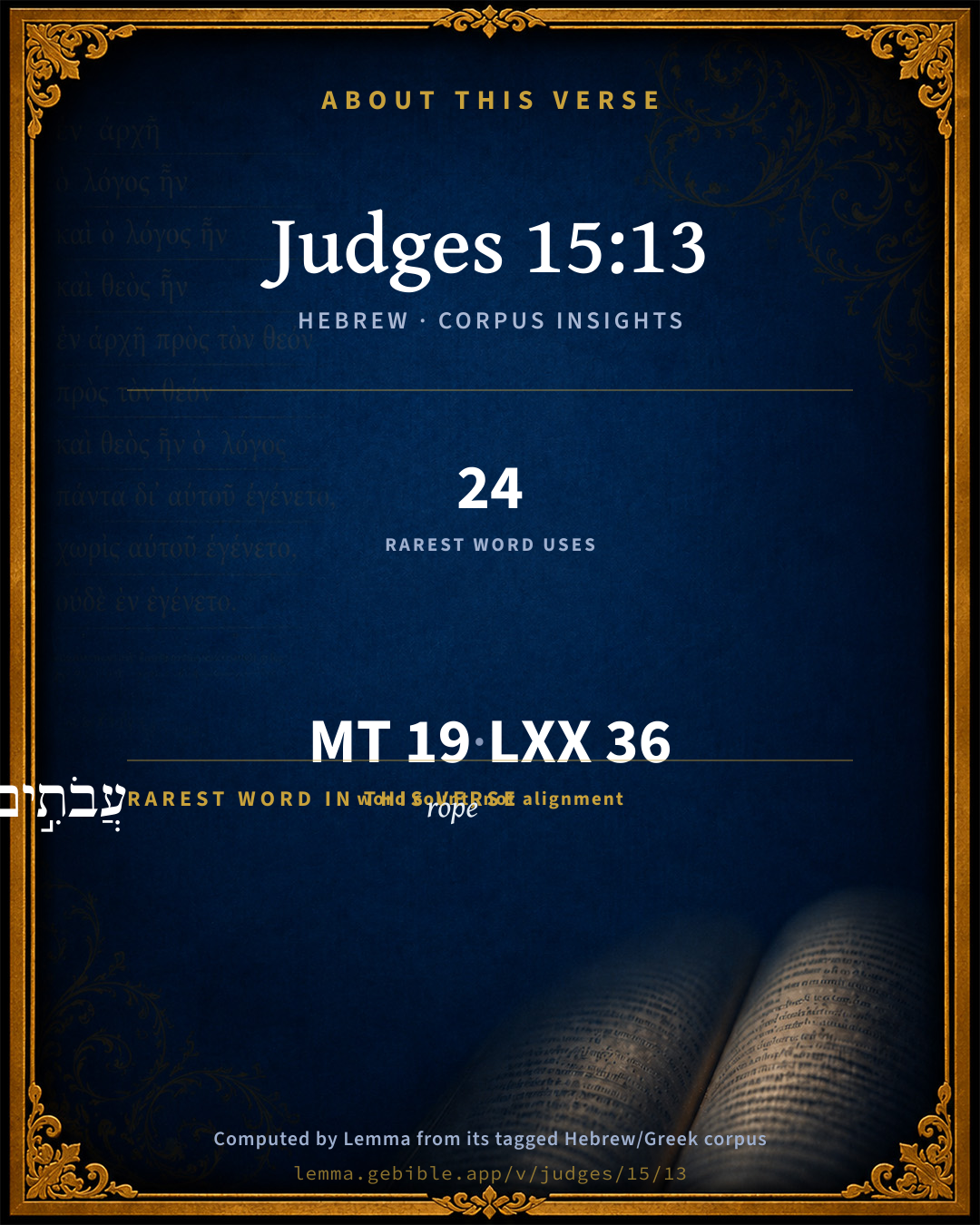
The rarest word here is עֲבֹתִ֣ים rope H5688 — appearing just 24 times in the whole Hebrew Bible.

Shared distinctive vocabulary

עֲבֹתִ֣ים rope H5688 occurs in 23 verses of the Hebrew Bible. Also found in:

Grammatical profile

  • 9 verbs
  • 3 nouns
  • 2 adjectives
  • 2 prepositions
  • 1 conjunction
  • 2 particles

Verb forms

  • וַיֹּ֧אמְרוּ Qal · Sequential Imperfect
  • לֵאמֹ֗ר Qal · Infinitive Construct
  • אָסֹ֤ר Qal · Infinitive Absolute
  • נֶֽאֱסָרְךָ֙ Qal · Imperfect
  • וּנְתַנּ֣וּךָ Qal · Perfect
  • וְהָמֵ֖ת Hiphil · Infinitive Absolute
  • נְמִיתֶ֑ךָ Hiphil · Imperfect
  • וַיַּאַסְרֻ֗הוּ Qal · Sequential Imperfect
  • וַֽיַּעֲל֖וּהוּ Hiphil · Sequential Imperfect

Repetition

Words recur within this verse — often emphatic in Hebrew:

  • אָסֹ֤ר to bind H631 ×3
  • וַיֹּ֧אמְרוּ to say H559 ×2
  • וְהָמֵ֖ת to die H4191 ×2
  • לֹ֚א not H3808 ×2

Hebrew & Septuagint length

In English translation the verse runs 39 words from the Hebrew and 41 from the Septuagint (LXX English) — closely comparable.

A rough comparison of the two English renderings, which tokenize alike — not a word-level alignment.

Word counts can differ between the Hebrew and the Greek without any difference in meaning — e.g. the Hebrew direct-object marker אֵת has no separate Greek word, and Greek often adds the article ὁ.

In the original languages it is 19 Hebrew tokens and 36 Greek tokens — but the two are counted differently (Hebrew bundles its prefixes and suffixes into one token; the Greek is in lemma form), so that isn’t a like-for-like length.

Hebrew and Greek witnesses Masoretic Hebrew ↔ Greek Septuagint

The same verse in the two great witnesses to the Old Testament, shown verse-for-verse.

These are two independent witnesses, not word-aligned to each other, and the Septuagint is shown in lemma (dictionary) form.

Hebrew Judges 15:13 Masoretic · Westminster Leningrad Codex

וַיֹּ֧אמְרוּ ל֣וֹ לֵאמֹ֗ר לֹ֚א כִּֽי אָסֹ֤ר נֶֽאֱסָרְךָ֙ וּנְתַנּ֣וּךָ בְיָדָ֔ם וְהָמֵ֖ת לֹ֣א נְמִיתֶ֑ךָ וַיַּאַסְרֻ֗הוּ בִּשְׁנַ֨יִם֙ עֲבֹתִ֣ים חֲדָשִׁ֔ים וַֽיַּעֲל֖וּהוּ מִן הַסָּֽלַע

They spoke to him, saying, No; but we will bind you fast, and deliver you into their hand: but surely we will not kill you. They bound him with two new ropes, and brought him up from the rock.

World English Bible · Public Domain

Greek LXX Judges 15:13 Septuagint · lemma form

καί εἶπον αὐτός λέγω οὐ ὅτι ἀλλά ἤ δεσμός δέω σύ καί παραδίδωμι σύ ἐν χείρ αὐτός καί θάνατος οὐ θανατόω σύ καί δέω αὐτός ἐν δύο καλώδιον καινός καί ἀναφέρω αὐτός ἀπό ὁ πέτρα ἐκεῖνος

And they spoke to him, saying, Nay, but we will only bind you fast, and deliver you into their hand, and will by no means kill you: and they bound him with two new ropes, and brought him from that rock.

LXX2012 (modern English Septuagint) · Public Domain

On this verse, Haydock's Catholic Bible Commentary discusses the Septuagint’s reading. Read the note in Commentary ↓

Hebrew: Westminster Leningrad Codex (CC BY 4.0). Greek: Septuagint (public domain); English from LXX2012 (modern English Septuagint) (Public Domain). How the Septuagint differs from the Hebrew →

Targum (Aramaic paraphrase)

1

The Targum is the ancient Jewish Aramaic paraphrase of the Hebrew Scriptures — an interpretive translation, not the Hebrew text itself. Onkelos (literal) and Pseudo-Jonathan (expansive) render the Torah, and Jonathan the Prophets. Coverage is partial: where no permissively-licensed English translation exists for a verse, only the Aramaic is shown. This is verse-level text, not a word-by-word alignment to the Hebrew.

  1. Targum Jonathan Prophets (Joshua–Malachi)
    וַאֲמַרוּ לֵיהּ לְמֵימָר לָא אֲרֵי מֵיסַר נִיסְרִינָךְ וְנִמְסְרִינָךְ בִּידֵיהוֹן וּמִקְטַל לָא נִקְטְלִנָךְ וְאַסְרוּהִי בְּתַרְתֵּין גְדִילַן חַדְתִּין וְאַסְקוּהִי מִן כֵּיפָא:

    (no public-domain English translation for this verse)

    Targum Jonathan — Aramaic: “Mikraot Gedolot” (public domain). English: “Sefaria Community Translation” (CC0 1.0 (public-domain dedication)); “London "Chaldee Paraphrase," 1871” (public domain). Text via Sefaria.

Commentary

Notes on Judges 15:13 from classic Christian and Jewish commentators (each source and its license shown beneath its notes). The classic Christian expositions comment on the surrounding passage and are grouped to its opening verse, so a note may address several verses; the Jewish commentaries on the Tanakh (Rashi and others) are per-verse, so they appear only where the commentator wrote on this verse.

Lemma curates 59 commentaries, every one of them public domain or Creative Commons licensed, each selected and text-cleaned for this edition rather than reprinted as found. About our sources →

Trapp's Complete Commentary

John Trapp

Jdg 15:13 And they spake unto him, saying, No; but we will bind thee fast, and deliver thee into their hand: but surely we will not kill thee. And they bound him with two new cords, and brought him up from the rock.

Ver. 13. But surely we will not kill thee.] No, but you will do as bad: for qui non cum potest servat occidit. This is the world’s wages; expect hard usage, even from some professors, when it comes to a critical point once: they will dispraise what erst they praised and applauded, and turn cat in pan, as they say, to provide for their own ease and safety.

And they bound him with two new cords.] So that now he seemed to be in a forlorn and desperate condition. God reserveth his holy hand for a dead lift; and helpeth those that are forsaken of their hopes.

John Trapp, A Commentary or Exposition upon All the Books of the Old and New Testament (1647–1656) — public domain. Text from a community e-Sword module.

Joseph Benson's Commentary

Jdg 15:13. And they bound him — Thus was he a type of Christ, who yielded himself to be bound, yea, and led as a lamb to the slaughter. Never were men so infatuated as these men of Judah, except those who thus treated our blessed Saviour. Up from the rock — That is, from the cave in the rock, in which he had secured himself, out of which he was first brought up, and then carried down from the rock to the plain.

Joseph Benson's Commentary on the Old and New Testaments (1811–1818) — public domain. Text from a community e-Sword module.

Geneva Bible (1599)

Geneva Bible translators

Thus they had rather betray their brother, than use the means that God had given for their deliverance.

Geneva Bible (1599) marginal notes — public domain. Text via Bolls.life.

Adam Clarke's Commentary

Verse 13. They bound him with two new cords] Probably his hands with one and his legs with the other.

Adam Clarke's Commentary on the Bible (1810–1826) — public domain. Text from a community e-Sword/MySword module.

Ellicott's Commentary for English Readers

(13) Brought him up from the rock.—Again the details are uncertain. Was Samson’s cave down the steep side of a cliff? Such caves are common in Palestine, and such a situation would explain these expressions. (See Josephus, Antt. xiv. 15, § 5, where he says that the brigands’ caves were inaccessible against a few defenders, either from below or from above, and that Herod could only attack the robbers by letting down soldiers in chests from the top of the precipices.)

A Bible Commentary for English Readers, edited by Charles John Ellicott (1878–1897) — public domain. Text from a community e-Sword module.

John Gill's Exposition

And they spake unto him, saying, no,.... They declared they would not fall upon him themselves and slay him; nor would the Jews put Christ to death themselves, though they were virtually his betrayers and murderers, Joh 18:31.

but we will bind thee fast and deliver thee into their hands; as the Jews did Christ, and not only delivered him bound to the high priest, but also to the Roman governor, Mat 27:2.

but surely we will not kill thee: not with their own hands, but then they proposed to deliver him into the hands of the Philistines, from whence nothing but death could be expected; so that had they put him to death, they would have been accessory to it, as the Jews were to the death of Christ by delivering him to the Gentiles, and are charged with it, Act 2:23.

and they bound him with two new cords; not with one only, lest it should not be sufficient to hold him, knowing his strength, but with two, and these not old worn out ones, but new ones just made, and very strong; and, as Joseph Kimchi, noted by Ben Melech, were trebled, or made of three cords or thongs, for greater security; and of flax, as the following verse intimates, and such are most firm and strongest to hold anything; hence nets were made of flax to hold creatures in, fish, fowl, or beasts (i):

and brought him up from the rock; the place, as Kimchi says, where the men of Judah dwelt, being higher than the rock; though rather the true sense is, they brought him up out of the cave in the rock.

(i) Vid. Plin Nat. Hist. l. 19. 1.

John Gill's Exposition of the Whole Bible (1746–1763) — public domain (CC PDM 1.0). Text via the HelloAO Bible API.

Haydock's Catholic Bible Commentary

Cords. Hebrew habothim, Septuagint Greek: Kalodiois, denote strong ropes or cables. (Menochius) --- Etam is not in Hebrew or the Septuagint. (Haydock)

George Leo Haydock (1774–1849), Haydock's Catholic Family Bible and Commentary, 1859 edition — public domain. Excludes Psalms (Douay-Rheims chapter numbering differs from Protestant) and Deuterocanonical books (Catholic canon only).

Matthew Poole's English Annotations

i.e. from the cave or hole in the rock, in which he had secured himself, out of which he was first brought up, and then carried down from the rock to the plain.

Matthew Poole's English Annotations on the Holy Bible (1683–1685) — public domain. Text from a community e-Sword/MySword module.

Whedon's Commentary on the Bible

Daniel D. Whedon

13. Brought him up from the rock — Led him a prisoner out of the cleft which he had made his stronghold.

Daniel D. Whedon (gen. ed.), Commentary on the Old and New Testaments (1874–1909) — public domain. Text from a community e-Sword module.

John Wesley's Explanatory Notes

And they bound him - Thus was he a type of Christ, who yielded himself to be bound, yea and led as a lamb to the slaughter. Never were men so besotted as these men of Judah, except those who thus treated our blessed saviour. The rock - That is, from the cave in the rock, in which he had secured himself, out of which he was first brought up, and then carried down from the rock to the plain.

John Wesley, Explanatory Notes Upon the Whole Bible (1754–1765) — public domain. Text via the GEBible commentary corpus.

Rashi

Rabbi Shlomo Yitzchaki (Rashi)

No! We shall merely tie you down. We shall not execute you, but merely tie you down.

Rashi on the Tanakh — English translations: “The Judaica Press complete Tanach with Rashi, translated by A. J. Rosenberg” (CC BY 4.0); “Pentateuch with Rashi's commentary by M. Rosenbaum and A.M. Silbermann, 1929-1934” (public domain); “The Metsudah Tanach series, Lakewood, N.J” (CC BY 4.0); and “The Book of Joshua, Metsudah Publications, 1997” (CC BY 4.0). Text via Sefaria.

Lesson kit

Teaching starters — assembled from the data on this page, not authored interpretation. Every prompt links to the verse data it draws on. Edit before teaching.

Judges, in the Historical, opens this verse with 19 words (13 distinct Hebrew lemmas). Its most distinctive word is ʻăbôth (“rope”). A historical commentator’s framing appears above. Read the whole chapter for the surrounding context.

Discussion questions

  1. The word ʻăbôth carries the sense “rope.” How does it shape the verse?
  2. Exodus 28:14 shares the word «rope» with this verse. How do the two illuminate each other?
  3. “to bind” occurs 3× in this one verse. What is the effect of the repetition?
  4. The translations on this page render this verse differently — a whole-verse word diff, not a word-by-word alignment. What might account for the different wordings?
  5. The verb «וַיֹּ֧אמְרוּ» is Qal Sequential Imperfect. How does its form color the action?
  6. Reading how Trapp's Complete Commentary and Joseph Benson's Commentary read this verse, where do the two commentators agree and where do they part?

Things to notice

Reading settings

Reading text

Shown beneath each verse's original-language words.

Old Testament
Old Testament edition

Read the OT as the Masoretic Hebrew (MT) or the Greek Septuagint (LXX).

English shown for the Greek Septuagint (in the Hebrew ↔ Greek comparison).

Comparing translations? Open the Compare panel on any verse page to stack up to four side by side.