
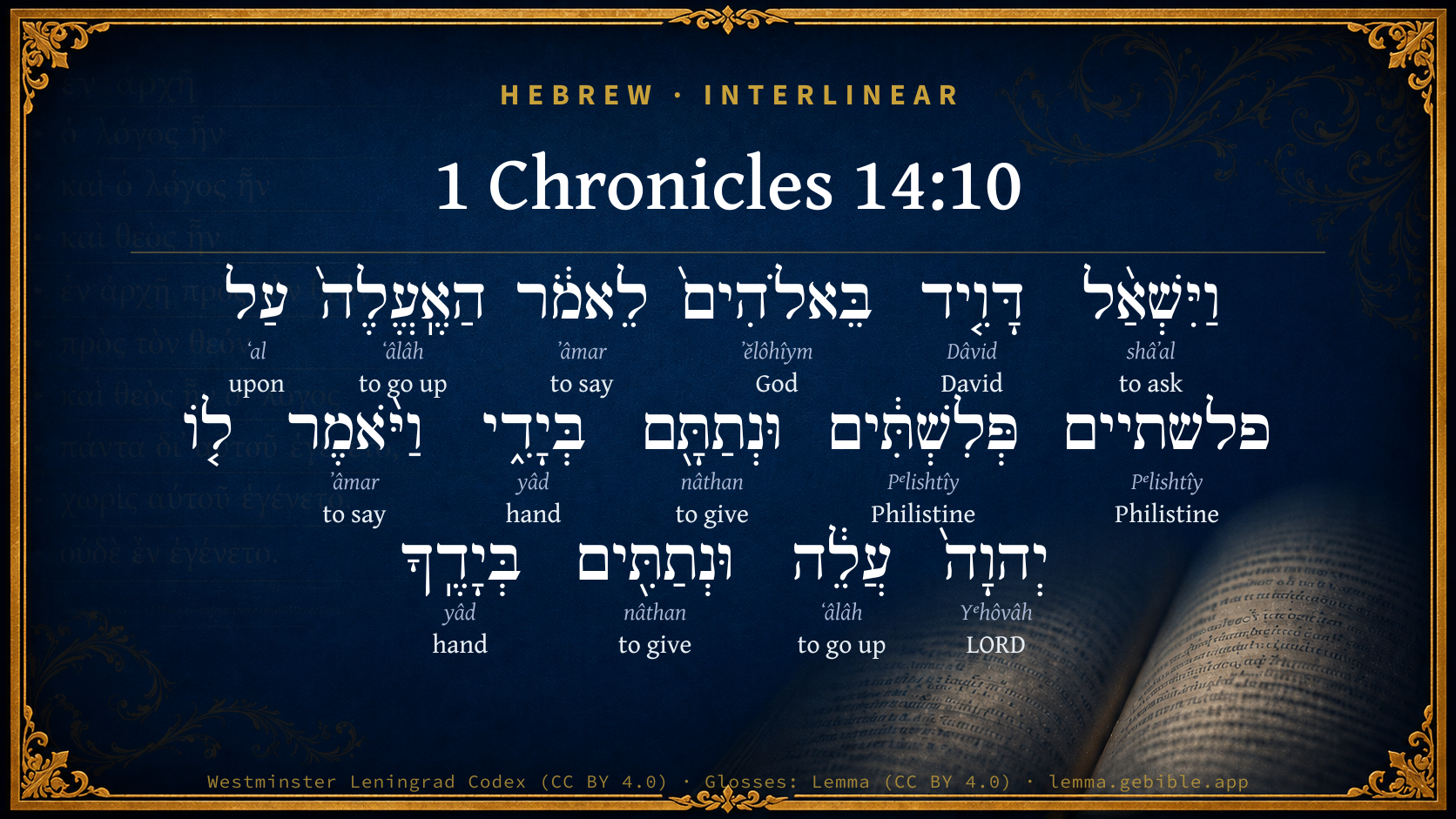
1 Chronicles 14:10

Hebrew (Westminster Leningrad Codex) 1 Chronicles 14:10 appears in the Hebrew Old Testament. The text above is from the Westminster Leningrad Codex. Each word links to its Strong’s number, a concise gloss, and parsing drawn from the Open Scriptures Hebrew Bible morphology. Click any word for its full Brown-Driver-Briggs (BDB) entry.
Download image
Cite this verse

1 Chronicles 14:10 (World English Bible). Public Domain. Lemma interlinear Bible study tool, https://lemma.gebible.app/v/1-chronicles/14/10.

Show BibTeX & RIS
BibTeX
RIS
English Translation
David inquired of God, saying, Shall I go up against the Philistines? and will you deliver them into my hand? Yahweh said to him, Go up; for I will deliver them into your hand.
World English Bible · Public Domain
Download a study sheet

One document with this verse’s original text, its word-by-word gloss line, the meaning frame, cross-references with their text, attributed commentary, and full source and license credits — printable, and it pastes into notes with its structure intact.

This verse Autodidact and up

Study sheet (.html) Plain text (.txt)

A passage Seminary Student

Up to 50 verses in one chapter. A passage sheet keeps up to 6 commentary sources and 12 cross-references per verse, in the order this page ranks them, and says so on the sheet whenever that leaves anything out. Ask for a single verse and you get the Autodidact verse sheet above.

Everything on this page stays free to read, with no account — the sheet is a download of what is already on screen, not access to it.

Want to remove ads? Support Godless Engineer
Compare translations 3

The same verse in 3 English versions, stacked beneath the original-language interlinear above. Click any original word for its lexicon entry.

Each is an independent rendering of the whole verse — the interlinear is not word-aligned to these translations.

Highlighted words mark where these versions differ — a whole-verse word diff, not a word-by-word alignment.

  • World English Bible Public Domain
    David inquired of God, saying, Shall I go up against the Philistines? and will you deliver them into my hand? Yahweh said to him, Go up; for I will deliver them into your hand.
  • King James Version Public Domain
    And David inquired of God, saying, Shall I go up against the Philistines? And wilt thou deliver them into mine hand? And the LORD said unto him, Go up; for I will deliver them into thine hand.
  • unfoldingWord Literal Text CC BY-SA 4.0
    Then David asked God, saying, “Shall I go up against the Philistines? And will you give them into my hand?” And Yahweh said to him, “Go up, for I will give them into your hand.”

unfoldingWord Literal Text — © unfoldingWord, licensed CC BY-SA 4.0. Word-aligned USFM3 via Door43 (git.door43.org/unfoldingWord/en_ult).

Versions to compare (up to 4)

3 of 4 selected

Show all 18 translations

Every available English version of this verse, each an independent rendering of the whole verse.

  • World English Bible Public Domain
    David inquired of God, saying, Shall I go up against the Philistines? and will you deliver them into my hand? Yahweh said to him, Go up; for I will deliver them into your hand.
  • Berean Standard Bible Public Domain
    So David inquired of God, “Should I go up against the Philistines? Will You deliver them into my hand?” “Go,” replied the LORD, “for I will deliver them into your hand.”
  • Majority Standard Bible Public Domain
    So David inquired of God, “Should I go up against the Philistines? Will You deliver them into my hand?” “Go,” replied the LORD, “for I will deliver them into your hand.”
  • King James Version Public Domain
    And David inquired of God, saying, Shall I go up against the Philistines? And wilt thou deliver them into mine hand? And the LORD said unto him, Go up; for I will deliver them into thine hand.
  • American Standard Version (1901) Public Domain
    And David inquired of God, saying, Shall I go up against the Philistines? and wilt thou deliver them into my hand? And Jehovah said unto him, Go up; for I will deliver them into thy hand.
  • Revised Version (1885) Public Domain
    And David inquired of God, saying, Shall I go up against the Philistines? and wilt thou deliver them into mine hand? And the LORD said unto him, Go up; for I will deliver them into thine hand.
  • Geneva Bible (1599) Public Domain
    Then Dauid asked counsel at God, saying, Shall I goe vp against the Philistims, and wilt thou deliuer them into mine hande? And the Lord saide vnto him, Goe vp: for I will deliuer them into thine hande.
  • Douay-Rheims (1899) Public Domain
    And David consulted the Lord, saying: Shall I go up against the Philistines, and wilt thou deliver them into my hand? And the Lord said to him: Go up, and I will deliver them into thy hand.
  • Young's Literal Translation Public Domain
    and David asketh of God, saying, `Do I go up against the Philistines -- and hast Thou given them into my hand?' And Jehovah saith to him, `Go up, and I have given them into thy hand.'
  • Literal Standard Version CC BY-SA 4.0
    and David asks of God, saying, “Do I go up against the Philistines—and have You given them into my hand?” And YHWH says to him, “Go up, and I have given them into your hand.”
  • Unlocked Literal Bible CC BY-SA 4.0
    Then David asked for help from God. He said, “Should I attack the Philistines? Will you give victory over them?” Yahweh said to him, “Attack, for I will certainly give them to you.”
  • unfoldingWord Literal Text CC BY-SA 4.0
    Then David asked God, saying, “Shall I go up against the Philistines? And will you give them into my hand?” And Yahweh said to him, “Go up, for I will give them into your hand.”
  • Darby Bible Public Domain
    And David inquired of God saying, Shall I go up against the Philistines, and wilt thou give them into my hand? And Jehovah said to him, Go up; and I will give them into thy hand.
  • World Messianic Bible Public Domain
    David inquired of God, saying, “Shall I go up against the Philistines? Will you deliver them into my hand?” The LORD said to him, “Go up; for I will deliver them into your hand.”
  • Webster's Bible Public Domain
    And David inquired of God, saying, Shall I go up against the Philistines? and wilt thou deliver them into my hand? And the LORD said to him, Go up; for I will deliver them into thy hand.
  • Free Bible Version CC BY-SA 4.0
    David consulted God, asking “Shall I go and attack the Philistines? Will you make me victorious over them?” “Go ahead,” the Lord told him, “I will make you victorious over them.”
  • Bible in Basic English Public Domain
    And David, desiring directions from God, said, Am I to go up against the Philistines? and will you give them into my hands? And the Lord said, Go up; for I will give them into your hands.
  • JPS Tanakh (1917) Public Domain
    And David inquired of God, saying: 'Shall I go up against the Philistines? and wilt Thou deliver them into my hand?' And the LORD said unto him: 'Go up; for I will deliver them into thy hand.'

Literal Standard Version (2020), Covenant Press — licensed CC BY-SA 4.0. Text via the HelloAO Bible API (eBible.org). Unlocked Literal Bible (unfoldingWord) — licensed CC BY-SA 4.0. Text via the HelloAO Bible API (eBible.org). unfoldingWord Literal Text — © unfoldingWord, licensed CC BY-SA 4.0. Word-aligned USFM3 via Door43 (git.door43.org/unfoldingWord/en_ult). Free Bible Version, Dr. Jonathan Gallagher — licensed CC BY-SA 4.0. Text via the HelloAO Bible API (eBible.org).

Word by word

More ways to search: Search by grammar → Find every occurrence → Compare this word →

Practice this passage: Drill this verse → Learn its vocabulary →

וַיִּשְׁאַ֨ל
shâʼal
H7592
“and · to ask”
Conjunction + Verb, Qal, Sequential Imperfect, 3rd Person, Masculine, Singular
Part of Speech
Conjunction + Verb
Stem
Qal
Form
Sequential Imperfect
Person
3rd Person
Gender
Masculine
Number
Singular
Full BDB Definition

Origin: a primitive root

TWOT: 2303

to ask, enquire, borrow, beg - (Qal) - to ask, ask for - to ask (as a favour), borrow - to enquire, enquire of - to enquire of, consult (of deity, oracle) - to seek - (Niphal) to ask for oneself, ask leave of absence - (Piel) - to enquire, enquire carefully - to beg, practise beggary - (Hiphil) - to be given on request - to grant, make over to, let (one) ask (successfully) or give or lend on request (then) grant or make over to
  1. דָּוִ֤יד Dâvid H1732 “David” Noun, Proper
  2. בֵּאלֹהִים֙ ʼĕlôhîym H430 “in/at · God(s)” Preposition + Noun, Common, Masculine, Plural, Absolute
  3. לֵאמֹ֔ר ʼâmar H559 “to say” Preposition + Verb, Qal, Infinitive Construct
  4. הַאֶֽעֱלֶה֙ ʻâlâh H5927 “to go up” Particle, Interrogative + Verb, Qal, Imperfect, 1st Person, Common, Singular
  5. עַל ʻal H5921 “upon” Preposition
  6. פלשתיים Pᵉlishtîy H6430 “Philistines” Noun, Gentilic, Masculine, Plural, Absolute
  7. פְּלִשְׁתִּ֔ים Pᵉlishtîy H6430 “Philistines” Noun, Gentilic, Masculine, Plural, Absolute
  8. וּנְתַתָּ֖ם nâthan H5414 “and · to give · them” Conjunction + Verb, Qal, Sequential Perfect, 2nd Person, Masculine, Singular + Suffix, Personal, 3rd Person, Masculine, Plural
  9. בְּיָדִ֑י yâd H3027 “in/at · hand · my” Preposition + Noun, Common, Both, Singular, Construct + Suffix, Personal, 1st Person, Common, Singular
  10. וַיֹּ֨אמֶר ʼâmar H559 “and · to say” Conjunction + Verb, Qal, Sequential Imperfect, 3rd Person, Masculine, Singular
  11. יְהוָה֙ Yᵉhôvâh H3068 “LORD” Noun, Proper
  12. עֲלֵ֔ה ʻâlâh H5927 “go up” Verb, Qal, Imperative, 2nd Person, Masculine, Singular
  13. וּנְתַתִּ֖ים nâthan H5414 “and · to give · them” Conjunction + Verb, Qal, Sequential Perfect, 1st Person, Common, Singular + Suffix, Personal, 3rd Person, Masculine, Plural
  14. בְּיָדֶֽךָ yâd H3027 “in/at · hand · your” Preposition + Noun, Common, Both, Singular, Construct + Suffix, Personal, 2nd Person, Masculine, Singular

About this verse

These counts appear in no published source. They are computed here, from the morphology-tagged text and Lemma’s own curated glosses. What Lemma adds →

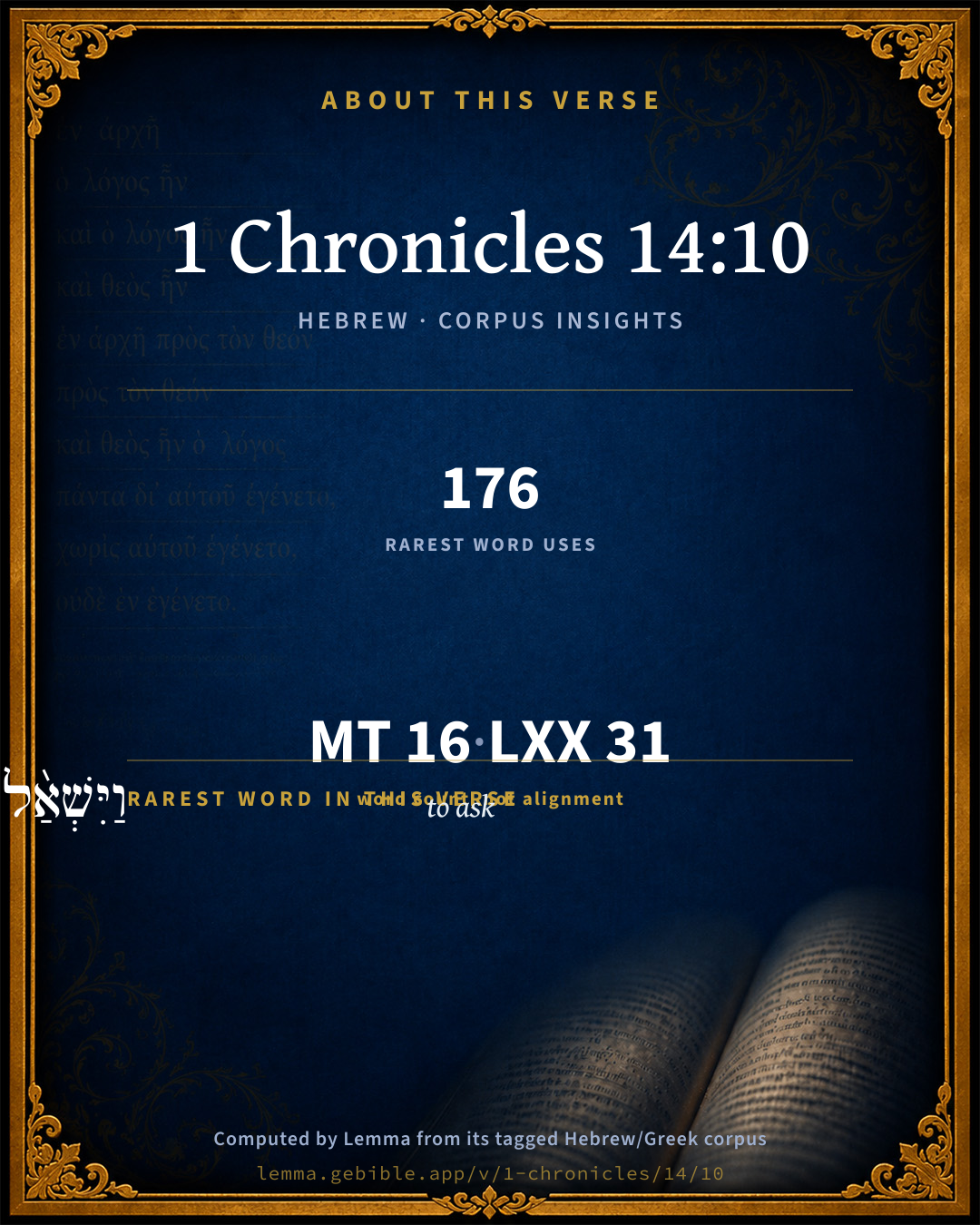
16
words
10
distinct lemmas
Historical
section

Grammatical profile

  • 7 verbs
  • 7 nouns
  • 2 prepositions

Verb forms

  • וַיִּשְׁאַ֨ל Qal · Sequential Imperfect
  • לֵאמֹ֔ר Qal · Infinitive Construct
  • הַאֶֽעֱלֶה֙ Qal · Imperfect
  • וּנְתַתָּ֖ם Qal · Sequential Perfect
  • וַיֹּ֨אמֶר Qal · Sequential Imperfect
  • עֲלֵ֔ה Qal · Imperative
  • וּנְתַתִּ֖ים Qal · Sequential Perfect

Repetition

Words recur within this verse — often emphatic in Hebrew:

  • לֵאמֹ֔ר to say H559 ×2
  • הַאֶֽעֱלֶה֙ to go up H5927 ×2
  • פלשתיים Philistine H6430 ×2
  • וּנְתַתָּ֖ם to give H5414 ×2
  • בְּיָדִ֑י hand H3027 ×2

Hebrew & Septuagint length

In English translation the verse runs 34 words from the Hebrew and 37 from the Septuagint (LXX English) — closely comparable.

A rough comparison of the two English renderings, which tokenize alike — not a word-level alignment.

Word counts can differ between the Hebrew and the Greek without any difference in meaning — e.g. the Hebrew direct-object marker אֵת has no separate Greek word, and Greek often adds the article ὁ.

In the original languages it is 16 Hebrew tokens and 31 Greek tokens — but the two are counted differently (Hebrew bundles its prefixes and suffixes into one token; the Greek is in lemma form), so that isn’t a like-for-like length.

Cross-references

12

Topical passages linked to 1 Chronicles 14:10 in the Treasury of Scripture Knowledge — connected by theme and wording, ordered by reader-vote popularity; previews shown in the World English Bible.

  • Proverbs 3:6 In all your ways acknowledge him, And he will direct your paths.
  • 1 Chronicles 14:14 David inquired again of God; and God said to him, You shall not go up after them: turn away from them, and come on them over against the mulberry trees.
  • 2 Samuel 2:1 It happened after this, that David inquired of Yahweh, saying, Shall I go up into any of the cities of Judah? Yahweh said to him, Go up. David said, Where shall I go up? He said, To Hebron.
  • 2 Samuel 5:19 David inquired of Yahweh, saying, Shall I go up against the Philistines? will you deliver them into my hand? Yahweh said to David, Go up; for I will certainly deliver the Philistines into your hand.
  • 1 Chronicles 13:3 and let us bring again the ark of our God to us: for we didn't seek it in the days of Saul.
  • Judges 4:6–7 She sent and called Barak the son of Abinoam out of Kedesh-naphtali, and said to him, Hasn't Yahweh, the God of Israel, commanded, [saying], Go and draw to Mount Tabor, and take with you ten thousand men of the children of Naphtali and of the children of Zebulun?
  • 1 Samuel 23:9–12 David knew that Saul was devising mischief against him; and he said to Abiathar the priest, Bring here the ephod.
  • 1 Samuel 30:8 David inquired of Yahweh, saying, If I pursue after this troop, shall I overtake them? He answered him, Pursue; for you shall surely overtake [them], and shall without fail recover [all].
  • 1 Kings 22:6 Then the king of Israel gathered the prophets together, about four hundred men, and said to them, Shall I go against Ramoth-gilead to battle, or shall I forbear? They said, Go up; for the Lord will deliver it into the hand of the king.
  • 1 Kings 22:15–17 When he was come to the king, the king said to him, Micaiah, shall we go to Ramoth-gilead to battle, or shall we forbear? He answered him, Go up and prosper; and Yahweh will deliver it into the hand of the king.
  • 1 Samuel 23:2–4 Therefore David inquired of Yahweh, saying, Shall I go and strike these Philistines? Yahweh said to David, Go, and strike the Philistines, and save Keilah.
  • 2 Samuel 5:23 When David inquired of Yahweh, he said, You shall not go up: make a circuit behind them, and come on them over against the mulberry trees.

Cross-references courtesy of OpenBible.info (CC BY 4.0).

Hebrew and Greek witnesses Masoretic Hebrew ↔ Greek Septuagint

The same verse in the two great witnesses to the Old Testament, shown verse-for-verse.

These are two independent witnesses, not word-aligned to each other, and the Septuagint is shown in lemma (dictionary) form.

Hebrew 1 Chronicles 14:10 Masoretic · Westminster Leningrad Codex

וַיִּשְׁאַ֨ל דָּוִ֤יד בֵּאלֹהִים֙ לֵאמֹ֔ר הַאֶֽעֱלֶה֙ עַל פלשתיים פְּלִשְׁתִּ֔ים וּנְתַתָּ֖ם בְּיָדִ֑י וַיֹּ֨אמֶר ל֤וֹ יְהוָה֙ עֲלֵ֔ה וּנְתַתִּ֖ים בְּיָדֶֽךָ

David inquired of God, saying, Shall I go up against the Philistines? and will you deliver them into my hand? Yahweh said to him, Go up; for I will deliver them into your hand.

World English Bible · Public Domain

Greek LXX 1 Chronicles 14:10 Septuagint · lemma form

καί ἐρωτάω δαυίδ διά ὁ θεός λέγω εἰ ἀναβαίνω ἐπί ὁ ἀλλόφυλος καί δίδωμι αὐτός εἰς ὁ χείρ ἐγώ καί εἶπον αὐτός κύριος ἀναβαίνω καί δίδωμι αὐτός εἰς ὁ χείρ σύ

And David enquired of God, saying, Shall I go up against the Philistines? and will you deliver them into my hand? And the Lord said to him, Go up, and I will deliver them into your hands.

LXX2012 (modern English Septuagint) · Public Domain

Hebrew: Westminster Leningrad Codex (CC BY 4.0). Greek: Septuagint (public domain); English from LXX2012 (modern English Septuagint) (Public Domain). How the Septuagint differs from the Hebrew →

Commentary

Notes on 1 Chronicles 14:10 from classic Christian and Jewish commentators (each source and its license shown beneath its notes). The classic Christian expositions comment on the surrounding passage and are grouped to its opening verse, so a note may address several verses; the Jewish commentaries on the Tanakh (Rashi and others) are per-verse, so they appear only where the commentator wrote on this verse.

Lemma curates 59 commentaries, every one of them public domain or Creative Commons licensed, each selected and text-cleaned for this edition rather than reprinted as found. About our sources →

The Biblical Illustrator

Joseph S. Exell

1Ch_14:10

And David inquired of God.

Inquiring of God

The Israelites usually asked counsel of God by the ephod, the Grecians by their oracles, the Persians by their magi, the Egyptians by their hierophantae, the Indians by their gymnosophistae, the ancient Gauls and Britons by their Druids, the Romans by their augures or soothsayers. It was not lawful to propose any matter of moment in the senate, priusquam de coelo observatum erat, before their wizards had made observations from the heaven or sky. That which they did impiously and superstitiously, we may, nay we ought to do in another sense, piously, religiously, conscionably, i.e., not to embark ourselves into any action of great importance and consequence, priusquam de Coelo observatum est, before we have observed from Heaven, not the flight of birds, not the houses of planets, or their aspects or conjunctions, but the countenance of God, whether it shineth upon our enterprises or not, whether He approve of our projects and designs or not. (J. Spencer.)

The Biblical Illustrator, edited by Joseph S. Exell (c. 1880s–1900s) — public domain. Text from a community e-Sword module.

Adam Clarke's Commentary

Verse 10. David inquired of God] "David consulted the WORD of the Lord." - T.

Adam Clarke's Commentary on the Bible (1810–1826) — public domain. Text from a community e-Sword/MySword module.

Ellicott's Commentary for English Readers

(10) And David enquired of God.—How? Through the high priest Abiathar, who sought Divine direction by means of the Urim and Thummim, or sacred lots, which he carried in a pouch on his breast, which was fastened to the ephod, or priestly mantle. (See Exo_28:30; Exo_39:21; Lev_8:8; Num_27:21; 1Sa_14:18-19; 1Sa_14:37; 1Sa_14:41; 1Sa_23:9; 1 Samuel 28; 1Sa_30:7-8.)

Against.—Samuel, “unto.” There should be a comma, not a query, at “Philistines;” the whole sentence forms but one question in the Hebrew. Samuel gives two distinct questions, disconnected from each other. The rest of the verse is abridged here. (Comp. Samuel.)

A Bible Commentary for English Readers, edited by Charles John Ellicott (1878–1897) — public domain. Text from a community e-Sword module.

The Cambridge Bible for Schools and Colleges

gen. ed. J. J. S. Perowne

10. inquired of God] probably by means of Urim and Thummim. Cp. Kirkpatrick’s notes on 1Sa_10:22; 1Sa_23:6.

The Cambridge Bible for Schools and Colleges (gen. ed. J. J. S. Perowne; Cambridge University Press, 1878–1918) — public domain. Text from a community e-Sword module.

The Pulpit Commentary

David inquired of God. The "inquiring" was made, as matter of course, through the high priest, and not merely, as we should say, in private prayer (Jud_1:1, 3 20:23, 27; 1Sa_23:2, 4 30:8; 2Sa_2:1) The directness of the Divine answer was some echo of the old reply when Judah was authorized to go up against the Canaanites. (Jud_1:2)

HOMILIES BY R. TUCK Ver. 10.

Inquiring of God concerning common things.

Explain the anxiety of the situation in which David was placed, and show what he might have done. From the point of view of the skilful general, he might have counted his forces, estimated their strength, set them on vantage-ground, drawn out a plan of battle, and, swayed by his own energy, he might have led them on to victory. But then he would only have acted as Saul had acted. He would have taken up the position of the independent sovereign, rather than that of the prince and vicegerent of Jehovah. It was important that, at the very outset of his kingly career, he should make it publicly and distinctly known that he was king only as Jehovah"s servant. He could not make this known better than by "inquiring of the Lord" on the first occasion of national anxiety. It is always of great importance that we start right. But it might be said that this was only a business matter, and so quite within the power of David to arrange, and he need not "inquire of God" at all about it. That sentiment is a common, but a sadly mistaken one. It divides our life into two parts, the one of which we can manage ourselves, but for the other we need the help of God. There can really be no distinction of the "sacred" and the "secular." There can properly be no circle drawn round within which alone prayer can be acceptable. Nothing interests us that does not interest our God. "In everything, by prayer and supplication, we may make known our requests unto him." This may be further enforced.

I WHAT IS THE GOD-SPHERE? The difficulties into which men get, and the subtle self-seeking they manifest, when they try to make the God-sphere limited and narrow. The awakened and sincere heart is prepared to say before God

Take my body, spirit, soul; Only thou possess the whole?

The God-sphere is a man"s whole life, his whole thought, his every interest. Nothing is too great for God to compass; nothing too small for him to use and glorify. The things we count most common air and sunshine and rain are his. And the things in our lives that seem most trivial fit into his great plan and should be referred to him. Illustrate from the teachings of the Apostle James, that our very "journeyings," our very "buyings and sellings," must be made dependent on the Lord"s will, (Jam_4:13-15) Modern sentiment tends to limit the sphere within which prayer is appropriate; it is assumed that it should not deal with the material world, which is under fixed law. But law is not something out beyond the control of God or we misname him; for there is something greater than he. All laws are within the God-sphere, so we may "inquire of God" about them.

II WHAT IS GOD"S CLAIM WITHIN HIS SPHERE? That everything shall be referred to him, and in everything his counsel and direction shall be taken. Illustrate from David"s feeling of the claims of the theocracy. The entire life of the Israelitish nation being the God-sphere, absolutely everything had to be referred to him, and he recognized and punished all failures to meet his claim. By the mouth of his prophet the claim is distinctly expressed: "For all these things will I be inquired of by the house of Israel, to do it for them." This claim may be shown in detailed application to the circumstances of our lives. The kind of reference to God takes different forms for different kinds of things.

III THE OBEDIENCE OF MEN IS BETTER TESTED BY THE LITTLE THAN BY THE GREAT. Practical observation of life proves that it is harder to do little things in a right spirit than to do great ones. Many a man stands well before mighty swords and spears, and falls before a pebble slung by a youth. Few of us can stand the serious testing of the commoner scenes and relations of our lives. Yet the Divine testings come most frequently in connection with them; and sometimes God even makes us do nothing wait; and he watches to see whether, even concerning this, we will "inquire of him. R.T.

The Pulpit Commentary (1880–1919), ed. H.D.M. Spence-Jones & Joseph S. Exell — public domain. Text from a community e-Sword module.

unfoldingWord translationNotes

Door43 World Missions Community

give them to you

This idiom means that Yahweh will enable David to have victory over them. AT: "give you victory over them" (See: Idiom)

Baal Perazim

This is the name of a place. You may add a footnote that says, "The name 'Baal Perazim' means 'Lord of breaking through.'" (See: How to Translate Names)

God has burst through my enemies ... like a bursting flood of water

David speaks of God easily defeating David's enemies as if God had burst through them, like a flood bursts through anything in its path. AT: "God has easily defeated my enemies ... like a flood easily bursts through everything" (See: Simile)

by my hand

This refers to David's resources. AT: "using my army" (See: Metonymy)

that they should be burned

This can be stated in active form. AT: "to burn their false gods" (See: Active or Passive)

translationWords

God

adversary

hand

false god

unfoldingWord translationNotes — © Distant Shores Media and the Door43 World Missions Community, licensed CC BY-SA 4.0. Source: git.door43.org/Door43/en_tn.

Rashi

Rabbi Shlomo Yitzchaki (Rashi)

And David inquired of God through the Urim and Tummim.

Rashi on the Tanakh — English translations: “The Judaica Press complete Tanach with Rashi, translated by A. J. Rosenberg” (CC BY 4.0); “Pentateuch with Rashi's commentary by M. Rosenbaum and A.M. Silbermann, 1929-1934” (public domain); “The Metsudah Tanach series, Lakewood, N.J” (CC BY 4.0); and “The Book of Joshua, Metsudah Publications, 1997” (CC BY 4.0). Text via Sefaria.

Lesson kit

Teaching starters — assembled from the data on this page, not authored interpretation. Every prompt links to the verse data it draws on. Edit before teaching.

1 Chronicles, in the Historical, opens this verse with 16 words (10 distinct Hebrew lemmas). Its most distinctive word is shâʼal (“to ask”). A historical commentator’s framing appears above. Read the whole chapter for the surrounding context.

Discussion questions

  1. How does “to ask” (shâʼal) shape what this verse is saying?
  2. How does Proverbs 3:6, which shares this passage’s theme, read alongside this verse?
  3. What does the repetition of “to say” (2× in this one verse) do in this verse?
  4. These translations render this verse differently; the difference is in the English rendering, not the original. What questions does that raise?
  5. «וַיִּשְׁאַ֨ל» is a Qal Sequential Imperfect verb. How does that grammatical form shape the action described?
  6. Compare how The Biblical Illustrator and Adam Clarke's Commentary read this verse. Where do they agree or differ?

Things to notice

Reading settings

Reading text

Shown beneath each verse's original-language words.

Old Testament
Old Testament edition

Read the OT as the Masoretic Hebrew (MT) or the Greek Septuagint (LXX).

English shown for the Greek Septuagint (in the Hebrew ↔ Greek comparison).

Comparing translations? Open the Compare panel on any verse page to stack up to four side by side.