Genesis 40:10

Hebrew (Westminster Leningrad Codex) Genesis 40:10 appears in the Hebrew Old Testament. The text above is from the Westminster Leningrad Codex. Each word links to its Strong’s number, a concise gloss, and parsing drawn from the Open Scriptures Hebrew Bible morphology. Click any word for its full Brown-Driver-Briggs (BDB) entry.
Download image
Cite this verse

Genesis 40:10 (World English Bible). Public Domain. Lemma interlinear Bible study tool, https://lemma.gebible.app/v/genesis/40/10.

Show BibTeX & RIS
BibTeX
RIS
English Translation
and in the vine were three branches. It was as though it budded, its blossoms shot forth, and the clusters of it brought forth ripe grapes.
World English Bible · Public Domain
Highlights
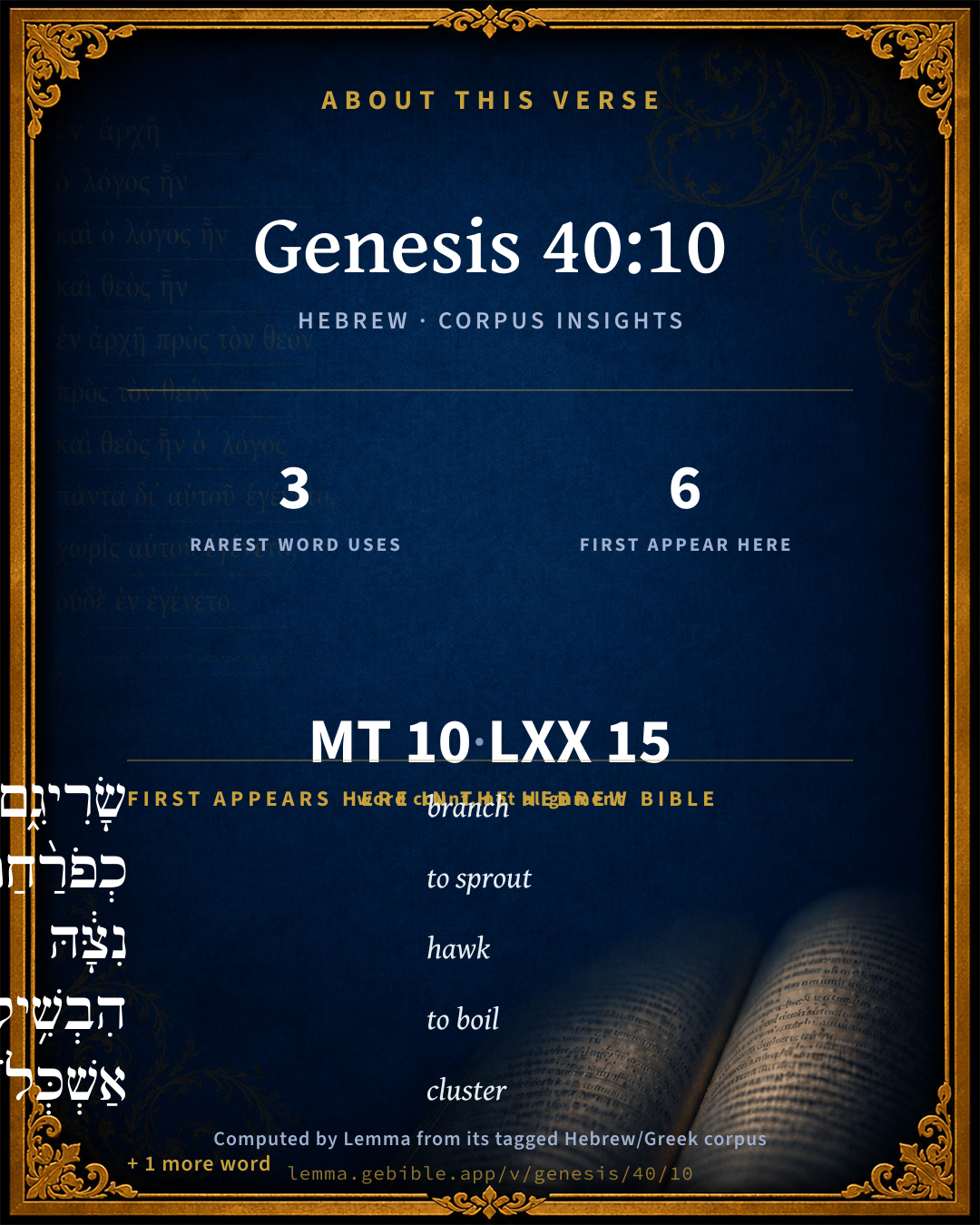
  • 6 first appearances in the Hebrew Bible
Full analysis ↓
Download a study sheet

One document with this verse’s original text, its word-by-word gloss line, the meaning frame, cross-references with their text, attributed commentary, and full source and license credits — printable, and it pastes into notes with its structure intact.

This verse Autodidact and up

Study sheet (.html) Plain text (.txt)

A passage Seminary Student

Up to 50 verses in one chapter. A passage sheet keeps up to 6 commentary sources and 12 cross-references per verse, in the order this page ranks them, and says so on the sheet whenever that leaves anything out. Ask for a single verse and you get the Autodidact verse sheet above.

Everything on this page stays free to read, with no account — the sheet is a download of what is already on screen, not access to it.

Want to remove ads? Support Godless Engineer
Compare translations 3

The same verse in 3 English versions, stacked beneath the original-language interlinear above. Click any original word for its lexicon entry.

Each is an independent rendering of the whole verse — the interlinear is not word-aligned to these translations.

Highlighted words mark where these versions differ — a whole-verse word diff, not a word-by-word alignment.

  • World English Bible Public Domain
    and in the vine were three branches. It was as though it budded, its blossoms shot forth, and the clusters of it brought forth ripe grapes.
  • King James Version Public Domain
    And in the vine were three branches: and it was as though it budded, and her blossoms shot forth; and the clusters thereof brought forth ripe grapes:
  • unfoldingWord Literal Text CC BY-SA 4.0
    and on the grapevine three branches. Then while it was budding, its blossoms came out, its clusters ripened grapes.

unfoldingWord Literal Text — © unfoldingWord, licensed CC BY-SA 4.0. Word-aligned USFM3 via Door43 (git.door43.org/unfoldingWord/en_ult).

Versions to compare (up to 4)

3 of 4 selected

Show all 18 translations

Every available English version of this verse, each an independent rendering of the whole verse.

  • World English Bible Public Domain
    and in the vine were three branches. It was as though it budded, its blossoms shot forth, and the clusters of it brought forth ripe grapes.
  • Berean Standard Bible Public Domain
    and on the vine were three branches. As it budded, its blossoms opened and its clusters ripened into grapes.
  • Majority Standard Bible Public Domain
    and on the vine were three branches. As it budded, its blossoms opened and its clusters ripened into grapes.
  • King James Version Public Domain
    And in the vine were three branches: and it was as though it budded, and her blossoms shot forth; and the clusters thereof brought forth ripe grapes:
  • American Standard Version (1901) Public Domain
    and in the vine were three branches: and it was as though it budded, `and' its blossoms shot forth; `and' the clusters thereof brought forth ripe grapes:
  • Revised Version (1885) Public Domain
    and in the vine were three branches: and it was as though it budded, and its blossoms shot forth; and the clusters thereof brought forth ripe grapes:
  • Geneva Bible (1599) Public Domain
    And in the vine were three branches, and as it budded, her flowre came foorth: and the clusters of grapes waxed ripe.
  • Douay-Rheims (1899) Public Domain
    On which were three branches, which by little and little sent out buds, and after the blossoms brought forth ripe grapes:
  • Young's Literal Translation Public Domain
    and in the vine `are' three branches, and it `is' as it were flourishing; gone up hath its blossom, its clusters have ripened grapes;
  • Literal Standard Version CC BY-SA 4.0
    And in the vine [are] three branches, and it [is] as it were flourishing; gone up has its blossom, its clusters have ripened grapes;
  • Unlocked Literal Bible CC BY-SA 4.0
    In the vine were three branches. As it budded, its blossoms came out and the clusters of grapes ripened.
  • unfoldingWord Literal Text CC BY-SA 4.0
    and on the grapevine three branches. Then while it was budding, its blossoms came out, its clusters ripened grapes.
  • Darby Bible Public Domain
    and in the vine were three branches; and it was as though it budded: its blossoms shot forth, its clusters ripened into grapes.
  • World Messianic Bible Public Domain
    and in the vine were three branches. It was as though it budded, it blossomed, and its clusters produced ripe grapes.
  • Webster's Bible Public Domain
    And on the vine were three branches: and it was as though it budded, and its blossoms shot forth; and its clusters brought forth ripe grapes:
  • Free Bible Version CC BY-SA 4.0
    “The vine had three branches. As soon as it budded, it flowered, and produced clusters of ripe grapes.
  • Bible in Basic English Public Domain
    And on the vine were three branches; and it seemed as if it put out buds and flowers, and from them came grapes ready for cutting.
  • JPS Tanakh (1917) Public Domain
    and in the vine were three branches; and as it was budding, its blossoms shot forth, and the clusters thereof brought forth ripe grapes,

Literal Standard Version (2020), Covenant Press — licensed CC BY-SA 4.0. Text via the HelloAO Bible API (eBible.org). Unlocked Literal Bible (unfoldingWord) — licensed CC BY-SA 4.0. Text via the HelloAO Bible API (eBible.org). unfoldingWord Literal Text — © unfoldingWord, licensed CC BY-SA 4.0. Word-aligned USFM3 via Door43 (git.door43.org/unfoldingWord/en_ult). Free Bible Version, Dr. Jonathan Gallagher — licensed CC BY-SA 4.0. Text via the HelloAO Bible API (eBible.org).

Word by word

More ways to search: Search by grammar → Find every occurrence → Compare this word →

Practice this passage: Drill this verse → Learn its vocabulary →

שָׂרִיגִ֑ם
sârîyg
H8299
“branches”
Noun, Common, Masculine, Plural, Absolute
Part of Speech
Noun
Type
Common
Gender
Masculine
Number
Plural
State
Absolute
Full BDB Definition

Origin: from H8276

TWOT: 2284a

tendril, twig, branch
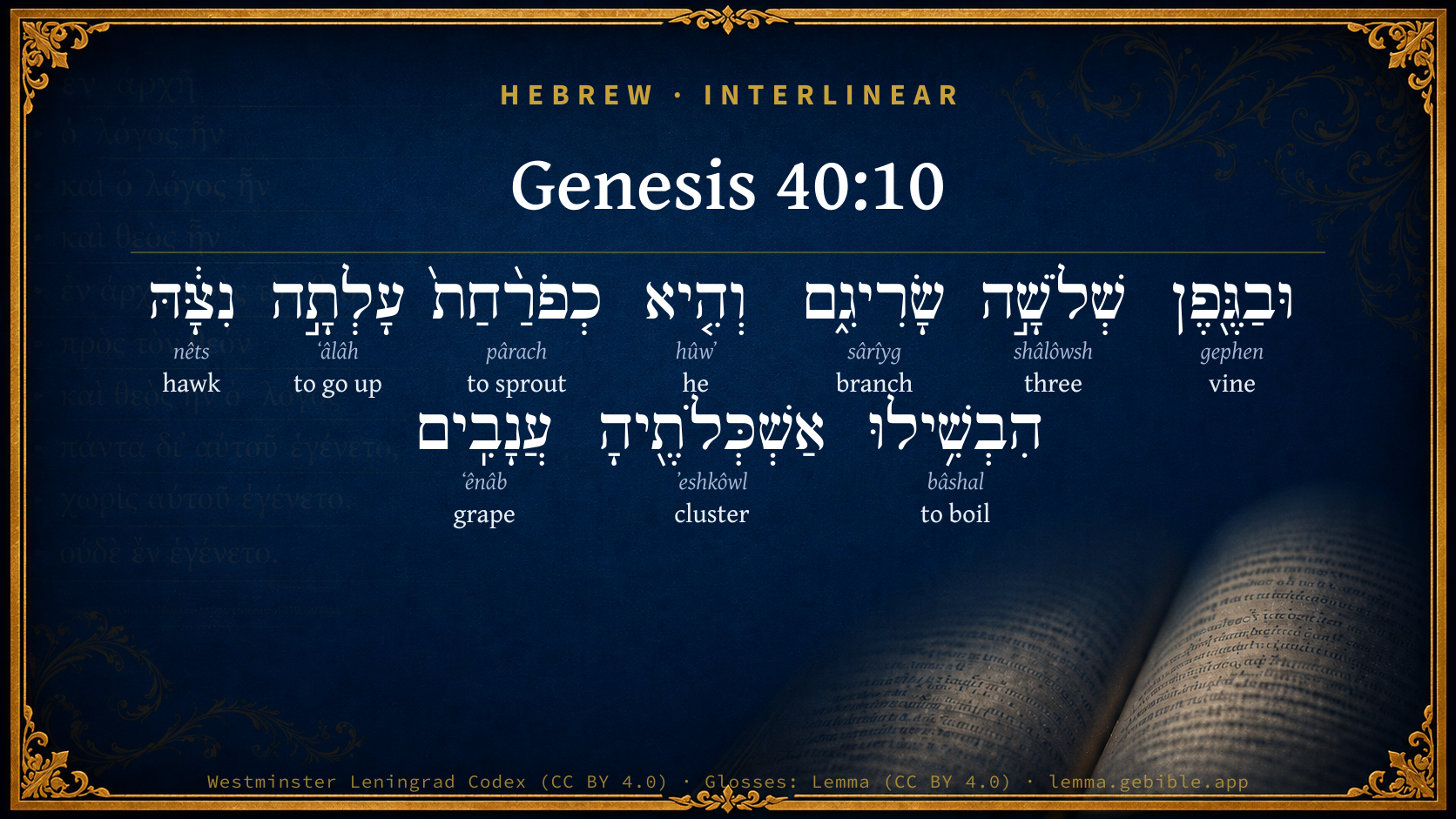
  1. וּבַגֶּ֖פֶן gephen H1612 “and · in/at the · vine” Conjunction + Preposition, Determined + Noun, Common, Both, Singular, Absolute
  2. שְׁלֹשָׁ֣ה shâlôwsh H7969 “three” Adjective, Cardinal number, Masculine, Singular, Absolute
  3. וְהִ֤יא hûwʼ H1931 “and · he” Conjunction + Pronoun, Personal, 3rd Person, Feminine, Singular
  4. כְפֹרַ֨חַת֙ pârach H6524 “like/as · sprouting” Preposition + Verb, Qal, Participle Active, Feminine, Singular, Absolute
  5. עָלְתָ֣ה ʻâlâh H5927 “to go up” Verb, Qal, Perfect, 3rd Person, Feminine, Singular
  6. נִצָּ֔הּ nêts H5322 “hawk · her” Noun, Common, Masculine, Singular, Construct + Suffix, Personal, 3rd Person, Feminine, Singular
  7. הִבְשִׁ֥ילוּ bâshal H1310 “to boil” Verb, Hiphil, Perfect, 3rd Person, Common, Plural
  8. אַשְׁכְּלֹתֶ֖יהָ ʼeshkôwl H811 “clusters · her” Noun, Common, Masculine, Plural, Construct + Suffix, Personal, 3rd Person, Feminine, Singular
  9. עֲנָבִֽים ʻênâb H6025 “grapes” Noun, Common, Masculine, Plural, Absolute

About this verse

These counts appear in no published source. They are computed here, from the morphology-tagged text and Lemma’s own curated glosses. What Lemma adds →

10
words
10
distinct lemmas
Pentateuch
section

Notable vocabulary

The rarest word here is שָׂרִיגִ֑ם branch H8299 — appearing just 3 times in the whole Hebrew Bible.

First appearance in Scripture

These words make their first canonical appearance in the Hebrew Bible here:

  • שָׂרִיגִ֑ם branch H8299
  • כְפֹרַ֨חַת֙ to sprout H6524
  • נִצָּ֔הּ hawk H5322
  • הִבְשִׁ֥ילוּ to boil H1310
  • אַשְׁכְּלֹתֶ֖יהָ cluster H811
  • עֲנָבִֽים grape H6025

Shared distinctive vocabulary

שָׂרִיגִ֑ם branch H8299 occurs in 3 verses of the Hebrew Bible. Also found in:

Grammatical profile

  • 3 verbs
  • 5 nouns
  • 1 adjective
  • 1 pronoun

Verb forms

  • כְפֹרַ֨חַת֙ Qal · Participle Active
  • עָלְתָ֣ה Qal · Perfect
  • הִבְשִׁ֥ילוּ Hiphil · Perfect

Hebrew & Septuagint length

In English translation the verse runs 26 words from the Hebrew and 19 from the Septuagint (LXX English) — closely comparable.

A rough comparison of the two English renderings, which tokenize alike — not a word-level alignment.

Word counts can differ between the Hebrew and the Greek without any difference in meaning — e.g. the Hebrew direct-object marker אֵת has no separate Greek word, and Greek often adds the article ὁ.

In the original languages it is 10 Hebrew tokens and 15 Greek tokens — but the two are counted differently (Hebrew bundles its prefixes and suffixes into one token; the Greek is in lemma form), so that isn’t a like-for-like length.

Hebrew and Greek witnesses Masoretic Hebrew ↔ Greek Septuagint

The same verse in the two great witnesses to the Old Testament, shown verse-for-verse.

These are two independent witnesses, not word-aligned to each other, and the Septuagint is shown in lemma (dictionary) form.

Hebrew Genesis 40:10 Masoretic · Westminster Leningrad Codex

וּבַגֶּ֖פֶן שְׁלֹשָׁ֣ה שָׂרִיגִ֑ם וְהִ֤יא כְפֹרַ֨חַת֙ עָלְתָ֣ה נִצָּ֔הּ הִבְשִׁ֥ילוּ אַשְׁכְּלֹתֶ֖יהָ עֲנָבִֽים

and in the vine were three branches. It was as though it budded, its blossoms shot forth, and the clusters of it brought forth ripe grapes.

World English Bible · Public Domain

Greek LXX Genesis 40:10 Septuagint · lemma form

ἐν δέ ὁ ἄμπελος τρεῖς πυθμήν καί αὐτός θάλλω ἀναφέρω βλαστός πέπειρος ὁ βότρυς σταφυλή

And in the vine were three stems; and it budding shot forth blossoms; the clusters of grapes were ripe.

LXX2012 (modern English Septuagint) · Public Domain

Hebrew: Westminster Leningrad Codex (CC BY 4.0). Greek: Septuagint (public domain); English from LXX2012 (modern English Septuagint) (Public Domain). How the Septuagint differs from the Hebrew →

Targum (Aramaic paraphrase)

2

The Targum is the ancient Jewish Aramaic paraphrase of the Hebrew Scriptures — an interpretive translation, not the Hebrew text itself. Onkelos (literal) and Pseudo-Jonathan (expansive) render the Torah, and Jonathan the Prophets. Coverage is partial: where no permissively-licensed English translation exists for a verse, only the Aramaic is shown. This is verse-level text, not a word-by-word alignment to the Hebrew.

  1. Targum Onkelos Torah (Genesis–Deuteronomy)
    וּבְגוּפְנָא תְּלָתָא שִׁבְשִׁין וְהִיא כַד אַפְרַחַת אַפֵּקַת לַבְלְבִין וַאֲנִיצַת נֵץ בַּשִּׁילוּ אִתְכְּלָתָהָא עִנְּבִין

    (no public-domain English translation for this verse)

    Targum Onkelos — Aramaic: “Onkelos Genesis” (public domain); “Onkelos Exodus” (public domain); “Onkelos Leviticus” (public domain); “Onkelos Numbers” (public domain); “Onkelos Deuteronomy” (public domain). English: “Sefaria Community Translation” (CC0 1.0 (public-domain dedication)); “J.W. Etheridge. The Targums of Onkelos and Jonathan Ben Uzziel on the Pentateuch. London: Longmans, Green, 1862” (public domain). Text via Sefaria.

  2. Targum Pseudo-Jonathan Torah (Genesis–Deuteronomy)
    וּבְגוּפְנָא תְּלָתֵי מְצוֹגְיָא וְהוּא כְדִי אַפְרַחַת אַפֵּיקַת לַבְלוֹבָהָא וּמִן יַד בָּשְׁלוּ סְגוֹלְיָהָא הֲווֹ עֲנָבִין

    And in the vine were three branches; and as it sprouted it brought forth buds, and immediately they ripened into clusters, and became grapes.

    Targum Pseudo-Jonathan — Aramaic: “Targum Jonathan on Genesis” (public domain); “Targum Jonathan on Exodus” (public domain); “Targum Jonathan on Leviticus” (public domain); “Targum Jonathan on Numbers” (public domain); “Targum Jonathan on Deuteronomy” (public domain). English: “The Targum of Jonathan ben Uzziel, trans. J. W. Etheridge, London, 1862” (public domain). Text via Sefaria.

Commentary

Notes on Genesis 40:10 from classic Christian and Jewish commentators (each source and its license shown beneath its notes). The classic Christian expositions comment on the surrounding passage and are grouped to its opening verse, so a note may address several verses; the Jewish commentaries on the Tanakh (Rashi and others) are per-verse, so they appear only where the commentator wrote on this verse.

Lemma curates 59 commentaries, every one of them public domain or Creative Commons licensed, each selected and text-cleaned for this edition rather than reprinted as found. About our sources →

Trapp's Complete Commentary

John Trapp

Gen 40:10 And in the vine [were] three branches: and it [was] as though it budded, [and] her blossoms shot forth; and the clusters thereof brought forth ripe grapes:

Ver. 10. It was as though it budded.] As though; for dreams are but the empty bubbles of the mind, children and tales of fancy, &c.

John Trapp, A Commentary or Exposition upon All the Books of the Old and New Testament (1647–1656) — public domain. Text from a community e-Sword module.

The Cambridge Bible for Schools and Colleges

gen. ed. J. J. S. Perowne

9–19. The Interpretation of their Dreams

10. it was as though it budded] Another rendering is “and as it budded, its blossoms shot forth.” But the rendering in the text is grammatically to be preferred. The dream combines, as it were, in a moment the successive stages, by which the vine first budded and blossomed, then brought forth grapes, the grapes ripened, and their juice was transformed into wine. Things will happen in a dream which do not admit of a scientific explanation.

The Cambridge Bible for Schools and Colleges (gen. ed. J. J. S. Perowne; Cambridge University Press, 1878–1918) — public domain. Text from a community e-Sword module.

John Gill's Exposition

And in the vine were three branches,.... Which shot out from the root or body of it:

and it was as though it budded; the branches seemed to sprout out:

and her blossoms shot forth; it knotted, and the flowers of the vine appeared, which blowing off, the tender grapes were seen:

and the clusters thereof brought forth ripe grapes; all which is agreeably to the order nature observes, from the first putting forth of the vine, to its producing ripe fruit; and which in this dream immediately followed one another, as it seemed according to the representation of things to the, mind of the butler, and which he perfectly remembered, it having made a strong impression upon him.

John Gill's Exposition of the Whole Bible (1746–1763) — public domain (CC PDM 1.0). Text via the HelloAO Bible API.

Rashi

Rabbi Shlomo Yitzchaki (Rashi)

שריגם BRANCHES — long branches called in old French. vitis.

והיא כפרחת means AND IT WAS AS THOUGH IT BUDDED — it seemed to me in my dream as though it budded, and after the bud its blossom sprang up — i.e. it began to flower; old French spanier — and after that the clusters brought forth ripe grapes. The Targum has והיא כד אפרחת אפיקת לבלבין “and it, when it budded, brought forth blossoms”, These words (ע״כ, abbreviation for עד כאן “till here”. The abbreviation is employed to show where a quotation ends.) are the translation of the word פרחת"” only. A נץ is larger than a פרח (i.e. נץ is a later stage of the bud), as it is written (Isaiah 18:5) “and the blossom (נצה) becometh a ripening grape”, and it is written (Numbers 17:23) “And it brought forth buds (פרח)” and afterwards it states “it brought forth (ציץ) blossoms”.

Rashi on the Tanakh — English translations: “The Judaica Press complete Tanach with Rashi, translated by A. J. Rosenberg” (CC BY 4.0); “Pentateuch with Rashi's commentary by M. Rosenbaum and A.M. Silbermann, 1929-1934” (public domain); “The Metsudah Tanach series, Lakewood, N.J” (CC BY 4.0); and “The Book of Joshua, Metsudah Publications, 1997” (CC BY 4.0). Text via Sefaria.

Ramban (Nachmanides)

Rabbi Moshe ben Nachman (Ramban / Nachmanides)

AND IT WAS AS THOUGH IT BUDDED AND ITS BLOSSOM WENT UP. “It seemed as though it budded. And it was as though it budded, i.e., it seemed to me in my dream as though it budded, and after the bud its blossom shot up, and after that it brought forth the clusters and then the ripe grapes. Onkelos translates: ‘And, when it buddeth, it brought forth sprouts.’ These words are the translation of the word porachath alone.”. Rashi’s intent, in quoting the Targum, is to say that Onkelos’ words, apeikath lavlevin (brought forth sprouts), is an expression which Onkelos appended to his translation of the Hebrew word porachath. Ramban will later differ with this opinion, holding that it constitutes Onkelos’ rendition of the Hebrew word althah, and signifies: “And it, when it budded, immediately brought forth sprouts.” See below, Note 271. Thus far the words of Rashi.This is not correct. If he is speaking in terms of appearances because they are matters of a dream, he should say, “Behold, like a vine was before me, and on the vine like three shoots.” This kaph of comparison is found neither in the dream of the chief of the bakers nor in the dream of Pharaoh. Why then should the chief of butlers use the comparative form more than the others? Instead, in all three dreams it says v’hinei (and behold). is used in connection with Pharaoh’s dream. It is this word which indicates comparison, for its meaning is “as if.”But the explanation of the verse before us, And it was ‘keporachath’ its blossoms shot up, is that he saw that immediately as it budded, its blossoms shot up and its clusters ripened into grapes. This was to indicate that G-d was hastening to do it. This is how Joseph recognized that the “three shoots” indicated three days, and not months or years, and he himself deduced that on the same day the two will be summoned before the king. It may be [that this was also indicated by the dreams] because both of them dreamed in one night. Thus there is no need for the words of Rabbi Abraham ibn Ezra, who says that Joseph knew of Pharaoh’s birthday.This usage of a kaph to indicate immediacy is found in many places: And it came to pass, ‘k’meishiv’ (as he drew back) his hand; ‘k’vo Avram’ (as Abram came);, 12:14. ‘uk’eith’ (and at the time) of her death the women that stood by her said, and many others.Onkelos’ rendition into Aramaic stating, “And when it budded, it brought forth sprouts,” [means to say that the expression “brought forth sprouts”] is a translation of the Hebrew word althah, meaning that it immediately brought forth sprouts of the vine. That is, as soon as it budded, it brought forth large sprouts, its blossoms shot up, and its clusters ripened into grapes., (not mentioned by Ramban, but appearing in the Targum, following apeikath lavlevin, mentioned above in Note 265), is the Aramaic equivalent of the Hebrew althah nitzah. Ramban however says that it is the translation only of the word nitzah, for althah (shoot up) could not refer to nitzah (sprouts). This is why, according to Ramban, Onkelos translated the word althah as apeikath lavlevin (it brought forth sprouts). In brief, according to Rashi’s understanding of the Targum, the Hebrew v’hi keporachath is rendered by the Targum as kad aphrachath apeikath lavlevin. The Hebrew althah nitzah is rendered va’aneitzath neitz. In the opinion of Ramban, v’hi keporachath is rendered by the Targum as kad aphrachath; the Hebrew althah is rendered apeikath lavlevin, and the Hebrew nitzah has its equivalent in Onkelos’ va’aneitzath nitzah. Onkelos would not apply the word althah (shoot up) to nitzah (sprouts), as they do not “shoot up.”

Ramban (Nachmanides) on the Tanakh — English translation: “Commentary on the Torah by Ramban (Nachmanides). Translated and annotated by Charles B. Chavel. New York, Shilo Pub. House, 1971-1976” (CC BY 4.0). Text via Sefaria.

Radak

Rabbi David Kimhi (Radak)

שלשה שריגים, branches of the grape vine are known as שריגים.

והיא כפורחת, at the time when the vine was in bloom it produced leaves at the same time.

עלתה נצה, the unripe grapes suddenly ripened until they were fully matured fruit. The fruit of the grape vine is not called ענבים until it has fully matured. We have already discussed the meaning of the preposition כ in the word כפרחת in 38,29.

Radak on the Tanakh — English translations: “Sefaria Community Translation” (CC0 1.0 (public-domain dedication)); “Eliyahu Munk, HaChut Hameshulash” (CC BY 4.0); “Rabbi Mike Feuer, Jerusalem Anthology” (CC BY 4.0); and “R. David Kimhi on the first book of Psalms, Translated by R.G. Finch, London, 1919” (public domain). Text via Sefaria.

Lesson kit

Teaching starters — assembled from the data on this page, not authored interpretation. Every prompt links to the verse data it draws on. Edit before teaching.

Genesis, in the Pentateuch, opens this verse with 10 words (10 distinct Hebrew lemmas). Its most distinctive word is sârîyg (“branch”). A historical commentator’s framing appears above. Read the whole chapter for the surrounding context.

Discussion questions

  1. What does “branch” (sârîyg) contribute to the verse as a whole?
  2. 6 words make their first appearance in Scripture here. What does this debut establish?
  3. How does Genesis 40:12, which shares the word «branch», read alongside this verse?
  4. These translations render this verse differently; the difference is in the English rendering, not the original. What questions does that raise?
  5. «כְפֹרַ֨חַת֙» is a Qal Participle Active verb. How does that grammatical form shape the action described?
  6. Compare how Trapp's Complete Commentary and The Cambridge Bible for Schools and Colleges read this verse. Where do they agree or differ?

Things to notice

Reading settings

Reading text

Shown beneath each verse's original-language words.

Old Testament
Old Testament edition

Read the OT as the Masoretic Hebrew (MT) or the Greek Septuagint (LXX).

English shown for the Greek Septuagint (in the Hebrew ↔ Greek comparison).

Comparing translations? Open the Compare panel on any verse page to stack up to four side by side.