
Exodus 20:26

Hebrew (Westminster Leningrad Codex) Exodus 20:26 appears in the Hebrew Old Testament. The text above is from the Westminster Leningrad Codex. Each word links to its Strong’s number, a concise gloss, and parsing drawn from the Open Scriptures Hebrew Bible morphology. Click any word for its full Brown-Driver-Briggs (BDB) entry.
Download image
Cite this verse

Exodus 20:26 (World English Bible). Public Domain. Lemma interlinear Bible study tool, https://lemma.gebible.app/v/exodus/20/26.

Show BibTeX & RIS
BibTeX
RIS
English Translation
Neither shall you go up by steps to my altar, that your nakedness may not be exposed to it.'
World English Bible · Public Domain
Highlights
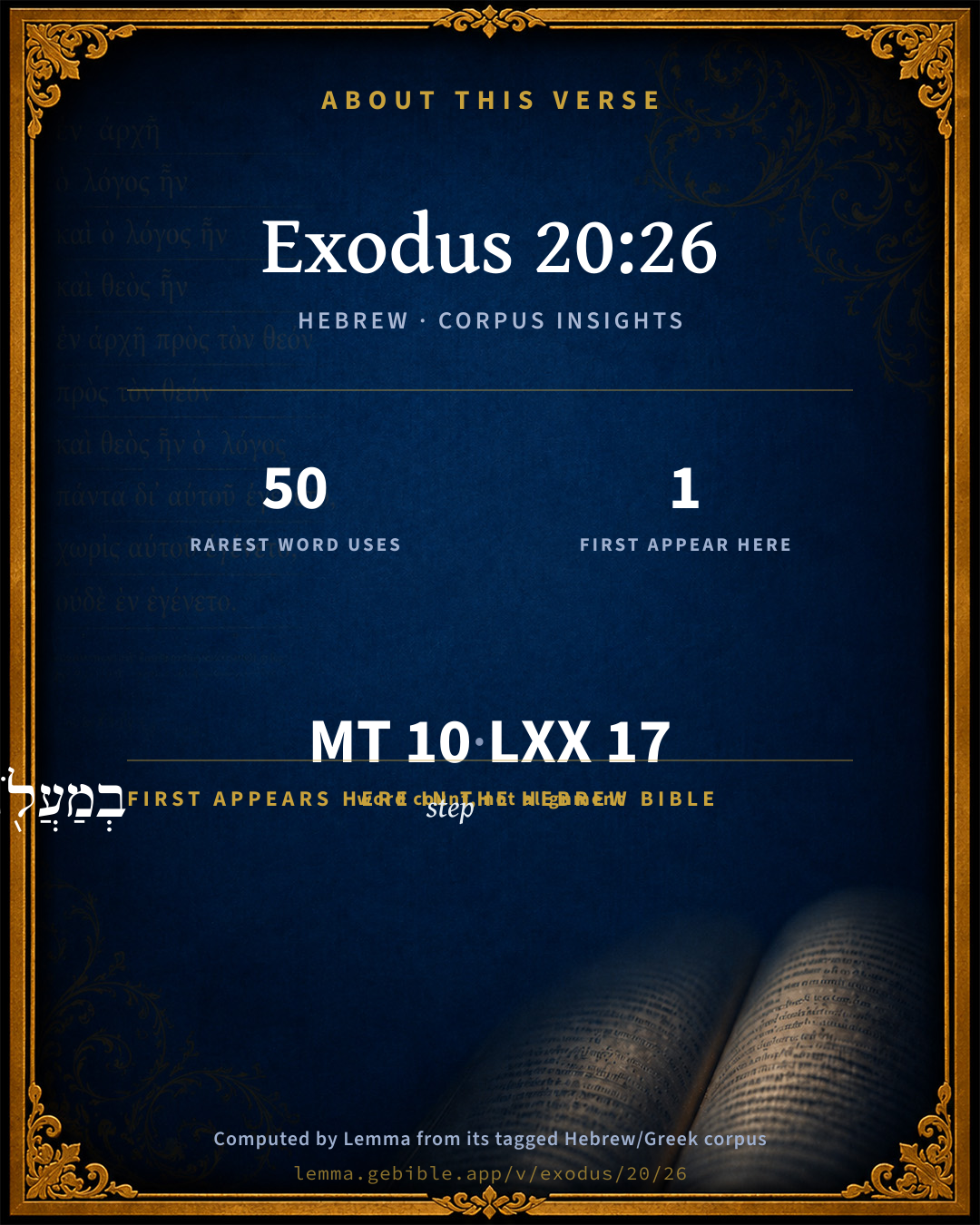
  • 1 first appearance in the Hebrew Bible
Full analysis ↓
Download a study sheet

One document with this verse’s original text, its word-by-word gloss line, the meaning frame, cross-references with their text, attributed commentary, and full source and license credits — printable, and it pastes into notes with its structure intact.

This verse Autodidact and up

Study sheet (.html) Plain text (.txt)

A passage Seminary Student

Up to 50 verses in one chapter. A passage sheet keeps up to 6 commentary sources and 12 cross-references per verse, in the order this page ranks them, and says so on the sheet whenever that leaves anything out. Ask for a single verse and you get the Autodidact verse sheet above.

Everything on this page stays free to read, with no account — the sheet is a download of what is already on screen, not access to it.

Want to remove ads? Support Godless Engineer
Compare translations 3

The same verse in 3 English versions, stacked beneath the original-language interlinear above. Click any original word for its lexicon entry.

Each is an independent rendering of the whole verse — the interlinear is not word-aligned to these translations.

Highlighted words mark where these versions differ — a whole-verse word diff, not a word-by-word alignment.

  • World English Bible Public Domain
    Neither shall you go up by steps to my altar, that your nakedness may not be exposed to it.'
  • King James Version Public Domain
    Neither shalt thou go up by steps unto mine altar, that thy nakedness be not discovered thereon.
  • unfoldingWord Literal Text CC BY-SA 4.0
    And you shall not go up to my altar on steps, so that your nakedness is not exposed over it.’

unfoldingWord Literal Text — © unfoldingWord, licensed CC BY-SA 4.0. Word-aligned USFM3 via Door43 (git.door43.org/unfoldingWord/en_ult).

Versions to compare (up to 4)

3 of 4 selected

Show all 18 translations

Every available English version of this verse, each an independent rendering of the whole verse.

  • World English Bible Public Domain
    Neither shall you go up by steps to my altar, that your nakedness may not be exposed to it.'
  • Berean Standard Bible Public Domain
    And you must not go up to My altar on steps, lest your nakedness be exposed on it.’
  • Majority Standard Bible Public Domain
    And you must not go up to My altar on steps, lest your nakedness be exposed on it.’
  • King James Version Public Domain
    Neither shalt thou go up by steps unto mine altar, that thy nakedness be not discovered thereon.
  • American Standard Version (1901) Public Domain
    Neither shalt thou go up by steps unto mine altar, that thy nakedness be not uncovered thereon.
  • Revised Version (1885) Public Domain
    Neither shalt thou go up by steps unto mine altar, that thy nakedness be not discovered thereon.
  • Geneva Bible (1599) Public Domain
    Neither shalt thou goe vp by steppes vnto mine altar, that thy filthines be not discouered thereon.
  • Douay-Rheims (1899) Public Domain
    Thou shalt not go up by steps unto my altar, lest thy nakedness be discovered.
  • Young's Literal Translation Public Domain
    neither dost thou go up by steps on Mine altar, that thy nakedness be not revealed upon it.
  • Literal Standard Version CC BY-SA 4.0
    neither do you go up by steps on My altar, that your nakedness is not revealed on it.
  • Unlocked Literal Bible CC BY-SA 4.0
    You must not go up to my altar on steps, so that your nakedness is not exposed.'”
  • unfoldingWord Literal Text CC BY-SA 4.0
    And you shall not go up to my altar on steps, so that your nakedness is not exposed over it.’
  • Darby Bible Public Domain
    Neither shalt thou go up by steps unto mine altar, that thy nakedness be not discovered thereon.
  • World Messianic Bible Public Domain
    You shall not go up by steps to my altar, that your nakedness may not be exposed to it.’
  • Webster's Bible Public Domain
    Neither shalt thou go up by steps to my altar, that thy nakedness be not discovered thereon.
  • Free Bible Version CC BY-SA 4.0
    Also, you must not go up to my altar using steps, so your private parts are not seen.’”
  • Bible in Basic English Public Domain
    And do not go up by steps to my altar, for fear that your bodies may be seen uncovered.
  • JPS Tanakh (1917) Public Domain
    (20-23) Neither shalt thou go up by steps unto Mine altar, that thy nakedness be not uncovered thereon.

Literal Standard Version (2020), Covenant Press — licensed CC BY-SA 4.0. Text via the HelloAO Bible API (eBible.org). Unlocked Literal Bible (unfoldingWord) — licensed CC BY-SA 4.0. Text via the HelloAO Bible API (eBible.org). unfoldingWord Literal Text — © unfoldingWord, licensed CC BY-SA 4.0. Word-aligned USFM3 via Door43 (git.door43.org/unfoldingWord/en_ult). Free Bible Version, Dr. Jonathan Gallagher — licensed CC BY-SA 4.0. Text via the HelloAO Bible API (eBible.org).

Word by word

More ways to search: Search by grammar → Find every occurrence → Compare this word →

Practice this passage: Drill this verse → Learn its vocabulary →

בְמַעֲלֹ֖ת
maʻălâh
H4609
“in/at · steps”
Preposition + Noun, Common, Feminine, Plural, Absolute
Part of Speech
Preposition + Noun
Type
Common
Gender
Feminine
Number
Plural
State
Absolute
Full BDB Definition

Origin: from H4608

TWOT: 1624 L, 1624m

what comes up, thoughts - step, stair - step, stair - steps (of sundial) - stories (of heaven) - ascent - song of ascent - to the three great pilgrim feasts (Psalm titles)
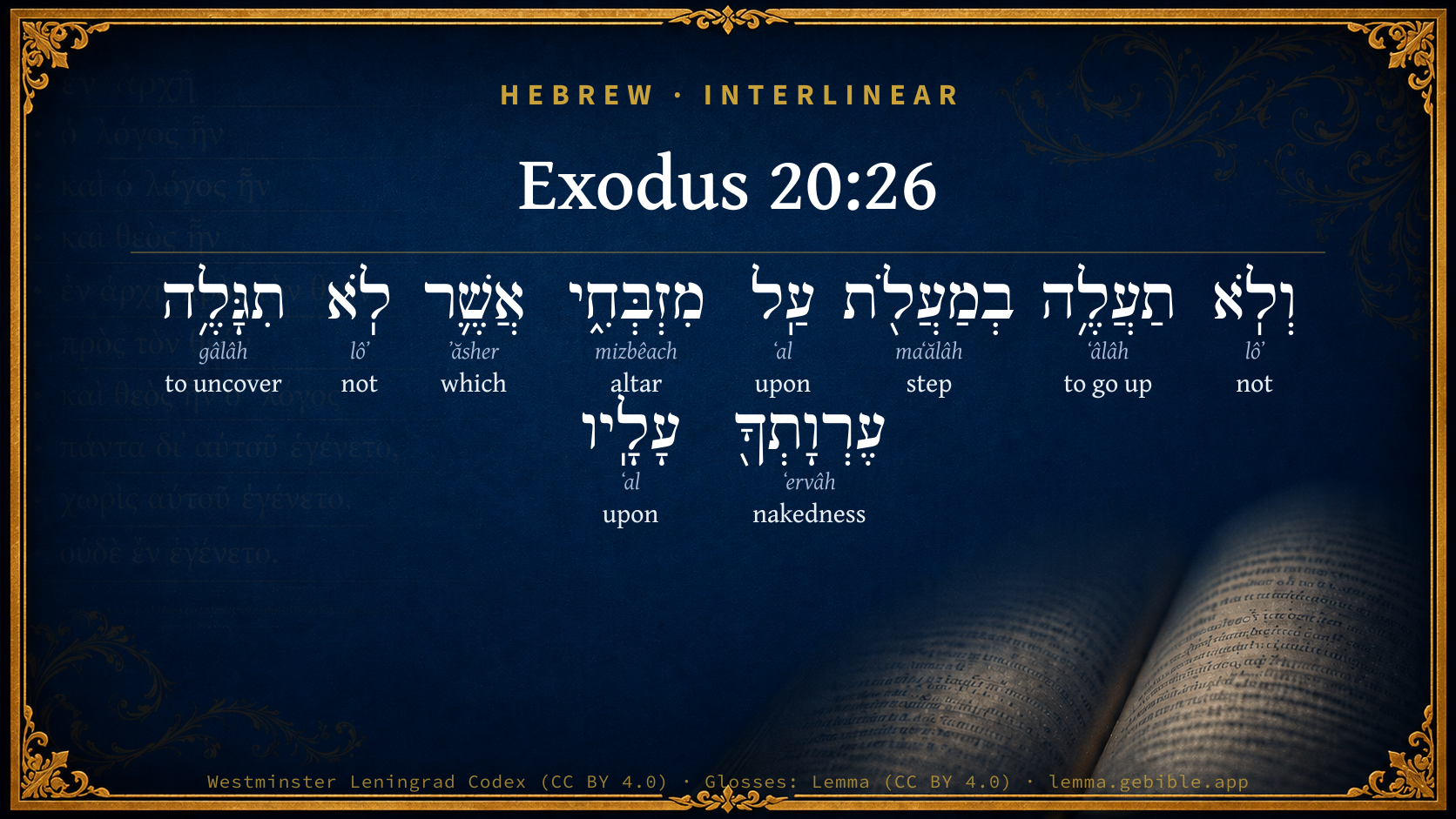
  1. וְלֹֽא lôʼ H3808 “and · not” Conjunction + Particle, Negative
  2. תַעֲלֶ֥ה ʻâlâh H5927 “to go up” Verb, Qal, Imperfect, 2nd Person, Masculine, Singular
  3. עַֽל ʻal H5921 “upon” Preposition
  4. מִזְבְּחִ֑י mizbêach H4196 “altar · my” Noun, Common, Masculine, Singular, Construct + Suffix, Personal, 1st Person, Common, Singular
  5. אֲשֶׁ֛ר ʼăsher H834 “which” Particle, Relative
  6. לֹֽא lôʼ H3808 “not” Particle, Negative
  7. תִגָּלֶ֥ה gâlâh H1540 “to uncover” Verb, Niphal, Imperfect, 3rd Person, Feminine, Singular
  8. עֶרְוָתְךָ֖ ʻervâh H6172 “nakedness · your” Noun, Common, Feminine, Singular, Construct + Suffix, Personal, 2nd Person, Masculine, Singular
  9. עָלָֽיו ʻal H5921 “upon · him” Preposition + Suffix, Personal, 3rd Person, Masculine, Singular

About this verse

These counts appear in no published source. They are computed here, from the morphology-tagged text and Lemma’s own curated glosses. What Lemma adds →

10
words
8
distinct lemmas
Pentateuch
section

First appearance in Scripture

This word makes its first canonical appearance in the Hebrew Bible here:

  • בְמַעֲלֹ֖ת step H4609

Shared distinctive vocabulary

בְמַעֲלֹ֖ת step H4609 occurs in 40 verses of the Hebrew Bible. Also found in:

Grammatical profile

  • 2 verbs
  • 3 nouns
  • 2 prepositions
  • 3 particles

Verb forms

  • תַעֲלֶ֥ה Qal · Imperfect
  • תִגָּלֶ֥ה Niphal · Imperfect

Repetition

Words recur within this verse — often emphatic in Hebrew:

  • עַֽל upon H5921 ×2
  • וְלֹֽא not H3808 ×2

Hebrew & Septuagint length

In English translation the verse runs 19 words from the Hebrew and 19 from the Septuagint (LXX English) — the same length.

A rough comparison of the two English renderings, which tokenize alike — not a word-level alignment.

Word counts can differ between the Hebrew and the Greek without any difference in meaning — e.g. the Hebrew direct-object marker אֵת has no separate Greek word, and Greek often adds the article ὁ.

In the original languages it is 10 Hebrew tokens and 17 Greek tokens — but the two are counted differently (Hebrew bundles its prefixes and suffixes into one token; the Greek is in lemma form), so that isn’t a like-for-like length.

Cross-references

5

Topical passages linked to Exodus 20:26 in the Treasury of Scripture Knowledge — connected by theme and wording, ordered by reader-vote popularity; previews shown in the World English Bible.

  • 1 Peter 1:16 because it is written, "You shall be holy; for I am holy."
  • Ecclesiastes 5:1 Guard your steps when you go to God's house; for to draw near to listen is better than to give the sacrifice of fools, for they don't know that they do evil.
  • Leviticus 10:3 Then Moses said to Aaron, "This is what Yahweh spoke of, saying, "'I will show myself holy to those who come near me, And before all the people I will be glorified.'" Aaron held his peace.
  • Psalms 89:7 A very awesome God in the council of the holy ones, To be feared above all those who are around him?
  • Hebrews 12:28–29 Therefore, receiving a Kingdom that can't be shaken, let us have grace, through which we serve God acceptably, with reverence and awe,

Cross-references courtesy of OpenBible.info (CC BY 4.0).

Hebrew and Greek witnesses Masoretic Hebrew ↔ Greek Septuagint

The same verse in the two great witnesses to the Old Testament, shown verse-for-verse.

These are two independent witnesses, not word-aligned to each other, and the Septuagint is shown in lemma (dictionary) form.

Hebrew Exodus 20:26 Masoretic · Westminster Leningrad Codex

וְלֹֽא תַעֲלֶ֥ה בְמַעֲלֹ֖ת עַֽל מִזְבְּחִ֑י אֲשֶׁ֛ר לֹֽא תִגָּלֶ֥ה עֶרְוָתְךָ֖ עָלָֽיו

Neither shall you go up by steps to my altar, that your nakedness may not be exposed to it.'

World English Bible · Public Domain

Greek LXX Exodus 20:26 Septuagint · lemma form

οὐ ἀναβαίνω ἐν ἀναβαθμίς ἐπί ὁ θυσιαστήριον ἐγώ ὅπως ἄν μή ἀποκαλύπτω ὁ ἀσχημοσύνη σύ ἐπί αὐτός

You shall not go up to my altar by steps, that you may not uncover your nakedness upon it.

LXX2012 (modern English Septuagint) · Public Domain

Hebrew: Westminster Leningrad Codex (CC BY 4.0). Greek: Septuagint (public domain); English from LXX2012 (modern English Septuagint) (Public Domain). How the Septuagint differs from the Hebrew →

Commentary

Notes on Exodus 20:26 from classic Christian and Jewish commentators (each source and its license shown beneath its notes). The classic Christian expositions comment on the surrounding passage and are grouped to its opening verse, so a note may address several verses; the Jewish commentaries on the Tanakh (Rashi and others) are per-verse, so they appear only where the commentator wrote on this verse.

Lemma curates 59 commentaries, every one of them public domain or Creative Commons licensed, each selected and text-cleaned for this edition rather than reprinted as found. About our sources →

Trapp's Complete Commentary

John Trapp

Exo 20:26 Neither shalt thou go up by steps unto mine altar, that thy nakedness be not discovered thereon.

Ver. 26. That thy nakedness.] We blush when taken naked, as if the blood would run forth to cover us. What beasts, then, were those priests of Priapus, and those base Bacchanalists, that ran up and down naked!

John Trapp, A Commentary or Exposition upon All the Books of the Old and New Testament (1647–1656) — public domain. Text from a community e-Sword module.

Joseph Benson's Commentary

Exo 20:26. Neither shalt thou go up by steps unto mine altar — Indeed afterward God appointed an altar ten cubits high. But it is probable they went not up to that by steps, but by a sloping ascent. The garments worn in those countries, being perfectly loose, were easily blown aside, so as to discover the lower parts of the body; to prevent, therefore, this inconvenience, and that no indecency might be intermixed with the service of God, this precaution was necessary. And for the same reason the priests were afterward appointed to wear breeches, which were worn by none of the people besides, Exo 28:42.

Joseph Benson's Commentary on the Old and New Testaments (1811–1818) — public domain. Text from a community e-Sword module.

Geneva Bible (1599)

Geneva Bible translators

Which might be by his stooping or flying abroad of his clothes.

Geneva Bible (1599) marginal notes — public domain. Text via Bolls.life.

Jamieson, Fausset & Brown

Robert Jamieson, A. R. Fausset & David Brown

by steps--a precaution taken for the sake of decency, in consequence of the loose, wide, flowing garments of the priests.

Next: Exodus Chapter 21

Jamieson, Fausset & Brown — Commentary Critical and Explanatory on the Whole Bible (1871) — public domain (CC PDM 1.0). Text via the HelloAO Bible API.

Adam Clarke's Commentary

Verse 26. Neither shalt thou go up by steps unto mine altar] The word altar comes from altus, high or elevated, though the Hebrew word מזבח mizbach, from זבח zabach, to slay, kill, c., signifies merely a place for sacrifice see Ge 8:20. But the heathens, who imitated the rites of the true God in their idolatrous worship, made their altars very high; whence they derived their name altaria, altars, i.e., very high or elevated places; which they built thus, partly through pride and vain glory, and partly that their gods might the better hear them. Hence also the high places or idolatrous altars so often and so severely condemned in the Holy Scriptures. The heathens made some of their altars excessively high; and some imagine that the pyramids were altars of this kind, and that the inspired writer refers to those in these prohibitions. God therefore ordered his altars to be made,

1. either of simple turf, that there might be no unnecessary expense, which, in their present circumstances, the people could not well afford; and that they might be no incentives to idolatry from their costly or curious structure; or

2. of unhewn stone, that no images of animals or of the celestial bodies might be sculptured on them, as was the case among the idolaters, and especially among the Egyptians, as several of their ancient altars which remain to the present day amply testify; which altars themselves, and the images carved on them, became in process of time incentives to idolatry, and even objects of worship.

In short, God formed every part of his worship so that every thing belonging to it might be as dissimilar as possible from that of the surrounding heathenish nations, and especially the Egyptians, from whose land they had just now departed. This seems to have been the whole design of those statutes on which many commentators have written so largely and learnedly, imagining difficulties where probably there are none. The altars of the tabernacle were of a different kind.

IN this and the preceding chapter we have met with some of the most awful displays of the Divine Majesty; manifestations of justice and holiness which have no parallel, and can have none till that day arrive in which he shall appear in his glory, to judge the quick and the dead. The glory was truly terrible, and to the children of Israel insufferable; and yet how highly privileged to have God himself speaking to them from the midst of the fire, giving them statutes and judgments so righteous, so pure, so holy, and so truly excellent in their operation and their end, that they have been the admiration of all the wise and upright in all countries and ages of the world, where their voice has been heard! Mohammed defied all the poets and literati of Arabia to match the language of the Koran; and for purity, elegance, and dignity it bore away the palm, and remained unrivalled. This indeed was the only advantage which the work derived from its author; for its other excellences it was indebted to Moses and the prophets, to Christ and the apostles; as there is scarcely a pure, consistent, theologic notion in it, that has not been borrowed from our sacred books. Moses calls the attention of the people, not to the language in which these Divine laws were given, though that is all that it should be, and every way worthy of its author; compressed yet perspicuous; simple yet dignified; in short, such as God should speak if he wished his creatures to comprehend; but he calls their attention to the purity, righteousness, and usefulness of the grand revelation which they had just received. For what nation, says he, is there so great, who hath God so nigh unto them, as Jehovah our God is, in all things that we call upon him for? And what nation hath statutes and judgments so righteous as all this law which I set before you this day? And that which was the sum of all excellence in the present case was this, that the GOD who gave these laws dwelt among his people; to him they had continual access, and from him received that power without which obedience so extensive and so holy would have been impossible; and yet not one of these laws exacted more than eternal reason, the nature and fitness of things, the prosperity of the community, and the peace and happiness of the individual, required. The LAW is holy, and the COMMANDMENT is HOLY, JUST, and GOOD.

To show still more clearly the excellence and great utility of the ten commandments, and to correct some mistaken notions concerning them, it may be necessary to make a few additional observations. And

1. It is worthy of remark that there is none of these commandments, nor any part of one, which can fairly be considered as merely ceremonial. All are moral, and consequently of everlasting obligation.

2. When considered merely as to the letter, there is certainly no difficulty in the moral obedience required to them. Let every reader take them up one by one, and ask his conscience before God, which of them he is under a fatal and uncontrollable necessity to break?

3. Though by the incarnation and death of Christ all the ceremonial law which referred to him and his sacrifice is necessarily abrogated, yet, as none of these ten commandments refer to any thing properly ceremonial, therefore they are not abrogated.

4. Though Christ came into the world to redeem them who believe from the curse of the law, he did not redeem them from the necessity of walking in that newness of life which these commandments so strongly inculcate.

5. Though Christ is said to have fulfilled the law for us, yet it is nowhere intimated in the Scripture that he has so fulfilled these TEN LAWS, as to exempt us from the necessity and privilege of being no idolaters, swearers, Sabbath-breakers, disobedient and cruel children, murderers, adulterers, thieves, and corrupt witnesses. All these commandments, it is true, he punctually fulfilled himself; and all these he writes on the heart of every soul redeemed by his blood.

6. Do not those who scruple not to insinuate that the proper observation of these laws is impossible in this life, and that every man since the fall does daily break them in thought, word, and deed, bear false witness against God and his truth? and do they not greatly err, not knowing the Scripture, which teaches the necessity of such obedience, nor the power of God, by which the evil principle of the heart is destroyed, and the law of purity written on the soul? If even the regenerate man, as some have unwarily asserted, does daily break these commands, these ten words, in thought, word, and deed, he may be as bad as Satan for aught we know; for Satan himself cannot transgress in more forms than these, for sin can be committed in no other way, either by bodied or disembodied spirits, than by thought, or word, or deed. Such sayings as these tend to destroy the distinction between good and evil, and leave the infidel and the believer on a par as to their moral state. The people of God should be careful how they use them.

7. It must be granted, and indeed has sufficiently appeared from the preceding exposition of these commandments, that they are not only to be understood in the letter but also in the spirit, and that therefore they may be broken in the heart while outwardly kept inviolate; yet this does not prove that a soul influenced by the grace and spirit of Christ cannot most conscientiously observe them; for the grace of the Gospel not on)y saves a man from outward but also from inward sin; for, says the heavenly messenger, his name shall be called JESUS, (i.e., Saviour,) because he shall save, (i.e., DELIVER) his people FROM their sins. Therefore the weakness or corruption of human nature forms no argument here, because the blood of Christ cleanses from all unrighteousness; and he saves to the uttermost all who come unto the Father through him. It is therefore readily granted that no man unassisted and uninfluenced by the grace of Christ can keep these commandments, either in the letter or in the spirit; but he who is truly converted to God, and has Christ dwelling in his heart by faith, can, in the letter and in the spirit, do all these things, BECAUSE CHRIST STRENGTHENS him. - Reader, the following is a good prayer, and oftentimes thou hast said it; now learn to pray it: "Lord, have mercy upon us, and incline our hearts to keep these laws! Lord, have mercy upon us, and write all these thy laws in our hearts, we beseech thee!" - Com. Service.

Adam Clarke's Commentary on the Bible (1810–1826) — public domain. Text from a community e-Sword/MySword module.

Ellicott's Commentary for English Readers

(26) Neither shalt thou go up by steps unto mine altar.—When the dress of the priests had been so arranged that no exposure of the person was possible (verses 42, 43), this precept became unnecessary. Thus it would seem that Solomon’s altar had steps. (Compare 2Ch_4:1 with Eze_43:17.)

A Bible Commentary for English Readers, edited by Charles John Ellicott (1878–1897) — public domain. Text from a community e-Sword module.

The Cambridge Bible for Schools and Colleges

gen. ed. J. J. S. Perowne

26. Steps are prohibited, because the command is addressed to the Israelite in general, who would sacrifice in his ordinary dress. In later times, when altars of larger size were constructed, a ledge (see on Exo_27:5), or steps (Eze_43:17), came into use: but sacrifice was then confined to the priests, and exposure of the person was guarded against in their case by linen drawers being specially prescribed for their use (Exo_28:42). Cf. OTJC.2[183] p. 358.

[183] W. R. Smith, Old Testament in the Jewish Church, ed. 2, 1892.

The Cambridge Bible for Schools and Colleges (gen. ed. J. J. S. Perowne; Cambridge University Press, 1878–1918) — public domain. Text from a community e-Sword module.

Haydock's Catholic Bible Commentary

Steps. These were afterwards allowed in the temple, Ezechiel xliii. 17. The Egyptians made use of their pyramids for altars; and some suppose, that the high places of Juda were of a similar nature, and exposed the priests, who wore long robes without breeches, to the danger of being seen, chap. xxviii. 42. The steps allowed by God were therefore very low, and enclosed with boards, after the Greek fashion. Such were used by the priest and priestess of Jupiter. (Serv. in Æneid iv. 646.) Linen breeches, or girdles, were afterwards required, Leviticus xxxix. 27. and Exodus xxviii. 42. (Calmet)

George Leo Haydock (1774–1849), Haydock's Catholic Family Bible and Commentary, 1859 edition — public domain. Excludes Psalms (Douay-Rheims chapter numbering differs from Protestant) and Deuterocanonical books (Catholic canon only).

Matthew Poole's English Annotations

He seems to mean the steps of ladders, or others of the same nature, which could suddenly be made, and were proper for their present condition, where there was danger of the following inconvenience. For afterwards God appointed an altar ten cubits high, 2Ch 4:1; though some conceive they went not up to that by steps, but by an insensible ascent upon the ground raised by degrees for that purpose. But if the priests did go up to it by steps, God provided against the indecency here mentioned, by prescribing linen breeches to them in that service.

That thy nakedness be not discovered thereon; for these linen breeches were not yet appointed, and the manner then and there was for men to wear long coats or gowns like women. God would remove all appearance or occasion of immodesty, especially in sacred persons and things; and the rather, to show his detestation of that impudence and filthiness which was very usual in some of the solemnities and worships of the heathen.

Matthew Poole's English Annotations on the Holy Bible (1683–1685) — public domain. Text from a community e-Sword/MySword module.

Whedon's Commentary on the Bible

Daniel D. Whedon

26. Neither shalt thou go up by steps — That is, by an elevated staircase or means of ascent which would indecently expose the person of the one who offered the sacrifice.

Daniel D. Whedon (gen. ed.), Commentary on the Old and New Testaments (1874–1909) — public domain. Text from a community e-Sword module.

The Pulpit Commentary

Neither shalt thou go up by steps unto mine altar. Here the reason of decency, added in the text, is obvious; and the law would necessarily continue until sacerdotal vestments of a very different character from the clothes commonly worn by Orientals were introduced (38:3-43). After their introduction, the reason for the law, and with it the law itself, would drop The supposed "slope of earth" by which the priests are thought to have ascended to the "ledge" on the altar of burnt offerings, and the "inclined plane," said by Josephus to have given access to the great altar of Solomon, rest on no sufficient authority, and are probably pure fictions. As soon as an ascent was needed, owing to the height of the altar, it was probably an ascent by steps. (see Eze_43:17)

The Pulpit Commentary (1880–1919), ed. H.D.M. Spence-Jones & Joseph S. Exell — public domain. Text from a community e-Sword module.

John Wesley's Explanatory Notes

Neither shall thou go at by steps unto mine altar - Indeed afterwards God appointed an altar ten cubits high. But it is probable, they went not up to that by steps, but by a sloping ascent.

John Wesley, Explanatory Notes Upon the Whole Bible (1754–1765) — public domain. Text via the GEBible commentary corpus.

Lesson kit

Teaching starters — assembled from the data on this page, not authored interpretation. Every prompt links to the verse data it draws on. Edit before teaching.

Exodus, in the Pentateuch, opens this verse with 10 words (8 distinct Hebrew lemmas). Its most distinctive word is maʻălâh (“step”). A historical commentator’s framing appears above. Read the whole chapter for the surrounding context.

Discussion questions

  1. How does “step” (maʻălâh) shape what this verse is saying?
  2. The word “step” first appears here in Scripture. What is being introduced at this debut?
  3. Joshua 10:10 shares the word «step» with this verse. How do the two illuminate each other?
  4. “upon” occurs 2× in this one verse. What is the effect of the repetition?
  5. The translations on this page render this verse differently — a whole-verse word diff, not a word-by-word alignment. What might account for the different wordings?
  6. The verb «תַעֲלֶ֥ה» is Qal Imperfect. How does its form color the action?
  7. Reading how Trapp's Complete Commentary and Joseph Benson's Commentary read this verse, where do the two commentators agree and where do they part?

Things to notice

Reading settings

Reading text

Shown beneath each verse's original-language words.

Old Testament
Old Testament edition

Read the OT as the Masoretic Hebrew (MT) or the Greek Septuagint (LXX).

English shown for the Greek Septuagint (in the Hebrew ↔ Greek comparison).

Comparing translations? Open the Compare panel on any verse page to stack up to four side by side.