
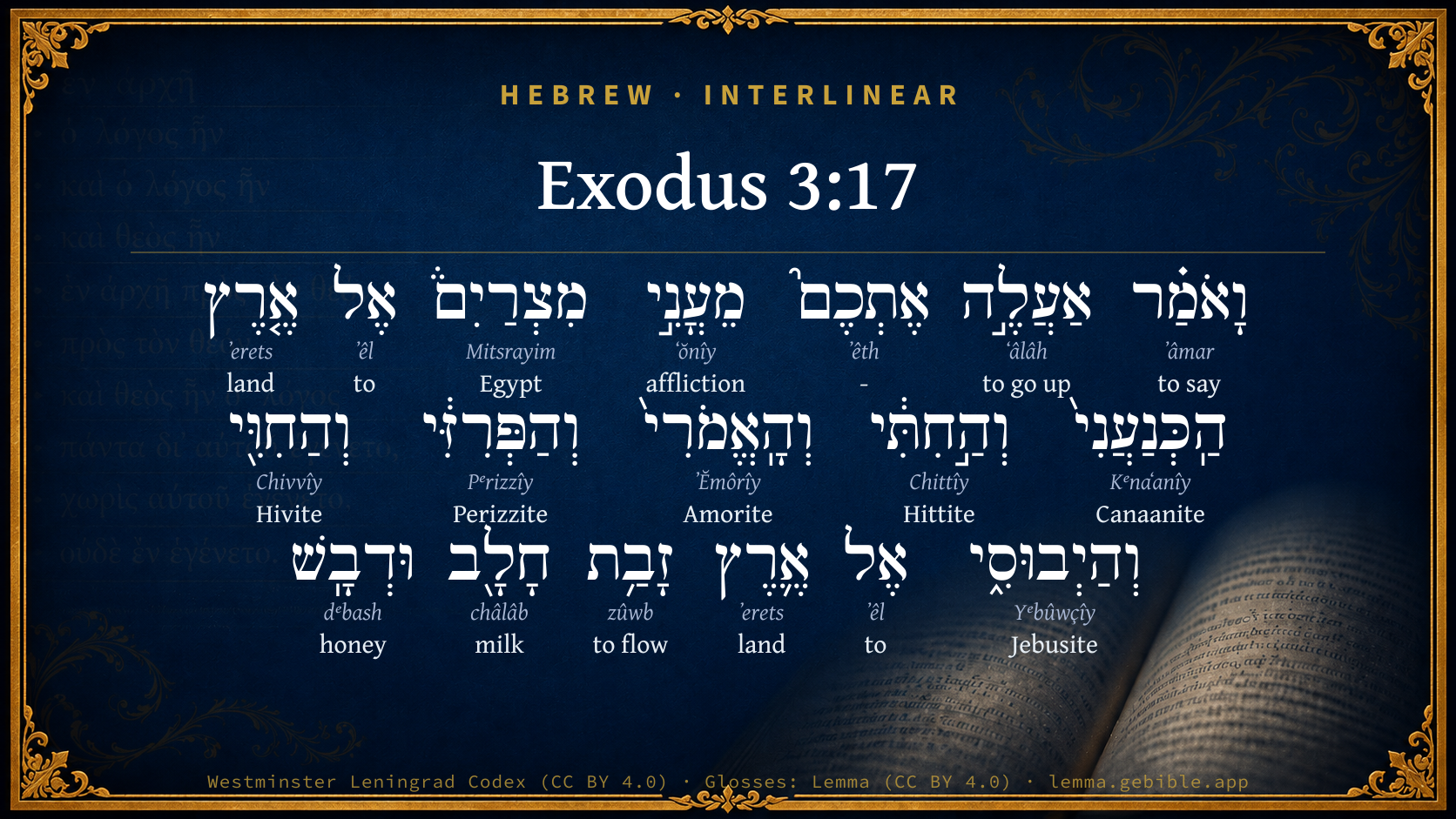
Exodus 3:17

Hebrew (Westminster Leningrad Codex) Exodus 3:17 appears in the Hebrew Old Testament. The text above is from the Westminster Leningrad Codex. Each word links to its Strong’s number, a concise gloss, and parsing drawn from the Open Scriptures Hebrew Bible morphology. Click any word for its full Brown-Driver-Briggs (BDB) entry.
Download image
Cite this verse

Exodus 3:17 (World English Bible). Public Domain. Lemma interlinear Bible study tool, https://lemma.gebible.app/v/exodus/3/17.

Show BibTeX & RIS
BibTeX
RIS
English Translation
and I have said, I will bring you up out of the affliction of Egypt to the land of the Canaanite, the Hittite, the Amorite, the Perizzite, the Hivite, and the Jebusite, to a land flowing with milk and honey."'
World English Bible · Public Domain
Download a study sheet

One document with this verse’s original text, its word-by-word gloss line, the meaning frame, cross-references with their text, attributed commentary, and full source and license credits — printable, and it pastes into notes with its structure intact.

This verse Autodidact and up

Study sheet (.html) Plain text (.txt)

A passage Seminary Student

Up to 50 verses in one chapter. A passage sheet keeps up to 6 commentary sources and 12 cross-references per verse, in the order this page ranks them, and says so on the sheet whenever that leaves anything out. Ask for a single verse and you get the Autodidact verse sheet above.

Everything on this page stays free to read, with no account — the sheet is a download of what is already on screen, not access to it.

Want to remove ads? Support Godless Engineer
Compare translations 3

The same verse in 3 English versions, stacked beneath the original-language interlinear above. Click any original word for its lexicon entry.

Each is an independent rendering of the whole verse — the interlinear is not word-aligned to these translations.

Highlighted words mark where these versions differ — a whole-verse word diff, not a word-by-word alignment.

  • World English Bible Public Domain
    and I have said, I will bring you up out of the affliction of Egypt to the land of the Canaanite, the Hittite, the Amorite, the Perizzite, the Hivite, and the Jebusite, to a land flowing with milk and honey."'
  • King James Version Public Domain
    And I have said, I will bring you up out of the affliction of Egypt unto the land of the Canaanites, and the Hittites, and the Amorites, and the Perizzites, and the Hivites, and the Jebusites, unto a land flowing with milk and honey.
  • unfoldingWord Literal Text CC BY-SA 4.0
    and I said, ‘I will bring you up from affliction in Egypt to the land of the Canaanites and the Hittites and the Amorites and the Perizzites and the Hivites and the Jebusites, to a land flowing with milk and honey.’”’

unfoldingWord Literal Text — © unfoldingWord, licensed CC BY-SA 4.0. Word-aligned USFM3 via Door43 (git.door43.org/unfoldingWord/en_ult).

Versions to compare (up to 4)

3 of 4 selected

Show all 18 translations

Every available English version of this verse, each an independent rendering of the whole verse.

  • World English Bible Public Domain
    and I have said, I will bring you up out of the affliction of Egypt to the land of the Canaanite, the Hittite, the Amorite, the Perizzite, the Hivite, and the Jebusite, to a land flowing with milk and honey."'
  • Berean Standard Bible Public Domain
    And I have promised to bring you up out of your affliction in Egypt, into the land of the Canaanites, Hittites, Amorites, Perizzites, Hivites, and Jebusites—a land flowing with milk and honey.’
  • Majority Standard Bible Public Domain
    And I have promised to bring you up out of your affliction in Egypt, into the land of the Canaanites, Hittites, Amorites, Perizzites, Hivites, and Jebusites—a land flowing with milk and honey.’
  • King James Version Public Domain
    And I have said, I will bring you up out of the affliction of Egypt unto the land of the Canaanites, and the Hittites, and the Amorites, and the Perizzites, and the Hivites, and the Jebusites, unto a land flowing with milk and honey.
  • American Standard Version (1901) Public Domain
    and I have said, I will bring you up out of the affliction of Egypt unto the land of the Canaanite, and the Hittite, and the Amorite, and the Perizzite, and the Hivite, and the Jebusite, unto a land flowing with milk and honey.
  • Revised Version (1885) Public Domain
    and I have said, I will bring you up out of the affliction of Egypt unto the land of the Canaanite, and the Hittite, and the Amorite, and the Perizzite, and the Hivite, and the Jebusite, unto a land flowing with milk and honey.
  • Geneva Bible (1599) Public Domain
    Therefore I did say, I wil bring you out of the affliction of Egypt vnto the land of the Canaanites, and the Hittites, and the Amorites, and the Perizzites, and the Hiuites, and the Iebusites, vnto a lande that floweth with milke and honie.
  • Douay-Rheims (1899) Public Domain
    And I have said the word to bring you forth out of the affliction of Egypt, into the land of the Chanaanite, the Hethite, and the Amorrhite, and Pherezite, and Hevite, and Jebusite, to a land that floweth with milk and honey.
  • Young's Literal Translation Public Domain
    and I say, I bring you up out of the affliction of Egypt, unto the land of the Canaanite, and the Hittite, and the Amorite, and the Perizzite, and the Hivite, and the Jebusite, unto a land flowing `with' milk and honey.
  • Literal Standard Version CC BY-SA 4.0
    and I say [that] I bring you up out of the affliction of Egypt to the land of the Canaanite, and the Hittite, and the Amorite, and the Perizzite, and the Hivite, and the Jebusite, to a land flowing [with] milk and honey.
  • Unlocked Literal Bible CC BY-SA 4.0
    I have promised to bring you up from the oppression in Egypt to the land of the Canaanites, Hittites, Amorites, Perizzites, Hivites, and Jebusites, a land flowing with milk and honey.”'
  • unfoldingWord Literal Text CC BY-SA 4.0
    and I said, ‘I will bring you up from affliction in Egypt to the land of the Canaanites and the Hittites and the Amorites and the Perizzites and the Hivites and the Jebusites, to a land flowing with milk and honey.’”’
  • Darby Bible Public Domain
    and I have said, I will bring you up out of the affliction of Egypt, unto the land of the Canaanites, and the Hittites, and the Amorites, and the Perizzites, and the Hivites, and the Jebusites, unto a land flowing with milk and honey.
  • World Messianic Bible Public Domain
    I have said, I will bring you up out of the affliction of Egypt to the land of the Canaanite, the Hittite, the Amorite, the Perizzite, the Hivite, and the Jebusite, to a land flowing with milk and honey.”’
  • Webster's Bible Public Domain
    And I have said, I will bring you out of the affliction of Egypt to the land of the Canaanites, and the Hittites, and the Amorites, and the Perizzites, and the Hivites, and the Jebusites, to a land flowing with milk and honey.
  • Free Bible Version CC BY-SA 4.0
    I have decided to take you away from the misery you're having in Egypt and bring you to the land of the Canaanites, Hittites, Amorites, Perizzites, Hivites, and Jebusites, a land flowing with milk and honey.”
  • Bible in Basic English Public Domain
    And I have said, I will take you up out of the sorrows of Egypt into the land of the Canaanite and the Hittite and the Amorite and the Perizzite and the Hivite and the Jebusite, into a land flowing with milk and honey.
  • JPS Tanakh (1917) Public Domain
    And I have said: I will bring you up out of the affliction of Egypt unto the land of the Canaanite, and the Hittite, and the Amorite, and the Perizzite, and the Hivite, and the Jebusite, unto a land flowing with milk and honey.

Literal Standard Version (2020), Covenant Press — licensed CC BY-SA 4.0. Text via the HelloAO Bible API (eBible.org). Unlocked Literal Bible (unfoldingWord) — licensed CC BY-SA 4.0. Text via the HelloAO Bible API (eBible.org). unfoldingWord Literal Text — © unfoldingWord, licensed CC BY-SA 4.0. Word-aligned USFM3 via Door43 (git.door43.org/unfoldingWord/en_ult). Free Bible Version, Dr. Jonathan Gallagher — licensed CC BY-SA 4.0. Text via the HelloAO Bible API (eBible.org).

Word by word

More ways to search: Search by grammar → Find every occurrence → Compare this word →

Practice this passage: Drill this verse → Learn its vocabulary →

וְהַפְּרִזִּ֔י
Pᵉrizzîy
H6522
“and · the · Perizzite”
Conjunction + Particle, Definite Article + Noun, Gentilic, Masculine, Singular, Absolute
Part of Speech
Conjunction + Particle + Noun
Type
Gentilic
Gender
Masculine
Number
Singular
State
Absolute
Full BDB Definition

Origin: for H6521

TWOT: None

Perizzite = "belonging to a village" - a people who inhabited southern Canaan prior to the conquest
  1. וָאֹמַ֗ר ʼâmar H559 “and · to say” Conjunction + Verb, Qal, Sequential Imperfect, 1st Person, Common, Singular
  2. אַעֲלֶ֣ה ʻâlâh H5927 “to go up” Verb, Hiphil, Imperfect, 1st Person, Common, Singular
  3. אֶתְכֶם֮ ʼêth H853 “- · you” Particle, Direct Object + Suffix, Personal, 2nd Person, Masculine, Plural
  4. מֵעֳנִ֣י ʻŏnîy H6040 “from · affliction of” Preposition + Noun, Common, Masculine, Singular, Construct
  5. מִצְרַיִם֒ Mitsrayim H4714 “Egypt” Noun, Proper
  6. אֶל ʼêl H413 “to” Preposition
  7. אֶ֤רֶץ ʼerets H776 “land of” Noun, Common, Both, Singular, Construct
  8. הַֽכְּנַעֲנִי֙ Kᵉnaʻanîy H3669 “the · Canaanite” Particle, Definite Article + Noun, Gentilic, Masculine, Singular, Absolute
  9. וְהַ֣חִתִּ֔י Chittîy H2850 “and · the · Hittite” Conjunction + Particle, Definite Article + Noun, Gentilic, Masculine, Singular, Absolute
  10. וְהָֽאֱמֹרִי֙ ʼĔmôrîy H567 “and · the · Amorite” Conjunction + Particle, Definite Article + Noun, Gentilic, Masculine, Singular, Absolute
  11. וְהַחִוִּ֖י Chivvîy H2340 “and · the · Hivite” Conjunction + Particle, Definite Article + Noun, Gentilic, Masculine, Singular, Absolute
  12. וְהַיְבוּסִ֑י Yᵉbûwçîy H2983 “and · the · Jebusite” Conjunction + Particle, Definite Article + Noun, Gentilic, Masculine, Singular, Absolute
  13. אֶל ʼêl H413 “to” Preposition
  14. אֶ֛רֶץ ʼerets H776 “land” Noun, Common, Both, Singular, Absolute
  15. זָבַ֥ת zûwb H2100 “flowing” Verb, Qal, Participle Active, Feminine, Singular, Construct
  16. חָלָ֖ב châlâb H2461 “milk” Noun, Common, Masculine, Singular, Absolute
  17. וּדְבָֽשׁ dᵉbash H1706 “and · honey” Conjunction + Noun, Common, Masculine, Singular, Absolute

About this verse

These counts appear in no published source. They are computed here, from the morphology-tagged text and Lemma’s own curated glosses. What Lemma adds →

18
words
16
distinct lemmas
Pentateuch
section

Notable vocabulary

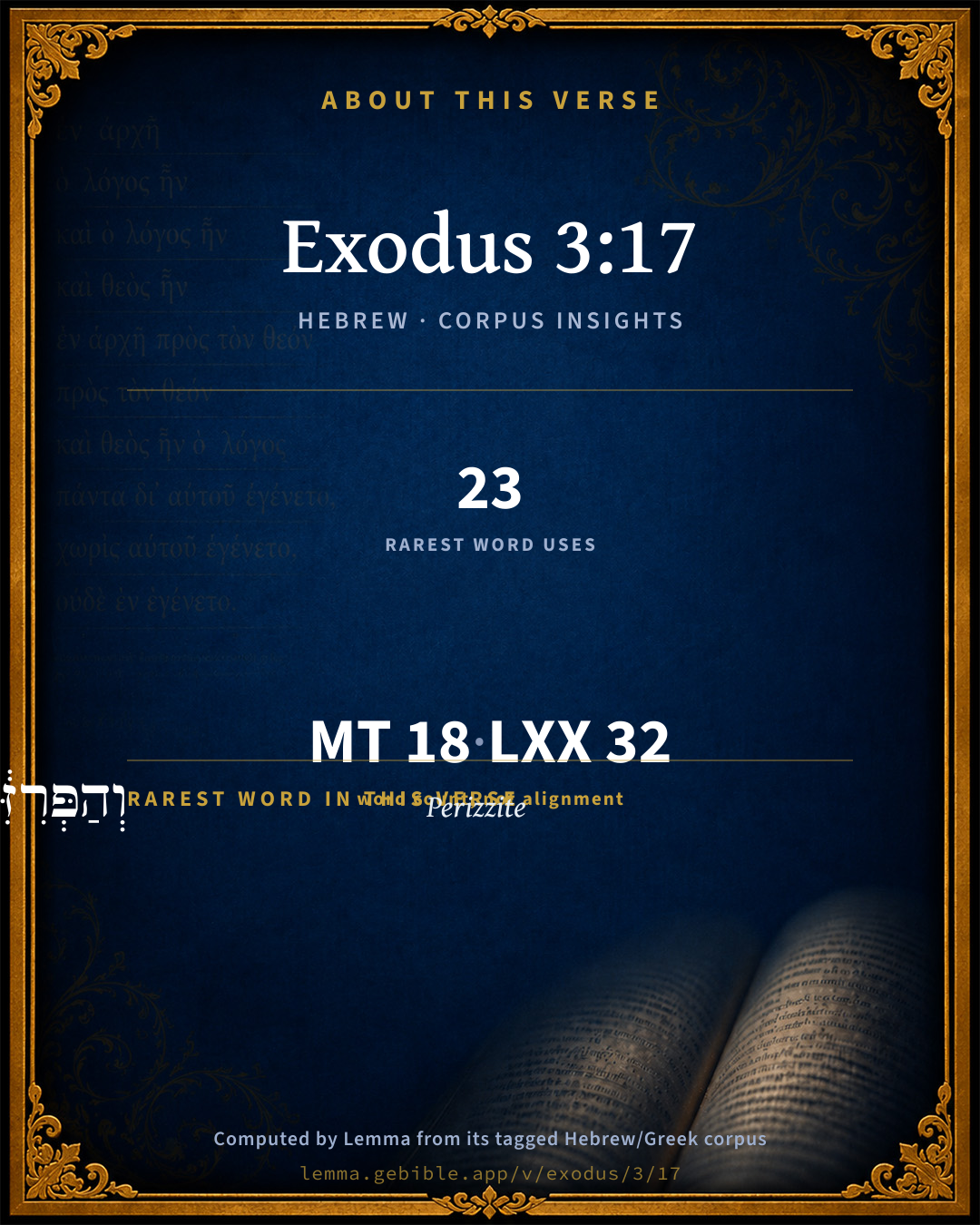
The rarest word here is וְהַפְּרִזִּ֔י Perizzite H6522 — appearing just 23 times in the whole Hebrew Bible.

Shared distinctive vocabulary

וְהַפְּרִזִּ֔י Perizzite H6522 occurs in 23 verses of the Hebrew Bible. Also found in:

Grammatical profile

  • 3 verbs
  • 12 nouns
  • 2 prepositions
  • 1 particle

Verb forms

  • וָאֹמַ֗ר Qal · Sequential Imperfect
  • אַעֲלֶ֣ה Hiphil · Imperfect
  • זָבַ֥ת Qal · Participle Active

Repetition

Words recur within this verse — often emphatic in Hebrew:

  • אֶ֤רֶץ land H776 ×2
  • אֶל to H413 ×2

Hebrew & Septuagint length

In English translation the verse runs 40 words from the Hebrew and 42 from the Septuagint (LXX English) — closely comparable.

A rough comparison of the two English renderings, which tokenize alike — not a word-level alignment.

Word counts can differ between the Hebrew and the Greek without any difference in meaning — e.g. the Hebrew direct-object marker אֵת has no separate Greek word, and Greek often adds the article ὁ.

In the original languages it is 18 Hebrew tokens and 32 Greek tokens — but the two are counted differently (Hebrew bundles its prefixes and suffixes into one token; the Greek is in lemma form), so that isn’t a like-for-like length.

Cross-references

6

Topical passages linked to Exodus 3:17 in the Treasury of Scripture Knowledge — connected by theme and wording, ordered by reader-vote popularity; previews shown in the World English Bible.

  • Genesis 15:13–21 He said to Abram, "Know for sure that your seed will live as foreigners in a land that is not theirs, and will serve them. They will afflict them four hundred years.
  • Genesis 50:24 Joseph said to his brothers, "I am dying, but God will surely visit you, and bring you up out of this land to the land which he swore to Abraham, to Isaac, and to Jacob."
  • Exodus 3:8–9 I have come down to deliver them out of the hand of the Egyptians, and to bring them up out of that land to a good and large land, to a land flowing with milk and honey; to the place of the Canaanite, the Hittite, the Amorite, the Perizzite, the Hivite, and the Jebusite.
  • Genesis 46:4 I will go down with you into Egypt. I will also surely bring you up again. Joseph will close your eyes."
  • Exodus 2:23–25 It happened in the course of those many days, that the king of Egypt died, and the children of Israel sighed because of the bondage, and they cried, and their cry came up to God because of the bondage.
  • Joshua 24:11 You went over the Jordan, and came to Jericho: and the men of Jericho fought against you, the Amorite, and the Perizzite, and the Canaanite, and the Hittite, and the Girgashite, the Hivite, and the Jebusite; and I delivered them into your hand.

Cross-references courtesy of OpenBible.info (CC BY 4.0).

Hebrew and Greek witnesses Masoretic Hebrew ↔ Greek Septuagint

The same verse in the two great witnesses to the Old Testament, shown verse-for-verse.

These are two independent witnesses, not word-aligned to each other, and the Septuagint is shown in lemma (dictionary) form.

Hebrew Exodus 3:17 Masoretic · Westminster Leningrad Codex

וָאֹמַ֗ר אַעֲלֶ֣ה אֶתְכֶם֮ מֵעֳנִ֣י מִצְרַיִם֒ אֶל אֶ֤רֶץ הַֽכְּנַעֲנִי֙ וְהַ֣חִתִּ֔י וְהָֽאֱמֹרִי֙ וְהַפְּרִזִּ֔י וְהַחִוִּ֖י וְהַיְבוּסִ֑י אֶל אֶ֛רֶץ זָבַ֥ת חָלָ֖ב וּדְבָֽשׁ

and I have said, I will bring you up out of the affliction of Egypt to the land of the Canaanite, the Hittite, the Amorite, the Perizzite, the Hivite, and the Jebusite, to a land flowing with milk and honey."'

World English Bible · Public Domain

Greek LXX Exodus 3:17 Septuagint · lemma form

καί εἶπον ἀναβιβάζω σύ ἐκ ὁ κάκωσις ὁ αἰγύπτιος εἰς ὁ γῆ ὁ χαναναῖος καί χετταῖος καί ἀμορραῖος καί φερεζαῖος καί γεργεσαῖος καί ευαῖος καί ιεβουσαῖος εἰς γῆ ῥέω γάλα καί μέλι

And he said, I will bring you up out of the affliction of the Egyptians to the land of the Chananites and the Chettites, and Amorites and Pherezites, and Gergesites, and Evites, and Jebusites, to a land flowing with milk and honey.

LXX2012 (modern English Septuagint) · Public Domain

Hebrew: Westminster Leningrad Codex (CC BY 4.0). Greek: Septuagint (public domain); English from LXX2012 (modern English Septuagint) (Public Domain). How the Septuagint differs from the Hebrew →

Targum (Aramaic paraphrase)

2

The Targum is the ancient Jewish Aramaic paraphrase of the Hebrew Scriptures — an interpretive translation, not the Hebrew text itself. Onkelos (literal) and Pseudo-Jonathan (expansive) render the Torah, and Jonathan the Prophets. Coverage is partial: where no permissively-licensed English translation exists for a verse, only the Aramaic is shown. This is verse-level text, not a word-by-word alignment to the Hebrew.

  1. Targum Onkelos Torah (Genesis–Deuteronomy)
    וַאֲמָרִית אַסֵיק יָתְכוֹן מִשִׁעְבּוּד מִצְרָאֵי לַאֲרַע כְּנַעֲנָאֵי וְחִתָּאֵי וֶאֱמוֹרָאֵי וּפְרִזָאֵי וְחִוָאֵי וִיבוּסָאֵי לְאַרְעָא עַבְדָא חֲלָב וּדְבָשׁ:

    (no public-domain English translation for this verse)

    Targum Onkelos — Aramaic: “Onkelos Genesis” (public domain); “Onkelos Exodus” (public domain); “Onkelos Leviticus” (public domain); “Onkelos Numbers” (public domain); “Onkelos Deuteronomy” (public domain). English: “Sefaria Community Translation” (CC0 1.0 (public-domain dedication)); “J.W. Etheridge. The Targums of Onkelos and Jonathan Ben Uzziel on the Pentateuch. London: Longmans, Green, 1862” (public domain). Text via Sefaria.

  2. Targum Pseudo-Jonathan Torah (Genesis–Deuteronomy)
    וַאֲמָרִית בְּמֵימְרִי אַפִּיק יַתְכוֹן מִסִיגוּף מִצְרָאֵי לְאַרַע כְּנַעֲנָאֵי וְחִיתָּאֵי וְאִימוֹרָאֵי וּפְרִיזָאֵי וְחִיוָאֵי וִיבוּסָאֵי לְאַרְעָא עַבְדָא חֲלָב וּדְבָשׁ

    and I have said in My Word, I will bring you up out from the oppression of the Mizraee into the land of the Kenaanaee, and Hittaee, and Amoraee, and Pherizaee, and Hivaee, and Jebusaee, to the land that yieldeth milk and honey.

    Targum Pseudo-Jonathan — Aramaic: “Targum Jonathan on Genesis” (public domain); “Targum Jonathan on Exodus” (public domain); “Targum Jonathan on Leviticus” (public domain); “Targum Jonathan on Numbers” (public domain); “Targum Jonathan on Deuteronomy” (public domain). English: “The Targum of Jonathan ben Uzziel, trans. J. W. Etheridge, London, 1862” (public domain). Text via Sefaria.

Commentary

Notes on Exodus 3:17 from classic Christian and Jewish commentators (each source and its license shown beneath its notes). The classic Christian expositions comment on the surrounding passage and are grouped to its opening verse, so a note may address several verses; the Jewish commentaries on the Tanakh (Rashi and others) are per-verse, so they appear only where the commentator wrote on this verse.

Lemma curates 59 commentaries, every one of them public domain or Creative Commons licensed, each selected and text-cleaned for this edition rather than reprinted as found. About our sources →

Trapp's Complete Commentary

John Trapp

Exo 3:17 And I have said, I will bring you up out of the affliction of Egypt unto the land of the Canaanites, and the Hittites, and the Amorites, and the Perizzites, and the Hivites, and the Jebusites, unto a land flowing with milk and honey.

Ver. 17. I have said, I will bring you up.] And now I am come to do it. This is some part of the import of "I am that I am," "the same yesterday, today, and for ever." {Heb 13:8} Ero qui eram, I will be the same to you in my performances that I was to your fathers in my proraises.

A land flowing with milk.] Sumen totius orbis, as one calleth it, where the hard rocks did sweat out oil and honey. {Deu 32:13} See Exo 3:8.

John Trapp, A Commentary or Exposition upon All the Books of the Old and New Testament (1647–1656) — public domain. Text from a community e-Sword module.

The Biblical Illustrator

Joseph S. Exell

Exo_3:17

A land flowing with milk and honey.

An inferior motive for a religious life

I. Some people are religious because they hope thereby to be saved from affliction. I will bring you out of the affliction of Egypt.

1. They hope to escape the affliction of a bad name.

2. They hope to escape the affliction of a retributive providence.

3. They hope to escape the affliction of moral punishment from God.

II. Other people are religious because they hope thereby to better their condition, and gain greater enjoyment. Unto a land flowing with milk and honey.--

1. Because they imagine religion will free them from slavery.

2. Because they imagine religion will give them an advantage over their enemies.

3. Because they imagine religion will give them rich possession.

III. That while the land flowing with milk and honey may be one motive for a religious life, the superior is love to God and moral freedom (J. S. Exell, M. A.)

The resolution of Divine mercy

1. Awakens instruments to convey its message.

2. Prepares Churches to welcome its tidings.

3. The giving of a new impulse to history. (J. S. Exell, M. A.)

The encouragement God gives to Christian workers

1. Divine aid in the work.

2. Bright hope in their future.

3. Glad success in their toil. (J. S. Exell, M. A.)

A happy residence

1. A land of plenty,

2. A land of beauty.

3. A land of promise.

4. A land of freedom.

5. A land of rest.

6. A land typical of heaven. (J. S. Exell, M. A.)

The Biblical Illustrator, edited by Joseph S. Exell (c. 1880s–1900s) — public domain. Text from a community e-Sword module.

Ellicott's Commentary for English Readers

(17) I have said.—See Exo_3:8. Perhaps there is also a reference to the promise made to Abraham (Gen.XV. 14).

The affliction of Egypt.—Comp. Gen_15:13 · Exo_1:11-12; Exo_3:7.

A Bible Commentary for English Readers, edited by Charles John Ellicott (1878–1897) — public domain. Text from a community e-Sword module.

The Cambridge Bible for Schools and Colleges

gen. ed. J. J. S. Perowne

17. said] i.e. as often, said mentally = resolved.

bring you up] from the low-lying land of Egypt into the high ground of Canaan. So regularly (cf. Exo_1:10).

The Cambridge Bible for Schools and Colleges (gen. ed. J. J. S. Perowne; Cambridge University Press, 1878–1918) — public domain. Text from a community e-Sword module.

John Gill's Exposition

And I have said,.... Within himself, resolved in his own mind, and had declared it to Moses:

I will bring you up out of the affliction of Egypt: with which they were afflicted in Egypt, and by the Egyptians; this he both purposed and promised to bring them out of: unto the land of the Canaanites, &c. then in the possession of the Canaanites, and others after named; See Gill on Exo 3:8.

John Gill's Exposition of the Whole Bible (1746–1763) — public domain (CC PDM 1.0). Text via the HelloAO Bible API.

The Pulpit Commentary

Vers. 17, 18. The promises to the elders, and to Moses.

The elders were promised two things:

(1) that they should be brought forth out of the affliction of Egypt, and

(2) that they should be established in a good land, "a land flowing with. milk and honey" Ordinary men men who are, spiritually speaking, backward and undeveloped require to be stirred to action by comparatively low motives. Escape from present suffering and unpleasantness, enjoyment of happiness in the future these are practically the two chief moving powers of human action. Neither of them is a wrong motive; and Moses was instructed to appeal to each by a special promise. So may the preacher rightly do with his congregation, the minister with his flock, the father with his children. As long as men are what they are, appeals to the lower motives cannot be dispensed with at first. Care must, however, be taken that before each one, as he becomes fit for it, higher motives are set such as duty, the love of goodness for goodness" sake, and last, not least the highest motive of all, the love of God, our Creator, Sustainer, Sanctifier, "in whom we live, and move, and have our being." Moses was promised at this point, to stimulate him to action, immediate success. He had doubted whether his people would listen to him, or regard him as anything but a dreamer. He is told, "they shall hearken unto thy voice." A great comfort to every one who feels that he has a mission is the acceptance of it by others. Each man, more or less, misdoubts himself, questions his own ability, sincerity, singleness of heart. The seal of an apostleship is the success of the apostolic efforts. (1Co_9:2) Direct promise of success at the mouth of God was, to one so faithful as Moses, as powerful to cheer, encourage, and sustain, as success itself.

The Pulpit Commentary (1880–1919), ed. H.D.M. Spence-Jones & Joseph S. Exell — public domain. Text from a community e-Sword module.

Lesson kit

Teaching starters — assembled from the data on this page, not authored interpretation. Every prompt links to the verse data it draws on. Edit before teaching.

Exodus, in the Pentateuch, opens this verse with 18 words (16 distinct Hebrew lemmas). Its most distinctive word is Pᵉrizzîy (“Perizzite”). A historical commentator’s framing appears above. Read the whole chapter for the surrounding context.

Discussion questions

  1. What does “Perizzite” (Pᵉrizzîy) contribute to the verse as a whole?
  2. How does Genesis 13:7, which shares the word «Perizzite», read alongside this verse?
  3. What does the repetition of “land” (2× in this one verse) do in this verse?
  4. These translations render this verse differently. What is at stake in choosing one wording over another?
  5. «וָאֹמַ֗ר» is a Qal Sequential Imperfect verb. How does that grammatical form shape the action described?
  6. Compare how Trapp's Complete Commentary and The Biblical Illustrator read this verse. Where do they agree or differ?

Things to notice

Reading settings

Reading text

Shown beneath each verse's original-language words.

Old Testament
Old Testament edition

Read the OT as the Masoretic Hebrew (MT) or the Greek Septuagint (LXX).

English shown for the Greek Septuagint (in the Hebrew ↔ Greek comparison).

Comparing translations? Open the Compare panel on any verse page to stack up to four side by side.