
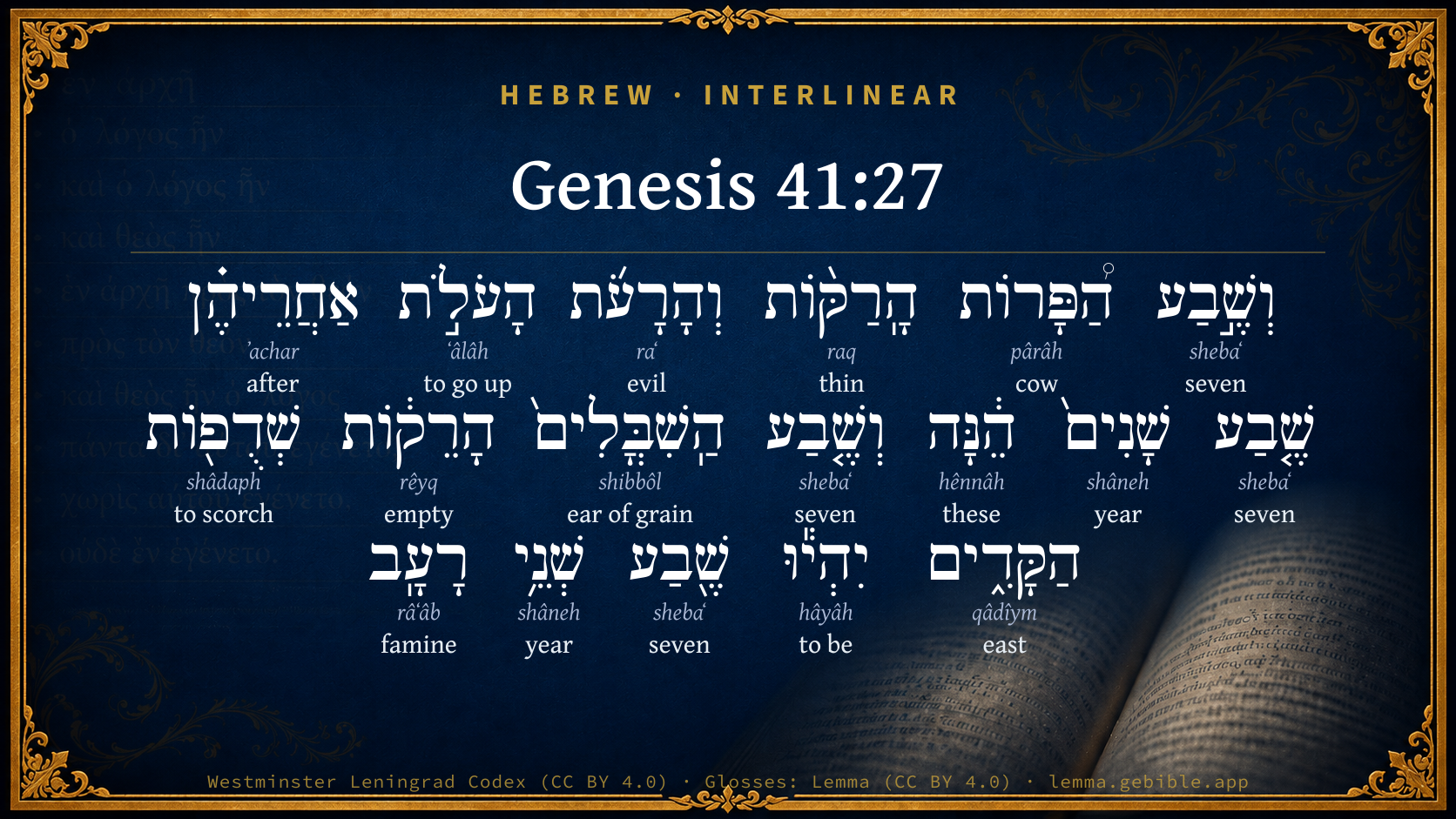
Genesis 41:27

Hebrew (Westminster Leningrad Codex) Genesis 41:27 appears in the Hebrew Old Testament. The text above is from the Westminster Leningrad Codex. Each word links to its Strong’s number, a concise gloss, and parsing drawn from the Open Scriptures Hebrew Bible morphology. Click any word for its full Brown-Driver-Briggs (BDB) entry.
Download image
Cite this verse

Genesis 41:27 (World English Bible). Public Domain. Lemma interlinear Bible study tool, https://lemma.gebible.app/v/genesis/41/27.

Show BibTeX & RIS
BibTeX
RIS
English Translation
The seven lean and ill-favored cattle that came up after them are seven years, and also the seven empty heads of grain blasted with the east wind; they will be seven years of famine.
World English Bible · Public Domain
Download a study sheet

One document with this verse’s original text, its word-by-word gloss line, the meaning frame, cross-references with their text, attributed commentary, and full source and license credits — printable, and it pastes into notes with its structure intact.

This verse Autodidact and up

Study sheet (.html) Plain text (.txt)

A passage Seminary Student

Up to 50 verses in one chapter. A passage sheet keeps up to 6 commentary sources and 12 cross-references per verse, in the order this page ranks them, and says so on the sheet whenever that leaves anything out. Ask for a single verse and you get the Autodidact verse sheet above.

Everything on this page stays free to read, with no account — the sheet is a download of what is already on screen, not access to it.

Want to remove ads? Support Godless Engineer
Compare translations 3

The same verse in 3 English versions, stacked beneath the original-language interlinear above. Click any original word for its lexicon entry.

Each is an independent rendering of the whole verse — the interlinear is not word-aligned to these translations.

Highlighted words mark where these versions differ — a whole-verse word diff, not a word-by-word alignment.

  • World English Bible Public Domain
    The seven lean and ill-favored cattle that came up after them are seven years, and also the seven empty heads of grain blasted with the east wind; they will be seven years of famine.
  • King James Version Public Domain
    And the seven thin and ill favored kine that came up after them are seven years; and the seven empty ears blasted with the east wind shall be seven years of famine.
  • unfoldingWord Literal Text CC BY-SA 4.0
    And the seven thin and ugly cows that came up after them seven years, and the seven thin heads of grain scorched by the east wind. There will be seven years of famine.

unfoldingWord Literal Text — © unfoldingWord, licensed CC BY-SA 4.0. Word-aligned USFM3 via Door43 (git.door43.org/unfoldingWord/en_ult).

Versions to compare (up to 4)

3 of 4 selected

Show all 18 translations

Every available English version of this verse, each an independent rendering of the whole verse.

  • World English Bible Public Domain
    The seven lean and ill-favored cattle that came up after them are seven years, and also the seven empty heads of grain blasted with the east wind; they will be seven years of famine.
  • Berean Standard Bible Public Domain
    Moreover, the seven thin, ugly cows that came up after them are seven years, and so are the seven worthless heads of grain scorched by the east wind—they are seven years of famine.
  • Majority Standard Bible Public Domain
    Moreover, the seven thin, ugly cows that came up after them are seven years, and so are the seven worthless heads of grain scorched by the east wind—they are seven years of famine.
  • King James Version Public Domain
    And the seven thin and ill favored kine that came up after them are seven years; and the seven empty ears blasted with the east wind shall be seven years of famine.
  • American Standard Version (1901) Public Domain
    And the seven lean and ill-favored kine that came up after them are seven years, and also the seven empty ears blasted with the east wind; they shall be seven years of famine.
  • Revised Version (1885) Public Domain
    And the seven lean and ill favoured kine that came up after them are seven years, and also the seven empty ears blasted with the east wind; they shall be seven years of famine.
  • Geneva Bible (1599) Public Domain
    Likewise the seuen thinne and euilfauoured kine, that came out after them, are seuen yeeres: and the seuen emptie eares blasted with the East winde, are seuen yeeres of famine.
  • Douay-Rheims (1899) Public Domain
    Joseph answered: The king's dream is one: God hath shewn to Pharao what he is about to do.
  • Young's Literal Translation Public Domain
    and the seven thin and bad kine which are coming up after them are seven years, and the seven empty ears, blasted with an east wind, are seven years of famine;
  • Literal Standard Version CC BY-SA 4.0
    and the seven thin and bad cows which are coming up after them are seven years, and the seven empty ears, blasted with an east wind, are seven years of famine;
  • Unlocked Literal Bible CC BY-SA 4.0
    The seven thin and undesirable cows that came up after them are seven years, and also the seven thin heads scorched by the east wind will be seven years of famine.
  • unfoldingWord Literal Text CC BY-SA 4.0
    And the seven thin and ugly cows that came up after them seven years, and the seven thin heads of grain scorched by the east wind. There will be seven years of famine.
  • Darby Bible Public Domain
    And the seven lean and bad kine that came up after them are seven years; and the seven empty ears, parched with the east wind, will be seven years of famine.
  • World Messianic Bible Public Domain
    The seven thin and ugly cattle that came up after them are seven years, and also the seven empty heads of grain blasted with the east wind; they will be seven years of famine.
  • Webster's Bible Public Domain
    And the seven thin and ill-favored cows that came up after them are seven years; and the seven empty ears blasted with the east wind will be seven years of famine.
  • Free Bible Version CC BY-SA 4.0
    The seven skinny and ugly cows that came after them and the seven thin heads of grain dried by the east wind represent seven years of famine.
  • Bible in Basic English Public Domain
    The seven thin and poor-looking cows who came up after them are seven years; and the seven heads of grain, dry and wasted by the east wind, are seven years when there will be no food.
  • JPS Tanakh (1917) Public Domain
    And the seven lean and ill-favoured kine that came up after them are seven years, and also the seven empty ears blasted with the east wind; they shall be seven years of famine.

Literal Standard Version (2020), Covenant Press — licensed CC BY-SA 4.0. Text via the HelloAO Bible API (eBible.org). Unlocked Literal Bible (unfoldingWord) — licensed CC BY-SA 4.0. Text via the HelloAO Bible API (eBible.org). unfoldingWord Literal Text — © unfoldingWord, licensed CC BY-SA 4.0. Word-aligned USFM3 via Door43 (git.door43.org/unfoldingWord/en_ult). Free Bible Version, Dr. Jonathan Gallagher — licensed CC BY-SA 4.0. Text via the HelloAO Bible API (eBible.org).

Word by word

More ways to search: Search by grammar → Find every occurrence → Compare this word →

Practice this passage: Drill this verse → Learn its vocabulary →

הָֽרַקּ֨וֹת
raq
H7534
“the · thin”
Particle, Definite Article + Adjective, Adjective, Feminine, Plural, Absolute
Part of Speech
Particle + Adjective
Type
Adjective
Gender
Feminine
Number
Plural
State
Absolute
Full BDB Definition

Origin: from H7556 in its original sense

TWOT: 2218a

thin, lean
  1. וְשֶׁ֣בַע shebaʻ H7651 “and · seven” Conjunction + Adjective, Cardinal number, Feminine, Singular, Absolute
  2. הַ֠פָּרוֹת pârâh H6510 “the · cows” Particle, Definite Article + Noun, Common, Feminine, Plural, Absolute
  3. וְהָרָעֹ֜ת raʻ H7451 “and · the · evil” Conjunction + Particle, Definite Article + Adjective, Adjective, Feminine, Plural, Absolute
  4. הָעֹלֹ֣ת ʻâlâh H5927 “the · going up” Particle, Definite Article + Verb, Qal, Participle Active, Feminine, Plural, Absolute
  5. אַחֲרֵיהֶ֗ן ʼachar H310 “after · them” Preposition + Suffix, Personal, 3rd Person, Feminine, Plural
  6. שֶׁ֤בַע shebaʻ H7651 “seven” Adjective, Cardinal number, Feminine, Singular, Absolute
  7. שָׁנִים֙ shâneh H8141 “years” Noun, Common, Feminine, Plural, Absolute
  8. הֵ֔נָּה hênnâh H2007 “these” Pronoun, Personal, 3rd Person, Feminine, Plural
  9. וְשֶׁ֤בַע shebaʻ H7651 “and · seven” Conjunction + Adjective, Cardinal number, Feminine, Singular, Absolute
  10. הַֽשִׁבֳּלִים֙ shibbôl H7641 “the · ears of grain” Particle, Definite Article + Noun, Common, Feminine, Plural, Absolute
  11. הָרֵק֔וֹת rêyq H7386 “the · empty” Particle, Definite Article + Adjective, Adjective, Feminine, Plural, Absolute
  12. שְׁדֻפ֖וֹת shâdaph H7710 “scorched” Verb, Qal, Participle Passive, Feminine, Plural, Construct
  13. הַקָּדִ֑ים qâdîym H6921 “the · east” Particle, Definite Article + Noun, Common, Masculine, Singular, Absolute
  14. יִהְי֕וּ hâyâh H1961 “to be” Verb, Qal, Imperfect, 3rd Person, Masculine, Plural
  15. שֶׁ֖בַע shebaʻ H7651 “seven” Adjective, Cardinal number, Feminine, Singular, Absolute
  16. שְׁנֵ֥י shâneh H8141 “year” Adjective, Cardinal number, Masculine, Dual, Construct
  17. רָעָֽב râʻâb H7458 “famine” Noun, Common, Masculine, Singular, Absolute

About this verse

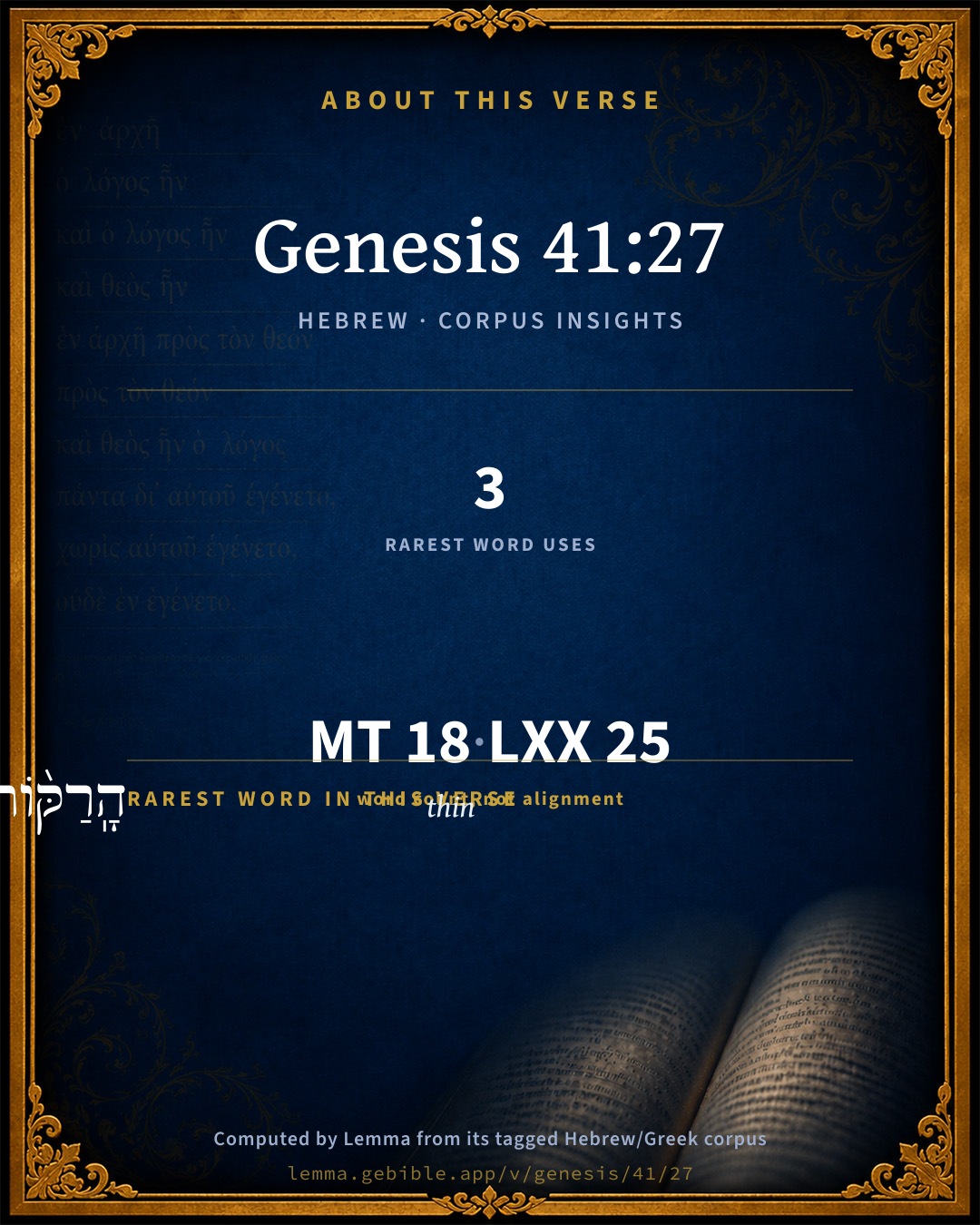
These counts appear in no published source. They are computed here, from the morphology-tagged text and Lemma’s own curated glosses. What Lemma adds →

18
words
14
distinct lemmas
Pentateuch
section

Notable vocabulary

The rarest word here is הָֽרַקּ֨וֹת thin H7534 — appearing just 3 times in the whole Hebrew Bible.

Shared distinctive vocabulary

הָֽרַקּ֨וֹת thin H7534 occurs in 3 verses of the Hebrew Bible. Also found in:

Grammatical profile

  • 3 verbs
  • 5 nouns
  • 8 adjectives
  • 1 pronoun
  • 1 preposition

Verb forms

  • הָעֹלֹ֣ת Qal · Participle Active
  • שְׁדֻפ֖וֹת Qal · Participle Passive
  • יִהְי֕וּ Qal · Imperfect

Repetition

Words recur within this verse — often emphatic in Hebrew:

  • וְשֶׁ֣בַע seven H7651 ×4
  • שָׁנִים֙ year H8141 ×2

Hebrew & Septuagint length

In English translation the verse runs 34 words from the Hebrew and 30 from the Septuagint (LXX English) — closely comparable.

A rough comparison of the two English renderings, which tokenize alike — not a word-level alignment.

Word counts can differ between the Hebrew and the Greek without any difference in meaning — e.g. the Hebrew direct-object marker אֵת has no separate Greek word, and Greek often adds the article ὁ.

In the original languages it is 18 Hebrew tokens and 25 Greek tokens — but the two are counted differently (Hebrew bundles its prefixes and suffixes into one token; the Greek is in lemma form), so that isn’t a like-for-like length.

Cross-references

2

Topical passages linked to Genesis 41:27 in the Treasury of Scripture Knowledge — connected by theme and wording, ordered by reader-vote popularity; previews shown in the World English Bible.

  • 2 Kings 8:1 Now Elisha had spoken to the woman, whose son he had restored to life, saying, Arise, and go you and your household, and sojourn wherever you can sojourn: for Yahweh has called for a famine; and it shall also come on the land seven years.
  • 2 Samuel 24:19 David went up according to the saying of Gad, as Yahweh commanded.

Cross-references courtesy of OpenBible.info (CC BY 4.0).

Hebrew and Greek witnesses Masoretic Hebrew ↔ Greek Septuagint

The same verse in the two great witnesses to the Old Testament, shown verse-for-verse.

These are two independent witnesses, not word-aligned to each other, and the Septuagint is shown in lemma (dictionary) form.

Hebrew Genesis 41:27 Masoretic · Westminster Leningrad Codex

וְשֶׁ֣בַע הַ֠פָּרוֹת הָֽרַקּ֨וֹת וְהָרָעֹ֜ת הָעֹלֹ֣ת אַחֲרֵיהֶ֗ן שֶׁ֤בַע שָׁנִים֙ הֵ֔נָּה וְשֶׁ֤בַע הַֽשִׁבֳּלִים֙ הָרֵק֔וֹת שְׁדֻפ֖וֹת הַקָּדִ֑ים יִהְי֕וּ שֶׁ֖בַע שְׁנֵ֥י רָעָֽב

The seven lean and ill-favored cattle that came up after them are seven years, and also the seven empty heads of grain blasted with the east wind; they will be seven years of famine.

World English Bible · Public Domain

Greek LXX Genesis 41:27 Septuagint · lemma form

καί ὁ ἑπτά βοῦς ὁ λεπτός ὁ ἀναβαίνω ὀπίσω αὐτός ἑπτά ἔτος εἰμί καί ὁ ἑπτά στάχυς ὁ λεπτός καί ἀνεμόφθορος εἰμί ἑπτά ἔτος λιμός

And the seven thin kine that came up after them are seven years; and the seven thin and blasted ears are seven years; there shall be seven years of famine.

LXX2012 (modern English Septuagint) · Public Domain

Hebrew: Westminster Leningrad Codex (CC BY 4.0). Greek: Septuagint (public domain); English from LXX2012 (modern English Septuagint) (Public Domain). How the Septuagint differs from the Hebrew →

Targum (Aramaic paraphrase)

2

The Targum is the ancient Jewish Aramaic paraphrase of the Hebrew Scriptures — an interpretive translation, not the Hebrew text itself. Onkelos (literal) and Pseudo-Jonathan (expansive) render the Torah, and Jonathan the Prophets. Coverage is partial: where no permissively-licensed English translation exists for a verse, only the Aramaic is shown. This is verse-level text, not a word-by-word alignment to the Hebrew.

  1. Targum Onkelos Torah (Genesis–Deuteronomy)
    וּשְׁבַע תּוֹרְתָּא חֲסִיכָתָא וּבִישָׁתָא דְסָלְקָן בַּתְרֵיהוֹן שְׁבַע שְׁנִין אִנּוּן וּשְׁבַע שֻׁבְּלַיָּא לָקְיָתָא דִּשְׁקִיפָן קִדּוּם יְהֶוְיָן שְׁבַע שְׁנֵי כַפְנָא

    (no public-domain English translation for this verse)

    Targum Onkelos — Aramaic: “Onkelos Genesis” (public domain); “Onkelos Exodus” (public domain); “Onkelos Leviticus” (public domain); “Onkelos Numbers” (public domain); “Onkelos Deuteronomy” (public domain). English: “Sefaria Community Translation” (CC0 1.0 (public-domain dedication)); “J.W. Etheridge. The Targums of Onkelos and Jonathan Ben Uzziel on the Pentateuch. London: Longmans, Green, 1862” (public domain). Text via Sefaria.

  2. Targum Pseudo-Jonathan Torah (Genesis–Deuteronomy)
    וּשְׁבַע תּוֹרָתָא כְּחִישְׁתָּא וּבִשְׁתָא דְסַלְקָן בַּתְרֵיהֶן שְׁבַע שְׁנַיָיא חוֹרַנְיָיתָא אִינוּן מְבַשְרָן וּשְׁבַע תּוּבְלַיָיא לַקְיָיתָא שְׁקִיפַן קִידוּם הֵם הָכִי מְבַשְרָן דִיהֶוְוַין שְׁבַע שְׁנֵי כַפְנָא

    And the seven wasted and evil oxen which arose after them announce seven other years; and the seven ears thin and blighted with the east wind likewise make known that there will be seven years of famine.

    Targum Pseudo-Jonathan — Aramaic: “Targum Jonathan on Genesis” (public domain); “Targum Jonathan on Exodus” (public domain); “Targum Jonathan on Leviticus” (public domain); “Targum Jonathan on Numbers” (public domain); “Targum Jonathan on Deuteronomy” (public domain). English: “The Targum of Jonathan ben Uzziel, trans. J. W. Etheridge, London, 1862” (public domain). Text via Sefaria.

Commentary

Notes on Genesis 41:27 from classic Christian and Jewish commentators (each source and its license shown beneath its notes). The classic Christian expositions comment on the surrounding passage and are grouped to its opening verse, so a note may address several verses; the Jewish commentaries on the Tanakh (Rashi and others) are per-verse, so they appear only where the commentator wrote on this verse.

Lemma curates 59 commentaries, every one of them public domain or Creative Commons licensed, each selected and text-cleaned for this edition rather than reprinted as found. About our sources →

John Gill's Exposition

And there shall arise after them seven years of famine,.... Which might be occasioned by the river Nile not rising so high as to overflow its banks, as, when it did not rise to more than twelve cubits, a famine ensued, as the above writer says (n); and it must be owing to the overruling providence of God that this should be the case for seven years running:

and all the plenty shall be forgotten in the land of Egypt; the seven years of plenty being all spent, it should be as if it never was; the minds of men would be so intent upon their present distressed case and circumstances, that they should wholly forget how it had been with them in time past; or it would be as if they had never enjoyed it, or were never the better for it: this answers to and explains how it was with the ill favoured kine, when they had eaten up the fat kine; they seemed never the better, nor could it be known by their appearance that they had so done:

and the famine shall consume the land: the inhabitants of it, and all the fruits and increase of it the former years produced.

(n) Nat Hist. l. 5. c. 9.

John Gill's Exposition of the Whole Bible (1746–1763) — public domain (CC PDM 1.0). Text via the HelloAO Bible API.

unfoldingWord translationNotes

Door43 World Missions Community

General Information:

Joseph continues his interpretation of Pharaoh's dreams

thin and undesirable cows

"skinny and weak cows." See how you translated a similar phrase in Genesis 41:3.

seven thin heads scorched by the east wind

This can be stated in active form. AT: "seven thin heads of grain scorched because of the hot wind from the east" (See: Active or Passive)

That is the thing which I spoke to Pharaoh ... revealed to Pharaoh

Joseph speaks to Pharaoh in the third person. This is a way of showing respect. It can be stated in second person. AT: "These events will happen just as I have told you ... revealed to you, Pharaoh" (See: First, Second, or Third Person)

he has revealed

"he has made known"

Look, seven

"Pay attention, because what I am about to say is both true and important: seven"

seven years of great abundance will come throughout all the land of Egypt

This speaks about the years of abundance as if time is something that travels and comes to a place. AT: "there will be seven years in which there will be plenty of food throughout the land of Egypt" (See: Metaphor)

translationWords

cow

year

famine

Pharaoh

God

reveal

Egypt

unfoldingWord translationNotes — © Distant Shores Media and the Door43 World Missions Community, licensed CC BY-SA 4.0. Source: git.door43.org/Door43/en_tn.

Ramban (Nachmanides)

Rabbi Moshe ben Nachman (Ramban / Nachmanides)

THEY SHALL BE SEVEN YEARS OF FAMINE. Since plentifulness in the land of Egypt is not a great novelty since the country is as the garden of the Eternal, Joseph first mentioned the interpretation concerning the bad events, for it was this that constituted the novelty and the purpose of the dream. G-d in His mercy showed the famine to Pharaoh to save life for a great deliverance. This is the sense of the verse, And the seven years of famine began to come, according as Joseph had said, for the truth of Joseph’s words was not realized until the years of famine.

Ramban (Nachmanides) on the Tanakh — English translation: “Commentary on the Torah by Ramban (Nachmanides). Translated and annotated by Charles B. Chavel. New York, Shilo Pub. House, 1971-1976” (CC BY 4.0). Text via Sefaria.

Radak

Rabbi David Kimhi (Radak)

ושבע הפרות הרקות, the word הרקות is again derived from רקיק, wafer, as on the previous occasions it was mentioned.

השבלים הרקות, here the word הרקות is derived from the word ריק, empty, as in והבור רק אין בו מים, “the pit was empty, it did not contain water.” (Genesis 37,24)

Radak on the Tanakh — English translations: “Sefaria Community Translation” (CC0 1.0 (public-domain dedication)); “Eliyahu Munk, HaChut Hameshulash” (CC BY 4.0); “Rabbi Mike Feuer, Jerusalem Anthology” (CC BY 4.0); and “R. David Kimhi on the first book of Psalms, Translated by R.G. Finch, London, 1919” (public domain). Text via Sefaria.

Lesson kit

Teaching starters — assembled from the data on this page, not authored interpretation. Every prompt links to the verse data it draws on. Edit before teaching.

Genesis, in the Pentateuch, opens this verse with 18 words (14 distinct Hebrew lemmas). Its most distinctive word is raq (“thin”). A historical commentator’s framing appears above. Read the whole chapter for the surrounding context.

Discussion questions

  1. What does “thin” (raq) contribute to the verse as a whole?
  2. Genesis 41:19 shares the word «thin» with this verse. How do the two illuminate each other?
  3. “seven” occurs 4× in this one verse. What is the effect of the repetition?
  4. These translations render this verse differently; the difference is in the English rendering, not the original. What questions does that raise?
  5. The verb «הָעֹלֹ֣ת» is Qal Participle Active. How does its form color the action?
  6. Reading how John Gill's Exposition and unfoldingWord translationNotes read this verse, where do the two commentators agree and where do they part?

Things to notice

Reading settings

Reading text

Shown beneath each verse's original-language words.

Old Testament
Old Testament edition

Read the OT as the Masoretic Hebrew (MT) or the Greek Septuagint (LXX).

English shown for the Greek Septuagint (in the Hebrew ↔ Greek comparison).

Comparing translations? Open the Compare panel on any verse page to stack up to four side by side.