
Exodus 33:5

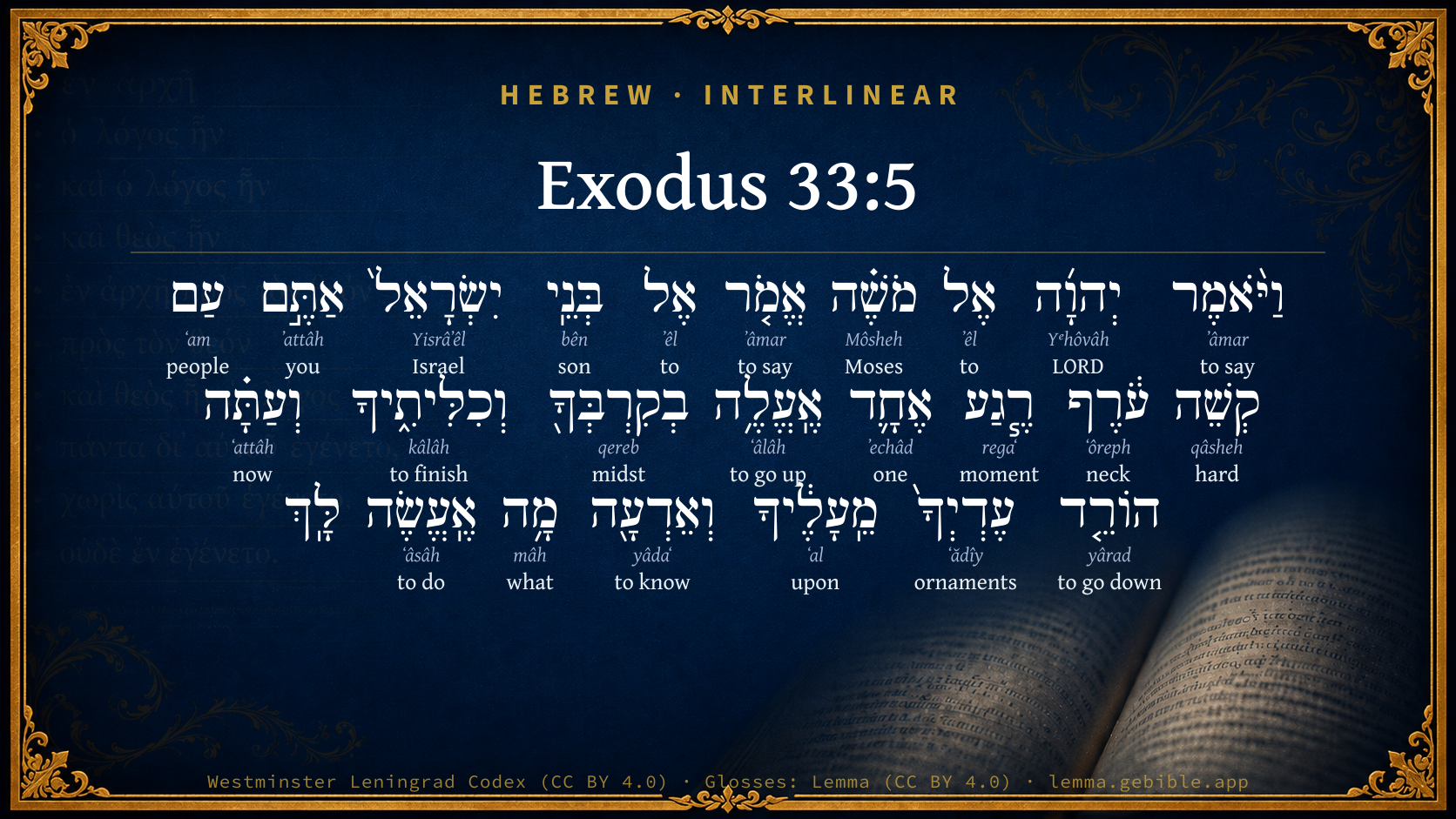
Hebrew (Westminster Leningrad Codex) Exodus 33:5 appears in the Hebrew Old Testament. The text above is from the Westminster Leningrad Codex. Each word links to its Strong’s number, a concise gloss, and parsing drawn from the Open Scriptures Hebrew Bible morphology. Click any word for its full Brown-Driver-Briggs (BDB) entry.
Download image
Cite this verse

Exodus 33:5 (World English Bible). Public Domain. Lemma interlinear Bible study tool, https://lemma.gebible.app/v/exodus/33/5.

Show BibTeX & RIS
BibTeX
RIS
English Translation
Yahweh said to Moses, "Tell the children of Israel, 'You are a stiff-necked people. If I were to go up into your midst for one moment, I would consume you. Therefore now take off your jewelry from you, that I may know what to do to you."
World English Bible · Public Domain
Highlights
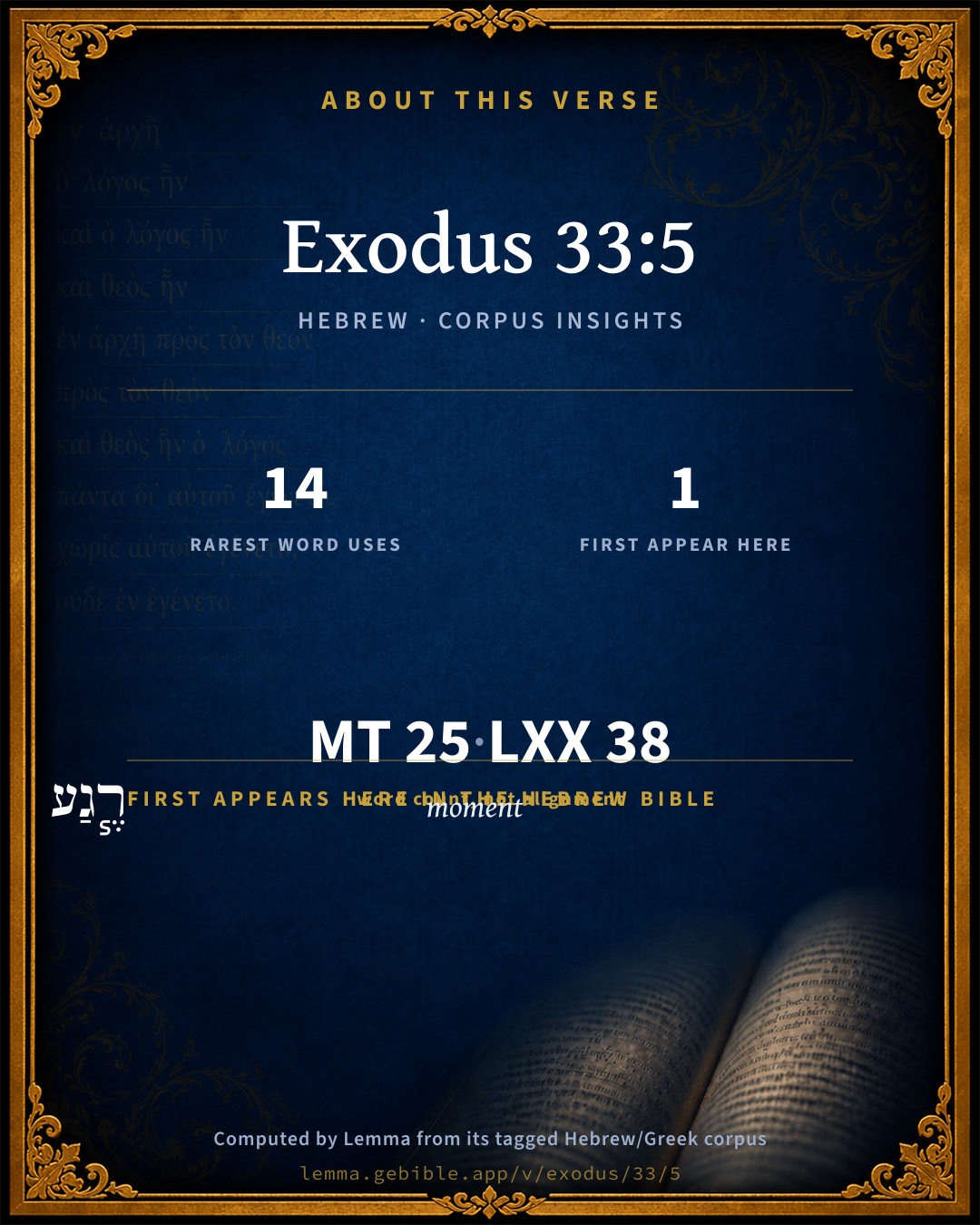
  • 1 first appearance in the Hebrew Bible
Full analysis ↓
Download a study sheet

One document with this verse’s original text, its word-by-word gloss line, the meaning frame, cross-references with their text, attributed commentary, and full source and license credits — printable, and it pastes into notes with its structure intact.

This verse Autodidact and up

Study sheet (.html) Plain text (.txt)

A passage Seminary Student

Up to 50 verses in one chapter. A passage sheet keeps up to 6 commentary sources and 12 cross-references per verse, in the order this page ranks them, and says so on the sheet whenever that leaves anything out. Ask for a single verse and you get the Autodidact verse sheet above.

Everything on this page stays free to read, with no account — the sheet is a download of what is already on screen, not access to it.

Want to remove ads? Support Godless Engineer
Compare translations 3

The same verse in 3 English versions, stacked beneath the original-language interlinear above. Click any original word for its lexicon entry.

Each is an independent rendering of the whole verse — the interlinear is not word-aligned to these translations.

Highlighted words mark where these versions differ — a whole-verse word diff, not a word-by-word alignment.

  • World English Bible Public Domain
    Yahweh said to Moses, "Tell the children of Israel, 'You are a stiff-necked people. If I were to go up into your midst for one moment, I would consume you. Therefore now take off your jewelry from you, that I may know what to do to you."
  • King James Version Public Domain
    For the LORD had said unto Moses, Say unto the children of Israel, Ye are a stiffnecked people: I will come up into the midst of thee in a moment, and consume thee: therefore now put off thy ornaments from thee, that I may know what to do unto thee.
  • unfoldingWord Literal Text CC BY-SA 4.0
    And Yahweh said to Moses, “Say to the sons of Israel, ‘You are a people hard of neck. I went up among you one moment, then I destroy you. And now, take your ornaments down from on you, and I will know what I will do to you.’”

unfoldingWord Literal Text — © unfoldingWord, licensed CC BY-SA 4.0. Word-aligned USFM3 via Door43 (git.door43.org/unfoldingWord/en_ult).

Versions to compare (up to 4)

3 of 4 selected

Show all 18 translations

Every available English version of this verse, each an independent rendering of the whole verse.

  • World English Bible Public Domain
    Yahweh said to Moses, "Tell the children of Israel, 'You are a stiff-necked people. If I were to go up into your midst for one moment, I would consume you. Therefore now take off your jewelry from you, that I may know what to do to you."
  • Berean Standard Bible Public Domain
    For the LORD had said to Moses, “Tell the Israelites, ‘You are a stiff-necked people. If I should go with you for a single moment, I would destroy you. Now take off your jewelry, and I will decide what to do with you.’”
  • Majority Standard Bible Public Domain
    For the LORD had said to Moses, “Tell the Israelites, ‘You are a stiff-necked people. If I should go with you for a single moment, I would destroy you. Now take off your jewelry, and I will decide what to do with you.’”
  • King James Version Public Domain
    For the LORD had said unto Moses, Say unto the children of Israel, Ye are a stiffnecked people: I will come up into the midst of thee in a moment, and consume thee: therefore now put off thy ornaments from thee, that I may know what to do unto thee.
  • American Standard Version (1901) Public Domain
    And Jehovah said unto Moses, Say unto the children of Israel, Ye are a stiffnecked people; if I go up into the midst of thee for one moment, I shall consume thee: therefore now put off thy ornaments from thee, that I may know what to do unto thee.
  • Revised Version (1885) Public Domain
    And the LORD said unto Moses, Say unto the children of Israel, Ye are a stiffnecked people: if I go up into the midst of thee for one moment, I shall consume thee: therefore now put off thy ornaments from thee, that I may know what to do unto thee.
  • Geneva Bible (1599) Public Domain
    (For the Lord had said to Moses, Say vnto the children of Israel, Ye are a stiffe necked people, I wil come suddenly vpon thee, and consume thee: therefore now put thy costly rayment from thee, that I may know what to do vnto thee)
  • Douay-Rheims (1899) Public Domain
    And the Lord said to Moses: Say to the children of Israel: Thou are a stiffnecked people; once I shall come up in the midst of thee, and shall destroy thee. Now presently lay aside thy ornaments, that I may know what to do with thee.
  • Young's Literal Translation Public Domain
    And Jehovah saith unto Moses, `Say unto the sons of Israel, Ye `are' a stiff-necked people; one moment -- I come up into thy midst, and have consumed thee; and now, put down thine ornaments from off thee, and I know what I do to thee;'
  • Literal Standard Version CC BY-SA 4.0
    And YHWH says to Moses, “Say to the sons of Israel: You [are] a stiff-necked people; [in] one moment I could come up into your midst and could have consumed you; and now, put down your ornaments from off you, and I know what I do to you”;
  • Unlocked Literal Bible CC BY-SA 4.0
    Yahweh had said to Moses, “Say to the Israelites, 'You are a stubborn people. If I went among you for even one moment, I would destroy you. So now, take off your jewelry so that I may decide what to do with you.'”
  • unfoldingWord Literal Text CC BY-SA 4.0
    And Yahweh said to Moses, “Say to the sons of Israel, ‘You are a people hard of neck. I went up among you one moment, then I destroy you. And now, take your ornaments down from on you, and I will know what I will do to you.’”
  • Darby Bible Public Domain
    Now Jehovah had said to Moses, Say unto the children of Israel, Ye are a stiff-necked people: in one moment I will come up into the midst of thee and will consume thee. And now put off thine ornaments from thee, and I will know what I will do unto thee.
  • World Messianic Bible Public Domain
    The LORD had said to Moses, “Tell the children of Israel, ‘You are a stiff-necked people. If I were to go up among you for one moment, I would consume you. Therefore now take off your jewelry from you, that I may know what to do to you.’”
  • Webster's Bible Public Domain
    For the LORD had said to Moses, Say to the children of Israel, Ye are a stiff-necked people: I will come up into the midst of thee in a moment, and consume thee: therefore now put off thy ornaments from thee, that I may know what to do to thee.
  • Free Bible Version CC BY-SA 4.0
    For the Lord had previously told Moses, “Tell the people of Israel, ‘You are a rebellious people. If I was with you for just a moment, I would wipe you out. Now remove your jewelry, and I'll decide what to do with you.’”
  • Bible in Basic English Public Domain
    And the Lord said to Moses, Say to the children of Israel, You are a stiff-necked people: if I come among you, even for a minute, I will send destruction on you; so take off all your ornaments, so that I may see what to do with you.
  • JPS Tanakh (1917) Public Domain
    And the LORD said unto Moses: 'Say unto the children of Israel: Ye are a stiffnecked people; if I go up into the midst of thee for one moment, I shall consume thee; therefore now put off thy ornaments from thee, that I may know what to do unto thee.'

Literal Standard Version (2020), Covenant Press — licensed CC BY-SA 4.0. Text via the HelloAO Bible API (eBible.org). Unlocked Literal Bible (unfoldingWord) — licensed CC BY-SA 4.0. Text via the HelloAO Bible API (eBible.org). unfoldingWord Literal Text — © unfoldingWord, licensed CC BY-SA 4.0. Word-aligned USFM3 via Door43 (git.door43.org/unfoldingWord/en_ult). Free Bible Version, Dr. Jonathan Gallagher — licensed CC BY-SA 4.0. Text via the HelloAO Bible API (eBible.org).

Word by word

More ways to search: Search by grammar → Find every occurrence → Compare this word →

Practice this passage: Drill this verse → Learn its vocabulary →

עֶדְיְךָ֙
ʻădîy
H5716
“ornaments · your”
Noun, Common, Masculine, Singular, Construct + Suffix, Personal, 2nd Person, Masculine, Singular
Part of Speech
Noun
Type
Common
Gender
Masculine
Number
Singular
State
Construct
Full BDB Definition

Origin: from H5710 in the sense of trappings

TWOT: 1566a

ornaments - ornaments - trappings (of horses)
  1. וַיֹּ֨אמֶר ʼâmar H559 “and · to say” Conjunction + Verb, Qal, Sequential Imperfect, 3rd Person, Masculine, Singular
  2. יְהוָ֜ה Yᵉhôvâh H3068 “LORD” Noun, Proper
  3. אֶל ʼêl H413 “to” Preposition
  4. מֹשֶׁ֗ה Môsheh H4872 “Moses” Noun, Proper
  5. אֱמֹ֤ר ʼâmar H559 “say” Verb, Qal, Imperative, 2nd Person, Masculine, Singular
  6. אֶל ʼêl H413 “to” Preposition
  7. בְּנֵֽי bên H1121 “sons of” Noun, Common, Masculine, Plural, Construct
  8. יִשְׂרָאֵל֙ Yisrâʼêl H3478 “Israel” Noun, Proper
  9. אַתֶּ֣ם ʼattâh H859 “you” Pronoun, Personal, 2nd Person, Masculine, Plural
  10. עַם ʻam H5971 “people” Noun, Common, Masculine, Singular, Absolute
  11. קְשֵׁה qâsheh H7186 “hard of” Adjective, Adjective, Masculine, Singular, Construct
  12. עֹ֔רֶף ʻôreph H6203 “neck” Noun, Common, Masculine, Singular, Absolute
  13. רֶ֧גַע regaʻ H7281 “moment” Noun, Common, Masculine, Singular, Absolute
  14. אֶחָ֛ד ʼechâd H259 “one” Adjective, Cardinal number, Masculine, Singular, Absolute
  15. אֶֽעֱלֶ֥ה ʻâlâh H5927 “to go up” Verb, Qal, Imperfect, 1st Person, Common, Singular
  16. בְקִרְבְּךָ֖ qereb H7130 “in/at · midst · your” Preposition + Noun, Common, Masculine, Singular, Construct + Suffix, Personal, 2nd Person, Masculine, Singular
  17. וְכִלִּיתִ֑יךָ kâlâh H3615 “and · to finish · you” Conjunction + Verb, Piel, Sequential Perfect, 1st Person, Common, Singular + Suffix, Personal, 2nd Person, Masculine, Singular
  18. וְעַתָּ֗ה ʻattâh H6258 “and · now” Conjunction + Adverb
  19. הוֹרֵ֤ד yârad H3381 “go down” Verb, Hiphil, Imperative, 2nd Person, Masculine, Singular
  20. מֵֽעָלֶ֔יךָ ʻal H5921 “from · upon · you” Preposition + Preposition + Suffix, Personal, 2nd Person, Masculine, Singular
  21. וְאֵדְעָ֖ה yâdaʻ H3045 “and · to know” Conjunction + Verb, Qal, Cohortative, 1st Person, Common, Singular
  22. מָ֥ה mâh H4100 “what” Particle, Interrogative
  23. אֶֽעֱשֶׂה ʻâsâh H6213 “to do” Verb, Qal, Imperfect, 1st Person, Common, Singular

About this verse

These counts appear in no published source. They are computed here, from the morphology-tagged text and Lemma’s own curated glosses. What Lemma adds →

25
words
22
distinct lemmas
Pentateuch
section

Notable vocabulary

The rarest word here is עֶדְיְךָ֙ ornaments H5716 — appearing just 14 times in the whole Hebrew Bible.

First appearance in Scripture

This word makes its first canonical appearance in the Hebrew Bible here:

  • רֶ֧גַע moment H7281

Shared distinctive vocabulary

עֶדְיְךָ֙ ornaments H5716 occurs in 13 verses of the Hebrew Bible. Also found in:

Grammatical profile

  • 7 verbs
  • 9 nouns
  • 2 adjectives
  • 1 pronoun
  • 4 prepositions
  • 1 adverb
  • 1 particle

Verb forms

  • וַיֹּ֨אמֶר Qal · Sequential Imperfect
  • אֱמֹ֤ר Qal · Imperative
  • אֶֽעֱלֶ֥ה Qal · Imperfect
  • וְכִלִּיתִ֑יךָ Piel · Sequential Perfect
  • הוֹרֵ֤ד Hiphil · Imperative
  • וְאֵדְעָ֖ה Qal · Cohortative
  • אֶֽעֱשֶׂה Qal · Imperfect

Repetition

Words recur within this verse — often emphatic in Hebrew:

  • וַיֹּ֨אמֶר to say H559 ×2
  • אֶל to H413 ×2

Hebrew & Septuagint length

In English translation the verse runs 47 words from the Hebrew and 47 from the Septuagint (LXX English) — the same length.

A rough comparison of the two English renderings, which tokenize alike — not a word-level alignment.

Word counts can differ between the Hebrew and the Greek without any difference in meaning — e.g. the Hebrew direct-object marker אֵת has no separate Greek word, and Greek often adds the article ὁ.

In the original languages it is 25 Hebrew tokens and 38 Greek tokens — but the two are counted differently (Hebrew bundles its prefixes and suffixes into one token; the Greek is in lemma form), so that isn’t a like-for-like length.

Cross-references

11

Topical passages linked to Exodus 33:5 in the Treasury of Scripture Knowledge — connected by theme and wording, ordered by reader-vote popularity; previews shown in the World English Bible.

  • Numbers 16:21 Separate yourselves from among this congregation, that I may consume them in a moment.
  • Exodus 33:3–4 to a land flowing with milk and honey: for I will not go up in the midst of you, for you are a stiff-necked people, lest I consume you in the way."
  • Numbers 16:45–46 Get away from among this congregation, that I may consume them in a moment. They fell on their faces.
  • Deuteronomy 8:2 You shall remember all the way which Yahweh your God has led you these forty years in the wilderness, that he might humble you, to prove you, to know what was in your heart, whether you would keep his commandments, or not.
  • Psalms 139:23 Search me, God, and know my heart. Try me, and know my thoughts.
  • Genesis 22:12 He said, "Don't lay your hand on the boy, neither do anything to him. For now I know that you fear God, seeing you have not withheld your son, your only son, from me."
  • Job 34:20 In a moment they die, even at midnight; The people are shaken and pass away, The mighty are taken away without hand.
  • Psalms 73:19 How they are suddenly destroyed! They are completely swept away with terrors.
  • Isaiah 22:12 In that day did the Lord, Yahweh of Hosts, call to weeping, and to mourning, and to baldness, and to girding with sackcloth:
  • Genesis 18:21 I will go down now, and see whether they have done altogether according to the cry of it, which is come to me. If not, I will know."
  • Lamentations 4:6 For the iniquity of the daughter of my people is greater than the sin of Sodom, That was overthrown as in a moment, and no hands were laid on her.

Cross-references courtesy of OpenBible.info (CC BY 4.0).

Hebrew and Greek witnesses Masoretic Hebrew ↔ Greek Septuagint

The same verse in the two great witnesses to the Old Testament, shown verse-for-verse.

These are two independent witnesses, not word-aligned to each other, and the Septuagint is shown in lemma (dictionary) form.

Hebrew Exodus 33:5 Masoretic · Westminster Leningrad Codex

וַיֹּ֨אמֶר יְהוָ֜ה אֶל מֹשֶׁ֗ה אֱמֹ֤ר אֶל בְּנֵֽי יִשְׂרָאֵל֙ אַתֶּ֣ם עַם קְשֵׁה עֹ֔רֶף רֶ֧גַע אֶחָ֛ד אֶֽעֱלֶ֥ה בְקִרְבְּךָ֖ וְכִלִּיתִ֑יךָ וְעַתָּ֗ה הוֹרֵ֤ד עֶדְיְךָ֙ מֵֽעָלֶ֔יךָ וְאֵדְעָ֖ה מָ֥ה אֶֽעֱשֶׂה לָּֽךְ

Yahweh said to Moses, "Tell the children of Israel, 'You are a stiff-necked people. If I were to go up into your midst for one moment, I would consume you. Therefore now take off your jewelry from you, that I may know what to do to you."

World English Bible · Public Domain

Greek LXX Exodus 33:5 Septuagint · lemma form

καί εἶπον κύριος ὁ υἱός ἰσραήλ σύ λαός σκληροτράχηλος ὁράω μή πληγή ἄλλος ἐπιἄγω ἐγώ ἐπί σύ καί ἐκ ἀναἁλίσκω σύ νῦν οὖν ἀποαἱρέω ὁ στολή ὁ δόξα σύ καί ὁ κόσμος καί δεικνύω σύ ὅς ποιέω σύ

For the Lord said to the children of Israel, You⌃ are a stiff-necked people; take heed lest I bring on you another plague, and destroy you: now then put off your glorious apparel, and your ornaments, and I will show you what I will do to you.

LXX2012 (modern English Septuagint) · Public Domain

On this verse, Adam Clarke's Commentary discusses the Septuagint’s reading. Read the note in Commentary ↓

Hebrew: Westminster Leningrad Codex (CC BY 4.0). Greek: Septuagint (public domain); English from LXX2012 (modern English Septuagint) (Public Domain). How the Septuagint differs from the Hebrew →

Targum (Aramaic paraphrase)

2

The Targum is the ancient Jewish Aramaic paraphrase of the Hebrew Scriptures — an interpretive translation, not the Hebrew text itself. Onkelos (literal) and Pseudo-Jonathan (expansive) render the Torah, and Jonathan the Prophets. Coverage is partial: where no permissively-licensed English translation exists for a verse, only the Aramaic is shown. This is verse-level text, not a word-by-word alignment to the Hebrew.

  1. Targum Onkelos Torah (Genesis–Deuteronomy)
    וַאֲמַר יְיָ לְמשֶׁה אֵימַר לִבְנֵי יִשְׂרָאֵל אַתּוּן עַם קְשֵׁי קְדַל שָׁעָה חֲדָא אֲסַלֵק שְׁכִנְתִּי מִבֵּינָךְ וְאֵשֵׁיצִינָךְ וּכְעַן אַעְדִי תִּקוּן זֵינָךְ מִנָךְ וּגְלֵי קֳדָמַי מָה אַעְבֵּד לָךְ:

    (no public-domain English translation for this verse)

    Targum Onkelos — Aramaic: “Onkelos Genesis” (public domain); “Onkelos Exodus” (public domain); “Onkelos Leviticus” (public domain); “Onkelos Numbers” (public domain); “Onkelos Deuteronomy” (public domain). English: “Sefaria Community Translation” (CC0 1.0 (public-domain dedication)); “J.W. Etheridge. The Targums of Onkelos and Jonathan Ben Uzziel on the Pentateuch. London: Longmans, Green, 1862” (public domain). Text via Sefaria.

  2. Targum Pseudo-Jonathan Torah (Genesis–Deuteronomy)
    וַאֲמַר יְיָ לְמשֶׁה אֵימַר לִבְנֵי יִשְרָאֵל אַתּוּן עַם קְשֵׁי קְדַל שְׁעָא חֲדָא קְלִילָא אֵיסַלֵּק אִיקַר שְׁכִינְתִּי מִבֵּינָךְ וְאֵישֵׁיצִינָךְ וּכְדוֹן אַעֲדֵי תִיקוּן זֵינָךְ מִינָךְ דְּאִתְגְּלֵי קֳדָמַי מַאן אֶעֱבַד לָךְ

    And the Lord said to Mosheh, Speak to the sons of Israel, Ye are a hard-necked people: were the glory of My Shekinah to go up with you, in one little hour I should destroy you. And now put thy accustomed ornaments from thee, that it may be manifest before Me what I may do to thee.

    Targum Pseudo-Jonathan — Aramaic: “Targum Jonathan on Genesis” (public domain); “Targum Jonathan on Exodus” (public domain); “Targum Jonathan on Leviticus” (public domain); “Targum Jonathan on Numbers” (public domain); “Targum Jonathan on Deuteronomy” (public domain). English: “The Targum of Jonathan ben Uzziel, trans. J. W. Etheridge, London, 1862” (public domain). Text via Sefaria.

Commentary

Notes on Exodus 33:5 from classic Christian and Jewish commentators (each source and its license shown beneath its notes). The classic Christian expositions comment on the surrounding passage and are grouped to its opening verse, so a note may address several verses; the Jewish commentaries on the Tanakh (Rashi and others) are per-verse, so they appear only where the commentator wrote on this verse.

Lemma curates 59 commentaries, every one of them public domain or Creative Commons licensed, each selected and text-cleaned for this edition rather than reprinted as found. About our sources →

Trapp's Complete Commentary

John Trapp

Exo 33:5 For the LORD had said unto Moses, Say unto the children of Israel, Ye [are] a stiffnecked people: I will come up into the midst of thee in a moment, and consume thee: therefore now put off thy ornaments from thee, that I may know what to do unto thee.

Ver. 5. And consume thee.] God’s threatenings are cordial, but conditional. Minatur Deus ut non puniat. "Fury is not in me." {Isa 27:4} He punisheth not "till there be no other remedy," {2Ch 36:16} as the bee stings not till provoked.

John Trapp, A Commentary or Exposition upon All the Books of the Old and New Testament (1647–1656) — public domain. Text from a community e-Sword module.

Joseph Benson's Commentary

Exo 33:5. I will come up in the midst of thee — In anger, not in favour. This threatening hath a condition implied, except thou repent, as the next words plainly show. That I may know what to do unto thee — That I may either inflict my judgments or suspend them, as thou art penitent or impenitent.

Joseph Benson's Commentary on the Old and New Testaments (1811–1818) — public domain. Text from a community e-Sword module.

Geneva Bible (1599)

Geneva Bible translators

That either I may show mercy, if thou repent, or else punish thy rebellion.

Geneva Bible (1599) marginal notes — public domain. Text via Bolls.life.

Jamieson, Fausset & Brown

Robert Jamieson, A. R. Fausset & David Brown

put off thy ornaments--In seasons of mourning, it is customary with Eastern people to lay aside all gewgaws and divest themselves of their jewels, their gold, and every thing rich and splendid in their dress. This token of their sorrow the Lord required of His offending people.

that I may know what to do unto thee--The language is accommodated to the feeble apprehensions of men. God judges the state of the heart by the tenor of the conduct. In the case of the Israelites, He cherished a design of mercy; and the moment He discerned the first symptoms of contrition, by their stripping off their ornaments, as penitents conscious of their error and sincerely sorrowful, this fact added its weight to the fervency of Moses' prayers, and gave them prevalence with God in behalf of the people.

Jamieson, Fausset & Brown — Commentary Critical and Explanatory on the Whole Bible (1871) — public domain (CC PDM 1.0). Text via the HelloAO Bible API.

Adam Clarke's Commentary

Verse 5. Now put off thy ornaments from thee] "The Septuagint, in their translation, suppose that the children of Israel not only laid aside their ear-rings, and such like ornaments, in a time of professed deep humiliation before God, but their upper or more beautiful garments too. Moses says nothing of this last circumstance; but as it is a modern practice, so it appears by their version to have been as ancient as their time, and probably took place long before that. The Septuagint gives us this as the translation of the passage: 'The people, having heard this sad declaration, mourned with lamentations. And the Lord said unto the children of Israel, Now, therefore, put off your robes of glory, and your ornaments, and I will show you the things I will do unto you. And the children of Israel put off their ornaments and robes by the mount, by Horeb.'

"If it had not been the custom to put off their upper garments in times of deep mourning, in the days that the Septuagint translation was made, they would not have inserted this circumstance in the account Moses gives of their mourning, and concerning which he was silent. They must have supposed too that this practice might be in use in those elder times.

"That it is now practised in the east, appears from the account Pitts gives of the ceremonies of the Mohammedan pilgrimage to Mecca. 'A few days after this we came to a place called Rabbock, about four days' sail on this side of Mecca, where all the hagges or pilgrims, (excepting those of the female sex) do enter into hirrawem or ihram, i.e., they take off all their clothes, covering themselves with two hirrawems, or large white cotton wrappers; one they put about their middle, which reaches down to their ancles; with the other they cover the upper part of their body, except the head; and they wear no other thing on their bodies but these wrappers, only a pair of grimgameca, that is thin-soled shoes like sandals, the over-leather of which covers only the toes, the insteps being all naked. In this manner, like humble penitents, they go from Rabbock until they come to Mecca, to approach the temple, many times enduring the scorching heat of the sun until the very skin is burnt off their backs and arms, and their heads swollen to a very great degree.' - pp. 115, 116. Presently after he informs us 'that the time of their wearing this mortifying habit is about the space of seven days.' Again, (p. 138:) 'It was a sight, indeed, able to pierce one's heart, to behold so many thousands in their garments of humility and mortification, with their naked heads, and cheeks watered with tears; and to hear their grievous sighs and sobs, begging earnestly for the remission of their sins, promising newness of life, using a form of penitential expressions, and thus continuing for the space of four or five hours.'

"The Septuagint suppose the Israelites made much the same appearance as these Mohammedan pilgrims, when Israel stood in anguish of soul at the foot of Mount Horeb, though Moses says nothing of putting off any of their vestments.

"Some passages of the Jewish prophets seem to confirm the notion of their stripping themselves of some of their clothes in times of deep humiliation, particularly Mic 1:8: Therefore I will wail and howl; I will go stripped and naked; I will make a wailing like the dragons, and mourning as the owls.

"Saul's stripping himself, mentioned 1Sa 19:24, is perhaps to be understood of his assuming the appearance of those that were deeply engaged in devotional exercises, into which he was unintentionally brought by the prophetic influences that came upon him, and in which he saw others engaged." - Harmer's Observat., vol. iv., p. 172.

The ancient Jewish commentators were of opinion that the Israelites had the name יהוה Jehovah inscribed on them in such a way as to ensure them the Divine protection; and that this, inscribed probably on a plate of gold, was considered their choicest ornament; and that when they gave their ornaments to make the golden calf, this was given by many, in consequence of which they were considered as naked and defenceless. All the remaining parts of their ornaments, which it is likely were all emblematical of spiritual things, God commands them here to lay off; for they could not with propriety bear the symbols of the Divine protection, who had forfeited that protection for their transgression.

That I may know what to do unto thee.] For it seems that while they had these emblematic ornaments on them, they were still considered as under the Divine protection. These were a shield to them, which God commands them to throw aside. Though many had parted with their choicest ornaments, yet not all, only a few comparatively, of the wives, daughters, and sons of 600,000 men, could have been thus stripped to make one golden calf. The major part still had these ornaments, and they are now commanded to lay them aside.

Adam Clarke's Commentary on the Bible (1810–1826) — public domain. Text from a community e-Sword/MySword module.

Ellicott's Commentary for English Readers

(5)For the Lord had said unto Moses.—Rather, And the Lord said unto Moses. The message did not precede the repentance of the people, but followed it.

I will come up into the midst of thee in a moment, and consume thee.—Rather, were I to go up in the midst of thee, even for a moment (a brief space), I should consume thee. The people learnt by this the reason of God’s proposed withdrawal. It was in mercy, that they might not be consumed, as there was danger of their being unless they repented and turned to God.

Put off thy ornaments.—Rather, leave off thy ornaments, i.e., put them aside altogether; show thy penitence by giving up the use of them; then shall I know what to do with thee; then shall I be able to deal with thee in a way which otherwise were impossible.

A Bible Commentary for English Readers, edited by Charles John Ellicott (1878–1897) — public domain. Text from a community e-Sword module.

The Cambridge Bible for Schools and Colleges

gen. ed. J. J. S. Perowne

5. The people are here told to do what they have already done (v. 4b), a clear proof that two narratives have been combined. In v. 4 the removal of the ornaments is a spontaneous token of grief; in v. 5 it is done at Jehovah’s command. It is true, LXX. omit v. 4b: but the omission is open to the suspicion of having been made to avoid the awkward anticipation of v. 5b.

Ye are, &c.] The compiler (so Di.) emphasizes afresh (see v. 3) Israel’s stiffneckedness. The entire context of the words assigned to E has naturally not been preserved.

go up in the midst of thee] viz. towards Canaan (as v. 3).

what to do unto thee] i.e. how o deal with thee.

The Cambridge Bible for Schools and Colleges (gen. ed. J. J. S. Perowne; Cambridge University Press, 1878–1918) — public domain. Text from a community e-Sword module.

John Gill's Exposition

For the Lord had said to Moses,.... At the same time he had told it to the people:

say unto the children of Israel: Menachem, as quoted by Ainsworth, observes, that this is said in a way of mercy; for since their idolatry he had only called them the people of Moses, and the people, but now calls them by their beloved name, the children of Israel; but whether this was any hint of mercy and favour, is not very apparent by what follows:

ye are a stiffnecked people; obstinate and untractable; see Gill on Exo 32:9,

I will come up into the midst of thee in a moment, and consume thee; before he threatens them that he would not go up in the midst of them, that is, in a way of grace and mercy, to guide, protect, and defend them himself; and now that he would come up in the midst of them, but in a different manner, in a way of wrath, and to take vengeance on them for their sins; and the meaning is, either that should he do so but one moment it would be all over with them, or they would be utterly consumed; or this is threatened on condition, provided they did not repent of their sins, and humble themselves:

therefore now put off thy ornaments from thee; not their armour, as some, nor the clothes they wore at the festival for the golden calf, for this was long after that; but the clothes they usually wore, the best they had, with all their decorations and ornaments, and put on mournful habits as an outward token of their repentance and mourning for their sins, if they had any real concern: this shows that these words must have been said before; since the people on hearing the evil tidings had clothed themselves in a mournful habit, and did not put on their ornaments, Exo 33:4,

that I may know what to do unto thee; which does not suppose ignorance or irresolution in God, but is said after the manner of men, that he should deal with them in proportion to their conduct and behaviour, and as that should outwardly appear.

John Gill's Exposition of the Whole Bible (1746–1763) — public domain (CC PDM 1.0). Text via the HelloAO Bible API.

Albert Barnes' Notes on the Bible

I will come up ... - Better; If I were to go up for one moment in the midst of thee, I should consume thee.

That I may know ... - By that sign of their repentance Yahweh would decide in what way they were to be punished.

Albert Barnes' Notes on the Bible (1834–1885) — public domain. Text from a community e-Sword/MySword module.

Haydock's Catholic Bible Commentary

Once, &c. "In a moment." (Pagnin.) --- Shall destroy, if you prove rebellious any more, as I foresee you will. --- Lay aside, as you have done. --- To thee, according to the measure of your repentance or negligence. (Menochius)

George Leo Haydock (1774–1849), Haydock's Catholic Family Bible and Commentary, 1859 edition — public domain. Excludes Psalms (Douay-Rheims chapter numbering differs from Protestant) and Deuterocanonical books (Catholic canon only).

Matthew Poole's English Annotations

I will come up into the midst of thee, to wit, in anger; not in favour, Exo 33:3, where the words are the same, but the sense differing,

and consume thee.

Object. But God had promised he would not do so, Exo 33:3.

Answ. That was signified to Moses, not to the people, to whom the threatening was most proper and profitable; and this threatening hath a condition implied, to wit, except they repent, as the next words plainly show.

That I may know what to do unto thee; that I may either inflict my judgments, or suspend them, as thou art penitent or impenitent.

Matthew Poole's English Annotations on the Holy Bible (1683–1685) — public domain. Text from a community e-Sword/MySword module.

Whedon's Commentary on the Bible

Daniel D. Whedon

5. I will come up — This passage is better translated conditionally: One moment let me come in thy midst, and I would consume thee. So terrible is the power of the presence of the Holy One. Hence the reason of what is said in Exo_33:3 above, where see note.

Put off thy ornaments — As a proof of true penitence.

Daniel D. Whedon (gen. ed.), Commentary on the Old and New Testaments (1874–1909) — public domain. Text from a community e-Sword module.

The Pulpit Commentary

For the Lord had said unto Moses, etc. Rather, "And the Lord said unto M." (so most recent commentators, as Keil, Kalisch, etc.) The message was sent to the people after their repentance, and in reply to it. It was not, however, as our version makes it, a threat of destruction, but only a repetition of the statement made in ver. 2, that, if God went up with them, the probable result would be their destruction. Translate are a stiff-necked people; were I for one moment to go up in the midst of thee, I should destroy thee," Put off thy ornaments. The command seems strange, when we had just been told that "no man did put on him his ornaments" (ver 4) but the word translated put off probably means "lay aside altogether." The intention was to make their continued disuse of the ornaments a test of their penitence.

The Pulpit Commentary (1880–1919), ed. H.D.M. Spence-Jones & Joseph S. Exell — public domain. Text from a community e-Sword module.

John Wesley's Explanatory Notes

I will come up - As if he had said, ye deserve that I should do so. Put off thine ornaments, that I may know what to do with thee - That is, put thyself into the posture of a penitent, that the dispute may be determined in thy favour, and mercy may rejoice against judgment.

John Wesley, Explanatory Notes Upon the Whole Bible (1754–1765) — public domain. Text via the GEBible commentary corpus.

Keil & Delitzsch

C. F. Keil & F. Delitzsch

That this good beginning of repentance might lead to a true and permanent change of heart, Jehovah repeated His threat in a most emphatic manner: "Thou art a stiff-necked people; if I go a moment in the midst of thee, I destroy thee:" i.e., if I were to go up in the midst of thee for only a single moment, I should be compelled to destroy thee because of thine obduracy. He then issued this command: "Throw thine ornament away from thee, and I shall know (by that) what to do to thee."

Keil & Delitzsch — Biblical Commentary on the Old Testament (1861–1891) — public domain (CC PDM 1.0). Text via the HelloAO Bible API. (Old Testament only.)

Rashi

Rabbi Shlomo Yitzchaki (Rashi)

רגע אחד אעלה בקרבך וכליתיך WERE I TO GO UP AMONG THEE ONE MOMENT, I SHOULD CONSUME THEE — If I were to go up amongst you and you rebelled against Me in your stiff-neckedness I would be angry with you but one moment — for this is the duration of His wrath (Berakhot 7a), as it is said, (Isaiah 26:20) “Hide thyself for a short moment, until the indignation be passed” — and I would consume you; therefore it is better for you that I should send an angel.

ועתה AND NOW — This punishment shall be inflicted upon you now, at once, viz., that you should put off your ornaments from you.

ואדעה מה אעשה לך AND I KNOW WHAT I SHALL DO UNTO THEE — In respect to the visitation for the remainder of the sin which still remains unpunished (cf. Rashi on Exodus 32:34) I know what is in My mind to do unto you.

Rashi on the Tanakh — English translations: “The Judaica Press complete Tanach with Rashi, translated by A. J. Rosenberg” (CC BY 4.0); “Pentateuch with Rashi's commentary by M. Rosenbaum and A.M. Silbermann, 1929-1934” (public domain); “The Metsudah Tanach series, Lakewood, N.J” (CC BY 4.0); and “The Book of Joshua, Metsudah Publications, 1997” (CC BY 4.0). Text via Sefaria.

Lesson kit

Teaching starters — assembled from the data on this page, not authored interpretation. Every prompt links to the verse data it draws on. Edit before teaching.

Exodus, in the Pentateuch, opens this verse with 25 words (22 distinct Hebrew lemmas). Its most distinctive word is ʻădîy (“ornaments”). A historical commentator’s framing appears above. Read the whole chapter for the surrounding context.

Discussion questions

  1. What does “ornaments” (ʻădîy) contribute to the verse as a whole?
  2. This is the first place “moment” appears in Scripture (first appears here). What does its debut here establish?
  3. How does Exodus 33:4, which shares the word «ornaments», read alongside this verse?
  4. What does the repetition of “to say” (2× in this one verse) do in this verse?
  5. The translations on this page render this verse differently — a whole-verse word diff, not a word-by-word alignment. What might account for the different wordings?
  6. «וַיֹּ֨אמֶר» is a Qal Sequential Imperfect verb. How does that grammatical form shape the action described?
  7. Compare how Trapp's Complete Commentary and Joseph Benson's Commentary read this verse. Where do they agree or differ?

Things to notice

Reading settings

Reading text

Shown beneath each verse's original-language words.

Old Testament
Old Testament edition

Read the OT as the Masoretic Hebrew (MT) or the Greek Septuagint (LXX).

English shown for the Greek Septuagint (in the Hebrew ↔ Greek comparison).

Comparing translations? Open the Compare panel on any verse page to stack up to four side by side.