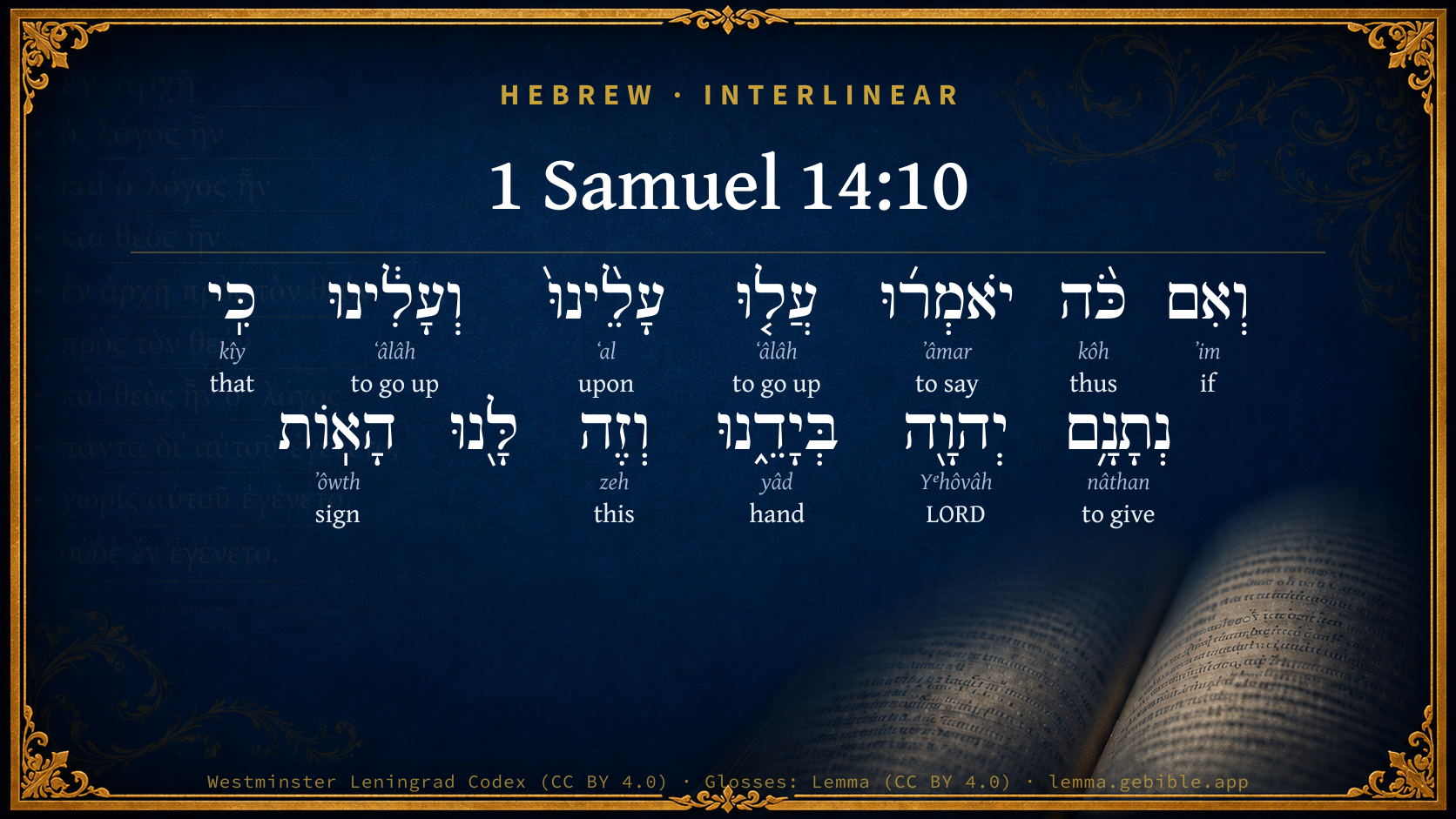
1 Samuel 14:10

Hebrew (Westminster Leningrad Codex) 1 Samuel 14:10 appears in the Hebrew Old Testament. The text above is from the Westminster Leningrad Codex. Each word links to its Strong’s number, a concise gloss, and parsing drawn from the Open Scriptures Hebrew Bible morphology. Click any word for its full Brown-Driver-Briggs (BDB) entry.
Download image
Cite this verse

1 Samuel 14:10 (World English Bible). Public Domain. Lemma interlinear Bible study tool, https://lemma.gebible.app/v/1-samuel/14/10.

Show BibTeX & RIS
BibTeX
RIS
English Translation
But if they say thus, Come up to us; then we will go up; for Yahweh has delivered them into our hand: and this shall be the sign to us.
World English Bible · Public Domain
Download a study sheet

One document with this verse’s original text, its word-by-word gloss line, the meaning frame, cross-references with their text, attributed commentary, and full source and license credits — printable, and it pastes into notes with its structure intact.

This verse Autodidact and up

Study sheet (.html) Plain text (.txt)

A passage Seminary Student

Up to 50 verses in one chapter. A passage sheet keeps up to 6 commentary sources and 12 cross-references per verse, in the order this page ranks them, and says so on the sheet whenever that leaves anything out. Ask for a single verse and you get the Autodidact verse sheet above.

Everything on this page stays free to read, with no account — the sheet is a download of what is already on screen, not access to it.

Want to remove ads? Support Godless Engineer
Compare translations 3

The same verse in 3 English versions, stacked beneath the original-language interlinear above. Click any original word for its lexicon entry.

Each is an independent rendering of the whole verse — the interlinear is not word-aligned to these translations.

Highlighted words mark where these versions differ — a whole-verse word diff, not a word-by-word alignment.

  • World English Bible Public Domain
    But if they say thus, Come up to us; then we will go up; for Yahweh has delivered them into our hand: and this shall be the sign to us.
  • King James Version Public Domain
    But if they say thus, Come up unto us; then we will go up: for the LORD hath delivered them into our hand: and this shall be a sign unto us.
  • unfoldingWord Literal Text CC BY-SA 4.0
    But if thus they say, ‘Come up to us,’ then we will go up, for Yahweh has given them into our hand, and this the sign for us.”

unfoldingWord Literal Text — © unfoldingWord, licensed CC BY-SA 4.0. Word-aligned USFM3 via Door43 (git.door43.org/unfoldingWord/en_ult).

Versions to compare (up to 4)

3 of 4 selected

Show all 18 translations

Every available English version of this verse, each an independent rendering of the whole verse.

  • World English Bible Public Domain
    But if they say thus, Come up to us; then we will go up; for Yahweh has delivered them into our hand: and this shall be the sign to us.
  • Berean Standard Bible Public Domain
    But if they say, ‘Come on up,’ then we will go up, because this will be our sign that the LORD has delivered them into our hands.”
  • Majority Standard Bible Public Domain
    But if they say, ‘Come on up,’ then we will go up, because this will be our sign that the LORD has delivered them into our hands.”
  • King James Version Public Domain
    But if they say thus, Come up unto us; then we will go up: for the LORD hath delivered them into our hand: and this shall be a sign unto us.
  • American Standard Version (1901) Public Domain
    But if they say thus, Come up unto us; then we will go up; for Jehovah hath delivered them into our hand: and this shall be the sign unto us.
  • Revised Version (1885) Public Domain
    But if they say thus, Come up unto us; then we will go up: for the LORD hath delivered them into our hand: and this shall be the sign unto us.
  • Geneva Bible (1599) Public Domain
    But if they say, Come vp vnto vs, then we will goe vp: for the Lord hath deliuered them into our hande: and this shall be a signe vnto vs.
  • Douay-Rheims (1899) Public Domain
    But if they shall say: Come up to us: let us go up, because the Lord hath delivered them into our hands, this shall be a sign unto us.
  • Young's Literal Translation Public Domain
    and if thus they say, `Come up against us,' then we have gone up, for Jehovah hath given them into our hand, and this to us `is' the sign.
  • Literal Standard Version CC BY-SA 4.0
    and if they thus say, Come up against us, then we have gone up, for YHWH has given them into our hand, and this [is] the sign to us.”
  • Unlocked Literal Bible CC BY-SA 4.0
    But if they reply, 'Come over to us,' then we will cross over; because Yahweh has given them into our hand. This will be the sign to us.”
  • unfoldingWord Literal Text CC BY-SA 4.0
    But if thus they say, ‘Come up to us,’ then we will go up, for Yahweh has given them into our hand, and this the sign for us.”
  • Darby Bible Public Domain
    And if they say thus, Come up to us, then we will go up; for Jehovah has given them into our hand; and this shall be the sign to us.
  • World Messianic Bible Public Domain
    But if they say this, ‘Come up to us!’ then we will go up, for the LORD has delivered them into our hand. This shall be the sign to us.”
  • Webster's Bible Public Domain
    But if they say thus, Come up to us; then we will go up: for the LORD hath delivered them into our hand; and this shall be a sign to us.
  • Free Bible Version CC BY-SA 4.0
    But if they say, ‘Come on up to us,’ we'll climb up, for that will be the sign that the Lord has handed them over to us.”
  • Bible in Basic English Public Domain
    But if they say, Come up to us; then we will go up, for the Lord has given them into our hands: and this will be the sign to us.
  • JPS Tanakh (1917) Public Domain
    But if they say thus: Come up unto us; then we will go up; for the LORD hath delivered them into our hand; and this shall be the sign unto us.'

Literal Standard Version (2020), Covenant Press — licensed CC BY-SA 4.0. Text via the HelloAO Bible API (eBible.org). Unlocked Literal Bible (unfoldingWord) — licensed CC BY-SA 4.0. Text via the HelloAO Bible API (eBible.org). unfoldingWord Literal Text — © unfoldingWord, licensed CC BY-SA 4.0. Word-aligned USFM3 via Door43 (git.door43.org/unfoldingWord/en_ult). Free Bible Version, Dr. Jonathan Gallagher — licensed CC BY-SA 4.0. Text via the HelloAO Bible API (eBible.org).

Word by word

More ways to search: Search by grammar → Find every occurrence → Compare this word →

Practice this passage: Drill this verse → Learn its vocabulary →

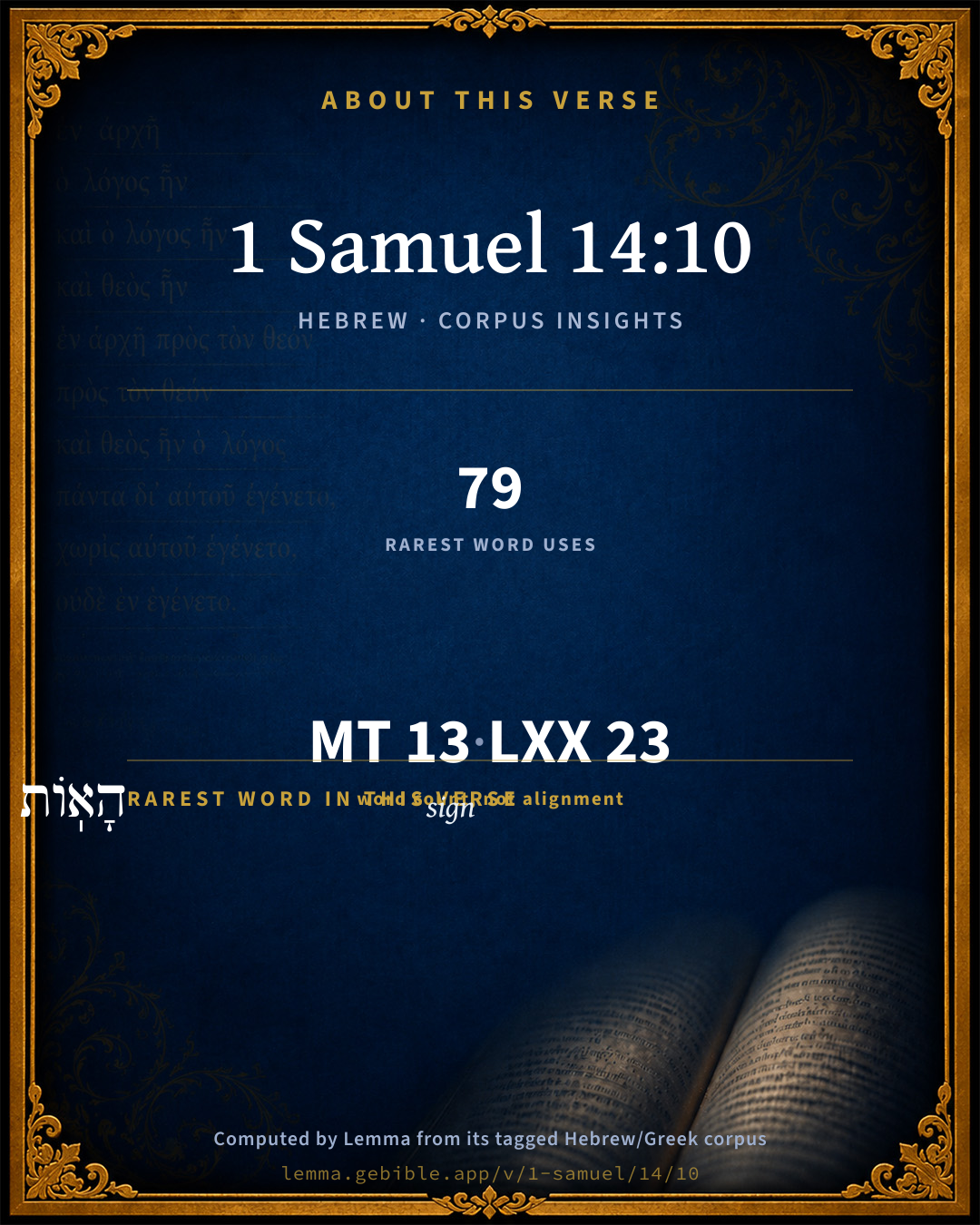
הָאֽוֹת
ʼôwth
H226
“the · sign”
Particle, Definite Article + Noun, Common, Both, Singular, Absolute
Part of Speech
Particle + Noun
Type
Common
Gender
Both
Number
Singular
State
Absolute
Full BDB Definition

Origin: probably from H225 (in the sense of appearing)

TWOT: 41a

sign, signal - a distinguishing mark - banner - remembrance - miraculous sign - omen - warning - token, ensign, standard, miracle, proof
  1. וְאִם ʼim H518 “and · if” Conjunction + Conjunction
  2. כֹּ֨ה kôh H3541 “thus” Adverb
  3. יֹאמְר֜וּ ʼâmar H559 “to say” Verb, Qal, Imperfect, 3rd Person, Masculine, Plural
  4. עֲל֤וּ ʻâlâh H5927 “go up” Verb, Qal, Imperative, 2nd Person, Masculine, Plural
  5. עָלֵ֨ינוּ֙ ʻal H5921 “upon · us” Preposition + Suffix, Personal, 1st Person, Common, Plural
  6. וְעָלִ֔ינוּ ʻâlâh H5927 “and · to go up” Conjunction + Verb, Qal, Sequential Perfect, 1st Person, Common, Plural
  7. כִּֽי kîy H3588 “that” Conjunction
  8. נְתָנָ֥ם nâthan H5414 “to give · them” Verb, Qal, Perfect, 3rd Person, Masculine, Singular + Suffix, Personal, 3rd Person, Masculine, Plural
  9. יְהוָ֖ה Yᵉhôvâh H3068 “LORD” Noun, Proper
  10. בְּיָדֵ֑נוּ yâd H3027 “in/at · hand · our” Preposition + Noun, Common, Both, Singular, Construct + Suffix, Personal, 1st Person, Common, Plural
  11. וְזֶה zeh H2088 “and · this” Conjunction + Pronoun, Demonstrative, Masculine, Singular

About this verse

These counts appear in no published source. They are computed here, from the morphology-tagged text and Lemma’s own curated glosses. What Lemma adds →

13
words
11
distinct lemmas
Historical
section

Grammatical profile

  • 4 verbs
  • 3 nouns
  • 1 pronoun
  • 2 prepositions
  • 2 conjunctions
  • 1 adverb

Verb forms

  • יֹאמְר֜וּ Qal · Imperfect
  • עֲל֤וּ Qal · Imperative
  • וְעָלִ֔ינוּ Qal · Sequential Perfect
  • נְתָנָ֥ם Qal · Perfect

Repetition

A word recurs within this verse — often emphatic in Hebrew:

  • עֲל֤וּ to go up H5927 ×2

Hebrew & Septuagint length

In English translation the verse runs 30 words from the Hebrew and 33 from the Septuagint (LXX English) — closely comparable.

A rough comparison of the two English renderings, which tokenize alike — not a word-level alignment.

Word counts can differ between the Hebrew and the Greek without any difference in meaning — e.g. the Hebrew direct-object marker אֵת has no separate Greek word, and Greek often adds the article ὁ.

In the original languages it is 13 Hebrew tokens and 23 Greek tokens — but the two are counted differently (Hebrew bundles its prefixes and suffixes into one token; the Greek is in lemma form), so that isn’t a like-for-like length.

Cross-references

5

Topical passages linked to 1 Samuel 14:10 in the Treasury of Scripture Knowledge — connected by theme and wording, ordered by reader-vote popularity; previews shown in the World English Bible.

  • Genesis 24:14 Let it happen, that the young lady to whom I will say, 'Please let down your pitcher, that I may drink.' She will say, 'Drink, and I will also give your camels a drink.' Let the same be she who you have appointed for your servant Isaac. Thereby will I know that you have shown kindness to my master."
  • Judges 7:11 and you shall hear what they say; and afterward shall your hands be strengthened to go down into the camp. Then went he down with Purah his servant to the outermost part of the armed men who were in the camp.
  • 1 Samuel 10:7 Let it be, when these signs are come to you, that you do as occasion shall serve you; for God is with you.
  • Judges 6:36 Gideon said to God, If you will save Israel by my hand, as you have spoken,
  • Isaiah 7:11–14 "Ask a sign of Yahweh your God; ask it either in the depth, or in the height above."

Cross-references courtesy of OpenBible.info (CC BY 4.0).

Hebrew and Greek witnesses Masoretic Hebrew ↔ Greek Septuagint

The same verse in the two great witnesses to the Old Testament, shown verse-for-verse.

These are two independent witnesses, not word-aligned to each other, and the Septuagint is shown in lemma (dictionary) form.

Hebrew 1 Samuel 14:10 Masoretic · Westminster Leningrad Codex

וְאִם כֹּ֨ה יֹאמְר֜וּ עֲל֤וּ עָלֵ֨ינוּ֙ וְעָלִ֔ינוּ כִּֽי נְתָנָ֥ם יְהוָ֖ה בְּיָדֵ֑נוּ וְזֶה לָּ֖נוּ הָאֽוֹת

But if they say thus, Come up to us; then we will go up; for Yahweh has delivered them into our hand: and this shall be the sign to us.

World English Bible · Public Domain

Greek LXX 1 Samuel 14:10 Septuagint · lemma form

καί ἐάν ὅδε εἶπον πρός ἐγώ ἀναβαίνω πρός ἐγώ καί ἀναβαίνω ὅτι παραδίδωμι αὐτός κύριος εἰς ὁ χείρ ἐγώ οὗτος ἐγώ ὁ σημεῖον

But if they should say thus to us, Come up to us; then will we go up, for the Lord has delivered them into our hands; this shall be a sign to us.

LXX2012 (modern English Septuagint) · Public Domain

Hebrew: Westminster Leningrad Codex (CC BY 4.0). Greek: Septuagint (public domain); English from LXX2012 (modern English Septuagint) (Public Domain). How the Septuagint differs from the Hebrew →

Targum (Aramaic paraphrase)

1

The Targum is the ancient Jewish Aramaic paraphrase of the Hebrew Scriptures — an interpretive translation, not the Hebrew text itself. Onkelos (literal) and Pseudo-Jonathan (expansive) render the Torah, and Jonathan the Prophets. Coverage is partial: where no permissively-licensed English translation exists for a verse, only the Aramaic is shown. This is verse-level text, not a word-by-word alignment to the Hebrew.

  1. Targum Jonathan Prophets (Joshua–Malachi)
    וְאִם כְּדֵין יֵימְרוּן סָקוּ עֲלָנָא וְנִיסַק אֲרֵי מַסְרִינוּן יְיָ בִּידָנָא וְדֵין לָנָא אָתָא:

    (no public-domain English translation for this verse)

    Targum Jonathan — Aramaic: “Mikraot Gedolot” (public domain). English: “Sefaria Community Translation” (CC0 1.0 (public-domain dedication)); “London "Chaldee Paraphrase," 1871” (public domain). Text via Sefaria.

Commentary

Notes on 1 Samuel 14:10 from classic Christian and Jewish commentators (each source and its license shown beneath its notes). The classic Christian expositions comment on the surrounding passage and are grouped to its opening verse, so a note may address several verses; the Jewish commentaries on the Tanakh (Rashi and others) are per-verse, so they appear only where the commentator wrote on this verse.

Lemma curates 59 commentaries, every one of them public domain or Creative Commons licensed, each selected and text-cleaned for this edition rather than reprinted as found. About our sources →

Trapp's Complete Commentary

John Trapp

1Sa 14:10 But if they say thus, Come up unto us; then we will go up: for the LORD hath delivered them into our hand: and this [shall be] a sign unto us.

Ver. 10. But if they say thus, Come up unto us.] Come up if ye can; for they were confident upon the defence of the place: wherefore Jonathan doubted not but God would confute them, saith Josephus. See the like, Isa 22:16; Isa 22:18.

John Trapp, A Commentary or Exposition upon All the Books of the Old and New Testament (1647–1656) — public domain. Text from a community e-Sword module.

Joseph Benson's Commentary

1Sa 14:10. This shall be a sign unto us — Jonathan, not being assured of the success of this intended exploit, desires a sign, and by the instinct of God’s Spirit pitches on this. He could upon no good ground have spoken in this manner without an impulse from God, who often suggested such thoughts and resolutions unto good men’s minds in ancient times, as we see in the example of Abraham’s servant, Gen 24:14, &c. God, we must observe, has the governing of the hearts and tongues of all men, even of those that know him not, and serves his own purposes by them, though they mean not so, neither do their hearts think so.

Joseph Benson's Commentary on the Old and New Testaments (1811–1818) — public domain. Text from a community e-Sword module.

The Cambridge Bible for Schools and Colleges

gen. ed. J. J. S. Perowne

10. this shall be a sign unto us] “The sign” is clearly regarded by Jonathan as an intimation of the Divine will. Cp. Gen_24:14; Jdg_6:36 ff., and ch. 1Sa_2:34, note.

The Cambridge Bible for Schools and Colleges (gen. ed. J. J. S. Perowne; Cambridge University Press, 1878–1918) — public domain. Text from a community e-Sword module.

John Gill's Exposition

But if they say unto us, come up unto us,.... Which however spoken in contempt of them, yet would discover some fear, that they did not care to come out of their hold to them, and expose themselves to any danger; and besides being bid to come up, though it might be in a sneering ironical way, as supposing it impracticable for them; yet this would lead them on to make the attempt; and while the men were careless and secure, they might obtain their point:

then we will go up: the precipice, which was supposed impassable:

for the Lord hath delivered them into our hands: they being afraid to come out, and scornful and self-confident in their garrison: and this shall be a sign unto us; a direction how to behave, what steps to take, and a confirming sign assuring of success. Bishop Patrick and others observe, from Herodotus (o), something similar to this, of the Paeonians, who went to war with the Perinthians, directed by the oracle; and were ordered that if the Perinthians provoked them to fight, calling them by name, then they should invade them; but, if not, should abstain; and so they did, and overcame; for when they met, there were three single combats; in the two first the Perinthians were conquerors, and began to triumph and insult; upon which the Paeonians said to one another, now is the oracle fulfilled, now is our business, and so fell upon them, and left few of them.

(o) Terpsichore, sive, l. 5. c. 1.

John Gill's Exposition of the Whole Bible (1746–1763) — public domain (CC PDM 1.0). Text via the HelloAO Bible API.

Albert Barnes' Notes on the Bible

Though it is not expressly said, as in the case of Gideon Jdg 6:34, Othniel Jdg 3:10, and others, that the Spirit of the Lord came upon him, yet the whole course of the narrative, especially 1Sa 14:13-16, indicates an extraordinary divine interposition.

Albert Barnes' Notes on the Bible (1834–1885) — public domain. Text from a community e-Sword/MySword module.

Haydock's Catholic Bible Commentary

This shall be a sign. It is likely Jonathan was instructed by divine inspiration, to make choice of this sign; otherwise, the observation of omens is superstitious and sinful. (Challoner) (Menochius) (Worthington)

George Leo Haydock (1774–1849), Haydock's Catholic Family Bible and Commentary, 1859 edition — public domain. Excludes Psalms (Douay-Rheims chapter numbering differs from Protestant) and Deuterocanonical books (Catholic canon only).

Matthew Poole's English Annotations

Jonathan not being assured of the success of this present exploit, desires a sign; and by the instinct of God’s Spirit, as the success shows, pitched upon this. Divers such heroical motions and extraordinary impulses there were among great and good men in ancient times; as Gen 24:13; Jdg 6:37; which are not precedents to us.

Matthew Poole's English Annotations on the Holy Bible (1683–1685) — public domain. Text from a community e-Sword/MySword module.

Whedon's Commentary on the Bible

Daniel D. Whedon

10. Come up unto us — This invitation from the men of the Philistine garrison they would regard as a sign from Jehovah — a prophecy of success. “It was not tempting God for Jonathan to fix upon such a sign by which to determine the success of his enterprise, for he did it in the exercise of his calling, when fighting not for personal objects, but for the kingdom of God, which the uncircumcised were threatening to annihilate. He did it in the most confident belief that the Lord would deliver and preserve his people; and such faith as this God would not put to shame.” — Keil.

Daniel D. Whedon (gen. ed.), Commentary on the Old and New Testaments (1874–1909) — public domain. Text from a community e-Sword module.

The Pulpit Commentary

A sign. The waiting of the garrison for Jonathan and his armour bearer to mount up to them would be a sign of great indifference and supineness on their part; but what he rather meant was that they were to regard it as an omen. Kim"hi has a long digression in his commentary on this place to show that there was nothing superstitous in their looking for a prognostic to encourage them in their hazardous undertaking. God, he says, bade Gideon go to the camp of the Midianites to obtain such a sign. as Jonathan looked for here. (see Jud_1:7:11)

The Pulpit Commentary (1880–1919), ed. H.D.M. Spence-Jones & Joseph S. Exell — public domain. Text from a community e-Sword module.

John Wesley's Explanatory Notes

A sign - Jonathan not being assured of the success of this exploit, desires a sign; and by the instinct of God's Spirit, pitches upon this. Divers such motions and extraordinary impulses there were among great and good men in ancient times. Observe; God has the governing of the hearts and tongues of all men, even of those that know him not, and serves his own purposes by them, tho' they mean not so, neither does their hearts think so.

John Wesley, Explanatory Notes Upon the Whole Bible (1754–1765) — public domain. Text via the GEBible commentary corpus.

Rashi

Rabbi Shlomo Yitzchaki (Rashi)

But if they say [to us], 'Come up to us.' A fear inspired by the Holy One, Blessed is He, is in their heart and they are afraid to move from their place.

Rashi on the Tanakh — English translations: “The Judaica Press complete Tanach with Rashi, translated by A. J. Rosenberg” (CC BY 4.0); “Pentateuch with Rashi's commentary by M. Rosenbaum and A.M. Silbermann, 1929-1934” (public domain); “The Metsudah Tanach series, Lakewood, N.J” (CC BY 4.0); and “The Book of Joshua, Metsudah Publications, 1997” (CC BY 4.0). Text via Sefaria.

Lesson kit

Teaching starters — assembled from the data on this page, not authored interpretation. Every prompt links to the verse data it draws on. Edit before teaching.

1 Samuel, in the Historical, opens this verse with 13 words (11 distinct Hebrew lemmas). Its most distinctive word is ʼôwth (“sign”). A historical commentator’s framing appears above. Read the whole chapter for the surrounding context.

Discussion questions

  1. What does “sign” (ʼôwth) contribute to the verse as a whole?
  2. Genesis 24:14 shares this passage’s theme. How do the two illuminate each other?
  3. “to go up” occurs 2× in this one verse. What is the effect of the repetition?
  4. These translations render this verse differently. What is at stake in choosing one wording over another?
  5. The verb «יֹאמְר֜וּ» is Qal Imperfect. How does its form color the action?
  6. Reading how Trapp's Complete Commentary and Joseph Benson's Commentary read this verse, where do the two commentators agree and where do they part?

Things to notice

Reading settings

Reading text

Shown beneath each verse's original-language words.

Old Testament
Old Testament edition

Read the OT as the Masoretic Hebrew (MT) or the Greek Septuagint (LXX).

English shown for the Greek Septuagint (in the Hebrew ↔ Greek comparison).

Comparing translations? Open the Compare panel on any verse page to stack up to four side by side.