
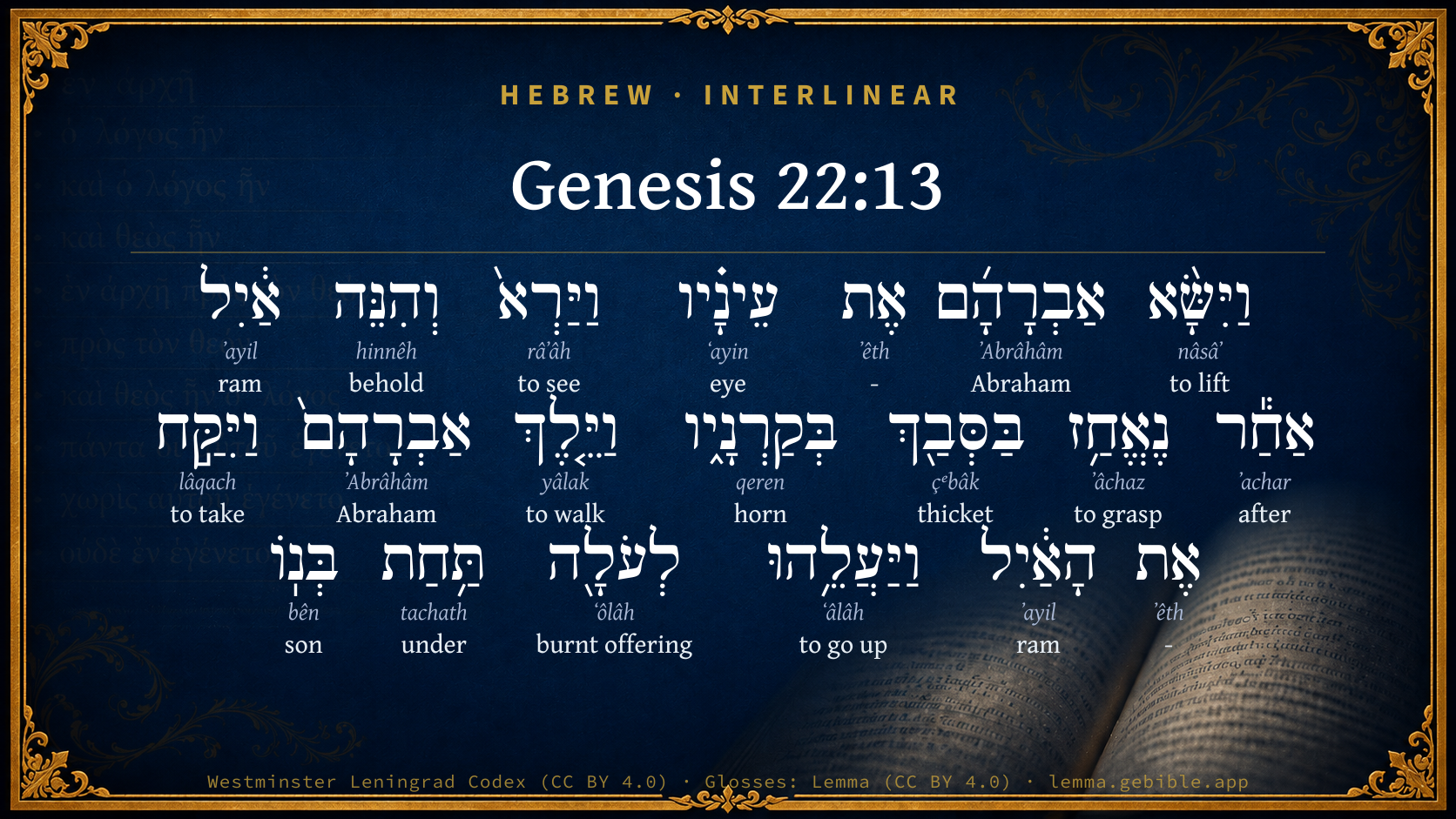
Genesis 22:13

Hebrew (Westminster Leningrad Codex) Genesis 22:13 appears in the Hebrew Old Testament. The text above is from the Westminster Leningrad Codex. Each word links to its Strong’s number, a concise gloss, and parsing drawn from the Open Scriptures Hebrew Bible morphology. Click any word for its full Brown-Driver-Briggs (BDB) entry.
Download image
Cite this verse

Genesis 22:13 (World English Bible). Public Domain. Lemma interlinear Bible study tool, https://lemma.gebible.app/v/genesis/22/13.

Show BibTeX & RIS
BibTeX
RIS
English Translation
Abraham lifted up his eyes, and looked, and saw that behind him was a ram caught in the thicket by his horns. Abraham went and took the ram, and offered him up for a burnt offering instead of his son.
World English Bible · Public Domain
Highlights
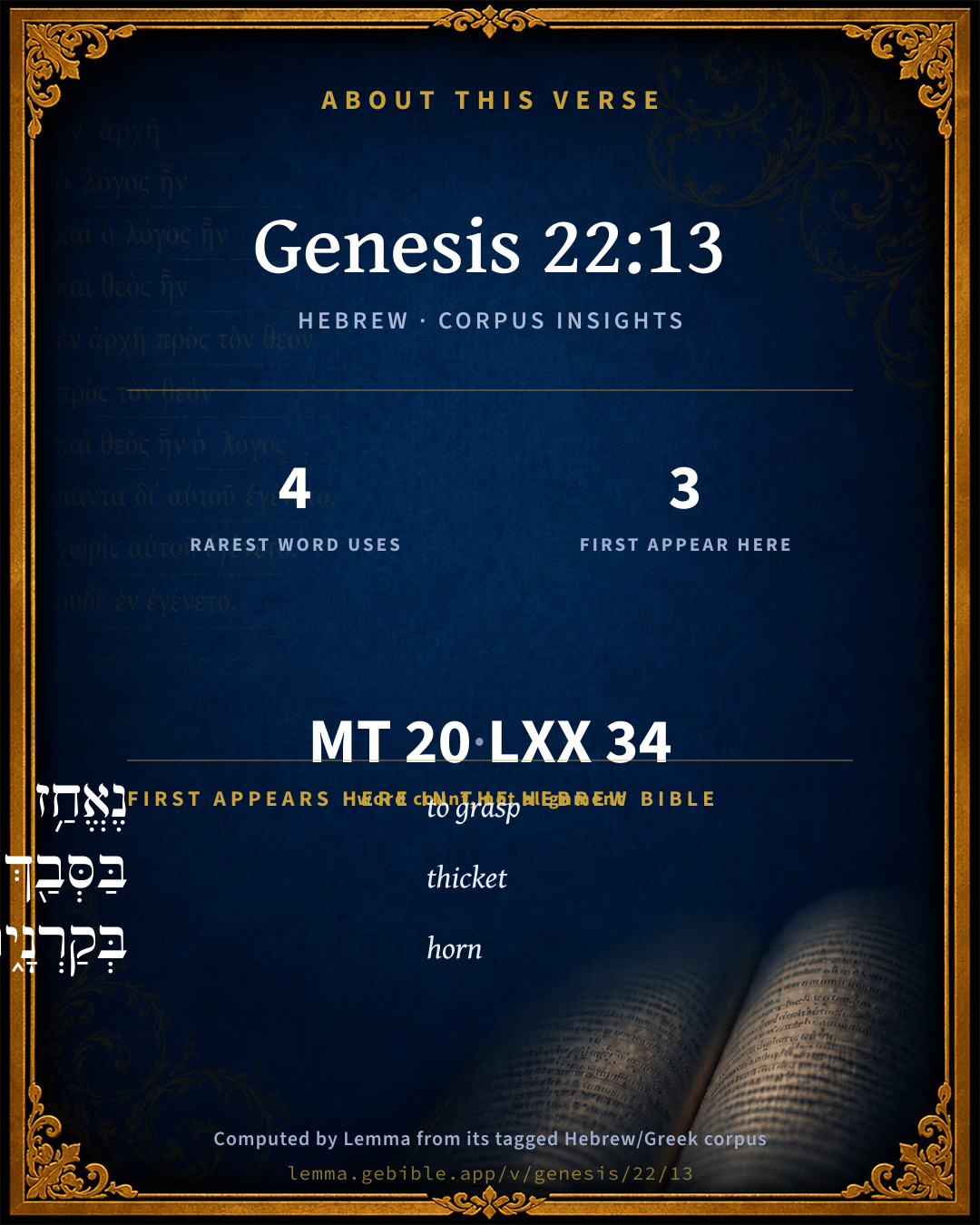
  • 3 first appearances in the Hebrew Bible
Full analysis ↓
Download a study sheet

One document with this verse’s original text, its word-by-word gloss line, the meaning frame, cross-references with their text, attributed commentary, and full source and license credits — printable, and it pastes into notes with its structure intact.

This verse Autodidact and up

Study sheet (.html) Plain text (.txt)

A passage Seminary Student

Up to 50 verses in one chapter. A passage sheet keeps up to 6 commentary sources and 12 cross-references per verse, in the order this page ranks them, and says so on the sheet whenever that leaves anything out. Ask for a single verse and you get the Autodidact verse sheet above.

Everything on this page stays free to read, with no account — the sheet is a download of what is already on screen, not access to it.

Want to remove ads? Support Godless Engineer
Compare translations 3

The same verse in 3 English versions, stacked beneath the original-language interlinear above. Click any original word for its lexicon entry.

Each is an independent rendering of the whole verse — the interlinear is not word-aligned to these translations.

Highlighted words mark where these versions differ — a whole-verse word diff, not a word-by-word alignment.

  • World English Bible Public Domain
    Abraham lifted up his eyes, and looked, and saw that behind him was a ram caught in the thicket by his horns. Abraham went and took the ram, and offered him up for a burnt offering instead of his son.
  • King James Version Public Domain
    And Abraham lifted up his eyes, and looked, and behold behind him a ram caught in a thicket by his horns: and Abraham went and took the ram, and offered him up for a burnt offering in the stead of his son.
  • unfoldingWord Literal Text CC BY-SA 4.0
    Then Abraham lifted his eyes and looked, and behold, a ram behind, caught in the thicket by its horns. So Abraham went and took the ram, and sacrificed it as a burnt offering instead of his son.

unfoldingWord Literal Text — © unfoldingWord, licensed CC BY-SA 4.0. Word-aligned USFM3 via Door43 (git.door43.org/unfoldingWord/en_ult).

Versions to compare (up to 4)

3 of 4 selected

Show all 18 translations

Every available English version of this verse, each an independent rendering of the whole verse.

  • World English Bible Public Domain
    Abraham lifted up his eyes, and looked, and saw that behind him was a ram caught in the thicket by his horns. Abraham went and took the ram, and offered him up for a burnt offering instead of his son.
  • Berean Standard Bible Public Domain
    Then Abraham looked up and saw behind him a ram in a thicket, caught by its horns. So he went and took the ram and offered it as a burnt offering in place of his son.
  • Majority Standard Bible Public Domain
    Then Abraham looked up and saw behind him a ram in a thicket, caught by its horns. So he went and took the ram and offered it as a burnt offering in place of his son.
  • King James Version Public Domain
    And Abraham lifted up his eyes, and looked, and behold behind him a ram caught in a thicket by his horns: and Abraham went and took the ram, and offered him up for a burnt offering in the stead of his son.
  • American Standard Version (1901) Public Domain
    And Abraham lifted up his eyes, and looked, and behold, behind `him' a ram caught in the thicket by his horns. And Abraham went and took the ram, and offered him up for a burnt-offering in the stead of his son.
  • Revised Version (1885) Public Domain
    And Abraham lifted up his eyes, and looked, and behold, behind him a ram caught in the thicket by his horns: and Abraham went and took the ram, and offered him up for a burnt offering in the stead of his son.
  • Geneva Bible (1599) Public Domain
    And Abraham lifting vp his eyes, looked: and behold, there was a ramme behind him caught by the hornes in a bush. then Abraham went and tooke the ramme, and offered him vp for a burnt offering in the steade of his sonne.
  • Douay-Rheims (1899) Public Domain
    Abraham lifted up his eyes, and saw behind his back a ram amongst the briers sticking fast by the horns, which he took and offered for a holocaust instead of his son.
  • Young's Literal Translation Public Domain
    And Abraham lifteth up his eyes, and looketh, and lo, a ram behind, seized in a thicket by its horns; and Abraham goeth, and taketh the ram, and causeth it to ascend for a burnt-offering instead of his son;
  • Literal Standard Version CC BY-SA 4.0
    And Abraham lifts up his eyes, and looks, and behold, a ram behind, seized in a thicket by its horns; and Abraham goes, and takes the ram, and causes it to ascend for a burnt-offering instead of his son;
  • Unlocked Literal Bible CC BY-SA 4.0
    Abraham looked up and behold, behind him was a ram caught in the bushes by his horns. Abraham went and took the ram and offered him up as a burnt offering instead of his son.
  • unfoldingWord Literal Text CC BY-SA 4.0
    Then Abraham lifted his eyes and looked, and behold, a ram behind, caught in the thicket by its horns. So Abraham went and took the ram, and sacrificed it as a burnt offering instead of his son.
  • Darby Bible Public Domain
    And Abraham lifted up his eyes, and looked, and behold, behind was a ram caught in the thicket by its horns; and Abraham went and took the ram, and offered it up for a burnt-offering instead of his son.
  • World Messianic Bible Public Domain
    Abraham lifted up his eyes, and looked, and saw that behind him was a ram caught in the thicket by his horns. Abraham went and took the ram, and offered him up for a burnt offering instead of his son.
  • Webster's Bible Public Domain
    And Abraham lifted up his eyes, and looked, and behold, behind him a ram caught in a thicket by his horns: And Abraham went and took the ram, and offered him for a burnt-offering in the stead of his son.
  • Free Bible Version CC BY-SA 4.0
    Abraham looked up and saw a ram caught by its horns in some bushes. He brought the ram over and sacrificed it as a burnt offering in place of his son.
  • Bible in Basic English Public Domain
    And lifting up his eyes, Abraham saw a sheep fixed by its horns in the brushwood: and Abraham took the sheep and made a burned offering of it in place of his son.
  • JPS Tanakh (1917) Public Domain
    And Abraham lifted up his eyes, and looked, and behold behind him a ram caught in the thicket by his horns. And Abraham went and took the ram, and offered him up for a burnt-offering in the stead of his son.

Literal Standard Version (2020), Covenant Press — licensed CC BY-SA 4.0. Text via the HelloAO Bible API (eBible.org). Unlocked Literal Bible (unfoldingWord) — licensed CC BY-SA 4.0. Text via the HelloAO Bible API (eBible.org). unfoldingWord Literal Text — © unfoldingWord, licensed CC BY-SA 4.0. Word-aligned USFM3 via Door43 (git.door43.org/unfoldingWord/en_ult). Free Bible Version, Dr. Jonathan Gallagher — licensed CC BY-SA 4.0. Text via the HelloAO Bible API (eBible.org).

Word by word

More ways to search: Search by grammar → Find every occurrence → Compare this word →

Practice this passage: Drill this verse → Learn its vocabulary →

בַּסְּבַ֖ךְ
çᵉbâk
H5442
“in/at the · thicket”
Preposition, Determined + Noun, Common, Masculine, Singular, Absolute
Part of Speech
Preposition + Noun
Type
Common
Gender
Masculine
Number
Singular
State
Absolute
Full BDB Definition

Origin: from H5440

TWOT: 1457a

thicket
  1. וַיִּשָּׂ֨א nâsâʼ H5375 “and · to lift” Conjunction + Verb, Qal, Sequential Imperfect, 3rd Person, Masculine, Singular
  2. אַבְרָהָ֜ם ʼAbrâhâm H85 “Abraham” Noun, Proper
  3. אֶת ʼêth H853 “-” Particle, Direct Object
  4. עֵינָ֗יו ʻayin H5869 “eyes · his” Noun, Common, Both, Dual, Construct + Suffix, Personal, 3rd Person, Masculine, Singular
  5. וַיַּרְא֙ râʼâh H7200 “and · to see” Conjunction + Verb, Qal, Sequential Imperfect, 3rd Person, Masculine, Singular
  6. וְהִנֵּה hinnêh H2009 “and · behold” Conjunction + Particle, Demonstrative
  7. אַ֔יִל ʼayil H352 “ram” Noun, Common, Masculine, Singular, Absolute
  8. אַחַ֕ר ʼachar H310 “after” Preposition
  9. נֶאֱחַ֥ז ʼâchaz H270 “to grasp” Verb, Niphal, Perfect, 3rd Person, Masculine, Singular
  10. בְּקַרְנָ֑יו qeren H7161 “in/at · horns · his” Preposition + Noun, Common, Both, Dual, Construct + Suffix, Personal, 3rd Person, Masculine, Singular
  11. וַיֵּ֤לֶךְ yâlak H3212 “and · to walk” Conjunction + Verb, Qal, Sequential Imperfect, 3rd Person, Masculine, Singular
  12. אַבְרָהָם֙ ʼAbrâhâm H85 “Abraham” Noun, Proper
  13. וַיִּקַּ֣ח lâqach H3947 “and · to take” Conjunction + Verb, Qal, Sequential Imperfect, 3rd Person, Masculine, Singular
  14. אֶת ʼêth H853 “-” Particle, Direct Object
  15. הָאַ֔יִל ʼayil H352 “the · ram” Particle, Definite Article + Noun, Common, Masculine, Singular, Absolute
  16. וַיַּעֲלֵ֥הוּ ʻâlâh H5927 “and · to go up · him” Conjunction + Verb, Hiphil, Sequential Imperfect, 3rd Person, Masculine, Singular + Suffix, Personal, 3rd Person, Masculine, Singular
  17. לְעֹלָ֖ה ʻôlâh H5930 “to/for · burnt offering” Preposition + Noun, Common, Feminine, Singular, Absolute
  18. תַּ֥חַת tachath H8478 “under” Preposition
  19. בְּנֽוֹ bên H1121 “son · his” Noun, Common, Masculine, Singular, Construct + Suffix, Personal, 3rd Person, Masculine, Singular

About this verse

These counts appear in no published source. They are computed here, from the morphology-tagged text and Lemma’s own curated glosses. What Lemma adds →

20
words
17
distinct lemmas
Pentateuch
section

Notable vocabulary

The rarest word here is בַּסְּבַ֖ךְ thicket H5442 — appearing just 4 times in the whole Hebrew Bible.

First appearance in Scripture

These words make their first canonical appearance in the Hebrew Bible here:

  • נֶאֱחַ֥ז to grasp H270
  • בַּסְּבַ֖ךְ thicket H5442
  • בְּקַרְנָ֑יו horn H7161

Shared distinctive vocabulary

בַּסְּבַ֖ךְ thicket H5442 occurs in 4 verses of the Hebrew Bible. Also found in:

Grammatical profile

  • 6 verbs
  • 9 nouns
  • 2 prepositions
  • 3 particles

Verb forms

  • וַיִּשָּׂ֨א Qal · Sequential Imperfect
  • וַיַּרְא֙ Qal · Sequential Imperfect
  • נֶאֱחַ֥ז Niphal · Perfect
  • וַיֵּ֤לֶךְ Qal · Sequential Imperfect
  • וַיִּקַּ֣ח Qal · Sequential Imperfect
  • וַיַּעֲלֵ֥הוּ Hiphil · Sequential Imperfect

Repetition

Words recur within this verse — often emphatic in Hebrew:

  • אַבְרָהָ֜ם Abraham H85 ×2
  • אַ֔יִל ram H352 ×2

Hebrew & Septuagint length

In English translation the verse runs 40 words from the Hebrew and 44 from the Septuagint (LXX English) — closely comparable.

A rough comparison of the two English renderings, which tokenize alike — not a word-level alignment.

Word counts can differ between the Hebrew and the Greek without any difference in meaning — e.g. the Hebrew direct-object marker אֵת has no separate Greek word, and Greek often adds the article ὁ.

In the original languages it is 20 Hebrew tokens and 34 Greek tokens — but the two are counted differently (Hebrew bundles its prefixes and suffixes into one token; the Greek is in lemma form), so that isn’t a like-for-like length.

Cross-references

8

Topical passages linked to Genesis 22:13 in the Treasury of Scripture Knowledge — connected by theme and wording, ordered by reader-vote popularity; previews shown in the World English Bible.

  • 1 Corinthians 10:13 No temptation has taken you except what is common to man. God is faithful, who will not allow you to be tempted above what you are able, but will with the temptation also make the way of escape, that you may be able to endure it.
  • Psalms 40:6–8 Sacrifice and offering you didn't desire. You have opened my ears: Burnt offering and sin offering you have not required.
  • 2 Corinthians 1:9–10 Yes, we ourselves have had the sentence of death within ourselves, that we should not trust in ourselves, but in God who raises the dead,
  • Genesis 22:8 Abraham said, "God will provide himself the lamb for a burnt offering, my son." So they both went together.
  • Psalms 89:19–20 Then you spoke in vision to your saints, And said, "I have bestowed strength on the warrior. I have exalted a young man from the people.
  • Isaiah 30:21 and your ears shall hear a word behind you, saying, This is the way, walk you in it; when you turn to the right hand, and when you turn to the left.
  • 1 Corinthians 5:7–8 Purge out the old yeast, that you may be a new lump, even as you are unleavened. For indeed Christ, our Passover, has been sacrificed in our place.
  • 1 Peter 1:19–20 but with precious blood, as of a lamb without spot, the blood of Christ;

Cross-references courtesy of OpenBible.info (CC BY 4.0).

Hebrew and Greek witnesses Masoretic Hebrew ↔ Greek Septuagint

The same verse in the two great witnesses to the Old Testament, shown verse-for-verse.

These are two independent witnesses, not word-aligned to each other, and the Septuagint is shown in lemma (dictionary) form.

Hebrew Genesis 22:13 Masoretic · Westminster Leningrad Codex

וַיִּשָּׂ֨א אַבְרָהָ֜ם אֶת עֵינָ֗יו וַיַּרְא֙ וְהִנֵּה אַ֔יִל אַחַ֕ר נֶאֱחַ֥ז בַּסְּבַ֖ךְ בְּקַרְנָ֑יו וַיֵּ֤לֶךְ אַבְרָהָם֙ וַיִּקַּ֣ח אֶת הָאַ֔יִל וַיַּעֲלֵ֥הוּ לְעֹלָ֖ה תַּ֥חַת בְּנֽוֹ

Abraham lifted up his eyes, and looked, and saw that behind him was a ram caught in the thicket by his horns. Abraham went and took the ram, and offered him up for a burnt offering instead of his son.

World English Bible · Public Domain

Greek LXX Genesis 22:13 Septuagint · lemma form

καί ἀναβλέπω αβρααμ ὁ ὀφθαλμός αὐτός ὁράω καί ἰδού κριός εἷς καταἔχω ἐν φυτόν σαβεκ ὁ κέρας καί πορεύομαι αβρααμ καί λαμβάνω ὁ κριός καί ἀναφέρω αὐτός εἰς ὁλοκάρπωσις ἀντί ισαακ ὁ υἱός αὐτός

And Abraam lifted up his eyes and saw, and behold! a ram caught by his horns in a plant of Sabec; and Abraam went and took the ram, and offered him up for a whole burnt offering in the place of Isaac his son.

LXX2012 (modern English Septuagint) · Public Domain

On this verse, The Cambridge Bible for Schools and Colleges discusses the Septuagint’s reading. Read the note in Commentary ↓

Hebrew: Westminster Leningrad Codex (CC BY 4.0). Greek: Septuagint (public domain); English from LXX2012 (modern English Septuagint) (Public Domain). How the Septuagint differs from the Hebrew →

Targum (Aramaic paraphrase)

2

The Targum is the ancient Jewish Aramaic paraphrase of the Hebrew Scriptures — an interpretive translation, not the Hebrew text itself. Onkelos (literal) and Pseudo-Jonathan (expansive) render the Torah, and Jonathan the Prophets. Coverage is partial: where no permissively-licensed English translation exists for a verse, only the Aramaic is shown. This is verse-level text, not a word-by-word alignment to the Hebrew.

  1. Targum Onkelos Torah (Genesis–Deuteronomy)
    וּזְקַף אַבְרָהָם יָת עֵינוֹהִי בָּתַר אִלֵּין וַחֲזָא וְהָא דִּכְרָא בָּתַר אֲחִיד בְּאִילָנָא בְּקַרְנוֹהִי וַאֲזַל אַבְרָהָם וּנְסֵיב יָת דִּכְרָא וְאַסְקֵהּ לַעֲלָתָא חֲלַף בְּרֵהּ

    (no public-domain English translation for this verse)

    Targum Onkelos — Aramaic: “Onkelos Genesis” (public domain); “Onkelos Exodus” (public domain); “Onkelos Leviticus” (public domain); “Onkelos Numbers” (public domain); “Onkelos Deuteronomy” (public domain). English: “Sefaria Community Translation” (CC0 1.0 (public-domain dedication)); “J.W. Etheridge. The Targums of Onkelos and Jonathan Ben Uzziel on the Pentateuch. London: Longmans, Green, 1862” (public domain). Text via Sefaria.

  2. Targum Pseudo-Jonathan Torah (Genesis–Deuteronomy)
    וּזְקִף אַבְרָהָם יַת עֵינוֹי וַחֲזָא וְהָא דִכְרָא חַד דְאִתְבְּרֵי בֵּנֵי שַׁמְשְׁתָא דְשִׁכְלוּל עַלְמָא אָחִיד בַּחֲרִישׁוּתָא דְאִילָנָא בְּקַרְנוֹי וְאָזֵל אַבְרָהָם וּנְסֵיב יָתֵיהּ וְאַסֵיקְהִי לְעָלָתָא חֲלַף בְּרֵיהּ

    And Abraham lifted up his eyes and saw, and, behold, a certain ram which had been created between the evenings of the foundation of the world, was held in the entanglement of a tree by his horns. And Abraham went and took him, and offered him an offering instead of his son.

    Targum Pseudo-Jonathan — Aramaic: “Targum Jonathan on Genesis” (public domain); “Targum Jonathan on Exodus” (public domain); “Targum Jonathan on Leviticus” (public domain); “Targum Jonathan on Numbers” (public domain); “Targum Jonathan on Deuteronomy” (public domain). English: “The Targum of Jonathan ben Uzziel, trans. J. W. Etheridge, London, 1862” (public domain). Text via Sefaria.

Commentary

Notes on Genesis 22:13 from classic Christian and Jewish commentators (each source and its license shown beneath its notes). The classic Christian expositions comment on the surrounding passage and are grouped to its opening verse, so a note may address several verses; the Jewish commentaries on the Tanakh (Rashi and others) are per-verse, so they appear only where the commentator wrote on this verse.

Lemma curates 59 commentaries, every one of them public domain or Creative Commons licensed, each selected and text-cleaned for this edition rather than reprinted as found. About our sources →

Trapp's Complete Commentary

John Trapp

Gen 22:13 And Abraham lifted up his eyes, and looked, and behold behind [him] a ram caught in a thicket by his horns: and Abraham went and took the ram, and offered him up for a burnt offering in the stead of his son.

Ver. 13. Behold, behind him a ram.] Be like the angel called behind him; which when he turned to listen to, he spied the ram caught in a thicket, Heb., Sabbech, which signifies the perplexity; winding or binding of a bush or brier. And to this both David seems to allude, {Psa 116:19} and the son of David in that famous "Lama Sabachthani" of his. {Mar 15:34}

And Abraham went and took the ram, &c.] How likely is it, saith one, {a} that we will offer to God Isaac, our joy, who will not sacrifice the ram; that is, mortify our sinful lusts, and the desires of our flesh! God tempteth us now, saith Mr Philpot, martyr, as he did our father Abraham - commanding him to slay his son Isaac, which by interpretation signifieth mirth and joy - who by his obedience preserved Isaac unto life, and offered a ram in his stead. Similarly, we are to sacrifice to God, our Isaac; that is, our joy and consolation; which if we be ready to do, our joy shall not perish, but live and be increased: although our ram be sacrificed; that is, the pride and concupiscence of our flesh entangled, through sin, with the cares of this stinging world, for the preservation and perfect augmentation of our mirth and joy, sealed up for us in Christ. Thus he. {b} And as God provided another sacrifice, saith a third, {c} for Abraham, that so he might save his son, which was a ram tied and entangled in thorns: so God provided a sacrifice for the salvation of the world, Christ that immaculate Lamb; whose head being crowned with thorns, and hanging on the cross, by his death opened unto us the door, and made us capable of eternal happiness. It is probable, saith Bucholcerus, that Abraham, when he slew and sacrificed the ram, looked up to heaven with new eyes full of divine light; and that being filled with the Spirit of God, and carried beyond himself, he thought of more things, he felt more, he seemed to see and hear more than was possible to be uttered. Ipse Deus quodammodo expositurus, et declaraturus Abrahae actionis praesentis augustam significationem, et manu eum ducturus ad introspicienda huius sacrificii sui adyta, promissionem de Christo repetit, et iureiurando confirmat .{ d}

{a} Bastard’s Serm. on Gen 22:1.

{b} Act. and Mon., 1667.

{c} Itinerar. Scripturae , fol. 99.

{d} Bucholc. in Chronol., p. 187.

John Trapp, A Commentary or Exposition upon All the Books of the Old and New Testament (1647–1656) — public domain. Text from a community e-Sword module.

Joseph Benson's Commentary

Gen 22:13. Behold a ram — Though that blessed Seed was now typified by Isaac, yet the offering of him up was suspended till the latter end of the world, and in the mean time the sacrifice of beasts was accepted, as a pledge of that expiation which should be made by that great Sacrifice. And it is observable, that the temple, the place of sacrifice, was afterward built upon this mount Moriah, 2Ch 3:1; and mount Calvary, where Christ was crucified, was not far off.

Joseph Benson's Commentary on the Old and New Testaments (1811–1818) — public domain. Text from a community e-Sword module.

Tyndale Open Study Notes

Tyndale Open Resources

22:13 God provided a ram caught by its horns in a thicket for the sacrifice. God graciously allowed Abraham to substitute an animal sacrifice in place of Isaac. Later, all Israel would offer animals to the Lord, knowing that God’s grace had provided this substitution (Exod 29:10; Lev 4:15; 16:20-22). In the New Testament, God substituted his only son for all humanity; the perfect sacrifice was made once and for all (Isa 53:6, 10; John 1:29; Heb 7:27; 10:1-14; 1 Pet 3:18).

Tyndale Open Study Notes — © Tyndale Open Resources, licensed CC BY-SA 4.0. Text via the HelloAO Bible API.

Jamieson, Fausset & Brown

Robert Jamieson, A. R. Fausset & David Brown

Abraham lifted up his eyes . . . and behold . . . a ram, &c.--No method was more admirably calculated to give the patriarch a distinct idea of the purpose of grace than this scenic representation: and hence our Lord's allusion to it (Joh 8:56).

Next: Genesis Chapter 23

Jamieson, Fausset & Brown — Commentary Critical and Explanatory on the Whole Bible (1871) — public domain (CC PDM 1.0). Text via the HelloAO Bible API.

John Calvin's Commentaries

13. And, behold, behind him a ram. What the Jews feign respecting this ram, as having been created on the sixth day of the world, is like the rest of their fictions. We need not doubt that it was presented there by miracle, whether it was then first created, or whether it was brought from some other place; for God intended to give that to his servant which would enable him, with joy and cheerfulness, to offer up a pleasant sacrifice: and at the same time he admonishes him to return thanks. Moreover, since a ram is substituted in the place of Isaac, God shows us, as in a glass, what is the design of our mortification; namely, that by the Spirit of God dwelling within us, we, though dead, may yet be living sacrifices. I am not ignorant that more subtle allegories may be elicited; but I do not see on what foundation they rest.

John Calvin's Commentaries (1540-1563) — public domain. Text from the Calvin Translation Society English edition (1840s-50s) via the Christian Classics Ethereal Library (ccel.org). Calvin's coverage is partial (roughly two-thirds of the Bible); uncommented books and verses are honest gaps, never fabricated. The 19th-century editor's footnotes and remarks are omitted so the notes are faithfully Calvin's own voice.

Ellicott's Commentary for English Readers

(13) Behind.—By a slight change in the shape of a consonant, many ancient authorities read one ram instead of a ram behind (“him” is not in the Hebrew). This correction is almost certain, as nowhere else is the word translated behind used as an adverb of place. The ram was probably that with four horns, still common in the East.

A burnt offering in the stead of his son.—We have here the fact of substitution, and the doctrine of a vicarious sacrifice. The ram took Isaac’s place, and by its actual death completed the typical representation of the Saviour’s death on Calvary. In The Speaker’s Commentary it has been well shown, that there is no difficulty in this representation being composed of two parts, so that what was wanting in Isaac should be supplied by the ram. And while it would have been most painful for Isaac to have actually died by his father’s hand, the doctrine of the possibility of a vicarious sacrifice would have been even less clearly taught thereby. He therefore rises again to life from the altar, and the ram dies in his stead, and by the two combined the whole mystery is set forth of God giving His Son to die for mankind, and of life springing from His death. Compare the mystery of the two birds, Lev_14:4; and the two goats, Lev_16:8.

A Bible Commentary for English Readers, edited by Charles John Ellicott (1878–1897) — public domain. Text from a community e-Sword module.

The Cambridge Bible for Schools and Colleges

gen. ed. J. J. S. Perowne

13. and behold, behind him] The R.V. marginal note refers to a difference of reading, arising from the similarity of the two Heb. letters for r (ר) and (ד) d. The word, rendered “behind,” would, by the alteration of r into d, appear with the same consonants as the word meaning “one”: and this reading is found in the LXX, Sam., Peshitto, Targums, and many Heb. MSS. But the text, “behind him,” is to be preferred.

For the sudden appearance of a ram, cf. the similar suddenness of appearance in Gen_18:2, Gen_21:19. God’s gifts may be near at hand, and not yet discerned; the recognition of God’s voice brings a sudden realization of His gifts.

a ram] The conjecture that the word rendered “ram” (ayil) should, with different vowel points, be rendered a “hart” (ayyâl) is not to be approved. For (1) wild animals were not usually sacrificed by Hebrews; (2) Gen_22:7-8, by the mention of “lamb,” prepare us for “a ram”; (3) the word “thicket” seems to imply the twisted horns of a ram being entangled in brushwood.

The Cambridge Bible for Schools and Colleges (gen. ed. J. J. S. Perowne; Cambridge University Press, 1878–1918) — public domain. Text from a community e-Sword module.

John Gill's Exposition

And Abraham lifted up his eyes,.... They were before fixed upon his son lying upon the altar, and intent upon that part he was going to thrust his knife into; but hearing a voice from heaven above him, he lift up his eyes thitherward:

and looked, and, behold, behind him a ram caught in a thicket by his horns; the ram making a noise and rustling among the bushes behind the place where Abraham was, he turned himself, and looked and saw it: the Targum of Onkelos introduces the clause thus, "after these things"; and so the Arabic version: after Abraham had heard the voice of the angel, and had lift up his eyes to heaven, he was directed to look behind him; and both that and the Targum of Jonathan paraphrase it,"and he saw and beheld one ram;''and so the Septuagint, Syriac and Samaritan versions, reading instead of This ram was caught and held by his horns in a thicket of briers, brambles, and thorns, or in the thick branches of the shrubs or bushes which grew upon the mount; and the horns of a ram being crooked, are easily implicated in such thickets, but not easily loosed. From whence this ram came is not known; it can hardly be thought to come from Abraham's fold, or to be his property, since he was three days' journey distant from home; very likely it had strayed from neighbouring flocks, and was by the providence of God directed hither at a seasonable time. The Jewish writers (k) say, it was from the creation of the world; and there is no absurdity or improbability to suppose it was immediately created by the power of God, and in an extraordinary manner provided; and was a type of our Lord Jesus, who was foreordained of God before the foundation of the world, and came into the world in an uncommon way, being born of a virgin, and that in the fulness of time, and seasonably, and in due time died for the sins of men. The ram has its name from "strength", in the Hebrew language, and was an emblem of a great personage, Dan 8:3; and may denote the strength and dignity of Christ as a divine Person; being caught in a thicket, may be an emblem of the decrees of God, in which he was appointed to be the Saviour; or the covenant agreement and transactions with his Father, in which he voluntarily involved himself, and by which he was held; or the sins of his people, which were laid upon him by imputation, were wreathed about him, and justice finding him implicated with them, required satisfaction, and had it; or the hands of wicked men, sons of Belial, comparable to thorns, by whom he was taken; or the sorrows of death and hell that encompassed him, and the curses of a righteous law which lay upon him; and perhaps he never more resembled this ram caught in a thicket, than when a platted crown of thorns was put upon his head, and he wore it:

and Abraham went and took the ram; without regarding whose property it was, since God, the owner and proprietor of all, had provided it for him, and brought it to him at a very seasonable time, and directed him to take it:

and offered him for a burnt offering in the stead of his son; in which also was a type of Christ, who was made an offering for sin, and a sacrifice to God of a sweet smelling savour; and its being a burnt offering denotes the sufferings of Christ, and the severity of them; and which were in the room and stead of his people, of God's Isaac, of spiritual seed of Abraham, of the children of God of the promise, of all his beloved ones; who therefore are let go, justice being satisfied with what Christ has done and suffered, it being all one as if they had suffered themselves; as here in the type, the ram having, its throat cut, its blood shed, its skin flayed, and the whole burnt to ashes, were as if Isaac himself had been thus dealt with, as Jarchi observes. Alexander Polyhistor (l), an Heathen writer, has, in agreement with the sacred history, given a narrative of this affair in a few words,"God (he says) commanded Abraham to offer up his son Isaac to him for a burnt offering, and taking the lad with him to a mountain, laid and kindled an heap of wood, and put Isaac upon it; and when he was about to slay him, was forbidden by an angel, who presented a ram to him for sacrifice, and then Abraham removed his son from the pile, and offered up the ram.''

(k) Pirke Eliezer, ut supra. (c. 31.). Targum Jon. & Jarchi in loc. (l) Apud Euseb. Evangel. Praepar. l. 9. c. 19. p. 421.

John Gill's Exposition of the Whole Bible (1746–1763) — public domain (CC PDM 1.0). Text via the HelloAO Bible API.

Haydock's Catholic Bible Commentary

He took; God having given him the dominion over it. (Calmet)

George Leo Haydock (1774–1849), Haydock's Catholic Family Bible and Commentary, 1859 edition — public domain. Excludes Psalms (Douay-Rheims chapter numbering differs from Protestant) and Deuterocanonical books (Catholic canon only).

Matthew Poole's English Annotations

Behind him; which way he looked, either because the voice came that way, or because he heard the noise made by the motion of the ram in the thicket, which had gone astray from the rest of the flock, and whose errors were directed hither by God’s wise and powerful providence; and being young, though horned, it might be called either lamb, as Gen 22:7, or

ram, as it is here. There needs no curious inquiry how he could offer up that to God which was not his own, both because it was found in a public place, and in all probability utterly lost to its owner, and because he had no doubt a warrant and inspiration for it from the great Lord and supreme Owner of all things.

Matthew Poole's English Annotations on the Holy Bible (1683–1685) — public domain. Text from a community e-Sword/MySword module.

Whedon's Commentary on the Bible

Daniel D. Whedon

13. Lifted… looked… behold — These verbs afford another vivid word-picture. The startled patriarch hears, stops short, looks up and all around to see and know all that Jehovah wills.

A ram — The Samaritan, Sept., Syriac, and many MSS. read one ram, which would result from the mere changing of רinto דin the word אחר, translated behind. Such a reading would emphasize the ram as being single and separate from the flock, thus typifying, as some think, the Lamb of God as being “separate from sinners.” Heb_7:26. The same thought, however, may be held with the common reading. God had truly provided a lamb for a burnt offering. Comp. Gen_22:8.

Caught in a thicket by his horns — “What, then, did he represent,” asks Augustine, “but Jesus. who before he was offered up, was crowned with thorns by the Jews?”

Offered him up… in the stead of his son — Here comes out prominently the idea of substitution in sacrifice; the animal for the human life. But it is scarcely proper to hold up this incident as designed to teach or enhance the doctrine of vicarious atonement. That doctrine is, indeed, implied; but the prominent thought is not that either Isaac’s or Abraham’s life was now demanded in order to atone for sin. The typical lessons of the whole procedure are rather incidental, and to be presented as by accommodation and analogy, (see below,) not as the great thought, which is to show the perfection of Abraham’s faith in God.

Daniel D. Whedon (gen. ed.), Commentary on the Old and New Testaments (1874–1909) — public domain. Text from a community e-Sword module.

The Pulpit Commentary

And Abraham lifted up his eyes (in the direction of the voice), and looked, and behold behind him either at his back (Furst, Keil, Lange, Murphy), or in the background of the altar, i.e. in front of him (Gesenius, Kalisch). The LXX, Samaritan, Syriac, mistaking rja for rja, read "one," which adds nothing to the sense or picturesqueness of the compositiona ram lyia; in the component letters of which cabalistic writers find the initial letters of wOLAha,ryi God will provide for himself (Ver. 8; vide Glass, "Philippians Tract.," p. 196). In the animal itself the Fathers (Augustine, Tertullian, Origen, Chrysostom, Theodoret, Ambrose) rightly discerned a type of Christ, though it is fanciful to detect a shadow of the Crown of thorns in the words that follow caught in a thicket by his horns (the sebach being the intertwined branches of trees or brushwood): and Abraham went and took the ram, and (though not directed what to do, yet with a fine spiritual instinct discerning the Divine purpose) offered him up for a burnt offering in the stead of his son whom be thus received from the dead as in a figure. (Heb_11:19)

The Pulpit Commentary (1880–1919), ed. H.D.M. Spence-Jones & Joseph S. Exell — public domain. Text from a community e-Sword module.

John Wesley's Explanatory Notes

Behold a ram - Tho' that blessed Seed was now typified by Isaac, yet the offering of him up was suspended 'till the latter end of the world, and in the mean time the sacrifice of beasts was accepted, as a pledge of that expiation which should be made by that great sacrifice. And it is observable, that the temple, the place of sacrifice, was afterward built upon this mount Moriah, 2 Chron. iii, 1, and mount Calvary, where Christ was crucified, was not far off.

John Wesley, Explanatory Notes Upon the Whole Bible (1754–1765) — public domain. Text via the GEBible commentary corpus.

unfoldingWord translationNotes

Door43 World Missions Community

behold

The word "behold" here alerts us to pay attention to the surprising information that follows.

was a ram caught in the bushes by his horns

This can be stated in active form. AT: "was a ram whose horns were stuck in the bushes" or "was a ram stuck in the bushes" (See: Active or Passive)

went and took the ram

"Abraham went over to the ram and took it"

will provide ... will be provided

Use the same word for "provide" as you used in Genesis 22:8.

to this day

"even now." This means even to the time that the author was writing this book.

it will be provided

This can be stated in active form. AT: "he will provide" (See: Active or Passive)

translationWords

Abraham

ewe

burnt offering

Yahweh

unfoldingWord translationNotes — © Distant Shores Media and the Door43 World Missions Community, licensed CC BY-SA 4.0. Source: git.door43.org/Door43/en_tn.

Rashi

Rabbi Shlomo Yitzchaki (Rashi)

והנה איל BEHOLD, A RAM — It was predestined for that purpose from the six days of Creation (Avot 5:5; Midrash Tanchuma, Vayera 23).

אחר AFTER the angel had said to him “Lay not thy hand upon the lad” he saw it being caught in the thicket. And that is what we mean when we translate it in the Targum by “And Abraham lifted up his eyes after these (i.e. after these words)”. Other versions of Rashi have: according to the Midrashic explanation, after means after all the words of the angel and the Shechinah, and after all the arguments of Abraham.

בסבך IN A THICKET— a tree.

בקרניו BY ITS HORNS — because it was running towards Abraham, but Satan caused it to be caught and entangled among the trees (Pirkei DeRabbi Eliezer 31).

תחת בנו IN THE STEAD OF HIS SON — Since it is written, “He offered it up for a burnt offering”, surely nothing is missing in the text; what then is the force of “in the stead of his son”? At every sacrificial act he performed on it he prayed saying, “May it be Thy will that this act may be regarded as having been done to my son — as though my son is being slain; as though his blood is being sprinkled; as though his skin were being flayed; as though he is being burnt and is being reduced to ashes” (Genesis Rabbah 56:9).

Rashi on the Tanakh — English translations: “The Judaica Press complete Tanach with Rashi, translated by A. J. Rosenberg” (CC BY 4.0); “Pentateuch with Rashi's commentary by M. Rosenbaum and A.M. Silbermann, 1929-1934” (public domain); “The Metsudah Tanach series, Lakewood, N.J” (CC BY 4.0); and “The Book of Joshua, Metsudah Publications, 1997” (CC BY 4.0). Text via Sefaria.

Radak

Rabbi David Kimhi (Radak)

וישא, he raised his eyes in order to see if there was some pure animal suitable for a sacrifice which he could offer in lieu of his son.

וירא והנה איל אחר נאחז, after it had become enmeshed in the thicket. בסבך בקרניו, this served Avraham as an invitation from G’d that seeing that this ram was caught in a thicket away from the flock it belonged to, something which its shepherd had not even become aware of. This is why we have learned in the Mishnah Avot 5,6 (according to some scholars) that among the things which had been created at dusk on the 6th day of creation was also this ram which would eventually serve as the sacrifice brought by Avraham instead of his son. If Avraham had been able to locate the shepherd of this ram, he would have compensated him for the value of the animal. He would not have wanted to offer an animal as a sacrifice without paying for it.

Radak on the Tanakh — English translations: “Sefaria Community Translation” (CC0 1.0 (public-domain dedication)); “Eliyahu Munk, HaChut Hameshulash” (CC BY 4.0); “Rabbi Mike Feuer, Jerusalem Anthology” (CC BY 4.0); and “R. David Kimhi on the first book of Psalms, Translated by R.G. Finch, London, 1919” (public domain). Text via Sefaria.

Lesson kit

Teaching starters — assembled from the data on this page, not authored interpretation. Every prompt links to the verse data it draws on. Edit before teaching.

Genesis, in the Pentateuch, opens this verse with 20 words (17 distinct Hebrew lemmas). Its most distinctive word is çᵉbâk (“thicket”). A historical commentator’s framing appears above. Read the whole chapter for the surrounding context.

Discussion questions

  1. How does “thicket” (çᵉbâk) shape what this verse is saying?
  2. 3 words here appear for the first time in Scripture. What is being introduced at this debut?
  3. Psalms 74:5 shares the word «thicket» with this verse. How do the two illuminate each other?
  4. “Abraham” occurs 2× in this one verse. What is the effect of the repetition?
  5. These translations render this verse differently; the difference is in the English rendering, not the original. What questions does that raise?
  6. The verb «וַיִּשָּׂ֨א» is Qal Sequential Imperfect. How does its form color the action?
  7. Reading how Trapp's Complete Commentary and Joseph Benson's Commentary read this verse, where do the two commentators agree and where do they part?

Things to notice

Reading settings

Reading text

Shown beneath each verse's original-language words.

Old Testament
Old Testament edition

Read the OT as the Masoretic Hebrew (MT) or the Greek Septuagint (LXX).

English shown for the Greek Septuagint (in the Hebrew ↔ Greek comparison).

Comparing translations? Open the Compare panel on any verse page to stack up to four side by side.