Exodus 34:2

Hebrew (Westminster Leningrad Codex) Exodus 34:2 appears in the Hebrew Old Testament. The text above is from the Westminster Leningrad Codex. Each word links to its Strong’s number, a concise gloss, and parsing drawn from the Open Scriptures Hebrew Bible morphology. Click any word for its full Brown-Driver-Briggs (BDB) entry.
Download image
Cite this verse

Exodus 34:2 (World English Bible). Public Domain. Lemma interlinear Bible study tool, https://lemma.gebible.app/v/exodus/34/2.

Show BibTeX & RIS
BibTeX
RIS
English Translation
Be ready by the morning, and come up in the morning to Mount Sinai, and present yourself there to me on the top of the mountain.
World English Bible · Public Domain
Download a study sheet

One document with this verse’s original text, its word-by-word gloss line, the meaning frame, cross-references with their text, attributed commentary, and full source and license credits — printable, and it pastes into notes with its structure intact.

This verse Autodidact and up

Study sheet (.html) Plain text (.txt)

A passage Seminary Student

Up to 50 verses in one chapter. A passage sheet keeps up to 6 commentary sources and 12 cross-references per verse, in the order this page ranks them, and says so on the sheet whenever that leaves anything out. Ask for a single verse and you get the Autodidact verse sheet above.

Everything on this page stays free to read, with no account — the sheet is a download of what is already on screen, not access to it.

Want to remove ads? Support Godless Engineer
Compare translations 3

The same verse in 3 English versions, stacked beneath the original-language interlinear above. Click any original word for its lexicon entry.

Each is an independent rendering of the whole verse — the interlinear is not word-aligned to these translations.

Highlighted words mark where these versions differ — a whole-verse word diff, not a word-by-word alignment.

  • World English Bible Public Domain
    Be ready by the morning, and come up in the morning to Mount Sinai, and present yourself there to me on the top of the mountain.
  • King James Version Public Domain
    And be ready in the morning, and come up in the morning unto mount Sinai, and present thyself there to me in the top of the mount.
  • unfoldingWord Literal Text CC BY-SA 4.0
    And be ready by morning, and in the morning come up to Mount Sinai, and present yourself there to me on the top of the mountain.

unfoldingWord Literal Text — © unfoldingWord, licensed CC BY-SA 4.0. Word-aligned USFM3 via Door43 (git.door43.org/unfoldingWord/en_ult).

Versions to compare (up to 4)

3 of 4 selected

Show all 18 translations

Every available English version of this verse, each an independent rendering of the whole verse.

  • World English Bible Public Domain
    Be ready by the morning, and come up in the morning to Mount Sinai, and present yourself there to me on the top of the mountain.
  • Berean Standard Bible Public Domain
    Be ready in the morning, and come up on Mount Sinai to present yourself before Me on the mountaintop.
  • Majority Standard Bible Public Domain
    Be ready in the morning, and come up on Mount Sinai to present yourself before Me on the mountaintop.
  • King James Version Public Domain
    And be ready in the morning, and come up in the morning unto mount Sinai, and present thyself there to me in the top of the mount.
  • American Standard Version (1901) Public Domain
    And be ready by the morning, and come up in the morning unto mount Sinai, and present thyself there to me on the top of the mount.
  • Revised Version (1885) Public Domain
    And be ready by the morning, and come up in the morning unto mount Sinai, and present thyself there to me on the top of the mount.
  • Geneva Bible (1599) Public Domain
    And be ready in ye morning, that thou mayest come vp earely vnto the mount of Sinai, and waite there for me in the top of the mount.
  • Douay-Rheims (1899) Public Domain
    Be ready in the morning, that thou mayst forthwith go up into mount Sinai, and thou shalt stand with me upon the top of the mount.
  • Young's Literal Translation Public Domain
    and be prepared at morning, and thou hast come up in the morning unto mount Sinai, and hast stood before Me there, on the top of the mount,
  • Literal Standard Version CC BY-SA 4.0
    and be prepared at morning, and you have come up in the morning to Mount Sinai, and have stood before Me there, on the top of the mountain,
  • Unlocked Literal Bible CC BY-SA 4.0
    Be ready by morning and come up Mount Sinai, and present yourself there to me on the mountain top.
  • unfoldingWord Literal Text CC BY-SA 4.0
    And be ready by morning, and in the morning come up to Mount Sinai, and present yourself there to me on the top of the mountain.
  • Darby Bible Public Domain
    And be ready for the morning, and go up in the morning to mount Sinai, and stand there before me on the top of the mountain.
  • World Messianic Bible Public Domain
    Be ready by the morning, and come up in the morning to Mount Sinai, and present yourself there to me on the top of the mountain.
  • Webster's Bible Public Domain
    And be ready in the morning, and come up in the morning to mount Sinai, and present thyself there to me on the top of the mount.
  • Free Bible Version CC BY-SA 4.0
    Get ready in the morning, and then come up Mount Sinai. Stand before me there on the mountain top.
  • Bible in Basic English Public Domain
    And be ready by the morning, and come up on Mount Sinai, and come before me there in the morning, on the top of the mountain.
  • JPS Tanakh (1917) Public Domain
    And be ready by the morning, and come up in the morning unto mount Sinai, and present thyself there to Me on the top of the mount.

Literal Standard Version (2020), Covenant Press — licensed CC BY-SA 4.0. Text via the HelloAO Bible API (eBible.org). Unlocked Literal Bible (unfoldingWord) — licensed CC BY-SA 4.0. Text via the HelloAO Bible API (eBible.org). unfoldingWord Literal Text — © unfoldingWord, licensed CC BY-SA 4.0. Word-aligned USFM3 via Door43 (git.door43.org/unfoldingWord/en_ult). Free Bible Version, Dr. Jonathan Gallagher — licensed CC BY-SA 4.0. Text via the HelloAO Bible API (eBible.org).

Word by word

More ways to search: Search by grammar → Find every occurrence → Compare this word →

Practice this passage: Drill this verse → Learn its vocabulary →

סִינַ֔י
Çîynay
H5514
“Sinai”
Noun, Proper
Part of Speech
Noun
Type
Proper
Full BDB Definition

Origin: of uncertain derivation

TWOT: 1488

Sinai = "thorny" - the mountain where Moses received the Law from Jehovah; located at the southern end of the Sinai peninsula between the horns of the Red Sea; exact site unknown
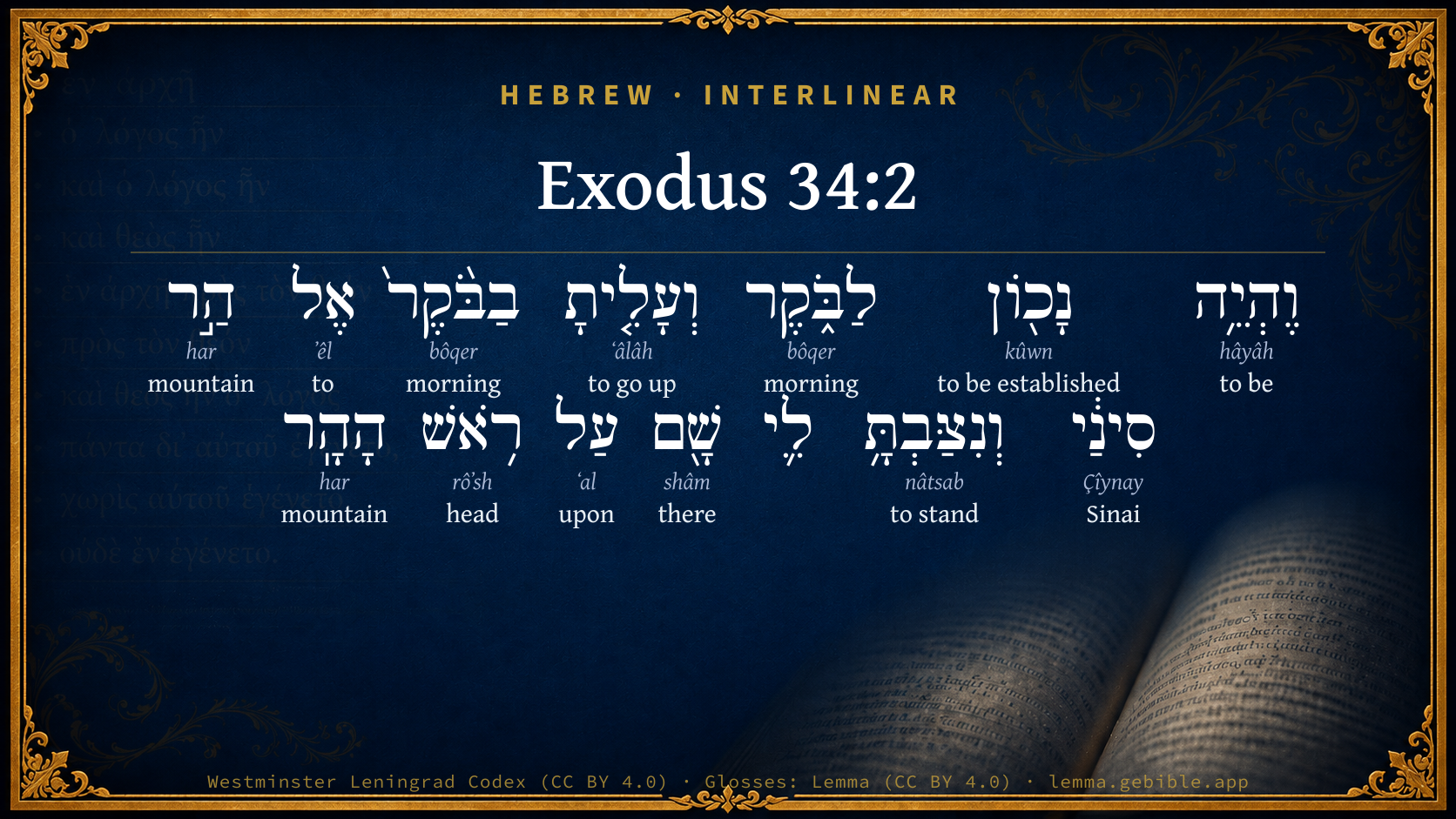
  1. וֶהְיֵ֥ה hâyâh H1961 “and · be” Conjunction + Verb, Qal, Imperative, 2nd Person, Masculine, Singular
  2. נָכ֖וֹן kûwn H3559 “being established” Verb, Niphal, Participle Active, Masculine, Singular, Absolute
  3. לַבֹּ֑קֶר bôqer H1242 “to/for the · morning” Preposition, Determined + Noun, Common, Masculine, Singular, Absolute
  4. וְעָלִ֤יתָ ʻâlâh H5927 “and · to go up” Conjunction + Verb, Qal, Perfect, 2nd Person, Masculine, Singular
  5. בַבֹּ֨קֶר֙ bôqer H1242 “in/at the · morning” Preposition, Determined + Noun, Common, Masculine, Singular, Absolute
  6. אֶל ʼêl H413 “to” Preposition
  7. הַ֣ר har H2022 “mountain of” Noun, Common, Masculine, Singular, Construct
  8. וְנִצַּבְתָּ֥ nâtsab H5324 “and · to stand” Conjunction + Verb, Niphal, Perfect, 2nd Person, Masculine, Singular
  9. שָׁ֖ם shâm H8033 “there” Adverb
  10. עַל ʻal H5921 “upon” Preposition
  11. רֹ֥אשׁ rôʼsh H7218 “head of” Noun, Common, Masculine, Singular, Construct
  12. הָהָֽר har H2022 “the · mountain” Particle, Definite Article + Noun, Common, Masculine, Singular, Absolute

About this verse

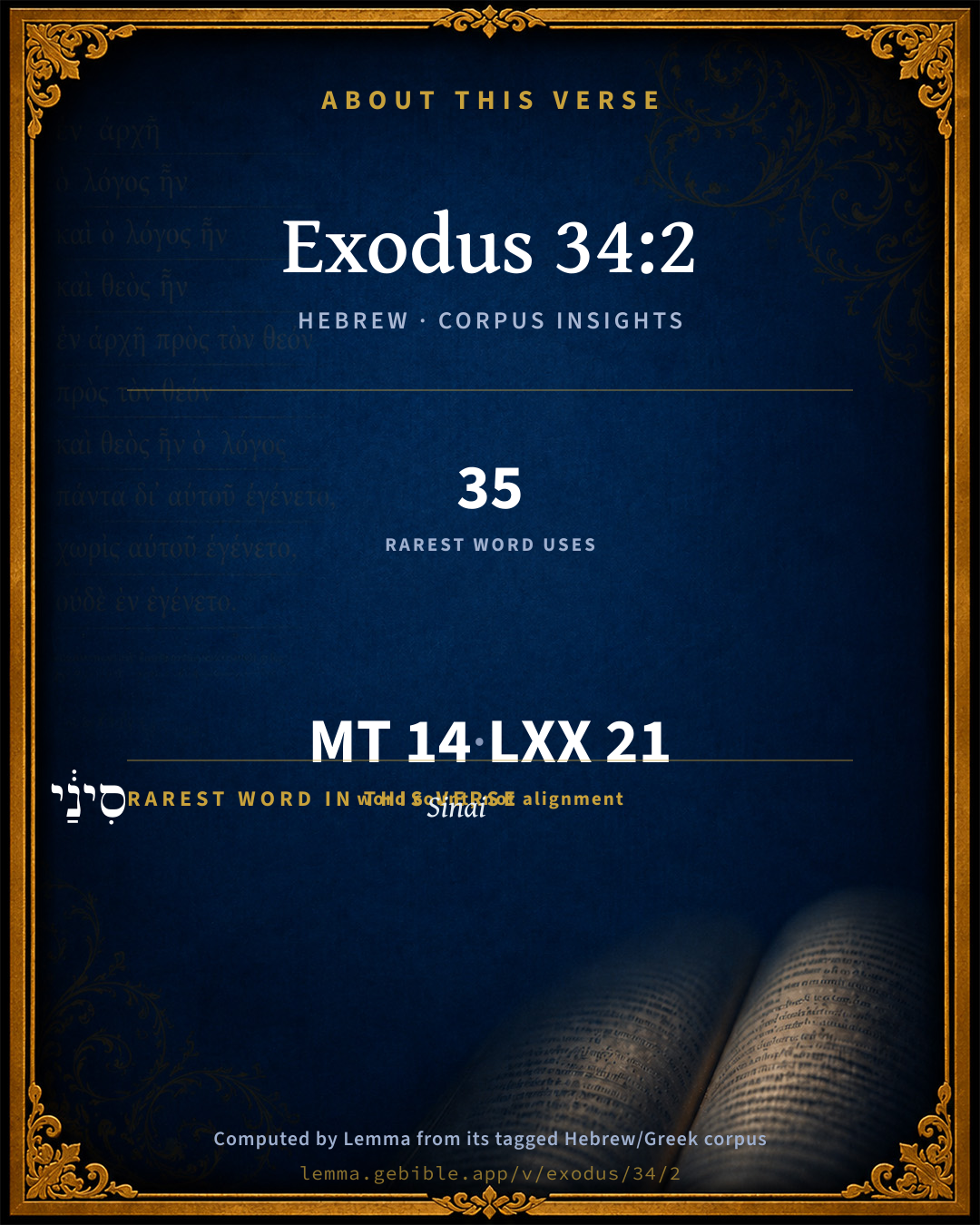
These counts appear in no published source. They are computed here, from the morphology-tagged text and Lemma’s own curated glosses. What Lemma adds →

14
words
11
distinct lemmas
Pentateuch
section

Shared distinctive vocabulary

סִינַ֔י Sinai H5514 occurs in 34 verses of the Hebrew Bible. Also found in:

Grammatical profile

  • 4 verbs
  • 6 nouns
  • 3 prepositions
  • 1 adverb

Verb forms

  • וֶהְיֵ֥ה Qal · Imperative
  • נָכ֖וֹן Niphal · Participle Active
  • וְעָלִ֤יתָ Qal · Perfect
  • וְנִצַּבְתָּ֥ Niphal · Perfect

Repetition

Words recur within this verse — often emphatic in Hebrew:

  • לַבֹּ֑קֶר morning H1242 ×2
  • הַ֣ר mountain H2022 ×2

Hebrew & Septuagint length

In English translation the verse runs 26 words from the Hebrew and 27 from the Septuagint (LXX English) — closely comparable.

A rough comparison of the two English renderings, which tokenize alike — not a word-level alignment.

Word counts can differ between the Hebrew and the Greek without any difference in meaning — e.g. the Hebrew direct-object marker אֵת has no separate Greek word, and Greek often adds the article ὁ.

In the original languages it is 14 Hebrew tokens and 21 Greek tokens — but the two are counted differently (Hebrew bundles its prefixes and suffixes into one token; the Greek is in lemma form), so that isn’t a like-for-like length.

Cross-references

5

Topical passages linked to Exodus 34:2 in the Treasury of Scripture Knowledge — connected by theme and wording, ordered by reader-vote popularity; previews shown in the World English Bible.

  • Exodus 19:20 Yahweh came down on Mount Sinai, to the top of the mountain. Yahweh called Moses to the top of the mountain, and Moses went up.
  • Exodus 19:11 and be ready against the third day; for on the third day Yahweh will come down in the sight of all the people on Mount Sinai.
  • Deuteronomy 9:25 So I fell down before Yahweh the forty days and forty nights that I fell down, because Yahweh had said he would destroy you.
  • Exodus 19:24 Yahweh said to him, "Go down and you shall bring Aaron up with you, but don't let the priests and the people break through to come up to Yahweh, lest he break forth on them."
  • Exodus 24:12 Yahweh said to Moses, "Come up to me on the mountain, and stay here, and I will give you the tables of stone with the law and the commands that I have written, that you may teach them."

Cross-references courtesy of OpenBible.info (CC BY 4.0).

Hebrew and Greek witnesses Masoretic Hebrew ↔ Greek Septuagint

The same verse in the two great witnesses to the Old Testament, shown verse-for-verse.

These are two independent witnesses, not word-aligned to each other, and the Septuagint is shown in lemma (dictionary) form.

Hebrew Exodus 34:2 Masoretic · Westminster Leningrad Codex

וֶהְיֵ֥ה נָכ֖וֹן לַבֹּ֑קֶר וְעָלִ֤יתָ בַבֹּ֨קֶר֙ אֶל הַ֣ר סִינַ֔י וְנִצַּבְתָּ֥ לִ֛י שָׁ֖ם עַל רֹ֥אשׁ הָהָֽר

Be ready by the morning, and come up in the morning to Mount Sinai, and present yourself there to me on the top of the mountain.

World English Bible · Public Domain

Greek LXX Exodus 34:2 Septuagint · lemma form

καί γίγνομαι ἕτοιμος εἰς ὁ πρωΐ καί ἀναβαίνω ἐπί ὁ ὄρος ὁ σινα καί ἵστημι ἐγώ ἐκεῖ ἐπί ἄκρος ὁ ὄρος

And be ready by the morning, and you shall go up to the mount Sina, and shall stand there for me on the top of the mountain.

LXX2012 (modern English Septuagint) · Public Domain

Hebrew: Westminster Leningrad Codex (CC BY 4.0). Greek: Septuagint (public domain); English from LXX2012 (modern English Septuagint) (Public Domain). How the Septuagint differs from the Hebrew →

Targum (Aramaic paraphrase)

2

The Targum is the ancient Jewish Aramaic paraphrase of the Hebrew Scriptures — an interpretive translation, not the Hebrew text itself. Onkelos (literal) and Pseudo-Jonathan (expansive) render the Torah, and Jonathan the Prophets. Coverage is partial: where no permissively-licensed English translation exists for a verse, only the Aramaic is shown. This is verse-level text, not a word-by-word alignment to the Hebrew.

  1. Targum Onkelos Torah (Genesis–Deuteronomy)
    וֶהֱוֵי זַמִין לְצַפְרָא וְתִסַק בְּצַפְרָא לְטוּרָא דְסִינַי וְתִתְעַתַּד קֳדָמַי תַּמָן עַל רֵישׁ טוּרָא:

    (no public-domain English translation for this verse)

    Targum Onkelos — Aramaic: “Onkelos Genesis” (public domain); “Onkelos Exodus” (public domain); “Onkelos Leviticus” (public domain); “Onkelos Numbers” (public domain); “Onkelos Deuteronomy” (public domain). English: “Sefaria Community Translation” (CC0 1.0 (public-domain dedication)); “J.W. Etheridge. The Targums of Onkelos and Jonathan Ben Uzziel on the Pentateuch. London: Longmans, Green, 1862” (public domain). Text via Sefaria.

  2. Targum Pseudo-Jonathan Torah (Genesis–Deuteronomy)
    וַהֲוֵי זַמִין לְצַפְרָא וְתִיסוֹק לְצַפְרָא לְטַוְורָא דְסִינַי וְתִתְעַתַּד קֳדָמַי תַּמָּן עַל רֵישׁ טוּרָא

    and be ready in the morn; and at morning ascend thou Mount Sinai and stand there before Me on the summit of the mountain.

    Targum Pseudo-Jonathan — Aramaic: “Targum Jonathan on Genesis” (public domain); “Targum Jonathan on Exodus” (public domain); “Targum Jonathan on Leviticus” (public domain); “Targum Jonathan on Numbers” (public domain); “Targum Jonathan on Deuteronomy” (public domain). English: “The Targum of Jonathan ben Uzziel, trans. J. W. Etheridge, London, 1862” (public domain). Text via Sefaria.

Commentary

Notes on Exodus 34:2 from classic Christian and Jewish commentators (each source and its license shown beneath its notes). The classic Christian expositions comment on the surrounding passage and are grouped to its opening verse, so a note may address several verses; the Jewish commentaries on the Tanakh (Rashi and others) are per-verse, so they appear only where the commentator wrote on this verse.

Lemma curates 59 commentaries, every one of them public domain or Creative Commons licensed, each selected and text-cleaned for this edition rather than reprinted as found. About our sources →

Trapp's Complete Commentary

John Trapp

Exo 34:2 And be ready in the morning, and come up in the morning unto mount Sinai, and present thyself there to me in the top of the mount.

Ver. 2. In the morning.] A sign of mercy. {Psa 90:14; Psa 30:5; Psa 5:3}

John Trapp, A Commentary or Exposition upon All the Books of the Old and New Testament (1647–1656) — public domain. Text from a community e-Sword module.

The Biblical Illustrator

Joseph S. Exell

Exo_34:2-3

Come up in the morning.

Be ready in the morning: an address for New Years eve

I. Be ready for a conscious contact with God in the future.

1. As a duty.

2. As a privilege. In Thy presence is fulness of joy.

3. As a calamity. The hell of the guilty.

II. Be ready for a conscious isolation of your being in the future. No man shall come up with thee.

1. There are events which will give us a profound consciousness of isolation.

(1) Bereavements.

(2) Personal affliction.

(3) Death.

2. There are mental operations that will give us a profound consciousness of isolation. Remembranee of past sins, etc. (Homilist.)

Morning on the mount

I. God wishes me to be alone with Him. How solemn will the meeting be! Father and child; Sovereign and subject; Creator and creature! The distance between us will be infinite, unless He shorten it by His mercy! Oh, my poor broken and weary heart, think of it and be glad. He will shed His light upon thy tears, and make them shine like jewels; He will make thee young again.

II. How shall i go before God? In what robe shall I dress myself? All the fitness He requires is to feel my need of Him. But when I think of Him the thought of my great sin comes at the same time, and it is like a black cloud spread between me and the sun. When I think of anything else, I am happy for the moment; but when I think of God, I burn with shame and tremble with fear. This morning I must meet Him on the mount--meet Him alone! Alone! Surely He need not have said expressly so; for to be with God is to be in solitude, though the mountain be alive with countless travellers.

III. God asks me to meet Him in the top of the mount. I am called to climb as far away from the world as I can. For many a day I have not seen the top of the mount. I have stood on the plain, or I have gone to the first cleft, or have tried a short way up the steep. I have not risen above the smoke of my own house, or the noise of my daily business. Oh, that I might urge my way to the very top of the hill chosen of God! What must it be to be there? The wind will be music. Earth and time will be seen as they are, in their littleness and their meanness.

IV. The morning is the time fixed for my meeting the Lord. What meaning there is in the time as well as in the place! This very word morning is as a cluster of rich grapes. Let me crush them, and drink the sacred wine. In the morning--then God means me to be at my best in strength and hope; I have not to climb in my weakness; in the night I have buried yesterdays fatigue, and in the morning I take a new lease of energy. Give God thy strength--all thy strength; He asks only what He first gave. In the morning--then He may mean to keep me long that He may make me rich! Blessed is the day whose morning is sanctified. Successful is the day whose first victory was won in prayer. Health is established in the morning. Wealth is won in the morning. (J. Parker, D. D.)

Rising early for prayer

We have a saying among us, that the morning is a friend to the muses; that is, the morning is a good studying time. I am sure it is as true that the morning is a great friend to the graces; the morning is the best praying time. (J. Caryl.)

Rising early for devotional exercises

It is told in Sir Henry Havelocks Life, how he always secured two hours for devotion before the business of the day began, even in his busiest time, by rising at five or four, as required . . . Colonel Gardiner had the same habit. Early rising for the objects of this world is usual enough, and much to be commended; but the same industry that will advance a mans temporal interests will make him spiritually rich, and give him great treasure in heaven, if it be used towards God . . . On the contrary, late rising in the morning, rapid dressing, curtailing even the few moments allotted to thanksgiving and prayer, before the plunge into the worlds affairs, deafens our ears and hearts to things spiritual; we exchange an interview with our God, who can give us all good, for the miserable gratification of our indolence.

Meriting prayer

Let the day have a blessed baptism by giving your first waking thoughts into the bosom of God. The first hour of the morning is the rudder of the day. (H. W. Beecher.)

The Biblical Illustrator, edited by Joseph S. Exell (c. 1880s–1900s) — public domain. Text from a community e-Sword module.

Geneva Bible (1599)

Geneva Bible translators

Hebrew, stand to me.

Geneva Bible (1599) marginal notes — public domain. Text via Bolls.life.

Jamieson, Fausset & Brown

Robert Jamieson, A. R. Fausset & David Brown

present thyself . . . to me in the top of the mount--Not absolutely the highest peak; for as the cloud of the Shekinah usually abode on the summit, and yet (Exo 34:5) it "descended," the plain inference is that Moses was to station himself at a point not far distant, but still below the loftiest pinnacle.

Jamieson, Fausset & Brown — Commentary Critical and Explanatory on the Whole Bible (1871) — public domain (CC PDM 1.0). Text via the HelloAO Bible API.

Ellicott's Commentary for English Readers

(2) Be ready in the morning.—It was necessary to allow an interval for the hewing of the stones.

In the top of the mount—i.e., in the same place as before. (Comp. Exo_19:20; Exo_24:12; Exo_24:18.)

A Bible Commentary for English Readers, edited by Charles John Ellicott (1878–1897) — public domain. Text from a community e-Sword module.

The Cambridge Bible for Schools and Colleges

gen. ed. J. J. S. Perowne

2. be ready] Cf. Exo_19:10.

station thyself for me] The same word as in Exo_33:21.

the top of the mount] Exo_19:20, Exo_24:17.

The Cambridge Bible for Schools and Colleges (gen. ed. J. J. S. Perowne; Cambridge University Press, 1878–1918) — public domain. Text from a community e-Sword module.

John Gill's Exposition

And be ready in the morning,.... This was, according to the Jewish chronology (e), on the twenty eighth day of the month Ab or July:

and come up in the morning unto Mount Sinai; the same mount where he had been before:

and present thyself there to me on the top of the mount; where the pillar of cloud removed and stood, and near it Moses was to stand and wait to hear what would be said unto him, and to see what would be made to pass before him.

(e) Seder Olam Rabba, c. 6. p. 19.

John Gill's Exposition of the Whole Bible (1746–1763) — public domain (CC PDM 1.0). Text via the HelloAO Bible API.

Haydock's Catholic Bible Commentary

Go up. From these expressions we might infer, that God gave the order first on Mount Sinai, and repeated it to Moses in the tabernacle, the night before he commenced his third fast and supplication of 40 days. (Haydock) --- After the first tables were broken, others were given; so after baptism we may obtain remission of sin by penance. (St. Jerome, ad Dem.) (Worthington)

George Leo Haydock (1774–1849), Haydock's Catholic Family Bible and Commentary, 1859 edition — public domain. Excludes Psalms (Douay-Rheims chapter numbering differs from Protestant) and Deuterocanonical books (Catholic canon only).

The Pulpit Commentary

Be ready in the morning. An interval was required for the hewing of the tables. It was made as short as possible. In the top of the mount. Where he had been with God previously. (Exo_19:20 Exo_24:12, Exo_24:18)

The Pulpit Commentary (1880–1919), ed. H.D.M. Spence-Jones & Joseph S. Exell — public domain. Text from a community e-Sword module.

Rashi

Rabbi Shlomo Yitzchaki (Rashi)

נכון means PREPARED.

Rashi on the Tanakh — English translations: “The Judaica Press complete Tanach with Rashi, translated by A. J. Rosenberg” (CC BY 4.0); “Pentateuch with Rashi's commentary by M. Rosenbaum and A.M. Silbermann, 1929-1934” (public domain); “The Metsudah Tanach series, Lakewood, N.J” (CC BY 4.0); and “The Book of Joshua, Metsudah Publications, 1997” (CC BY 4.0). Text via Sefaria.

Lesson kit

Teaching starters — assembled from the data on this page, not authored interpretation. Every prompt links to the verse data it draws on. Edit before teaching.

Exodus, in the Pentateuch, opens this verse with 14 words (11 distinct Hebrew lemmas). Its most distinctive word is Çîynay (“Sinai”). A historical commentator’s framing appears above. Read the whole chapter for the surrounding context.

Discussion questions

  1. How does “Sinai” (Çîynay) shape what this verse is saying?
  2. How does Exodus 16:1, which shares the word «Sinai», read alongside this verse?
  3. What does the repetition of “morning” (2× in this one verse) do in this verse?
  4. These translations render this verse differently; the difference is in the English rendering, not the original. What questions does that raise?
  5. «וֶהְיֵ֥ה» is a Qal Imperative verb. How does that grammatical form shape the action described?
  6. Compare how Trapp's Complete Commentary and The Biblical Illustrator read this verse. Where do they agree or differ?

Things to notice

Reading settings

Reading text

Shown beneath each verse's original-language words.

Old Testament
Old Testament edition

Read the OT as the Masoretic Hebrew (MT) or the Greek Septuagint (LXX).

English shown for the Greek Septuagint (in the Hebrew ↔ Greek comparison).

Comparing translations? Open the Compare panel on any verse page to stack up to four side by side.