Genesis 44:34

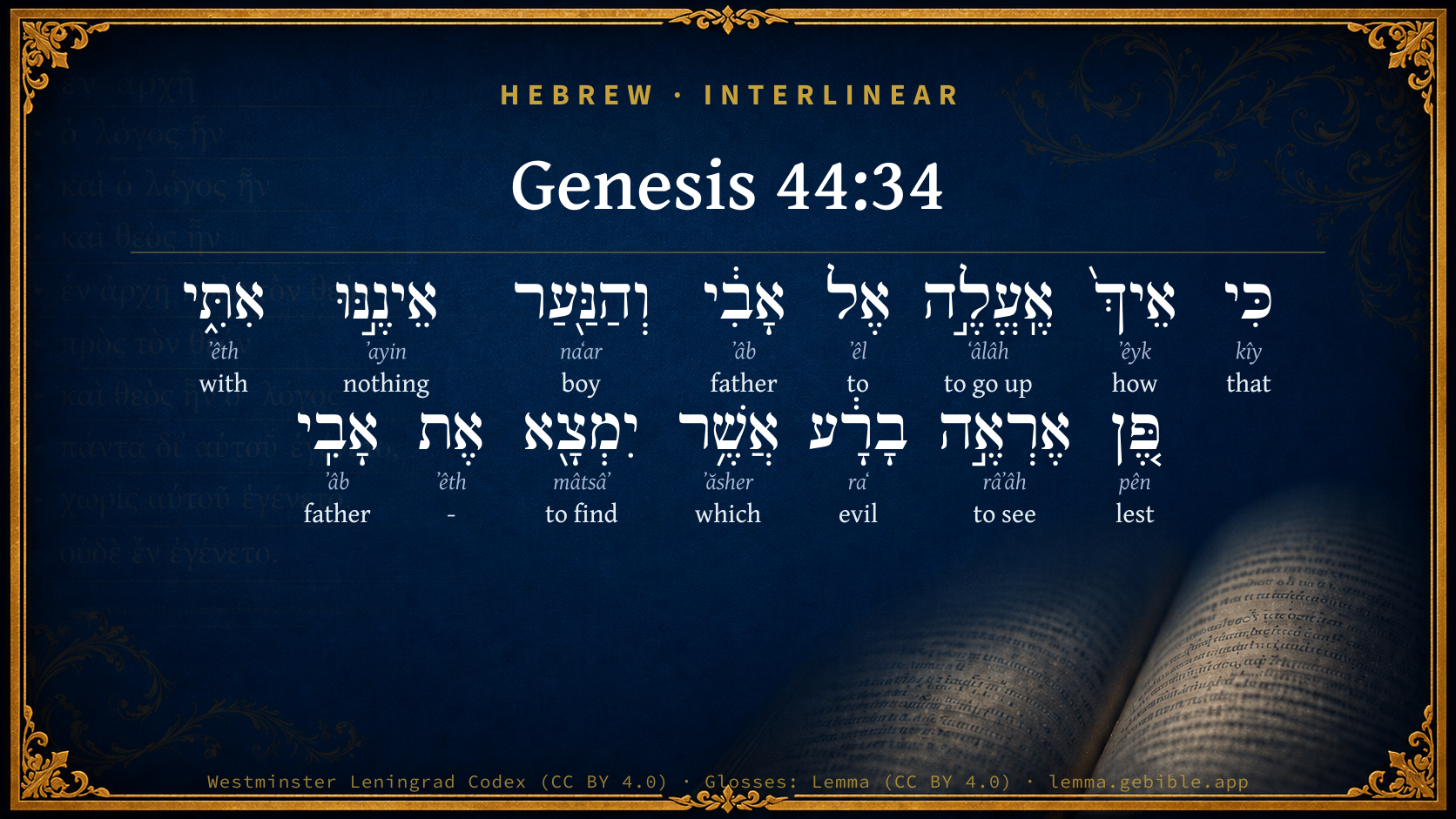
Hebrew (Westminster Leningrad Codex) Genesis 44:34 appears in the Hebrew Old Testament. The text above is from the Westminster Leningrad Codex. Each word links to its Strong’s number, a concise gloss, and parsing drawn from the Open Scriptures Hebrew Bible morphology. Click any word for its full Brown-Driver-Briggs (BDB) entry.
Download image
Cite this verse

Genesis 44:34 (World English Bible). Public Domain. Lemma interlinear Bible study tool, https://lemma.gebible.app/v/genesis/44/34.

Show BibTeX & RIS
BibTeX
RIS
English Translation
For how will I go up to my father, if the boy isn't with me? Lest I see the evil that will come on my father."
World English Bible · Public Domain
Download a study sheet

One document with this verse’s original text, its word-by-word gloss line, the meaning frame, cross-references with their text, attributed commentary, and full source and license credits — printable, and it pastes into notes with its structure intact.

This verse Autodidact and up

Study sheet (.html) Plain text (.txt)

A passage Seminary Student

Up to 50 verses in one chapter. A passage sheet keeps up to 6 commentary sources and 12 cross-references per verse, in the order this page ranks them, and says so on the sheet whenever that leaves anything out. Ask for a single verse and you get the Autodidact verse sheet above.

Everything on this page stays free to read, with no account — the sheet is a download of what is already on screen, not access to it.

Want to remove ads? Support Godless Engineer
Compare translations 3

The same verse in 3 English versions, stacked beneath the original-language interlinear above. Click any original word for its lexicon entry.

Each is an independent rendering of the whole verse — the interlinear is not word-aligned to these translations.

Highlighted words mark where these versions differ — a whole-verse word diff, not a word-by-word alignment.

  • World English Bible Public Domain
    For how will I go up to my father, if the boy isn't with me? Lest I see the evil that will come on my father."
  • King James Version Public Domain
    For how shall I go up to my father, and the lad be not with me? lest peradventure I see the evil that shall come on my father.
  • unfoldingWord Literal Text CC BY-SA 4.0
    For how will I go up to my father if the young man is not with me? I fear to see the misery that would find my father!”

unfoldingWord Literal Text — © unfoldingWord, licensed CC BY-SA 4.0. Word-aligned USFM3 via Door43 (git.door43.org/unfoldingWord/en_ult).

Versions to compare (up to 4)

3 of 4 selected

Show all 18 translations

Every available English version of this verse, each an independent rendering of the whole verse.

  • World English Bible Public Domain
    For how will I go up to my father, if the boy isn't with me? Lest I see the evil that will come on my father."
  • Berean Standard Bible Public Domain
    For how can I go back to my father without the boy? I could not bear to see the misery that would overwhelm him.”
  • Majority Standard Bible Public Domain
    For how can I go back to my father without the boy? I could not bear to see the misery that would overwhelm him.”
  • King James Version Public Domain
    For how shall I go up to my father, and the lad be not with me? lest peradventure I see the evil that shall come on my father.
  • American Standard Version (1901) Public Domain
    For how shall I go up to my father, if the lad be not with me? lest I see the evil that shall come on my father.
  • Revised Version (1885) Public Domain
    For how shall I go up to my father, and the lad be not with me? lest I see the evil that shall come on my father.
  • Geneva Bible (1599) Public Domain
    For how can I go vp to my father, if the childe be not with me, vnlesse I woulde see the euil that shall come on my father?
  • Douay-Rheims (1899) Public Domain
    For I cannot return to my father without the boy, lest I be a witness of the calamity that will oppress my father.
  • Young's Literal Translation Public Domain
    for how do I go up unto my father, and the youth not with me? lest I look on the evil which doth find my father.'
  • Literal Standard Version CC BY-SA 4.0
    for how do I go up to my father, and the youth not with me? Lest I look on the evil which finds my father.”
  • Unlocked Literal Bible CC BY-SA 4.0
    For how can I go up to my father if the boy is not with me? I am afraid to see the evil that would come on my father.”
  • unfoldingWord Literal Text CC BY-SA 4.0
    For how will I go up to my father if the young man is not with me? I fear to see the misery that would find my father!”
  • Darby Bible Public Domain
    for how should I go up to my father if the lad were not with me? -- lest I see the evil that would come on my father.
  • World Messianic Bible Public Domain
    For how will I go up to my father, if the boy isn’t with me?—lest I see the evil that will come on my father.”
  • Webster's Bible Public Domain
    For how shall I return to my father, and the lad be not with me? lest perhaps I see the evil that shall come on my father.
  • Free Bible Version CC BY-SA 4.0
    For how could I ever go back to my father if the boy wasn't with me? I couldn't stand seeing the anguish that would cause my father.”
  • Bible in Basic English Public Domain
    For how may I go back to my father without the boy, and see the evil which will come on my father?
  • JPS Tanakh (1917) Public Domain
    For how shall I go up to my father, if the lad be not with me? lest I look upon the evil that shall come on my father.'

Literal Standard Version (2020), Covenant Press — licensed CC BY-SA 4.0. Text via the HelloAO Bible API (eBible.org). Unlocked Literal Bible (unfoldingWord) — licensed CC BY-SA 4.0. Text via the HelloAO Bible API (eBible.org). unfoldingWord Literal Text — © unfoldingWord, licensed CC BY-SA 4.0. Word-aligned USFM3 via Door43 (git.door43.org/unfoldingWord/en_ult). Free Bible Version, Dr. Jonathan Gallagher — licensed CC BY-SA 4.0. Text via the HelloAO Bible API (eBible.org).

Word by word

More ways to search: Search by grammar → Find every occurrence → Compare this word →

Practice this passage: Drill this verse → Learn its vocabulary →

אֵיךְ֙
ʼêyk
H349
“how”
Particle, Interrogative
Part of Speech
Particle
Type
Interrogative
Full BDB Definition

Origin: prolonged from H335

TWOT: 75

how? (interrogative adverb) - how! (in lamentation) (interjection) - expression of satisfaction (interjection)
  1. כִּי kîy H3588 “that” Conjunction
  2. אֶֽעֱלֶ֣ה ʻâlâh H5927 “to go up” Verb, Qal, Imperfect, 1st Person, Common, Singular
  3. אֶל ʼêl H413 “to” Preposition
  4. אָבִ֔י ʼâb H1 “father · my” Noun, Common, Masculine, Singular, Construct + Suffix, Personal, 1st Person, Common, Singular
  5. וְהַנַּ֖עַר naʻar H5288 “and · the · boy” Conjunction + Particle, Definite Article + Noun, Common, Masculine, Singular, Absolute
  6. אֵינֶ֣נּוּ ʼayin H369 “nothing · him” Particle, Negative + Suffix, Personal, 3rd Person, Masculine, Singular
  7. אִתִּ֑י ʼêth H854 “with · me” Preposition + Suffix, Personal, 1st Person, Common, Singular
  8. פֶּ֚ן pên H6435 “lest” Conjunction
  9. אֶרְאֶ֣ה râʼâh H7200 “to see” Verb, Qal, Imperfect, 1st Person, Common, Singular
  10. בָרָ֔ע raʻ H7451 “in/at the · evil” Preposition, Determined + Adjective, Adjective, Masculine, Singular, Absolute
  11. אֲשֶׁ֥ר ʼăsher H834 “which” Particle, Relative
  12. יִמְצָ֖א mâtsâʼ H4672 “to find” Verb, Qal, Imperfect, 3rd Person, Masculine, Singular
  13. אֶת ʼêth H853 “-” Particle, Direct Object
  14. אָבִֽי ʼâb H1 “father · my” Noun, Common, Masculine, Singular, Construct + Suffix, Personal, 1st Person, Common, Singular

About this verse

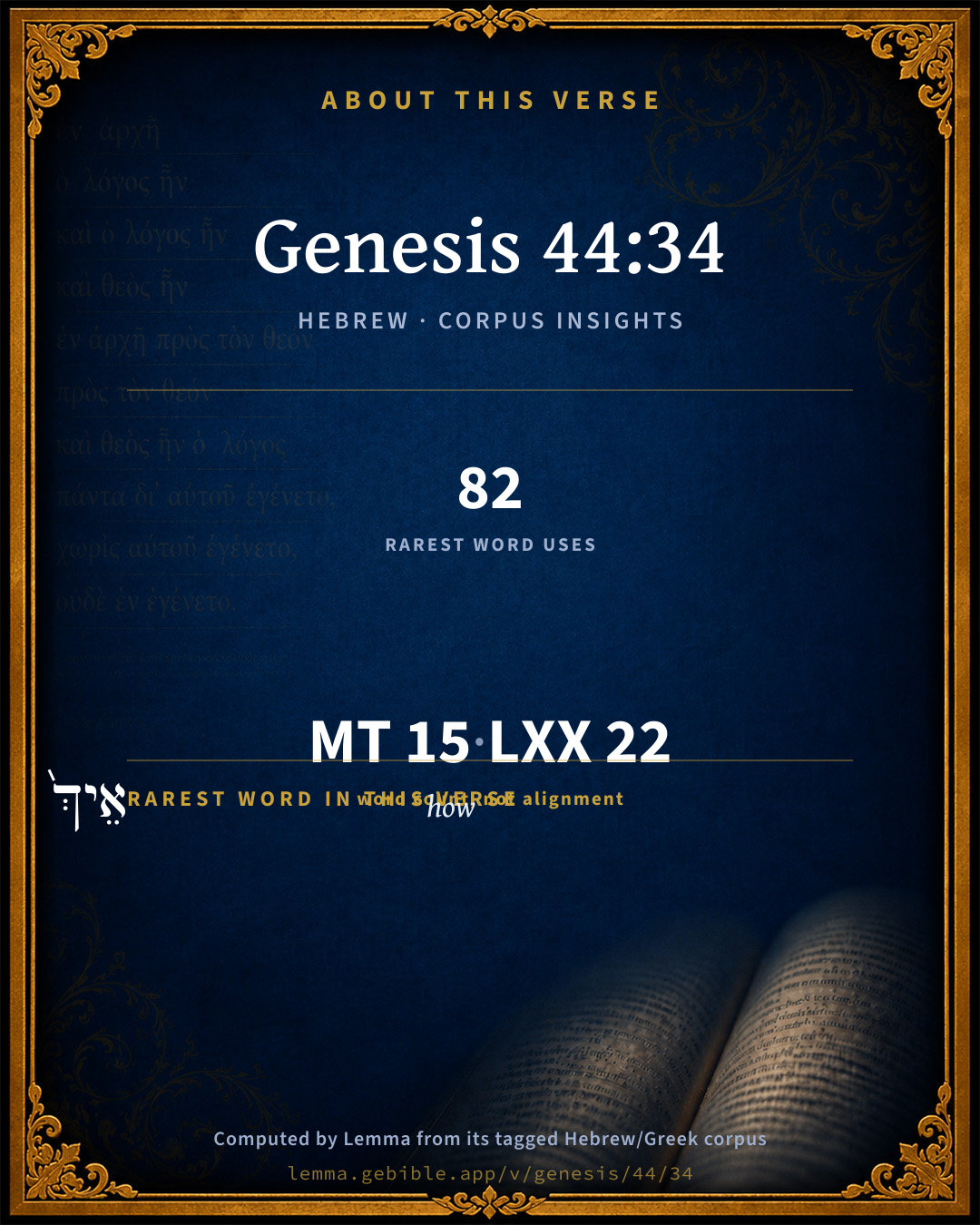
These counts appear in no published source. They are computed here, from the morphology-tagged text and Lemma’s own curated glosses. What Lemma adds →

15
words
14
distinct lemmas
Pentateuch
section

Grammatical profile

  • 3 verbs
  • 3 nouns
  • 1 adjective
  • 2 prepositions
  • 2 conjunctions
  • 4 particles

Verb forms

  • אֶֽעֱלֶ֣ה Qal · Imperfect
  • אֶרְאֶ֣ה Qal · Imperfect
  • יִמְצָ֖א Qal · Imperfect

Repetition

A word recurs within this verse — often emphatic in Hebrew:

  • אָבִ֔י father H1 ×2

Hebrew & Septuagint length

In English translation the verse runs 26 words from the Hebrew and 25 from the Septuagint (LXX English) — closely comparable.

A rough comparison of the two English renderings, which tokenize alike — not a word-level alignment.

Word counts can differ between the Hebrew and the Greek without any difference in meaning — e.g. the Hebrew direct-object marker אֵת has no separate Greek word, and Greek often adds the article ὁ.

In the original languages it is 15 Hebrew tokens and 22 Greek tokens — but the two are counted differently (Hebrew bundles its prefixes and suffixes into one token; the Greek is in lemma form), so that isn’t a like-for-like length.

Cross-references

8

Topical passages linked to Genesis 44:34 in the Treasury of Scripture Knowledge — connected by theme and wording, ordered by reader-vote popularity; previews shown in the World English Bible.

  • Esther 8:6 for how can I endure to see the evil that shall come to my people? or how can I endure to see the destruction of my relatives?
  • Exodus 18:8 Moses told his father-in-law all that Yahweh had done to Pharaoh and to the Egyptians for Israel's sake, all the hardships that had come on them on the way, and how Yahweh delivered them.
  • 1 Samuel 2:33–34 The man of yours, [whom] I shall not cut off from my altar, [shall be] to consume your eyes, and to grieve your heart; and all the increase of your house shall die in the flower of their age.
  • 2 Chronicles 34:28 Behold, I will gather you to your fathers, and you shall be gathered to your grave in peace, neither shall your eyes see all the evil that I will bring on this place, and on the inhabitants of it. They brought back word to the king.
  • Job 31:29 "If I have rejoiced at the destruction of him who hated me, Or lifted up myself when evil found him;
  • Psalms 116:3 The cords of death surrounded me, The pains of Sheol got a hold of me. I found trouble and sorrow.
  • Psalms 119:143 Trouble and anguish have taken hold of me. Your commandments are my delight.
  • Jeremiah 52:10–11 The king of Babylon killed the sons of Zedekiah before his eyes: he killed also all the princes of Judah in Riblah.

Cross-references courtesy of OpenBible.info (CC BY 4.0).

Hebrew and Greek witnesses Masoretic Hebrew ↔ Greek Septuagint

The same verse in the two great witnesses to the Old Testament, shown verse-for-verse.

These are two independent witnesses, not word-aligned to each other, and the Septuagint is shown in lemma (dictionary) form.

Hebrew Genesis 44:34 Masoretic · Westminster Leningrad Codex

כִּי אֵיךְ֙ אֶֽעֱלֶ֣ה אֶל אָבִ֔י וְהַנַּ֖עַר אֵינֶ֣נּוּ אִתִּ֑י פֶּ֚ן אֶרְאֶ֣ה בָרָ֔ע אֲשֶׁ֥ר יִמְצָ֖א אֶת אָבִֽי

For how will I go up to my father, if the boy isn't with me? Lest I see the evil that will come on my father."

World English Bible · Public Domain

Greek LXX Genesis 44:34 Septuagint · lemma form

πῶς γάρ ἀναβαίνω πρός ὁ πατήρ ὁ παιδίον μή εἰμί μετά ἐγώ ἵνα μή ὁράω ὁ κακός ὅς εὑρίσκω ὁ πατήρ ἐγώ

For how shall I go up to my father, the lad not being with us? lest I behold the evils which will befall my father.

LXX2012 (modern English Septuagint) · Public Domain

Hebrew: Westminster Leningrad Codex (CC BY 4.0). Greek: Septuagint (public domain); English from LXX2012 (modern English Septuagint) (Public Domain). How the Septuagint differs from the Hebrew →

Targum (Aramaic paraphrase)

2

The Targum is the ancient Jewish Aramaic paraphrase of the Hebrew Scriptures — an interpretive translation, not the Hebrew text itself. Onkelos (literal) and Pseudo-Jonathan (expansive) render the Torah, and Jonathan the Prophets. Coverage is partial: where no permissively-licensed English translation exists for a verse, only the Aramaic is shown. This is verse-level text, not a word-by-word alignment to the Hebrew.

  1. Targum Onkelos Torah (Genesis–Deuteronomy)
    אֲרֵי אֶכְדֵּין אֶסַּק לְוַת אַבָּא וְעוּלֵימָא לֵיתוֹהִי עִמִּי דִּלְמָא אֶחֱזֵי בְּבִישׁוּ דִּי יִשְׁכַּח יָת אַבָּא

    (no public-domain English translation for this verse)

    Targum Onkelos — Aramaic: “Onkelos Genesis” (public domain); “Onkelos Exodus” (public domain); “Onkelos Leviticus” (public domain); “Onkelos Numbers” (public domain); “Onkelos Deuteronomy” (public domain). English: “Sefaria Community Translation” (CC0 1.0 (public-domain dedication)); “J.W. Etheridge. The Targums of Onkelos and Jonathan Ben Uzziel on the Pentateuch. London: Longmans, Green, 1862” (public domain). Text via Sefaria.

  2. Targum Pseudo-Jonathan Torah (Genesis–Deuteronomy)
    אֲרוּם הֵיכְדֵין אֶסַק לְוַת אַבָּא וְטַלְיָא לֵיתוֹי עִמִי דִלְמָא אֶחֱמֵי בְּבִישְׁתָּא דְתִבְרַז יַת אַבָּא

    For how can I go up to my father, and the young man be not with us lest I behold the evil that will strike my father through!

    Targum Pseudo-Jonathan — Aramaic: “Targum Jonathan on Genesis” (public domain); “Targum Jonathan on Exodus” (public domain); “Targum Jonathan on Leviticus” (public domain); “Targum Jonathan on Numbers” (public domain); “Targum Jonathan on Deuteronomy” (public domain). English: “The Targum of Jonathan ben Uzziel, trans. J. W. Etheridge, London, 1862” (public domain). Text via Sefaria.

Commentary

Notes on Genesis 44:34 from classic Christian and Jewish commentators (each source and its license shown beneath its notes). The classic Christian expositions comment on the surrounding passage and are grouped to its opening verse, so a note may address several verses; the Jewish commentaries on the Tanakh (Rashi and others) are per-verse, so they appear only where the commentator wrote on this verse.

Lemma curates 59 commentaries, every one of them public domain or Creative Commons licensed, each selected and text-cleaned for this edition rather than reprinted as found. About our sources →

Trapp's Complete Commentary

John Trapp

Gen 44:34 For how shall I go up to my father, and the lad [be] not with me? lest peradventure I see the evil that shall come on my father.

Ver. 34. For how shall I go up, &c.] Here love ascends, as fit it should. Judah, a man wise and well spoken, prefers his father’s life before his own liberty. He could not live to see the death of his aged father. A certain citizen of Toledo being condemned to die, his son ceased not with prayers and tears to entreat that he might be put to death instead of his father. This he obtained after much suit, and most gladly died for him. {a} At Gaunt in Flanders, when a father and his son were condemned to die together, the earl, desirous to make trial whether of the two were more loving, granted that he should live that would cut off the other’s head. And after much ado between them, the father, by many arguments, persuaded his son to be his executioner. {b}

{a} B. Fulgos, lib. v.

{b} Philip. Camerar., cent. i. cap. 92.

John Trapp, A Commentary or Exposition upon All the Books of the Old and New Testament (1647–1656) — public domain. Text from a community e-Sword module.

Geneva Bible (1599)

Geneva Bible translators

Meaning, he had rather remain their prisoner, than to return and see his father in heaviness.

Geneva Bible (1599) marginal notes — public domain. Text via Bolls.life.

John Gill's Exposition

For how shall I go up to my father, and the lad be not with me?.... Signifying that he must abide in Egypt, and chose to do it, and could not go up to the land of Canaan any more or see his father's face without Benjamin along with him, to whom he was a surety for him:

lest peradventure I see the evil that shall come on my father; see him die, or live a life of sorrow worse than death: this he could not bear, and chose rather to be a slave in Egypt, than to be the spectator of such an affecting scene. By this speech of Judah, Joseph plainly saw the great affection which his brethren, especially Judah, had for his father and his brother Benjamin, as well as the sense they had of their evil in selling him, which lay uppermost on their minds, and for which they thought themselves brought into all this trouble; wherefore he could no longer conceal himself from them, but makes himself known unto them, which is the principal subject of the following chapter.

Next: Genesis Chapter 45

John Gill's Exposition of the Whole Bible (1746–1763) — public domain (CC PDM 1.0). Text via the HelloAO Bible API.

Haydock's Catholic Bible Commentary

CHAPTER XLIV.

My father; who will drop down dead, oppressed with grief. How eloquent and pathetic was this address! Joseph could bear no more.

George Leo Haydock (1774–1849), Haydock's Catholic Family Bible and Commentary, 1859 edition — public domain. Excludes Psalms (Douay-Rheims chapter numbering differs from Protestant) and Deuterocanonical books (Catholic canon only).

Ramban (Nachmanides)

Rabbi Moshe ben Nachman (Ramban / Nachmanides)

He said, For how shall I go up to my father, in order to let him [Joseph] know that he [Judah] would choose to be a permanent servant rather than go up to his father without the lad for he could not bear to see his sorrow, as he would constantly weep and mourn for him all day. Judah mentioned this so that he should not suspect him of planning some deceit since he would know how to escape better than the lad.

Ramban (Nachmanides) on the Tanakh — English translation: “Commentary on the Torah by Ramban (Nachmanides). Translated and annotated by Charles B. Chavel. New York, Shilo Pub. House, 1971-1976” (CC BY 4.0). Text via Sefaria.

Lesson kit

Teaching starters — assembled from the data on this page, not authored interpretation. Every prompt links to the verse data it draws on. Edit before teaching.

Genesis, in the Pentateuch, opens this verse with 15 words (14 distinct Hebrew lemmas). Its most distinctive word is ʼêyk (“how”). A historical commentator’s framing appears above. Read the whole chapter for the surrounding context.

Discussion questions

  1. What does “how” (ʼêyk) contribute to the verse as a whole?
  2. How does Esther 8:6, which shares this passage’s theme, read alongside this verse?
  3. What does the repetition of “father” (2× in this one verse) do in this verse?
  4. The translations on this page render this verse differently — a whole-verse word diff, not a word-by-word alignment. What might account for the different wordings?
  5. «אֶֽעֱלֶ֣ה» is a Qal Imperfect verb. How does that grammatical form shape the action described?
  6. Compare how Trapp's Complete Commentary and Geneva Bible (1599) read this verse. Where do they agree or differ?

Things to notice

Reading settings

Reading text

Shown beneath each verse's original-language words.

Old Testament
Old Testament edition

Read the OT as the Masoretic Hebrew (MT) or the Greek Septuagint (LXX).

English shown for the Greek Septuagint (in the Hebrew ↔ Greek comparison).

Comparing translations? Open the Compare panel on any verse page to stack up to four side by side.