Genesis 32:26

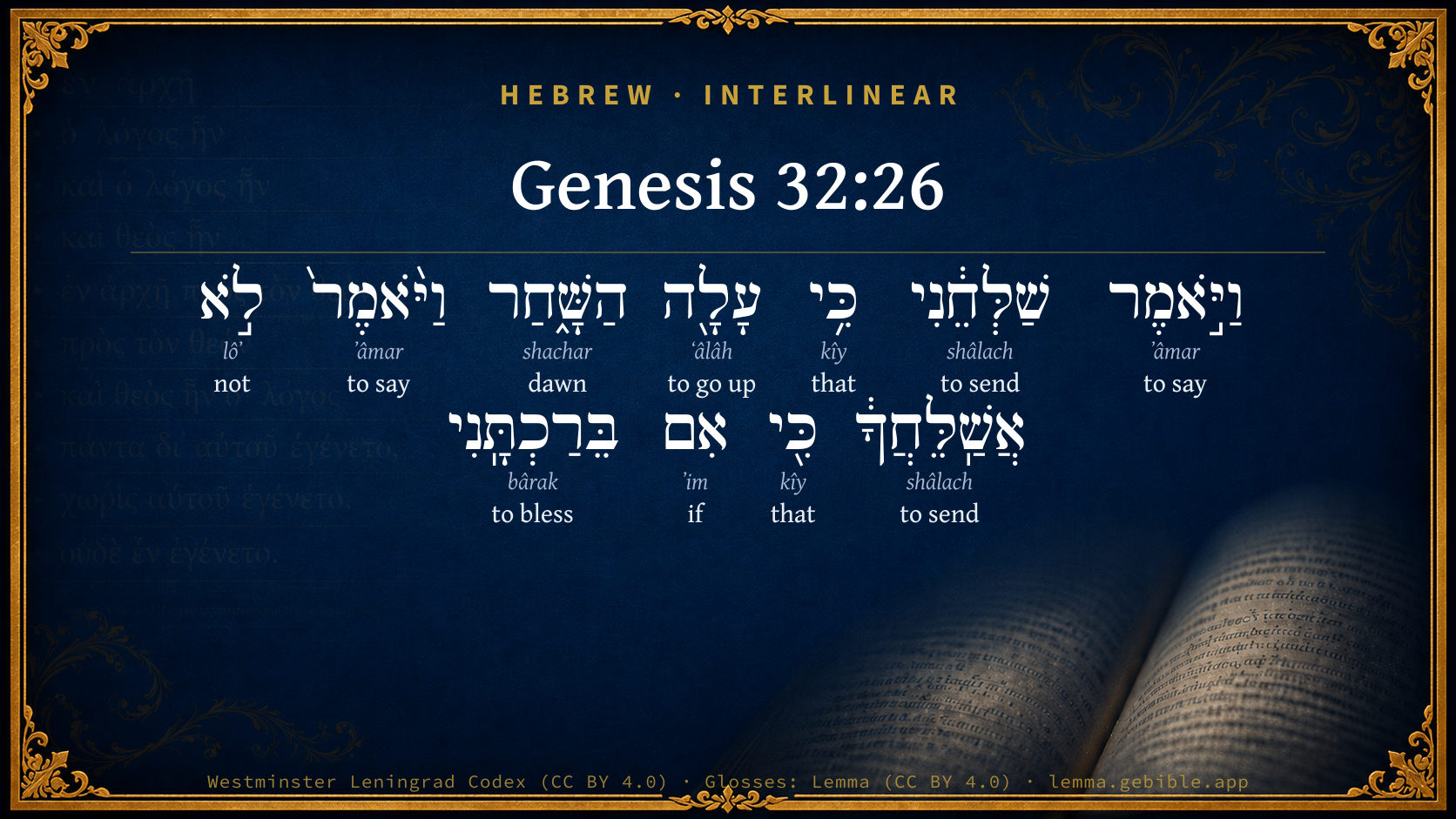
Hebrew (Westminster Leningrad Codex) Genesis 32:26 appears in the Hebrew Old Testament. The text above is from the Westminster Leningrad Codex. Each word links to its Strong’s number, a concise gloss, and parsing drawn from the Open Scriptures Hebrew Bible morphology. Click any word for its full Brown-Driver-Briggs (BDB) entry.
Download image
Cite this verse

Genesis 32:26 (World English Bible). Public Domain. Lemma interlinear Bible study tool, https://lemma.gebible.app/v/genesis/32/26.

Show BibTeX & RIS
BibTeX
RIS
English Translation
The man said, "Let me go, for the day breaks." Jacob said, "I won't let you go, unless you bless me."
World English Bible · Public Domain
Download a study sheet

One document with this verse’s original text, its word-by-word gloss line, the meaning frame, cross-references with their text, attributed commentary, and full source and license credits — printable, and it pastes into notes with its structure intact.

This verse Autodidact and up

Study sheet (.html) Plain text (.txt)

A passage Seminary Student

Up to 50 verses in one chapter. A passage sheet keeps up to 6 commentary sources and 12 cross-references per verse, in the order this page ranks them, and says so on the sheet whenever that leaves anything out. Ask for a single verse and you get the Autodidact verse sheet above.

Everything on this page stays free to read, with no account — the sheet is a download of what is already on screen, not access to it.

Want to remove ads? Support Godless Engineer
Compare translations 3

The same verse in 3 English versions, stacked beneath the original-language interlinear above. Click any original word for its lexicon entry.

Each is an independent rendering of the whole verse — the interlinear is not word-aligned to these translations.

Highlighted words mark where these versions differ — a whole-verse word diff, not a word-by-word alignment.

  • World English Bible Public Domain
    The man said, "Let me go, for the day breaks." Jacob said, "I won't let you go, unless you bless me."
  • King James Version Public Domain
    And he said, Let me go, for the day breaketh. And he said, I will not let thee go, except thou bless me.
  • unfoldingWord Literal Text CC BY-SA 4.0
    Then he said, “Release me, because the dawn has come up!” But he said, “I will not release you unless you bless me!”

unfoldingWord Literal Text — © unfoldingWord, licensed CC BY-SA 4.0. Word-aligned USFM3 via Door43 (git.door43.org/unfoldingWord/en_ult).

Versions to compare (up to 4)

3 of 4 selected

Show all 18 translations

Every available English version of this verse, each an independent rendering of the whole verse.

  • World English Bible Public Domain
    The man said, "Let me go, for the day breaks." Jacob said, "I won't let you go, unless you bless me."
  • Berean Standard Bible Public Domain
    Then the man said, “Let me go, for it is daybreak.” But Jacob replied, “I will not let you go unless you bless me.”
  • Majority Standard Bible Public Domain
    Then the man said, “Let me go, for it is daybreak.” But Jacob replied, “I will not let you go unless you bless me.”
  • King James Version Public Domain
    And he said, Let me go, for the day breaketh. And he said, I will not let thee go, except thou bless me.
  • American Standard Version (1901) Public Domain
    And he said, Let me go, for the day breaketh. And he said, I will not let thee go, except thou bless me.
  • Revised Version (1885) Public Domain
    And he said, Let me go, for the day breaketh. And he said, I will not let thee go, except thou bless me.
  • Geneva Bible (1599) Public Domain
    And he saide, Let me goe, for the morning appeareth. Who answered, I will not let thee go except thou blesse me.
  • Douay-Rheims (1899) Public Domain
    And he said to him: Let me go, for it is break of day. He answered: I will not let thee go except thou bless me.
  • Young's Literal Translation Public Domain
    and he saith, `Send me away, for the dawn hath ascended:' and he saith, `I send thee not away, except thou hast blessed me.'
  • Literal Standard Version CC BY-SA 4.0
    and He says, “Send Me away, for the dawn has ascended”: and he says, “I do not send You away, except You have blessed me.”
  • Unlocked Literal Bible CC BY-SA 4.0
    The man said, “Let me go, for the dawn is breaking.” Jacob said, “I will not let you go unless you bless me.”
  • unfoldingWord Literal Text CC BY-SA 4.0
    Then he said, “Release me, because the dawn has come up!” But he said, “I will not release you unless you bless me!”
  • Darby Bible Public Domain
    And he said, Let me go, for the dawn ariseth. And he said, I will not let thee go except thou bless me.
  • World Messianic Bible Public Domain
    The man said, “Let me go, for the day breaks.” Jacob said, “I won’t let you go unless you bless me.”
  • Webster's Bible Public Domain
    And he said, Let me go, for the day breaketh; And he said, I will not let thee go, except thou bless me.
  • Free Bible Version CC BY-SA 4.0
    Then the man said, “Let me go because it's almost dawn.” “I won't let you go unless you bless me,” Jacob replied.
  • Bible in Basic English Public Domain
    And he said to him, Let me go now, for the dawn is near. But Jacob said, I will not let you go till you have given me your blessing.
  • JPS Tanakh (1917) Public Domain
    (32-27) And he said: 'Let me go, for the day breaketh.' And he said: 'I will not let thee go, except thou bless me.'

Literal Standard Version (2020), Covenant Press — licensed CC BY-SA 4.0. Text via the HelloAO Bible API (eBible.org). Unlocked Literal Bible (unfoldingWord) — licensed CC BY-SA 4.0. Text via the HelloAO Bible API (eBible.org). unfoldingWord Literal Text — © unfoldingWord, licensed CC BY-SA 4.0. Word-aligned USFM3 via Door43 (git.door43.org/unfoldingWord/en_ult). Free Bible Version, Dr. Jonathan Gallagher — licensed CC BY-SA 4.0. Text via the HelloAO Bible API (eBible.org).

Word by word

More ways to search: Search by grammar → Find every occurrence → Compare this word →

Practice this passage: Drill this verse → Learn its vocabulary →

הַשָּׁ֑חַר
shachar
H7837
“the · dawn”
Particle, Definite Article + Noun, Common, Masculine, Singular, Absolute
Part of Speech
Particle + Noun
Type
Common
Gender
Masculine
Number
Singular
State
Absolute
Full BDB Definition

Origin: from H7836

TWOT: 2369a

dawn - dawn - at dawn (as adverb)
  1. וַיֹּ֣אמֶר ʼâmar H559 “and · to say” Conjunction + Verb, Qal, Sequential Imperfect, 3rd Person, Masculine, Singular
  2. שַׁלְּחֵ֔נִי shâlach H7971 “send · me” Verb, Piel, Imperative, 2nd Person, Masculine, Singular + Suffix, Personal, 1st Person, Common, Singular
  3. כִּ֥י kîy H3588 “that” Conjunction
  4. עָלָ֖ה ʻâlâh H5927 “to go up” Verb, Qal, Perfect, 3rd Person, Masculine, Singular
  5. וַיֹּ֨אמֶר֙ ʼâmar H559 “and · to say” Conjunction + Verb, Qal, Sequential Imperfect, 3rd Person, Masculine, Singular
  6. לֹ֣א lôʼ H3808 “not” Particle, Negative
  7. אֲשַֽׁלֵּחֲךָ֔ shâlach H7971 “to send · you” Verb, Piel, Imperfect, 1st Person, Common, Singular + Suffix, Personal, 2nd Person, Masculine, Singular
  8. כִּ֖י kîy H3588 “that” Conjunction
  9. אִם ʼim H518 “if” Conjunction
  10. בֵּרַכְתָּֽנִי bârak H1288 “to bless · me” Verb, Piel, Perfect, 2nd Person, Masculine, Singular + Suffix, Personal, 1st Person, Common, Singular

About this verse

These counts appear in no published source. They are computed here, from the morphology-tagged text and Lemma’s own curated glosses. What Lemma adds →

11
words
8
distinct lemmas
Pentateuch
section

Notable vocabulary

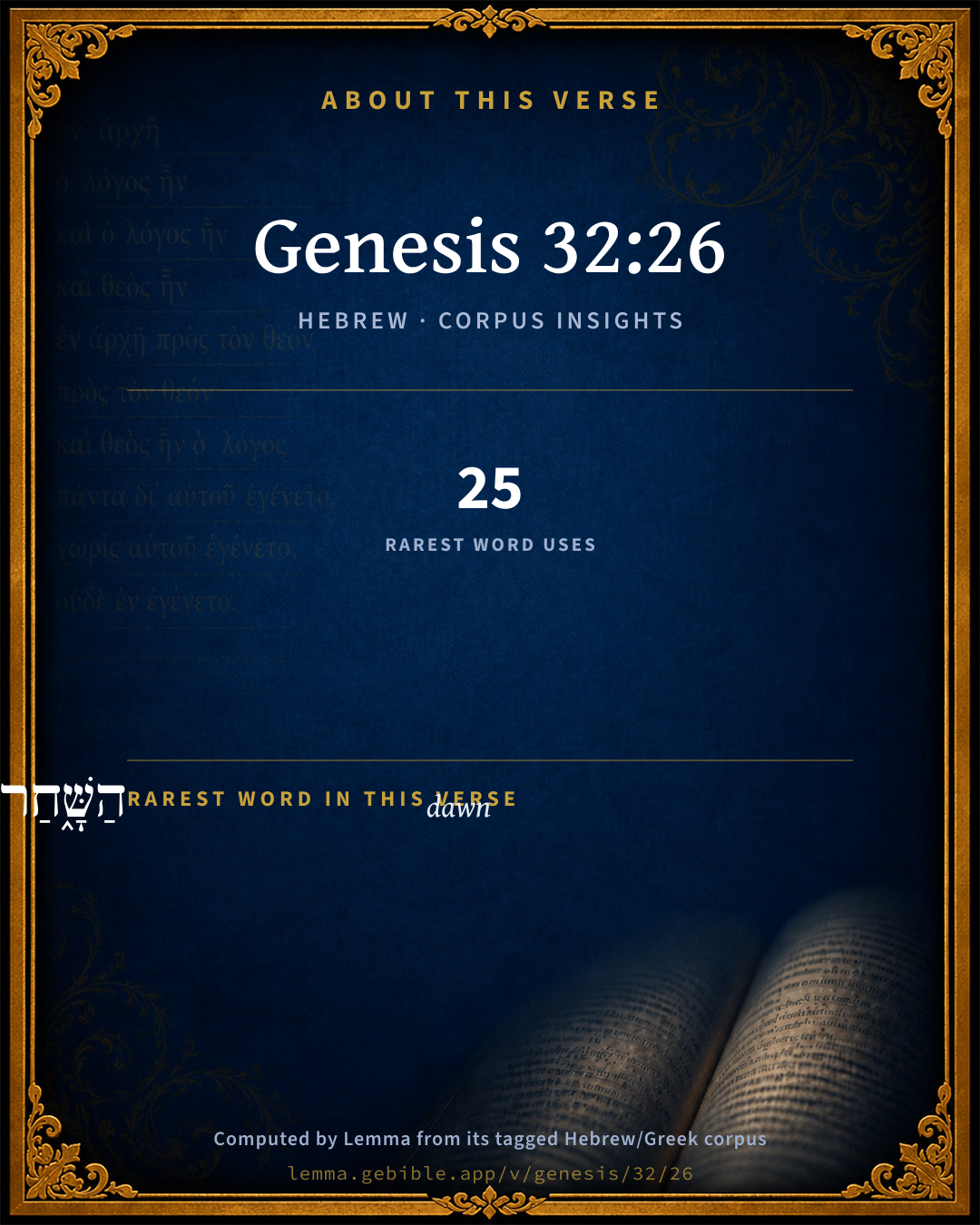
The rarest word here is הַשָּׁ֑חַר dawn H7837 — appearing just 25 times in the whole Hebrew Bible.

Shared distinctive vocabulary

הַשָּׁ֑חַר dawn H7837 occurs in 24 verses of the Hebrew Bible. Also found in:

Grammatical profile

  • 6 verbs
  • 1 noun
  • 3 conjunctions
  • 1 particle

Verb forms

  • וַיֹּ֣אמֶר Qal · Sequential Imperfect
  • שַׁלְּחֵ֔נִי Piel · Imperative
  • עָלָ֖ה Qal · Perfect
  • וַיֹּ֨אמֶר֙ Qal · Sequential Imperfect
  • אֲשַֽׁלֵּחֲךָ֔ Piel · Imperfect
  • בֵּרַכְתָּֽנִי Piel · Perfect

Repetition

Words recur within this verse — often emphatic in Hebrew:

  • וַיֹּ֣אמֶר to say H559 ×2
  • שַׁלְּחֵ֔נִי to send H7971 ×2
  • כִּ֥י that H3588 ×2

Hebrew & Septuagint length

In English translation the verse runs 21 words from the Hebrew and 26 from the Septuagint (LXX English) — closely comparable.

A rough comparison of the two English renderings, which tokenize alike — not a word-level alignment.

Word counts can differ between the Hebrew and the Greek without any difference in meaning — e.g. the Hebrew direct-object marker אֵת has no separate Greek word, and Greek often adds the article ὁ.

Cross-references

17

Topical passages linked to Genesis 32:26 in the Treasury of Scripture Knowledge — connected by theme and wording, ordered by reader-vote popularity; previews shown in the World English Bible.

  • Hosea 12:4 Indeed, he had power over the angel, and prevailed; He wept, and made supplication to him. He found him at Bethel, and there he spoke with us,
  • Psalms 115:12–13 Yahweh remembers us. He will bless us. He will bless the house of Israel. He will bless the house of Aaron.
  • 2 Corinthians 12:8–9 Concerning this thing, I begged the Lord three times that it might depart from me.
  • 1 Chronicles 4:10 Jabez called on the God of Israel, saying, Oh that you would bless me indeed, and enlarge my border, and that your hand might be with me, and that you would keep me from evil, that it not be to my sorrow! God granted him that which he requested.
  • Psalms 67:1 May God be merciful to us, bless us, And cause his face to shine on us. Selah.
  • Song of Solomon 3:4 I had scarcely passed from them, When I found him whom my soul loves. I held him, and would not let him go, Until I had brought him into my mother's house, Into the chamber of her who conceived me.
  • Luke 18:1–7 He also spoke a parable to them that they must always pray, and not give up,
  • Luke 24:28–29 They drew near to the village, where they were going, and he acted like he would go further.
  • Romans 8:37 No, in all these things, we are more than conquerors through him who loved us.
  • Exodus 32:10 Now therefore leave me alone, that my wrath may burn hot against them, and that I may consume them; and I will make of you a great nation."
  • Deuteronomy 9:14 let me alone, that I may destroy them, and blot out their name from under the sky; and I will make of you a nation mightier and greater than they.
  • Psalms 67:6–7 The earth has yielded its increase. God, even our own God, will bless us.
  • Song of Solomon 7:5 Your head on you is like Carmel, The hair of your head like purple; The king is held captive in its tresses.
  • Isaiah 45:11 Thus says Yahweh, the Holy One of Israel, and his Maker: Ask me of the things that are to come; concerning my sons, and concerning the work of my hands, command you me.
  • Isaiah 64:7 There is none who calls on your name, who stirs up himself to take hold of you; for you have hid your face from us, and have consumed us by means of our iniquities.
  • Hebrews 5:7 He, in the days of his flesh, having offered up prayers and petitions with strong crying and tears to him who was able to save him from death, and having been heard for his godly fear,
  • 1 Corinthians 15:58 Therefore, my beloved brothers, be steadfast, immovable, always abounding in the Lord's work, because you know that your labor is not in vain in the Lord.

Cross-references courtesy of OpenBible.info (CC BY 4.0).

Hebrew and Greek witnesses Masoretic Hebrew ↔ Greek Septuagint

The same verse in the two great witnesses to the Old Testament, shown verse-for-verse.

These are two independent witnesses, not word-aligned to each other, and the Septuagint is shown in lemma (dictionary) form.

Hebrew Genesis 32:26 Masoretic · Westminster Leningrad Codex

וַיֹּ֣אמֶר שַׁלְּחֵ֔נִי כִּ֥י עָלָ֖ה הַשָּׁ֑חַר וַיֹּ֨אמֶר֙ לֹ֣א אֲשַֽׁלֵּחֲךָ֔ כִּ֖י אִם בֵּרַכְתָּֽנִי

The man said, "Let me go, for the day breaks." Jacob said, "I won't let you go, unless you bless me."

World English Bible · Public Domain

Greek LXX Genesis 32:26 Septuagint · lemma form

ὁράω δέ ὅτι οὐ δύναμαι πρός αὐτός καί ἅπτομαι ὁ πλάτος ὁ μηρός αὐτός καί ναρκάω ὁ πλάτος ὁ μηρός ἰακώβ ἐν ὁ παλαίω αὐτός μετά αὐτός

And he said to him, Let me go, for the day has dawned; but he said, I will not let you go, except you bless me.

LXX2012 (modern English Septuagint) · Public Domain

Hebrew: Westminster Leningrad Codex (CC BY 4.0). Greek: Septuagint (public domain); English from LXX2012 (modern English Septuagint) (Public Domain). How the Septuagint differs from the Hebrew →

Targum (Aramaic paraphrase)

2

The Targum is the ancient Jewish Aramaic paraphrase of the Hebrew Scriptures — an interpretive translation, not the Hebrew text itself. Onkelos (literal) and Pseudo-Jonathan (expansive) render the Torah, and Jonathan the Prophets. Coverage is partial: where no permissively-licensed English translation exists for a verse, only the Aramaic is shown. This is verse-level text, not a word-by-word alignment to the Hebrew.

  1. Targum Onkelos Torah (Genesis–Deuteronomy)
    וַחֲזָא אֲרֵי לָא יָכִיל לֵהּ וּקְרֵב בִּפְתֵי יַרְכֵּהּ וְזָע פְּתֵי יַרְכָּא דְיַעֲקֹב בְּאִשְׁתַּדָּלוּתֵהּ עִמֵּהּ

    (no public-domain English translation for this verse)

    Targum Onkelos — Aramaic: “Onkelos Genesis” (public domain); “Onkelos Exodus” (public domain); “Onkelos Leviticus” (public domain); “Onkelos Numbers” (public domain); “Onkelos Deuteronomy” (public domain). English: “Sefaria Community Translation” (CC0 1.0 (public-domain dedication)); “J.W. Etheridge. The Targums of Onkelos and Jonathan Ben Uzziel on the Pentateuch. London: Longmans, Green, 1862” (public domain). Text via Sefaria.

  2. Targum Pseudo-Jonathan Torah (Genesis–Deuteronomy)
    וַחֲמָא אֲרֵי לָא הֲוָה לֵיהּ רְשׁוּ לְאַבְאָשָׁא לֵיהּ וְקָרֵיב בִּפְּתֵי יַרְכֵיהּ וְזַעְזָא פְּתֵי יַרְכָא דְיַעֲקב בְּאִיתְבַּחְשׁוּתֵיהּ עִמֵיהּ

    And he saw that he had not power to hurt him, and he touched the hollow of his thigh, and the hollow of Jakob's thigh was distorted in his contending with him.

    Targum Pseudo-Jonathan — Aramaic: “Targum Jonathan on Genesis” (public domain); “Targum Jonathan on Exodus” (public domain); “Targum Jonathan on Leviticus” (public domain); “Targum Jonathan on Numbers” (public domain); “Targum Jonathan on Deuteronomy” (public domain). English: “The Targum of Jonathan ben Uzziel, trans. J. W. Etheridge, London, 1862” (public domain). Text via Sefaria.

Commentary

Notes on Genesis 32:26 from classic Christian and Jewish commentators (each source and its license shown beneath its notes). The classic Christian expositions comment on the surrounding passage and are grouped to its opening verse, so a note may address several verses; the Jewish commentaries on the Tanakh (Rashi and others) are per-verse, so they appear only where the commentator wrote on this verse.

Lemma curates 59 commentaries, every one of them public domain or Creative Commons licensed, each selected and text-cleaned for this edition rather than reprinted as found. About our sources →

Trapp's Complete Commentary

John Trapp

Gen 32:26 And he said, Let me go, for the day breaketh. And he said, I will not let thee go, except thou bless me.

Ver. 26. Let me go, &c.] Pugna suum finem, cum rogat hostis, habet. Jacob, though lamed, and hard laid at, will not let Christ go without a blessing: to teach us, as our Saviour did, by the parable of the importunate widow, {Luk 18:1-8} to persevere in prayer, and to devour all discouragements. Jacob holds with his hands, when his joints were out of joint. The woman of Canaan will not be put off, either with silence or sad answers. The importunate widow teacheth us to press God so far, till we put him to the blush, yea, leave a blot in his face (as the word there used signifies, υπωπιαζη, Luk 18:5), unless we be masters of our request. Latimer so plied the throne of grace with his, Once again, once again, restore the gospel to England, that he would have no nay at God’s hands. {a} He many times continued kneeling and knocking so long together, that he was not able to rise without help. His knees were grown hard like camels’ knees, as Eusebius reports of James, the Lord’s brother. Paul "prayed thrice," {2Co 12:8} that is, often, till he had his desire. Nay, Paulus Aemelius, the Roman general, began to fight against Perses, king of Macedonia, when, as he had sacrificed to his god Hercules and it proved not to his mind, he slew twenty various sacrifices one after another; and would not stop till in the one and twentieth he had descried certain arguments of victory. {b} Surely his superstition shames our indevotion, his importunity our faint heartedness and shortness of spirit. Surely, as painfulness of speaking shows a sick body, so doth irksomeness of praying a sick soul.

{a} Act. and Mon.

{b} Sabellicus.

John Trapp, A Commentary or Exposition upon All the Books of the Old and New Testament (1647–1656) — public domain. Text from a community e-Sword module.

The Biblical Illustrator

Joseph S. Exell

Gen_32:26

I will not let Thee go, except Thou bless me

Jacobs struggle for a blessing

I.

He was thoroughly in earnest; he wrestled till he got the blessing.

II. If we wish to gain a blessing like Jacobs, we must be alone with God. It is possible to be alone with God, even in the midst of a multitude.

III. Jacobs heart was hardened with a load of sin. It crushed his spirit, and was breaking his heart. He could bear it no more, and so he made supplication. He wanted to be lifted out of his weakness, and made a new man.

IV. in the moment of his weakness, Jacob made a great discovery. He found that when we cannot wrestle we can cling.

V. He received the blessing wrestled for as soon as he became content to accept it as Gods free gift. (W. Hay Aitken, M. A.)

Jacobs prevailing prayer

I. THE SOULS AGONY.

1. The soul is absorbed in the awful loneliness of its own thought. Jacob was left alone. So is every one in similar experiences. In times of agony, friendly sympathy seems distant and ineffectual. We are even impatient with well-meant words of kindness. Then comes a sense of powerlessness. The afflicted one has done all he can, and now can only wait. At this juncture he begins to ask himself as to the cause of his misery. Why is he thus situated? Perhaps, like Jacob, he recognizes his sorrows as the lineal descendants of some former sin; or more likely, he now perceives, as never before, the general fact of his sinfulness, his imperfections as a Christian, and his failure to enjoy religious privileges.

2. Just here the soul is arrested by Gods presence. Abstracted from the world, because grief has made him indifferent to worldly thoughts, the Christian can now see God and feel His power. We can imagine Jacob, in his conflict of emotion, standing in the darkness by the brook Jabbok, lost in thought, when suddenly a heavy hand is laid upon his shoulder. He turns to find a mysterious Presence of terrible reality and power. That Presence he speedily recognizes as God. So now every storm-racked heart is introduced by conscience to its God.

3. In such times of trial, the soul at first finds God a seeming foe. Jacob at first was obliged to defend himself against his mysterious adversary. Who can tell what fearful surmises came over him as he wrestled in the dark with his terrible opponent? Can this be Esau? No; this is a superhuman strength. Can this be God? It surely is none else; but why does He meet me thus? God hedges men in to bring them to His feet, to show them themselves, to prevent prosperity from injuring them, very likely to prepare them for it, to purify them from remaining sin, frequently to fit them for some great work. We must pass through the furnace before we are what we should be.

II. THE RELIEF OF THE SOUL.

1. The narrative discloses the human means of securing this relief, namely, prayer.

2. The narrative sets before us the Divine methods of giving relief to the soul.

(1) Development of character.

(2) Knowledge of God.

(3) Confidence in God.

3. The narrative indicates the safeguard of the soul in this secured relief. Jacob, though his troubles were now passed, yet halted on his thigh, and doubtless limped through life. He carried from that place of conflict and triumph a reminder of his dependence. He had then, ever after, a sense of his weakness, and could say with Paul, When I am weak, then am I strong. There is danger, after meeting God face to face and securing His favour, of undue elation. Even Paul, with all his saintliness, needed a thorn in the flesh, lest he be exalted above measure. We may forget that every successful struggle with sin or attainment in piety is due solely to the Divine help. For this reason, doubtless, God has established a universal law in life. We cannot pass through a terrible experience like Jacobs without bearing the scars of battle. (A. P. Foster.)

Jacobs powerful prayer

1. It was a prayer that by living faith took firm hold upon God. He came to God, not as one far off, but close at hand; not merely on the throne, but present in all the affairs of daily life. He comes to Him as the God of his fathers, the God of the covenant. He at once lays hold of the Divine faithfulness. As much as any one thing, we need to-day this sense of God as ever present to be a restraining power in business life. Like the patriarch, every believing soul must draw nigh to God, reverently, it is true, but not timidly or distrustfully. The command is to come boldly to a throne of grace. We must come not as though we more than half questioned whether there is any God, or, if there be, whether He cares anything about us, and will hear our prayer; but with all the heart believing that He is, and is the Rewarder of those that diligently seek Him.

2. Jacob did not offer a hasty prayer for safety merely in general terms, and then go about his worldly business with all the intensity of his nature. His need was urgent, was deeply felt; and he found time enough to press it before God. The whole night was none too long for his business with God.

3. Wrestling, Jacob came to a point where he was powerless. All he could do was to hold fast to God. God never takes from any of His children their power to do this. Every other refuge may be swept away, but they can cling still.

4. Jacobs prayer was direct and simple. He asked for just what he wanted, then stopped. (The Study.)

Importunate prayer

I. THE OBJECTS OF JACOBS PRAYER; or, the blessings implored. It need not be disguised that one of these was the preservation of his own life, and the safety of his family and substance. It would be doing Jacob injustice, however, to deny that higher objects than the preservation of himself, and of his family and substance, occupied his thoughts and prayers on this critical occasion. The very circumstances in which he was placed were calculated to call his sins to remembrance; just as his sons were reminded of their unnatural and criminal conduct towards Joseph, by being thereby involved in difficulties in Egypt many long years after their sin had been committed. Jacob being reminded of the falsehood and deceit by which he had provoked the anger and vengeance of his brother, would humbly confess his sin and earnestly pray for the salvation of his soul, whatever might be the fate of his body at this time. Knowing that the souls of his family were as precious as his own, and remembering the relation in which he stood to them, and the duty that he owed them, he would be very importunate in prayer for their salvation also, though they should fall by the sword of Esau. But he would not despair of their preservation. He would remember the covenant of God with his father Abraham, and the promise that He would make of him a great nation, and that in his seed, which is Christ, all the families of the earth would be blessed. He would pray that he and his family might live to be witnesses for God in a world lying in wickedness, and might introduce the spiritual seed, in whom all the families of the earth were to be blessed.

II. THE MANNER IN WHICH THE DUTY SHOULD BE PERFORMED.

1. Jacob sought retirement for devotion.

2. Jacob spent a long time in prayer.

3. We must implore lawful things, and employ proper arguments to attain them.

4. We ought to be earnest and persevering in prayer.

5. We should pray in faith and hope.

III. THE ANSWER WHICH JACOB OBTAINED TO HIS PRAYERS. God blessed him there. He obtained a gracious answer. (R. Smith, D. D.)

Importunity in prayer

I. EXPLAIN THIS HOLY WRESTLING IN PRAYER. Wrestling implies some resistance to be overcome. Some of the chief obstructions which must be overcome are--

1. A sense of guilt whelming the soul.

2. A frowning Providence discouraging the mind.

3. Unbelieving thoughts and inward temptations.

4. Coldness and slothfulness of the heart.

5. Discouragement through Divine delays.

II. THE REASONABLENESS OF IMPORTUNITY IN PRAYING.

1. It strengthens in our minds a sense of Gods glory.

2. Our unworthiness vindicates it.

3. The inestimable value of the blessings to be obtained requires it.

III. ITS ADVANTAGES.

1. It prepares for blessings in many cases: it is itself the actual possession of them.

2. It has the promises of success.

3. Memorable examples confirm its worth.

IV. IMPROVEMENT.

1. How many have cause to mourn their lack of this spirit!

2. Its absence is one cause of the low state of religion.

3. As you would persevere in prayer, be watchful and circumspect, observe the course of Providence, be much in intercession for others. (Dr. J. Wotherspoon.)

Now

Canon Wilberforce tells a pathetic story illustrating the force of this little word now. It was of a miner who, hearing the gospel preached, determined that, if the promised blessing of immediate salvation were indeed true, he would not leave the presence of the minister who was declaring it until assured of its possession by himself. He waited, consequently, after the meeting to speak with the minister, and, in his untutored way, said, Didnt ye say I could have the blessin now? Yes, my friend. Then pray with me, for Im not goin awa wiout it. And they did pray, these two men, wrestling in prayer until midnight, like Jacob at Penuel, until the wrestling miner heard silent words of comfort and cheer, even as Jacob heard the angels announcement, As a prince hast thou power with God and with men, and hast prevailed. Ive got it now! cried the miner, his face reflecting the joy within; Ive got it now! The next day a terrible accident occurred at the mines--one of those accidents which so frequently shock us with their horror merely in the reading of them. The same minister was called to the scene, and among the men, dead and dying, was the quivering, almost breathless body of this man, who only the night before, big and brawny, came to him to know if salvation could really be had now for the asking. There was but a fleeting moment of recognition between the two, ere the miners soul took flight, but in that moment he had time to say, in response to the ministers sympathy, Oh, I dont mind, for Ive got it--Ive got it--its mine! Then the name of this poor man went into the bald list of killed. There was no note made of the royal inherit-ante to which he had but a few hours before come into possession, and all by his believing grip of the word now.

Grip

This is what every Christian ought to have, and what many a one lacks. There is a certain inspiration in the very thought of the clenched hand, with its tense muscle and unyielding grasp. It signifies not only strength, but purpose; not only earnestness, but endurance. It is the symbol of a necessary and important element of a Christians success. It typifies consecrated self-control, that mastery which every true child of Christ has in some degree over his own sinful nature, and which, having secured by the Holy Spirits help, he maintains by the aid of the same blessed agency. It typifies, too, that hold which he has upon Christ Himself, that tenacious, yet reverent, clinging of spirit which imparts to his prayers the temper of Jacobs words, I will not let Thee go, except Thou bless me. It typifies also that benevolent, yet authoritative influence which he seeks to gain, and usually succeeds in gaining, over his more sorely tempted fellows; the drunkard, for instance, who is rapidly losing confidence in himself without yet finding it in God, and who needs the protection of some sturdy, masterful soul who has no personal fear of his temptation, and has the power and the will to stand by him through everything to cheer and uphold, and by Gods grace to save. Grip is the holding fast and not letting go, in spiritual as in material life. It is tenacity of holy purpose, renewal of effort after moral failure, cheerfulness in the teeth of discouragement, hopefulness for others, no matter how low they may have sunk, and unfaltering faith in the truth that God reigns, can save to the uttermost, and somehow will bring out all things aright for His own. What wonder that he who has it is a healthy, useful Christian! He may be timid by nature, weak in body, and humble in place, but if he illustrate what a true Christian grip is upon himself and his little world, men learn to marvel at him. Something of Gods own Almighty power is visible in him. What he does succeeds, and in blessing others he is doubly blessed himself.

The Prayer-meeting at Jabbok

Events drive Jacobs mind back on the past, which has been a series of wrestlings with his nearest neighbour, the gain of which has been wealth, but the loss that, in most important senses, he is left alone. Jacob is one of those men who, wild among their fellows, are tame and best when alone. The world contemns the man who is crafty as one of its own children when among men, but afterwards goes to the prayer-meeting. The world, however, would not be better pleased with him if he did not go, and the man, in that case, very likely would be a wilder man. There are three way-side prayer-meetings in Jacobs journeyings so far. Where God tells him that the world has been too much with him of late--Bethel, Mahanaim, Jabbok. Jacob is redeemed from the world by the prayer--meeting. How do we use the opportunities which God gives when He throws open to us the hallowed gates of the lonely hour? Do we enter with thanksgiving and betake ourselves to prayer, the flight of the lonely man to the only God? There wrestled, &c. Again and again the heavenly world enters into controversy with Jacob, and breaks the spell of this world. At Bethel he saw angels, at Mahanaim he met angels, but at Jabbok one of them stayed to minister to the man who wrestled with the old self and needed help. I can do all things through Christ, that strengtheneth me. When we make a vow, we lay hold on the angel of the covenant. If we forget our vow, we let the angel go. A little shell-fish can cling to the rock, despite the Atlantic, because of a tiny vacuum in the shell. Our emptiness is our strength with God. Jacob in the world is somebody, but at the prayer-meeting nobody but broken, sinewless Jacob. Our wrestling must be with pleading, not with contradiction. He blessed him there. The blessing, in brief, was the power to look at the world and himself from a cleaner heart through a cleaner eye. The place was Penuel, the face of God, and he was Israel, a prince, from that time. No religious meeting or exercise will have done us good unless it exalt us, and make the world- wife, children, home, friends, business--look lovelier and more sacred. (T. M. Rees.)

Boldness in prayer exemplified

There is a wide difference between striving against God and striving with God. Some men strive against God by their sins, and they must be conquered by His power; but Jacob strove with God. Jehovah Himself gave strength and determination to his servant, for the express purpose that he might, as a prince, have power and prevail. It is one of the most delightful evidences of Divine condescension, that He is willing to be conquered by human prayer and importunities.

1. Who was that personage that appeared to Jacob, and wrestled with him? The narrative calls him a man; but all interpreters are agreed, that by this is meant some one in the form of a man. Was it, then, a created angel? or, was it God Himself? We think the latter; because, though He is called an angel, Jacob paid Him Divine homage. Again, because the inspired prophet, referring to this event, says that Jacob had power with God. And again, because Jacob himself said, I have seen God face to face, and my life is preserved. Once more, because the patriarch appeals to Him in our text for a blessing, which he could hardly look for from any being but God. There is another point to which I would direct your attention, viz., that this angel was not merely God, but God the Son, who in this, and in many other instances, anticipated His Incarnation, by appearing in the form and fashion of a man. With whom should Jacob wrestle to obtain pardon for his sin, and deliverance from its just consequences, but with the appointed Mediator, who should make atonement, and then enter into the heaven of heavens, there to appear in the presence of God for us?

2. What was this wrestling? Was it spiritual, or corporeal, or both? There are a few interpreters, and but a few, who think it was purely spiritual; and that there was no bodily conflict at all, but that it was illusive and imaginary. It is said distinctly, There wrestled a Man with him; and that Man, when the conflict had lasted long, says, Let me go, for the day breaketh. Finally, he touched Jacobs thigh upon the sinew that shrank, so that he went halting to the end of his days. All these are strong marks of reality, which go far to prove that the outward form of this conflict was corporeal. Yet, beyond all question, it was connected with a mental and spiritual wrestling with God in prayer. The outward was a sign and picture of the inward strife; and Jacob to this day is an image of every saint who prevails with God by the holy boldness, earnest opportunity, and untiring perseverance of His supplications.

3. Why did this wrestling take place? what was its great end? With respect to Jacob himself, it signified that he should overcome the hatred of his brother Esau; for what has he to fear from man, who, as a prince, hath power with God? With respect to ourselves, and to the Church generally, we may consider this scene as descriptive pictorially, not of Jacobs condition only, but of all the saints with him. They are all wrestlers, by their very calling; wrestlers with affliction, with temptation, with outward and with inward, with carnal and with spiritual enemies: yet, in the strength of God, they shall all overcome. Wrestlers with God; that is, men of prayer. Now, we take our text as exemplifying to us this one subject, boldness in prayer: I will not let Thee go, except Thou bless me. Now, there are two reflections that, in a manner, force themselves upon our notice. One is, that God never violently withdraws Himself from a praying man. His trial of our faith and importunity never stretch beyond this, Let me go, if Thou canst consent; and, even when the trial proceeds so far, it is only done to provoke a refusal. It was obviously not the Divine intention to send Jacob away unblessed, but to elicit this proof of his determination. The other reflection is consequent upon it; namely, that when God withdraws from any man, it is always with his own consent. He must be willing to give up the point before he loses his advantage. No man can fail to obtain everything that he really needs, and everything that God has promised, unless he himself voluntarily draws back and yields; otherwise, God consents to be overcome by prayer. This is the great comfort of every sinner, and of every saint.

I. Consider WHAT KIND OF BOLDNESS IT IS THAT GOD APPROVES, NEGATIVELY AND POSITIVELY.

1. God does not approve the boldness which is grounded on self-righteous principles: it must, therefore, be connected with a deep sense of guilt and unworthiness (Gen_32:10).

2. God does not approve that boldness which loses sight of His own awful majesty and holiness. Boldness must be associated with reverence and godly fear, to be acceptable. What! can Gods condescension and love give an unworthy creature the smallest ground to forget his own unworthiness, and the infinitude of Him with whom he has to do? On the contrary, it should deepen his sense of his own meanness, and increase his adoration.

But let us come more particularly to the question.

1. God approves that boldness which surmounts all the doubts and fears adapted to obstruct our freedom of access to Him. There are improper fears, and a sinful diffidence opposed to the exercise of prayer. When, for instance, a sense of guilt and unworthiness leads us to suspect that God will not hear us, will not forgive; this is a sign of faint-heartedness, not of humility. It is a sentiment directly contrary to His revealed will. Now, Jacob might have been restrained by similar considerations. He might have thought of all his sins.

2. God approves that boldness in prayer which is evinced by the largeness of its desires. He is not honoured by feeble desires and limited supplications. His promises are most ample, and various in the benefits which they convey.

3. God approves that boldness which is importunate, and will take no denial. It is often necessary that a blessing be withheld for a season, in order that its full value may be realized. Moreover, this is an important test of sincerity. Coldness and languor are repulsed and betrayed. Genuine devotion believes the word, and will not consent to go empty away. Formality is satisfied without the blessing, when conscience is appeased by the performance of the duty. The true worshipper cannot rest in outward services if the blessing be not given.

II. Let us take notice of one or TWO CONSIDERATIONS WHICH NOT MERELY JUSTIFY THIS BOLDNESS, BUT GO FAR TO PROVE IT INDISPENSABLE.

1. The urgency of our wants. The fervency of prayer should be regulated by our condition. It is evident that the secret of Jacobs importunity was the pressing circumstances in which he felt himself to be placed. His was a kind of desperation, inspired by the extremity of his danger.

2. The importance of the blessing. We plead not merely for well-being, we plead for life; life, not of the body, hut of the soul. If we do not prevail we are lost.

3. The absolute certainty of its prevalence. There will be timidity in asking, wherever there exists a doubt of obtaining. Thine own word is my warrant, when I answer, I will not let Thee go, except Thou bless me.

IN CONCLUSION, the subject is adapted to impress upon our minds these two points of instruction: the quality of prayer, and the power of prayer.

1. Boldness is an essential characteristic of prayer. This may be made clear by barely mentioning the defects and infirmities to which it is opposed. Can there be sincerity and acceptableness where there is a want of sensibility and zeal, where low views are entertained of the kindness and grace of God, and where the suppliant is ready to withdraw from the mercy-seat without the blessing, at the least discouragement or delay?

2. Observe exemplified the power of prayer. I said not unto the seed of Jacob, seek ye Me in vain! (D. Katterns.)

The characteristic of true prayer

Now that Jacob found himself once more in Esaus power, he trembled to think of the consequences. There were two considerations which must have intensified his agony of mind.

1. That he had brought these difficulties upon himself. Conscience now accused him of his crime with the same vehemence as if it had been committed only yesterday. Ah! this is a solemn fact in connection with certain sins which we rashly perpetrate! Painful indeed was Jacobs reflection now upon the past. Had he conducted himself as a straightforward man in his youth, he might have avoided his present trouble. How he wished he could have commenced life again! Even in old age men are doomed to possess the sins of their youth, to reap the inevitable consequences of early aberrations.

2. That others beside himself shared in the impending danger. He is now the head of a family; he has wives and children whom he passionately loves; they are in danger of being put to death on the morrow by his furious brother; and his conscience reproaches him with being the cause of their misery. Surely this was the keenest pang of all--the bitterest ingredient in his cup of bitterness. Such is human life. Say not that children are never punished for the transgressions of their parents; reason not concerning the injustice of such an arrangement; the hard fact continually stares us in the face, and warns us at every step to beware, to take heed to ourselves, to be prudent in our conduct, not only for our own sake, but also for the sake of others, whom we may unwittingly injure. And Jacob was left alone. It is when you are alone with the powers of nature-powers whose existence speaks of a higher Power, which sustains them all--that the light of Heaven is most likely to flash upon your soul. It was when banished to the isle of Patmos that John saw the glorious visions recorded in the Book of Revelation; it was when imprisoned in Bedford goal that Bunyan dreamed his Pilgrims Progress; it was when shut up in total darkness that Milton sang his Paradise Lost. We are taught here that--

I. WHEN WE TRULY PRAY, WE BECOME CONSCIOUS OF THE PRESENCE OF A PERSONAL GOD. It is stated that there wrestled a man with Jacob until the breaking of the day. God is not an abstract idea of the mind; is not the natural powers by which we are surrounded; for He has a personal existence. God is a person, and as such, men in all ages have desired to know Him; to commune with Him, to call upon Him in distress. It is when we pray, however, that this fact forces itself most vividly upon our minds. It may be said, therefore, that true prayer can never be uttered where the presence of a personal God does not inspire the soul. You must feel, like Jacob, that there is a Parson with you, standing at your side, listening to your cry; for otherwise it will not be prayer, but a form--it will not be an outpouring of the heart, but a meaningless performance.

II. WHEN WE TRULY PRAY, WE BECOME CONSCIOUS OF A STRUGGLE TO OVERCOME DIFFICULTIES. The experience of formidable opposition in drawing near to God is by no means uncommon. The repelling power with which Jacob struggled on this occasion, has been encountered by almost every suppliant at the throne of grace. Indeed, our Lord seemed anxious to prepare the minds of His disciples to expect it. And He spake a parable unto them for this end, that men ought always to pray and not to faint. But our Lord prepared His disciples to expect difficulties in prayer by other means than parables--by His dealings with some who sought temporal favours at His hands. While He sojourned in the coasts of Tyre and Sidon, a woman of Canaan came to Him, crying, Have mercy on me, O Lord, Thou Son of David; my daughter is grievously vexed with a devil. Passing on with perfect unconcern, He feigned not to hear her; for He answered her not a word. She then cried all the more, Have mercy on me, so that His disciples felt annoyed, and besought Him to send her away. Thus when we encounter difficulties in prayer, when we feel as if God did not hear us, it is because God wishes to test our faith, and by testing to strengthen it. Consequently, not only do we enjoy Gods blessing with greater relish when it comes, but we are also made stronger for His service.

III. WHEN WE TRULY PRAY, WE BECOME CONSCIOUS OF A CHANGE IN OURSELVES, AS A TOKEN OF SUCCESS. It may be that when we are apparently most unsuccessful, we are really most successful. We do not obtain the very thing we seek at the time, but the spiritual strength we acquire in the effort may be infinitely more important than the thing itself. It always happens thus when true, fervent, earnest prayer is sent up from the heart to God; when there is a mighty struggle to obtain a blessing from above, there comes over the soul a change for the better, a visible improvement, a closer resemblance to Gods image. Jacob carried in his body ever after a memorial of the wrestling of that night; for he halted on his thigh. We are reminded here of a beautiful story, told of the celebrated John Elias, the prince of Welsh orators. He addressed on one occasion a meeting presided over by the late Marquis of Anglesey. The marquis, as you know, was lame, having lost a limb in the famous battle of Waterloo. Referring, therefore, to that circumstance, the speaker thrilled his audience by this striking remark, We have a president here this evening, whose very step as he walks reminds you of his bravery! So Jacob halted on his thigh. His limping gait kept in remembrance his wonderful victory with God. A man of prayer is well known as such; there are certain marks which reveal his character; his public performances bear the impress of his private wrestlings. In this transforming, elevating, and invigorating influence of prayer lies the secret of a godly mans strength. (D. Rowlands, B. A.)

Earnest prayer

When a person told a story in a heartless way, Demosthenes said, I dont believe you. But when the person then repeated the assertion with great fervour, Demosthenes replied, Now I do believe you. Sincerity and earnestness are ever urgent. The prophetess at Delphos would not go into the temple once when Alexander wished to consult the oracle. He then forced her to go, when she said, My son, thou art invincible; a remark which led him to believe he should always conquer in war. Luther was so earnest in his prayers that it used to be said, He will not be denied. When Scotland was in danger of becoming Popish, John Knox prayed most mightily for its preservation in the true faith. Give me Scotland, he pleaded, or I die; and his prayers have been answered. Epaphras laboured fervently in prayer. Christ, being in an agony, prayed the more fervently.

The Biblical Illustrator, edited by Joseph S. Exell (c. 1880s–1900s) — public domain. Text from a community e-Sword module.

Joseph Benson's Commentary

Gen 32:26. Let me go — Thus the angel, by an admirable condescension, speaks to Jacob as God did to Moses, Exo 32:10, Let me alone, and that to show the prevalency of his prayer with God, and also to encourage him to persist in the conflict. For the day breaketh — Therefore he would not any longer detain Jacob, who had business to do, a family to look after, a journey to take. I will not let thee go except thou bless me — He resolves he will have a blessing, and rather shall all his bones be put out of joint than he will suffer the angel to leave him without a blessing. Those who would be blessed by Christ, and have his salvation, must be in good earnest and importunate for it. Reader, art thou so? Dost thou pray and not faint?

Joseph Benson's Commentary on the Old and New Testaments (1811–1818) — public domain. Text from a community e-Sword module.

Tyndale Open Study Notes

Tyndale Open Resources

32:26 At daybreak, the significance of this fight began to dawn on Jacob. He realized who his assailant was, and since it was futile to fight, he held on to obtain God’s blessing.

Tyndale Open Study Notes — © Tyndale Open Resources, licensed CC BY-SA 4.0. Text via the HelloAO Bible API.

Geneva Bible (1599)

Geneva Bible translators

Hos. 12:4

Geneva Bible (1599) marginal notes — public domain. Text via Bolls.life.

Jamieson, Fausset & Brown

Robert Jamieson, A. R. Fausset & David Brown

I will not let thee go, except thou bless me--It is evident that Jacob was aware of the character of Him with whom he wrestled; and, believing that His power, though by far superior to human, was yet limited by His promise to do him good, he determined not to lose the golden opportunity of securing a blessing. And nothing gives God greater pleasure than to see the hearts of His people firmly adhering to Him.

Jamieson, Fausset & Brown — Commentary Critical and Explanatory on the Whole Bible (1871) — public domain (CC PDM 1.0). Text via the HelloAO Bible API.

Adam Clarke's Commentary

Verse 26. Let me go, for the day breaketh] Probably meaning, that as it was now morning, Jacob must rejoin his wives and children, and proceed on their journey. Though phantoms are supposed to disappear when the sun rises, that could be no reason in this case. Most of the angelic appearances mentioned in the Old and New Testaments took place in open day, which put their reality out of question.

Adam Clarke's Commentary on the Bible (1810–1826) — public domain. Text from a community e-Sword/MySword module.

John Calvin's Commentaries

26. Let me go. God concedes the praise of victory to his servant, and is ready to depart, as if unequal to him in strength: not because a truce was needed by him, to whom it belongs to grant a truce or peace whenever he pleases; but that Jacob might rejoice over the grace afforded to him. A wonderful method of triumphing; where the Lord, to whose power all praise is entirely due, yet chooses that feeble man shall excel as a conqueror, and thus raises him on high with special eulogy. At the same time he commends the invincible perseverance of Jacob, who, having endured a long and severe conflict, still strenuously maintains his ground. And certainly we adopt a proper mode of contending, when we never grow weary, till the Lord recedes of his own accord. We are, indeed, permitted to ask him to consider our infirmity, and, according to his paternal indulgence, to spare the tender and the weak: we may even groan under our burden, and desire the termination of our contests; nevertheless, in the meantime, we must beware lest our minds should become relaxed or faint; and rather endeavor, with collected mind and strength, to persist unwearied in the conflict. The reason which the angel assigns, namely, that the day breaketh, is to this effect, that Jacob may now that he has been divinely taught by the nocturnal vision.

I will not let thee go, except. Hence it appears, that at length the holy man knew his antagonist; for this prayer, in which he asks to be blessed, is no common prayer. The inferior is blessed by the greater; and therefore it is the property of God alone to bless us. Truly the father of Jacob did not otherwise bless him, than by divine command, as one who represented the person of God. A similar office also was imposed on the priests under the law, that, as ministers and expositors of divine grace, they might bless the people. Jacob knew, then, that the combatant with whom he had wrestled was God; because he desires a blessing from him, which it was not lawful simply to ask from mortal man. So, in my judgment, ought the place in Hosea (Hosea 12:3) to be understood, Jacob prevailed over the angel, and was strengthened; he wept, and made supplication to him. For the Prophet means, that after Jacob had come off conqueror, he was yet a suppliant before God, and prayed with tears. Moreover, this passage teaches us always to expect the blessing of God, although we may have experienced his presence to be harsh and grievous, even to the disjointing of our members. For it is far better for the sons of God to be blessed, though mutilated and half destroyed, than to desire that peace in which they shall fall asleep, or than they should withdraw themselves from the presence of God, so as to turn away from his command, that they may riot with the wicked.

John Calvin's Commentaries (1540-1563) — public domain. Text from the Calvin Translation Society English edition (1840s-50s) via the Christian Classics Ethereal Library (ccel.org). Calvin's coverage is partial (roughly two-thirds of the Bible); uncommented books and verses are honest gaps, never fabricated. The 19th-century editor's footnotes and remarks are omitted so the notes are faithfully Calvin's own voice.

Ellicott's Commentary for English Readers

(26) Let me go . . . —Heb., send me away, for the gleam of morning has gone up. The asking of permission to depart was the acknowledgment of defeat. The struggle must end at daybreak, because Jacob must now go to do his duty; and the wrestling had been for the purpose of giving him courage, and enabling him to meet danger and difficulty in the power of faith. A curious Jewish idea is that the angel was that one whose duty it was to defend and protect Esau. By the aid of his own protecting angel Jacob, they say, had overpowered him, and had won the birthright and the precedence as “Israel, a prince with God and man.”

Except thou bless me.—The vanquished must yield the spoil to the victor; and Jacob, who had gradually become aware that the being who was wrestling with him was something more than man, asks of him, as his ransom, a blessing.

A Bible Commentary for English Readers, edited by Charles John Ellicott (1878–1897) — public domain. Text from a community e-Sword module.

The Cambridge Bible for Schools and Colleges

gen. ed. J. J. S. Perowne

26. the day breaketh] A survival of the old belief that unearthly visitants of the night must be gone before daybreak. In Plautus, Amphitr. 532f., Jupiter says, “Cur me tenes? Tempus est: exire ex urbe, priusquam lucescat, volo.” Shakespeare, Hamlet, Act i. Scene i.:

“Ber. It was about to speak, when the cock crew.

Hor. And then it started like a guilty thing.”

See note on Gen_19:15; Gen_19:23.

except thou bless me] Jacob had suddenly realized, through the touch of physical suffering, that he was in the grasp of more than mortal power. He neither shrinks, nor desists, but maintains his hold and asks for a blessing.

The Cambridge Bible for Schools and Colleges (gen. ed. J. J. S. Perowne; Cambridge University Press, 1878–1918) — public domain. Text from a community e-Sword module.

John Gill's Exposition

And he said, let me go, for the day breaketh,.... This was said that he might seem to be a man that was desirous of going about his business, as men do early in the morning; though the true reason perhaps was, that his form might not be more distinctly seen by Jacob, and much less by any other person:

and he said, I will not let thee go except thou bless me; for by his touching his thigh, and the effect of that, he perceived he was more than a man, even a divine Person, and therefore insisted upon being blessed by him: thus faith in prayer lays hold on God, and will not let him go without leaving the blessing it is pleading for; which shows the great strength of faith, and the efficacy of the prayer of faith with God; see Exo 32:10.

John Gill's Exposition of the Whole Bible (1746–1763) — public domain (CC PDM 1.0). Text via the HelloAO Bible API.

Matthew Poole's English Annotations

And he said, Let me go: he saith this, partly to show the prevailing power of his prayer with God, and partly to quicken and encourage Jacob to persist in his conflict. Compare Exo 32:10; Deu 9:14.

The day breaketh, and I am not willing that there should be any spectators or witnesses of these things.

Except thou bless me with the blessings which thou hast promised to Abraham and to me, among which one is protection in this hour of my danger. For Jacob now began to think that it was no man, nor ordinary angel, that was with him, but God himself, as he saith, Gen 32:30.

Matthew Poole's English Annotations on the Holy Bible (1683–1685) — public domain. Text from a community e-Sword/MySword module.

Whedon's Commentary on the Bible

Daniel D. Whedon

26. Let me go — He had power to free himself from Jacob’s grasp as easily as he touched his thigh. But still he accommodates himself to Jacob’s condition and needs, that he may teach a lesson for all ages.

For the day breaketh — Hebrews, the morning ariseth. This is not to be explained as a part of the superstitious notion that spirits perform their earthly ministries in the dark hours of the night, and cannot abide the morning air. The three angels appeared at midday to Abraham.

Gen_18:1-2. But the rising dawn required that Jacob should be now moving on to look after his family and to meet Esau.

I will not let thee go, except thou bless me — Thus “he wept and made supplication unto him.” Hos_12:4. It is the language of earnest, persistent prayer.

“Yield to me now, for I am weak,

But confident in self-despair,

Speak to my heart, in blessing speak,

Be conquered by my instant prayer.”

Daniel D. Whedon (gen. ed.), Commentary on the Old and New Testaments (1874–1909) — public domain. Text from a community e-Sword module.

The Pulpit Commentary

And he (the man) said, Let me go (literally, send me away; meaning that he yielded the victory to Jacob, adding as a reason for his desire to depart), for the day breaketh literally, for the morning or the dawn ascendeth; and therefore it is time for thee to proceed to other duties (Wilet, Clarke, Murphy), e.g. to meet Esau and appease his anger ("Speaker"s Commentary"). Perhaps also the angel was unwilling that the vision which was meant for Jacob only should be seen by others (Pererius), or even that his own glory should be beheld by Jacob (Ainsworth). Calvin thinks the language was so shaped as to lead Jacob to infer nocturna visions se divinitus fuisse edoctum. And he said, I will not let thee go, except thou bless me. The words show that Jacob now clearly recognized his mysterious Antagonist to be Divine, and sought to obtain from him the blessing which he had previously stolen from his aged father by craft.

The Pulpit Commentary (1880–1919), ed. H.D.M. Spence-Jones & Joseph S. Exell — public domain. Text from a community e-Sword module.

John Wesley's Explanatory Notes

Let me go - The angel, by an admirable condescension, speaks Jacob fair to let him go, as God said to Moses, Exod. xxxii, 10. Let me alone. Could not a mighty angel get clear of Jacob's grapples? He could; but thus he would put an honour upon Jacob's faith and prayer. The reason the angel gives why he would be gone is because the day breaks, and therefore he would not any longer detain Jacob, who had business to do, a journey to go, a family to look after. And he said, I will not let thee go except thou bless me - He resolves he will have a blessing, and rather shall all his bones be put out of joint, than he will go away without one. Those that would have the blessing of Christ must be in good earnest, and be importunate for it.

John Wesley, Explanatory Notes Upon the Whole Bible (1754–1765) — public domain. Text via the GEBible commentary corpus.

Keil & Delitzsch

C. F. Keil & F. Delitzsch

"And when He (the unknown) saw that He did not overcome him, He touched his hip-socket; and his hip-socket was put out of joint (תּקע from רקע) as He wrestled with him." Still Jacob would not let Him go until He blessed him. He then said to Jacob, "They name shall be called no more Jacob, but Israel (ישׂראל, God's fighter, from שׂרה to fight, and אל God); for thou hast fought with God and with men, and hast prevailed." When Jacob asked Him His name, He declined giving any definite answer, and "blessed him there." He did not tell him His name; not merely, as the angel stated to Manoah in reply to a similar question (Jdg 13:18), because it was פּלא wonder, i.e., incomprehensible to mortal man, but still more to fill Jacob's soul with awe at the mysterious character of the whole event, and to lead him to take it to heart. What Jacob wanted to know, with regard to the person of the wonderful Wrestler, and the meaning and intention of the struggle, he must already have suspected, when he would not let Him go until He blessed him; and it was put before him still more plainly in the new name that was given to him with this explanation, "Thou hast fought with Elohim and with men, and hast conquered." God had met him in the form of a man: God in the angel, according to Hos 12:4-5, i.e., not in a created angel, but in the Angel of Jehovah, the visible manifestation of the invisible God. Our history does not speak of Jehovah, or the Angel of Jehovah, but of Elohim, for the purpose of bringing out the contrast between God and the creature.

This remarkable occurrence is not to be regarded as a dream or an internal vision, but fell within the sphere of sensuous perception. At the same time, it was not a natural or corporeal wrestling, but a "real conflict of both mind and body, a work of the spirit with intense effort of the body" (Delitzsch), in which Jacob was lifted up into a highly elevated condition of body and mind resembling that of ecstasy, through the medium of the manifestation of God. In a merely outward conflict, it is impossible to conquer through prayers and tears. As the idea of a dream or vision has no point of contact in the history; so the notion, that the outward conflict of bodily wrestling, and the spiritual conflict with prayer and tears, are two features opposed to one another and spiritually distinct, is evidently at variance with the meaning of the narrative and the interpretation of the prophet Hosea. Since Jacob still continued his resistance, even after his hip had been put out of joint, and would not let Him go till He had blessed him, it cannot be said that it was not till all hope of maintaining the conflict by bodily strength was taken from him, that he had recourse to the weapon of prayer. And when Hosea (Hos 12:4-5) points his contemporaries to their wrestling forefather as an example for their imitation, in these words, "He took his brother by the heel in the womb, and in his human strength he fought with God; and he fought with the Angel and prevailed; he wept and made supplication unto Him," the turn by which the explanatory periphrasis of Jacob's words, "I will not let Thee go except Thou bless me," is linked on to the previous clause by בּכה without a copula or vav consec., is a proof that the prophet did not regard the weeping and supplication as occurring after the wrestling, or as only a second element, which was subsequently added to the corporeal struggle. Hosea evidently looked upon the weeping and supplication as the distinguishing feature in the conflict, without thereby excluding the corporeal wrestling. At the same time, by connecting this event with what took place at the birth of the twins (Gen 25:26), the prophet teaches that Jacob merely completed, by his wrestling with God, what he had already been engaged in even from his mother's womb, viz., his striving for the birthright; in other words, for the possession of the covenant promise and the covenant blessing. This meaning is also indicated by the circumstances under which the event took place. Jacob had wrested the blessing of the birthright from his brother Esau; but it was by cunning and deceit, and he had been obliged to flee from his wrath in consequence. And now that he desired to return to the land of promise and his father's house, and to enter upon the inheritance promised him in his father's blessing; Esau was coming to meet him with 400 men, which filled him with great alarm. As he felt too weak to enter upon a conflict with him, he prayed to the covenant God for deliverance from the hand of his brother, and the fulfilment of the covenant promises. The answer of God to this prayer was the present wrestling with God, in which he was victorious indeed, but not without carrying the marks of it all his life long in the dislocation of his thigh. Jacob's great fear of Esau's wrath and vengeance, which he could not suppress notwithstanding the divine revelations at Bethel and Mahanaim, had its foundation in his evil conscience, in the consciousness of the sin connected with his wilful and treacherous appropriation of the blessing of the first-born. To save him from the hand of his brother, it was necessary that God should first meet him as an enemy, and show him that his real opponent was God Himself, and that he must first of all overcome Him before he could hope to overcome his brother. And Jacob overcame God; not with the power of the flesh however, with which he had hitherto wrestled for God against man (God convinced him of that by touching his hip, so that it was put out of joint), but by the power of faith and prayer, reaching by firm hold of God even to the point of being blessed, by which he proved himself to be a true wrestler of God, who fought with God and with men, i.e., who by his wrestling with God overcame men as well. And whilst by the dislocation of his hip the carnal nature of his previous wrestling was declared to be powerless and wrong, he received in the new name of Israel the prize of victory, and at the same time directions from God how he was henceforth to strive for the cause of the Lord. - By his wrestling with God, Jacob entered upon a new stage in his life. As a sign of this, he received a new name, which indicated, as the result of this conflict, the nature of his new relation to God. But whilst Abram and Sarai, from the time when God changed their names (Gen 17:5 and Gen 17:15), are always called by their new names; in the history of Jacob we find the old name used interchangeably with the new. "For the first two names denoted a change into a new and permanent position, effected and intended by the will and promise of God; consequently the old names were entirely abolished. But the name Israel denoted a spiritual state determined by faith; and in Jacob's life the natural state, determined by flesh and blood, still continued to stand side by side with this. Jacob's new name was transmitted to his descendants, however, who were called Israel as the covenant nation. For as the blessing of their forefather's conflict came down to them as a spiritual inheritance, so did they also enter upon the duty of preserving this inheritance by continuing in a similar conflict.

Keil & Delitzsch — Biblical Commentary on the Old Testament (1861–1891) — public domain (CC PDM 1.0). Text via the HelloAO Bible API. (Old Testament only.)

Rashi

Rabbi Shlomo Yitzchaki (Rashi)

ויגע בכף ירכו HE TOUCHED THE HOLLOW OF HIS THIGH — The upper thigh-bone that is sunk in the hip is called כף because the flesh on it (on this bone) has the form of the hollow part of a pot-ladle (כף).

ותקע AND WAS STRAINED — It was violently torn from its joint. Similar in meaning is (Jeremiah 6:8) “Lest My soul be alienated (תקע) from thee” — i.e. removed from thee; and in the Mishna, לקעקע בצתם, which means to remove violently (לשרש) their roots.

Rashi on the Tanakh — English translations: “The Judaica Press complete Tanach with Rashi, translated by A. J. Rosenberg” (CC BY 4.0); “Pentateuch with Rashi's commentary by M. Rosenbaum and A.M. Silbermann, 1929-1934” (public domain); “The Metsudah Tanach series, Lakewood, N.J” (CC BY 4.0); and “The Book of Joshua, Metsudah Publications, 1997” (CC BY 4.0). Text via Sefaria.

Ramban (Nachmanides)

Rabbi Moshe ben Nachman (Ramban / Nachmanides)

AND HE SAW THAT HE PREVAILED NOT AGAINST HIM. Ye angels of His, ye mighty in strength, that fulfill His word. Because of this the angel could not prevail against him to harm him for it was not permitted to him to do other than that which he did to him, namely, to disjoint the hollow of his thigh. Now the Rabbis have said in Bereshith Rabbah: “He touched all the righteous people who were destined to come from Jacob. This refers to the generation of religious persecution.” The purport of this Midrash is that this entire event constitutes a hint to his generations, indicating that there will be a generation from the seed of Jacob against whom Esau [Rome] will prevail to the extent of almost uprooting his seed. This occurred in one generation during the period of the Sages of the Mishnah, which was the generation of Rabbi Yehudah ben Baba and his companions., the Ten great Rabbis who endured martyrdom rather than abide by the Hadrianic regulations. As they said: “Rabbi Chiya bar Abba said, ‘If a person were to tell me, “Give your life for the sanctification of the Name of the Holy One, blessed be He,” I would give it, providing only that they slay me immediately. But in the generation of religious persecution I could not endure!’ And what did the Romans do in that generation? They would bring iron balls and heat them in fire and then place them under their arm-pits and cause their death.” And there are other generations in which they have done to us such things as these and even worse, but we have endured and it has passed over us, just as it is hinted in the verse, And Jacob came in peace.

Ramban (Nachmanides) on the Tanakh — English translation: “Commentary on the Torah by Ramban (Nachmanides). Translated and annotated by Charles B. Chavel. New York, Shilo Pub. House, 1971-1976” (CC BY 4.0). Text via Sefaria.

Radak

Rabbi David Kimhi (Radak)

וירא כי לא יוכל לו, that he could not force him to the ground.

ויגע בכף ירכו, he hinted to him that whereas Esau would not be able to overpower him, danger lurked for him from another source, that someone of his own children would cause him grief. He referred to his daughter who would be raped by an uncircumcised gentile. This is why he injured his כף ירכו, the word כף being feminine. Yaakov understood all this from what the angel had done, but he may not have understood how this hint applied to his daughter until it happened. He may have thought that she would either take sick or die. The entire episode must be viewed as a dream he had, even though on the morrow he found himself limping. This was a sign from G’d, a reprisal of a kind, for the doubts he had expressed about the various promises G’d had made him. G’d now punished him by making him unable to rely on parts of his body that he was in the habit of relying on. True, Yaakov trusted G’d with all his heart, but he was in a constant state of worry that the promises he had received would not come true due to some sin he had committed. Considering that G’d’s promise had been repeated on different occasions, proving that in the interval Yaakov had not forfeited his claim to them, he should no longer have doubted that G’d would not keep His promise for whatever reason. His servile behaviour towards Esau, including the many times he called him adoni, “my lord,” implied a lack of trust in the validity of G’d’s promises to him. Neither should he have sent him such an elaborate gift, nor should he have prostrated himself before him repeatedly. By doing so he committed a sin and G’d punished him in this life by afflicting his body, retribution already for planning to do this. If you prefer, you may understand this story as something taking place while Yaakov was awake but that he day dreamed the event and that the man appeared to him in this dream but that was a figment of his imagination. Similar events occurred in Joshua 5,13 although the conversation between Joshua and the angel sounds very real. In Judges 6,11 a similar wakeful encounter with someone perceived as an angel in human guise happened to Gideon, and there are more such instances in the Scriptures. In fact, we could also understand the encounter between angels and Avraham, and between Lot and the angels in such terms. However, the difficulty with such an interpretation in our example is the physical contact not only described in the narrative, but the evidence of an injury sustained by Yaakov which could hardly have resulted from some hallucinatory encounter. It is difficult to reconcile the Torah’s historical note that in commemoration of Yaakov’s injury the Jewish people do not eat the organ of an animal that corresponds to the one which was injured in Yaakov’s body during that encounter.

ותקע, we find the word used in a similar meaning in Jeremiah 6,8 פן תקע נפשי ממך, “lest My essence be removed from you.”

Radak on the Tanakh — English translations: “Sefaria Community Translation” (CC0 1.0 (public-domain dedication)); “Eliyahu Munk, HaChut Hameshulash” (CC BY 4.0); “Rabbi Mike Feuer, Jerusalem Anthology” (CC BY 4.0); and “R. David Kimhi on the first book of Psalms, Translated by R.G. Finch, London, 1919” (public domain). Text via Sefaria.

Lesson kit

Teaching starters — assembled from the data on this page, not authored interpretation. Every prompt links to the verse data it draws on. Edit before teaching.

Genesis, in the Pentateuch, opens this verse with 11 words (8 distinct Hebrew lemmas). Its most distinctive word is shachar (“dawn”). A historical commentator’s framing appears above. Read the whole chapter for the surrounding context.

Discussion questions

  1. The word shachar carries the sense “dawn.” How does it shape the verse?
  2. How does Genesis 19:15, which shares the word «dawn», read alongside this verse?
  3. What does the repetition of “to say” (2× in this one verse) do in this verse?
  4. These translations render this verse differently. What is at stake in choosing one wording over another?
  5. «וַיֹּ֣אמֶר» is a Qal Sequential Imperfect verb. How does that grammatical form shape the action described?
  6. Compare how Trapp's Complete Commentary and The Biblical Illustrator read this verse. Where do they agree or differ?

Things to notice

Reading settings

Reading text

Shown beneath each verse's original-language words.

Old Testament
Old Testament edition

Read the OT as the Masoretic Hebrew (MT) or the Greek Septuagint (LXX).

English shown for the Greek Septuagint (in the Hebrew ↔ Greek comparison).

Comparing translations? Open the Compare panel on any verse page to stack up to four side by side.