Exodus 30:8

Hebrew (Westminster Leningrad Codex) Exodus 30:8 appears in the Hebrew Old Testament. The text above is from the Westminster Leningrad Codex. Each word links to its Strong’s number, a concise gloss, and parsing drawn from the Open Scriptures Hebrew Bible morphology. Click any word for its full Brown-Driver-Briggs (BDB) entry.
Download image
Cite this verse

Exodus 30:8 (World English Bible). Public Domain. Lemma interlinear Bible study tool, https://lemma.gebible.app/v/exodus/30/8.

Show BibTeX & RIS
BibTeX
RIS
English Translation
When Aaron lights the lamps at evening, he shall burn it, a perpetual incense before Yahweh throughout your generations.
World English Bible · Public Domain
Download a study sheet

One document with this verse’s original text, its word-by-word gloss line, the meaning frame, cross-references with their text, attributed commentary, and full source and license credits — printable, and it pastes into notes with its structure intact.

This verse Autodidact and up

Study sheet (.html) Plain text (.txt)

A passage Seminary Student

Up to 50 verses in one chapter. A passage sheet keeps up to 6 commentary sources and 12 cross-references per verse, in the order this page ranks them, and says so on the sheet whenever that leaves anything out. Ask for a single verse and you get the Autodidact verse sheet above.

Everything on this page stays free to read, with no account — the sheet is a download of what is already on screen, not access to it.

Want to remove ads? Support Godless Engineer
Compare translations 3

The same verse in 3 English versions, stacked beneath the original-language interlinear above. Click any original word for its lexicon entry.

Each is an independent rendering of the whole verse — the interlinear is not word-aligned to these translations.

Highlighted words mark where these versions differ — a whole-verse word diff, not a word-by-word alignment.

  • World English Bible Public Domain
    When Aaron lights the lamps at evening, he shall burn it, a perpetual incense before Yahweh throughout your generations.
  • King James Version Public Domain
    And when Aaron lighteth the lamps at even, he shall burn incense upon it, a perpetual incense before the LORD throughout your generations.
  • unfoldingWord Literal Text CC BY-SA 4.0
    and when Aaron lifts up the lamps between the evenings, he will make it smoke. Incense will be continually before the face of Yahweh throughout your generations.

unfoldingWord Literal Text — © unfoldingWord, licensed CC BY-SA 4.0. Word-aligned USFM3 via Door43 (git.door43.org/unfoldingWord/en_ult).

Versions to compare (up to 4)

3 of 4 selected

Show all 18 translations

Every available English version of this verse, each an independent rendering of the whole verse.

  • World English Bible Public Domain
    When Aaron lights the lamps at evening, he shall burn it, a perpetual incense before Yahweh throughout your generations.
  • Berean Standard Bible Public Domain
    When Aaron sets up the lamps at twilight, he must burn the incense perpetually before the LORD for the generations to come.
  • Majority Standard Bible Public Domain
    When Aaron sets up the lamps at twilight, he must burn the incense perpetually before the LORD for the generations to come.
  • King James Version Public Domain
    And when Aaron lighteth the lamps at even, he shall burn incense upon it, a perpetual incense before the LORD throughout your generations.
  • American Standard Version (1901) Public Domain
    And when Aaron lighteth the lamps at even, he shall burn it, a perpetual incense before Jehovah throughout your generations.
  • Revised Version (1885) Public Domain
    And when Aaron lighteth the lamps at even, he shall burn it, a perpetual incense before the LORD throughout your generations.
  • Geneva Bible (1599) Public Domain
    Likewise at eue, when Aaron setteth vp the lampes thereof, he shall burne incense: this perfume shalbe perpetually before ye Lord, throughout your generations.
  • Douay-Rheims (1899) Public Domain
    And when he shall place them in the evening, he shall burn an everlasting incense before the Lord throughout your generations.
  • Young's Literal Translation Public Domain
    and in Aaron's causing the lamps to go up between the evenings, he doth perfume it; a continual perfume before Jehovah to your generations.
  • Literal Standard Version CC BY-SA 4.0
    and in Aaron’s causing the lamps to go up between the evenings, he makes incense [on] it; [it is] a continual incense before YHWH throughout your generations.
  • Unlocked Literal Bible CC BY-SA 4.0
    and Aaron lights the lamps again in the evening so incense will burn on it regularly before Yahweh, throughout your generations.
  • unfoldingWord Literal Text CC BY-SA 4.0
    and when Aaron lifts up the lamps between the evenings, he will make it smoke. Incense will be continually before the face of Yahweh throughout your generations.
  • Darby Bible Public Domain
    And when Aaron lighteth the lamps between the two evenings, he shall burn the incense -- a continual incense before Jehovah throughout your generations.
  • World Messianic Bible Public Domain
    When Aaron lights the lamps at evening, he shall burn it, a perpetual incense before the LORD throughout your generations.
  • Webster's Bible Public Domain
    And when Aaron lighteth the lamps at evening, he shall burn incense upon it; a perpetual incense before the LORD, throughout your generations.
  • Free Bible Version CC BY-SA 4.0
    When he lights the lamps in the evening he must burn incense again so that incense will always be burned in the Lord's presence for generations to come.
  • Bible in Basic English Public Domain
    And every evening, when he puts the lights up in their places, the spices are to be burned, a sweet-smelling smoke going up before the Lord from generation to generation for ever.
  • JPS Tanakh (1917) Public Domain
    And when Aaron lighteth the lamps at dusk, he shall burn it, a perpetual incense before the LORD throughout your generations.

Literal Standard Version (2020), Covenant Press — licensed CC BY-SA 4.0. Text via the HelloAO Bible API (eBible.org). Unlocked Literal Bible (unfoldingWord) — licensed CC BY-SA 4.0. Text via the HelloAO Bible API (eBible.org). unfoldingWord Literal Text — © unfoldingWord, licensed CC BY-SA 4.0. Word-aligned USFM3 via Door43 (git.door43.org/unfoldingWord/en_ult). Free Bible Version, Dr. Jonathan Gallagher — licensed CC BY-SA 4.0. Text via the HelloAO Bible API (eBible.org).

Word by word

More ways to search: Search by grammar → Find every occurrence → Compare this word →

Practice this passage: Drill this verse → Learn its vocabulary →

הַנֵּרֹ֛ת
nîyr
H5216
“the · lamps”
Particle, Definite Article + Noun, Common, Masculine, Plural, Absolute
Part of Speech
Particle + Noun
Type
Common
Gender
Masculine
Number
Plural
State
Absolute
Full BDB Definition

Origin: from a primitive root [see H5214 ; H5135 ] properly, meaning to glisten

TWOT: 1333b

lamp
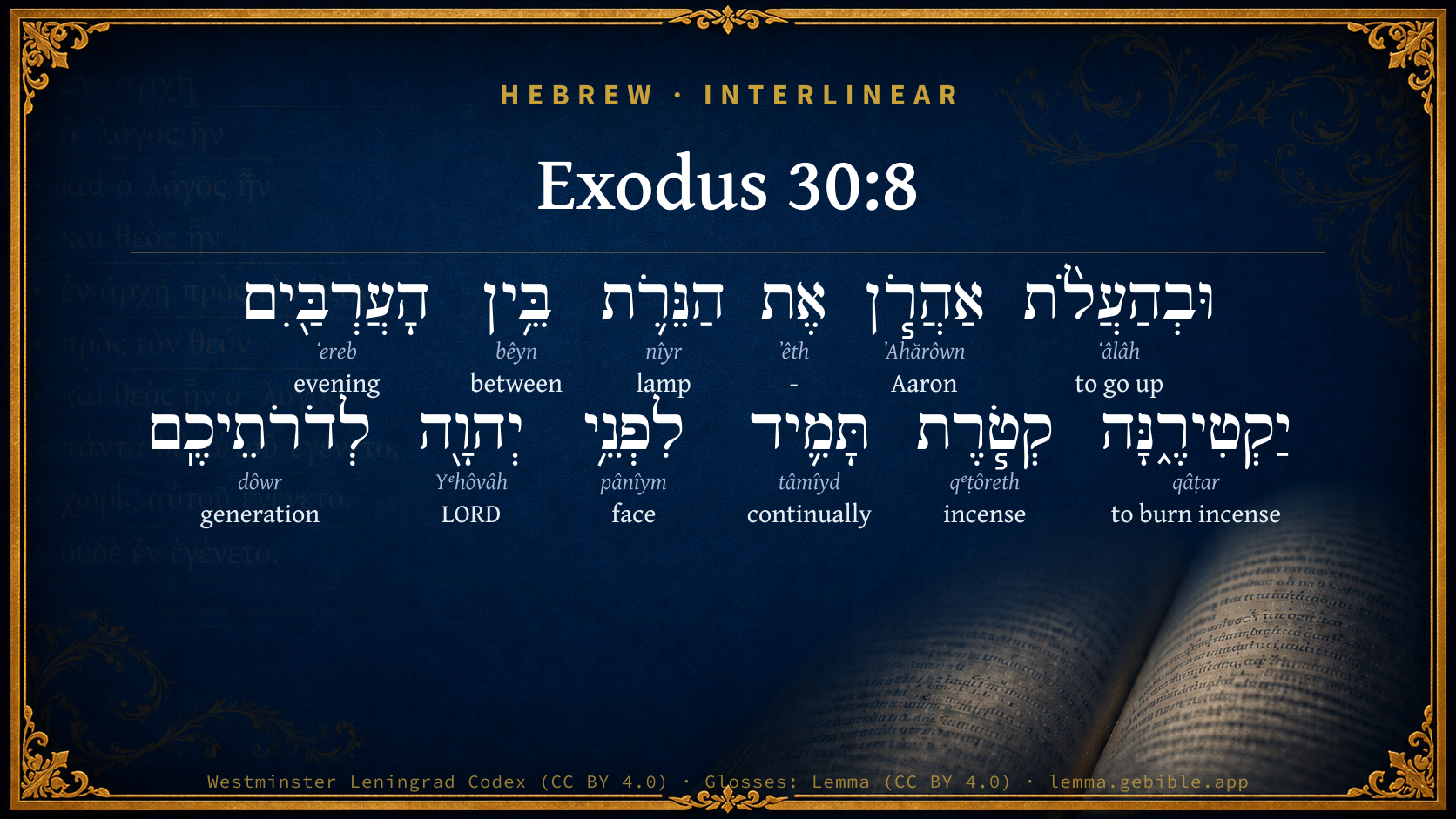
  1. וּבְהַעֲלֹ֨ת ʻâlâh H5927 “and · in/at · to go up” Conjunction + Preposition + Verb, Hiphil, Infinitive Construct
  2. אַהֲרֹ֧ן ʼAhărôwn H175 “Aaron” Noun, Proper
  3. אֶת ʼêth H853 “-” Particle, Direct Object
  4. בֵּ֥ין bêyn H996 “between” Preposition
  5. הָעֲרְבַּ֖יִם ʻereb H6153 “the · evenings” Particle, Definite Article + Noun, Common, Masculine, Dual, Absolute
  6. יַקְטִירֶ֑נָּה qâṭar H6999 “to burn incense · her” Verb, Hiphil, Imperfect, 3rd Person, Masculine, Singular + Suffix, Personal, 3rd Person, Feminine, Singular
  7. קְטֹ֧רֶת qᵉṭôreth H7004 “incense of” Noun, Common, Feminine, Singular, Construct
  8. תָּמִ֛יד tâmîyd H8548 “continually” Noun, Common, Masculine, Singular, Absolute
  9. לִפְנֵ֥י pânîym H6440 “to/for · face(s) of” Preposition + Noun, Common, Both, Plural, Construct
  10. יְהוָ֖ה Yᵉhôvâh H3068 “LORD” Noun, Proper
  11. לְדֹרֹתֵיכֶֽם dôwr H1755 “to/for · generations · your” Preposition + Noun, Common, Masculine, Plural, Construct + Suffix, Personal, 2nd Person, Masculine, Plural

About this verse

These counts appear in no published source. They are computed here, from the morphology-tagged text and Lemma’s own curated glosses. What Lemma adds →

12
words
12
distinct lemmas
Pentateuch
section

Shared distinctive vocabulary

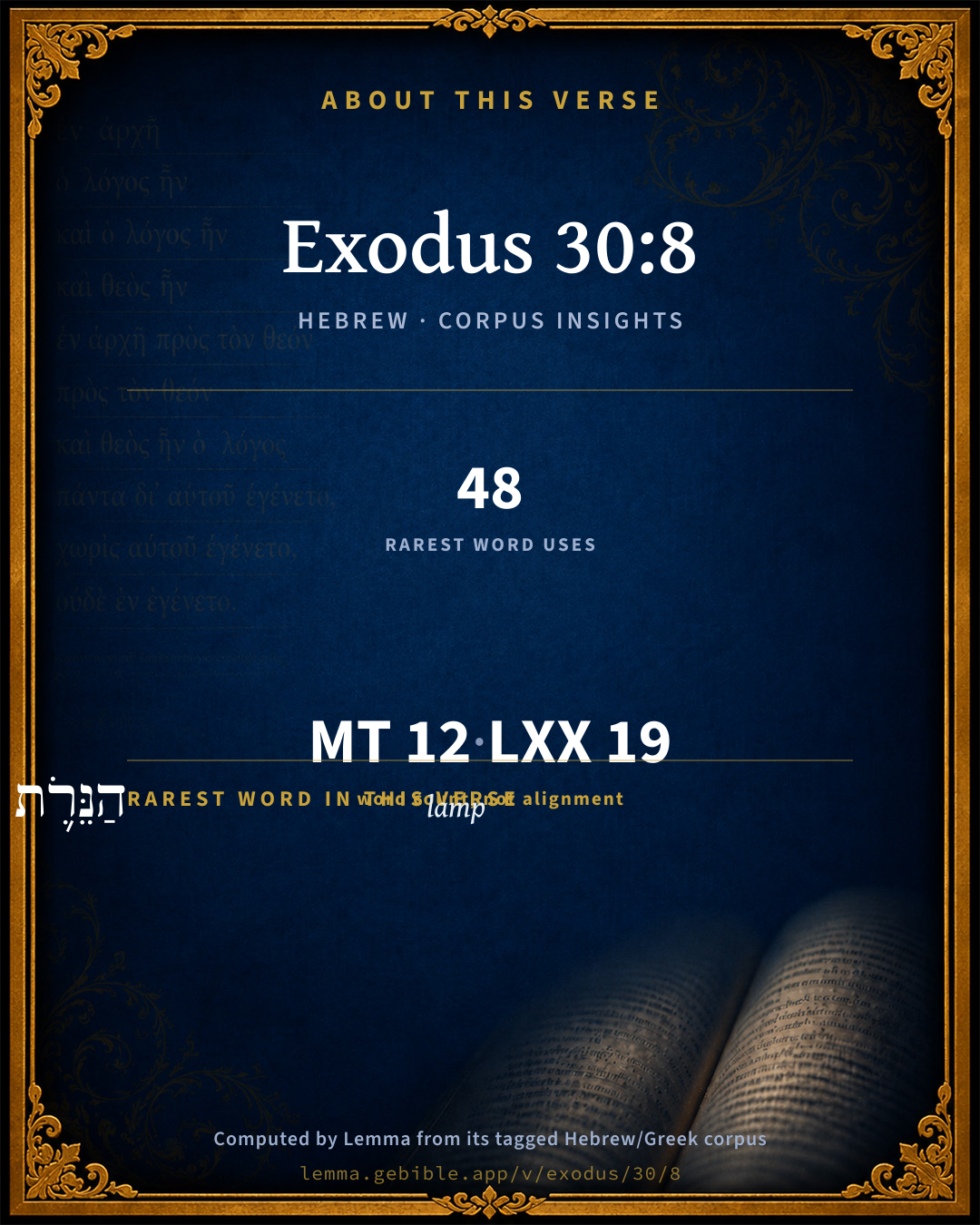
הַנֵּרֹ֛ת lamp H5216 occurs in 42 verses of the Hebrew Bible. Also found in:

Grammatical profile

  • 2 verbs
  • 8 nouns
  • 1 preposition
  • 1 particle

Verb forms

  • וּבְהַעֲלֹ֨ת Hiphil · Infinitive Construct
  • יַקְטִירֶ֑נָּה Hiphil · Imperfect

Hebrew & Septuagint length

In English translation the verse runs 19 words from the Hebrew and 25 from the Septuagint (LXX English) — closely comparable.

A rough comparison of the two English renderings, which tokenize alike — not a word-level alignment.

Word counts can differ between the Hebrew and the Greek without any difference in meaning — e.g. the Hebrew direct-object marker אֵת has no separate Greek word, and Greek often adds the article ὁ.

In the original languages it is 12 Hebrew tokens and 19 Greek tokens — but the two are counted differently (Hebrew bundles its prefixes and suffixes into one token; the Greek is in lemma form), so that isn’t a like-for-like length.

Cross-references

5

Topical passages linked to Exodus 30:8 in the Treasury of Scripture Knowledge — connected by theme and wording, ordered by reader-vote popularity; previews shown in the World English Bible.

  • Hebrews 9:24 For Christ hasn't entered into holy places made with hands, which are representations of the true, but into heaven itself, now to appear in the presence of God for us;
  • Exodus 12:6 and you shall keep it until the fourteenth day of the same month; and the whole assembly of the congregation of Israel shall kill it at evening.
  • Romans 8:34 Who is he who condemns? It is Christ who died, yes rather, who was raised from the dead, who is at the right hand of God, who also makes intercession for us.
  • 1 Thessalonians 5:17 Pray without ceasing.
  • Hebrews 7:25 Therefore he is also able to save to the uttermost those who draw near to God through him, seeing he ever lives to make intercession for them.

Cross-references courtesy of OpenBible.info (CC BY 4.0).

Hebrew and Greek witnesses Masoretic Hebrew ↔ Greek Septuagint

The same verse in the two great witnesses to the Old Testament, shown verse-for-verse.

These are two independent witnesses, not word-aligned to each other, and the Septuagint is shown in lemma (dictionary) form.

Hebrew Exodus 30:8 Masoretic · Westminster Leningrad Codex

וּבְהַעֲלֹ֨ת אַהֲרֹ֧ן אֶת הַנֵּרֹ֛ת בֵּ֥ין הָעֲרְבַּ֖יִם יַקְטִירֶ֑נָּה קְטֹ֧רֶת תָּמִ֛יד לִפְנֵ֥י יְהוָ֖ה לְדֹרֹתֵיכֶֽם

When Aaron lights the lamps at evening, he shall burn it, a perpetual incense before Yahweh throughout your generations.

World English Bible · Public Domain

Greek LXX Exodus 30:8 Septuagint · lemma form

καί ὅταν ἐκἅπτω ααρων ὁ λύχνος ὀψέ θυμιάω ἐπί αὐτός θυμίαμα ἐνδελεχισμός διά πᾶς ἔναντι κύριος εἰς γενεά αὐτός

And when Aaron lights the lamps in the evening, he shall burn incense upon it; a constant incense-offering always before the Lord for their generations.

LXX2012 (modern English Septuagint) · Public Domain

Hebrew: Westminster Leningrad Codex (CC BY 4.0). Greek: Septuagint (public domain); English from LXX2012 (modern English Septuagint) (Public Domain). How the Septuagint differs from the Hebrew →

Targum (Aramaic paraphrase)

2

The Targum is the ancient Jewish Aramaic paraphrase of the Hebrew Scriptures — an interpretive translation, not the Hebrew text itself. Onkelos (literal) and Pseudo-Jonathan (expansive) render the Torah, and Jonathan the Prophets. Coverage is partial: where no permissively-licensed English translation exists for a verse, only the Aramaic is shown. This is verse-level text, not a word-by-word alignment to the Hebrew.

  1. Targum Onkelos Torah (Genesis–Deuteronomy)
    וּבְאַדְלָקוּת אַהֲרֹן יָת בּוֹצִינַיָא בֵּין שִׁמְשַׁיָא יַסֵקִנַהּ קְטוֹרֶת בּוּסְמַיָא תְדִירָא קֳדָם יְיָ לְדָרֵיכוֹן:

    (no public-domain English translation for this verse)

    Targum Onkelos — Aramaic: “Onkelos Genesis” (public domain); “Onkelos Exodus” (public domain); “Onkelos Leviticus” (public domain); “Onkelos Numbers” (public domain); “Onkelos Deuteronomy” (public domain). English: “Sefaria Community Translation” (CC0 1.0 (public-domain dedication)); “J.W. Etheridge. The Targums of Onkelos and Jonathan Ben Uzziel on the Pentateuch. London: Longmans, Green, 1862” (public domain). Text via Sefaria.

  2. Targum Pseudo-Jonathan Torah (Genesis–Deuteronomy)
    וּבְאַדְלָקוּת אַהֲרן יַת בּוֹצִינַיָא בֵּינֵי שִׁמְשְׁתָא יַקְטְרִינָהּ קְטוֹרֶת בּוּסְמִין תְּדִירָא קֳדָם יְיָ לְדָרֵיכוֹן

    And when Aharon kindleth the lamps between the evenings, he shall burn sweet incense perpetually before the Lord in your generations.

    Targum Pseudo-Jonathan — Aramaic: “Targum Jonathan on Genesis” (public domain); “Targum Jonathan on Exodus” (public domain); “Targum Jonathan on Leviticus” (public domain); “Targum Jonathan on Numbers” (public domain); “Targum Jonathan on Deuteronomy” (public domain). English: “The Targum of Jonathan ben Uzziel, trans. J. W. Etheridge, London, 1862” (public domain). Text via Sefaria.

Commentary

Notes on Exodus 30:8 from classic Christian and Jewish commentators (each source and its license shown beneath its notes). The classic Christian expositions comment on the surrounding passage and are grouped to its opening verse, so a note may address several verses; the Jewish commentaries on the Tanakh (Rashi and others) are per-verse, so they appear only where the commentator wrote on this verse.

Lemma curates 59 commentaries, every one of them public domain or Creative Commons licensed, each selected and text-cleaned for this edition rather than reprinted as found. About our sources →

Trapp's Complete Commentary

John Trapp

Exo 30:8 And when Aaron lighteth the lamps at even, he shall burn incense upon it, a perpetual incense before the LORD throughout your generations.

Ver. 8. And when Aaron lighteth the lamps.] To show that our prayers must be made according to the light and direction of God’s Word, lest we ask we know not what, and worship we know not how.

John Trapp, A Commentary or Exposition upon All the Books of the Old and New Testament (1647–1656) — public domain. Text from a community e-Sword module.

The Biblical Illustrator

Joseph S. Exell

Exo_30:8

Burn incense upon it.

Incense

All religious ceremony and ritual is a picture, in external and material form, and upon a lower platform, of something higher, properly religious. Now this altar of incense had a very distinct meaning.

I. The first thing that I want to point out is what a lovely, significant, and instructive symbol of prayer the incense is. Now what were the aspects of prayer suggested by the symbolism?

1. First of all, I suppose that the essence of it is the ascent of a mans soul to God. To enter into thyself is to ascend to God. To go deep down into thine own heart is to go straight up to the Father in heaven. Incense is prayer, because incense surely wreathes itself upwards to God.

2. Let us learn another lesson from the incense, and that is that the prayer which ascends must be the prayer that comes from a fire. The incense only climbs when it is hot.

3. The kindled incense gave forth fragrant odours. When we present our prayers, they rise up acceptable to God in curling wreaths of fragrance that He accepts.

II. Notice the position of the altar of incense in relation to the rest of the sanctuary. It stood in the holy place, midway between the outer court, where the whole assembly of worshippers were in the habit of meeting, and the holiest of all. It stood in a right line betwixt the outer court and the mercy-seat, where the symbolical presence of God was visible in the Shekinah: and whosoever approached the altar of incense had to pass by the altar of sacrifice: and whosoever was on his way to the holiest of all had to pass by the altar of incense. All prayer must be preceded by the perfect sacrifice; and my prayer must be offered on the footing of that perfect Sacrifice which Christ Himself has offered. And so you and I remember the Altar of Sacrifice whenever we say, For Christs sake.

Amen. And if we mean anything by these words except the mere empty formula, we mean this:--I stand here, and venture to put my grains of incense upon the altar, because He died yonder upon the Cross, that I might pass into the Holy Place. The prayer that goes another way round, and does not pass by the Altar of Sacrifice, is not the prayer that God desires and accepts. And, still further, let me remind you that, as I said, whosoever was on his road into the holiest of all had to pass by the altar of incense. That is to say, there is no true communion of spirit with God, except on condition of habitual prayer, and they that are strangers to the one, are strangers to the other.

III. The perpetuity of this offering. Morning and evening the incense was piled up and blown into a flame, and all the day and night it smouldered quietly on the altar; that is to say, special seasons and continual devotion, morning and evening kindled, heaped up, and all the day and night glowing. And dim lives may still, like the priests in this ritual, pile up the incense on the altar at fixed seasons, sure that if we do, it will glow there all the day long. But only remember, there is not much chance of a mans devotion being continuous unless he has, and sticks to, his fixed seasons for formal and verbal supplication.

IV. This altar that bore the perpetual incense, once a year aaron had to offer a sacrifice of expiation for it. It was never used for anything except the laying upon it of the fragrant incense, and yet yearly this sacrifice to cleanse it from defilement was duly presented. Now why was that? Was it not in order to express the profound feeling that the purest worship is stained, and that howsoever clear and exclusive may be the occupation and the use of this altar for the one solemn purpose, the iniquities of the offerers had defiled it. Let us be thankful that we have a great High Priest who truly cleanses us from the infirmities of our worship, and bears the iniquities of our natures, and is ever ready to aid our prayers with the incense of His own sacrifice, that all their imperfections may be washed away, and they and we received and made acceptable in His sight. (A. Maclaren, D. D.)

The altar of incense

The altar of incense was made of acacia wood, and stood about a yard high and eighteen inches square. The altar and incense were symbolic--

I. Of the prayers of Gods people.

1. In prayer we speak to God and tell Him the thoughts of our minds, the feelings of our hearts, the desires of our spirits. The incense smoke ascended, arrow-like, in a straight and most direct column to heaven. Our prayers ascend immediately and in the directest way to the heart and ear of God.

2. In prayer we stand very near God. The altar of incense was placed before the mercy-seat.

3. The pleasant odour of the incense is symbolic of the acceptableness of prayer.

II. Of intelligent, unceasing, and reverent prayer.

1. The burning of incense is intelligent prayer. It took place in the light; and our prayers should be presented to God intelligently.

2. Unceasing prayer. It was a perpetual incense before the Lord.

3. Reverent prayer (Exo_30:9)

III. Of prayer offered in Christs name. Aaron sprinkled the golden horns, with the blood of atonement. This act is typical of the offering of prayer in the name of Christ.

IV. Of the power of prayer. The horns of the altar symbolize power. The effectual fervent prayer of a righteous man availeth much (D. R. Jenkins.)

The altar of incense

I. We gather our first lesson from the shape and position of this altar. The altar was four-square. The same measure and estimate were thus presented every way, whether towards God, or towards man. But the squareness of the altar also denoted the stability of the service connected with it. Prayer and praise are not temporary things. Prayer indeed will be confined to earth, for it is the language of want. But praise waiteth for God in the heavenly, as well as in the earthly Zion.

II. Our second lesson from the golden altar is taught us by the condition necessary to the offering of its incense, viz., that there be a fire burning on it.

1. This incense on the altar typified the intercession of Christ. But the fragrance of the incense could not be brought out, nor its efficacy put forth till the action of fire was employed. And these burning coals on the golden altar, to what do they point us in this view of our subject but the sufferings of Christ? It behoved Christ to suffer.

2. The golden censer on this altar, with the incense rising from it, denotes, we know, the prayers of Gods people (see Rev_8:3-4). Here again we see that the incense could yield no fragrance without fire. The priest put it on the live coals, and then the odorous clouds went fuming up, a sweet savour, acceptable to God. And here we are taught in a most significant way, the necessity of heartiness in our worship if we would have it well-pleasing to God.

III. Our third lesson from this altar is taught us by the continuousness of the incense upon it. How beautifully this points us to Jesus, His offering, once made upon the brazen altar, was never repeated; and so the incense of His merits, once thrown upon the fire on the golden altar, never needs to be repeated. The intercession of Christ is uninterrupted.

IV. Our fourth lesson from this subject is furnished by observing the connection of the altar of incense with both the outer and inner sanctuary. Now we know that the outer part of the sanctuary, or the holy place, represented the Church on earth; while the inner part, or the most holy place, represented the Church in heaven. The lesson taught us by the part of the subject now before us is, that the golden altar, with its incense, belongs alike to both these departments of the Church of Christ. All the service performed, and all the joy experienced by the redeemed in the Church on earth is based upon the sacrifice of Christ, and connected with the incense of His merits. And the same will be true of the redeemed in the Church in heaven.

V. Our fifth and last lesson from this subject is gathered from the nature and composition of the incense offered upon the golden altar. Now, observe this incense was composed of four substances. Three of these, onycha, stacte, and galbanum, were substances entirely unknown to us. These may point to the divinity of Christ, in the mysteriousness of its connection with His death and sacrifice. The frankincense was a substance with which we are acquainted. It may represent the humanity of Christ. This we know and understand, for it was like our own, in all respects, save that it was free from sin. The elements composing this incense were mingled together in equal parts. This seems to point significantly to the entire and perfect harmony of character which distinguished our glorious Saviour. There was nothing out of place in Him. Again, the materials of which the incense was composed had to be beaten into small particles, or reduced to powder before it was prepared to give out its rich fragrance. And so Jesus, our glorious Saviour, had to be brought very low, and stoop to the most wondrous humiliation, before the golden censer of His merits could yield those sweet odours which are so refreshing to the souls of His people, and at the same time so well pleasing to God, and so efficacious to secure our acceptance before Him. (R. Newton, D. D.)

Incense and light

I desire to call your attention to the conjunction which was established by the Divine law between the burning of the incense and the lighting of the lamps; these two things, being both of daily observance, were attended to at the same moment for reasons worthy of our study.

I. And first I call your attention to the wonderful co-operation between the intercession of Christ for us, and the work of the Holy Spirit in us.

1. Note, that we have these both revealed in their fulness at the same time. When our Lord ascended on high to plead before the throne, the Spirit descended to abide in the Church. After the Lord was taken up the disciples received the promise of the Father and were illuminated by the Holy Ghost.

2. Now, as they were connected historically, so are they continually connected as a matter of fact. Herein lies our hope for our own eternal salvation, in the ceaseless plea and the quenchless light.

3. Furthermore, this conjunction, as it is a matter of history, and as it is continuous, will always be seen by us personally when our prayer is the effectual fervent prayer of a righteous man that availeth much.

4. That in Gods drawing near to man there is the same conjunction of incense and light. If the glory of God were to come forth from between the cherubim, if it should come past the veil to be revealed throughout the world, that glory would pass by these two, the golden altar of incense and the golden lamp of light. I mean this: God can have no dealing with men at all except through the merit of Christ and the light of the Spirit.

II. Secondly, our text seems to teach the connection between prayer and knowledge. The golden altar represents intercession offered by Christ, and also the prayers of all the saints, which are accepted through His intercession; and as the candlestick stood side by side with it, and represented the light of the Spirit of truth, so must true prayer and true knowledge never be separated.

1. So I gather, first, that prayer should be attended with knowledge. It is ill when men worship they know not what. God is light, and He will not have His people worship Him in the dark. When they burn the incense they must also light the lamp.

2. But now turn the thought round the other way--knowledge should always be accompanied by prayer. Revealed truth is as a church-bell summoning us to come into the presence of the Lord, and bow the knee before Him.

III. I desire, in the third place, to show some special practical connection between the incense and the lamp. And Aaron shall burn thereon sweet incense every morning: when he dresseth the lamps, he shall burn incense upon it. So, then, there should be prayer especially at the dressing of the lamps: that is to say, when preparing our minds for that ministry by which we enlighten the people among whom we dwell we should be specially earnest in prayer. Dr. Adam Clarke used to say to young ministers, Study yourselves dead, and then pray yourselves alive again; and that is an excellent rule. One thing more, this burning of the incense was not only at the dressing of the lamps, but also at the kindling of the lamps, when they began to shine. I want to plead very heartily with you that when it is my privilege to come here this week and at all other times to light the lamps, you who are my beloved helpers will take care to burn the incense at the same time. We need the incense of prayer more than ever in these latter days. (C. H. Spurgeon.)

The altar of incense

This altar of incense may remind us of many things concerning prayer.

I. Its size: not very large, the smallest altar. A good prayer need not be long. God knows what we have need of. Like the Lords Prayer, it may include much.

II. Its design: symmetrical. Prayers should not be one-sided, but well-proportioned. Not all about one thing, or too many things. There was a simple beauty about the altar. Four-square, crown of gold.

III. Its material: choice, the best wood and metal. In prayer there may be the word of human infirmity and need; but there must be the fine gold of truth, etc.

IV. Its place: in the holy place, in front of the vail that concealed the most holy. There should be prayer before entering Gods house, as well as inside the house.

V. Its use: to burn incense, offering to God of holy desire, thanksgiving, praise. Note--

1. This incense, carefully compounded of the most precious ingredients. Not to be used for ordinary purposes. Prayer is holy to the Lord.

2. The lamp was lighted opposite when the incense was kindled. Prayer needs Divine illumination: should bear the light as being without hypocrisy.

3. The incense was burnt morning and evening. Our days should begin and end with prayer. (Biblical Museum)

.

The altar of incense

Consider this as--

I. A typical institution. Notice here--

1. Its daily use.

2. Its annual expiation.

II. An emblematic rite. In this view it marks--

1. The privilege of Christians.

2. The ground of their acceptance. Application:

(1) How highly we are privileged under the Christian dispensation.

(2) What a holy people we should be unto the Lord. (C. Simeon, M. A.)

The altar of incense

At the west end of the outer apartment, in front of the curtain which separated it from the holy of holies, stood the altar of incense, three feet high, with four equal sides, each one foot and six inches in horizontal measure. It consisted of a frame of acacia wood, with horns of the same material at the four upper corners; plated over all the external surface with gold. It was not left open at the top, like the great altar of burnt-offering, but covered with a board of acacia wood, overlaid with gold like the four vertical sides; and this cover is designated by the word which signifies the roof of a house. Like the ark and the table, it had rings for convenience in transporting it, and a pair of gilded staves, which, however, did not remain in the rings when the altar was in place. Just above the rings was a crown, or cincture, of the kind affixed to the ark and the table. The incense was probably burned in a censer placed on the top of the altar; the ashes remaining in, and being carried away with, the censer. (E. E. Atwater.)

The Biblical Illustrator, edited by Joseph S. Exell (c. 1880s–1900s) — public domain. Text from a community e-Sword module.

Jamieson, Fausset & Brown

Robert Jamieson, A. R. Fausset & David Brown

Aaron shall burn incense--seemingly limiting the privilege of officiating at the altar of incense to the high priest alone, and there is no doubt that he and his successors exclusively attended this altar on the great religious festivals. But "Aaron" is frequently used for the whole priestly order, and in later times, any of the priests might have officiated at this altar in rotation (Luk 1:9).

Jamieson, Fausset & Brown — Commentary Critical and Explanatory on the Whole Bible (1871) — public domain (CC PDM 1.0). Text via the HelloAO Bible API.

The Cambridge Bible for Schools and Colleges

gen. ed. J. J. S. Perowne

8. lighteth] fixeth on: see on Exo_25:37.

at even] between the two evenings, as Exo_29:39 : see on Exo_12:6.

perpetual] better, continual: the expression is a standing one; see on Exo_29:42.

before Jehovah] as Exo_29:25, and constantly in the priestly laws.

The Cambridge Bible for Schools and Colleges (gen. ed. J. J. S. Perowne; Cambridge University Press, 1878–1918) — public domain. Text from a community e-Sword module.

John Gill's Exposition

And when Aaron lighteth the lamps at even, he shall burn incense upon it,.... In the evening the priest went into the holy place to light the lamps that were gone out; see Gill on Exo 27:20 at the same time he burnt incense on the altar; and as the daily sacrifice was offered up morning and evening, so the incense was burnt every morning and evening, and much about the same time: the Jews say (t), that the incense of the morning was offered between the blood (i.e. the sprinkling of the blood of the daily sacrifice) and the members, or the laying of the pieces on the altar; and the incense of the evening was between the pieces and the drink offering: and with this Philo agrees (u), who says, twice every day most fragrant odours were offered, at the sun rising and setting, before the morning and after the evening sacrifice:

a perpetual incense before the Lord throughout your generations; thus Christ's mediation and intercession is constant and continual; as his sacrifice continually takes away the sin of the world, in which it was the antitype of the daily sacrifice; so his blood continually speaks for peace and pardon, and every blessing of grace for his people, in which it is the antitype of the morning and evening incense; for he ever lives to make intercession; and so the prayers of the saints are directed to God both morning and evening, and they cease not praying as long as they live.

(t) Misn. Yoma, c. 3. sect. 4. (u) De Victimis, p. 836.

John Gill's Exposition of the Whole Bible (1746–1763) — public domain (CC PDM 1.0). Text via the HelloAO Bible API.

Matthew Poole's English Annotations

The even was the time when all the lamps were to be lighted, 1Sa 3:3. See Poole on "Exo 27:20", See Poole on "Exo 27:21".

Matthew Poole's English Annotations on the Holy Bible (1683–1685) — public domain. Text from a community e-Sword/MySword module.

The Pulpit Commentary

At even. Literally, "between the two evenings." (See the comment on Exo_12:6) The offering of incense by the high priest twice a day, at the time of the morning and evening sacrifice, indicated that prayer was needed as constantly as expiation, and that neither might for a single day be intermitted. A perpetual incense. "Perpetual," in the sense that it was to be burnt twice a day, as long as the religion lasted not in the sense that it was to be kept burning constantly.

The Pulpit Commentary (1880–1919), ed. H.D.M. Spence-Jones & Joseph S. Exell — public domain. Text from a community e-Sword module.

Rashi

Rabbi Shlomo Yitzchaki (Rashi)

ובהעלת means when he kindles them by making their flame ascend (cf. Rashi on Exodus 27:20 and on Numbers 8:2).

יקטירנה HE SHALL BURN IT [A CONTINUAL INCENSE] — תמיד, “continual”, means every day regularly: a half he burnt in the morning and a half he burnt in the evening (Keritot 6b).

Rashi on the Tanakh — English translations: “The Judaica Press complete Tanach with Rashi, translated by A. J. Rosenberg” (CC BY 4.0); “Pentateuch with Rashi's commentary by M. Rosenbaum and A.M. Silbermann, 1929-1934” (public domain); “The Metsudah Tanach series, Lakewood, N.J” (CC BY 4.0); and “The Book of Joshua, Metsudah Publications, 1997” (CC BY 4.0). Text via Sefaria.

Lesson kit

Teaching starters — assembled from the data on this page, not authored interpretation. Every prompt links to the verse data it draws on. Edit before teaching.

Exodus, in the Pentateuch, opens this verse with 12 words (12 distinct Hebrew lemmas). Its most distinctive word is nîyr (“lamp”). A historical commentator’s framing appears above. Read the whole chapter for the surrounding context.

Discussion questions

  1. How does “lamp” (nîyr) shape what this verse is saying?
  2. How does Exodus 25:37, which shares the word «lamp», read alongside this verse?
  3. These translations render this verse differently; the difference is in the English rendering, not the original. What questions does that raise?
  4. «וּבְהַעֲלֹ֨ת» is a Hiphil Infinitive Construct verb. How does that grammatical form shape the action described?
  5. Compare how Trapp's Complete Commentary and The Biblical Illustrator read this verse. Where do they agree or differ?

Things to notice

Reading settings

Reading text

Shown beneath each verse's original-language words.

Old Testament
Old Testament edition

Read the OT as the Masoretic Hebrew (MT) or the Greek Septuagint (LXX).

English shown for the Greek Septuagint (in the Hebrew ↔ Greek comparison).

Comparing translations? Open the Compare panel on any verse page to stack up to four side by side.