Zechariah 14:19

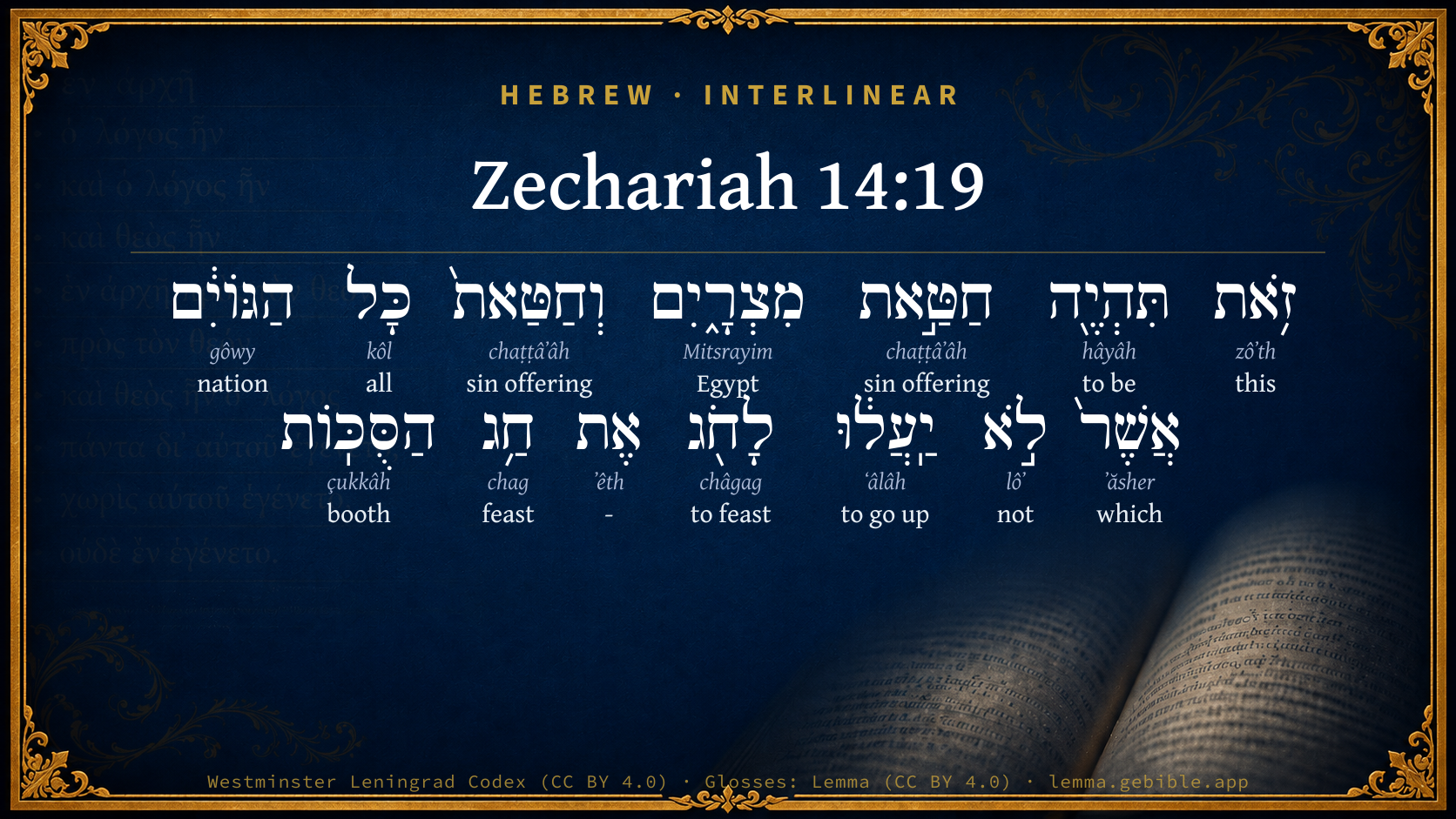
Hebrew (Westminster Leningrad Codex) Zechariah 14:19 appears in the Hebrew Old Testament. The text above is from the Westminster Leningrad Codex. Each word links to its Strong’s number, a concise gloss, and parsing drawn from the Open Scriptures Hebrew Bible morphology. Click any word for its full Brown-Driver-Briggs (BDB) entry.
Download image
Cite this verse

Zechariah 14:19 (World English Bible). Public Domain. Lemma interlinear Bible study tool, https://lemma.gebible.app/v/zechariah/14/19.

Show BibTeX & RIS
BibTeX
RIS
English Translation
This will be the punishment of Egypt, and the punishment of all the nations that don't go up to keep the feast of tents.
World English Bible · Public Domain
Download a study sheet

One document with this verse’s original text, its word-by-word gloss line, the meaning frame, cross-references with their text, attributed commentary, and full source and license credits — printable, and it pastes into notes with its structure intact.

This verse Autodidact and up

Study sheet (.html) Plain text (.txt)

A passage Seminary Student

Up to 50 verses in one chapter. A passage sheet keeps up to 6 commentary sources and 12 cross-references per verse, in the order this page ranks them, and says so on the sheet whenever that leaves anything out. Ask for a single verse and you get the Autodidact verse sheet above.

Everything on this page stays free to read, with no account — the sheet is a download of what is already on screen, not access to it.

Want to remove ads? Support Godless Engineer
Compare translations 3

The same verse in 3 English versions, stacked beneath the original-language interlinear above. Click any original word for its lexicon entry.

Each is an independent rendering of the whole verse — the interlinear is not word-aligned to these translations.

Highlighted words mark where these versions differ — a whole-verse word diff, not a word-by-word alignment.

  • World English Bible Public Domain
    This will be the punishment of Egypt, and the punishment of all the nations that don't go up to keep the feast of tents.
  • King James Version Public Domain
    This shall be the punishment of Egypt, and the punishment of all nations that come not up to keep the feast of tabernacles.
  • unfoldingWord Literal Text CC BY-SA 4.0
    This will be the punishment for Egypt and the punishment for every nation that does not go up to keep the Festival of Shelters.

unfoldingWord Literal Text — © unfoldingWord, licensed CC BY-SA 4.0. Word-aligned USFM3 via Door43 (git.door43.org/unfoldingWord/en_ult).

Versions to compare (up to 4)

3 of 4 selected

Show all 18 translations

Every available English version of this verse, each an independent rendering of the whole verse.

  • World English Bible Public Domain
    This will be the punishment of Egypt, and the punishment of all the nations that don't go up to keep the feast of tents.
  • Berean Standard Bible Public Domain
    This will be the punishment of Egypt and of all the nations that do not go up to celebrate the Feast of Tabernacles.
  • Majority Standard Bible Public Domain
    This will be the punishment of Egypt and of all the nations that do not go up to celebrate the Feast of Tabernacles.
  • King James Version Public Domain
    This shall be the punishment of Egypt, and the punishment of all nations that come not up to keep the feast of tabernacles.
  • American Standard Version (1901) Public Domain
    This shall be the punishment of Egypt, and the punishment of all the nations that go not up to keep the feast of tabernacles.
  • Revised Version (1885) Public Domain
    This shall be the punishment of Egypt, and the punishment of all the nations that go not up to keep the feast of tabernacles.
  • Geneva Bible (1599) Public Domain
    This shall be the punishment of Egypt, and the punishment of all the nations that come not vp to keepe the feast of Tabernacles.
  • Douay-Rheims (1899) Public Domain
    This shall be the sin of Egypt, and this the sin of all nations, that will not go up to keep the feast of tabernacles.
  • Young's Literal Translation Public Domain
    This is the punishment of the sin of Egypt, And the punishment of the sin of all the nations, That go not up to celebrate the feast of booths.
  • Literal Standard Version CC BY-SA 4.0
    This is the punishment of the sin of Egypt, || And the punishment of the sin of all the nations, || That do not go up to celebrate the Celebration of Shelters.
  • Unlocked Literal Bible CC BY-SA 4.0
    This will be the punishment for Egypt and the punishment for every nation that does not go up to keep the Festival of Shelters.
  • unfoldingWord Literal Text CC BY-SA 4.0
    This will be the punishment for Egypt and the punishment for every nation that does not go up to keep the Festival of Shelters.
  • Darby Bible Public Domain
    This shall be the punishment of Egypt, and the punishment of all the nations that go not up to celebrate the feast of tabernacles.
  • World Messianic Bible Public Domain
    This will be the punishment of Egypt and the punishment of all the nations that don’t go up to keep the feast of booths.
  • Webster's Bible Public Domain
    This shall be the punishment of Egypt, and the punishment of all nations that come not up to keep the feast of tabernacles.
  • Free Bible Version CC BY-SA 4.0
    This will be the punishment on Egypt and all the nations if they do not go to Jerusalem and celebrate.
  • Bible in Basic English Public Domain
    This will be the punishment of Egypt, and the punishment of all the nations who do not go up to keep the feast of tents.
  • JPS Tanakh (1917) Public Domain
    This shall be the punishment of Egypt, and the punishment of all the nations that go not up to keep the feast of tabernacles.

Literal Standard Version (2020), Covenant Press — licensed CC BY-SA 4.0. Text via the HelloAO Bible API (eBible.org). Unlocked Literal Bible (unfoldingWord) — licensed CC BY-SA 4.0. Text via the HelloAO Bible API (eBible.org). unfoldingWord Literal Text — © unfoldingWord, licensed CC BY-SA 4.0. Word-aligned USFM3 via Door43 (git.door43.org/unfoldingWord/en_ult). Free Bible Version, Dr. Jonathan Gallagher — licensed CC BY-SA 4.0. Text via the HelloAO Bible API (eBible.org).

Word by word

More ways to search: Search by grammar → Find every occurrence → Compare this word →

Practice this passage: Drill this verse → Learn its vocabulary →

לָחֹ֖ג
châgag
H2287
“to feast”
Preposition + Verb, Qal, Infinitive Construct
Part of Speech
Preposition + Verb
Stem
Qal
Form
Infinitive Construct
Full BDB Definition

Origin: a primitive root [compare H2283 , H2328 ]

TWOT: 602

to hold a feast, hold a festival, make pilgrimage, keep a pilgrim-feast, celebrate, dance, stagger - (Qal) - to keep a pilgrim-feast - to reel
  1. זֹ֥את zôʼth H2063 “this” Pronoun, Demonstrative, Feminine, Singular
  2. תִּהְיֶ֖ה hâyâh H1961 “to be” Verb, Qal, Imperfect, 3rd Person, Feminine, Singular
  3. חַטַּ֣את chaṭṭâʼâh H2403 “sin offering of” Noun, Common, Feminine, Singular, Construct
  4. מִצְרָ֑יִם Mitsrayim H4714 “Egypt” Noun, Proper
  5. וְחַטַּאת֙ chaṭṭâʼâh H2403 “and · sin offering of” Conjunction + Noun, Common, Feminine, Singular, Construct
  6. כָּל kôl H3605 “all of” Noun, Common, Masculine, Singular, Construct
  7. הַגּוֹיִ֔ם gôwy H1471 “the · nations” Particle, Definite Article + Noun, Common, Masculine, Plural, Absolute
  8. אֲשֶׁר֙ ʼăsher H834 “which” Particle, Relative
  9. לֹ֣א lôʼ H3808 “not” Particle, Negative
  10. יַֽעֲל֔וּ ʻâlâh H5927 “to go up” Verb, Qal, Imperfect, 3rd Person, Masculine, Plural
  11. אֶת ʼêth H853 “-” Particle, Direct Object
  12. חַ֥ג chag H2282 “feast of” Noun, Common, Masculine, Singular, Construct
  13. הַסֻּכּֽוֹת çukkâh H5521 “the · booths” Particle, Definite Article + Noun, Common, Feminine, Plural, Absolute

About this verse

These counts appear in no published source. They are computed here, from the morphology-tagged text and Lemma’s own curated glosses. What Lemma adds →

14
words
13
distinct lemmas
Prophets
section

Notable vocabulary

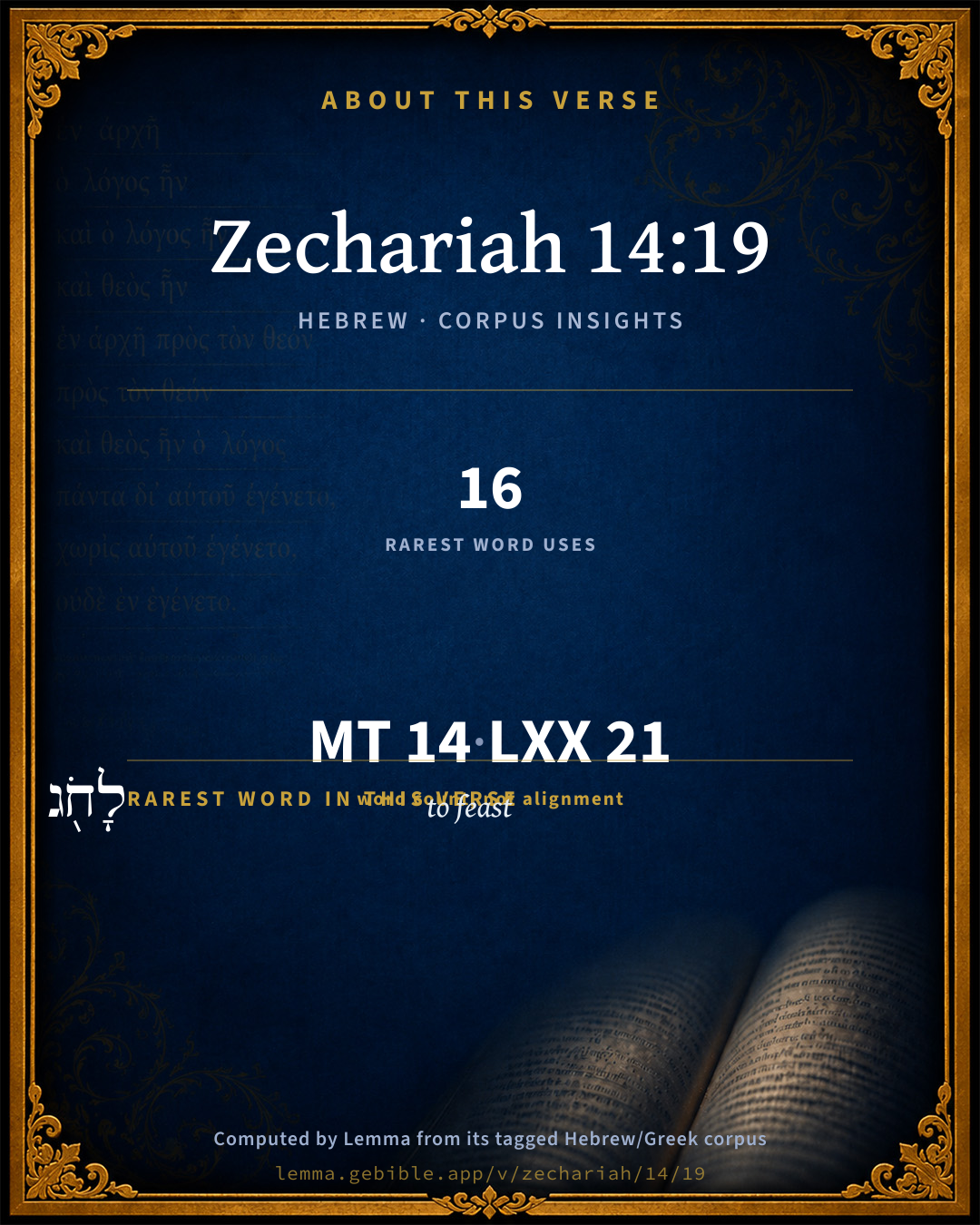
The rarest word here is לָחֹ֖ג to feast H2287 — appearing just 16 times in the whole Hebrew Bible.

Shared distinctive vocabulary

לָחֹ֖ג to feast H2287 occurs in 14 verses of the Hebrew Bible. Also found in:

Grammatical profile

  • 3 verbs
  • 7 nouns
  • 1 pronoun
  • 3 particles

Verb forms

  • תִּהְיֶ֖ה Qal · Imperfect
  • יַֽעֲל֔וּ Qal · Imperfect
  • לָחֹ֖ג Qal · Infinitive Construct

Repetition

A word recurs within this verse — often emphatic in Hebrew:

  • חַטַּ֣את sin offering H2403 ×2

Hebrew & Septuagint length

In English translation the verse runs 24 words from the Hebrew and 25 from the Septuagint (LXX English) — closely comparable.

A rough comparison of the two English renderings, which tokenize alike — not a word-level alignment.

Word counts can differ between the Hebrew and the Greek without any difference in meaning — e.g. the Hebrew direct-object marker אֵת has no separate Greek word, and Greek often adds the article ὁ.

In the original languages it is 14 Hebrew tokens and 21 Greek tokens — but the two are counted differently (Hebrew bundles its prefixes and suffixes into one token; the Greek is in lemma form), so that isn’t a like-for-like length.

Cross-references

1

Topical passages linked to Zechariah 14:19 in the Treasury of Scripture Knowledge — connected by theme and wording, ordered by reader-vote popularity; previews shown in the World English Bible.

  • John 3:19 This is the judgment, that the light has come into the world, and men loved the darkness rather than the light; for their works were evil.

Cross-references courtesy of OpenBible.info (CC BY 4.0).

Hebrew and Greek witnesses Masoretic Hebrew ↔ Greek Septuagint

The same verse in the two great witnesses to the Old Testament, shown verse-for-verse.

These are two independent witnesses, not word-aligned to each other, and the Septuagint is shown in lemma (dictionary) form.

Hebrew Zechariah 14:19 Masoretic · Westminster Leningrad Codex

זֹ֥את תִּהְיֶ֖ה חַטַּ֣את מִצְרָ֑יִם וְחַטַּאת֙ כָּל הַגּוֹיִ֔ם אֲשֶׁר֙ לֹ֣א יַֽעֲל֔וּ לָחֹ֖ג אֶת חַ֥ג הַסֻּכּֽוֹת

This will be the punishment of Egypt, and the punishment of all the nations that don't go up to keep the feast of tents.

World English Bible · Public Domain

Greek LXX Zechariah 14:19 Septuagint · lemma form

οὗτος εἰμί ὁ ἁμαρτία αἴγυπτος καί ὁ ἁμαρτία πᾶς ὁ ἔθνος ὅσος ἄν μή ἀναβαίνω ὁ ἑορτάζω ὁ ἑορτή ὁ σκηνοπηγία

This shall be the sin of Egypt, and the sin of all the nations, whoever shall not come up to keep the feast of tabernacles.

LXX2012 (modern English Septuagint) · Public Domain

Hebrew: Westminster Leningrad Codex (CC BY 4.0). Greek: Septuagint (public domain); English from LXX2012 (modern English Septuagint) (Public Domain). How the Septuagint differs from the Hebrew →

Targum (Aramaic paraphrase)

1

The Targum is the ancient Jewish Aramaic paraphrase of the Hebrew Scriptures — an interpretive translation, not the Hebrew text itself. Onkelos (literal) and Pseudo-Jonathan (expansive) render the Torah, and Jonathan the Prophets. Coverage is partial: where no permissively-licensed English translation exists for a verse, only the Aramaic is shown. This is verse-level text, not a word-by-word alignment to the Hebrew.

  1. Targum Jonathan Prophets (Joshua–Malachi)
    דָא תְהֵי פוּרְעֲנוּת מִצְרַיִם וּפוּרְעֲנוּת כָּל עַמְמַיָא דְלָא יִסְקוּן לְמֵיחַג יַת חַגָא דִמְטָלַיָא:

    (no public-domain English translation for this verse)

    Targum Jonathan — Aramaic: “Mikraot Gedolot” (public domain). English: “Sefaria Community Translation” (CC0 1.0 (public-domain dedication)); “London "Chaldee Paraphrase," 1871” (public domain). Text via Sefaria.

Commentary

Notes on Zechariah 14:19 from classic Christian and Jewish commentators (each source and its license shown beneath its notes). The classic Christian expositions comment on the surrounding passage and are grouped to its opening verse, so a note may address several verses; the Jewish commentaries on the Tanakh (Rashi and others) are per-verse, so they appear only where the commentator wrote on this verse.

Lemma curates 59 commentaries, every one of them public domain or Creative Commons licensed, each selected and text-cleaned for this edition rather than reprinted as found. About our sources →

Trapp's Complete Commentary

John Trapp

Zec 14:19 This shall be the punishment of Egypt, and the punishment of all nations that come not up to keep the feast of tabernacles.

Ver. 19. This shall be the punishment of Eyypt, and the punishment] Or sin; indeed, the sin of sins, to slight God’s ordinances and offers of grace; and to neglect so great salvation as is tendered by Christ. This very sin is its own punishment. This is condemnation, or hell beforehand, Joh 3:19. This brought Capernaum down from heaven to hell, Mat 11:23. Pagans that never heard of Christ shall have an easier judgment than such, Mat 11:24, for they shall have a double condemnation. One from the law, which they had broken, wherein Christ found them; another from the gospel, for rejecting Christ and the bath of his blood, to the which even princes of Sodom are invited, Isa 1:10. See Joh 12:48 Mat 21:44. It is with such as with a malefactor, that being dead in law, doth yet refuse a pardon. Danaeus observeth here that mention is made of the feast of Tabernacles especially, 1. Because this feast was now most solemnly kept among the Jews, Neh 8:16-18, and secondly, Because it was a most evident testimony of the first gathering together of the people of Israel, that is, of a free ordained Church; therefore it was better liked of the people, and a more evident sign of their uniting or knitting together within themselves, as is unto us the holy supper of our Lord Jesus Christ.

John Trapp, A Commentary or Exposition upon All the Books of the Old and New Testament (1647–1656) — public domain. Text from a community e-Sword module.

Jamieson, Fausset & Brown

Robert Jamieson, A. R. Fausset & David Brown

punishment--literally, "sin"; that is, "punishment for sin."

Jamieson, Fausset & Brown — Commentary Critical and Explanatory on the Whole Bible (1871) — public domain (CC PDM 1.0). Text via the HelloAO Bible API.

Adam Clarke's Commentary

Verse 19. This shall be the punishment - of all nations that come not up] God will have his public worship established everywhere, and those who do not worship him shall lie under his curse.

Adam Clarke's Commentary on the Bible (1810–1826) — public domain. Text from a community e-Sword/MySword module.

John Calvin's Commentaries

He repeats the same thing, and almost in the same words; but yet it is not done without reason: for we ought to consider how difficult it was to believe what is said, as the Jews who had returned to their country were few in number, and unwarlike, and on every side opposed by their enemies. Since then the Church was almost every moment in danger, it was no wonder that the faithful had need of being strengthened under their trials, which often disturbed and harassed their minds. This then is the reason why the Prophet repeats often the same thing.

This, he says, shall be the sin of Egypt and of all nations, etc. The word חטאת, chethat, properly means wickedness, sin; but as piaculum in Latin sometimes means sin, and sometimes expiation, so חטאת, chethat, in Hebrew: it signifies at one time sin, at another the sacrifice by which sin is atoned: and hence Christ is said to have been made sin; for when he offered himself as an expiation, he sustained the curse which belonged to us all, by having it transferred on himself (Galatians 3:13.) As Christ then was an expiation, he was on this account called sin. And the Greek translators did not change the name, because they saw that חטאת, chethat, in Hebrew, is taken for a sacrifice or punishment as well as for sin; hence they used the word hamartia indiscriminately.

So then the Prophet says that this would be the sin or the punishment of Egypt and of all nations, as though he had said, “If they despise the God of Israel and condemn his worship, such a contumacy shall not be unpunished; for God will show himself to be the vindicator of his own glory.” And hence we conclude, that nothing ought to be more desired by us than that God should reveal himself to us, so that we may not presumptuously wander after superstitions, but purely worship him; for no one rightly worships God, except he who is taught by his word. It is then a singular favor, when the Lord prescribes to us the rule by which we may rightly worship him: but when we assent not to his true and legitimate worship, we here see that our whole life is accursed. It now follows —

John Calvin's Commentaries (1540-1563) — public domain. Text from the Calvin Translation Society English edition (1840s-50s) via the Christian Classics Ethereal Library (ccel.org). Calvin's coverage is partial (roughly two-thirds of the Bible); uncommented books and verses are honest gaps, never fabricated. The 19th-century editor's footnotes and remarks are omitted so the notes are faithfully Calvin's own voice.

Ellicott's Commentary for English Readers

(19-21) We cannot see, as many commentators affirm, that these concluding verses clearly indicate a passing away of everything that is distinctly Levitical. They only state that in that day there will be a general elevation of everything in sanctity. Even “the bells upon the horses” will, like the plate of gold on the mitre of the high priest, have inscribed on them “HOLINESS TO THE LORD” (Exo_28:36, &c.). The pots of the sanctuary in which the “peace offerings” were cooked will be raised to the grade of sanctity of the bowls in which the blood was caught; and ordinary pots will be raised to the grade of sanctuary pots. Neither can we see in this passage a promise of the restoration of the Mosaic ritual, for the whole chapter is composed in most unmistakably figurative language.

A Bible Commentary for English Readers, edited by Charles John Ellicott (1878–1897) — public domain. Text from a community e-Sword module.

The Cambridge Bible for Schools and Colleges

gen. ed. J. J. S. Perowne

19. punishment] Lit. sin, as in margin of A. V. and R. V., but sin here as manifested in its consequences. Comp. Lam_3:39, where it is literally, a man for his sins.

The Cambridge Bible for Schools and Colleges (gen. ed. J. J. S. Perowne; Cambridge University Press, 1878–1918) — public domain. Text from a community e-Sword module.

John Gill's Exposition

This shall be the punishment of Egypt,.... Or "sin" (d), as in the original text: rightly is the word rendered "punishment", as it is by the Targum:

and the punishment of all nations that come not up to keep the feast of tabernacles; which will be one and the same; they shall have no rain, or what answers to it; they shall all have a famine; or it will be different, Egypt shall be punished with a consumption of their flesh, and the other nations with want of rain: the former sense seems best.

(d) "peccatum", V. L.

John Gill's Exposition of the Whole Bible (1746–1763) — public domain (CC PDM 1.0). Text via the HelloAO Bible API.

Albert Barnes' Notes on the Bible

This shall be the sin of Egypt and the sin of all nations that come not up to keep the feast of tabernacles - For before the coming of the Saviour, good perhaps had been in part the excuse of the pagan, that they had been called by none. For no one had preached unto them. Wherefore the Saviour also, pointing out this in the Gospel parables, said, ‘the laborers’ Mat 20:7, called ‘at the eleventh hour, said, No man hath hired us.’ But when Christ cast His light upon us, ‘bound the strong man’ Mat 12:29, removed from his perverseness those subject to him, justified by faith those who came to Him, laid down His life for the life of all, they will find no sufficient excuse who admit not so reverend a grace. It will be true of the pagan too, if Christ said of them, ‘If I had not come and spoken unto them, they had not had sin: but now they have no cloke for their sin’ Joh 15:22.”

The prophet says “sin,” not punishment , for sin includes “the punishment,” which is its due, and which it entails: it does not express the punishment, apart from the sin. It was “the sin” which comprised and involved all other sin, the refusal to worship God as He had revealed Himself, and to turn to Him. It was to say, “We will not have” Him “to reign over us” Luk 19:14.

Albert Barnes' Notes on the Bible (1834–1885) — public domain. Text from a community e-Sword/MySword module.

Haydock's Catholic Bible Commentary

Sin, or punishment. Formerly various nations were excluded from the religion or assemblies of Israel, Leviticus xxii. 25., and Deuteronomy xxiii. 1. Now all are invited and compelled to enter the Church, so that they can have no excuse, Luke xiv. 24. (Calmet) --- Those rejected by the Jews might still have true faith. (Haydock)

George Leo Haydock (1774–1849), Haydock's Catholic Family Bible and Commentary, 1859 edition — public domain. Excludes Psalms (Douay-Rheims chapter numbering differs from Protestant) and Deuterocanonical books (Catholic canon only).

Matthew Poole's English Annotations

And what he saith of Egypt, he saith of all contemners of his law and worship; their sin is the same, their punishment shall be the same, for with God is no respect of persons.

Matthew Poole's English Annotations on the Holy Bible (1683–1685) — public domain. Text from a community e-Sword/MySword module.

The Pulpit Commentary

The punishment; literally, sin; amartia : peccatum; here obviously the punishment of sin sin with all its fatal consequences. (comp. Num_18:22 Lam_3:39 Lam_4:6)

The Pulpit Commentary (1880–1919), ed. H.D.M. Spence-Jones & Joseph S. Exell — public domain. Text from a community e-Sword module.

unfoldingWord translationNotes

Door43 World Missions Community

General Information:

These verses continue the description of the final war for the city of Jerusalem and of how God will save her.

translationWords

punish

Egypt

nation

festival

unfoldingWord translationNotes — © Distant Shores Media and the Door43 World Missions Community, licensed CC BY-SA 4.0. Source: git.door43.org/Door43/en_tn.

Lesson kit

Teaching starters — assembled from the data on this page, not authored interpretation. Every prompt links to the verse data it draws on. Edit before teaching.

Zechariah, in the Prophets, opens this verse with 14 words (13 distinct Hebrew lemmas). Its most distinctive word is châgag (“to feast”). A historical commentator’s framing appears above. Read the whole chapter for the surrounding context.

Discussion questions

  1. The word châgag carries the sense “to feast.” How does it shape the verse?
  2. Exodus 5:1 shares the word «to feast» with this verse. How do the two illuminate each other?
  3. “sin offering” occurs 2× in this one verse. What is the effect of the repetition?
  4. These translations render this verse differently. What is at stake in choosing one wording over another?
  5. The verb «תִּהְיֶ֖ה» is Qal Imperfect. How does its form color the action?
  6. Reading how Trapp's Complete Commentary and Jamieson, Fausset & Brown read this verse, where do the two commentators agree and where do they part?

Things to notice

Reading settings

Reading text

Shown beneath each verse's original-language words.

Old Testament
Old Testament edition

Read the OT as the Masoretic Hebrew (MT) or the Greek Septuagint (LXX).

English shown for the Greek Septuagint (in the Hebrew ↔ Greek comparison).

Comparing translations? Open the Compare panel on any verse page to stack up to four side by side.