Exodus 13:18

Hebrew (Westminster Leningrad Codex) Exodus 13:18 appears in the Hebrew Old Testament. The text above is from the Westminster Leningrad Codex. Each word links to its Strong’s number, a concise gloss, and parsing drawn from the Open Scriptures Hebrew Bible morphology. Click any word for its full Brown-Driver-Briggs (BDB) entry.
Download image
Cite this verse

Exodus 13:18 (World English Bible). Public Domain. Lemma interlinear Bible study tool, https://lemma.gebible.app/v/exodus/13/18.

Show BibTeX & RIS
BibTeX
RIS
English Translation
but God led the people around by the way of the wilderness by the Red Sea; and the children of Israel went up armed out of the land of Egypt.
World English Bible · Public Domain
Highlights
  • 1 first appearance in the Hebrew Bible
Full analysis ↓
Download a study sheet

One document with this verse’s original text, its word-by-word gloss line, the meaning frame, cross-references with their text, attributed commentary, and full source and license credits — printable, and it pastes into notes with its structure intact.

This verse Autodidact and up

Study sheet (.html) Plain text (.txt)

A passage Seminary Student

Up to 50 verses in one chapter. A passage sheet keeps up to 6 commentary sources and 12 cross-references per verse, in the order this page ranks them, and says so on the sheet whenever that leaves anything out. Ask for a single verse and you get the Autodidact verse sheet above.

Everything on this page stays free to read, with no account — the sheet is a download of what is already on screen, not access to it.

Want to remove ads? Support Godless Engineer
Compare translations 3

The same verse in 3 English versions, stacked beneath the original-language interlinear above. Click any original word for its lexicon entry.

Each is an independent rendering of the whole verse — the interlinear is not word-aligned to these translations.

Highlighted words mark where these versions differ — a whole-verse word diff, not a word-by-word alignment.

  • World English Bible Public Domain
    but God led the people around by the way of the wilderness by the Red Sea; and the children of Israel went up armed out of the land of Egypt.
  • King James Version Public Domain
    But God led the people about, through the way of the wilderness of the Red sea: and the children of Israel went up harnessed out of the land of Egypt.
  • unfoldingWord Literal Text CC BY-SA 4.0
    And God caused the people to turn to the way of the wilderness, to the Sea of Reeds. And the sons of Israel went up from the land of Egypt by fives.

unfoldingWord Literal Text — © unfoldingWord, licensed CC BY-SA 4.0. Word-aligned USFM3 via Door43 (git.door43.org/unfoldingWord/en_ult).

Versions to compare (up to 4)

3 of 4 selected

Show all 18 translations

Every available English version of this verse, each an independent rendering of the whole verse.

  • World English Bible Public Domain
    but God led the people around by the way of the wilderness by the Red Sea; and the children of Israel went up armed out of the land of Egypt.
  • Berean Standard Bible Public Domain
    So God led the people around by the way of the wilderness toward the Red Sea. And the Israelites left the land of Egypt arrayed for battle.
  • Majority Standard Bible Public Domain
    So God led the people around by the way of the wilderness toward the Red Sea. And the Israelites left the land of Egypt arrayed for battle.
  • King James Version Public Domain
    But God led the people about, through the way of the wilderness of the Red sea: and the children of Israel went up harnessed out of the land of Egypt.
  • American Standard Version (1901) Public Domain
    but God led the people about, by the way of the wilderness by the Red Sea: and the children of Israel went up armed out of the land of Egypt.
  • Revised Version (1885) Public Domain
    but God led the people about, by the way of the wilderness by the Red Sea: and the children of Israel went up armed out of the land of Egypt.
  • Geneva Bible (1599) Public Domain
    But God made the people to go about by the way of the wildernesse of the red sea: and the children of Israel went vp armed out of the land of Egypt.
  • Douay-Rheims (1899) Public Domain
    But he led them about by the way of the desert, which is by the Red Sea: and the children of Israel went up armed out of the land of Egypt.
  • Young's Literal Translation Public Domain
    and God turneth round the people the way of the wilderness of the Red Sea, and by fifties have the sons of Israel gone up from the land of Egypt.
  • Literal Standard Version CC BY-SA 4.0
    and God turns around the people the way of the wilderness of the Red Sea, and the sons of Israel have gone up by fifties from the land of Egypt.
  • Unlocked Literal Bible CC BY-SA 4.0
    So God led the people around through the wilderness to the Sea of Reeds. The Israelites went up out of the land of Egypt armed for battle.
  • unfoldingWord Literal Text CC BY-SA 4.0
    And God caused the people to turn to the way of the wilderness, to the Sea of Reeds. And the sons of Israel went up from the land of Egypt by fives.
  • Darby Bible Public Domain
    And God led the people about, the way of the wilderness of the Red Sea; and the children of Israel went arrayed out of the land of Egypt.
  • World Messianic Bible Public Domain
    but God led the people around by the way of the wilderness by the Sea of Suf; and the children of Israel went up armed out of the land of Egypt.
  • Webster's Bible Public Domain
    But God led the people about, through the way of the wilderness of the Red Sea: and the children of Israel went up harnassed from the land of Egypt.
  • Free Bible Version CC BY-SA 4.0
    So God led the people by the longer way through the desert towards the Red Sea. When the Israelites left the land of Egypt they were like an army ready for battle.
  • Bible in Basic English Public Domain
    But God took the people round by the waste land near the Red Sea: and the children of Israel went up in fighting order out of the land of Egypt.
  • JPS Tanakh (1917) Public Domain
    But God led the people about, by the way of the wilderness by the Red Sea; and the children of Israel went up armed out of the land of Egypt.

Literal Standard Version (2020), Covenant Press — licensed CC BY-SA 4.0. Text via the HelloAO Bible API (eBible.org). Unlocked Literal Bible (unfoldingWord) — licensed CC BY-SA 4.0. Text via the HelloAO Bible API (eBible.org). unfoldingWord Literal Text — © unfoldingWord, licensed CC BY-SA 4.0. Word-aligned USFM3 via Door43 (git.door43.org/unfoldingWord/en_ult). Free Bible Version, Dr. Jonathan Gallagher — licensed CC BY-SA 4.0. Text via the HelloAO Bible API (eBible.org).

Word by word

More ways to search: Search by grammar → Find every occurrence → Compare this word →

Practice this passage: Drill this verse → Learn its vocabulary →

וַחֲמֻשִׁ֛ים
châmush
H2571
“and · arrayed for battle”
Conjunction + Verb, Qal, Participle Passive, Masculine, Plural, Absolute
Part of Speech
Conjunction + Verb
Stem
Qal
Form
Participle Passive
Gender
Masculine
Number
Plural
State
Absolute
Full BDB Definition

Origin: pass. participle of the same as H2570

TWOT: TWOT- 688a

in battle array, arrayed for battle by fives, armed
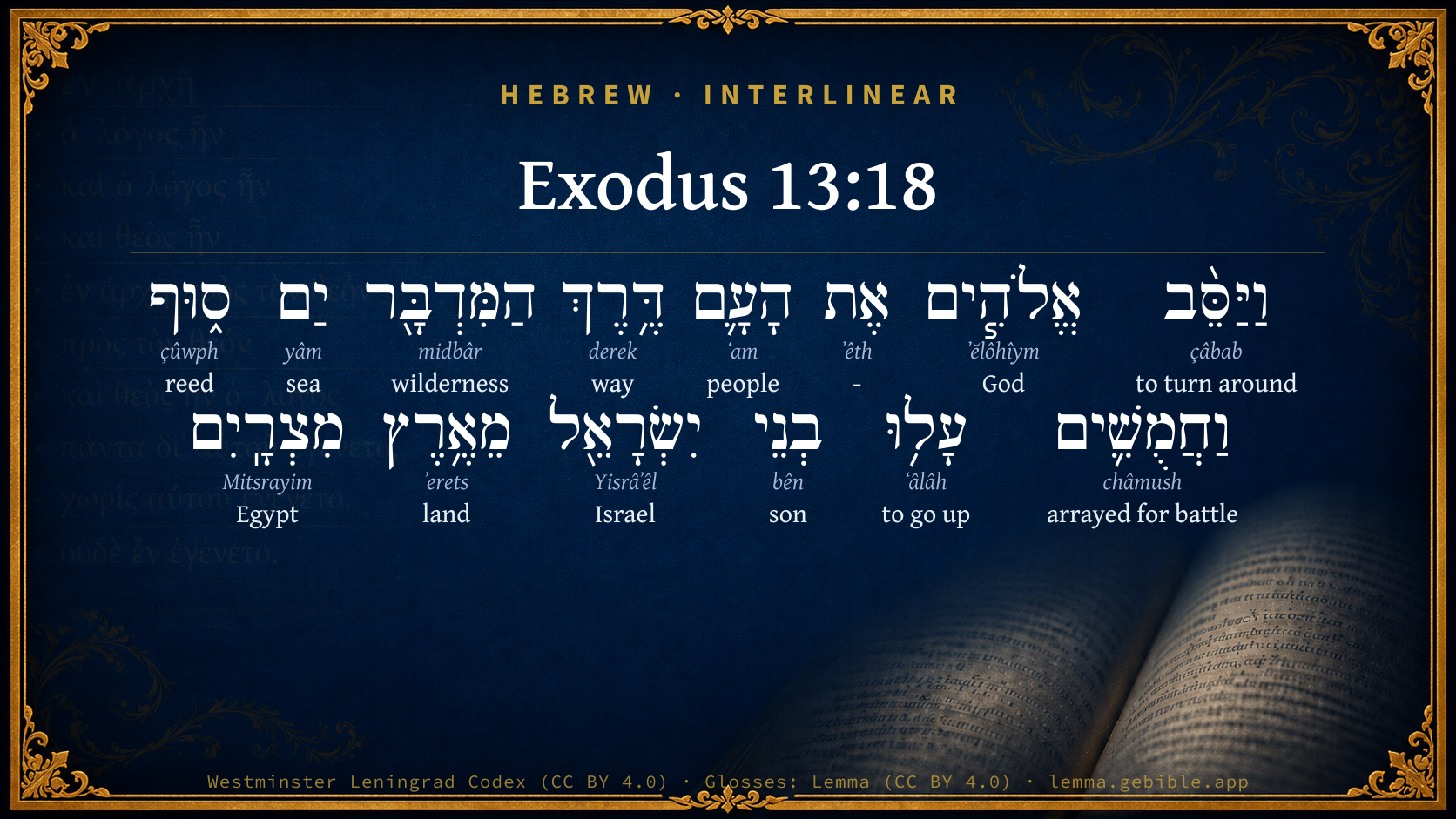
  1. וַיַּסֵּ֨ב çâbab H5437 “and · to turn around” Conjunction + Verb, Hiphil, Sequential Imperfect, 3rd Person, Masculine, Singular
  2. אֱלֹהִ֧ים ʼĕlôhîym H430 “God(s)” Noun, Common, Masculine, Plural, Absolute
  3. אֶת ʼêth H853 “-” Particle, Direct Object
  4. הָעָ֛ם ʻam H5971 “the · people” Particle, Definite Article + Noun, Common, Masculine, Singular, Absolute
  5. דֶּ֥רֶךְ derek H1870 “way of” Noun, Common, Both, Singular, Construct
  6. הַמִּדְבָּ֖ר midbâr H4057 “the · wilderness” Particle, Definite Article + Noun, Common, Masculine, Singular, Absolute
  7. יַם yâm H3220 “sea of” Noun, Common, Masculine, Singular, Construct
  8. ס֑וּף çûwph H5488 “reed” Noun, Common, Masculine, Singular, Absolute
  9. עָל֥וּ ʻâlâh H5927 “to go up” Verb, Qal, Perfect, 3rd Person, Common, Plural
  10. בְנֵי bên H1121 “sons of” Noun, Common, Masculine, Plural, Construct
  11. יִשְׂרָאֵ֖ל Yisrâʼêl H3478 “Israel” Noun, Proper
  12. מֵאֶ֥רֶץ ʼerets H776 “from · land of” Preposition + Noun, Common, Both, Singular, Construct
  13. מִצְרָֽיִם Mitsrayim H4714 “Egypt” Noun, Proper

About this verse

These counts appear in no published source. They are computed here, from the morphology-tagged text and Lemma’s own curated glosses. What Lemma adds →

14
words
14
distinct lemmas
Pentateuch
section

Notable vocabulary

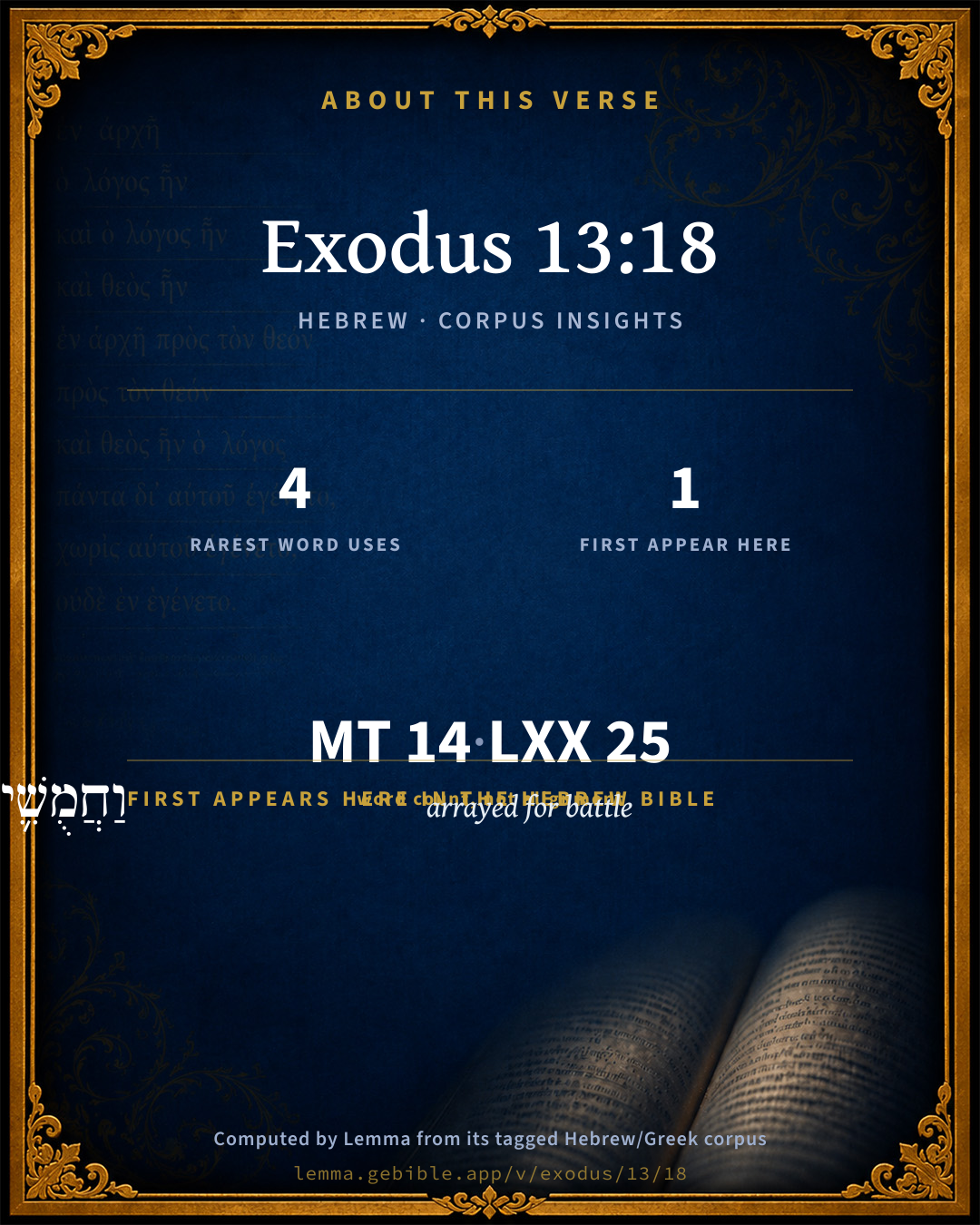
The rarest word here is וַחֲמֻשִׁ֛ים arrayed for battle H2571 — appearing just 4 times in the whole Hebrew Bible.

First appearance in Scripture

This word makes its first canonical appearance in the Hebrew Bible here:

  • וַחֲמֻשִׁ֛ים arrayed for battle H2571

Shared distinctive vocabulary

וַחֲמֻשִׁ֛ים arrayed for battle H2571 occurs in 4 verses of the Hebrew Bible. Also found in:

Grammatical profile

  • 3 verbs
  • 10 nouns
  • 1 particle

Verb forms

  • וַיַּסֵּ֨ב Hiphil · Sequential Imperfect
  • וַחֲמֻשִׁ֛ים Qal · Participle Passive
  • עָל֥וּ Qal · Perfect

Hebrew & Septuagint length

In English translation the verse runs 30 words from the Hebrew and 33 from the Septuagint (LXX English) — closely comparable.

A rough comparison of the two English renderings, which tokenize alike — not a word-level alignment.

Word counts can differ between the Hebrew and the Greek without any difference in meaning — e.g. the Hebrew direct-object marker אֵת has no separate Greek word, and Greek often adds the article ὁ.

In the original languages it is 14 Hebrew tokens and 25 Greek tokens — but the two are counted differently (Hebrew bundles its prefixes and suffixes into one token; the Greek is in lemma form), so that isn’t a like-for-like length.

Cross-references

6

Topical passages linked to Exodus 13:18 in the Treasury of Scripture Knowledge — connected by theme and wording, ordered by reader-vote popularity; previews shown in the World English Bible.

  • Exodus 14:2 "Speak to the children of Israel, that they turn back and encamp before Pihahiroth, between Migdol and the sea, before Baal Zephon. You shall encamp opposite it by the sea.
  • Numbers 33:6–8 They traveled from Succoth, and encamped in Etham, which is in the edge of the wilderness.
  • Deuteronomy 32:10 He found him in a desert land, In the waste howling wilderness; He compassed him about, he cared for him, He kept him as the apple of his eye.
  • Exodus 12:51 It happened the same day, that Yahweh brought the children of Israel out of the land of Egypt by their hosts.
  • Joshua 1:14 Your wives, your little ones, and your cattle, shall abide in the land which Moses gave you beyond the Jordan; but you shall pass over before your brothers armed, all the mighty men of valor, and shall help them;
  • Psalms 107:7 He led them also by a straight way, That they might go to a city to live in.

Cross-references courtesy of OpenBible.info (CC BY 4.0).

Hebrew and Greek witnesses Masoretic Hebrew ↔ Greek Septuagint

The same verse in the two great witnesses to the Old Testament, shown verse-for-verse.

These are two independent witnesses, not word-aligned to each other, and the Septuagint is shown in lemma (dictionary) form.

Hebrew Exodus 13:18 Masoretic · Westminster Leningrad Codex

וַיַּסֵּ֨ב אֱלֹהִ֧ים אֶת הָעָ֛ם דֶּ֥רֶךְ הַמִּדְבָּ֖ר יַם ס֑וּף וַחֲמֻשִׁ֛ים עָל֥וּ בְנֵי יִשְׂרָאֵ֖ל מֵאֶ֥רֶץ מִצְרָֽיִם

but God led the people around by the way of the wilderness by the Red Sea; and the children of Israel went up armed out of the land of Egypt.

World English Bible · Public Domain

Greek LXX Exodus 13:18 Septuagint · lemma form

καί κυκλόω ὁ θεός ὁ λαός ὁδός ὁ εἰς ὁ ἔρημος εἰς ὁ ἐρυθρός θάλασσα πέμπτος δέ γενεά ἀναβαίνω ὁ υἱός ἰσραήλ ἐκ γῆ αἴγυπτος

And God led the people round by the way to the wilderness, to the Red Sea: and in the fifth generation the children of Israel went up out of the land of Egypt.

LXX2012 (modern English Septuagint) · Public Domain

Hebrew: Westminster Leningrad Codex (CC BY 4.0). Greek: Septuagint (public domain); English from LXX2012 (modern English Septuagint) (Public Domain). How the Septuagint differs from the Hebrew →

Targum (Aramaic paraphrase)

2

The Targum is the ancient Jewish Aramaic paraphrase of the Hebrew Scriptures — an interpretive translation, not the Hebrew text itself. Onkelos (literal) and Pseudo-Jonathan (expansive) render the Torah, and Jonathan the Prophets. Coverage is partial: where no permissively-licensed English translation exists for a verse, only the Aramaic is shown. This is verse-level text, not a word-by-word alignment to the Hebrew.

  1. Targum Onkelos Torah (Genesis–Deuteronomy)
    וְאַסְחַר יְיָ יָת עַמָא אֹרַח מַדְבְּרָא יַמָא דְסוּף וּמְזָרְזִין סְלִיקוּ בְּנֵי יִשְׂרָאֵל מֵאַרְעָא דְמִצְרָיִם:

    (no public-domain English translation for this verse)

    Targum Onkelos — Aramaic: “Onkelos Genesis” (public domain); “Onkelos Exodus” (public domain); “Onkelos Leviticus” (public domain); “Onkelos Numbers” (public domain); “Onkelos Deuteronomy” (public domain). English: “Sefaria Community Translation” (CC0 1.0 (public-domain dedication)); “J.W. Etheridge. The Targums of Onkelos and Jonathan Ben Uzziel on the Pentateuch. London: Longmans, Green, 1862” (public domain). Text via Sefaria.

  2. Targum Pseudo-Jonathan Torah (Genesis–Deuteronomy)
    וְאַחֲזַר יְיָ יַת עַמָּא אוֹרַח מַדְבְּרָא דְיַמָא דְסוּף וְכָל חַד עִם חַמְשָׁא טַפְלִין סְלִיקוּ בְּנֵי יִשְרָאֵל מֵאַרְעָא דְמִצְרָיִם

    But the Lord led the people round by the way of the desert of the sea of Suph; and every one of the sons of Israel, with five children, went up from the land of Mizraim.

    Targum Pseudo-Jonathan — Aramaic: “Targum Jonathan on Genesis” (public domain); “Targum Jonathan on Exodus” (public domain); “Targum Jonathan on Leviticus” (public domain); “Targum Jonathan on Numbers” (public domain); “Targum Jonathan on Deuteronomy” (public domain). English: “The Targum of Jonathan ben Uzziel, trans. J. W. Etheridge, London, 1862” (public domain). Text via Sefaria.

Commentary

Notes on Exodus 13:18 from classic Christian and Jewish commentators (each source and its license shown beneath its notes). The classic Christian expositions comment on the surrounding passage and are grouped to its opening verse, so a note may address several verses; the Jewish commentaries on the Tanakh (Rashi and others) are per-verse, so they appear only where the commentator wrote on this verse.

Lemma curates 59 commentaries, every one of them public domain or Creative Commons licensed, each selected and text-cleaned for this edition rather than reprinted as found. About our sources →

Trapp's Complete Commentary

John Trapp

Exo 13:18 But God led the people about, [through] the way of the wilderness of the Red sea: and the children of Israel went up harnessed out of the land of Egypt.

Ver. 18. God led the people about.] Philo writeth, that it was not much above three days’ journey from Egypt to Canaan the other way: Sed Dei voluntas est summa necessitas. {a}

{a} Tertul.

John Trapp, A Commentary or Exposition upon All the Books of the Old and New Testament (1647–1656) — public domain. Text from a community e-Sword module.

Joseph Benson's Commentary

Exo 13:18. There were various reasons why God led them through the way of the wilderness of the Red sea. The Egyptians were to be drowned in the Red sea, the Israelites were to be humbled and proved in the wilderness, Deu 8:2. God had given it to Moses for a sign, Exo 3:12, Ye shall serve God in this mountain. They had again and again told Pharaoh that they must go three days’ journey into the wilderness to do sacrifice, and therefore it was requisite they should march that way, else they had justly been exclaimed against as dissemblers. Before they entered the lists with their enemies, matters must be settled between them and their God; laws must be given, ordinances instituted, covenants sealed; and for the doing of this it was necessary they should retire into the solitudes of a wilderness, the only closet for such a crowd; the high road would be no proper place for these transactions. The reason why God did not lead them the nearest way, which would have brought them in a few days to the land of the Philistines, was because they were not yet fit for war, much less for war with the Philistines. Their spirits were broken with slavery; the Philistines were formidable enemies; it was convenient they should begin with the Amalekites, and be prepared for the wars of Canaan, by experiencing the difficulties of the wilderness. God is said to bring Israel out of Egypt, as the eagle brings up her young ones, Deu 32:11, teaching them by degrees to fly. They went up harnessed — The original word for harnessed here is variously rendered: it comes from a root which signifies five, hence some render it five in a rank. The same word is rendered prepared for war, Jos 1:14; Jos 4:12-13. Targum, girded, harnessed. Vulg. armati, armed. So the Seventy, ευζωνοι equipped, διεσκυασμενοι prepared, furnished: thus in Joshua; but in this place of Exodus the Seventy render the word πεντη γενεα, the fifth generation, and translate the passage, In the fifth generation, the children of Israel went up out of the land of Egypt.

Joseph Benson's Commentary on the Old and New Testaments (1811–1818) — public domain. Text from a community e-Sword module.

Tyndale Open Study Notes

Tyndale Open Resources

13:18 roundabout way: There is disagreement among scholars about the identification of some of the sites mentioned (13:20; 14:2), so there is little consensus about the precise route the Israelites took. • Red Sea: Literally sea of reeds. The Red Sea proper is too far south. The Sea of Reeds was part of the Red Sea, probably located at the northern end of the Gulf of Suez.

Tyndale Open Study Notes — © Tyndale Open Resources, licensed CC BY-SA 4.0. Text via the HelloAO Bible API.

Geneva Bible (1599)

Geneva Bible translators

That is, not privily, but openly and as the word doth signify, set in order by five and five.

Geneva Bible (1599) marginal notes — public domain. Text via Bolls.life.

Jamieson, Fausset & Brown

Robert Jamieson, A. R. Fausset & David Brown

God led the people about, through the way of the wilderness of the Red Sea, &c.--This wondrous expanse of water is a gulf of the Indian ocean. It was called in Hebrew "the weedy sea," from the forest of marine plants with which it abounds. But the name of the Red Sea is not so easily traced. Some think it was given from its contiguity to the countries of Edom ("red"); others derive it from its coral rocks; while a third class ascribe the origin of the name to an extremely red appearance of the water in some parts, caused by a numberless multitude of very small mollusca. This sea, at its northern extremity, separates into two smaller inlets--the eastern called anciently the Elanitic gulf, now the gulf of Akaba; and the western the Heroopolite gulf, now the gulf of Suez, which, there can be no doubt, extended much more to the north anciently than it does now. It was toward the latter the Israelites marched.

went up harnessed--that is, girded, equipped for a long journey. (See Psa 105:37). The Margin renders it "five in a rank," meaning obviously five large divisions, under five presiding officers, according to the usages of all caravans; and a spectacle of such a mighty and motley multitude must have presented an imposing appearance, and its orderly progress could have been effected only by the superintending influence of God.

Jamieson, Fausset & Brown — Commentary Critical and Explanatory on the Whole Bible (1871) — public domain (CC PDM 1.0). Text via the HelloAO Bible API.

Adam Clarke's Commentary

Verse 18. But God led the people about] Dr. Shaw has shown that there were two roads from Egypt to Canaan, one through the valleys of Jendilly, Rumeleah, and Baideah, bounded on each side by the mountains of the lower Thebais; the other lies higher, having the northern range of the mountains of Mocatee running parallel with it on the right hand, and the desert of the Egyptian Arabia, which lies all the way open to the land of the Philistines, to the left. See his account of these encampments at the end of Exodus. See Clarke on Ex 40:38.

Went up harnessed] חמשים chamushim. It is truly astonishing what a great variety of opinions are entertained relative to the meaning of this word. After having maturely considered all that I have met with on the subject, I think it probable that the word refers simply to that orderly or well arranged manner in which the Israelites commenced their journey from Egypt. For to arrange, array, or set in order, seems to be the ideal meaning of the word חמש chamash. As it was natural to expect that in such circumstances there must have been much hurry and confusion, the inspired writer particularly marks the contrary, to show that God had so disposed matters that the utmost regularity and order prevailed; and had it been otherwise, thousands of men, women, and children must have been trodden to death. Our margin has it by five in a rank; but had they marched only five abreast, supposing only one yard for each rank to move in, it would have required not less than sixty-eight miles for even the 600,000 to proceed on regularly in this way; for 600,000 divided by five gives 120,000 ranks of five each; and there being only 1,760 yards in a mile, the dividing 120,000 by 1,760 will give the number of miles such a column of people would take up, which by such an operation will be found to be something more than sixty-eight miles. But this the circumstances of the history will by no means admit.-Harmer. The simple meaning therefore appears to be that given above; and if the note on the concluding verse of the preceding chapter be considered, it may serve to place this explanation in a still clearer point of view.

Adam Clarke's Commentary on the Bible (1810–1826) — public domain. Text from a community e-Sword/MySword module.

Ellicott's Commentary for English Readers

(18) But God led the people about.—Or, led the people a circuit—took them, not by the direct route, through Pelusium, past Lake Serbônis, to Rhinocolura and Gaza, but led them by the most circuitous route possible—the way of the Red Sea and the wilderness of Sinai to the Transjordanic region, the land of the Amorites, and so across Jordan to Canaan proper. The passage seems to dispose altogether of Dr. Brugsch’s theory, that the “Red Sea” of the writer of Exodus was the Lake Serbônis, and that it was not until after this lake was passed that their journey was deflected to the south.

The children of Israel went up harnessed out of the land of Egypt.—It is generally agreed that this is a wrong translation. Very few of the Israelites can have possessed suits of armour until after the passage of the Red Sea, when they may have stripped the bodies of the slain Egyptians. Nor has the word used ever the force of “harnessed.” It might mean “with their loins girded,” but such an exposition would deprive the statement made of any force. Loins were always girded in preparation for a journey, and there would be no need to mention the fact. The best explanation is, that the word here means “organised,” “in military order” (Saadia, Gesenius, Lee, Knobel, Cook). It was clearly necessary, to prevent confusion, that a military order should have been adopted, and there are not wanting indications that during the year of contention with Pharaoh such an organisation was introduced and proceeded with. (See Exo_4:29; Exo_4:31; Exo_6:26; Exo_12:3; Exo_12:21; Exo_12:51.) It must have been brought to a high pitch of perfection for the Exodus to have taken place, as it seems to have done, without serious confusion or entanglement.

A Bible Commentary for English Readers, edited by Charles John Ellicott (1878–1897) — public domain. Text from a community e-Sword module.

The Cambridge Bible for Schools and Colleges

gen. ed. J. J. S. Perowne

18. Instead of leading them straight on, across the N. part of the isthmus of Suez, by the direct route mentioned above, God led the people about (or round), in the direction of the wilderness,—i.e. the Egyptian wilderness, S. of the Wâdy Ṭumîlât, and West of the N. end of the Gulf of Suez (a shallow extension of which reached perhaps at this time as far N. as L. Timsâḥ: see p. 125 ff.),—to the Red Sea (the Gulf of Suez, or its ancient Northern extension, just referred to).

the Red Sea] Heb., as always, the Sea of sûph; probably, the Sea of reeds. The origin of the name is uncertain. Sûph (outside this expression) is used of reeds or rushes (cf. Luther’s Schilfmeer, ‘Reed-sea’) growing along the Nile (Exo_2:3 [see note], 5, Isa_19:6 †), and of sea-weed (Jon_2:6 †): it seems also to correspond to the late Eg. thuf, Copt. joouf, ‘papyrus.’ Reeds or rushes however do not grow in the salt water of the Red Sea, though (Di.) clumps of them have been found on spots S. of Suez, where fresh water mixes with the salt; but they abound in Lake Timsâḥ. ‘This lake with its large marshes full of reeds, exactly at the entrance of Goshen, would fulfil all conditions for the Exodus and for the Heb. name’ (W. M. Müller, EB., Red Sea). If it is true that there was once a shallow extension of the Gulf of Suez reaching to L. Timsâḥ, it is possible that it was called by the Hebrews, from these growths, the ‘Sea of reeds’; and that afterwards the name was extended to the ‘Red Sea’ generally (so Di. as well as W. M. Müller).

armed] The Heb. word is a rare one (Jos_1:14; Jos_4:12, Jdg_7:11 †; read also conjecturally by many in Num_32:17), and its precise meaning is uncertain. It in any case implies that the Israelites were prepared for hostile encounters.

The Cambridge Bible for Schools and Colleges (gen. ed. J. J. S. Perowne; Cambridge University Press, 1878–1918) — public domain. Text from a community e-Sword module.

John Gill's Exposition

But God led the people about,.... Instead of their going to the west, or northwest, towards Gaza, &c. and the Mediterranean sea, the Lord going before them in a pillar of cloud and fire, as after related, directed them to turn off to the right, between the east and south, to the southeast:

through the way of the wilderness of the Red sea: the wilderness of Etham, by the Red sea:

and the children of Israel went up harnessed out of the land of Egypt or "girt" (m) about the loins under the fifth rib; not with armour, as some (n) understand it, for it is not likely that they could, or that Pharaoh would suffer them to be furnished with armour, but their garments were girt about them, and so fit for travelling; or they went up "by fives" (o), as it may be rendered, either by five in a rank, or rather in five bodies or squadrons, and so marched out, not in a disorderly and confused way, but in great order and regularity. The latter is much more reasonable to suppose, for five in a rank is too small a number for an army of 600,000 men to march in; since allowing the ranks to be but three feet asunder, and a mile to consist of about two thousand yards, the front and rear of the army would be sixty miles distant from each other (p).

(m) "accincti", Fagninus, Vatablus, Cartwright; so Onkelos, Aben Ezra. (n) Kimchi & Pen Melech. (o) "Quintati", Montanus: "quini", Piscater, Rivet. (p) See the Bishop of Clogher's Chronology of the Hebrew Bible, p. 272.

John Gill's Exposition of the Whole Bible (1746–1763) — public domain (CC PDM 1.0). Text via the HelloAO Bible API.

Albert Barnes' Notes on the Bible

Harnessed - More probably, “marshalled” or “in orderly array.” There is not the least indication that the Israelites had been disarmed by the Egyptians, and as occupying a frontier district frequently assailed by the nomads of the desert they would of necessity be accustomed to the use of arms. Compare Exo 1:10.

Albert Barnes' Notes on the Bible (1834–1885) — public domain. Text from a community e-Sword/MySword module.

Haydock's Catholic Bible Commentary

Armed, in order of battle. Hebrew chamushim, "by fives," or in five battalions. (Josue i. 14; Judges viii. 11.) (Calmet) --- Calvin asks where the Hebrews could procure arms, as if to cavil with this translation. But surely they might get them in the same manner as the vessels of gold; and they undoubtedly were not destitute of arms when they encountered the Amalecites, ver. 17. (Haydock)

George Leo Haydock (1774–1849), Haydock's Catholic Family Bible and Commentary, 1859 edition — public domain. Excludes Psalms (Douay-Rheims chapter numbering differs from Protestant) and Deuterocanonical books (Catholic canon only).

Matthew Poole's English Annotations

Or, armed, or girt with swords and belts about the fifth rib, as the Hebrew word may imply. But it doth not appear how or whence they should get their arms, nor how the Egyptians would permit so numerous a people to have and to keep arms, especially when they had a long time oppressed and exasperated them, and made them desperate. It is true, some few of them might procure arms, but this word is here used concerning the whole body of them. Others render it by fives, five and five in a rank, that is, by a usual synecdoche, in military order, not doubtfully and fearfully, but confidently and courageously; not confusedly, as men that steal or run away, but in good order, so as one might not hinder another. Which interpretation is strengthened by comparing Jos 1:14. It may be rendered girt, to wit, about the fifth rib, as the word implies, the place where men used to gird their garments, this being the usual posture for travellers: he implies that they went out resolved upon and prepared for their journey.

Matthew Poole's English Annotations on the Holy Bible (1683–1685) — public domain. Text from a community e-Sword/MySword module.

The Pulpit Commentary

God led the people about. Or "led the people a circuit," i.e., made them take a circuitous route to Canaan, the way of the wilderness of the Red Seai.e. , by the southern wilderness, or what is now called "the wilderness of Sinai." Kalisch shows the wisdom of this course how it gave time for the nation to be "gradually accustomed to fatigues and hardships by a long and tiresome march in the desert to learn obedience to their chief and finally to be "trained to military discipline and martial, virtue by occasional expeditions against the weaker tribes of the desert." He errs, however, in ascribing the wisdom of the course taken to Moses, since Moses expressly declares that the conception was not his, but God"s. And the children of Israel went up harnessed. The word here translated "harnessed," is generally thought to mean either "with their loins girded" (Onkelos, Kimchi, Kalisch) or "in military order" (Gesenius, Lee, Knobel). Ewald, who inclines to the latter of these two senses, suggests that, strictly, it means "in five divisions viz., van, centre, two wings, and rearguard. The word is, apparently, a derivative from khamesh, "five.

Vers. 18-21. It is the method of the Divine action to accomplish ends by circuitous means.

God "led the Israelites about." Instead of conducting them straight from Tanis to Canaan in the course of six or seven days, he carried them down nearly to the furthest point of the Sinaitic peninsula, at least two hundred miles out of the direct line of route. He afterwards made them occupy in desert wanderings the space of forty years, and brought them into Canaan on the side furthest from Egypt that which fronted the east. So it is

I IN GOD"S NATURAL WORKINGS. To make a planet suitable for the habitation of man, he does not create one fit for him straight off. He prepares an extended mass of matter which gradually condenses, throws off an atmosphere, settles into land and sea, undergoes for many thousands of years a series of aqueous and igneous changes, deposits strata, elevates them into mountains, works out river courses, raises and submerges continents; and only after a number of millennia does he, by this long and tedious process, effect the end aimed at from the first, the construction of a habitation suitable for such a being as man. Again, he will have man live on bread; but he does not make bread. He makes a germ capable of developing into a plant, of throwing out roots and leaves, deriving sustenance from air and earth and showers, increasing gradually for several months, and finally throwing up the tall spike, which after growing, and swelling, and ripening, bears ultimately the golden grain that is suited to be man"s food.

II IN GOD"S SPIRITUAL WORKINGS. If God has a work for a man to do, if for this a certain character is required, God again pursues no compendious method. The man is born in a certain sphere, given certain powers, and then it is left for the circumstances of life to work out in him, under Divine superintendence, the character required. Moses is trained for eighty years in order to qualify him for his position as deliverer of the Israelites from the bondage of Egypt; and is only rendered fit to accomplish the task by what befals him in that long period. All the saints of God, raised up to do any great work, have had some such long training. Even Christ did not enter on his ministry at once, but remained in obscurity for thirty years, before asserting his mission.

III EVEN IN GOD"S MIRACULOUS WORKINGS. Christ would assuage the pains of hunger of the five thousand. He does not simply, as he might have done, remove them by a word. He obtains such food as there is at hand: he blesses and breaks; he causes the multitude to sit down; he distributes the food among the apostles, and bids them distribute to the multitude. If the Red Sea is to be parted, an east wind is made to blow for some hours; if a blind man is to be cured, clay is taken, and mixed with spittle, and put upon the blind man"s eyes, and by a circuitous method his cure is effected. All this seems strange to us because we are so impatient. Our life here endures so short a space, and we so little realise the fact of the life to come, that we are always in a hurry to obtain results, and are annoyed at having to wait for them. But an Eternal Being can afford to be patient. "One day is with the Lord as a thousand years, and a thousand years as one day." The question with God is never as to the quickest, but always as to the best method. Haste is proverbially unsafe. "Most haste, worst speed," says theadage. It would bring much improvement into human life, if there were less of bustle and hurry in it if men were not in so much haste to be rich if they did not expect to reap the harvest so soon as they have sown the seed if they would allow time for plans to take effect, for improvements to be brought to perfection, for institutions to take root and grow.

The Pulpit Commentary (1880–1919), ed. H.D.M. Spence-Jones & Joseph S. Exell — public domain. Text from a community e-Sword module.

John Wesley's Explanatory Notes

There were many reasons why God led them through the way of the wilderness of the red sea. The Egyptians were to be drowned in the Red-sea, the Israelites were to be humbled, and proved in the wilderness. Deut. viii, 2. God had given it to Moses for a sign, chap. iii, 12, ye shall serve God in this mountain. They had again and again told Pharaoh that they must go three days journey into the wilderness to do sacrifice, and therefore it was requisite they should march that way, else they had justly been exclaimed against as dissemblers. Before they entered the lifts with their enemies, matters must be settled between them and their God; laws must be given, ordinances instituted, covenants sealed; and for the doing of this it was necessary they should retire into the solitudes of a wilderness, the only closet for such a crowd; the high road would be no proper place for these transactions. The reason why God did not lead them the nearest way, which would have brought them in a few days to the land of the Philistines, was because they were not yet fit for war, much less for war with the Philistines. Their spirits were broke with slavery; the Philistines were formidable enemies; it was convenient they should begin with the Amalekites, and be prepared for the wars of Canaan, by experiencing the difficulties of the wilderness. God is said to bring Israel out of Egypt as the eagle brings up her young ones, Deut. xxxii, 11, teaching them by degrees to fly. They went up harnessed - They went up by five in a rank, so some; in five squadrons, so others. They marched like an army with banners, which added much to strength and honour.

John Wesley, Explanatory Notes Upon the Whole Bible (1754–1765) — public domain. Text via the GEBible commentary corpus.

Rashi

Rabbi Shlomo Yitzchaki (Rashi)

ויסב means HE LED THE PEOPLE ABOUT from the direct route to a circuitous route.

ים סוף is the same as לים סוף TO THE RED SEA. The word סוף has the meaning of a marshy tract in which reeds grow; examples are: (Exodus 2:3) “She placed him in the reeds (בסוף)”; (Isaiah 19:6) “The flags and the reeds (וסוף) shall wither”.

וחמשים — The word חמשים means provided with weapons (Mekhilta). — [Because He led them by a circuitous route through the wilderness He brought it about that they went up from Egypt well-provided; for had He led them circuitously by the route of an inhabited district they would not have provided for themselves every thing that they needed, but only a part, like a person who is travelling from place to place and intends to purchase there whatever he will require. But if he were setting out for the wilderness he must provide all that he will require. — This verse (statement in the verse) is written only with the view of making the ear understand (preparing you for a later statement) viz., that you should not wonder with regard to the war with Amalek and the war with Sihon and Og and Midian where they obtained weapons, since they smote them with the sword]. In a similar sense it says, (Joshua 1:14) “and ye shall pass over armed (חמשים)”. Onkelos, too, translated it by מזרזין which signifies “armed” in Aramaic, just as he translates the word וירק in (Genesis 14:14) וירק את חניכיו which means, “And he armed his trained servants” by וזריז. Another explanation of חמשים is: only one out of five (חמשה) went forth from Egypt, and four parts of the people died during the three days of darkness because they were unworthy of being delivered (Mekhilta; cf. Rashi on 10:22).

Rashi on the Tanakh — English translations: “The Judaica Press complete Tanach with Rashi, translated by A. J. Rosenberg” (CC BY 4.0); “Pentateuch with Rashi's commentary by M. Rosenbaum and A.M. Silbermann, 1929-1934” (public domain); “The Metsudah Tanach series, Lakewood, N.J” (CC BY 4.0); and “The Book of Joshua, Metsudah Publications, 1997” (CC BY 4.0). Text via Sefaria.

Ramban (Nachmanides)

Rabbi Moshe ben Nachman (Ramban / Nachmanides)

AND THE CHILDREN OF ISRAEL WENT UP ARMED OUT OF THE LAND OF EGYPT. This means that even though G-d led them about by the way of the wilderness, they still feared lest the Philistines who dwelt in the nearby cities come upon them. Therefore they were armed, as are people who go out to war. Some scholars say that Scripture is relating that they went out with a high hand, deeming themselves redeemed from bondage, and they did not leave like slaves escaping [from their master].

Ramban (Nachmanides) on the Tanakh — English translation: “Commentary on the Torah by Ramban (Nachmanides). Translated and annotated by Charles B. Chavel. New York, Shilo Pub. House, 1971-1976” (CC BY 4.0). Text via Sefaria.

Lesson kit

Teaching starters — assembled from the data on this page, not authored interpretation. Every prompt links to the verse data it draws on. Edit before teaching.

Exodus, in the Pentateuch, opens this verse with 14 words (14 distinct Hebrew lemmas). Its most distinctive word is châmush (“arrayed for battle”). A historical commentator’s framing appears above. Read the whole chapter for the surrounding context.

Discussion questions

  1. The word châmush carries the sense “arrayed for battle.” How does it shape the verse?
  2. This is the first place “arrayed for battle” appears in Scripture (first appears here). What does its debut here establish?
  3. How does Joshua 1:14, which shares the word «arrayed for battle», read alongside this verse?
  4. These translations render this verse differently; the difference is in the English rendering, not the original. What questions does that raise?
  5. «וַיַּסֵּ֨ב» is a Hiphil Sequential Imperfect verb. How does that grammatical form shape the action described?
  6. Compare how Trapp's Complete Commentary and Joseph Benson's Commentary read this verse. Where do they agree or differ?

Things to notice

Reading settings

Reading text

Shown beneath each verse's original-language words.

Old Testament
Old Testament edition

Read the OT as the Masoretic Hebrew (MT) or the Greek Septuagint (LXX).

English shown for the Greek Septuagint (in the Hebrew ↔ Greek comparison).

Comparing translations? Open the Compare panel on any verse page to stack up to four side by side.