
Genesis 46:29

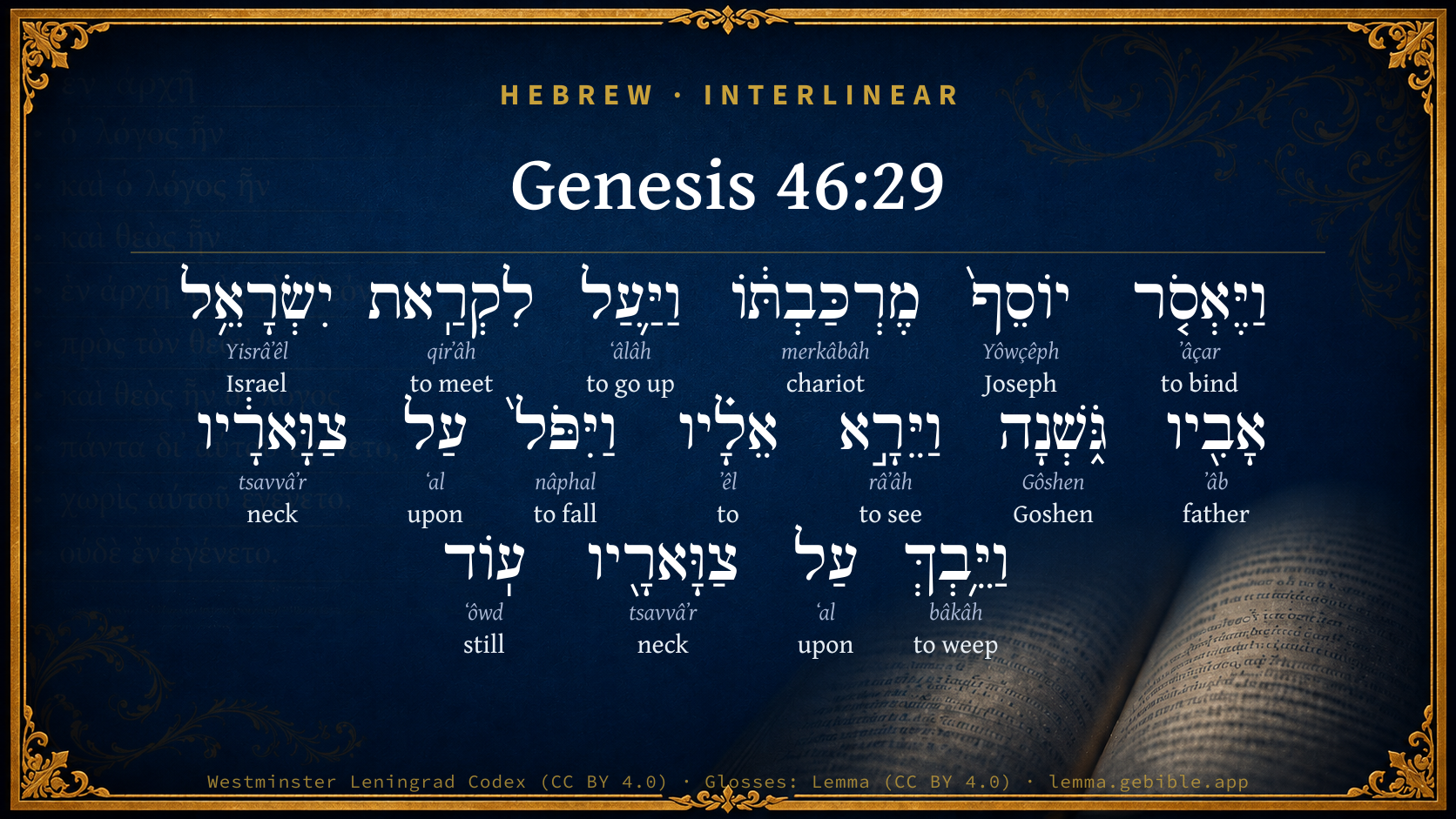
Hebrew (Westminster Leningrad Codex) Genesis 46:29 appears in the Hebrew Old Testament. The text above is from the Westminster Leningrad Codex. Each word links to its Strong’s number, a concise gloss, and parsing drawn from the Open Scriptures Hebrew Bible morphology. Click any word for its full Brown-Driver-Briggs (BDB) entry.
Download image
Cite this verse

Genesis 46:29 (World English Bible). Public Domain. Lemma interlinear Bible study tool, https://lemma.gebible.app/v/genesis/46/29.

Show BibTeX & RIS
BibTeX
RIS
English Translation
Joseph made ready his chariot, and went up to meet Israel, his father, in Goshen. He presented himself to him, and fell on his neck, and wept on his neck a good while.
World English Bible · Public Domain
Download a study sheet

One document with this verse’s original text, its word-by-word gloss line, the meaning frame, cross-references with their text, attributed commentary, and full source and license credits — printable, and it pastes into notes with its structure intact.

This verse Autodidact and up

Study sheet (.html) Plain text (.txt)

A passage Seminary Student

Up to 50 verses in one chapter. A passage sheet keeps up to 6 commentary sources and 12 cross-references per verse, in the order this page ranks them, and says so on the sheet whenever that leaves anything out. Ask for a single verse and you get the Autodidact verse sheet above.

Everything on this page stays free to read, with no account — the sheet is a download of what is already on screen, not access to it.

Want to remove ads? Support Godless Engineer
Compare translations 3

The same verse in 3 English versions, stacked beneath the original-language interlinear above. Click any original word for its lexicon entry.

Each is an independent rendering of the whole verse — the interlinear is not word-aligned to these translations.

Highlighted words mark where these versions differ — a whole-verse word diff, not a word-by-word alignment.

  • World English Bible Public Domain
    Joseph made ready his chariot, and went up to meet Israel, his father, in Goshen. He presented himself to him, and fell on his neck, and wept on his neck a good while.
  • King James Version Public Domain
    And Joseph made ready his chariot, and went up to meet Israel his father, to Goshen, and presented himself unto him; and he fell on his neck, and wept on his neck a good while.
  • unfoldingWord Literal Text CC BY-SA 4.0
    Then Joseph harnessed his chariot and went up to meet Israel his father in Goshen. And he appeared to him, and he fell on his neck and cried on his neck a long time.

unfoldingWord Literal Text — © unfoldingWord, licensed CC BY-SA 4.0. Word-aligned USFM3 via Door43 (git.door43.org/unfoldingWord/en_ult).

Versions to compare (up to 4)

3 of 4 selected

Show all 18 translations

Every available English version of this verse, each an independent rendering of the whole verse.

  • World English Bible Public Domain
    Joseph made ready his chariot, and went up to meet Israel, his father, in Goshen. He presented himself to him, and fell on his neck, and wept on his neck a good while.
  • Berean Standard Bible Public Domain
    Joseph prepared his chariot and went there to meet his father Israel. Joseph presented himself to him, embraced him, and wept profusely.
  • Majority Standard Bible Public Domain
    Joseph prepared his chariot and went there to meet his father Israel. Joseph presented himself to him, embraced him, and wept profusely.
  • King James Version Public Domain
    And Joseph made ready his chariot, and went up to meet Israel his father, to Goshen, and presented himself unto him; and he fell on his neck, and wept on his neck a good while.
  • American Standard Version (1901) Public Domain
    And Joseph made ready his chariot, and went up to meet Israel his father, to Goshen; and he presented himself unto him, and fell on his neck, and wept on his neck a good while.
  • Revised Version (1885) Public Domain
    And Joseph made ready his chariot, and went up to meet Israel his father, to Goshen; and he presented himself unto him, and fell on his neck, and wept on his neck a good while.
  • Geneva Bible (1599) Public Domain
    Then Ioseph made ready his charet and went vp to Goshen to meete Israel his father, and presented himselfe vnto him and fel on his necke, and wept vpon his necke a good while.
  • Douay-Rheims (1899) Public Domain
    And when he was come thither, Joseph made ready his chariot, and went up to meet his father, in the same place: and seeing him, he fell upon his neck, and embracing him wept.
  • Young's Literal Translation Public Domain
    and Joseph harnesseth his chariot, and goeth up to meet Israel his father, to Goshen, and appeareth unto him, and falleth on his neck, and weepeth on his neck again;
  • Literal Standard Version CC BY-SA 4.0
    and Joseph harnesses his chariot, and goes up to meet his father Israel, to Goshen, and appears to him, and falls on his neck, and weeps on his neck again;
  • Unlocked Literal Bible CC BY-SA 4.0
    Joseph prepared his chariot and went up to meet Israel his father in Goshen. He saw him, hugged his neck, and wept on his neck a long time.
  • unfoldingWord Literal Text CC BY-SA 4.0
    Then Joseph harnessed his chariot and went up to meet Israel his father in Goshen. And he appeared to him, and he fell on his neck and cried on his neck a long time.
  • Darby Bible Public Domain
    Then Joseph yoked his chariot, and went up to meet Israel his father, to Goshen, and he presented himself to him; and he fell on his neck, and wept on his neck a good while.
  • World Messianic Bible Public Domain
    Joseph prepared his chariot, and went up to meet Israel, his father, in Goshen. He presented himself to him, and fell on his neck, and wept on his neck a good while.
  • Webster's Bible Public Domain
    And Joseph made ready his chariot, and went to meet Israel his father to Goshen; and presented himself to him: and he fell on his neck, and wept on his neck a good while.
  • Free Bible Version CC BY-SA 4.0
    Joseph ordered his chariot made ready and went to meet his father Israel there. As soon as he arrived, he hugged his father and wept for a long time.
  • Bible in Basic English Public Domain
    And Joseph got his carriage ready and went to Goshen for the meeting with his father; and when he came before him, he put his arms round his neck, weeping.
  • JPS Tanakh (1917) Public Domain
    And Joseph made ready his chariot, and went up to meet Israel his father, to Goshen; and he presented himself unto him, and fell on his neck, and wept on his neck a good while.

Literal Standard Version (2020), Covenant Press — licensed CC BY-SA 4.0. Text via the HelloAO Bible API (eBible.org). Unlocked Literal Bible (unfoldingWord) — licensed CC BY-SA 4.0. Text via the HelloAO Bible API (eBible.org). unfoldingWord Literal Text — © unfoldingWord, licensed CC BY-SA 4.0. Word-aligned USFM3 via Door43 (git.door43.org/unfoldingWord/en_ult). Free Bible Version, Dr. Jonathan Gallagher — licensed CC BY-SA 4.0. Text via the HelloAO Bible API (eBible.org).

Word by word

More ways to search: Search by grammar → Find every occurrence → Compare this word →

Practice this passage: Drill this verse → Learn its vocabulary →

גֹּ֑שְׁנָה
Gôshen
H1657
“Goshen · toward”
Noun, Proper + Suffix, Demonstrative
Part of Speech
Noun
Type
Proper
Full BDB Definition

Origin: probably of Egyptian origin

TWOT: 390

Goshen = "drawing near" - a region in northern Egypt, east of the lower Nile, where the children of Israel lived from the time of Joseph to the time of Moses - a district in southern Palestine between Gaza and Gibeon - a town in the mountains of Judah probably in the district of Goshen
  1. וַיֶּאְסֹ֤ר ʼâçar H631 “and · to bind” Conjunction + Verb, Qal, Sequential Imperfect, 3rd Person, Masculine, Singular
  2. יוֹסֵף֙ Yôwçêph H3130 “Joseph” Noun, Proper
  3. מֶרְכַּבְתּ֔וֹ merkâbâh H4818 “chariot · his” Noun, Common, Feminine, Singular, Construct + Suffix, Personal, 3rd Person, Masculine, Singular
  4. וַיַּ֛עַל ʻâlâh H5927 “and · to go up” Conjunction + Verb, Qal, Sequential Imperfect, 3rd Person, Masculine, Singular
  5. לִקְרַֽאת qirʼâh H7125 “to meet” Preposition + Verb, Qal, Infinitive Construct
  6. יִשְׂרָאֵ֥ל Yisrâʼêl H3478 “Israel” Noun, Proper
  7. אָבִ֖יו ʼâb H1 “father · his” Noun, Common, Masculine, Singular, Construct + Suffix, Personal, 3rd Person, Masculine, Singular
  8. וַיֵּרָ֣א râʼâh H7200 “and · to see” Conjunction + Verb, Niphal, Sequential Imperfect, 3rd Person, Masculine, Singular
  9. אֵלָ֗יו ʼêl H413 “to · him” Preposition + Suffix, Personal, 3rd Person, Masculine, Singular
  10. וַיִּפֹּל֙ nâphal H5307 “and · to fall” Conjunction + Verb, Qal, Sequential Imperfect, 3rd Person, Masculine, Singular
  11. עַל ʻal H5921 “upon” Preposition
  12. צַוָּארָ֔יו tsavvâʼr H6677 “necks · his” Noun, Common, Masculine, Plural, Construct + Suffix, Personal, 3rd Person, Masculine, Singular
  13. וַיֵּ֥בְךְּ bâkâh H1058 “and · to weep” Conjunction + Verb, Qal, Sequential Imperfect, 3rd Person, Masculine, Singular
  14. עַל ʻal H5921 “upon” Preposition
  15. צַוָּארָ֖יו tsavvâʼr H6677 “necks · his” Noun, Common, Masculine, Plural, Construct + Suffix, Personal, 3rd Person, Masculine, Singular
  16. עֽוֹד ʻôwd H5750 “still” Adverb

About this verse

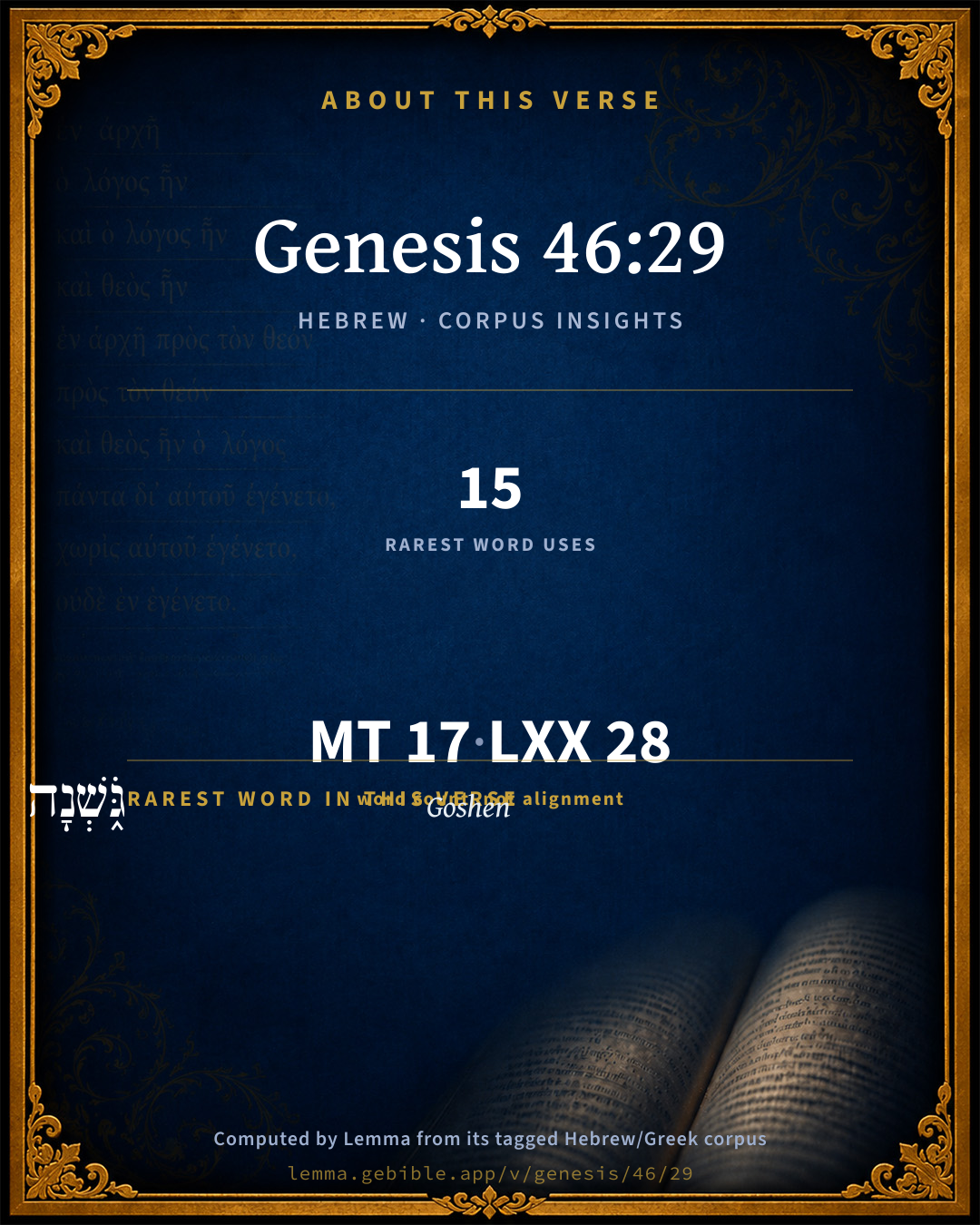
These counts appear in no published source. They are computed here, from the morphology-tagged text and Lemma’s own curated glosses. What Lemma adds →

17
words
15
distinct lemmas
Pentateuch
section

Notable vocabulary

The rarest word here is גֹּ֑שְׁנָה Goshen H1657 — appearing just 15 times in the whole Hebrew Bible.

Shared distinctive vocabulary

גֹּ֑שְׁנָה Goshen H1657 occurs in 14 verses of the Hebrew Bible. Also found in:

Grammatical profile

  • 6 verbs
  • 7 nouns
  • 3 prepositions
  • 1 adverb

Verb forms

  • וַיֶּאְסֹ֤ר Qal · Sequential Imperfect
  • וַיַּ֛עַל Qal · Sequential Imperfect
  • לִקְרַֽאת Qal · Infinitive Construct
  • וַיֵּרָ֣א Niphal · Sequential Imperfect
  • וַיִּפֹּל֙ Qal · Sequential Imperfect
  • וַיֵּ֥בְךְּ Qal · Sequential Imperfect

Repetition

Words recur within this verse — often emphatic in Hebrew:

  • עַל upon H5921 ×2
  • צַוָּארָ֔יו neck H6677 ×2

Hebrew & Septuagint length

In English translation the verse runs 33 words from the Hebrew and 33 from the Septuagint (LXX English) — the same length.

A rough comparison of the two English renderings, which tokenize alike — not a word-level alignment.

Word counts can differ between the Hebrew and the Greek without any difference in meaning — e.g. the Hebrew direct-object marker אֵת has no separate Greek word, and Greek often adds the article ὁ.

In the original languages it is 17 Hebrew tokens and 28 Greek tokens — but the two are counted differently (Hebrew bundles its prefixes and suffixes into one token; the Greek is in lemma form), so that isn’t a like-for-like length.

Cross-references

7

Topical passages linked to Genesis 46:29 in the Treasury of Scripture Knowledge — connected by theme and wording, ordered by reader-vote popularity; previews shown in the World English Bible.

  • Luke 15:20 "He arose, and came to his father. But while he was still far off, his father saw him, and was moved with compassion, and ran, and fell on his neck, and kissed him.
  • Genesis 33:4 Esau ran to meet him, embraced him, fell on his neck, kissed him, and they wept.
  • Genesis 45:14–15 He fell on his brother Benjamin's neck, and wept, and Benjamin wept on his neck.
  • Acts 20:37 They all wept a lot, and fell on Paul's neck and kissed him,
  • Genesis 41:43 and he made him to ride in the second chariot which he had. They cried before him, "Bow the knee!" He set him over all the land of Egypt.
  • Genesis 45:19 Now you are commanded: do this. Take wagons out of the land of Egypt for your little ones, and for your wives, and bring your father, and come.
  • Genesis 45:21 The sons of Israel did so. Joseph gave them wagons, according to the commandment of Pharaoh, and gave them provision for the way.

Cross-references courtesy of OpenBible.info (CC BY 4.0).

Hebrew and Greek witnesses Masoretic Hebrew ↔ Greek Septuagint

The same verse in the two great witnesses to the Old Testament, shown verse-for-verse.

These are two independent witnesses, not word-aligned to each other, and the Septuagint is shown in lemma (dictionary) form.

Hebrew Genesis 46:29 Masoretic · Westminster Leningrad Codex

וַיֶּאְסֹ֤ר יוֹסֵף֙ מֶרְכַּבְתּ֔וֹ וַיַּ֛עַל לִקְרַֽאת יִשְׂרָאֵ֥ל אָבִ֖יו גֹּ֑שְׁנָה וַיֵּרָ֣א אֵלָ֗יו וַיִּפֹּל֙ עַל צַוָּארָ֔יו וַיֵּ֥בְךְּ עַל צַוָּארָ֖יו עֽוֹד

Joseph made ready his chariot, and went up to meet Israel, his father, in Goshen. He presented himself to him, and fell on his neck, and wept on his neck a good while.

World English Bible · Public Domain

Greek LXX Genesis 46:29 Septuagint · lemma form

ζευγνύω δέ ιωσηφ ὁ ἅρμα αὐτός ἀναβαίνω εἰς συνάντησις ἰσραήλ ὁ πατήρ αὐτός κατά ἥρως πόλις καί ὁράω αὐτός ἐπιπίπτω ἐπί ὁ τράχηλος αὐτός καί κλαίω κλαυθμός πολύς

And Joseph having made ready his chariots, went up to meet Israel his father, at the city of Heroes; and having appeared to him, fell on his neck, and wept with abundant weeping.

LXX2012 (modern English Septuagint) · Public Domain

On this verse, The Pulpit Commentary discusses the Septuagint’s reading. Read the note in Commentary ↓

Hebrew: Westminster Leningrad Codex (CC BY 4.0). Greek: Septuagint (public domain); English from LXX2012 (modern English Septuagint) (Public Domain). How the Septuagint differs from the Hebrew →

Targum (Aramaic paraphrase)

2

The Targum is the ancient Jewish Aramaic paraphrase of the Hebrew Scriptures — an interpretive translation, not the Hebrew text itself. Onkelos (literal) and Pseudo-Jonathan (expansive) render the Torah, and Jonathan the Prophets. Coverage is partial: where no permissively-licensed English translation exists for a verse, only the Aramaic is shown. This is verse-level text, not a word-by-word alignment to the Hebrew.

  1. Targum Onkelos Torah (Genesis–Deuteronomy)
    וְטַקֵּיס יוֹסֵף רְתִכּוֹהִי וּסְלֵיק לְקַדָּמוּת יִשְׂרָאֵל אֲבוּהִי לְגשֶׁן וְאִתְגְּלִי לֵהּ וּנְפַל עַל צַוְארֵהּ וּבְכָא עַל צַוְארֵהּ עוֹד

    (no public-domain English translation for this verse)

    Targum Onkelos — Aramaic: “Onkelos Genesis” (public domain); “Onkelos Exodus” (public domain); “Onkelos Leviticus” (public domain); “Onkelos Numbers” (public domain); “Onkelos Deuteronomy” (public domain). English: “Sefaria Community Translation” (CC0 1.0 (public-domain dedication)); “J.W. Etheridge. The Targums of Onkelos and Jonathan Ben Uzziel on the Pentateuch. London: Longmans, Green, 1862” (public domain). Text via Sefaria.

  2. Targum Pseudo-Jonathan Torah (Genesis–Deuteronomy)
    וְטַקֵיס יוֹסֵף אַרְתִּיכֵיהּ וְסַלִיק לִקְדָמוּת יִשְרָאֵל אָבוּי לְגשֶׁן וְקָדָם דְאִשְׁתְּמוֹדְעֵיהּ אָבוֹי סְגַד לֵיהּ וְאִתְחַיֵיב לְמִיהֱוֵי שְׁנוֹי קְטִיעַן וּתְהָא וְאִתְחַמֵי לֵיהּ וּרְכִן עַל פְּרִיקַת צַוְורֵיהּ וּבְכָא עַל צַוְורֵיהּ תּוּב עַל דִסְגַד לֵיהּ

    And Joseph made ready his chariot, and went up to meet Israel his father in Goshen; and his father, before he recognised him, worshipped him, and thus became liable to be shortened (or cut off) in his years. And he wondered, and beheld him, and fell upon his neck, and wept still upon his neck, because he had worshipped him.

    Targum Pseudo-Jonathan — Aramaic: “Targum Jonathan on Genesis” (public domain); “Targum Jonathan on Exodus” (public domain); “Targum Jonathan on Leviticus” (public domain); “Targum Jonathan on Numbers” (public domain); “Targum Jonathan on Deuteronomy” (public domain). English: “The Targum of Jonathan ben Uzziel, trans. J. W. Etheridge, London, 1862” (public domain). Text via Sefaria.

Commentary

Notes on Genesis 46:29 from classic Christian and Jewish commentators (each source and its license shown beneath its notes). The classic Christian expositions comment on the surrounding passage and are grouped to its opening verse, so a note may address several verses; the Jewish commentaries on the Tanakh (Rashi and others) are per-verse, so they appear only where the commentator wrote on this verse.

Lemma curates 59 commentaries, every one of them public domain or Creative Commons licensed, each selected and text-cleaned for this edition rather than reprinted as found. About our sources →

Trapp's Complete Commentary

John Trapp

Gen 46:29 And Joseph made ready his chariot, and went up to meet Israel his father, to Goshen, and presented himself unto him; and he fell on his neck, and wept on his neck a good while.

Ver. 29. Presented himself unto him.] Joseph, a prince, was no whit ashamed of the poor old shepherd his father, before so many his peers, and other courtiers, that accompanied him and loathed such kind of persons. Colonel Edmonds is much commended for his ingenuous reply to a countryman of his, recently come to him, into the Low Countries, out of Scotland. This fellow desiring entertaimnent of him, told him, my lord his father, and such knights and gentlemen his cousins and kinsmen, were in good health. Quoth Colonel Edmonds, Gentlemen (to his friends by), believe not one word he says; my father is but a poor baker; whom this knave would make a lord, to curry favour with me, and make you believe I am a great man born. {a} {See Trapp on "Gen 22:10"}

And he fell on his neck, and wept, &c.] For exceeding joy. What then shall be the meeting of saints in heaven! Christ shall say, "Come, ye blessed of my Father." As if he should say, Where have ye been all this while, my dear brethren? It was a part of his joy, when he was on earth, "that we should be with him where he is, to behold his glory." {Joh 17:24} And this he now prays not, but, "Father I will that they be with me"; as that which he had merited for them. And now, what joy will there be, to see them and suaviate them, for whose sake he shed his most precious blood; through which they may safely sail into the bosom of the Father! Surely, if Plotinus the philosopher could say, Let us make haste to our heavenly country; there is our Father, there are all our friends; {b} how much more triumphantly may Christians say so! If Cicero could say, O praeclarum diem, cure ad illum animorum concilium caetumque proficiscar! &c.; Oh, what a brave day will that be, when I shall go to that council and company of happy souls! to my Cato, and other Roman worthies, dead before me; - how {c} much more may Christians exult, to think of that glorious "nightless day" (ανεσπερον ημεραν), as Nazianzen calls it, when they shall be admitted into the congregation house (πανηγυριν) of the firstborn, {Heb 12:23} as the apostle calls heaven; and joyfully welcomed by Abraham, David, Paul, &c., who shall be no less glad of their, than of their own happiness! Who can conceive the comfort of Jacob and Joseph, - or of those two cousins, Mary and Elizabeth, - at their first meeting? But for the joys of heaven, it is as impossible to comprehend them, as to compass heaven itself with a span, or contain the ocean in a nut shell. They are such, saith Augustine, ut quicquid homo dixerit, quasi gutta de mari, quasi scintilla de foco. {d} If the presence of Christ, though but in the womb, made John to spring, and dance a galliard, as the word imports (εσκιρτησεν εν αγαλλιασει, Luk 1:44); what shall it do when we come to heaven! Sermo non valet exprimere experimento opus est, saith Chrysostom. It is more fit to be believed, than possible to be discoursed, saith Prosper. Nec Christus nec caelum patitur hyperbolen, saith another. The apostle, after he had spoken of glorification, breaks forth by way of admiration, into these words; "What shall we say to these things?," {Rom 8:31} these "wordless words!" as he phraseth it (αρρηστα ρηματα, 2Co 12:4); and ever uttereth himself, in a transcendent expression, as 2Co 4:17, where he calleth it "a weight of glory"; such as, if the body were not by the power of God upheld, it were not able to bear. Jacob could hardly hear the news of Joseph, and live: but when once he saw him; "Now let me die," saith he.

{a} Peacham’s Complete Gentleman, p. 5.

{b} Fugiendum ad clarissimam patriam: ibi pater, ibi omnia. - Aug., De Civit. Dei., lib. ix. cap. 16.

{c} O praeclarum diem, cum ad illud animorum concilium caetumque proficiscar, ad Catonem meum, &c. - Cic., De Sen.

{d} Aug., De Triplici Habitu., cap. 4.

John Trapp, A Commentary or Exposition upon All the Books of the Old and New Testament (1647–1656) — public domain. Text from a community e-Sword module.

Tyndale Open Study Notes

Tyndale Open Resources

46:29 Joseph . . . embraced his father and wept: Joseph was seventeen when he had last seen his father (37:2); now he was thirty-nine.

Tyndale Open Study Notes — © Tyndale Open Resources, licensed CC BY-SA 4.0. Text via the HelloAO Bible API.

Geneva Bible (1599)

Geneva Bible translators

Hebrew, bound his chariot.

Hebrew, yet, or still.

Geneva Bible (1599) marginal notes — public domain. Text via Bolls.life.

Jamieson, Fausset & Brown

Robert Jamieson, A. R. Fausset & David Brown

Joseph made ready his chariot--The difference between chariot and wagon was not only in the lighter and more elegant construction of the former, but in the one being drawn by horses and the other by oxen. Being a public man in Egypt, Joseph was required to appear everywhere in an equipage suitable to his dignity; and, therefore, it was not owing either to pride or ostentatious parade that he drove his carriage, while his father's family were accommodated only in rude and humble wagons.

presented himself unto him--in an attitude of filial reverence (compare Exo 22:17). The interview was a most affecting one--the happiness of the delighted father was now at its height; and life having no higher charms, he could, in the very spirit of the aged Simeon, have departed in peace [Luk 2:25, Luk 2:29].

Jamieson, Fausset & Brown — Commentary Critical and Explanatory on the Whole Bible (1871) — public domain (CC PDM 1.0). Text via the HelloAO Bible API.

Adam Clarke's Commentary

Verse 29. And Joseph made ready his chariot] מרכבתו mercabto. In Ge 41:43, we have the first mention of a chariot, and if the translation be correct, it is a proof that the arts were not in a rude state in Egypt even at this early time. When we find wagons used to transport goods from place to place, we need not wonder that these suggested the idea of forming chariots for carrying persons, and especially those of high rank and authority. Necessity produces arts, and arts and science produce not only an increase of the conveniences but also of the refinements and luxuries of life. It has been supposed that a chariot is not intended here; for as the word מרכבה mercabah, which we and most of the ancient versions translate chariot, comes from רכב rachab, he rode, saddling his horse may be all that is intended. But it is more likely to signify a chariot, as the verb אסר asar, which signifies to bind, tie, or yoke, is used; and not חבש chabash, which signifies to saddle.

Fell on his neck] See Ge 45:14.

Adam Clarke's Commentary on the Bible (1810–1826) — public domain. Text from a community e-Sword/MySword module.

Ellicott's Commentary for English Readers

(29) He fell on his neck.—Most of the versions and commentators understand this of Joseph throwing himself on Jacob’s neck, but Maimonides says that a son would not take so great a liberty with his father. The Authorised Version seems to understand it of Jacob, and this gives the best and most natural sense. The preceding words literally are, and he appeared unto him: that is, came into his presence; whereupon Jacob fell on his neck, and wept there “again and again.”

A Bible Commentary for English Readers, edited by Charles John Ellicott (1878–1897) — public domain. Text from a community e-Sword module.

The Cambridge Bible for Schools and Colleges

gen. ed. J. J. S. Perowne

29. wept] The description of the meeting between Joseph and Jacob is in accord with the general representation of Joseph’s warm and emotional nature. Cf. Gen_45:1; Gen_45:14. “A good while,” i.e. at first neither of them can speak.

The Cambridge Bible for Schools and Colleges (gen. ed. J. J. S. Perowne; Cambridge University Press, 1878–1918) — public domain. Text from a community e-Sword module.

John Gill's Exposition

And it shall come to pass, when Pharaoh shall call you,.... Order them to come before him, to see them, and have some conversation with them:

and shall say, what is your occupation? or your works (c), their business and employment, whether they exercised any manufacture or handicraft, and what it was.

(c) "opus vestrum", Pagninus, Montanus, "opera vestra", Junius & Tremellius, Piscator, Drusius.

John Gill's Exposition of the Whole Bible (1746–1763) — public domain (CC PDM 1.0). Text via the HelloAO Bible API.

Matthew Poole's English Annotations

Doubtless Joseph fell down before him with all that reverence which children owe to their parents, and in this posture Jacob falls upon his neck, &c. Of which posture see Gen 33:4; 45:14; Luk 15:20; Act 20:37.

Matthew Poole's English Annotations on the Holy Bible (1683–1685) — public domain. Text from a community e-Sword/MySword module.

The Pulpit Commentary

And Joseph made ready his chariot, and went up to meet Israel his father, to Goshen, and presented himself unto him; literally, he (i.e. Joseph) appeared (the niph. form of the verb, which is commonly used of the appearance of God or his angels, being here employed to indicate the glory in which Joseph came to meet his father: Keil) unto him, vie., Jacoband he fell on his neck, i.e. Joseph fell upon Jacob s neck (LXX, Vulgate, Calvin, Dathe, Keil, and commentators generally), though Maimonides regards Jacob as the subject of the verb fell and wept on his neck a good while in undoubted transports of joy, feeling his soul by those delicious moments abundantly recompensed for all the tears he had shed since he parted from his father in Hebron, upwards of twenty years before.

The Pulpit Commentary (1880–1919), ed. H.D.M. Spence-Jones & Joseph S. Exell — public domain. Text from a community e-Sword module.

Rashi

Rabbi Shlomo Yitzchaki (Rashi)

ויאסר יוסף מרכבתו AND JOSEPH MADE READY (literally, bound, harnessed) HIS CHARIOT — He himself harnessed the horses to the chariot being eager to show honour to his father (Genesis Rabbah 95:8; Mechilta to בשלח).

וירא אליו AND HE APPEARED BEFORE HIM — Joseph appeared before his father.

ויבך על צואריו עוד AND WEPT ON HIS NECK A GOOD WHILE — The phrase ויבך עוד signifies weeping copiously. So, too, עוד has the same meaning in (Job 34:23) “For He doth not place upon a man עוד” — which means something more than is proper: God does not place on him accusations additional to his sins (the sins he has really committed) Here, also, he wept greatly and continuously — more than is usual. Jacob, however, did not fall upon Joseph’s neck nor did he kiss him. Our Rabbis say: the reason was that he was reciting the Shema (renewing his allegiance to God immediately on settling in a new land).

Rashi on the Tanakh — English translations: “The Judaica Press complete Tanach with Rashi, translated by A. J. Rosenberg” (CC BY 4.0); “Pentateuch with Rashi's commentary by M. Rosenbaum and A.M. Silbermann, 1929-1934” (public domain); “The Metsudah Tanach series, Lakewood, N.J” (CC BY 4.0); and “The Book of Joshua, Metsudah Publications, 1997” (CC BY 4.0). Text via Sefaria.

Ramban (Nachmanides)

Rabbi Moshe ben Nachman (Ramban / Nachmanides)

AND HE APPEARED BEFORE HIM. Joseph appeared before his father. And he wept on his neck a good while. The phrase vayeivk od signifies “weeping copiously.” Jacob, however, did not fall upon the neck of his son Joseph, nor did he kiss him. Our Rabbis said that this was because he was reciting the Shema, (the affirmation of G-d’s Unity). This is the language of Rashi. But [according to this interpretation, which says that it was Joseph who fell on his father’s neck and wept], I know of no reason for the statement, And he appeared before him, since it is understood that Joseph appeared before Jacob since he fell upon his neck. Moreover, it is not respectful for Joseph to fall upon his father’s neck. He should rather bow before him or kiss his hands, as it is written, And Joseph brought them out from between his knees, and he fell down on his face. And at the present moment, it was more fitting that he bow to him [than at the time referred to in the aforementioned verse]. So also, every term ‘od’ in Scripture indicates an addition to the original but does not imply copiousness. Thus: He doth not set a stated time ‘od’ for a man, which means, “He sets a stated time for a man in accordance with his transgression, and nothing is added.” can refer to a slight increase.The correct interpretation appears to me to be that Israel’s eyes were already slightly dim from age, and when Joseph arrived in the carriage of the second in rank, with a mitre on his head as was the custom of the Egyptian kings, his father did not recognize him. His brothers also had not recognized him., 42:8. Therefore Scripture mentioned that when he appeared before his father, who stared at him and finally recognized him, his father fell on his neck and cried again over him, even as he had continually cried over him to this day when he had not seen him after his disappearance, and then Jacob said, Now let me die, since I have seen thy face. It is a known matter as to whose tears are more constant: that of an old father who finds his son alive after having despaired of him and having mourned for him, or that of a grown-up son who reigns. Do not be concerned [lest this interpretation be open to question] because Scripture immediately says, And Israel said, [thus implying that the previous subject is not Israel but Joseph], whereas according to our interpretation Scripture is speaking of Jacob and then mentions his name once again in the following verse. A similar case is found in these verses: And he gathered up all the foods of the seven years, etc., [where Joseph is the subject of the verse, and yet Scripture mentions his name in the succeeding verse], And unto Joseph were born two sons., Verse 50. There are constantly many similar places in the Torah and in the other books of Scripture.

Ramban (Nachmanides) on the Tanakh — English translation: “Commentary on the Torah by Ramban (Nachmanides). Translated and annotated by Charles B. Chavel. New York, Shilo Pub. House, 1971-1976” (CC BY 4.0). Text via Sefaria.

Radak

Rabbi David Kimhi (Radak)

וירא אליו, my grandfather explained this somewhat strange formulation saying that Joseph appeared to Yaakov from a distance, someone having pointed him out to Yaakov, (he did not know what Joseph looked like at this time). This gave Yaakov an opportunity to adopt the appropriate posture before coming face to face with such a mighty ruler and not to be disoriented due to a sudden encounter.

ויפול על צואריו, when Joseph had come close enough to his father he fell around his neck weeping for joy for a considerable period of time. The meaning of the word.

עוד, is that this went on for a time. We find the word used in this sense in Exodus 4,6 where G’d is persisting in His efforts to convince Moses to accept the position of Israel’s leader by showing him miracles he could perform to legitimise himself before his people. The word describes something that happened repeatedly, at intervals. Yaakov wept only once, whereas Joseph wept repeatedly. Some commentators claim that Yaakov did not weep at all but was preoccupied with reciting the שמע ישראל, an affirmation of G’d and His uniqueness which he formulated on that occasion for the first time. (compare Rashi)

Radak on the Tanakh — English translations: “Sefaria Community Translation” (CC0 1.0 (public-domain dedication)); “Eliyahu Munk, HaChut Hameshulash” (CC BY 4.0); “Rabbi Mike Feuer, Jerusalem Anthology” (CC BY 4.0); and “R. David Kimhi on the first book of Psalms, Translated by R.G. Finch, London, 1919” (public domain). Text via Sefaria.

Lesson kit

Teaching starters — assembled from the data on this page, not authored interpretation. Every prompt links to the verse data it draws on. Edit before teaching.

Genesis, in the Pentateuch, opens this verse with 17 words (15 distinct Hebrew lemmas). Its most distinctive word is Gôshen (“Goshen”). A historical commentator’s framing appears above. Read the whole chapter for the surrounding context.

Discussion questions

  1. How does “Goshen” (Gôshen) shape what this verse is saying?
  2. How does Genesis 45:10, which shares the word «Goshen», read alongside this verse?
  3. What does the repetition of “upon” (2× in this one verse) do in this verse?
  4. The translations on this page render this verse differently — a whole-verse word diff, not a word-by-word alignment. What might account for the different wordings?
  5. «וַיֶּאְסֹ֤ר» is a Qal Sequential Imperfect verb. How does that grammatical form shape the action described?
  6. Compare how Trapp's Complete Commentary and Tyndale Open Study Notes read this verse. Where do they agree or differ?

Things to notice

Reading settings

Reading text

Shown beneath each verse's original-language words.

Old Testament
Old Testament edition

Read the OT as the Masoretic Hebrew (MT) or the Greek Septuagint (LXX).

English shown for the Greek Septuagint (in the Hebrew ↔ Greek comparison).

Comparing translations? Open the Compare panel on any verse page to stack up to four side by side.