
Exodus 19:18

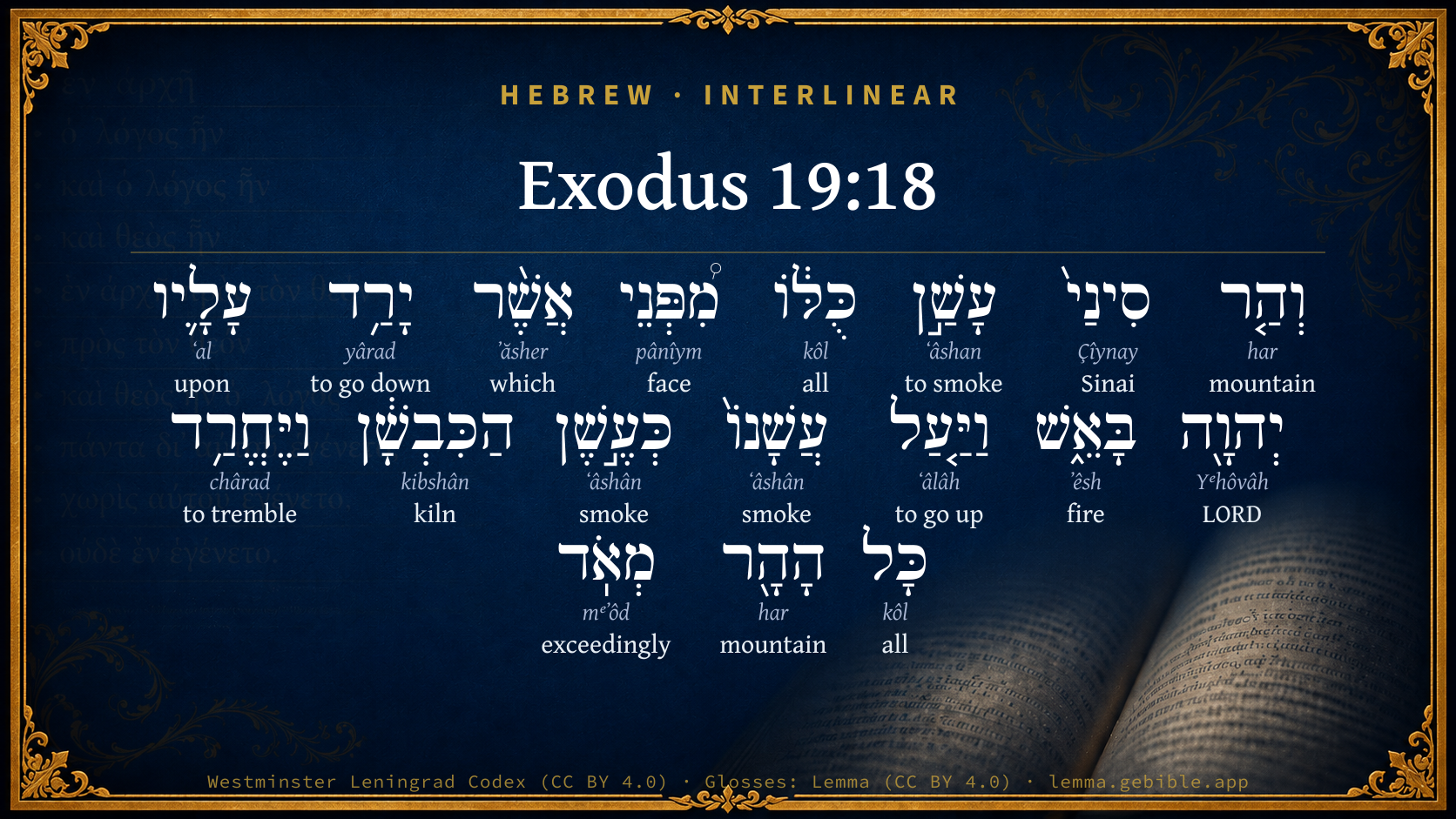
Hebrew (Westminster Leningrad Codex) Exodus 19:18 appears in the Hebrew Old Testament. The text above is from the Westminster Leningrad Codex. Each word links to its Strong’s number, a concise gloss, and parsing drawn from the Open Scriptures Hebrew Bible morphology. Click any word for its full Brown-Driver-Briggs (BDB) entry.
Download image
Cite this verse

Exodus 19:18 (World English Bible). Public Domain. Lemma interlinear Bible study tool, https://lemma.gebible.app/v/exodus/19/18.

Show BibTeX & RIS
BibTeX
RIS
English Translation
Mount Sinai, the whole of it, smoked, because Yahweh descended on it in fire; and its smoke ascended like the smoke of a furnace, and the whole mountain quaked greatly.
World English Bible · Public Domain
Highlights
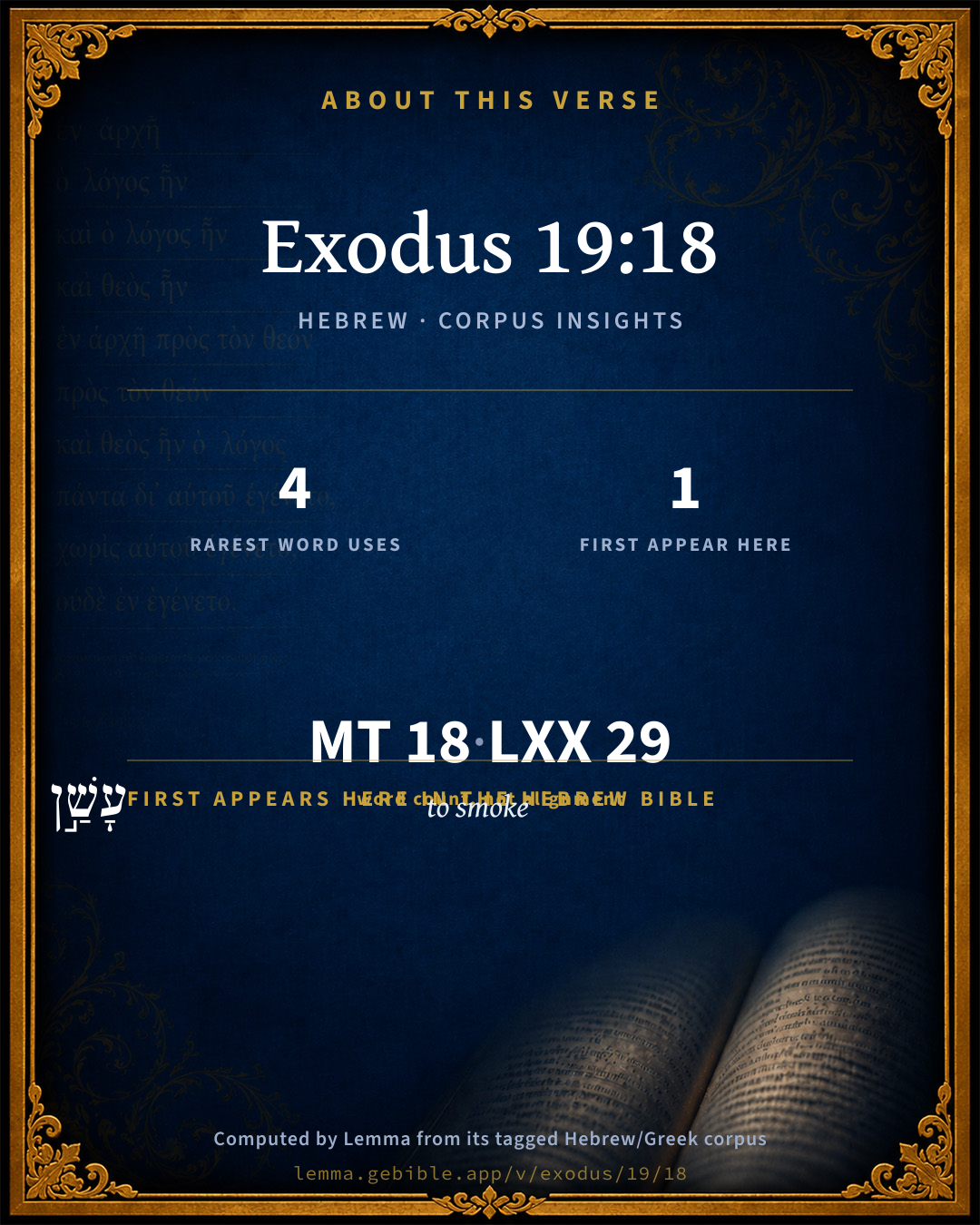
  • 1 first appearance in the Hebrew Bible
Full analysis ↓
Download a study sheet

One document with this verse’s original text, its word-by-word gloss line, the meaning frame, cross-references with their text, attributed commentary, and full source and license credits — printable, and it pastes into notes with its structure intact.

This verse Autodidact and up

Study sheet (.html) Plain text (.txt)

A passage Seminary Student

Up to 50 verses in one chapter. A passage sheet keeps up to 6 commentary sources and 12 cross-references per verse, in the order this page ranks them, and says so on the sheet whenever that leaves anything out. Ask for a single verse and you get the Autodidact verse sheet above.

Everything on this page stays free to read, with no account — the sheet is a download of what is already on screen, not access to it.

Want to remove ads? Support Godless Engineer
Compare translations 3

The same verse in 3 English versions, stacked beneath the original-language interlinear above. Click any original word for its lexicon entry.

Each is an independent rendering of the whole verse — the interlinear is not word-aligned to these translations.

Highlighted words mark where these versions differ — a whole-verse word diff, not a word-by-word alignment.

  • World English Bible Public Domain
    Mount Sinai, the whole of it, smoked, because Yahweh descended on it in fire; and its smoke ascended like the smoke of a furnace, and the whole mountain quaked greatly.
  • King James Version Public Domain
    And mount Sinai was altogether on a smoke, because the LORD descended upon it in fire: and the smoke thereof ascended as the smoke of a furnace, and the whole mount quaked greatly.
  • unfoldingWord Literal Text CC BY-SA 4.0
    And Mount Sinai smoked—all of it—because Yahweh descended on it in fire. And its smoke went up like the smoke of a furnace, and the whole mountain trembled mightily.

unfoldingWord Literal Text — © unfoldingWord, licensed CC BY-SA 4.0. Word-aligned USFM3 via Door43 (git.door43.org/unfoldingWord/en_ult).

Versions to compare (up to 4)

3 of 4 selected

Show all 18 translations

Every available English version of this verse, each an independent rendering of the whole verse.

  • World English Bible Public Domain
    Mount Sinai, the whole of it, smoked, because Yahweh descended on it in fire; and its smoke ascended like the smoke of a furnace, and the whole mountain quaked greatly.
  • Berean Standard Bible Public Domain
    Mount Sinai was completely enveloped in smoke, because the LORD had descended on it in fire. And the smoke rose like the smoke of a furnace, and the whole mountain quaked violently.
  • Majority Standard Bible Public Domain
    Mount Sinai was completely enveloped in smoke, because the LORD had descended on it in fire. And the smoke rose like the smoke of a furnace, and the whole mountain quaked violently.
  • King James Version Public Domain
    And mount Sinai was altogether on a smoke, because the LORD descended upon it in fire: and the smoke thereof ascended as the smoke of a furnace, and the whole mount quaked greatly.
  • American Standard Version (1901) Public Domain
    And mount Sinai, the whole of it, smoked, because Jehovah descended upon it in fire; and the smoke thereof ascended as the smoke of a furnace, and the whole mount quaked greatly.
  • Revised Version (1885) Public Domain
    And mount Sinai was altogether on smoke, because the LORD descended upon it in fire: and the smoke thereof ascended as the smoke of a furnace, and the whole mount quaked greatly.
  • Geneva Bible (1599) Public Domain
    And mount Sinai was all on smoke, because the Lord came downe vpon it in fire, and the smoke therof ascended, as the smoke of a fornace, and all the mount trembled exceedingly.
  • Douay-Rheims (1899) Public Domain
    And all mount Sinai was on a smoke: because the Lord was come down upon it in fire, and the smoke arose from it as out of a furnace: and all the mount was terrible.
  • Young's Literal Translation Public Domain
    and mount Sinai `is' wholly a smoke from the presence of Jehovah, who hath come down on it in fire, and its smoke goeth up as smoke of the furnace, and the whole mount trembleth exceedingly;
  • Literal Standard Version CC BY-SA 4.0
    and Mount Sinai [is] wholly [in] smoke from the presence of YHWH, who has come down on it in fire, and its smoke goes up as smoke of the furnace, and the whole mountain trembles exceedingly;
  • Unlocked Literal Bible CC BY-SA 4.0
    Mount Sinai was completely covered with smoke because Yahweh descended on it in fire and smoke. The smoke went up like the smoke of a furnace, and the whole mountain shook violently.
  • unfoldingWord Literal Text CC BY-SA 4.0
    And Mount Sinai smoked—all of it—because Yahweh descended on it in fire. And its smoke went up like the smoke of a furnace, and the whole mountain trembled mightily.
  • Darby Bible Public Domain
    And the whole of mount Sinai smoked, because Jehovah descended on it in fire; and its smoke ascended as the smoke of a furnace; and the whole mountain shook greatly.
  • World Messianic Bible Public Domain
    All of Mount Sinai smoked, because the LORD descended on it in fire; and its smoke ascended like the smoke of a furnace, and the whole mountain quaked greatly.
  • Webster's Bible Public Domain
    And mount Sinai was altogether in a smoke, because the LORD descended upon it in fire: and the smoke of it ascended as the smoke of a furnace, and the whole mount trembled greatly.
  • Free Bible Version CC BY-SA 4.0
    Smoke poured out over the whole of Mount Sinai because the Lord's presence had come down like fire. The smoke rose up like smoke from a furnace, and the whole mountain shook furiously.
  • Bible in Basic English Public Domain
    And all the mountain of Sinai was smoking, for the Lord had come down on it in fire: and the smoke of it went up like the smoke of a great burning; and all the mountain was shaking.
  • JPS Tanakh (1917) Public Domain
    Now mount Sinai was altogether on smoke, because the LORD descended upon it in fire; and the smoke thereof ascended as the smoke of a furnace, and the whole mount quaked greatly.

Literal Standard Version (2020), Covenant Press — licensed CC BY-SA 4.0. Text via the HelloAO Bible API (eBible.org). Unlocked Literal Bible (unfoldingWord) — licensed CC BY-SA 4.0. Text via the HelloAO Bible API (eBible.org). unfoldingWord Literal Text — © unfoldingWord, licensed CC BY-SA 4.0. Word-aligned USFM3 via Door43 (git.door43.org/unfoldingWord/en_ult). Free Bible Version, Dr. Jonathan Gallagher — licensed CC BY-SA 4.0. Text via the HelloAO Bible API (eBible.org).

Word by word

More ways to search: Search by grammar → Find every occurrence → Compare this word →

Practice this passage: Drill this verse → Learn its vocabulary →

הַכִּבְשָׁ֔ן
kibshân
H3536
“the · kiln”
Particle, Definite Article + Noun, Common, Masculine, Singular, Absolute
Part of Speech
Particle + Noun
Type
Common
Gender
Masculine
Number
Singular
State
Absolute
Full BDB Definition

Origin: from H3533

TWOT: 952

kiln (pottery or lime), smelting forge, furnace
  1. וְהַ֤ר har H2022 “and · mountain of” Conjunction + Noun, Common, Masculine, Singular, Construct
  2. סִינַי֙ Çîynay H5514 “Sinai” Noun, Proper
  3. עָשַׁ֣ן ʻâshan H6225 “to smoke” Verb, Qal, Perfect, 3rd Person, Masculine, Singular
  4. כֻּלּ֔וֹ kôl H3605 “all · his” Noun, Common, Masculine, Singular, Construct + Suffix, Personal, 3rd Person, Masculine, Singular
  5. מִ֠פְּנֵי pânîym H6440 “from · face(s) of” Preposition + Noun, Common, Both, Plural, Construct
  6. אֲשֶׁ֨ר ʼăsher H834 “which” Particle, Relative
  7. יָרַ֥ד yârad H3381 “to go down” Verb, Qal, Perfect, 3rd Person, Masculine, Singular
  8. עָלָ֛יו ʻal H5921 “upon · him” Preposition + Suffix, Personal, 3rd Person, Masculine, Singular
  9. יְהוָ֖ה Yᵉhôvâh H3068 “LORD” Noun, Proper
  10. בָּאֵ֑שׁ ʼêsh H784 “in/at the · fire” Preposition, Determined + Noun, Common, Both, Singular, Absolute
  11. וַיַּ֤עַל ʻâlâh H5927 “and · to go up” Conjunction + Verb, Qal, Sequential Imperfect, 3rd Person, Masculine, Singular
  12. עֲשָׁנוֹ֙ ʻâshân H6227 “smoke · his” Noun, Common, Masculine, Singular, Construct + Suffix, Personal, 3rd Person, Masculine, Singular
  13. כְּעֶ֣שֶׁן ʻâshân H6227 “like/as · smoke of” Preposition + Noun, Common, Masculine, Singular, Construct
  14. וַיֶּחֱרַ֥ד chârad H2729 “and · to tremble” Conjunction + Verb, Qal, Sequential Imperfect, 3rd Person, Masculine, Singular
  15. כָּל kôl H3605 “all of” Noun, Common, Masculine, Singular, Construct
  16. הָהָ֖ר har H2022 “the · mountain” Particle, Definite Article + Noun, Common, Masculine, Singular, Absolute
  17. מְאֹֽד mᵉʼôd H3966 “exceedingly” Adverb

About this verse

These counts appear in no published source. They are computed here, from the morphology-tagged text and Lemma’s own curated glosses. What Lemma adds →

18
words
15
distinct lemmas
Pentateuch
section

Notable vocabulary

The rarest word here is הַכִּבְשָׁ֔ן kiln H3536 — appearing just 4 times in the whole Hebrew Bible.

First appearance in Scripture

This word makes its first canonical appearance in the Hebrew Bible here:

  • עָשַׁ֣ן to smoke H6225

Shared distinctive vocabulary

הַכִּבְשָׁ֔ן kiln H3536 occurs in 4 verses of the Hebrew Bible. Also found in:

Grammatical profile

  • 4 verbs
  • 11 nouns
  • 1 preposition
  • 1 adverb
  • 1 particle

Verb forms

  • עָשַׁ֣ן Qal · Perfect
  • יָרַ֥ד Qal · Perfect
  • וַיַּ֤עַל Qal · Sequential Imperfect
  • וַיֶּחֱרַ֥ד Qal · Sequential Imperfect

Repetition

Words recur within this verse — often emphatic in Hebrew:

  • וְהַ֤ר mountain H2022 ×2
  • כֻּלּ֔וֹ all H3605 ×2
  • עֲשָׁנוֹ֙ smoke H6227 ×2

Hebrew & Septuagint length

In English translation the verse runs 30 words from the Hebrew and 34 from the Septuagint (LXX English) — closely comparable.

A rough comparison of the two English renderings, which tokenize alike — not a word-level alignment.

Word counts can differ between the Hebrew and the Greek without any difference in meaning — e.g. the Hebrew direct-object marker אֵת has no separate Greek word, and Greek often adds the article ὁ.

In the original languages it is 18 Hebrew tokens and 29 Greek tokens — but the two are counted differently (Hebrew bundles its prefixes and suffixes into one token; the Greek is in lemma form), so that isn’t a like-for-like length.

Cross-references

27

Topical passages linked to Exodus 19:18 in the Treasury of Scripture Knowledge — connected by theme and wording, ordered by reader-vote popularity; previews shown in the World English Bible.

  • Judges 5:5 The mountains quaked at the presence of Yahweh, Even yon Sinai at the presence of Yahweh, the God of Israel.
  • Exodus 3:2 The angel of Yahweh appeared to him in a flame of fire out of the midst of a bush. He looked, and behold, the bush burned with fire, and the bush was not consumed.
  • Psalms 144:5 Part your heavens, Yahweh, and come down. Touch the mountains, and they will smoke.
  • Revelation 15:8 The temple was filled with smoke from the glory of God, and from his power. No one was able to enter into the temple, until the seven plagues of the seven angels would be finished.
  • Genesis 19:28 He looked toward Sodom and Gomorrah, and toward all the land of the plain, and looked, and saw that the smoke of the land went up as the smoke of a furnace.
  • Psalms 68:7–8 God, when you went forth before your people, When you marched through the wilderness... Selah.
  • Jeremiah 4:24 I saw the mountains, and, behold, they trembled, and all the hills moved back and forth.
  • Exodus 24:17 The appearance of the glory of Yahweh was like devouring fire on the top of the mountain in the eyes of the children of Israel.
  • Deuteronomy 33:2 He said, Yahweh came from Sinai, Rose from Seir to them; He shined forth from Mount Paran, He came from the ten thousands of holy ones: At his right hand was a fiery law for them.
  • Psalms 104:32 He looks at the earth, and it trembles. He touches the mountains, and they smoke.
  • Genesis 15:17 It came to pass that, when the sun went down, and it was dark, behold, a smoking furnace, and a flaming torch passed between these pieces.
  • Deuteronomy 5:22 These words Yahweh spoke to all your assembly on the mountain out of the midst of the fire, of the cloud, and of the thick darkness, with a great voice: and he added no more. He wrote them on two tables of stone, and gave them to me.
  • 1 Kings 19:11–12 He said, Go forth, and stand on the mountain before Yahweh. Behold, Yahweh passed by, and a great and strong wind tore the mountains, and broke in pieces the rocks before Yahweh; but Yahweh was not in the wind: and after the wind an earthquake; but Yahweh was not in the earthquake:
  • 2 Chronicles 7:1–3 Now when Solomon had made an end of praying, the fire came down from heaven, and consumed the burnt offering and the sacrifices; and the glory of Yahweh filled the house.
  • Isaiah 6:4 The foundations of the thresholds shook at the voice of him who called, and the house was filled with smoke.
  • Hebrews 12:26 whose voice shook the earth, then, but now he has promised, saying, "Yet once more I will shake not only the earth, but also the heavens."
  • Exodus 19:13 No hand shall touch him, but he shall surely be stoned or shot through; whether it is animal or man, he shall not live.' When the trumpet sounds long, they shall come up to the mountain."
  • Exodus 20:18 All the people perceived the thunderings, the lightnings, the sound of the trumpet, and the mountain smoking. When the people saw it, they trembled, and stayed at a distance.
  • Deuteronomy 4:11–12 You came near and stood under the mountain; and the mountain burned with fire to the heart of the sky, with darkness, cloud, and thick darkness.
  • Psalms 77:18 The voice of your thunder was in the whirlwind. The lightnings lit up the world. The earth trembled and shook.
  • Psalms 114:7 Tremble, you earth, at the presence of the Lord, At the presence of the God of Jacob,
  • Nahum 1:5–6 The mountains quake before him, and the hills melt away. The earth trembles at his presence, yes, the world, and all who dwell in it.
  • Zechariah 14:5 You shall flee by the valley of my mountains; for the valley of the mountains shall reach to Azel; yes, you shall flee, just like you fled from before the earthquake in the days of Uzziah king of Judah. Yahweh my God will come, and all the holy ones with you.
  • Matthew 24:7 For nation will rise against nation, and kingdom against kingdom; and there will be famines, plagues, and earthquakes in various places.
  • 2 Thessalonians 1:8 giving vengeance to those who don't know God, and to those who don't obey the Gospel of our Lord Jesus,
  • Hebrews 12:18 For you have not come to a mountain that might be touched, and that burned with fire, and to blackness, darkness, tempest,
  • 2 Peter 3:10 But the day of the Lord will come as a thief in the night; in which the heavens will pass away with a great noise, and the elements will be dissolved with fervent heat, and the earth and the works that are in it will be burned up.

Cross-references courtesy of OpenBible.info (CC BY 4.0).

Hebrew and Greek witnesses Masoretic Hebrew ↔ Greek Septuagint

The same verse in the two great witnesses to the Old Testament, shown verse-for-verse.

These are two independent witnesses, not word-aligned to each other, and the Septuagint is shown in lemma (dictionary) form.

Hebrew Exodus 19:18 Masoretic · Westminster Leningrad Codex

וְהַ֤ר סִינַי֙ עָשַׁ֣ן כֻּלּ֔וֹ מִ֠פְּנֵי אֲשֶׁ֨ר יָרַ֥ד עָלָ֛יו יְהוָ֖ה בָּאֵ֑שׁ וַיַּ֤עַל עֲשָׁנוֹ֙ כְּעֶ֣שֶׁן הַכִּבְשָׁ֔ן וַיֶּחֱרַ֥ד כָּל הָהָ֖ר מְאֹֽד

Mount Sinai, the whole of it, smoked, because Yahweh descended on it in fire; and its smoke ascended like the smoke of a furnace, and the whole mountain quaked greatly.

World English Bible · Public Domain

Greek LXX Exodus 19:18 Septuagint · lemma form

ὁ δέ ὄρος ὁ σινα καπνίζω ὅλος διά ὁ καταβαίνω ἐπί αὐτός ὁ θεός ἐν πῦρ καί ἀναβαίνω ὁ καπνός ὡς καπνός κάμινος καί ἐκἵστημι πᾶς ὁ λαός σφόδρα

The mount of Sina was altogether on a smoke, because God had descended upon it in fire; and the smoke went up as the smoke of a furnace, and the people were exceedingly amazed.

LXX2012 (modern English Septuagint) · Public Domain

On this verse, The Cambridge Bible for Schools and Colleges discusses the Septuagint’s reading. Read the note in Commentary ↓

Hebrew: Westminster Leningrad Codex (CC BY 4.0). Greek: Septuagint (public domain); English from LXX2012 (modern English Septuagint) (Public Domain). How the Septuagint differs from the Hebrew →

Targum (Aramaic paraphrase)

2

The Targum is the ancient Jewish Aramaic paraphrase of the Hebrew Scriptures — an interpretive translation, not the Hebrew text itself. Onkelos (literal) and Pseudo-Jonathan (expansive) render the Torah, and Jonathan the Prophets. Coverage is partial: where no permissively-licensed English translation exists for a verse, only the Aramaic is shown. This is verse-level text, not a word-by-word alignment to the Hebrew.

  1. Targum Onkelos Torah (Genesis–Deuteronomy)
    וְטוּרָא דְסִינַי תָּנַן כֻּלֵהּ מִן קֳדָם דְאִתְגְלִי עֲלוֹהִי יְיָ בְּאֶשָׁתָא וּסְלִיק תְּנָנֵהּ כִּתְנָנָא דְאַתּוּנָא וְזָע כָּל טוּרָא לַחֲדָא:

    (no public-domain English translation for this verse)

    Targum Onkelos — Aramaic: “Onkelos Genesis” (public domain); “Onkelos Exodus” (public domain); “Onkelos Leviticus” (public domain); “Onkelos Numbers” (public domain); “Onkelos Deuteronomy” (public domain). English: “Sefaria Community Translation” (CC0 1.0 (public-domain dedication)); “J.W. Etheridge. The Targums of Onkelos and Jonathan Ben Uzziel on the Pentateuch. London: Longmans, Green, 1862” (public domain). Text via Sefaria.

  2. Targum Pseudo-Jonathan Torah (Genesis–Deuteronomy)
    וְטַוְורָא דְסִינַי תָנֵין כּוּלֵיהּ מִן בִּגְלַל דְּאַרְכִין לֵיהּ שְׁמַיָא וְאִתְגְּלֵי עֲלוֹי בְּאֵישָׁא מְצַלְהֲבָא וְסָלֵיק קוּטְרֵיהּ הֵי כְקוּטְרָא דְאַתּוּנָא וְזַע כָּל טַוְורָא לַחֲדָא

    And all the mount of Sinai was in flame; for the heavens had overspread it, and He was revealed over it in flaming fire, and the smoke went up as the smoke of a furnace, and all the mountain quaked greatly.

    Targum Pseudo-Jonathan — Aramaic: “Targum Jonathan on Genesis” (public domain); “Targum Jonathan on Exodus” (public domain); “Targum Jonathan on Leviticus” (public domain); “Targum Jonathan on Numbers” (public domain); “Targum Jonathan on Deuteronomy” (public domain). English: “The Targum of Jonathan ben Uzziel, trans. J. W. Etheridge, London, 1862” (public domain). Text via Sefaria.

Commentary

Notes on Exodus 19:18 from classic Christian and Jewish commentators (each source and its license shown beneath its notes). The classic Christian expositions comment on the surrounding passage and are grouped to its opening verse, so a note may address several verses; the Jewish commentaries on the Tanakh (Rashi and others) are per-verse, so they appear only where the commentator wrote on this verse.

Lemma curates 59 commentaries, every one of them public domain or Creative Commons licensed, each selected and text-cleaned for this edition rather than reprinted as found. About our sources →

Trapp's Complete Commentary

John Trapp

Exo 19:18 And mount Sinai was altogether on a smoke, because the LORD descended upon it in fire: and the smoke thereof ascended as the smoke of a furnace, and the whole mount quaked greatly.

Ver. 18. The Lord descended upon it in fire.] This fire wherein the law was given, is still in it, and will never out. {Deu 33:2}

John Trapp, A Commentary or Exposition upon All the Books of the Old and New Testament (1647–1656) — public domain. Text from a community e-Sword module.

Joseph Benson's Commentary

Exo 19:18. The whole mount quaked greatly — There cannot be a more grand, awful, and majestic description than this of the descent of Jehovah upon mount Sinai. We can scarcely read it without trembling; and all the tremendous majesty of God appears before our eyes. The psalmist seems to have conceived a most high idea of God from it: — “O God, when thou wentest forth before thy people, when thou didst march through the wilderness; the earth shook, the heavens also dropped at the presence of God, the God of Israel,” Psa 68:7-8.

Joseph Benson's Commentary on the Old and New Testaments (1811–1818) — public domain. Text from a community e-Sword module.

Geneva Bible (1599)

Geneva Bible translators

God used these fearful signs, that his law should be had in greater reverence, and his majesty the more feared.

Geneva Bible (1599) marginal notes — public domain. Text via Bolls.life.

Ellicott's Commentary for English Readers

(18) Mount Sinai was altogether on a smoke.—Heb., smoked, all of it. Some understand by this, “dense clouds, having the appearance of smoke.” But if “the mountain burned with fire,” as asserted (Deu_4:11), the smoke would be real.

The whole mount quaked greatly.—Comp. Psa_68:8, “The earth shook, the heavens also dropped at the presence of God: even Sinai itself was moved at the presence of God.” The expression is more suitable to an earthquake than to the vibration sometimes produced by very violent thunder.

A Bible Commentary for English Readers, edited by Charles John Ellicott (1878–1897) — public domain. Text from a community e-Sword module.

The Cambridge Bible for Schools and Colleges

gen. ed. J. J. S. Perowne

18. on smoke] For the archaism, see Wright’s Bible Word-Book, s.v. On; and cf. Hamlet v. 1. 211 ‘on a roar,’ 2Sa_9:3 ‘lame on his feet,’ Psa_78:14 (P. B. V.) ‘on an heap,’ Psa_79:1 ‘on heaps.’

the smoke of a kiln] as Exo_9:8, Gen_19:28 (‘the steam of a kiln’).

quaked] The word rendered ‘trembled’ in v. 16 end. LXX. and 9 Heb. MSS. have people for mount (as v. 16b); and it is true (Di.) that ḥârçd is not used elsewhere of the merely physical movement of inanimate objects.

The Cambridge Bible for Schools and Colleges (gen. ed. J. J. S. Perowne; Cambridge University Press, 1878–1918) — public domain. Text from a community e-Sword module.

John Gill's Exposition

And Mount Sinai was altogether on a smoke,.... Not from nature, as volcanos, but for a reason after given; it seemed to be one large body of smoke, nothing else to be seen but smoke; an emblem of the darkness of the legal dispensation, which was full of obscure types and figures, of dark shadows and smoky sacrifices, to which the clear day, of the Gospel dispensation is opposed, see Co2 3:12.

because the Lord descended upon it in fire; in flaming fire, as the Targums, which set the mountain on fire, and caused this prodigious smoke; for if he, who is a consuming fire, but toucheth the hills and mountains, they smoke, Psa 104:32.

and the smoke thereof ascended as the smoke of a furnace such an one as that which Abraham in vision saw, Gen 15:17.

and the whole mount quaked greatly; to which circumstance Deborah refers in her song, when she speaks of mountains melting and flowing from before the presence of the God of Israel, and particularly of Sinai, Jdg 5:4, and the psalmist, who makes mention of the earth shaking, and the heavens dropping, and of Sinai being moved at his presence, Psa 68:8, it is probable there was an earthquake at this time, which sometimes attends thunders and lightnings, see Rev 16:18.

John Gill's Exposition of the Whole Bible (1746–1763) — public domain (CC PDM 1.0). Text via the HelloAO Bible API.

Albert Barnes' Notes on the Bible

A furnace - The word in the original is Egyptian, and occurs only in the Pentateuch.

Albert Barnes' Notes on the Bible (1834–1885) — public domain. Text from a community e-Sword/MySword module.

Haydock's Catholic Bible Commentary

Terrible, by the display of so many instruments of God’s power; lightning, fire, a thick cloud, and various peals of thunder, and the sound of a trumpet; besides rain, and the company of millions of angels, Psalm lxvii. 9, 18. How different was the appearance of Sion, when Jesus proclaimed his gospel! (Hebrews xii. 18.)

George Leo Haydock (1774–1849), Haydock's Catholic Family Bible and Commentary, 1859 edition — public domain. Excludes Psalms (Douay-Rheims chapter numbering differs from Protestant) and Deuterocanonical books (Catholic canon only).

Matthew Poole's English Annotations

The Lord descended in fire for further terror to obstinate sinners. Hence this law is called a

fiery law, Deu 33:2.

The whole mount quaked greatly, by an earthquake, as appears from Psa 60:2; 104:32.

Matthew Poole's English Annotations on the Holy Bible (1683–1685) — public domain. Text from a community e-Sword/MySword module.

The Pulpit Commentary

Mount Sinai was altogether on a smoke. Literally, smoked, all of it. Kalisch suggests that "the dense clouds from which the thunders broke forth had the appearance of smoke." But the reason assigned the Lord descended on it in fire," seems to imply real smoke; and. the same re-suits from the comparison of it to "the smoke of a furnace." The whole mount quaked greatly. Scarcely "through the vehemence of the thunder" (Kalisch), for thunder does not shake the earth, though it shakes the air but rather by an actual earthquake. Compare Mat_27:51-54; Act_4:31 Act_16:26.

The Pulpit Commentary (1880–1919), ed. H.D.M. Spence-Jones & Joseph S. Exell — public domain. Text from a community e-Sword module.

Rashi

Rabbi Shlomo Yitzchaki (Rashi)

עשן כלו WAS ALTOGETHER ON A SMOKE — This word עָשַׁן is not a noun, because the ש is punctuated with Patach, but it has the meaning of “it was doing something”, similar to and אָמַר and שָׁמַר and שָׁמַע. On this account, its translation in the Targum is תָּנֵן כֻּלֵּהּ “it was altogether giving forth smoke” (תָּנֵן is a verb corresponding with the Hebrew עָשַׁן). and it does not translate it by תְּנָנָא (a noun denoting smoke, corresponding to Hebrew עָשָׁן). But wherever else the word עשן occurs in Scripture it is punctuated with Kametz because it is a noun.

הכבשן A FURNACE of lime (i. e. in which lime is burnt and which emits vast quantities of smoke). One might think that the mountain emitted smoke only like such a furnace and not to a greater degree! Scripture therefore states in another passage, (Deuteronomy 4:11) “[And the mountain] burned with fire unto the very midst of the heavens”. Then what reason is there for stating that it smoked only like a furnace? This is said in order to make intelligible to the human ear as much as it can understand: Scripture gives human beings an example (a comparison) which is well-known to them. A similar case is, (Hosea 11:10) “As a lion does He (God) roar”. But who gave the lion power if not He, and yet Scripture compares him only to a lion! But the reason is that we describe Him by comparing Him to His creatures in order to make intelligible to the human ear as much as it can understand. A similar example is: (Ezekiel 43:2) “And His voice was like the sound of many waters”. But who gave the waters a thunderous sound except He, and yet you describe Him by comparing Him to His handiwork — it is to make it intelligible to the human ear (Mekhilta).

Rashi on the Tanakh — English translations: “The Judaica Press complete Tanach with Rashi, translated by A. J. Rosenberg” (CC BY 4.0); “Pentateuch with Rashi's commentary by M. Rosenbaum and A.M. Silbermann, 1929-1934” (public domain); “The Metsudah Tanach series, Lakewood, N.J” (CC BY 4.0); and “The Book of Joshua, Metsudah Publications, 1997” (CC BY 4.0). Text via Sefaria.

Lesson kit

Teaching starters — assembled from the data on this page, not authored interpretation. Every prompt links to the verse data it draws on. Edit before teaching.

Exodus, in the Pentateuch, opens this verse with 18 words (15 distinct Hebrew lemmas). Its most distinctive word is kibshân (“kiln”). A historical commentator’s framing appears above. Read the whole chapter for the surrounding context.

Discussion questions

  1. The word kibshân carries the sense “kiln.” How does it shape the verse?
  2. This is the first place “to smoke” appears in Scripture (first appears here). What does its debut here establish?
  3. How does Genesis 19:28, which shares the word «kiln», read alongside this verse?
  4. What does the repetition of “mountain” (2× in this one verse) do in this verse?
  5. These translations render this verse differently; the difference is in the English rendering, not the original. What questions does that raise?
  6. «עָשַׁ֣ן» is a Qal Perfect verb. How does that grammatical form shape the action described?
  7. Compare how Trapp's Complete Commentary and Joseph Benson's Commentary read this verse. Where do they agree or differ?

Things to notice

Reading settings

Reading text

Shown beneath each verse's original-language words.

Old Testament
Old Testament edition

Read the OT as the Masoretic Hebrew (MT) or the Greek Septuagint (LXX).

English shown for the Greek Septuagint (in the Hebrew ↔ Greek comparison).

Comparing translations? Open the Compare panel on any verse page to stack up to four side by side.