
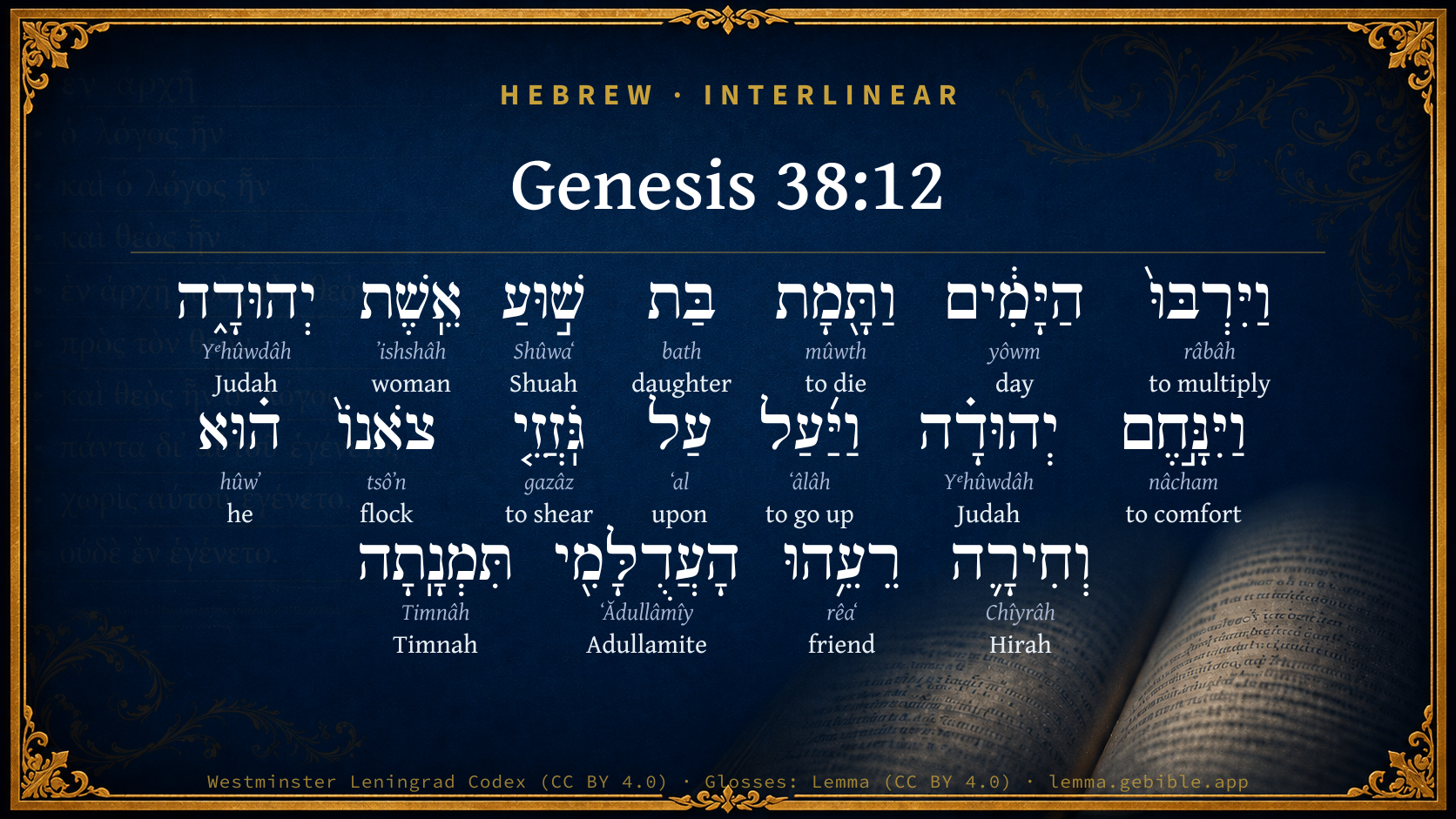
Genesis 38:12

Hebrew (Westminster Leningrad Codex) Genesis 38:12 appears in the Hebrew Old Testament. The text above is from the Westminster Leningrad Codex. Each word links to its Strong’s number, a concise gloss, and parsing drawn from the Open Scriptures Hebrew Bible morphology. Click any word for its full Brown-Driver-Briggs (BDB) entry.
Download image
Cite this verse

Genesis 38:12 (World English Bible). Public Domain. Lemma interlinear Bible study tool, https://lemma.gebible.app/v/genesis/38/12.

Show BibTeX & RIS
BibTeX
RIS
English Translation
After many days, Shua's daughter, the wife of Judah, died. Judah was comforted, and went up to his sheep-shearers to Timnah, he and his friend Hirah, the Adullamite.
World English Bible · Public Domain
Highlights
  • 1 first appearance in the Hebrew Bible
Full analysis ↓
Download a study sheet

One document with this verse’s original text, its word-by-word gloss line, the meaning frame, cross-references with their text, attributed commentary, and full source and license credits — printable, and it pastes into notes with its structure intact.

This verse Autodidact and up

Study sheet (.html) Plain text (.txt)

A passage Seminary Student

Up to 50 verses in one chapter. A passage sheet keeps up to 6 commentary sources and 12 cross-references per verse, in the order this page ranks them, and says so on the sheet whenever that leaves anything out. Ask for a single verse and you get the Autodidact verse sheet above.

Everything on this page stays free to read, with no account — the sheet is a download of what is already on screen, not access to it.

Want to remove ads? Support Godless Engineer
Compare translations 3

The same verse in 3 English versions, stacked beneath the original-language interlinear above. Click any original word for its lexicon entry.

Each is an independent rendering of the whole verse — the interlinear is not word-aligned to these translations.

Highlighted words mark where these versions differ — a whole-verse word diff, not a word-by-word alignment.

  • World English Bible Public Domain
    After many days, Shua's daughter, the wife of Judah, died. Judah was comforted, and went up to his sheep-shearers to Timnah, he and his friend Hirah, the Adullamite.
  • King James Version Public Domain
    And in process of time the daughter of Shuah Judah's wife died; and Judah was comforted, and went up unto his sheepshearers to Timnath, he and his friend Hirah the Adullamite.
  • unfoldingWord Literal Text CC BY-SA 4.0
    Then the days were many, and Shua’s daughter, the wife of Judah, died. Then Judah was comforted, and he went up to Timnah, to who were shearing his sheep, he and his friend Hirah the Adullamite.

unfoldingWord Literal Text — © unfoldingWord, licensed CC BY-SA 4.0. Word-aligned USFM3 via Door43 (git.door43.org/unfoldingWord/en_ult).

Versions to compare (up to 4)

3 of 4 selected

Show all 18 translations

Every available English version of this verse, each an independent rendering of the whole verse.

  • World English Bible Public Domain
    After many days, Shua's daughter, the wife of Judah, died. Judah was comforted, and went up to his sheep-shearers to Timnah, he and his friend Hirah, the Adullamite.
  • Berean Standard Bible Public Domain
    After a long time Judah’s wife, the daughter of Shua, died. When Judah had finished mourning, he and his friend Hirah the Adullamite went up to his sheepshearers at Timnah.
  • Majority Standard Bible Public Domain
    After a long time Judah’s wife, the daughter of Shua, died. When Judah had finished mourning, he and his friend Hirah the Adullamite went up to his sheepshearers at Timnah.
  • King James Version Public Domain
    And in process of time the daughter of Shuah Judah's wife died; and Judah was comforted, and went up unto his sheepshearers to Timnath, he and his friend Hirah the Adullamite.
  • American Standard Version (1901) Public Domain
    And in process of time Shua's daughter, the wife of Judah, died; and Judah was comforted, and went up unto his sheep-shearers to Timnah, he and his friend Hirah the Adullamite.
  • Revised Version (1885) Public Domain
    And in process of time Shua’s daughter, the wife of Judah, died; and Judah was comforted, and went up unto his sheepshearers to Timnah, he and his friend Hirah the Adullamite.
  • Geneva Bible (1599) Public Domain
    And in processe of time also the daughter of Shuah Iudahs wife dyed. Then Iudah, when he had left mourning, went vp to his sheepe sherers to Timnah, he, and his neighbour Hirah the Adullamite.
  • Douay-Rheims (1899) Public Domain
    And after many days were past, the daughter of Sue the wife of Juda died: and when he had taken comfort after his mourning, he went up to Thamnas, to the shearers of his sheep, he and Hiras the Odollamite the shepherd of his flock.
  • Young's Literal Translation Public Domain
    And the days are multiplied, and the daughter of Shuah, Judah's wife, dieth; and Judah is comforted, and goeth up unto his sheep-shearers, he and Hirah his friend the Adullamite, to Timnath.
  • Literal Standard Version CC BY-SA 4.0
    And the days are multiplied, and the daughter of Shuah, Judah’s wife, dies; and Judah is comforted, and goes up to his sheep-shearers, he and Hirah his friend the Adullamite, to Timnath.
  • Unlocked Literal Bible CC BY-SA 4.0
    After a long time, Shua's daughter, the wife of Judah, died. Judah was comforted and went up to his sheepshearers at Timnah, he and his friend Hirah the Adullamite.
  • unfoldingWord Literal Text CC BY-SA 4.0
    Then the days were many, and Shua’s daughter, the wife of Judah, died. Then Judah was comforted, and he went up to Timnah, to who were shearing his sheep, he and his friend Hirah the Adullamite.
  • Darby Bible Public Domain
    And as the days were multiplied, Judah's wife, the daughter of Shua, died. And Judah was comforted, and he went up to his sheep-shearers, to Timnah, he and his friend Hirah the Adullamite.
  • World Messianic Bible Public Domain
    After many days, Shua’s daughter, the wife of Judah, died. Judah was comforted, and went up to his sheep shearers to Timnah, he and his friend Hirah, the Adullamite.
  • Webster's Bible Public Domain
    And in process of time, the daughter of Shuah Judah's wife died: and Judah was comforted, and went up to his sheep-shearers to Timnath, he and his friend Hirah the Adullamite.
  • Free Bible Version CC BY-SA 4.0
    A long time later Judah's wife, the daughter of Shua, died. After Judah had finished the time of mourning, he went to visit his sheepshearers at Timnah with his friend Hirah from Adullam.
  • Bible in Basic English Public Domain
    And after a time, Bath-shua, Judah's wife, came to her end; and after Judah was comforted for her loss, he went to Timnah, where they were cutting the wool of his sheep, and his friend Hirah of Adullam went with him.
  • JPS Tanakh (1917) Public Domain
    And in process of time Shua's daughter, the wife of Judah, died; and Judah was comforted, and went up unto his sheep-shearers to Timnah, he and his friend Hirah the Adullamite.

Literal Standard Version (2020), Covenant Press — licensed CC BY-SA 4.0. Text via the HelloAO Bible API (eBible.org). Unlocked Literal Bible (unfoldingWord) — licensed CC BY-SA 4.0. Text via the HelloAO Bible API (eBible.org). unfoldingWord Literal Text — © unfoldingWord, licensed CC BY-SA 4.0. Word-aligned USFM3 via Door43 (git.door43.org/unfoldingWord/en_ult). Free Bible Version, Dr. Jonathan Gallagher — licensed CC BY-SA 4.0. Text via the HelloAO Bible API (eBible.org).

Word by word

More ways to search: Search by grammar → Find every occurrence → Compare this word →

Practice this passage: Drill this verse → Learn its vocabulary →

שׁ֣וּעַ
Shûwaʻ
H7770
“Shuah”
Noun, Proper
Part of Speech
Noun
Type
Proper
Full BDB Definition

Origin: the same as H7769

TWOT: None

Shuah = "wealth" - father of Judah's wife
  1. וַיִּרְבּוּ֙ râbâh H7235 “and · to multiply” Conjunction + Verb, Qal, Sequential Imperfect, 3rd Person, Masculine, Plural
  2. הַיָּמִ֔ים yôwm H3117 “the · days” Particle, Definite Article + Noun, Common, Masculine, Plural, Absolute
  3. וַתָּ֖מָת mûwth H4191 “and · to die” Conjunction + Verb, Qal, Sequential Imperfect, 3rd Person, Feminine, Singular
  4. בַּת bath H1323 “daughter of” Noun, Common, Feminine, Singular, Construct
  5. אֵֽשֶׁת ʼishshâh H802 “woman of” Noun, Common, Feminine, Singular, Construct
  6. יְהוּדָ֑ה Yᵉhûwdâh H3063 “Judah” Noun, Proper
  7. וַיִּנָּ֣חֶם nâcham H5162 “and · to comfort” Conjunction + Verb, Niphal, Sequential Imperfect, 3rd Person, Masculine, Singular
  8. יְהוּדָ֗ה Yᵉhûwdâh H3063 “Judah” Noun, Proper
  9. וַיַּ֜עַל ʻâlâh H5927 “and · to go up” Conjunction + Verb, Qal, Sequential Imperfect, 3rd Person, Masculine, Singular
  10. עַל ʻal H5921 “upon” Preposition
  11. גֹּֽזֲזֵ֤י gazâz H1494 “shearing” Verb, Qal, Participle Active, Masculine, Plural, Construct
  12. צֹאנוֹ֙ tsôʼn H6629 “flock · his” Noun, Common, Both, Singular, Construct + Suffix, Personal, 3rd Person, Masculine, Singular
  13. ה֗וּא hûwʼ H1931 “he” Pronoun, Personal, 3rd Person, Masculine, Singular
  14. וְחִירָ֛ה Chîyrâh H2437 “and · Hirah” Conjunction + Noun, Proper
  15. רֵעֵ֥הוּ rêaʻ H7453 “friend · his” Noun, Common, Masculine, Singular, Construct + Suffix, Personal, 3rd Person, Masculine, Singular
  16. הָעֲדֻלָּמִ֖י ʻĂdullâmîy H5726 “the · Adullamite” Particle, Definite Article + Noun, Gentilic, Masculine, Singular, Absolute
  17. תִּמְנָֽתָה Timnâh H8553 “Timnah · toward” Noun, Proper + Suffix, Demonstrative

About this verse

These counts appear in no published source. They are computed here, from the morphology-tagged text and Lemma’s own curated glosses. What Lemma adds →

18
words
17
distinct lemmas
Pentateuch
section

Notable vocabulary

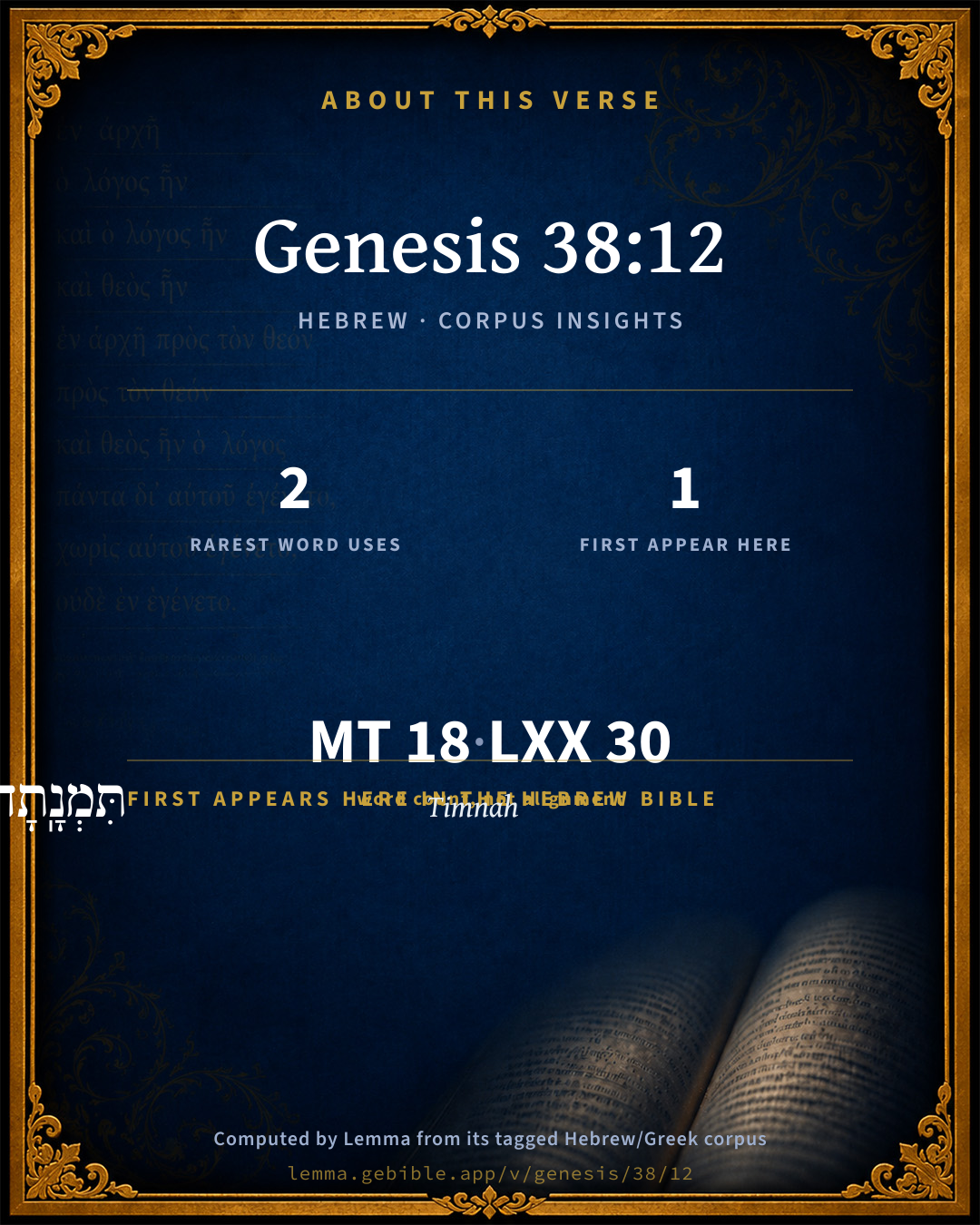
The rarest word here is שׁ֣וּעַ Shuah H7770 — appearing just 2 times in the whole Hebrew Bible.

First appearance in Scripture

This word makes its first canonical appearance in the Hebrew Bible here:

  • תִּמְנָֽתָה Timnah H8553

Shared distinctive vocabulary

שׁ֣וּעַ Shuah H7770 occurs in 2 verses of the Hebrew Bible. Also found in:

Grammatical profile

  • 5 verbs
  • 11 nouns
  • 1 pronoun
  • 1 preposition

Verb forms

  • וַיִּרְבּוּ֙ Qal · Sequential Imperfect
  • וַתָּ֖מָת Qal · Sequential Imperfect
  • וַיִּנָּ֣חֶם Niphal · Sequential Imperfect
  • וַיַּ֜עַל Qal · Sequential Imperfect
  • גֹּֽזֲזֵ֤י Qal · Participle Active

Repetition

A word recurs within this verse — often emphatic in Hebrew:

  • יְהוּדָ֑ה Judah H3063 ×2

Hebrew & Septuagint length

In English translation the verse runs 28 words from the Hebrew and 32 from the Septuagint (LXX English) — closely comparable.

A rough comparison of the two English renderings, which tokenize alike — not a word-level alignment.

Word counts can differ between the Hebrew and the Greek without any difference in meaning — e.g. the Hebrew direct-object marker אֵת has no separate Greek word, and Greek often adds the article ὁ.

In the original languages it is 18 Hebrew tokens and 30 Greek tokens — but the two are counted differently (Hebrew bundles its prefixes and suffixes into one token; the Greek is in lemma form), so that isn’t a like-for-like length.

Cross-references

13

Topical passages linked to Genesis 38:12 in the Treasury of Scripture Knowledge — connected by theme and wording, ordered by reader-vote popularity; previews shown in the World English Bible.

  • Joshua 15:10 and the border turned about from Baalah westward to Mount Seir, and passed along to the side of Mount Jearim on the north (the same is Chesalon), and went down to Beth-shemesh, and passed along by Timnah;
  • Genesis 24:67 Isaac brought her into his mother Sarah's tent, and took Rebekah, and she became his wife. He loved her. Isaac was comforted after his mother's death.
  • Judges 14:1 Samson went down to Timnah, and saw a woman in Timnah of the daughters of the Philistines.
  • 2 Samuel 13:39 [the soul of] king David longed to go forth to Absalom: for he was comforted concerning Amnon, seeing he was dead.
  • Genesis 31:19 Now Laban had gone to shear his sheep: and Rachel stole the teraphim that were her father's.
  • Genesis 38:1 It happened at that time, that Judah went down from his brothers, and visited a certain Adullamite, whose name was Hirah.
  • Joshua 15:35 Jarmuth, and Adullam, Socoh, and Azekah,
  • Joshua 15:37 Zenan, and Hadashah, and Migdal-gad,
  • Joshua 15:57 Kain, Gibeah, and Timnah; ten cities with their villages.
  • Joshua 19:43 and Elon, and Timnah, and Ekron,
  • 1 Samuel 25:4–8 David heard in the wilderness that Nabal was shearing his sheep.
  • 1 Samuel 25:36 Abigail came to Nabal; and, behold, he held a feast in his house, like the feast of a king; and Nabal's heart was merry within him, for he was very drunken: therefore she told him nothing, less or more, until the morning light.
  • 2 Samuel 13:23–29 It happened after two full years, that Absalom had sheep-shearers in Baal Hazor, which is beside Ephraim: and Absalom invited all the king's sons.

Cross-references courtesy of OpenBible.info (CC BY 4.0).

Hebrew and Greek witnesses Masoretic Hebrew ↔ Greek Septuagint

The same verse in the two great witnesses to the Old Testament, shown verse-for-verse.

These are two independent witnesses, not word-aligned to each other, and the Septuagint is shown in lemma (dictionary) form.

Hebrew Genesis 38:12 Masoretic · Westminster Leningrad Codex

וַיִּרְבּוּ֙ הַיָּמִ֔ים וַתָּ֖מָת בַּת שׁ֣וּעַ אֵֽשֶׁת יְהוּדָ֑ה וַיִּנָּ֣חֶם יְהוּדָ֗ה וַיַּ֜עַל עַל גֹּֽזֲזֵ֤י צֹאנוֹ֙ ה֗וּא וְחִירָ֛ה רֵעֵ֥הוּ הָעֲדֻלָּמִ֖י תִּמְנָֽתָה

After many days, Shua's daughter, the wife of Judah, died. Judah was comforted, and went up to his sheep-shearers to Timnah, he and his friend Hirah, the Adullamite.

World English Bible · Public Domain

Greek LXX Genesis 38:12 Septuagint · lemma form

πληθύνω δέ ὁ ἡμέρα καί ἀποθνήσκω σαυα ὁ γυνή ιουδα καί παρακαλέω ἰούδας ἀναβαίνω ἐπί ὁ κείρω ὁ πρόβατον αὐτός αὐτός καί ιρας ὁ ποιμήν αὐτός ὁ οδολλαμίτης εἰς θαμνα

And the days were fulfilled, and Sava the wife of Judas died; and Judas, being comforted, went to them that sheared his sheep, himself and Iras his Shepherd the Odollamite, to Thamna.

LXX2012 (modern English Septuagint) · Public Domain

On this verse, Ellicott's Commentary for English Readers discusses the Septuagint’s reading. Read the note in Commentary ↓

Hebrew: Westminster Leningrad Codex (CC BY 4.0). Greek: Septuagint (public domain); English from LXX2012 (modern English Septuagint) (Public Domain). How the Septuagint differs from the Hebrew →

Targum (Aramaic paraphrase)

2

The Targum is the ancient Jewish Aramaic paraphrase of the Hebrew Scriptures — an interpretive translation, not the Hebrew text itself. Onkelos (literal) and Pseudo-Jonathan (expansive) render the Torah, and Jonathan the Prophets. Coverage is partial: where no permissively-licensed English translation exists for a verse, only the Aramaic is shown. This is verse-level text, not a word-by-word alignment to the Hebrew.

  1. Targum Onkelos Torah (Genesis–Deuteronomy)
    וּסְגִיאוּ יוֹמַיָּא וּמִיתַת בַּת שׁוּעַ אִתַּת יְהוּדָה וְאִתְנַחֵם יְהוּדָה וּסְלִיק עַל גּוֹזְזֵי עָנֵהּ הוּא וְחִירָה רַחֲמֵהּ עֲדֻלָּמָאָה לְתִמְנָת

    (no public-domain English translation for this verse)

    Targum Onkelos — Aramaic: “Onkelos Genesis” (public domain); “Onkelos Exodus” (public domain); “Onkelos Leviticus” (public domain); “Onkelos Numbers” (public domain); “Onkelos Deuteronomy” (public domain). English: “Sefaria Community Translation” (CC0 1.0 (public-domain dedication)); “J.W. Etheridge. The Targums of Onkelos and Jonathan Ben Uzziel on the Pentateuch. London: Longmans, Green, 1862” (public domain). Text via Sefaria.

  2. Targum Pseudo-Jonathan Torah (Genesis–Deuteronomy)
    וּסְגוֹ יוֹמַיָא וּמִיתַת בַּת שׁוּעַ אִיתַּת יְהוּדָה וְאִתְנְחֵם יְהוּדָה וּסְלֵיק עַל גוֹזְזֵי עָנֵיהּ הוּא וְחִירָה רַחֲמֵיהּ עֲדוּלְמָאָה לְתִמְנָת

    And days multiplied and the daughter of Shuva, Jehuda's wife, had died, and Jehuda was comforted. And Jehuda went up to the shearing of his flock, he and Hira his friend the Adullemite, to Timnath.

    Targum Pseudo-Jonathan — Aramaic: “Targum Jonathan on Genesis” (public domain); “Targum Jonathan on Exodus” (public domain); “Targum Jonathan on Leviticus” (public domain); “Targum Jonathan on Numbers” (public domain); “Targum Jonathan on Deuteronomy” (public domain). English: “The Targum of Jonathan ben Uzziel, trans. J. W. Etheridge, London, 1862” (public domain). Text via Sefaria.

Commentary

Notes on Genesis 38:12 from classic Christian and Jewish commentators (each source and its license shown beneath its notes). The classic Christian expositions comment on the surrounding passage and are grouped to its opening verse, so a note may address several verses; the Jewish commentaries on the Tanakh (Rashi and others) are per-verse, so they appear only where the commentator wrote on this verse.

Lemma curates 59 commentaries, every one of them public domain or Creative Commons licensed, each selected and text-cleaned for this edition rather than reprinted as found. About our sources →

Trapp's Complete Commentary

John Trapp

Gen 38:12 And in process of time the daughter of Shuah Judah’s wife died; and Judah was comforted, and went up unto his sheepshearers to Timnath, he and his friend Hirah the Adullamite.

Ver. 12. The daughter of Shuah, &c.] This was just in God upon Judah, for his fraudulent dealing with Tamar; whom he neither married to his son Shelah, nor suffered to be married to another. Sin is oft punished in kind.

John Trapp, A Commentary or Exposition upon All the Books of the Old and New Testament (1647–1656) — public domain. Text from a community e-Sword module.

Keil & Delitzsch

C. F. Keil & F. Delitzsch

But when Thamar, after waiting a long time, saw that Shelah had grown up and yet was not given to her as a husband, she determined to procure children from Judah himself, who had become a widower in the meantime; and his going to Timnath to the sheep-shearing afforded her a good opportunity. The time mentioned ("the days multiplied," i.e., a long time passed by) refers not to the statement which follows, that Judah's wife died, but rather to the leading thought of the verse, viz., Judah's going to the sheep-shearing. ויּנּחם: he comforted himself, i.e., he ceased to mourn. Timnath is not the border town of Dan and Judah between Beth-shemesh and Ekron in the plain (Jos 15:10; Jos 19:43), but Timnah on the mountains of Judah (Jos 15:57, cf. Rob. Pal. ii. 343, note), as the expression "went up" shows. The sheep-shearing was a fte with shepherds, and was kept with great feasting. Judah therefore took his friend Hirah with him; a fact noticed in Gen 38:12 in relation to what follows.

Gen 38:13-14

As soon as Thamar heard of Judah's going to this feast, she took off her widow's clothes, put on a veil, and sat down, disguised as a harlot, by the gate of Enayim, where Judah would be sure to pass on his return from Timnath. Enayim was no doubt the same as Enam in the lowland of Judah (Jos 15:34).

Gen 38:15-18

When Judah saw her here and took her for a harlot, he made her an offer, and gave her his signet-ring, with the band (פּתיל) by which it was hung round his neck, and his staff, as a pledge of the young buck-goat which he offered her. They were both objects of value, and were regarded as ornaments in the East, as Herodotus (i. 195) has shown with regard to the Babylonians (see my Bibl. Arch. 2, 48). He then lay with her, and she became pregnant by him.

Gen 38:19-21

After this had occurred, Thamar laid aside her veil, put on her widow's dress again, and returned home. When Judah, therefore, sent the kid by his friend Hirah to the supposed harlot for the purpose of redeeming his pledges, he could not find her, and was told, on inquiring of the inhabitants of Enayim, that there was no קדשׁה there. הקּדשׁה: lit., "the consecrated," i.e., the hierodule, a woman sacred to Astarte, a goddess of the Canaanites, the deification of the generative and productive principle of nature; one who served this goddess by prostitution (vid., Deu 23:18). This was no doubt regarded as the most respectable designation for public prostitutes in Canaan.

Gen 38:22-23

When his friend returned with the kid and reported his want of success, Judah resolved to leave his pledges with the girl, that he might not expose himself to the ridicule of the people by any further inquiries, since he had done his part towards keeping his promise. "Let her take them (i.e., keep the signet-ring and staff) for herself, that we may not become a (an object of) ridicule." The pledges were unquestionably of more value than a young he-goat.

Gen 38:24-26

About three months afterwards (משׁלשׁ prob. for משּׁלשׁ with the prefix )מ Judah was informed that Thamar had played the harlot and was certainly (הנּה) with child. He immediately ordered, by virtue of his authority as head of the tribe, that she should be brought out and burned. Thamar was regarded as the affianced bride of Shelah, and was to be punished as a bride convicted of a breach of chastity. But the Mosaic law enjoined stoning in the case of those who were affianced and broke their promise, or of newly married women who were found to have been dishonoured (Deu 22:20-21, Deu 22:23-24); and it was only in the case of the whoredom of a priest's daughter, or of carnal intercourse with a mother or a daughter, that the punishment of burning was enjoined (Lev 21:9 and Lev 20:14). Judah's sentence, therefore, was more harsh than the subsequent law; whether according to patriarchal custom, or on other grounds, cannot be determined. When Thamar was brought out, she sent to Judah the things which she had kept as a pledge, with this message: "By a man to whom these belong am I with child: look carefully therefore to whom this signet-ring, and band, and stick belong." Judah recognised the things as his own, and was obliged to confess, "She is more in the right than I; for therefore (sc., that this might happen to me, or that it might turn out so; on כּי־על־כּן see Gen 18:5) have I not given her to my son Shelah." In passing sentence upon Thamar, Judah had condemned himself. His son, however, did not consist merely in his having given way to his lusts so afar as to lie with a supposed public prostitute of Canaan, but still more in the fact, that by breaking his promise to give her his son Shelah as her husband, he had caused his daughter-in-law to practise this deception upon him, just because in his heart he blamed her for the early and sudden deaths of his elder sons, whereas the real cause of the deaths which had so grieved his paternal heart was the wickedness of the sons themselves, the mainspring of which was to be found in his own marriage with a Canaanite in violation of the patriarchal call. And even if the sons of Jacob were not unconditionally prohibited from marrying the daughters of Canaanites, Judah's marriage at any rate had borne such fruit in his sons Ger and Onan, as Jehovah the covenant God was compelled to reject. But if Judah, instead of recognising the hand of the Lord in the sudden death of his sons, traced the cause to Thamar, and determined to keep her as a childless widow all her life long, not only in opposition to the traditional custom, but also in opposition to the will of God as expressed in His promises of a numerous increase of the seed of Abraham, Isaac, and Jacob; Thamar had by no means acted rightly in the stratagem by which she frustrated his plan, and sought to procure from Judah himself the seed of which he was unjustly depriving her, though her act might be less criminal than Judah's. For it is evident from the whole account, that she was not driven to her sin by lust, but by the innate desire for children (ὅτι δὲ παιδοποΐ́ιας χάριν, καὶ οὐ φιληδονίας τοῦτο ὁ Θάμαρ ἐμηχανήσατο, - Theodoret); and for that reason she was more in the right than Judah. Judah himself, however, not only saw his guilt, but he confessed it also; and showed both by this confession, and also by the fact that he had no further conjugal intercourse with Thamar, an earnest endeavour to conquer the lusts of the flesh, and to guard against the sin into which he had fallen. And because he thus humbled himself, God gave him grace, and not only exalted him to be the chief of the house of Israel, but blessed the children that were begotten in sin.

Gen 38:27-28

Thamar brought forth twins; and a circumstance occurred at the birth, which does occasionally happen when the children lie in an abnormal position, and always impedes the delivery, and which was regarded in this instance as so significant that the names of the children were founded upon the fact. At the birth ויּתּן־יד "there was a hand," i.e., a hand came out (יתּן as in Job 37:10; Pro 13:10), round which the midwife tied a scarlet thread, to mark this as the first-born.

Gen 38:29-30

"And it came to pass, when it (the child) drew back its hand (כּמשׁיב for משׁיב כּהיות as in Gen 40:10), behold its brother came out. Then she (the midwife) said, What a breach hast thou made for thy part? Upon thee the breach;" i.e., thou bearest the blame of the breach. פּרץ signifies not rupturam perinoei, but breaking through by pressing forward. From that he received the name of Perez (breach, breaker through). Then the other one with the scarlet thread came into the world, and was named Zerah (זרח exit, rising), because he sought to appear first, whereas in fact Perez was the first-born, and is even placed before Zerah in the lists in Gen 46:12; Num 26:20. Perez was the ancestor of the tribe-prince Nahshon (Num 2:3), and of king David also (Rut 4:18.; Ch1 2:5.). Through him, therefore, Thamar has a place as one of the female ancestors in the genealogy of Jesus Christ.

Keil & Delitzsch — Biblical Commentary on the Old Testament (1861–1891) — public domain (CC PDM 1.0). Text via the HelloAO Bible API. (Old Testament only.)

Tyndale Open Study Notes

Tyndale Open Resources

38:12-13 Without a marriage, the family’s future was in jeopardy. • Judah’s wife died: This made Judah available to fulfill the responsibility of providing an heir.

Tyndale Open Study Notes — © Tyndale Open Resources, licensed CC BY-SA 4.0. Text via the HelloAO Bible API.

Geneva Bible (1599)

Geneva Bible translators

Hebrew, was comforted.

Geneva Bible (1599) marginal notes — public domain. Text via Bolls.life.

Matthew Henry's Commentary

It is a very ill-favoured story that is here told concerning Judah; one would not have expected such folly in Israel. Judah had buried his wife; and widowers have need to stand upon their guard with the utmost caution and resolution against all fleshly lusts. He was unjust to his daughter-in-law, either through negligence or design, in not giving her his surviving son, and this exposed her to temptation.

I. Tamar wickedly prostituted herself as a harlot to Judah, that, if the son might not, the father might raise up seed to the deceased. Some excuse this by suggesting that, though she was a Canaanite, yet she had embraced the true religion, and believed the promise made to Abraham and his seed, particularly that of the Messiah, who was to descend from the loins of Judah, and that she was therefore thus earnestly desirous to have a child by one of that family that she might have the honour, or at least stand fair for the honour, of being the mother of the Messiah. And, if this was indeed her desire, it had its success; she is one of the four women particularly named in the genealogy of Christ, Mat 1:3. Her sinful practice was pardoned, and her good intention was accepted, which magnifies the grace of God, but can by no means be admitted to justify or encourage the like. Bishop Patrick thinks it probable that she hoped Shelah, who was by right her husband, might have come along with his father, and that he might have been allured to her embraces. There was a great deal of plot and contrivance in Tamar's sin. 1. She took an opportunity for it, when Judah had a time of mirth and feasting with his sheep-shearers. Note, Time of jollity often prove times of temptation, particularly to the sin of uncleanness; when men are fed to the full, the reins are apt to be let loose. 2. She exposed herself as a harlot in an open place, Gen 38:14. Those that are, and would be, chaste, must be keepers at home, Tit 2:5. It should seem, it was the custom of harlots, in those times, to cover their faces, that, though they were not ashamed, yet they might seem to be so. The sin of uncleanness did not then go so barefaced as it does now.

II. Judah was taken in the snare, and though it was ignorantly that he was guilty of incest with his daughter-in-law (not knowing who she was), yet he was willfully guilty of fornication: whoever she was, he knew she was not his wife, and therefore not to be touched. Nor was his sin capable, in the least, of such a charitable excuse as some make for Tamar, that though the action was bad the intention possibly might be good. Observe, 1. Judah's sin began in the eye (Gen 38:15): He saw her. Note, Those have eyes, and hearts too, full of adultery (as it is Pe2 2:14), that catch at every bait that presents itself to them and are as tinder to every spark. We have need to make a covenant with our eyes, and to turn them from beholding vanity, lest the eye infect the heart. 2. It added to the scandal that the hire of a harlot (than which nothing is more infamous) was demanded, offered, and accepted - a kid from the flock, a goodly price at which her chastity and honour were valued! Nay, had the consideration been thousands of rams, and ten thousand rivers of oil, it had not been a valuable consideration. The favour of God, the purity of the soul, the peace of conscience, and the hope of heaven, are too precious to be exposed to sale at any such rates; the Topaz of Ethiopia cannot equal them: what are those profited that lose their souls to gain the world? 3. It turned to the reproach of Judah that he left his jewels in pawn for a kid. Note, Fleshly lusts are not only brutish, but sottish, and ruining to men's secular interests. It is plain that whoredom, as well as wine, and new wine, takes away the heart first, else it would never take away the signet and the bracelets.

III. He lost his jewels by the bargain; he sent the kid, according to this promise, to redeem his pawn, but the supposed harlot could not be found. He sent it by his friend (who was indeed his back-friend, because he was aiding and abetting in his evil deeds) the Adullamite, who came back without the pledge. It is a good account (if it be but true) of any place which they here gave, there is no harlot in this place; for such sinners are the scandals and plagues of any place. Judah sits down content to lose his signet and his bracelets, and forbids his friend to make any further enquiry after them, giving this reason, lest we be shamed, Gen 38:23. Either, 1. Lest his sin should come to be known publicly, and be talked of. Fornication and uncleanness have ever been looked upon as scandalous things and the reproach and shame of those that are convicted of them. Nothing will make those blush that are not ashamed of these. 2. Lest he should be laughed at as a fool for trusting a strumpet with his signet and his bracelets. He expresses no concern about the sin, to get that pardoned, only about the shame, to prevent that. Note, There are many who are more solicitous to preserve their reputation with men than to secure the favour of God and a good conscience; lest we be shamed goes further with them than lest we be damned.

Matthew Henry's Commentary on the Whole Bible (1708–1710) — public domain (CC PDM 1.0). Text via the HelloAO Bible API.

Jamieson, Fausset & Brown

Robert Jamieson, A. R. Fausset & David Brown

Judah . . . went up unto his sheep-shearers--This season, which occurs in Palestine towards the end of March, was spent in more than usual hilarity, and the wealthiest masters invited their friends, as well as treated their servants, to sumptuous entertainments. Accordingly, it is said, Judah was accompanied by his friend Hirah.

Timnath--in the mountains of Judah.

Jamieson, Fausset & Brown — Commentary Critical and Explanatory on the Whole Bible (1871) — public domain (CC PDM 1.0). Text via the HelloAO Bible API.

Adam Clarke's Commentary

Verse 12. In process of time] This phrase, which is in general use in the Bible, needs explanation; the original is וירבו הימים valyirbu haiyamim, and the days were multiplied. Though it implies an indefinite time, yet it generally embraces a pretty long period, and in this place may mean several years.

Adam Clarke's Commentary on the Bible (1810–1826) — public domain. Text from a community e-Sword/MySword module.

Ellicott's Commentary for English Readers

(12) Timnath.—There were two places of this name (Jos_15:10; Jos_15:57). One was a little to the west of Bethlehem, the other upon the Philistine border, beyond Bethshemesh. As it lay, however, only about seven miles beyond Adullam, and as the flocks there were Judah’s private property (Gen_38:13), and under the charge of Hirah, this remoter place, now called Tibneh, is probably the Timnath meant, as at Bethlehem the pastures were occupied by his father. (See also Gen_38:14.) For the sheep-shearing, see Gen_31:19. Instead of “his friend Hirah,” the LXX. and Vulg. render his shepherd Hirah. This would require no change in the consonants, but only in the vowels. Most of the other authorities agree with the Authorised Version; but even so, there was most probably some partnership between Judah and Hirah in these flocks, and they would be under Hirah’s charge whenever Judah was absent, tending the flocks of his father.

A Bible Commentary for English Readers, edited by Charles John Ellicott (1878–1897) — public domain. Text from a community e-Sword module.

The Cambridge Bible for Schools and Colleges

gen. ed. J. J. S. Perowne

12–26. Tamar and Judah

12. Timnah] Possibly the same as in Jos_15:10; Jos_15:57; Jdg_14:1.

The Cambridge Bible for Schools and Colleges (gen. ed. J. J. S. Perowne; Cambridge University Press, 1878–1918) — public domain. Text from a community e-Sword module.

John Gill's Exposition

And it was told Tamar,.... By some of her neighbours, or by some of Judah's family:

saying, behold, thy father in law goeth up to Timnath to shear his sheep; which might be told her as an indifferent thing, without any design in it; but she took notice of it, and it gave her an opportunity she wanted.

John Gill's Exposition of the Whole Bible (1746–1763) — public domain (CC PDM 1.0). Text via the HelloAO Bible API.

Matthew Poole's English Annotations

In process of time, when many days had passed, and Shelah, though grown, was not given to Tamar,

Judah went up unto his sheep-shearers, to feast and rejoice with them at that time, as the manner was then and afterwards. See 1Sa 25:36.

Timnath; a place not far from Adullam; of which see Jos 15:57.

Matthew Poole's English Annotations on the Holy Bible (1683–1685) — public domain. Text from a community e-Sword/MySword module.

Whedon's Commentary on the Bible

Daniel D. Whedon

12. Went up… to Timnath — Probably the Timnath of the Philistine valley, so famous in the history of Samson. Jdg_14:1. If so, it was at the modern Tibeh, and must have been some eight or ten miles north of Adullam. There was also another Timnath in the mountains of Judah. See Jos_15:57.

His friend Hirah — Comp. Gen_38:1. Note how intimate Judah had become with the Canaanites.

Daniel D. Whedon (gen. ed.), Commentary on the Old and New Testaments (1874–1909) — public domain. Text from a community e-Sword module.

The Pulpit Commentary

And in process of timeliterally, and the days were multiplied, (cf. Gen_4:3) which is rendered by the same words in the A.Vthe daughter of Shuah Judah"s wife died; and Judah was comforted (or, comforted himself, ceased to mourn), and went up unto his sheep-shearers (vide Gen_31:19) to Timnath, a border town between Ekron and Bethshemesh (Jos_15:10) in the plain of Judah (Kalisch, Wordsworth, W. L. Alexander in Kitto"s "Cyclopedia"); but more probably here a town (Jos_15:57) in the mountains of Judah (Robinson, 2:343, Keil, Alford, "Speaker"s Commentary")he and his friend oJ poimhn aujtou (LXX)Hirah the Adullamite.

Vers. 12-26.

Judah"s sin with Tamar.

I COMMITTED.

1. Suddenly. It was occasioned by the sight of a supposed courtesan. Much evil enters by the eye (cf. 2Sa_11:2) Great need for the prayer of. (Psa_119:37)

1. Openly. Judah was in the company of Hirah, his friend, when he beheld Tamar sitting in the gate of Enajim, and, without attempting to hide it from his friend, went to seek her society. Shamelessness in sin betokens great depravity.

2. Willfully. Though in a manner surprised by the temptation, Judah was not inadvertently betrayed into commission of his sin with Tamar, but, on the contrary, went about it in a remarkably deliberate manner.

3. Inexcusably. There was no reason why Judah should not have sought a second wife to succeed Shuah"s daughter, rather than consort with prostitutes.

II DETECTED.

1. Quickly. No doubt Judah thought he had heard the last of his indiscretion on the way to Timnath; but lo I in three short months his guilt is discovered. Not every offender is so speedily arrested; but sooner or later detection is inevitable for all. "Be sure thy sin will find thee out.

2. Unexpectedly. Judah never imagined that his own signet, and chain, and staff would be produced as witnesses against him; and criminals never can be sure from what quarter testimony shall arise to condemn them.

3. Completely. There was no possibility of Judah s evading the charge of Tamar. By no sort of ingenuity could he repudiate the articles of dress with which probably his household were familiar.

4. Publicly. At the very moment when Tamar was produced for execution Judah was obliged to confess his guilt in presence of his assembled household; and in like manner will the wicked yet be openly convicted in the sight of an assembled world.

III CONFESSED.

1. Candidly. Found out, Judah did not attempt either to deny or to palliate his guilt, but frankly acknowledged that Tamar"s condition was due to him.

2. Promptly. Nor did he hesitate to own his guilt, but.immediately confessed what he had done.

3. Penitently. This we may infer from the statement of the historian that the offence was not again repeated.

IV FORGIVEN. It does not fall within the scope of the historian"s design to indicate whether Judah obtained mercy; but this may be reasonably concluded from

1. The promptness of his confession.

2. The sincerity of his penitence.

3. The reality of his faith

as evinced by the fact that he was reckoned among the ancestors of our Lord.

The Pulpit Commentary (1880–1919), ed. H.D.M. Spence-Jones & Joseph S. Exell — public domain. Text from a community e-Sword module.

Kretzmann's Popular Commentary

Paul E. Kretzmann

Judah Becomes Guilty of Incest

v. 12. And in process of time, after many days had elapsed, after some years, the daughter of Shuah, Judah’s wife, died; and Judah was comforted, after the usual period of mourning, and went up unto his sheep-shearers to Timnath, not the town in the Philistine plain, but that in the mountains of Judah, he and his friend Hirah, the Adullamite. The occasion of the shearing of the sheep was always a great festival for the shepherds, and Judah, after the days of mourning for his wife, was able to attend.

v. 13. And it was told Tamar, saying, Behold, thy father-in-law goeth up to Timnath to shear his sheep. She received the information simply in the manner in which a piece of news is passed on.

v. 14. And she put her widow’s garments off from her, and covered her with a veil, and wrapped herself, completely muffled and disguised both her face and her form, after the manner of the public harlots, or prostitutes, and sat in an open place, in the gate of Enajim or Enam, a town in the plain of Judah, Jos 15:34, which is by the way of Timnath; for she saw that Shelah was grown, and she was not given unto him to wife. Although her plan and object seems revolting, it was not mere lust which drove her to this step, but a feeling of unjust treatment and the fear of lasting barrenness and mourning widowhood.

v. 15. When Judah saw her, upon his return from the festivities at Timnath, he thought her to be an harlot; because she had covered her face, after the custom of such women.

v. 16. And he turned unto her by the way, turned aside from the road, and said, Go to, I pray thee, let me come in unto thee (for he knew not that she was his daughter-in-law). And she said, What wilt thou give me that thou mayest come in unto me?

v. 17. And he said, I will send thee a kid from the flock. And she said, Wilt thou give me a pledge till thou send it?

v. 18. And he said, What pledge shall I give thee? And she said, Thy signet, and thy bracelets, and thy staff that is in thine hand. Tamar had thus made her plans with full attention to detail; she had a special reason for demanding Judah’s seal-ring with its cord and the staff which he carried with him wherever he went, as badges of his dignity, by which he could definitely be identified. And he gave it her, and came in unto her, and she conceived by him, through the sin of incest.

v. 19. And she arose, and went away, and laid by her veil from her, and put on the garments of her widowhood. Her object being accomplished, she immediately returned to her father’s house.

v. 20. And Judah sent the kid which he had promised to the supposed harlot by the hand of his friend, the Adullamite, to receive his pledge from the woman’s hand; but he found her not.

v. 21. Then he asked the men of that place, saying, Where is the harlot that was openly by the wayside? Judah had told him that the harlot had sat in the gate of Enayim, and Hirah, accommodating himself to the custom of the country, asked for the devotee of the goddess Astarte, the goddess of love, for to her certain Canaanite women sacrificed their bodies by a life of shame. And they said, There was no harlot in this place. Tamar had arranged it so that her presence in the gate of the town had not been noticed by the inhabitants.

v. 22. And he returned to Judah and said, I cannot find her; and also the men of the place said that there was no harlot in this place. This report caused Judah some chagrin.

v. 23. And Judah said, Let her take it to her, lest we be shamed; behold, I sent this kid, and thou hast not found her. Judah feared that any further search for the woman would bring him, not moral condemnation, but mocking ridicule. It was characteristic of the times that he did not feel guilty, but expressed his satisfaction over the fact that she had his pledges, which were worth more than the kid. It is only by keeping the revolting aspect of sins and vices before the eyes all the time that we escape becoming callous with regard to them.

Paul E. Kretzmann, Popular Commentary of the Bible (1921–1924) — public domain. Text from a community e-Sword module.

unfoldingWord translationNotes

Door43 World Missions Community

Shua's

This is the name of a man. See how you translated this name in Genesis 38:2. (See: How to Translate Names)

Judah was comforted and

"When Judah was no longer grieving, he"

his sheepshearers at Timnah

"Timnah, where his men were shearing sheep"

Timnah ... Enaim

These are names of a places. (See: How to Translate Names)

he and his friend Hirah the Adullamite

"His friend Hiram, from Adullam, went with him"

Hirah the Adullamite

"Hiram" is the name of a man, and "Adullam" is the name of a village where he lived. See how you translated this name in Genesis 38:1. (See: How to Translate Names)

Tamar was told

This can be stated in active form. AT: "Someone told Tamar" (See: Active or Passive)

Look, your father-in-law

"Listen." Here the word "look" is used to get Tamar attention.

your father-in-law

"your husband's father"

of her widowhood

"that widows wear"

veil

a very thin material used to cover a woman's head and face

wrapped herself

This means that she hid herself with her clothing so that people would not recognize her. Traditionally, part of women's clothing were large pieces of cloth they wrapped themselves with. AT: "wrapped herself in her clothing so that people would not recognize her" (See: Assumed Knowledge and Implicit Information)

by the road

"along the road" or "on the way"

she had not been given to him as a wife

This can be stated in active form. AT: "Judah had not given her to Shelah as a wife" (See: Active or Passive)

translationWords

Judah

Tamar

ewe

gate

unfoldingWord translationNotes — © Distant Shores Media and the Door43 World Missions Community, licensed CC BY-SA 4.0. Source: git.door43.org/Door43/en_tn.

Rashi

Rabbi Shlomo Yitzchaki (Rashi)

ויעל על גזזי צאנו AND HE WENT UP UNTO HIS SHEEP-SHEARERS — it means: and he went up to Timnah to stand by his sheep-shearers.

Rashi on the Tanakh — English translations: “The Judaica Press complete Tanach with Rashi, translated by A. J. Rosenberg” (CC BY 4.0); “Pentateuch with Rashi's commentary by M. Rosenbaum and A.M. Silbermann, 1929-1934” (public domain); “The Metsudah Tanach series, Lakewood, N.J” (CC BY 4.0); and “The Book of Joshua, Metsudah Publications, 1997” (CC BY 4.0). Text via Sefaria.

Ramban (Nachmanides)

Rabbi Moshe ben Nachman (Ramban / Nachmanides)

AND JUDAH, WENT UP UNTO HIS SHEEP-SHEARERS. He would go there continually to console himself after his wife’s death so that he may turn his attention to the sheep and forget his poverty. Now when it was told to Tamar that he goes up there daily without fail, she waited for him on one of those days. It may be that since Judah was prominent in the land, people would assemble there to make a feast at the time of the shearing, similar to a royal feast, and the poor would go there, and it was told to her before he went up there.

Ramban (Nachmanides) on the Tanakh — English translation: “Commentary on the Torah by Ramban (Nachmanides). Translated and annotated by Charles B. Chavel. New York, Shilo Pub. House, 1971-1976” (CC BY 4.0). Text via Sefaria.

Radak

Rabbi David Kimhi (Radak)

וירבו, according to Bereshit Rabbah 85,6 the time frame discussed was 12 months.

ויעל, here the trip to Timnatah is described as an ascent, whereas in Judges 14,5 Shimshon is described as descending to that town. It all depends on the location from which one sets out.

על גוזזי, as if the Torah had written אל גוזזי, “to the shearers.” We find a similar construction involving the preposition על instead of אל in Samuel I 1,11 ותתפלל על ה' instead of ותתפלל אל ה', “she prayed to G’d.” There are numerous similar examples of such constructions in Scripture.

Radak on the Tanakh — English translations: “Sefaria Community Translation” (CC0 1.0 (public-domain dedication)); “Eliyahu Munk, HaChut Hameshulash” (CC BY 4.0); “Rabbi Mike Feuer, Jerusalem Anthology” (CC BY 4.0); and “R. David Kimhi on the first book of Psalms, Translated by R.G. Finch, London, 1919” (public domain). Text via Sefaria.

Lesson kit

Teaching starters — assembled from the data on this page, not authored interpretation. Every prompt links to the verse data it draws on. Edit before teaching.

Genesis, in the Pentateuch, opens this verse with 18 words (17 distinct Hebrew lemmas). Its most distinctive word is Shûwaʻ (“Shuah”). A historical commentator’s framing appears above. Read the whole chapter for the surrounding context.

Discussion questions

  1. The word Shûwaʻ carries the sense “Shuah.” How does it shape the verse?
  2. The word “Timnah” first appears here in Scripture. What is being introduced at this debut?
  3. Genesis 38:2 shares the word «Shuah» with this verse. How do the two illuminate each other?
  4. “Judah” occurs 2× in this one verse. What is the effect of the repetition?
  5. These translations render this verse differently. What is at stake in choosing one wording over another?
  6. The verb «וַיִּרְבּוּ֙» is Qal Sequential Imperfect. How does its form color the action?
  7. Reading how Trapp's Complete Commentary and Keil & Delitzsch read this verse, where do the two commentators agree and where do they part?

Things to notice

Reading settings

Reading text

Shown beneath each verse's original-language words.

Old Testament
Old Testament edition

Read the OT as the Masoretic Hebrew (MT) or the Greek Septuagint (LXX).

English shown for the Greek Septuagint (in the Hebrew ↔ Greek comparison).

Comparing translations? Open the Compare panel on any verse page to stack up to four side by side.