Genesis 44:33

Hebrew (Westminster Leningrad Codex) Genesis 44:33 appears in the Hebrew Old Testament. The text above is from the Westminster Leningrad Codex. Each word links to its Strong’s number, a concise gloss, and parsing drawn from the Open Scriptures Hebrew Bible morphology. Click any word for its full Brown-Driver-Briggs (BDB) entry.
Download image
Cite this verse

Genesis 44:33 (World English Bible). Public Domain. Lemma interlinear Bible study tool, https://lemma.gebible.app/v/genesis/44/33.

Show BibTeX & RIS
BibTeX
RIS
English Translation
Now therefore, please let your servant stay instead of the boy, a bondservant to my lord; and let the boy go up with his brothers.
World English Bible · Public Domain
Download a study sheet

One document with this verse’s original text, its word-by-word gloss line, the meaning frame, cross-references with their text, attributed commentary, and full source and license credits — printable, and it pastes into notes with its structure intact.

This verse Autodidact and up

Study sheet (.html) Plain text (.txt)

A passage Seminary Student

Up to 50 verses in one chapter. A passage sheet keeps up to 6 commentary sources and 12 cross-references per verse, in the order this page ranks them, and says so on the sheet whenever that leaves anything out. Ask for a single verse and you get the Autodidact verse sheet above.

Everything on this page stays free to read, with no account — the sheet is a download of what is already on screen, not access to it.

Want to remove ads? Support Godless Engineer
Compare translations 3

The same verse in 3 English versions, stacked beneath the original-language interlinear above. Click any original word for its lexicon entry.

Each is an independent rendering of the whole verse — the interlinear is not word-aligned to these translations.

Highlighted words mark where these versions differ — a whole-verse word diff, not a word-by-word alignment.

  • World English Bible Public Domain
    Now therefore, please let your servant stay instead of the boy, a bondservant to my lord; and let the boy go up with his brothers.
  • King James Version Public Domain
    Now therefore, I pray thee, let thy servant abide instead of the lad a bondman to my lord; and let the lad go up with his brethren.
  • unfoldingWord Literal Text CC BY-SA 4.0
    And now, please let your servant stay a slave for my lord instead of the young man, and let the young man go up with his brothers.

unfoldingWord Literal Text — © unfoldingWord, licensed CC BY-SA 4.0. Word-aligned USFM3 via Door43 (git.door43.org/unfoldingWord/en_ult).

Versions to compare (up to 4)

3 of 4 selected

Show all 18 translations

Every available English version of this verse, each an independent rendering of the whole verse.

  • World English Bible Public Domain
    Now therefore, please let your servant stay instead of the boy, a bondservant to my lord; and let the boy go up with his brothers.
  • Berean Standard Bible Public Domain
    Now please let your servant stay here as my lord’s slave in place of the boy. Let him return with his brothers.
  • Majority Standard Bible Public Domain
    Now please let your servant stay here as my lord’s slave in place of the boy. Let him return with his brothers.
  • King James Version Public Domain
    Now therefore, I pray thee, let thy servant abide instead of the lad a bondman to my lord; and let the lad go up with his brethren.
  • American Standard Version (1901) Public Domain
    Now therefore, let thy servant, I pray thee, abide instead of the lad a bondman to my lord; and let the lad go up with his brethren.
  • Revised Version (1885) Public Domain
    Now therefore, let thy servant, I pray thee, abide instead of the lad a bondman to my lord; and let the lad go up with his brethren.
  • Geneva Bible (1599) Public Domain
    Nowe therefore, I pray thee, let me thy seruant bide for the childe, as a seruant to my Lord, and let the childe go vp with his brethren.
  • Douay-Rheims (1899) Public Domain
    Therefore I thy servant will stay instead of the boy in the service of my lord, and let the boy go up with his brethren.
  • Young's Literal Translation Public Domain
    `And now, let thy servant, I pray thee, abide instead of the youth a servant to my lord, and the youth goeth up with his brethren,
  • Literal Standard Version CC BY-SA 4.0
    And now, please let your servant abide instead of the youth [as] a servant to my lord, and the youth goes up with his brothers,
  • Unlocked Literal Bible CC BY-SA 4.0
    Now therefore, please let your servant stay instead of the boy as slave to my master, and let the boy go up with his brothers.
  • unfoldingWord Literal Text CC BY-SA 4.0
    And now, please let your servant stay a slave for my lord instead of the young man, and let the young man go up with his brothers.
  • Darby Bible Public Domain
    And now, let thy servant stay, I pray thee, instead of the lad a bondman to my lord, and let the lad go up with his brethren;
  • World Messianic Bible Public Domain
    Now therefore, please let your servant stay instead of the boy, my lord’s slave; and let the boy go up with his brothers.
  • Webster's Bible Public Domain
    Now therefore, I pray thee, let thy servant abide instead of the lad, a bond-man to my lord; and let the lad return with his brethren.
  • Free Bible Version CC BY-SA 4.0
    So please let me stay here as my lord's slave instead of the boy. Let him go back home with his brothers.
  • Bible in Basic English Public Domain
    So now let me be my lord's servant here in place of the boy, and let him go back with his brothers.
  • JPS Tanakh (1917) Public Domain
    Now therefore, let thy servant, I pray thee, abide instead of the lad a bondman to my lord; and let the lad go up with his brethren.

Literal Standard Version (2020), Covenant Press — licensed CC BY-SA 4.0. Text via the HelloAO Bible API (eBible.org). Unlocked Literal Bible (unfoldingWord) — licensed CC BY-SA 4.0. Text via the HelloAO Bible API (eBible.org). unfoldingWord Literal Text — © unfoldingWord, licensed CC BY-SA 4.0. Word-aligned USFM3 via Door43 (git.door43.org/unfoldingWord/en_ult). Free Bible Version, Dr. Jonathan Gallagher — licensed CC BY-SA 4.0. Text via the HelloAO Bible API (eBible.org).

Word by word

More ways to search: Search by grammar → Find every occurrence → Compare this word →

Practice this passage: Drill this verse → Learn its vocabulary →

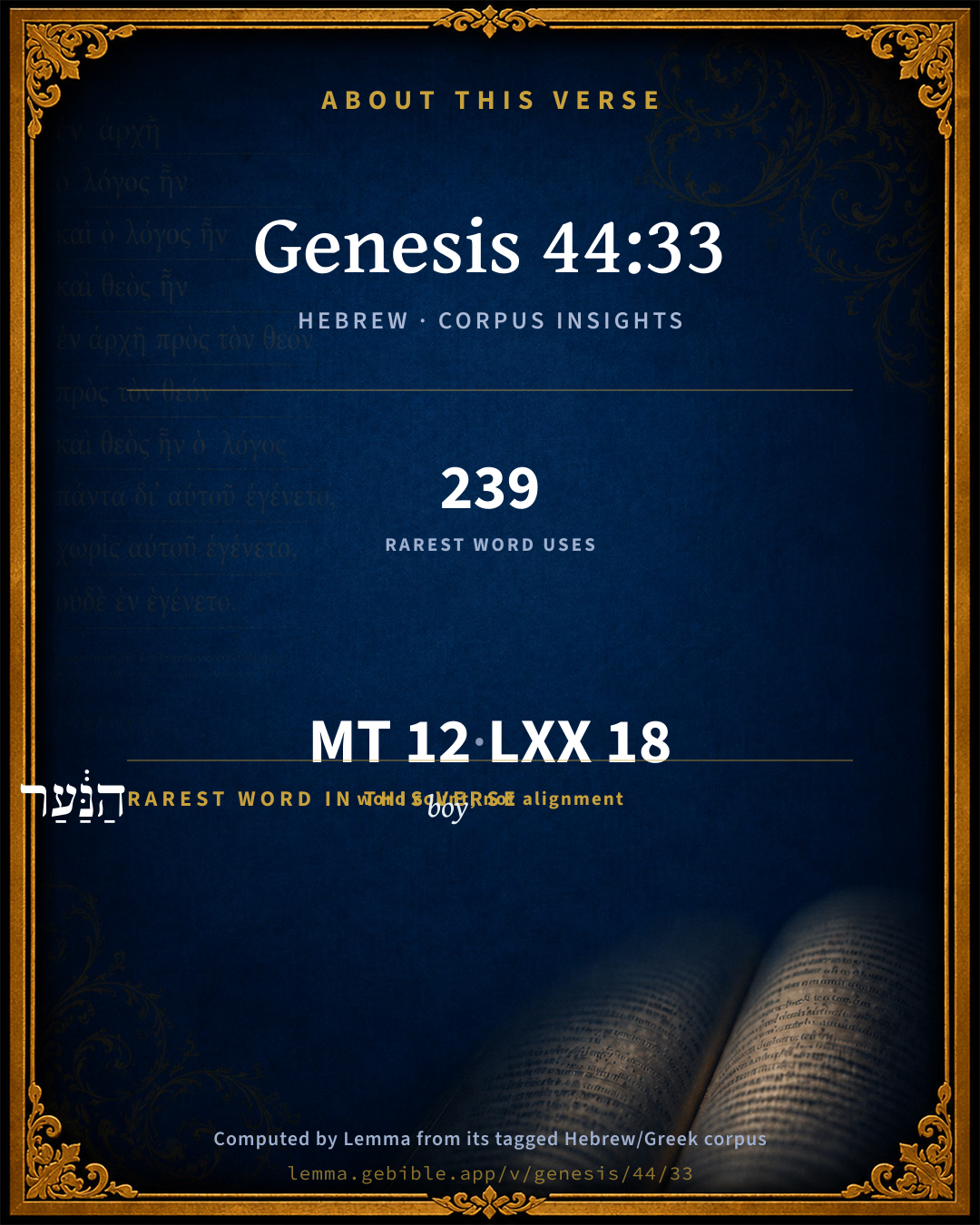
הַנַּ֔עַר
naʻar
H5288
“the · boy”
Particle, Definite Article + Noun, Common, Masculine, Singular, Absolute
Part of Speech
Particle + Noun
Type
Common
Gender
Masculine
Number
Singular
State
Absolute
Full BDB Definition

Origin: from H5287

TWOT: 1389a

a boy, lad, servant, youth, retainer - boy, lad, youth - servant, retainer
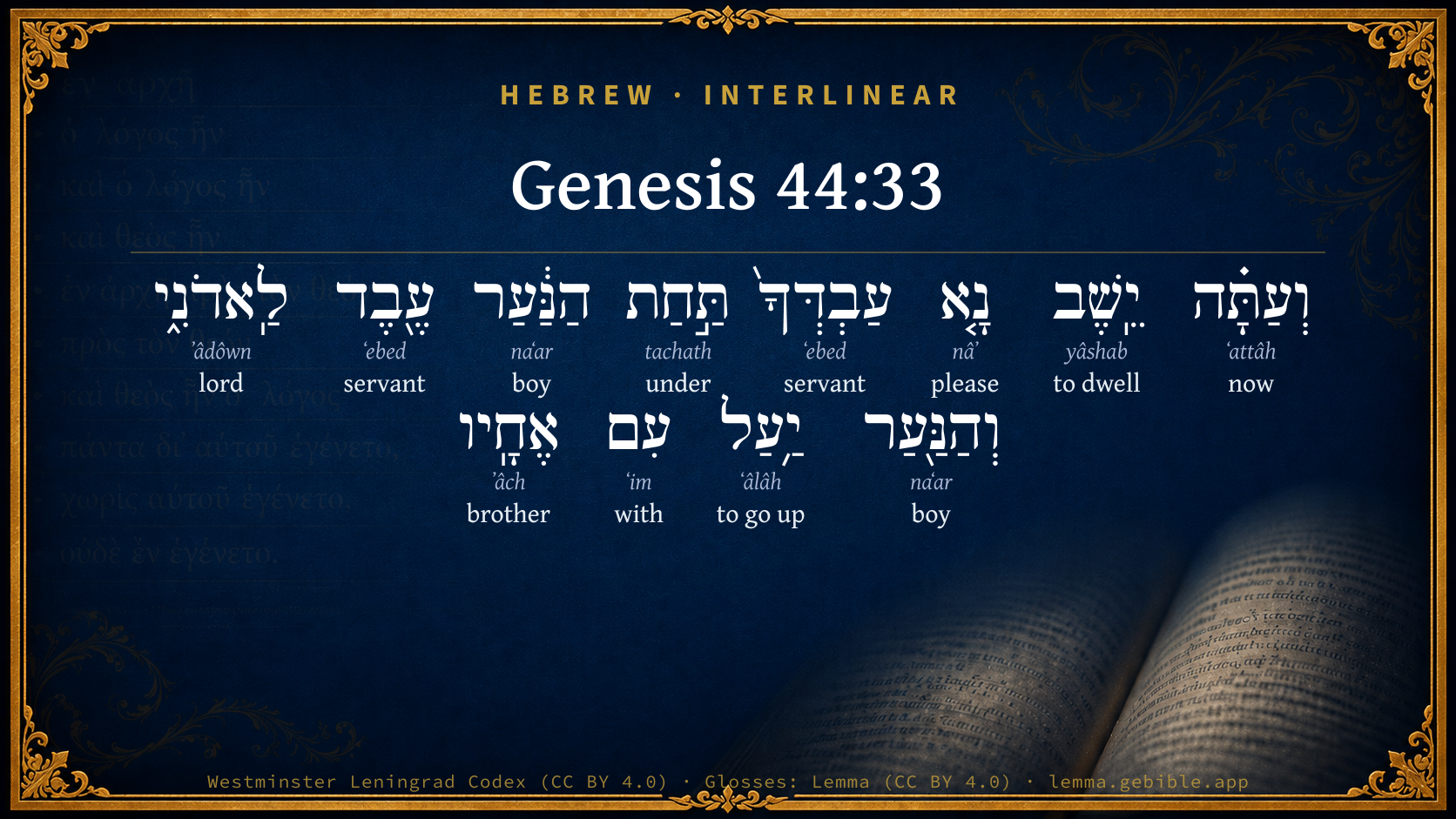
  1. וְעַתָּ֗ה ʻattâh H6258 “and · now” Conjunction + Adverb
  2. יֵֽשֶׁב yâshab H3427 “to dwell” Verb, Qal, Jussive, 3rd Person, Masculine, Singular
  3. נָ֤א nâʼ H4994 “please” Particle, Exhortation
  4. עַבְדְּךָ֙ ʻebed H5650 “servant · your” Noun, Common, Masculine, Singular, Construct + Suffix, Personal, 2nd Person, Masculine, Singular
  5. תַּ֣חַת tachath H8478 “under” Preposition
  6. עֶ֖בֶד ʻebed H5650 “servant” Noun, Common, Masculine, Singular, Absolute
  7. לַֽאדֹנִ֑י ʼâdôwn H113 “to/for · lord · my” Preposition + Noun, Common, Masculine, Singular, Construct + Suffix, Personal, 1st Person, Common, Singular
  8. וְהַנַּ֖עַר naʻar H5288 “and · the · boy” Conjunction + Particle, Definite Article + Noun, Common, Masculine, Singular, Absolute
  9. יַ֥עַל ʻâlâh H5927 “to go up” Verb, Qal, Jussive, 3rd Person, Masculine, Singular
  10. עִם ʻim H5973 “with” Preposition
  11. אֶחָֽיו ʼâch H251 “brothers · his” Noun, Common, Masculine, Plural, Construct + Suffix, Personal, 3rd Person, Masculine, Singular

About this verse

These counts appear in no published source. They are computed here, from the morphology-tagged text and Lemma’s own curated glosses. What Lemma adds →

12
words
10
distinct lemmas
Pentateuch
section

Grammatical profile

  • 2 verbs
  • 6 nouns
  • 2 prepositions
  • 1 adverb
  • 1 particle

Verb forms

  • יֵֽשֶׁב Qal · Jussive
  • יַ֥עַל Qal · Jussive

Repetition

Words recur within this verse — often emphatic in Hebrew:

  • עַבְדְּךָ֙ servant H5650 ×2
  • הַנַּ֔עַר boy H5288 ×2

Hebrew & Septuagint length

In English translation the verse runs 25 words from the Hebrew and 27 from the Septuagint (LXX English) — closely comparable.

A rough comparison of the two English renderings, which tokenize alike — not a word-level alignment.

Word counts can differ between the Hebrew and the Greek without any difference in meaning — e.g. the Hebrew direct-object marker אֵת has no separate Greek word, and Greek often adds the article ὁ.

In the original languages it is 12 Hebrew tokens and 18 Greek tokens — but the two are counted differently (Hebrew bundles its prefixes and suffixes into one token; the Greek is in lemma form), so that isn’t a like-for-like length.

Cross-references

5

Topical passages linked to Genesis 44:33 in the Treasury of Scripture Knowledge — connected by theme and wording, ordered by reader-vote popularity; previews shown in the World English Bible.

  • 1 John 3:16 By this we know love, because he laid down his life for us. And we ought to lay down our lives for the brothers.
  • Exodus 32:32 Yet now, if you will, forgive their sin-- and if not, please blot me out of your book which you have written."
  • Romans 5:7–10 For one will hardly die for a righteous man. Yet perhaps for a righteous person someone would even dare to die.
  • Romans 9:3 For I could wish that I myself were accursed from Christ for my brothers' sake, my relatives according to the flesh,
  • Hebrews 7:22 By so much has Jesus become the collateral of a better covenant.

Cross-references courtesy of OpenBible.info (CC BY 4.0).

Hebrew and Greek witnesses Masoretic Hebrew ↔ Greek Septuagint

The same verse in the two great witnesses to the Old Testament, shown verse-for-verse.

These are two independent witnesses, not word-aligned to each other, and the Septuagint is shown in lemma (dictionary) form.

Hebrew Genesis 44:33 Masoretic · Westminster Leningrad Codex

וְעַתָּ֗ה יֵֽשֶׁב נָ֤א עַבְדְּךָ֙ תַּ֣חַת הַנַּ֔עַר עֶ֖בֶד לַֽאדֹנִ֑י וְהַנַּ֖עַר יַ֥עַל עִם אֶחָֽיו

Now therefore, please let your servant stay instead of the boy, a bondservant to my lord; and let the boy go up with his brothers.

World English Bible · Public Domain

Greek LXX Genesis 44:33 Septuagint · lemma form

νῦν οὖν παραμένω σύ παῖς ἀντί ὁ παιδίον οἰκέτης ὁ κύριος ὁ δέ παιδίον ἀναβαίνω μετά ὁ ἀδελφός

Now then I will remain a servant with you instead of the lad, a domestic of my lord; but let the lad go up with his brethren.

LXX2012 (modern English Septuagint) · Public Domain

On this verse, The Cambridge Bible for Schools and Colleges discusses the Septuagint’s reading. Read the note in Commentary ↓

Hebrew: Westminster Leningrad Codex (CC BY 4.0). Greek: Septuagint (public domain); English from LXX2012 (modern English Septuagint) (Public Domain). How the Septuagint differs from the Hebrew →

Targum (Aramaic paraphrase)

2

The Targum is the ancient Jewish Aramaic paraphrase of the Hebrew Scriptures — an interpretive translation, not the Hebrew text itself. Onkelos (literal) and Pseudo-Jonathan (expansive) render the Torah, and Jonathan the Prophets. Coverage is partial: where no permissively-licensed English translation exists for a verse, only the Aramaic is shown. This is verse-level text, not a word-by-word alignment to the Hebrew.

  1. Targum Onkelos Torah (Genesis–Deuteronomy)
    וּכְעַן יֵתֶב כְּעַן עַבְדָּךְ תְּחוֹת עוּלֵימָא עַבְדָּא לְרִבּוֹנִי וְעוּלֵימָא יִסַּק עִם אֲחוֹהִי

    (no public-domain English translation for this verse)

    Targum Onkelos — Aramaic: “Onkelos Genesis” (public domain); “Onkelos Exodus” (public domain); “Onkelos Leviticus” (public domain); “Onkelos Numbers” (public domain); “Onkelos Deuteronomy” (public domain). English: “Sefaria Community Translation” (CC0 1.0 (public-domain dedication)); “J.W. Etheridge. The Targums of Onkelos and Jonathan Ben Uzziel on the Pentateuch. London: Longmans, Green, 1862” (public domain). Text via Sefaria.

  2. Targum Pseudo-Jonathan Torah (Genesis–Deuteronomy)
    וּכְדֵין יִתֵיב בְּבָעוּ עַבְדָךְ חוֹלַף טַלְיָא עַבְדָא לְרִיבּוֹנִי וְטַלְיָא יִסַק עִם אָחוֹהִי

    And now let thy servant remain, I beseech thee, as the slave of my lord, instead of the young man; and let the young man go up with his brothers.

    Targum Pseudo-Jonathan — Aramaic: “Targum Jonathan on Genesis” (public domain); “Targum Jonathan on Exodus” (public domain); “Targum Jonathan on Leviticus” (public domain); “Targum Jonathan on Numbers” (public domain); “Targum Jonathan on Deuteronomy” (public domain). English: “The Targum of Jonathan ben Uzziel, trans. J. W. Etheridge, London, 1862” (public domain). Text via Sefaria.

Commentary

Notes on Genesis 44:33 from classic Christian and Jewish commentators (each source and its license shown beneath its notes). The classic Christian expositions comment on the surrounding passage and are grouped to its opening verse, so a note may address several verses; the Jewish commentaries on the Tanakh (Rashi and others) are per-verse, so they appear only where the commentator wrote on this verse.

Lemma curates 59 commentaries, every one of them public domain or Creative Commons licensed, each selected and text-cleaned for this edition rather than reprinted as found. About our sources →

The Cambridge Bible for Schools and Colleges

gen. ed. J. J. S. Perowne

33. instead of the lad] This offer on the part of Judah to remain in Egypt in the bond-service of Joseph, as substitute for Benjamin (LXX ἀντὶ τοῦ παιδίου), forms the noble climax of the generous appeal to Joseph’s feelings. The unconscious irony of the situation is heightened by the fact that Judah is unaware of Joseph’s personality, and yet has succeeded in making his appeal hinge upon the reference (a) to the old age and affectionate feelings of Jacob, and (b) to the loss which he has already sustained in the death of Benjamin’s elder brother.

The Cambridge Bible for Schools and Colleges (gen. ed. J. J. S. Perowne; Cambridge University Press, 1878–1918) — public domain. Text from a community e-Sword module.

John Gill's Exposition

Now therefore, I pray thee, let thy servant abide instead of the lad a bondman to my lord,.... Being, as Jarchi observes preferable to Benjamin for strength, for war, and for service: in this Judah was a type of Christ, from whose tribe he sprung, who became the surety of God's Benjamins, his children who are beloved by him, and as dear to him as his right hand, and put himself in their legal place and stead, and became sin and a curse for them, that they might go free, as Judah desired his brother Benjamin might, as follows:

and let the lad go up with his brethren; from Egypt to Canaan's land, to their father there.

John Gill's Exposition of the Whole Bible (1746–1763) — public domain (CC PDM 1.0). Text via the HelloAO Bible API.

Haydock's Catholic Bible Commentary

The boy. I am older, and more fit for service. (Menochius)

George Leo Haydock (1774–1849), Haydock's Catholic Family Bible and Commentary, 1859 edition — public domain. Excludes Psalms (Douay-Rheims chapter numbering differs from Protestant) and Deuterocanonical books (Catholic canon only).

Matthew Poole's English Annotations

Partly in compassion to our aged father, and partly for thy own advantage; because I can be more serviceable to thee than he, because of my greater strength and experience.

Matthew Poole's English Annotations on the Holy Bible (1683–1685) — public domain. Text from a community e-Sword/MySword module.

Keil & Delitzsch

C. F. Keil & F. Delitzsch

Judah closed his appeal with the entreaty, "Now let thy servant (me) remain instead of the lad as slave to my lord, but let the lad go up with his brethren; for how could I go to my father without the lad being with me! (I cannot,) that I may not see the calamity which will befall my father!"

Keil & Delitzsch — Biblical Commentary on the Old Testament (1861–1891) — public domain (CC PDM 1.0). Text via the HelloAO Bible API. (Old Testament only.)

unfoldingWord translationNotes

Door43 World Missions Community

Now

This does not mean "at this moment," but is used to draw attention to the important point that follows.

let your servant

Judah refers to himself as "your servant." This is a formal way of speaking to someone with greater authority. AT: "let me, your servant" or "let me" (See: First, Second, or Third Person)

to my master

Judah refers to Joseph as "my master." AT: "to you, my master" or "to you" (See: First, Second, or Third Person)

let the boy go up

It was going to use the phrase "go up" when speaking about traveling from Egypt to Canaan.

For how can I go up to my father if the boy is not with me?

Judah uses a question to emphasize the grief he would have if Benjamin did not return home. AT: "I cannot return to my father if the boy is not with me." (See: Rhetorical Question)

I am afraid to see the evil that would come on my father

A person suffering terribly is spoken of as if "evil" were a thing that comes upon a person. AT: "I am afraid to see how much my father would suffer" (See: Metaphor)

translationWords

servant

lord

fear

evil

unfoldingWord translationNotes — © Distant Shores Media and the Door43 World Missions Community, licensed CC BY-SA 4.0. Source: git.door43.org/Door43/en_tn.

Rashi

Rabbi Shlomo Yitzchaki (Rashi)

'ישב נא עבדך וגו LET THY SERVANT ABIDE etc. — For all purposes I am superior to him in strength — whether for battle or for service as a slave.

Rashi on the Tanakh — English translations: “The Judaica Press complete Tanach with Rashi, translated by A. J. Rosenberg” (CC BY 4.0); “Pentateuch with Rashi's commentary by M. Rosenbaum and A.M. Silbermann, 1929-1934” (public domain); “The Metsudah Tanach series, Lakewood, N.J” (CC BY 4.0); and “The Book of Joshua, Metsudah Publications, 1997” (CC BY 4.0). Text via Sefaria.

Lesson kit

Teaching starters — assembled from the data on this page, not authored interpretation. Every prompt links to the verse data it draws on. Edit before teaching.

Genesis, in the Pentateuch, opens this verse with 12 words (10 distinct Hebrew lemmas). Its most distinctive word is naʻar (“boy”). A historical commentator’s framing appears above. Read the whole chapter for the surrounding context.

Discussion questions

  1. How does “boy” (naʻar) shape what this verse is saying?
  2. 1 John 3:16 shares this passage’s theme. How do the two illuminate each other?
  3. “servant” occurs 2× in this one verse. What is the effect of the repetition?
  4. These translations render this verse differently. What is at stake in choosing one wording over another?
  5. The verb «יֵֽשֶׁב» is Qal Jussive. How does its form color the action?
  6. Reading how The Cambridge Bible for Schools and Colleges and John Gill's Exposition read this verse, where do the two commentators agree and where do they part?

Things to notice

Reading settings

Reading text

Shown beneath each verse's original-language words.

Old Testament
Old Testament edition

Read the OT as the Masoretic Hebrew (MT) or the Greek Septuagint (LXX).

English shown for the Greek Septuagint (in the Hebrew ↔ Greek comparison).

Comparing translations? Open the Compare panel on any verse page to stack up to four side by side.