Exodus 27:20

Hebrew (Westminster Leningrad Codex) Exodus 27:20 appears in the Hebrew Old Testament. The text above is from the Westminster Leningrad Codex. Each word links to its Strong’s number, a concise gloss, and parsing drawn from the Open Scriptures Hebrew Bible morphology. Click any word for its full Brown-Driver-Briggs (BDB) entry.
Download image
Cite this verse

Exodus 27:20 (World English Bible). Public Domain. Lemma interlinear Bible study tool, https://lemma.gebible.app/v/exodus/27/20.

Show BibTeX & RIS
BibTeX
RIS
English Translation
"You shall command the children of Israel, that they bring to you pure olive oil beaten for the light, to cause a lamp to burn continually.
World English Bible · Public Domain
Highlights
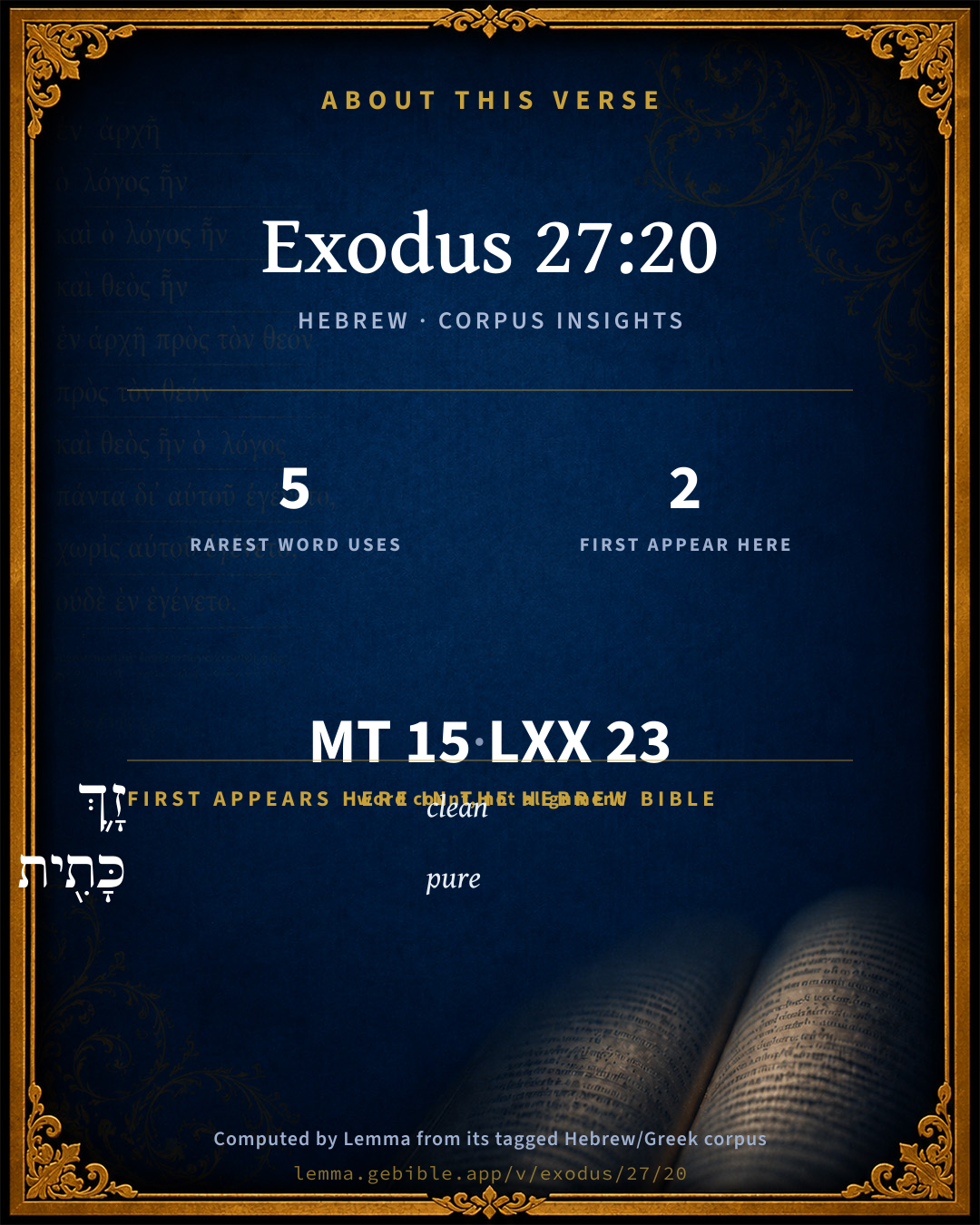
  • 2 first appearances in the Hebrew Bible
Full analysis ↓
Download a study sheet

One document with this verse’s original text, its word-by-word gloss line, the meaning frame, cross-references with their text, attributed commentary, and full source and license credits — printable, and it pastes into notes with its structure intact.

This verse Autodidact and up

Study sheet (.html) Plain text (.txt)

A passage Seminary Student

Up to 50 verses in one chapter. A passage sheet keeps up to 6 commentary sources and 12 cross-references per verse, in the order this page ranks them, and says so on the sheet whenever that leaves anything out. Ask for a single verse and you get the Autodidact verse sheet above.

Everything on this page stays free to read, with no account — the sheet is a download of what is already on screen, not access to it.

Want to remove ads? Support Godless Engineer
Compare translations 3

The same verse in 3 English versions, stacked beneath the original-language interlinear above. Click any original word for its lexicon entry.

Each is an independent rendering of the whole verse — the interlinear is not word-aligned to these translations.

Highlighted words mark where these versions differ — a whole-verse word diff, not a word-by-word alignment.

  • World English Bible Public Domain
    "You shall command the children of Israel, that they bring to you pure olive oil beaten for the light, to cause a lamp to burn continually.
  • King James Version Public Domain
    And thou shalt command the children of Israel, that they bring thee pure oil olive beaten for the light, to cause the lamp to burn always.
  • unfoldingWord Literal Text CC BY-SA 4.0
    And you shall command the sons of Israel and they shall bring pure pressed oil of olive to you for the lamp, to cause the lamp to burn continually.

unfoldingWord Literal Text — © unfoldingWord, licensed CC BY-SA 4.0. Word-aligned USFM3 via Door43 (git.door43.org/unfoldingWord/en_ult).

Versions to compare (up to 4)

3 of 4 selected

Show all 18 translations

Every available English version of this verse, each an independent rendering of the whole verse.

  • World English Bible Public Domain
    "You shall command the children of Israel, that they bring to you pure olive oil beaten for the light, to cause a lamp to burn continually.
  • Berean Standard Bible Public Domain
    And you are to command the Israelites to bring you pure oil of pressed olives for the light, to keep the lamps burning continually.
  • Majority Standard Bible Public Domain
    And you are to command the Israelites to bring you pure oil of pressed olives for the light, to keep the lamps burning continually.
  • King James Version Public Domain
    And thou shalt command the children of Israel, that they bring thee pure oil olive beaten for the light, to cause the lamp to burn always.
  • American Standard Version (1901) Public Domain
    And thou shalt command the children of Israel, that they bring unto thee pure olive oil beaten for the light, to cause a lamp to burn continually.
  • Revised Version (1885) Public Domain
    And thou shalt command the children of Israel, that they bring unto thee pure olive oil beaten for the light, to cause a lamp to burn continually.
  • Geneva Bible (1599) Public Domain
    And thou shalt commande the children of Israel, that they bring vnto thee pure oyle oliue beaten, for the light, that the lampes may alway burne.
  • Douay-Rheims (1899) Public Domain
    Command the children of Israel that they bring thee the purest oil of the olives, and beaten with a pestle: that a lamp may burn always,
  • Young's Literal Translation Public Domain
    `And thou -- thou dost command the sons of Israel, and they bring unto thee pure beaten olive oil for the light, to cause the lamp to go up continually;
  • Literal Standard Version CC BY-SA 4.0
    And you command the sons of Israel, and they bring pure oil of beaten olive to you for the light, to cause the lamp to go up continually.
  • Unlocked Literal Bible CC BY-SA 4.0
    You must command the people of Israel to bring olive oil, pure and pressed, for the lamps so they may burn continually.
  • unfoldingWord Literal Text CC BY-SA 4.0
    And you shall command the sons of Israel and they shall bring pure pressed oil of olive to you for the lamp, to cause the lamp to burn continually.
  • Darby Bible Public Domain
    And thou shalt command the children of Israel, that they bring thee olive oil, pure, beaten, for the light, to light the lamp continually.
  • World Messianic Bible Public Domain
    “You shall command the children of Israel, that they bring to you pure olive oil beaten for the light, to cause a lamp to burn continually.
  • Webster's Bible Public Domain
    And thou shalt command the children of Israel, that they bring the pure olive-oil beaten for the light, to cause the lamp to burn always.
  • Free Bible Version CC BY-SA 4.0
    You are to order the Israelites to bring you pure, hand-pressed olive oil for the lamps so they can go on burning, giving light.
  • Bible in Basic English Public Domain
    Give orders to the children of Israel to give you clear olive oil for the lights, so that a light may be burning there at all times.
  • JPS Tanakh (1917) Public Domain
    And thou shalt command the children of Israel, that they bring unto thee pure olive oil beaten for the light, to cause a lamp to burn continually.

Literal Standard Version (2020), Covenant Press — licensed CC BY-SA 4.0. Text via the HelloAO Bible API (eBible.org). Unlocked Literal Bible (unfoldingWord) — licensed CC BY-SA 4.0. Text via the HelloAO Bible API (eBible.org). unfoldingWord Literal Text — © unfoldingWord, licensed CC BY-SA 4.0. Word-aligned USFM3 via Door43 (git.door43.org/unfoldingWord/en_ult). Free Bible Version, Dr. Jonathan Gallagher — licensed CC BY-SA 4.0. Text via the HelloAO Bible API (eBible.org).

Word by word

More ways to search: Search by grammar → Find every occurrence → Compare this word →

Practice this passage: Drill this verse → Learn its vocabulary →

כָּתִ֖ית
kâthîyth
H3795
“pure”
Adjective, Adjective, Masculine, Singular, Absolute
Part of Speech
Adjective
Type
Adjective
Gender
Masculine
Number
Singular
State
Absolute
Full BDB Definition

Origin: from H3807

TWOT: 1062a

beaten out, pure, pounded fine (in a mortar), costly - of olive oil
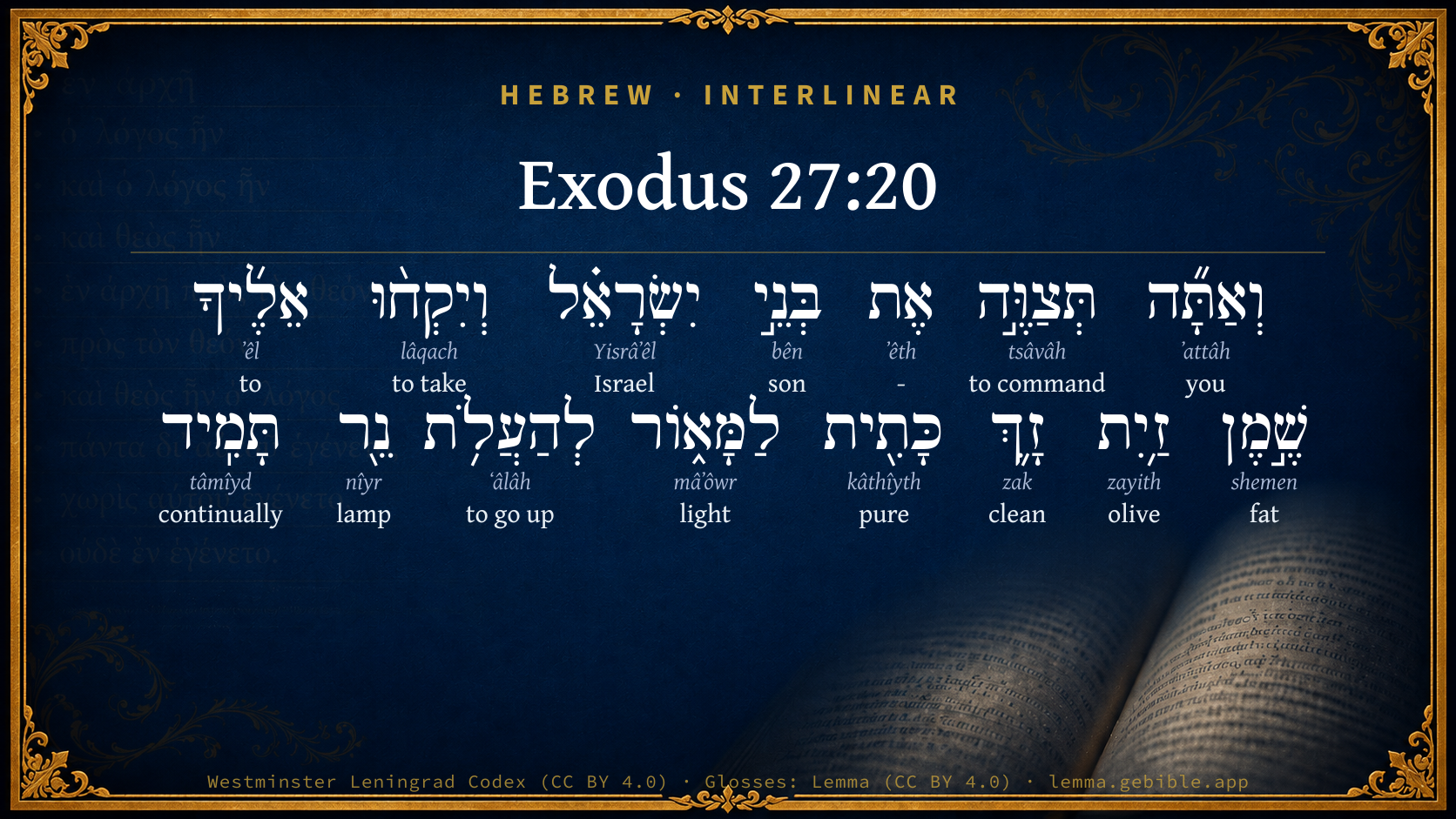
  1. וְאַתָּ֞ה ʼattâh H859 “and · you” Conjunction + Pronoun, Personal, 2nd Person, Masculine, Singular
  2. תְּצַוֶּ֣ה tsâvâh H6680 “to command” Verb, Piel, Imperfect, 2nd Person, Masculine, Singular
  3. אֶת ʼêth H853 “-” Particle, Direct Object
  4. בְּנֵ֣י bên H1121 “sons of” Noun, Common, Masculine, Plural, Construct
  5. יִשְׂרָאֵ֗ל Yisrâʼêl H3478 “Israel” Noun, Proper
  6. וְיִקְח֨וּ lâqach H3947 “and · to take” Conjunction + Verb, Qal, Imperfect, 3rd Person, Masculine, Plural
  7. אֵלֶ֜יךָ ʼêl H413 “to · you” Preposition + Suffix, Personal, 2nd Person, Masculine, Singular
  8. שֶׁ֣מֶן shemen H8081 “fat of” Noun, Common, Masculine, Singular, Construct
  9. זַ֥יִת zayith H2132 “olive” Noun, Common, Masculine, Singular, Absolute
  10. זָ֛ךְ zak H2134 “clean” Adjective, Adjective, Masculine, Singular, Absolute
  11. לַמָּא֑וֹר mâʼôwr H3974 “to/for the · light” Preposition, Determined + Noun, Common, Masculine, Singular, Absolute
  12. לְהַעֲלֹ֥ת ʻâlâh H5927 “to go up” Preposition + Verb, Hiphil, Infinitive Construct
  13. נֵ֖ר nîyr H5216 “lamp of” Noun, Common, Masculine, Singular, Construct
  14. תָּמִֽיד tâmîyd H8548 “continually” Noun, Common, Masculine, Singular, Absolute

About this verse

These counts appear in no published source. They are computed here, from the morphology-tagged text and Lemma’s own curated glosses. What Lemma adds →

15
words
15
distinct lemmas
Pentateuch
section

Notable vocabulary

The rarest word here is כָּתִ֖ית pure H3795 — appearing just 5 times in the whole Hebrew Bible.

First appearance in Scripture

These words make their first canonical appearance in the Hebrew Bible here:

  • זָ֛ךְ clean H2134
  • כָּתִ֖ית pure H3795

Shared distinctive vocabulary

כָּתִ֖ית pure H3795 occurs in 5 verses of the Hebrew Bible. Also found in:

Grammatical profile

  • 3 verbs
  • 7 nouns
  • 2 adjectives
  • 1 pronoun
  • 1 preposition
  • 1 particle

Verb forms

  • תְּצַוֶּ֣ה Piel · Imperfect
  • וְיִקְח֨וּ Qal · Imperfect
  • לְהַעֲלֹ֥ת Hiphil · Infinitive Construct

Hebrew & Septuagint length

In English translation the verse runs 26 words from the Hebrew and 28 from the Septuagint (LXX English) — closely comparable.

A rough comparison of the two English renderings, which tokenize alike — not a word-level alignment.

Word counts can differ between the Hebrew and the Greek without any difference in meaning — e.g. the Hebrew direct-object marker אֵת has no separate Greek word, and Greek often adds the article ὁ.

In the original languages it is 15 Hebrew tokens and 23 Greek tokens — but the two are counted differently (Hebrew bundles its prefixes and suffixes into one token; the Greek is in lemma form), so that isn’t a like-for-like length.

Cross-references

7

Topical passages linked to Exodus 27:20 in the Treasury of Scripture Knowledge — connected by theme and wording, ordered by reader-vote popularity; previews shown in the World English Bible.

  • Leviticus 24:1–4 Yahweh spoke to Moses, saying,
  • Psalms 23:5 You prepare a table before me in the presence of my enemies. You anoint my head with oil. My cup runs over.
  • Zechariah 4:11–14 Then I asked him, "What are these two olive trees on the right side of the lampstand and on the left side of it?"
  • Exodus 39:37 the pure lampstand, its lamps, even the lamps to be set in order, all its vessels, the oil for the light,
  • Judges 9:9 But the olive tree said to them, Should I leave my fatness, with which by me they honor God and man, and go to wave back and forth over the trees?
  • Exodus 25:31–37 "You shall make a lampstand of pure gold. Of hammered work shall the lampstand be made, even its base, its shaft, its cups, its buds, and its flowers, shall be of one piece with it.
  • Revelation 11:4 These are the two olive trees and the two lampstands, standing before the Lord of the earth.

Cross-references courtesy of OpenBible.info (CC BY 4.0).

Hebrew and Greek witnesses Masoretic Hebrew ↔ Greek Septuagint

The same verse in the two great witnesses to the Old Testament, shown verse-for-verse.

These are two independent witnesses, not word-aligned to each other, and the Septuagint is shown in lemma (dictionary) form.

Hebrew Exodus 27:20 Masoretic · Westminster Leningrad Codex

וְאַתָּ֞ה תְּצַוֶּ֣ה אֶת בְּנֵ֣י יִשְׂרָאֵ֗ל וְיִקְח֨וּ אֵלֶ֜יךָ שֶׁ֣מֶן זַ֥יִת זָ֛ךְ כָּתִ֖ית לַמָּא֑וֹר לְהַעֲלֹ֥ת נֵ֖ר תָּמִֽיד

"You shall command the children of Israel, that they bring to you pure olive oil beaten for the light, to cause a lamp to burn continually.

World English Bible · Public Domain

Greek LXX Exodus 27:20 Septuagint · lemma form

καί σύ συντάσσω ὁ υἱός ἰσραήλ καί λαμβάνω σύ ἔλαιον ἐκ ἔλαιον ἄτρυγος καθαρός κόπτω εἰς φῶς καίω ἵνα καίω λύχνος διά πᾶς

And do you charge the children of Israel, and let them take for you refined pure olive-oil beaten to burn for light, that a lamp may burn continually

LXX2012 (modern English Septuagint) · Public Domain

On this verse, The Cambridge Bible for Schools and Colleges discusses the Septuagint’s reading. Read the note in Commentary ↓

Hebrew: Westminster Leningrad Codex (CC BY 4.0). Greek: Septuagint (public domain); English from LXX2012 (modern English Septuagint) (Public Domain). How the Septuagint differs from the Hebrew →

Targum (Aramaic paraphrase)

2

The Targum is the ancient Jewish Aramaic paraphrase of the Hebrew Scriptures — an interpretive translation, not the Hebrew text itself. Onkelos (literal) and Pseudo-Jonathan (expansive) render the Torah, and Jonathan the Prophets. Coverage is partial: where no permissively-licensed English translation exists for a verse, only the Aramaic is shown. This is verse-level text, not a word-by-word alignment to the Hebrew.

  1. Targum Onkelos Torah (Genesis–Deuteronomy)
    וְאַתְּ תְּפַקֵד יָת בְּנֵי יִשְׂרָאֵל וְיִסְבוּן לָךְ מִשְׁחָא זֵיתָא דַכְיָא כָּתִישָׁא לְאַנְהָרָא לְאַדְלָקָא בוֹצִינַיָא תְּדִירָא:

    (no public-domain English translation for this verse)

    Targum Onkelos — Aramaic: “Onkelos Genesis” (public domain); “Onkelos Exodus” (public domain); “Onkelos Leviticus” (public domain); “Onkelos Numbers” (public domain); “Onkelos Deuteronomy” (public domain). English: “Sefaria Community Translation” (CC0 1.0 (public-domain dedication)); “J.W. Etheridge. The Targums of Onkelos and Jonathan Ben Uzziel on the Pentateuch. London: Longmans, Green, 1862” (public domain). Text via Sefaria.

  2. Targum Pseudo-Jonathan Torah (Genesis–Deuteronomy)
    ואתה וְאַנְתְּ תְּפַקֵיד יַת בְּנֵי יִשְרָאֵל וְיִסְבוּן לָךְ מִישְׁחָא דְזֵיתָא דַכְיָא כְּתִישָׁא לְאַנְהוֹרֵי לְאַדְלָקָא בּוֹצִינַיָא תְּדִירָא

    And thou shalt instruct the sons of Israel to bring the pure olive oil, beaten, for illumination, that the lamps may burn continually.

    Targum Pseudo-Jonathan — Aramaic: “Targum Jonathan on Genesis” (public domain); “Targum Jonathan on Exodus” (public domain); “Targum Jonathan on Leviticus” (public domain); “Targum Jonathan on Numbers” (public domain); “Targum Jonathan on Deuteronomy” (public domain). English: “The Targum of Jonathan ben Uzziel, trans. J. W. Etheridge, London, 1862” (public domain). Text via Sefaria.

Commentary

Notes on Exodus 27:20 from classic Christian and Jewish commentators (each source and its license shown beneath its notes). The classic Christian expositions comment on the surrounding passage and are grouped to its opening verse, so a note may address several verses; the Jewish commentaries on the Tanakh (Rashi and others) are per-verse, so they appear only where the commentator wrote on this verse.

Lemma curates 59 commentaries, every one of them public domain or Creative Commons licensed, each selected and text-cleaned for this edition rather than reprinted as found. About our sources →

Trapp's Complete Commentary

John Trapp

Exo 27:20 And thou shalt command the children of Israel, that they bring thee pure oil olive beaten for the light, to cause the lamp to burn always.

Ver. 20. Pure oil olive.] Signifying the precious gifts and graces of the Spirit in godly ministers, whose lips must both preserve knowledge, and present it to the people.

Oil olive beaten.] Signifying, saith one, how with much labour and affliction the light of God’s word is to be prepared, and with patience preached and made to shine in his Church. {2Co 1:4; 2Co 2:4; 2Co 11:21; 2Co 11:23-25 1Th 2:9}

John Trapp, A Commentary or Exposition upon All the Books of the Old and New Testament (1647–1656) — public domain. Text from a community e-Sword module.

The Biblical Illustrator

Joseph S. Exell

Exo_27:20-21

Pure oil olive beaten for the light.

Symbolic references

I. The purity of the light (Psa_26:9).

II. The perfection of the light.

III. The perpetuity of the light. Christ can never be superseded. (J. S. Exell, M. A.)

Oil for the light

1. The source whence the oil was obtained--the olive. Thus is grace, free and full, obtained from Christ, the Plant of renown.

2. The qualification it was to possess--it was to be pure. All the grace which comes from Christ is pure and unalloyed.

3. The instruments of its dispensation--the children of Israel. The children of God are now the recipients and dispensers of Christs grace.

4. The uses to which it was put--it caused the lamp to burn always. Grace causes the life of each Christian to shine with a brighter glow. (S. Thomas.)

Lamps burning always

It is difficult to understand from the various passages bearing on the subject, whether the lamps burned both day and night, or only during the night--some passages apparently favouring the one view, and some the other; thus, To cause the lamp to burn always (Exo_27:20); and, Command the children of Israel, that they bring unto thee pure olive oil, beaten for the light, to cause the lamps to burn continually (Lev_24:2). These passages seem to teach that the lamps burned both day and night. If they do not teach that, the meaning must be that continual and always signify at regular intervals, as in the case of some ordinances and offerings which are called perpetual, though occurring only at intervals. The other view, that they burned only during the night, seems to be supported by, Aaron and his sons shall order it from evening to morning (Exo_27:21); And Aaron shall burn thereon (the golden altar) sweet incense every morning, when he dresseth the lamps (Exo_30:7-8). From these texts it would appear that the lamps burned only during the night. If they were not intended to teach that, the meaning must be that the lamps were dressed in the morning, probably one after another, not necessitating more than one being extinguished at a time, and after being dressed and lighted, burned during the day, the lamps receiving such further attention in the evening as admitted of their burning till the morning. As there were no windows in the Tabernacle, and the priests had duties to perform during the day in the holy place, it is almost certain that the lamps burned always. (W. Brown.)

Light symbolism

As the first apartment in the Tabernacle was illuminated by the sevenfold light of the candlestick, and as the Church, composed of all genuine believers on earth in every age, is enlightened by the Holy Spirit, so will the Church triumphant in heaven, that great temple not made with hands, be a place of glorious light; and the light shall never go out, it will burn always; so that there shall be no night there, nor sun, nor moon, nor stars shall shine in that happy place, for the glory of God and the Lamb is the light thereof. (W. Brown.)

Burning with pure oil

It is related in the biography of one who lived to become a devoted Christian man, that while he was yet a little boy, the passage read from the Bible in the family on a certain occasion was Exo_27:20, describing the oil used in the vessels of the Tabernacle. The meaning and application of the verse was explained by other passages from the New Testament. This boy was then but five years old, and it was not supposed that he could understand or feel the slightest interest in a subject considered far beyond his age. The older children left the room after family worship, but the little boy was detained, as usual, to be taught some simple verses of the Bible by his mother, and to pray with her. He kneeled down at length to pray, and in the midst of his prayer he paused, and exclaimed, earnestly, O my God, make me to burn this day with pure oil! The morning lesson had not been lost upon him; he had understood its import. Most evidently, says his biographer, was this prayer heard and answered throughout the day of his life. How appropriate is this petition for the morning offering of every Christian, Make me to burn this day with pure oil! If He who hath all hearts in His keeping vouchsafe a gracious answer to that prayer, the example of the disciple must be one that will glorify the name of Jesus. Such a man will walk with God. No unhallowed fires will be lighted in his bosom. Neither revenge nor hate can burn there. The peace and joy of the believer will fill his soul..

The Biblical Illustrator, edited by Joseph S. Exell (c. 1880s–1900s) — public domain. Text from a community e-Sword module.

Joseph Benson's Commentary

Exo 27:20. Pure oil-olive beaten — Not squeezed out by a press or mill, such being full of sediment; but which run freely from the olives when bruised or beaten with a pestle. To cause the lamp to burn always — Josephus, who was himself a priest, says, they burned the lamps day and night, three of them being kept burning all day, and the rest being lighted in the evening. And indeed to keep them burning by day as well as night, was no more than what was necessary, for otherwise the priest must have ministered in the dark at the altar of incense; there being no windows in the holy place. Now the pure oil signifies the gifts and graces of the Spirit, which are communicated to all believers from Christ the good olive, “of whose fulness we receive,” Zec 4:11-12. The priests were to light the lamps, and to tend them; to cause the lamp to burn always, night and day. Thus it is the work of ministers to preach and expound the Scriptures, which are as a lamp to enlighten, the church. This is to be a statute for ever, that the lamps of the word be lighted as duly as the incense of prayer and praise is offered.

Joseph Benson's Commentary on the Old and New Testaments (1811–1818) — public domain. Text from a community e-Sword module.

Whedon's Commentary on the Bible

Daniel D. Whedon

THE OIL FOR THE LIGHT, Exo_27:20-21.

20. Pure oil olive beaten — See this passage as repeated in Lev_24:2-3. This oil for the light of the holy place was to be obtained, not by pressing the olives, but by beating or bruising them, by which means the finest quality of oil was produced.

Cause the lamp to burn always — According to Exo_30:7-8, and Lev_24:3-4, the lamps were to be dressed each morning, and lighted each evening, so that the light was perpetual; the light of the sun sufficiently finding its way within the tent by day, and the lamps of the golden candlestick (Exo_25:31-37) burning all the night. Comp. 1Sa_3:3, note.

Daniel D. Whedon (gen. ed.), Commentary on the Old and New Testaments (1874–1909) — public domain. Text from a community e-Sword module.

The Preacher's Complete Homiletical Commentary

Joseph S. Exell (gen. ed.)

MAIN HOMILETICS OF THE PARAGRAPH.—Exo_27:20-21

THE OIL FOR THE LAMPS

Consider the provision for the lamps as a service. The children of Israel were to bring oil for these lamps for ever, and the priests were to trim the lamps and keep them brightly burning. Notice:—

I. The service of the people. Is not the duty of the people in relation to this service most suggestive? a pattern of service to all after-times?

1. They were to bring their first. “The olive berry is first green, and assumes, later, a purple and black colour. The best kind of oil is obtained from the unripe green olives.” We are not to give God the gleanings of our power, or time, or influence, or life, but the first-fruits.

2. They were to bring their best. It was the purest and costliest oil. We are not to give to the cause of God anything that is inferior. We are to hold our best for God, and for His service.

3. They were to give freely their first and best. “Beaten oil. That is such oil as could easily be expressed from the olives after they had been bruised in a mortar; the mother-drop, as it is called, which drops out of itself, as soon as the olives are a little broken, and which is much purer than that which is obtained after the olives are put under the press.”—Clarke. Does not this signify that our service for God should flow freely from a loving heart? “God loveth a cheerful giver.”

II. The service of the priests. The priests were to feed the lamps. “Aaron and his sons shall arrange it from evening to morning before the Lord,” &c., Exo_27:21. A daily constant service. And thus it must be in this dispensation, if the Church is to be a brightly burning lamp. Every morning the priests cleansed the lamps and replenished the oil: and the Christian ministry must keep the Church pure, and preserve all its ordinances in vigour and brightness. As the lighthouse-keeper preserves all his lamps in cleanliness, and each evening sends for the guiding light, constant as the stars; so must the ministers of Christ’s Church see to it that no impurities dim the glory of the Church or impair its efficiency.

III. The glorious result when ministers and people are faithful in their service. The Church then stands forth with a guiding, warning, cheering light. If the people are unfaithful, it cannot be so. They are to bring the oil, and if that oil be wanting in quantity, or inferior in quality, the light is defective; and so if the members of the Christian Church do not bring the pure oil of a loving, generous, spiritual service, the lustre of the Church is dimmed. And if the ministers be slothful, or selfish, or unspiritual, the lamps are tarnished and the flame flickers. When ministers and people are faithful, the Church is the light of the world, the day-star of a grander world.

THE LAMPS OF THE TABERNACLE

Consider these lighted lamps as a symbol. The golden candlestick, lighted as in the text may justly be regarded as a symbol of Christ—the light of the world. Observe—

I. The purity of the light. “The oil prescribed for the holy service is of a white colour; it gives a better light and little smoke. The holy oil was pure, and unmixed with oil of any other quality.” Was not this significant of the light which God has given us in Jesus Christ? In our philosophies we have truth mixed with error, as much smoke as light; in the various religions of the heathen world we have the true and the false strangely blended, and giving forth a most uncertain ray; in Christ we have the true unclouded illumination. “God is light and in Him there is no darkness at all.” “For with Thee is the fountain of life: in Thy light shall we see light” (Psa_26:9). In that pure light it is our privilege to walk.

II. The perfection of the light. On each of the seven arms of the candelabrum rested a burning lamp. Seven, the note of perfection. On all the great questions touching our salvation from sin, our moral discipline and development, our duty to God and man, our preparation for the life beyond, we have sufficient light in the Lord Jesus. We have no need to resort to the philosophies of man. The speculations of the natural reason. No need to resort to ecclesiastical traditions. Opinions of the Fathers, &c., as in Catholicism; as if the New Testament did not contain all that was necessary for salvation, character, and destiny. All; spiritual light is in Christ, as all natural light is in the sun. The light in Christ brings conviction to the understanding, assurance to the heart. Don’t add to the lamps; don’t take any away. The doctrines of Christ are all necessary; they are all that are necessary.

III. The perpetuity of the light. That light on the candlestick was to burn on for ever. The light we have in Christ is not an artificial light to guide us through some passing perplexity, it is the essential and everlasting truth. It is not a light to be superseded in this world. Some tell us that Christ is destined to be eclipsed by greater teachers, that His Gospel is destined to be eclipsed by systems of moral and spiritual truth far more full and reliable than His own. The greater teacher, the grander gospel, has not yet appeared, and gives no sign of appearing. We need expect no grander light. The seven-branched golden candlestick of the Jewish Temple is buried, if we believe tradition, in the bed of the Tiber; but the Light of the world shall shine through all time, the master light of all our seeing.

“Our little systems have their day;

They have their day and cease to be:

They are but broken lights of Thee,

And Thou, O Lord, art more than they.”

It is not a light to be superseded in the world to come. “The Lord God and the lamb are an everlasting light.” In Christ we have the light of eternal truth, love, righteousness, felicity. “All flesh is grass,” &c.

“O house of Jacob, come ye, and let us walk in the light of the Lord.” (Isa_2:5).

SUGGESTIVE COMMENTS ON THE VERSES

You will observe,

1. The requirement of oil to cause the lamp of the sanctuary to burn. “Truly the light is sweet, and a pleasant thing it is for the eyes to behold the sun.” (Ecc_11:7.) In the absence of that glorious luminary, artificial light becomes a great convenience. The Tabernacle possessed no windows; whence the necessity for an ever-burning lamp. A lamp, however, although costly in material and exquisite in form, can emit no radiance of itself; oil, therefore, must be furnished for its use. In like manner, the Church of Christ must be illuminated by extraneous aid. It is not in mere human intellect, how rich soever in resources and attainments of a worldly kind it may be, to discover the way of life: it must consequently be taught of God and replenished with wisdom of a heavenly kind. It is the inspiration of the Almighty which alone giveth true and saving light unto mankind; and the oil that must burn in the lamp of our understanding is, the Holy Ghost.

—Mudge.

ILLUSTRATIONS

BY

REV. WILLIAM ADAMSON

Mosaic-Ritual! Exo_27:1-21.

(1.) Beautiful and rich as were the materials employed, there was a remarkable simplicity about the tabernacle and its adjuncts. And why? Glance at the books designed for the instruction of children. They may be rich in design and ornate in execution, but how mono-syllabic they are! What pictures of simplicity they contain! When the child develops in body and mind, the thoughts and words are also proportionately developed. We do not dream of instructing the babe-mind in the mysteries of algebra, or the intricacies of science.

(2.) God speaks, by the mouth of a later prophet, as of Israel as His child at this time. As a child, Israel’s host could but receive milk of truth—the elementary truths of Divine wisdom. Pictures interleave the Divine manual of saving instruction—pictures such as the tabernacle, the altar of burnt-offering, the outer court with its brazen laver, and encircling curtains, and solitary gateway.

(3.) And as Israel grew, so the instruction was raised. The theocratic nation was schooled in the deep things of God, while its saints and seers were permitted to drink deeply at the Fount of Divine Wisdom, searching diligently into the mystery of redemption, until the Teacher Himself became Incarnate. Thus the Law was alike the pedagogue leading to, and the schoolmaster instructing as to, Christ—the End of the law for righteousness to every one that believeth.

“And when the last trumpet shall sound through the skies,

When the dead from the dust of the earth shall arise,

With bright millions I’ll rise far above yonder sky,

To wear Christ’s Righteousness for ever on high.”

Olive-Oil! Exo_27:20.

(1.) Dr. Burden observes that by the expression “oil-olive” this oil is distinguished from other kinds. The addition “beaten” indicates that it is that oil obtained from olives pounded in a mortar, and not pressed from olives in the oil-mill. The oil obtained from pounded olives is, according to Columela’s observations, much purer and better tasted, does not emit much smoke, and has no offensive smell. From passages in the books of Joel and Micah, it would seem that the olives were usually crushed in the mill by men’s feet, just as in the vintage operation.

2. In the museum of Naples is a graceful olive in bronze, on whose spreading branches the various members of some old Pompeian household used to hang up their little lamps when they came from their different employments, and mustered in the family apartment around the symbolic family tree. Figure of each member of the Church of Christ, each of whom should contribute the small lamp of a Christian life, fed with the pure oil-olive of Divine Grace, to be suspended on the fair olive-tree of the Church (Psa_52:8).

“God’s saints are shining lights; who stays

Here long, must pass

O’er dark hills, swift streams, and steep ways

As smooth as glass.

But these all night,

Like candles, shed

Their beams, and light

Us into bed.”

—Vaughan.

Olive-Symbolism! Exo_27:20. The word “tree,” as pointed out by Grindon, actually means “intellect” in both English and Hebrew. It is even “intellect” in its widest sense amongst the Hebrews. The personifications of Scripture are not like those of merely human poetry, which are addressed simply to the object. On the contrary, they always involve a direct reference to the mental, the moral, or the spiritual. “The trees of the forest clap their hands.” Here the figure is borrowed from the waving of the branches; but the figure is itself figurative. The idea is that of the joys of the redeemed being expressed to God. When, therefore, particulars kinds of trees are mentioned in Scripture, it is in reference to specific mental gifts, moral virtues, or spiritual graces. It is the “tree department” of the language of flowers in its highest and noblest use. The olive has from time immemorial been identified with peace, forgiveness, charity, reconciliation, and similar high attitudes of virtue. In the sphere of Revelation and Grace, its oil thus symbolises “the Graces of the Holy Spirit.”

“For Nature dwells within our reach;

Yet though we stand so near her,

We still interpret half her speech

With ears too dull to hear her.”

—Anon.

Olive-Oil Objects! Exo_27:20-21. Thomas calls attention to,

1. The Plant, whence the oil came, as an emblem of Jesus, the Plant of renown, full of grace and truth; to,

2. The Properties of the oil, as expressive of the purity of the Spirit of Christ;

3. The Process of its manufacture, as predicting the sufferings of Jesus ere the Holy Spirit’s full descent at Pentecost;

4. The Persons receiving and dispensing, as types of the true Israel of God, who receive of Christ’s fulness, and grace for grace; and,

5. The Purposes to which the oil was put, as symbolic of the Divine Light ever shining in the holy place of the Church, and of the temple of the Christian heart.

“The Rites of God are fair for nought,

Unless our eyes, in seeing,

See hidden in the type the thought

That animates its being.”

—Anon.

The Preacher's Complete Homiletical Commentary (gen. ed. Joseph S. Exell; Funk & Wagnalls, c. 1892) — public domain (pre-1929). A full-Bible homiletical/sermon-outline anthology covering 65 of 66 books (2 John is absent from the source module). Text from a community e-Sword module.

Keil & Delitzsch

C. F. Keil & F. Delitzsch

The instructions concerning the Oil For the Candlestick, and the daily trimming of the lamps by the priests, form a transition from the fitting up of the sanctuary to the installation of its servants.

Exo 27:20

The sons of Israel were to bring to Moses (lit., fetch to thee) olive oil, pure (i.e., prepared from olives "which had been cleansed from leaves, twigs, dust, etc., before they were crushed"), beaten, i.e., obtained not by crushing in oil-presses, but by beating, when the oil which flows out by itself is of the finest quality and a white colour. This oil was to be "for the candlestick to set up a continual light."

Exo 27:21

Aaron and his sons were to prepare this light in the tabernacle outside the curtain, which was over the testimony (i.e., which covered or concealed it), from evening to morning, before Jehovah. "The tabernacle of the congregation," lit., tent of assembly: this expression is applied to the sanctuary for the first time in the preset passage, but it afterwards became the usual appellation, and accords both with its structure and design, as it was a tent in style, and was set apart as the place where Jehovah would meet with the Israelites and commune with them (Exo 25:22). The ordering of the light from evening to morning consisted, according to Exo 30:7-8, and Lev 24:3-4, in placing the lamps upon the candlestick in the evening and lighting them, that they might give light through the night, and then cleaning them in the morning and filling them with fresh oil. The words "a statute for ever unto their generations (see at Exo 12:14) on the part of the children of Israel," are to be understood as referring not merely to the gift of oil to be made by the Israelites for all time, but to the preparation of the light, which was to be regarded as of perpetual obligation and worth. "For ever," in the same sense as in Gen 17:7 and Gen 17:13.

Keil & Delitzsch — Biblical Commentary on the Old Testament (1861–1891) — public domain (CC PDM 1.0). Text via the HelloAO Bible API. (Old Testament only.)

Scofield Reference Notes

C. I. Scofield

oil

Oil is a symbol of the Holy Spirit (Cf) Joh 3:34; Heb 1:9. In Christ the oil- fed Light ever burns, the Light of the world Joh 8:12. But here we have not the world, but the sanctuary. It is a question, not of testimony in and to the world, but of our communion and worship as believer-priests in the holiest Heb 10:19; Heb 10:20. In the Tabernacle there were two compartments, two lights: the holy place with the candlestick (See Scofield "Exo 25:31") the holy of holies with the shekinah, or manifested glory of God. These two places are now one; Mat 27:50; Mat 27:51; Heb 9:6-8; Heb 10:19-21 but it is important to see that there are still two lights: Christ, the Light of life Joh 8:12 through the Spirit giving light upon the holy things of God, the showbread and altar of incense; and also the shekinah, now on the face of Jesus Christ 2Co 4:6. Into this twofold light we, as believer- priests, are brought 1Pe 2:9. We "walk in the light," not merely which He gives, but in which He lives 1Jn 1:7. But what of the command to "bring pure oil" Exo 27:20. Because our access, apprehension, communion, and transformation are by the Spirit; Eph 2:18; 1Co 2:14; 1Co 2:15; 2Co 13:14; Php 2:1; 2Co 3:18. Our title to His presence is the blood Eph 2:13 but only as filled with the Spirit Eph 5:18 do we really walk in the light.

The Scofield Reference Bible (1917 edition), notes by C. I. Scofield — public domain. Text from a community e-Sword module.

Tyndale Open Study Notes

Tyndale Open Resources

27:20–30:38 Following the instructions for Tabernacle structure, instructions are now given for those who would serve in the Tabernacle and for the elements involved in that service. Included are priestly functions (27:20-21; 29:38-46), clothing (ch 28), dedication ceremonies (29:1-37), furnishings (30:1-10, 17-21), and supplies (30:11-16, 22-38).

27:20-21 The first thing said about the function of the priests, Aaron and his sons, is that they were to keep the lamps burning continually through the night (see 30:8). As the lamps burned in the Lord’s presence, they would indicate the continuity of his presence.

Tyndale Open Study Notes — © Tyndale Open Resources, licensed CC BY-SA 4.0. Text via the HelloAO Bible API.

Geneva Bible (1599)

Geneva Bible translators

Such as cometh from the olive, when it is first pressed or beaten.

Or, ascend up.

Geneva Bible (1599) marginal notes — public domain. Text via Bolls.life.

Matthew Henry's Commentary

We read of the candlestick in the twenty-fifth chapter; here is an order given for the keeping of the lamps constantly burning in it, else it was useless; in every candlestick there should be a burning and shining light; candlesticks without candles are as wells without water or as clouds without rain. Now, 1. The people were to provide the oil; from them the Lord's ministers must have their maintenance. Or, rather, the pure oil signified the gifts and graces of the Spirit, which are communicated to all believers from Christ the good olive, of whose fulness we receive (Zac 4:11, Zac 4:12), and without which our light cannot shine before men. 2. The priests were to light the lamps, and to tend them; it was part of their daily service to cause the lamp to burn always, night and day; thus it is the work of ministers, by the preaching and expounding of the scriptures (which are as a lamp), to enlighten the church, God's tabernacle upon the earth, and to direct the spiritual priests in his service. This is to be a statute for ever, that the lamps of the word be lighted as duly as the incense of prayer and praise is offered.

Matthew Henry's Commentary on the Whole Bible (1708–1710) — public domain (CC PDM 1.0). Text via the HelloAO Bible API.

Jamieson, Fausset & Brown

Robert Jamieson, A. R. Fausset & David Brown

pure oil olive beaten--that is, such as runs from the olives when bruised and without the application of fire.

for the light . . . Aaron and his sons--were to take charge of lighting it in all time coming.

Jamieson, Fausset & Brown — Commentary Critical and Explanatory on the Whole Bible (1871) — public domain (CC PDM 1.0). Text via the HelloAO Bible API.

Adam Clarke's Commentary

Verse 20. Pure oil olive beaten] That is, such oil as could easily be expressed from the olives after they had been bruised in a mortar; the mother drop, as it is called, which drops out of itself as soon as the olives are a little broken, and which is much purer than that which is obtained after the olives are put under the press.

Columella, who is a legitimate evidence in all such matters, says that the oil which flowed out of the fruit either spontaneously, or with little application of the force of the press, was of a much finer flavour than that which was obtained otherwise. Quoniam longe melioris saporis est, quod minore vi preli, quasi luxurians, defluxerit. - COLUM., lib. xii., c. 50.

To cause the lamp to burn always] They were to be kept burning through the whole of the night, and some think all the day besides; but there is a difference of sentiment upon this subject. See the note on the following verse.

This oil and continual flame were not only emblematical of the unction and influences of the Holy Ghost, but also of that pure spirit of devotion which ever animates the hearts and minds of the genuine worshippers of the true God. The temple of VESTA, where a fire was kept perpetually burning, seems to have been formed on the model of the tabernacle; and from this the followers of Zeratusht, commonly called Zoroaster, appear to have derived their doctrine of the perpetual fire, which they still worship as an emblem of the Deity.

Adam Clarke's Commentary on the Bible (1810–1826) — public domain. Text from a community e-Sword/MySword module.

Ellicott's Commentary for English Readers

THE OIL FOR THE LAMP.

(20) Thou shalt command the children of Israel that they bring thee pure olive oil.—This instruction had been already given (Exo_25:2; Exo_25:6), only not with such particularity. “Oil” had been required, but not “pure olive oil beaten.” By this is meant the best possible olive oil—that which was obtained by “beating,” or pounding in a mortar; which was free from various impurities that belonged to the oil crushed out, after the ordinary fashion, in a mill.

To cause the lamp to burn always—i.e., every night without intermission. Josephus says that three lights were kept burning both night and day (Ant. Jud., iii. 7, § 7); but there is nothing in Scripture to confirm this. The tabernacle would have received sufficient light during the daytime through the entrance curtain, which was of linen (Exo_26:36), not to mention that the curtain may, when necessary, have been looped up. The lighting of the lamps every evening is distinctly asserted in Exo_30:8; their extinction in the morning appears from 1Sa_3:3.

A Bible Commentary for English Readers, edited by Charles John Ellicott (1878–1897) — public domain. Text from a community e-Sword module.

The Cambridge Bible for Schools and Colleges

gen. ed. J. J. S. Perowne

20. And thou, thou shalt, &c.] the emph. pron. marks the beginning of a new section (Exo_28:1, Exo_30:23, Exo_31:13, Num_1:50).

pure] clear: LXX. ἄτρυγον (‘without lees, clarified’) καθαρόν.

beaten] Exo_29:40, Lev_24:2, Num_28:5†. ‘Beaten’ oil was oil of the finest quality: it was obtained ‘by gently pounding the olives in a mortar; the pulp was then poured into a wicker or rush basket, which, acting as a strainer, allowed the liquid to run into a vessel underneath. The oil which would presently float upon the top was skimmed off,’ and this formed the oil in question. The commoner kinds of oil were obtained from the pulp remaining in the baskets (Kennedy, EB. iii. 3407, from descriptions in the Mishna).

to cause, &c.] to fix on a lamp continually: see on Exo_25:37.

continually] i.e. not continuously (Exo_25:30 Heb.), but regularly, as a standing practice, whether daily (as here, Exo_29:38; Exo_29:42, Exo_30:8 al.), or whenever occasion required (Exo_28:29-30).

The Cambridge Bible for Schools and Colleges (gen. ed. J. J. S. Perowne; Cambridge University Press, 1878–1918) — public domain. Text from a community e-Sword module.

John Gill's Exposition

And thou shall command the children of Israel,.... Here begins a new section of the law; an account being given of the tabernacle, and its parts, and the furniture thereof, next the several parts of service done in it are observed; and the account begins with that of the candlestick in the holy place, in order to which Moses is directed to command the people of Israel, whose business it was to provide for it:

that they bring thee pure oil olive beaten for the light; for the light of the candlestick, to light up the several lamps in the several branches of it; and the oil to be brought and used there was not any sort of oil, as what is got out of fishes, as train oil, or out of nuts, as oil of almonds, but what comes from the olive tree; and this must be pure and free from lees and dregs, and must be beaten with a pestle in a mortar, and not ground in a mill, that so it might be quite clear; for being bruised and beaten, only the pulp or flesh of the olive was broken, but being ground in a mill, the stones were broken and ground, and so the oil not so pure.Jarchi and Ben Melech, from their Rabbins, observe, that after the first drop was pressed out, they put them into mills and grind them; but then, though the oil was fit for offerings, it was not fit for the light of the candlestick. Ben Gersom says, they put the olives bruised into a basket, and the oil dropped from them without pressing at all; and this was the choicest and most excellent for the light. The quantity to be brought is not fixed; but the measure fixed by the wise men of Israel, as Jarchi says, was half a log, that is, for every lamp; and this was the measure for the longest nights, the nights of the month Tebet, and so the same for all other nights:

to cause the lamp to burn always night and day, continually, as it was proper it should, that the house of God might not be at any time in darkness; as it would otherwise be, since there were no windows in it; and his servants minister in it in the dark, even in the daytime, at the altar of incense, and at the shewbread table, which is not reasonable to suppose; and though there are some passages of Scripture which seem to intimate as though the lamps only burnt till the morning, and then went out, and were lighted every evening; this difficulty may be solved, and the matter reconciled by what Josephus (l) relates, who must be an eyewitness of it, that three of the lamps burned before the Lord in the daytime, and the rest were lighted at the evening; and Hecataeus (m), an Heathen writer, speaking of the golden candlestick, says, its light was unextinguished day and night, particularly the lamp which was in the middle; also the candlestick is by the ancient Jews, and by Nachmanides, said to have been never extinct.

(l) Antiqu. l. 3. c. 8. sect. 3. (m) Apud Euseb. Praepar. Evangel. l. 9. c. 4. p. 408.

John Gill's Exposition of the Whole Bible (1746–1763) — public domain (CC PDM 1.0). Text via the HelloAO Bible API.

Albert Barnes' Notes on the Bible

Pure oil olive beaten - The oil was to be of the best kind. It is called beaten, because it was obtained by merely bruising the olives in a mortar or mill, without the application of heat. The finest oil is now thus obtained from young fruit freshly gathered. The inferior kind is pressed from unselected fruit under stronger pressure, and with the application of heat.

The lamp - i. e. the lamps of the golden candlestick. (See Exo 25:37.)

To burn - See the margin “to ascend up.” It should be observed that the word does not properly mean to burn in the sense of to consume, but is the word regularly used to express the action of fire upon what was offered to Yahweh (see Lev 1:9).

Always - i. e. every night “from evening until morning.” Compare Exo 30:8.

Albert Barnes' Notes on the Bible (1834–1885) — public domain. Text from a community e-Sword/MySword module.

Haydock's Catholic Bible Commentary

Pestle. That it may be as free from dregs as possible; quasi luxurians defluxerit. (Columella xii. 20.) The Hebrew and Septuagint are silent about the pestle. The olives must, however, be a little bruised, before they will yield their oil. (Haydock) --- Always: four of the seven lamps were extinguished every morning. ( Josephus ([Antiquities?] iii. 9); 1 Kings iii. 3.) Hecateus (ap. Eusebuis, præp. ix. 4) assures us, that a light was kept always burning in the tabernacle. The temple of Hercules, at the Straits, its priests and ceremonies, bore some resemblance with the tabernacle and usages prescribed by Moses. It was probably erected by the Phenicians. (Calmet) --- "The wood seemed to be incorruptible. Women and swine are kept at a distance. White linen covers the priests at the altar; that which adorns their head is most beautiful, and brought from Pelusium. Et Pelusiaco præfulget stamine vertex. They offer incense in long ungirded robes, but the vestment in which they sacrifice, is distinguished with a Latus clavus, or with broad studs of purple, (like the Roman senators.) They go barefoot, their heads shaved, and they observe continence, castumque cubile. They keep a perpetual fire burning on the altars. But no images or statues of the gods have filled the place with majesty and sacred fear." Sed nulla effigies, simulacraque nota Deorum,

Majestate locum & sacro implevere timore. Sil. Italic. iii.

George Leo Haydock (1774–1849), Haydock's Catholic Family Bible and Commentary, 1859 edition — public domain. Excludes Psalms (Douay-Rheims chapter numbering differs from Protestant) and Deuterocanonical books (Catholic canon only).

Matthew Poole's English Annotations

Beaten out of the olives with a pestle, which is freer from dregs than that which is squeezed out with a press.

To burn always, i.e. at all the times. appointed; daily, though not continually; as the lamb offered only every morning and every evening is called a continual burnt-offering, Exo 29:42. For that these were lighted only at the evening, may seem probable from the next verse, and from Exo 27:21; 30:8; Lev 24:3; 1Sa 3:3; 2Ch 13:11. But because Josephus and Philo, who were eye-witnesses of the temple service, and had no temptation to lie in this matter, expressly affirm, that some lights did burn in the day-time; and it may seem indecent and improbable that God should dwell and the priests minister in darkness, and there were no windows to give light to the tabernacle by day; it may be granted that some few burnt in the day, and all in the night, and that the latter is only mentioned in the places alleged, as being a more solemn time when all are lighted.

Matthew Poole's English Annotations on the Holy Bible (1683–1685) — public domain. Text from a community e-Sword/MySword module.

The Pulpit Commentary

Vers. 20, 21. THE OIL FOR THE LAMP. It has been observed that this paragraph is somewhat out of place. It would more appro priately, according to human ideas, have terminated ch. 25. But "God"s ways are not as man"s ways, nor his thoughts as man"s thoughts." It is frequently difficult some-times impossible for the keenest human intellect to trace the connecting links between one portion of God"s word and the next. In such cases it is best not to speculate on the nature of the connection, but to content ourselves with laying to heart the lesson which each portion teaches separately.

Thou shalt command. Compare Exo_25:6, where the general command had been given. Here certain additions are made as to the quality of the oil which was to be brought. The oil was to be pure olive oil beaten that is to say, it was to be olive oil purified from any admixture of that watery juice which the Romans called amurca; and it was to be of the kind which is obtained by mere beating or pounding in a mortar, and not by crushing in a mill. Oil of this kind, which is usually made from the unripe fruit, is reckoned much the best; it is clear and colourless, and gives a bright pure light with little smoke. To cause the lamp to burn always. It has been supposed from this expression that the lamp must have been kept constantly burning both day and night; and Josephus declares that this was actually so, at least with three out of the seven lights. (Ant. Jud: 3:7, 7) But there are several places m Scripture which state, or imply, the contrary. (See especially. (Exo_30:8; and 1Sa_3:3) It seems to have been the duty of the high-priest to light the lamps every evening, and to give them a sufficient supply of oil to last till daybreak, at which time "the lamp of God went out". The supposition that "one light at least was always burning" (Kalisch), because no daylight could penetrate into the structure through the fourfold covering, ignores the fact that light would enter through the single curtain at the entrance, as well as the probability that some portion of that curtain may generally have been looped up. If we regard the lamp as extinguished during the daytime, we must understand "always" here to mean "regularly every night.

Vers. 20, 21. Oil for the lamp.

I THE PEOPLE"S DUTY.

(1) The people were to bring the oil regularly to attend to what may have seemed to them a little matter, but what was in God"s sight of such importance that he made it "a statute for ever and to attend to it with such regularity that oil should never be lacking.

(2) They were to bring of their best. The oil was to be from the olive not from the sesame plant, or the castor-oil plant, or the Raphanus olifer, or from any vegetable which furnished oil of a coarse kind. It was to be "pure," not adulterated, as oils often were in Egypt (Plin. H.N 13:1), and not mixed with the amurca, or watery juice of the olive, which made it unfit for burning. Next, it was to be "beaten oil oil made with extra trouble by careful pounding with the hand, instead of rough mechanical crushing in mills.

II THE PRIESTS" DUTY. The priests were perpetually to trim and tend the lamps. Daily, at even, they were to light them; daily, in the morning, they were to extinguish them, if any were still alight; to trim the wicks; to cleanse the bowls which held the oil; and to replenish them with a proper supply. They were to lake every care that a pure light was constantly maintained night after night, so that the house of God should never be dark, or even obscure, but be ever ready for worship, ever illumined, ever prepared for any visitation of its Lord, who might come at the third, or the sixth, or the ninth, or the twelfth hour. It does not appear that there were any night services in the tabernacle; but the lighted lamp was a testimony that the Church continued ever on the watch, strove ever to be "the light of the world" (Mat_5:14) like the wise virgins, "kept its lamp burning." And this is the duty of ministers at all times. The Christian ministry must take care that the light of the Church shines pure and bright continually that nothing dims it that it glows ever as a beacon light, a guide and a help amid the storms and tempests of the world. If the people do not bring a due supply of oili.e. , of loving, faithful service the Church must suffer, its light be dimmed. If the people do their duty, and the ministers fail, if they are careless, or slothful, or self-seeking, or worldly, or wanting in faith, the result is the same the flame flickers; the light sinks and threatens to go out; gross darkness settles down upon the people. A Church in this condition must expect to have its candlestick removed, unless it repents, and bestirs itself, and turns to God, and "does the first works", (Rev_2:5) and "strengthens the things that remain and are ready to die". (Rev_3:2)

III THE TRUE LIGHT. After all, let ministers and people be as faithful as they will, let them "keep their lamps burning," and cause "their light to shine before men" ever so brightly, still they are not, they will never be, "the true light." Christ is "the true light light that shineth in darkness and the darkness comprehendeth it not light which lighteth every man that cometh into the world". (Joh_1:4-9) In him are hid "all the treasures of wisdom and knowledge nothing needful for man to know but he has taught it nothing expedient for man to see but he has revealed it. "His word is a lantern unto our feet, and a light unto our paths." He is both an outward and an inward light. His gospel illumines the world without penetrates its dark places, exposes its unholy doings, throws a flood of light upon the past, makes plain to us the ways of God with man. And his Spirit illumines the soul within, quickens and guides the conscience, makes our own way plain before our face, "enables with perpetual light the dulness of our blinded sight." He is the only true "light of the world the light which will endure throughout all time the one Teacher who cannot deceive-the one Guide who cannot lead astray! And he is the light of the world to come. "In him is the well of life; and in his light shall we see light". (Psa_26:9) The "holy city, New Jerusalem," has therefore "no need of the sun, neither of the moon, to shine in it," because "the glory of God cloth lighten it, and the Lamb is the light thereof.

Vers. 20, 21. The burning lamp.

God"s care for his sanctuary descends even to so small a matter as the replenishing and trimming of its lamps, Note

1. The end of the ordinance. God desires that the light obtained from thelamps in his sanctuary be

(1) pure,

(2) bright,

(3) constant.

The best light possible. Such should be the light of the Christian life.

2. The means to this end.

(1) The lamps were to be fed with the best and purest oil. The Holy Spirit.

(2) The lamps were to be duly trimmed and ordered. Watchfulness, care. The light needs to be attended to. J.O.

HOMILIES BY D. YOUNG Vers. 20, 21. The oil for the lamp.

A special commandment was given that the oil should be pure and rich:

I THAT THERE MIGHT BE A DUE CORRESPONDENCE BETWEEN THE LIGHT AND THE GLORY OF THE CANDLESTICK. The candlestick was composed of the most precious of all metals, and it had been fashioned by the hands of an artist Divinely chosen and inspired. Great, therefore, would have been the incongruity, if any but the steadiest and most brilliant light had shone forth from this candlestick. Indeed the provision of the very best material might seem to have been self-suggested and to require no commandment at all, did we not know how forgetful, how inconsiderate human nature is. Man needs to be kept up to the mark by sharp and frequent admonitions; else he will keep the best for himself, and let anything be put forward for such a mere formality as too often he reckons the service of God to be. Still it surely would not require much thought to perceive how disgraceful a dim light would be in connection with such a glorious fabric as the candlestick presented. But there is a more glorious fabric far than this candlestick, if we only consider each human life that comes into this world; if we only consider the riches and strength that are in each one of us by natural constitution. There is something very glorious about the natural life of man, in spite of its depravity, its miseries and its mortality; and God has given us the opportunity of still further glorifying our natural life in this world by offering to make us supports such as may aid in sustaining and diffusing the light he would shed abroad amongst men. When God puts his gospel into the charge of human beings he calls attention to the peculiar glory and eminence of our nature. The more faithful his servants have been to the gospel charge put into their hands, the more they have revealed how vile a thing humanity is. God wishes us in all our connection with him to be worthy of our humanity, and to keep ever in our thoughts the gulf that divides us from even the highest of the brutes. Man is never more truly human, never more fully an exponent of the peculiarities of his nature than when he is doing his best to reveal.the saving light of God to men. The Christian, no matter what he may lack in such endowments as the world values, is the best kind of man; and the better Christian he becomes, the higher he stands in that best kind wherein he is already numbered.

II THAT THERE MIGHT BE A DUE CORRESPONDENCE BETWEEN THE LIGHT AND THE GLORY OF THE MOST HOLY PLACE. From between the cherubim within the veil God shone forth when it was so required with a glory and impressiveness which no light of human invention could rival. But outside the veil the seven-branched candlestick was ever to be lighted in the night-time to symbolise the glorious illumination which came from Jehovah himself. How important, therefore, that the light should be the very best which man could afford l Nowhere in all the tents of Israel was there to be a brighter light than that which shone in the holy place. A symbol was needed of such light, instruction and wisdom, as are not to be found in the most sagacious and experienced of men, advising simply upon the grounds of human sagacity and experience. When we look at a Christian we must be able to look at one whose light, while it does not fail in a certain sense to glorify himself, glorifies still more his Father who is in heaven. Every Christian is meant to live so as to arrest the attention of men, and make them ask whence comes the power to inspire him with such remarkable motives and make him the agent of such remarkable effects. Whereas the humiliating confession is to be made that most Christian lives are lived on such a low level that one is led to ask "Is this all?" We read of remarkable manifestations and approaches of the Divine in the way of an incarnate Son of God, a resurrection of the dead, a descent into the Church of a life-giving and transforming Spirit, so that all believers may become new creatures in Christ Jesus; and then, when we look at these professed new creatures, and see how much remains unchanged, inveterate as ever, we ask "Is this all the product of Christ"s appearance on the earthly scene?" It is a dreadful reproach that we should let our inconsistency and infirmity be made an excuse for unbelievers to mock at God. We ought to be so under Divine influences, as to combine in one the bright candlestick and the pure, rich oil; and then from us there might shine forth in a pure inviting radiance, a light such as would guide, and cheer while it guided, many a wanderer to God. Y.

The Pulpit Commentary (1880–1919), ed. H.D.M. Spence-Jones & Joseph S. Exell — public domain. Text from a community e-Sword module.

John Wesley's Explanatory Notes

We read of the candlestick in the 25th chapter; here is order given for the keeping of the lamps constantly burning in it. The pure oil signified the gifts and graces of the Spirit, which are communicated to all believers from Christ the good olive, of whose fulness we receive, Zech. iv, 11, 12. The priests were to light the lamps, and to tend them; to cause the lamp to burn always, night and day. Thus it is the work of ministers to preach and expound the scriptures, which are as a lamp to enlighten the church. This is to be a statute forever, that the lamps of the word be lighted as duly as the incense of prayer and praise is offered.

John Wesley, Explanatory Notes Upon the Whole Bible (1754–1765) — public domain. Text via the GEBible commentary corpus.

unfoldingWord translationNotes

Door43 World Missions Community

General Information:

Yahweh continues to tell Moses what the people must do.

tent of meeting

This is another name for the tabernacle.

ark of testimony

This is the chest that contains the sacred slabs of stone on which Yahweh had written his commandments.

This requirement will be a lasting ordinance

"I require that the people do this as a lasting ordinance"

translationWords

command

Israel

pure

olive

oil

lamp

tent of meeting

ark of the covenant

Aaron

Yahweh

ordinance

eternity

generation

nation

unfoldingWord translationNotes — © Distant Shores Media and the Door43 World Missions Community, licensed CC BY-SA 4.0. Source: git.door43.org/Door43/en_tn.

Rashi

Rabbi Shlomo Yitzchaki (Rashi)

ואתה תצוה... זך CLEAR — without lees; and this was effected not by straining the oil but as we learn in Treatise Menachoth 86a “He lets it (the olive) ripen on the top of the olive-tree etc.”

כתית BEATEN — he pounds the olives in a mortar and must not grind them in a mill, so that there may be no lees; and after he has thus extracted the first drop of oil he may bring them into the mill and grind them. The second oil (that obtained by grinding) is unfitted for use in the candelabrum but is permissible for the meal-offerings (which had to be mingled with oil) since it is said here, “Beaten for the light”, and hence it is not essential that it should be beaten for the meal-offerings (Menachot 86a; cf. Rashi on Exodus 29:40).

להעלות נר תמיד TO CAUSE THE LIGHT TO BURN (lit., to ascend) CONTINUALLY — he must enkindle it until the flame ascends by itself (Shabbat 21a).

תמיד CONTINUALLY — doing something every night, as is described here, may be termed תמיד, continually, just as you speak of (Numbers 27:6) “The continual (תמיד) burnt-offering”, although this was sacrificed only from day to day. So, too, in the case of the meal-offering made in a flat pan it is said, (Leviticus 6:13) that it should be brought continually (תמיד) and yet it was only brought thus: “Half of it in the morning, and half of it at evening”. However, the expression תמיד which is used in connection with the show-bread (Exodus 25:30) denotes the whole period without a break from Sabbath to Sabbath).

Rashi on the Tanakh — English translations: “The Judaica Press complete Tanach with Rashi, translated by A. J. Rosenberg” (CC BY 4.0); “Pentateuch with Rashi's commentary by M. Rosenbaum and A.M. Silbermann, 1929-1934” (public domain); “The Metsudah Tanach series, Lakewood, N.J” (CC BY 4.0); and “The Book of Joshua, Metsudah Publications, 1997” (CC BY 4.0). Text via Sefaria.

Ramban (Nachmanides)

Rabbi Moshe ben Nachman (Ramban / Nachmanides)

Scripture states here, and thou shalt command [and does not say, “command the children of Israel”], because He always said with reference to the Tabernacle and thou shalt make, which means by your command [i.e., “you Moses command them to do it”]. Therefore He said here “and you yourself command them that they bring to you the oil for the light.” [It says that they bring and not “that they make”] because they had no way of making the oil in the wilderness; [therefore they were told] to bring it if they had it in reserve. Actually it were the princes that brought it.

The meaning of the word eilecha (unto thee) — [that they bring ‘unto thee’ pure olive oil] is that they were to bring it to Moses and he would see if it was pure and beaten properly. A similar intent is present in the verse, Command the children of Israel, that they bring unto thee [pure olive oil beaten for the light].

The meaning of the expression of the children of Israel, is that they bring you the oil from the children of Israel, from whoever has it in his possession, just as He said, of every man whose heart maketh him willing. Similarly He said, And bring thou near unto thee Aaron thy brother, and his sons with him, meaning that you yourself are to call them and give them the tidings of this distinction. And thou shalt make them holy garments, Verse 2. means by commanding the wise men who wrought the work as was done with all the work of this pattern. Likewise, And thou shalt speak unto all that are wise-hearted means that Moses himself is to speak to them, for he will recognize their qualifications and know which is the work that ought to be given over to each of them. Now because He said, And bring thou near; And thou shalt make, Verse 2. it was necessary that He explain, And thou shalt speak unto all that are wise-hearted […that they make Aaron’s garments], for it was by the command of Moses that they were to make the garments, ] means that Moses himself is to speak to Aaron and his sons, as explained above, Verse 2 following [And thou shalt make holy garments for Aaron…] also means that Moses himself is to make them; hence it was necessary to explain in Verse 3 [And thou shalt speak unto all that are wise-hearted… that they make Aaron’s garments], meaning that they are to be made in the same way as the rest of the work. as was the case with the rest of the work of which it is said, See, I have called by name Bezalel etc.

TO CAUSE A LAMP TO BURN ‘TAMID’ (CONTINUALLY). “Doing something each and every night is called tamid (continually), just as you say, olath tamid (a continual burnt-offering) and yet it was brought only from day to day. Similarly in the case of the meal-offering made on the griddle [brought every day by the High Priest] it is said tamid, and yet it was brought only half of it in the morning, and half thereof in the evening. However, the word tamid used in connection with the showbread signifies [the whole period without interruption] from Sabbath to Sabbath.” Thus is Rashi’s language.But the Midrash [interpretation] of our Rabbis is not so. Instead they taught in the Sifre as follows:.— For meaning of “Sifre” see Seder Yithro, Note 52. “The seven lamps shall give light. I might think that they are to burn always; Scripture therefore says, from evening to morning. I might then think that they are to burn from evening to morning and then he is to extinguish them; Scripture therefore says, the seven lamps shall give light. — How is this to be understood? The seven lamps shall give light from evening to morning. Before the Eternal continually — this refers to the neir ma’aravi, and therefore is to burn continually, for it is to that particular light that the expression before the Eternal continually, applies. See further Note 23 as to which of the seven lamps in the candelabrum the term neir hama’aravi has reference to. which is to burn perpetually, since the candelabrum was lit from it in the evening.” In the Torath Kohanim 13:7. — Torath Kohanim is another name for the Sifra, which is the Halachic Midrash of the Tannaim on the Book of Leviticus. the Rabbis have likewise said: “To cause a lamp to burn continually — this means that ‘the western light’ should burn perpetually.” They have further taught there: “If [the priest who came into the Sanctuary in the morning to trim the candelabrum] found that it had gone out, he cleaned it out and kindled it from [the fire upon] the altar of the whole-offering.” Thus it is clear that even at daytime he kindled the neir ma’aravi, for that lamp always burnt regularly [and not as Rashi has it that the candelabrum was lit only in the evening]. And in Tractate Tamid we have been taught as follows: “[The priest] who was privileged to clean out the candelabrum [during the morning service] entered [the Sanctuary], and if he found the two easternmost lamps burning, he cleaned out the rest [leaving them to be lit during the evening service], but the two easternmost lamps he left burning as they were. If he found that [the two easternmost lamps] had gone out, he cleaned them out and kindled them from those that were still burning, and then cleaned out the rest” [leaving them to be kindled during the evening service]. was then kindled from the fire upon the altar of the burnt-offering which stood outside in the Sanctuary Court. Now this anonymous Mishnah conforms to the opinion of Rabbi Note 64. who says that the lamps of the candelabrum were placed in an east-west direction, and the neir ma’aravi (the western light) in his opinion is the second light from the east side., since that expression implies that there is one light still further away from the Holy of Holies [where the Divine Glory abided]. Hence the first lamp of which it might be said that it is before the Eternal is the second from the east, and since we must not pass over an occasion for performing a religious act, the second light from the east becomes affixed as being before the Eternal, and that is the neir ma’aravi (the western light). — There is, however, another opinion [mentioned further on in the text] that the candelabrum was placed in a south-north direction, and the term neir ma’aravi was given to the middle lamp, because the three lamps on each side turned towards the center one. — Menachoth 98b. See also Shabbath 22 b, Rashi. It is called ma’aravi (western) because it is to the west of the first, and since he has to kindle the western light to fulfill therewith the Divine command before the Eternal continually, he must kindle also the easternmost lamp, for the second lamp cannot be called “western” until there be an “eastern” next to it. But according to the opinion of the Sage who says that the candelabrum was placed in a north-south direction, the neir ma’aravi was the middle one — on the central shaft of the candelabrum — and that light alone he kindled in the morning [for since none of the lamps were “outside” of it towards the east it was not necessary that another lamp be lighted]. Thus the principle is clear that the expression before the Eternal continually applies to “the western light,” which burns regularly day and night.

Ramban (Nachmanides) on the Tanakh — English translation: “Commentary on the Torah by Ramban (Nachmanides). Translated and annotated by Charles B. Chavel. New York, Shilo Pub. House, 1971-1976” (CC BY 4.0). Text via Sefaria.

Ibn Ezra

Rabbi Abraham ibn Ezra

You shall command the B’nei Yisrael. The word “command” indicates that this instruction applies for all generations. That is, the oil of the lamp must always be purchased with public funds. Thus the oil brought by the leaders of the tribes could only be used for anointing.

Ibn Ezra on the Tanakh — English translations: “Sefaria Community Translation” (CC0 1.0 (public-domain dedication)); “Yalkut, Sifsei Chachomim Chumash, Metsudah Publications, 2009” (CC BY 4.0); and “Commentary of Ibn Ezra on Isaiah - trans. by M. Friedlander, 1873” (public domain). Text via Sefaria.

Lesson kit

Teaching starters — assembled from the data on this page, not authored interpretation. Every prompt links to the verse data it draws on. Edit before teaching.

Exodus, in the Pentateuch, opens this verse with 15 words (15 distinct Hebrew lemmas). Its most distinctive word is kâthîyth (“pure”). A historical commentator’s framing appears above. Read the whole chapter for the surrounding context.

Discussion questions

  1. How does “pure” (kâthîyth) shape what this verse is saying?
  2. 2 words make their first appearance in Scripture here. What does this debut establish?
  3. How does Exodus 29:40, which shares the word «pure», read alongside this verse?
  4. The translations on this page render this verse differently — a whole-verse word diff, not a word-by-word alignment. What might account for the different wordings?
  5. «תְּצַוֶּ֣ה» is a Piel Imperfect verb. How does that grammatical form shape the action described?
  6. Compare how Trapp's Complete Commentary and The Biblical Illustrator read this verse. Where do they agree or differ?

Things to notice

Reading settings

Reading text

Shown beneath each verse's original-language words.

Old Testament
Old Testament edition

Read the OT as the Masoretic Hebrew (MT) or the Greek Septuagint (LXX).

English shown for the Greek Septuagint (in the Hebrew ↔ Greek comparison).

Comparing translations? Open the Compare panel on any verse page to stack up to four side by side.