
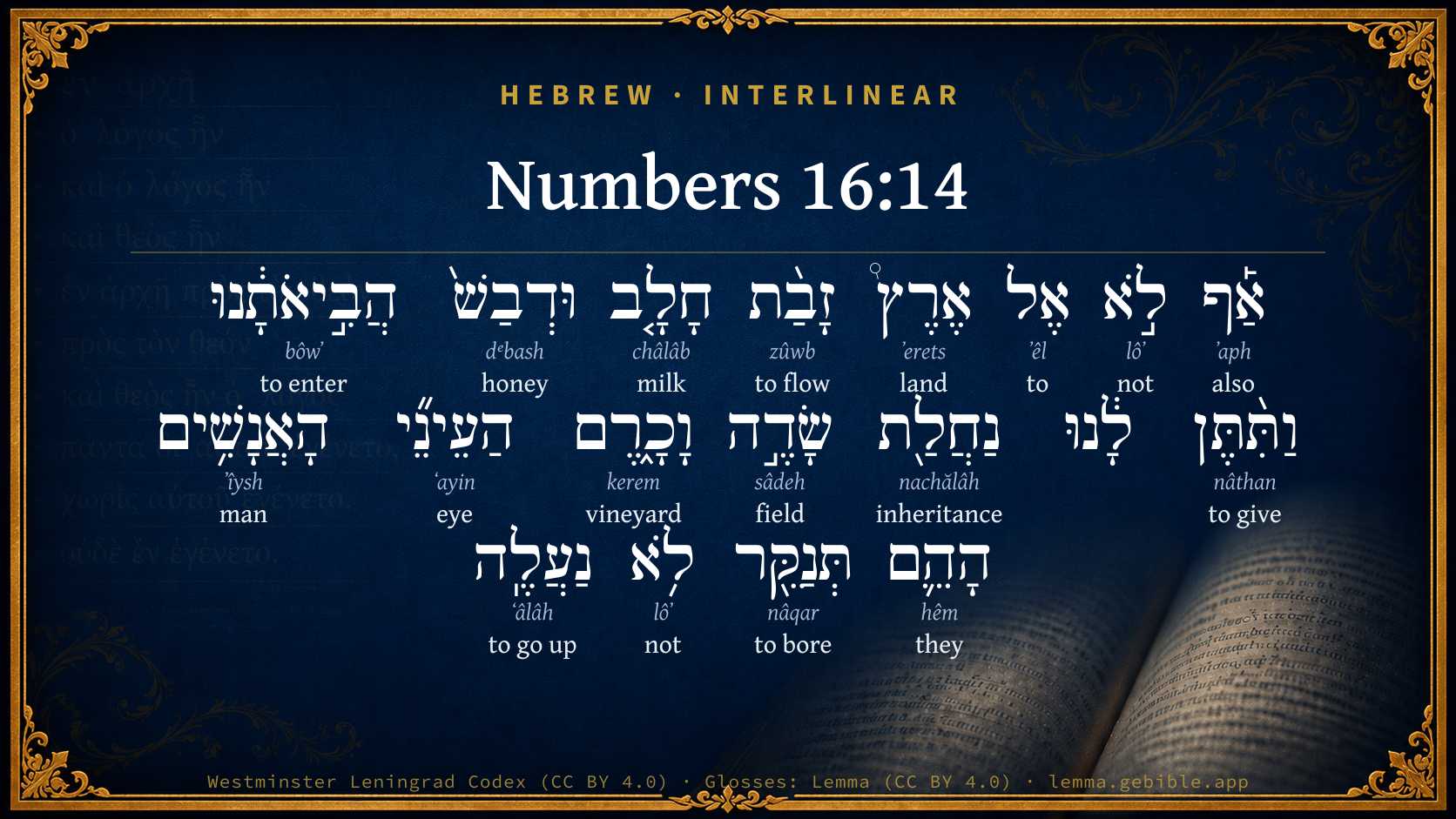
Numbers 16:14

Hebrew (Westminster Leningrad Codex) Numbers 16:14 appears in the Hebrew Old Testament. The text above is from the Westminster Leningrad Codex. Each word links to its Strong’s number, a concise gloss, and parsing drawn from the Open Scriptures Hebrew Bible morphology. Click any word for its full Brown-Driver-Briggs (BDB) entry.
Download image
Cite this verse

Numbers 16:14 (World English Bible). Public Domain. Lemma interlinear Bible study tool, https://lemma.gebible.app/v/numbers/16/14.

Show BibTeX & RIS
BibTeX
RIS
English Translation
Moreover you haven't brought us into a land flowing with milk and honey, nor given us inheritance of fields and vineyards: will you put out the eyes of these men? we won't come up.
World English Bible · Public Domain
Highlights
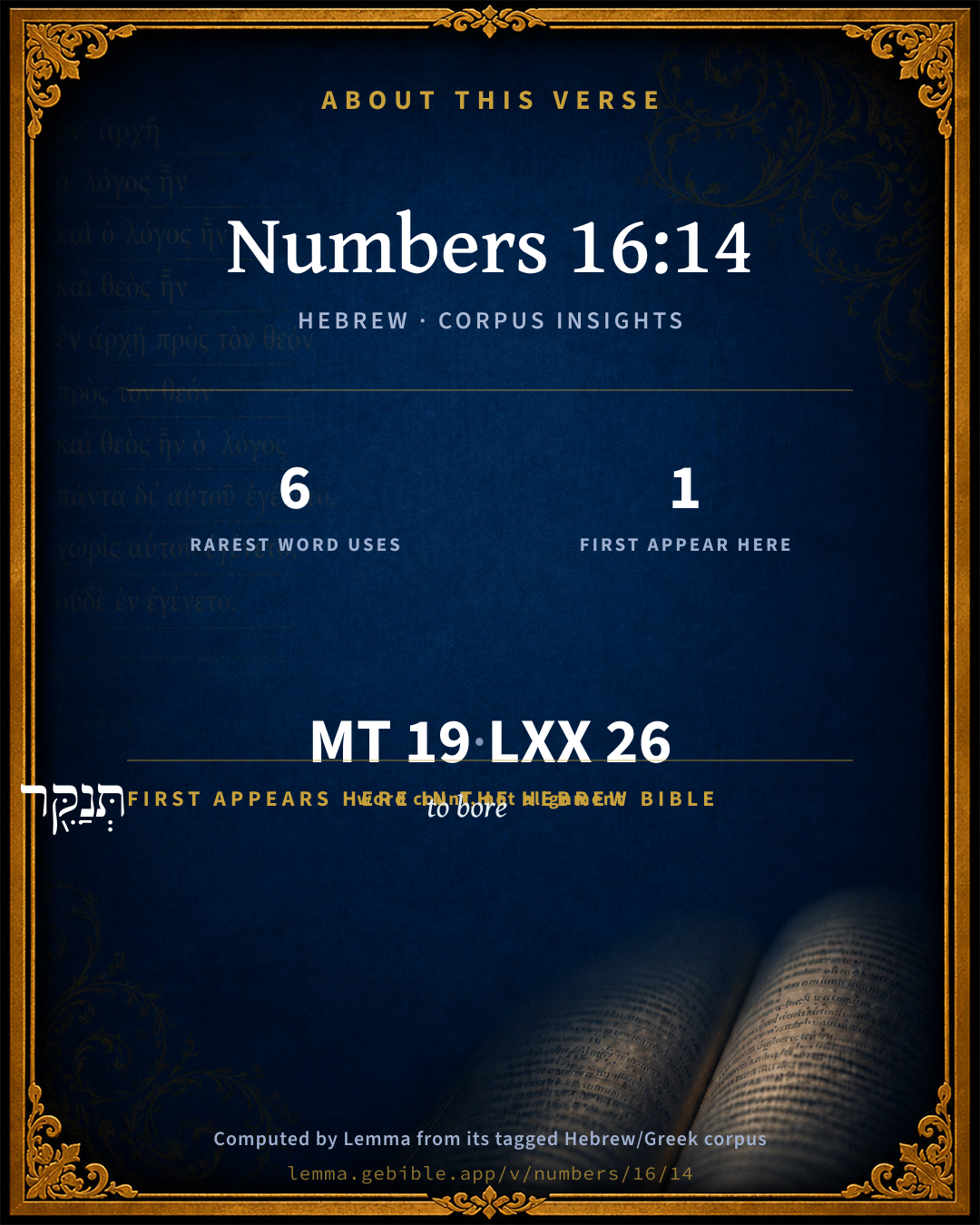
  • 1 first appearance in the Hebrew Bible
Full analysis ↓
Download a study sheet

One document with this verse’s original text, its word-by-word gloss line, the meaning frame, cross-references with their text, attributed commentary, and full source and license credits — printable, and it pastes into notes with its structure intact.

This verse Autodidact and up

Study sheet (.html) Plain text (.txt)

A passage Seminary Student

Up to 50 verses in one chapter. A passage sheet keeps up to 6 commentary sources and 12 cross-references per verse, in the order this page ranks them, and says so on the sheet whenever that leaves anything out. Ask for a single verse and you get the Autodidact verse sheet above.

Everything on this page stays free to read, with no account — the sheet is a download of what is already on screen, not access to it.

Want to remove ads? Support Godless Engineer
Compare translations 3

The same verse in 3 English versions, stacked beneath the original-language interlinear above. Click any original word for its lexicon entry.

Each is an independent rendering of the whole verse — the interlinear is not word-aligned to these translations.

Highlighted words mark where these versions differ — a whole-verse word diff, not a word-by-word alignment.

  • World English Bible Public Domain
    Moreover you haven't brought us into a land flowing with milk and honey, nor given us inheritance of fields and vineyards: will you put out the eyes of these men? we won't come up.
  • King James Version Public Domain
    Moreover thou hast not brought us into a land that floweth with milk and honey, or given us inheritance of fields and vineyards: wilt thou put out the eyes of these men? we will not come up.
  • unfoldingWord Literal Text CC BY-SA 4.0
    Also, you have not brought us to a land flowing milk and honey, or given to us an inheritance of field and vineyard. Will you gouge out the eyes of these men? We will not go up.”

unfoldingWord Literal Text — © unfoldingWord, licensed CC BY-SA 4.0. Word-aligned USFM3 via Door43 (git.door43.org/unfoldingWord/en_ult).

Versions to compare (up to 4)

3 of 4 selected

Show all 18 translations

Every available English version of this verse, each an independent rendering of the whole verse.

  • World English Bible Public Domain
    Moreover you haven't brought us into a land flowing with milk and honey, nor given us inheritance of fields and vineyards: will you put out the eyes of these men? we won't come up.
  • Berean Standard Bible Public Domain
    Moreover, you have not brought us into a land flowing with milk and honey or given us an inheritance of fields and vineyards. Will you gouge out the eyes of these men? No, we will not come!”
  • Majority Standard Bible Public Domain
    Moreover, you have not brought us into a land flowing with milk and honey or given us an inheritance of fields and vineyards. Will you gouge out the eyes of these men? No, we will not come!”
  • King James Version Public Domain
    Moreover thou hast not brought us into a land that floweth with milk and honey, or given us inheritance of fields and vineyards: wilt thou put out the eyes of these men? we will not come up.
  • American Standard Version (1901) Public Domain
    Moreover thou hast not brought us into a land flowing with milk and honey, nor given us inheritance of fields and vineyards: wilt thou put out the eyes of these men? we will not come up.
  • Revised Version (1885) Public Domain
    Moreover thou hast not brought us into a land flowing with milk and honey, nor given us inheritance of fields and vineyards: wilt thou put out the eyes of these men? we will not come up.
  • Geneva Bible (1599) Public Domain
    Also thou hast not brought vs vnto a land that floweth with milke and honie, neither giuen vs inheritance of fieldes and vineyardes: wilt thou put out the eyes of these men? we will not come vp.
  • Douay-Rheims (1899) Public Domain
    Thou best brought us indeed into a land that floweth with rivers of milk and honey, and hast given us possessions of fields and vineyards; wilt thou also pull out our eyes? We will not come.
  • Young's Literal Translation Public Domain
    Yea, unto a land flowing with milk and honey thou hast not brought us in, nor dost thou give to us an inheritance of field and vineyard; the eyes of these men dost thou pick out? we do not come up.'
  • Literal Standard Version CC BY-SA 4.0
    Indeed, you have not brought us into a land flowing with milk and honey, nor do you give an inheritance of field and vineyard to us; do you pick out the eyes of these men? We do not come up!”
  • Unlocked Literal Bible CC BY-SA 4.0
    In addition, you have not brought us into a land flowing with milk and honey, or given us the fields and vineyards as an inheritance. Now do you want to blind us with empty promises? We will not come to you.”
  • unfoldingWord Literal Text CC BY-SA 4.0
    Also, you have not brought us to a land flowing milk and honey, or given to us an inheritance of field and vineyard. Will you gouge out the eyes of these men? We will not go up.”
  • Darby Bible Public Domain
    Moreover, thou hast not brought us into a land flowing with milk and honey, or given us inheritance of fields and vineyards: wilt thou put out the eyes of these men? we will not come up!
  • World Messianic Bible Public Domain
    Moreover you haven’t brought us into a land flowing with milk and honey, nor given us inheritance of fields and vineyards. Will you put out the eyes of these men? We won’t come up.”
  • Webster's Bible Public Domain
    Moreover, thou hast not brought us into a land that floweth with milk and honey, or given us inheritance of fields and vineyards: wilt thou put out the eyes of these men? we will not come up.
  • Free Bible Version CC BY-SA 4.0
    On top of that you haven't taken us to a land flowing with milk and honey or given us fields and vineyards to own. Do you really think you can fool everyone? No, we will not attend!”
  • Bible in Basic English Public Domain
    And more than this, you have not taken us into a land flowing with milk and honey, or given us a heritage of fields and vine-gardens: will you put out the eyes of these men? We will not come up.
  • JPS Tanakh (1917) Public Domain
    Moreover thou hast not brought us into a land flowing with milk and honey, nor given us inheritance of fields and vineyards; wilt thou put out the eyes of these men? we will not come up.'

Literal Standard Version (2020), Covenant Press — licensed CC BY-SA 4.0. Text via the HelloAO Bible API (eBible.org). Unlocked Literal Bible (unfoldingWord) — licensed CC BY-SA 4.0. Text via the HelloAO Bible API (eBible.org). unfoldingWord Literal Text — © unfoldingWord, licensed CC BY-SA 4.0. Word-aligned USFM3 via Door43 (git.door43.org/unfoldingWord/en_ult). Free Bible Version, Dr. Jonathan Gallagher — licensed CC BY-SA 4.0. Text via the HelloAO Bible API (eBible.org).

Word by word

More ways to search: Search by grammar → Find every occurrence → Compare this word →

Practice this passage: Drill this verse → Learn its vocabulary →

תְּנַקֵּ֖ר
nâqar
H5365
“to bore”
Verb, Piel, Imperfect, 2nd Person, Masculine, Singular
Part of Speech
Verb
Stem
Piel
Form
Imperfect
Person
2nd Person
Gender
Masculine
Number
Singular
Full BDB Definition

Origin: a primitive root

TWOT: 1418

to bore, pick, dig, pick out - (Qal) to bore, pick, dig - (Piel) to bore out - (Pual) to be dug out
  1. אַ֡ף ʼaph H637 “also” Particle, Accusative
  2. לֹ֣א lôʼ H3808 “not” Particle, Negative
  3. אֶל ʼêl H413 “to” Preposition
  4. אֶרֶץ֩ ʼerets H776 “land” Noun, Common, Both, Singular, Absolute
  5. זָבַ֨ת zûwb H2100 “flowing” Verb, Qal, Participle Active, Feminine, Singular, Construct
  6. חָלָ֤ב châlâb H2461 “milk” Noun, Common, Masculine, Singular, Absolute
  7. וּדְבַשׁ֙ dᵉbash H1706 “and · honey” Conjunction + Noun, Common, Masculine, Singular, Absolute
  8. הֲבִ֣יאֹתָ֔נוּ bôwʼ H935 “to enter · us” Verb, Hiphil, Perfect, 2nd Person, Masculine, Singular + Suffix, Personal, 1st Person, Common, Plural
  9. וַתִּ֨תֶּן nâthan H5414 “and · to give” Conjunction + Verb, Qal, Sequential Imperfect, 2nd Person, Masculine, Singular
  10. נַחֲלַ֖ת nachălâh H5159 “inheritance of” Noun, Common, Feminine, Singular, Construct
  11. שָׂדֶ֣ה sâdeh H7704 “field” Noun, Common, Masculine, Singular, Absolute
  12. וָכָ֑רֶם kerem H3754 “and · vineyard” Conjunction + Noun, Common, Both, Singular, Absolute
  13. הַעֵינֵ֞י ʻayin H5869 “eyes of” Particle, Interrogative + Noun, Common, Both, Dual, Construct
  14. הָאֲנָשִׁ֥ים ʼîysh H376 “the · men” Particle, Definite Article + Noun, Common, Masculine, Plural, Absolute
  15. הָהֵ֛ם hêm H1992 “the · they” Particle, Definite Article + Pronoun, Personal, 3rd Person, Masculine, Plural
  16. לֹ֥א lôʼ H3808 “not” Particle, Negative
  17. נַעֲלֶֽה ʻâlâh H5927 “to go up” Verb, Qal, Imperfect, 1st Person, Common, Plural

About this verse

These counts appear in no published source. They are computed here, from the morphology-tagged text and Lemma’s own curated glosses. What Lemma adds →

19
words
17
distinct lemmas
Pentateuch
section

Notable vocabulary

The rarest word here is תְּנַקֵּ֖ר to bore H5365 — appearing just 6 times in the whole Hebrew Bible.

First appearance in Scripture

This word makes its first canonical appearance in the Hebrew Bible here:

  • תְּנַקֵּ֖ר to bore H5365

Shared distinctive vocabulary

תְּנַקֵּ֖ר to bore H5365 occurs in 6 verses of the Hebrew Bible. Also found in:

Grammatical profile

  • 5 verbs
  • 8 nouns
  • 1 pronoun
  • 2 prepositions
  • 3 particles

Verb forms

  • זָבַ֨ת Qal · Participle Active
  • הֲבִ֣יאֹתָ֔נוּ Hiphil · Perfect
  • וַתִּ֨תֶּן Qal · Sequential Imperfect
  • תְּנַקֵּ֖ר Piel · Imperfect
  • נַעֲלֶֽה Qal · Imperfect

Repetition

A word recurs within this verse — often emphatic in Hebrew:

Hebrew & Septuagint length

In English translation the verse runs 34 words from the Hebrew and 43 from the Septuagint (LXX English) — closely comparable.

A rough comparison of the two English renderings, which tokenize alike — not a word-level alignment.

Word counts can differ between the Hebrew and the Greek without any difference in meaning — e.g. the Hebrew direct-object marker אֵת has no separate Greek word, and Greek often adds the article ὁ.

In the original languages it is 19 Hebrew tokens and 26 Greek tokens — but the two are counted differently (Hebrew bundles its prefixes and suffixes into one token; the Greek is in lemma form), so that isn’t a like-for-like length.

Cross-references

9

Topical passages linked to Numbers 16:14 in the Treasury of Scripture Knowledge — connected by theme and wording, ordered by reader-vote popularity; previews shown in the World English Bible.

  • Leviticus 20:24 But I have said to you, "You shall inherit their land, and I will give it to you to possess it, a land flowing with milk and honey." I am Yahweh your God, who has separated you from the peoples.
  • Numbers 36:8–10 Every daughter, who possesses an inheritance in any tribe of the children of Israel, shall be wife to one of the family of the tribe of her father, that the children of Israel may possess every man the inheritance of his fathers.
  • Judges 16:21 The Philistines laid hold on him, and put out his eyes; and they brought him down to Gaza, and bound him with fetters of brass; and he did grind in the prison-house.
  • 1 Samuel 11:2 Nahash the Ammonite said to them, On this condition will I make it with you, that all your right eyes be put out; and I will lay it for a reproach on all Israel.
  • Exodus 3:8 I have come down to deliver them out of the hand of the Egyptians, and to bring them up out of that land to a good and large land, to a land flowing with milk and honey; to the place of the Canaanite, the Hittite, the Amorite, the Perizzite, the Hivite, and the Jebusite.
  • Exodus 3:17 and I have said, I will bring you up out of the affliction of Egypt to the land of the Canaanite, the Hittite, the Amorite, the Perizzite, the Hivite, and the Jebusite, to a land flowing with milk and honey."'
  • Exodus 22:5 "If a man causes a field or vineyard to be eaten, and lets his animal loose, and it grazes in another man's field, he shall make restitution from the best of his own field, and from the best of his own vineyard.
  • Exodus 23:11 but the seventh year you shall let it rest and lie fallow, that the poor of your people may eat; and what they leave the animal of the field shall eat. In like manner you shall deal with your vineyard and with your olive grove.
  • Numbers 20:5 Why have you made us to come up out of Egypt, to bring us in to this evil place? it is no place of seed, or of figs, or of vines, or of pomegranates; neither is there any water to drink.

Cross-references courtesy of OpenBible.info (CC BY 4.0).

Hebrew and Greek witnesses Masoretic Hebrew ↔ Greek Septuagint

The same verse in the two great witnesses to the Old Testament, shown verse-for-verse.

These are two independent witnesses, not word-aligned to each other, and the Septuagint is shown in lemma (dictionary) form.

Hebrew Numbers 16:14 Masoretic · Westminster Leningrad Codex

אַ֡ף לֹ֣א אֶל אֶרֶץ֩ זָבַ֨ת חָלָ֤ב וּדְבַשׁ֙ הֲבִ֣יאֹתָ֔נוּ וַתִּ֨תֶּן לָ֔נוּ נַחֲלַ֖ת שָׂדֶ֣ה וָכָ֑רֶם הַעֵינֵ֞י הָאֲנָשִׁ֥ים הָהֵ֛ם תְּנַקֵּ֖ר לֹ֥א נַעֲלֶֽה

Moreover you haven't brought us into a land flowing with milk and honey, nor given us inheritance of fields and vineyards: will you put out the eyes of these men? we won't come up.

World English Bible · Public Domain

Greek LXX Numbers 16:14 Septuagint · lemma form

εἰ καί εἰς γῆ ῥέω γάλα καί μέλι εἰςἄγω ἐγώ καί δίδωμι ἐγώ κλῆρος ἀγρός καί ἀμπελών ὁ ὀφθαλμός ὁ ἄνθρωπος ἐκεῖνος ἄν ἐκκόπτω οὐ ἀναβαίνω

You are a prince, and have you brought us into a land flowing with milk and honey, and have you given us an inheritance of land and vineyards? would you have put out the eyes of those men? we will not go up.

LXX2012 (modern English Septuagint) · Public Domain

On this verse, John Gill's Exposition discusses the Septuagint’s reading. Read the note in Commentary ↓

Hebrew: Westminster Leningrad Codex (CC BY 4.0). Greek: Septuagint (public domain); English from LXX2012 (modern English Septuagint) (Public Domain). How the Septuagint differs from the Hebrew →

Targum (Aramaic paraphrase)

2

The Targum is the ancient Jewish Aramaic paraphrase of the Hebrew Scriptures — an interpretive translation, not the Hebrew text itself. Onkelos (literal) and Pseudo-Jonathan (expansive) render the Torah, and Jonathan the Prophets. Coverage is partial: where no permissively-licensed English translation exists for a verse, only the Aramaic is shown. This is verse-level text, not a word-by-word alignment to the Hebrew.

  1. Targum Onkelos Torah (Genesis–Deuteronomy)
    בְּרַם לָא לְאַרְעָא עָבְדָא חֲלָב וּדְבָשׁ אַעֵלְתָּנָא וִיהַבְתְּ לָנָא אַחֲסָנַת חַקְלִין וְכַרְמִין הַעֵינֵי גֻבְרַיָא הָאִינוּן תְּשַׁלַח לְעַוָרָא לָא נִסָק

    (no public-domain English translation for this verse)

    Targum Onkelos — Aramaic: “Onkelos Genesis” (public domain); “Onkelos Exodus” (public domain); “Onkelos Leviticus” (public domain); “Onkelos Numbers” (public domain); “Onkelos Deuteronomy” (public domain). English: “Sefaria Community Translation” (CC0 1.0 (public-domain dedication)); “J.W. Etheridge. The Targums of Onkelos and Jonathan Ben Uzziel on the Pentateuch. London: Longmans, Green, 1862” (public domain). Text via Sefaria.

  2. Targum Pseudo-Jonathan Torah (Genesis–Deuteronomy)
    בְּרַם לָא לְאַרְעָא עַבְדָא חֲלַב וּדְבָשׁ אַעַלְתָּנָא וִיהַבְתְּ לָנָא אַחְסָנַת חַקְלִין וְכַרְמִין הַעֵינֵיהוֹן דְגוּבְרַיָא הָאִינוּן דִבְאַרְעָא הַהִיא תְּסַנְוַור וּתְנַצֵחַ יַתְהוֹן לָא נֵיסוֹק לְתַמָן

    Neither hast thou brought us into the land producing milk and honey to give us an inheritance of fields and vineyards. Wilt thou blind the eyes of the men of that land, that thou mayest overcome them? We shall not go up thither.

    Targum Pseudo-Jonathan — Aramaic: “Targum Jonathan on Genesis” (public domain); “Targum Jonathan on Exodus” (public domain); “Targum Jonathan on Leviticus” (public domain); “Targum Jonathan on Numbers” (public domain); “Targum Jonathan on Deuteronomy” (public domain). English: “The Targum of Jonathan ben Uzziel, trans. J. W. Etheridge, London, 1862” (public domain). Text via Sefaria.

Commentary

Notes on Numbers 16:14 from classic Christian and Jewish commentators (each source and its license shown beneath its notes). The classic Christian expositions comment on the surrounding passage and are grouped to its opening verse, so a note may address several verses; the Jewish commentaries on the Tanakh (Rashi and others) are per-verse, so they appear only where the commentator wrote on this verse.

Lemma curates 59 commentaries, every one of them public domain or Creative Commons licensed, each selected and text-cleaned for this edition rather than reprinted as found. About our sources →

Trapp's Complete Commentary

John Trapp

Num 16:14 Moreover thou hast not brought us into a land that floweth with milk and honey, or given us inheritance of fields and vineyards: wilt thou put out the eyes of these men? we will not come up.

Ver. 14. We will not come up,] sc., To the place of judgment. So they add rebellion to sin, and justify their treasonful practices; as did Ravailliac, Fawks, Saunders, others.

John Trapp, A Commentary or Exposition upon All the Books of the Old and New Testament (1647–1656) — public domain. Text from a community e-Sword module.

Joseph Benson's Commentary

Num 16:14. Wilt thou put out the eyes of these men — Of all the people who are of our mind? wilt thou make them blind, or persuade them that they do not see what is visible to all that have eyes, to wit, that thou hast deceived them, and broken thy faith and promise given to them?

Joseph Benson's Commentary on the Old and New Testaments (1811–1818) — public domain. Text from a community e-Sword module.

Tyndale Open Study Notes

Tyndale Open Resources

16:14 The Israelites were heading away from their new homeland precisely because they had rebelled against Moses, who had done all he could to take them to that land (chs 13–14). • Are you trying to fool these men? They were accusing Moses and Aaron of trying to mislead the Israelites (to “pull the wool over their eyes”).

Tyndale Open Study Notes — © Tyndale Open Resources, licensed CC BY-SA 4.0. Text via the HelloAO Bible API.

Geneva Bible (1599)

Geneva Bible translators

Wilt thou make them that searched the land, believe that they saw not that which they saw?

Geneva Bible (1599) marginal notes — public domain. Text via Bolls.life.

Ellicott's Commentary for English Readers

(14) Moreover thou hast not brought us . . . —The words which the Lord had spoken to Moses (Exo_3:8) concerning the deliverance from Egypt, and the bringing of the people into a land flowing with milk and honey, had been communicated by Aaron to the people (Exo_4:30). Dathan and Abiram reproach Moses, as though he was responsible for their protracted sojourn in the wilderness.

Wilt thou put out the eyes of these men?—Hebrew, those men. The same expression is employed in its literal signification in regard to Samson (Jdg_16:21). It is probably used here in the same manner; or, it may be, to denote an alleged attempt on the part of Moses to blind the eyes of the people to the violation of promises solemnly made to them, and to impose upon them a law of blind obedience to his own arbitrary injunctions.

A Bible Commentary for English Readers, edited by Charles John Ellicott (1878–1897) — public domain. Text from a community e-Sword module.

The Cambridge Bible for Schools and Colleges

gen. ed. J. J. S. Perowne

14. wilt thou bore out the eyes of these men?] A strong figure which means, metaphorically, to blind them by false promises. Gray (Numb. p. 200) compares the English expression ‘to throw dust in the eyes.’

The Cambridge Bible for Schools and Colleges (gen. ed. J. J. S. Perowne; Cambridge University Press, 1878–1918) — public domain. Text from a community e-Sword module.

John Gill's Exposition

Moreover, thou hast not brought us into a land that floweth with milk and honey,.... Meaning the land of Canaan; but this was no fault of Moses, he had brought them to the borders of it, he had bid them go up and possess it; but they refused, and chose to have spies first sent into it, who brought an ill report of it, which they listened to, and had so provoked the Lord thereby, that he ordered them to turn back, and threatened them with a consumption of them in the wilderness; or "certainly" (n), verily thou hast not brought us, &c. though the Septuagint version renders it affirmatively, "thou hast brought us"; and the Vulgate Latin version, indeed thou hast brought, directly contrary to the text; unless it is to be understood ironically, as it is by some:

or given us inheritance of fields and vineyards; that is, in the land of Canaan, as were promised them; they suggest, had this been the case, they could have been content that he should have been their prince, and they would have submitted to his government; but having received no advantage from him, but a great deal of hurt and damage, they could not but consider him not only as a tyrant, but as an impostor and deceiver:

wilt thou put out the eyes of these men? or "dig" them out (o); either in a literal sense, wilt thou be so cruel and merciless as to put out the eyes of these men, Korah and his company, and us for our opposition to thy government? or though thou shouldest do so:

we will not come up; we are determined not to obey thee, but to shake off the yoke, let our punishment be what it will; or figuratively, dost thou take us for blind persons, whose eyes thou hast put out, and think to lead us at thy pleasure? or dost thou cast a mist before the eyes of this whole congregation, that they are not able to see through thy designs? are the people so bewitched by them, as not to see thy deceits and impostures? pretending to bring them into a land flowing with milk and honey, which thou art not able to do, and now sayest that thou hast a message from God to return again towards the Red sea, and talkest of our posterity inheriting the land forty years hence; who is it that cannot see through all this? Aben Ezra thinks, by "these men" are meant the elders that were with Moses, whom he led as he pleased, and so blinded them with his delusions, as these pretended, that they could not see through them.

(n) "certe", Noldius, p. 97. No. 468. so Onkelos. (o) "effodies", Pagninus, Piscator; "vis effodere", Fagius; "fodies", Junius & Tremellius, Drusius.

John Gill's Exposition of the Whole Bible (1746–1763) — public domain (CC PDM 1.0). Text via the HelloAO Bible API.

Albert Barnes' Notes on the Bible

Wilt thou put out the eyes of these men? - i. e. “blind them to the fact that you keep none of your promises;” “throw dust in their eyes.”

Albert Barnes' Notes on the Bible (1834–1885) — public domain. Text from a community e-Sword/MySword module.

Haydock's Catholic Bible Commentary

Eyes. These princes of Ruben were not desirous of the priesthood, as Core was; they repined, that Moses had got possession of the sovereign authority, and therefore they endeavour to represent him as an imposter, who had promised great things, but in reality had deprived the people of all the happiness which they formerly enjoyed in Egypt, and was now disposed to exercise his tyranny upon their very persons. (Haydock) --- "Do you wish that we should not see through your impostures?" Hebrew, "wilt thou put out the eyes of these men," who have informed us what sort of a country Chanaan is? Septuagint, "thou hast blinded these men," who are so stupid as to obey thee. (Calmet) --- Chaldean, "though thou pull out our eyes, we will not come."

George Leo Haydock (1774–1849), Haydock's Catholic Family Bible and Commentary, 1859 edition — public domain. Excludes Psalms (Douay-Rheims chapter numbering differs from Protestant) and Deuterocanonical books (Catholic canon only).

Matthew Poole's English Annotations

Of these men, i.e. of those who are confederate with us, and of all the people who are of our mind. Wilt thou make them blind, or persuade them that they are blind, and that they do not see what is visible to all that have eyes, to wit, that thou hast deceived them, and broken thy faith and promise given to them? or wilt thou lead them about like blind men whither thou pleasest, one time towards Canaan, another time towards Egypt again?

We will not come up; we will not obey thy summons, nor own thy authority.

Matthew Poole's English Annotations on the Holy Bible (1683–1685) — public domain. Text from a community e-Sword/MySword module.

The Pulpit Commentary

Moreover thou hast not brought us. According to the promises (they meant to say) by which he had induced them to leave their comfortable homes in Egypt. (Exo_4:30, Exo_4:31) Wilt thou put out the eyes of these men? i.e., wilt thou blind them to the utter failure of thy plans and promises? wilt thou throw dust in their eyes?

The Pulpit Commentary (1880–1919), ed. H.D.M. Spence-Jones & Joseph S. Exell — public domain. Text from a community e-Sword module.

John Wesley's Explanatory Notes

These men - Of all the people who are of our mind: wilt thou make them blind, or persuade them that they do not see what is visible to all that have eyes, to wit, that thou hast deceived them, and broken thy faith and promise given to them?

John Wesley, Explanatory Notes Upon the Whole Bible (1754–1765) — public domain. Text via the GEBible commentary corpus.

Rashi

Rabbi Shlomo Yitzchaki (Rashi)

ותתן לנו (lit., thou hast given us) — The statement must he referred to the word לא, “not”, mentioned before, the meaning being: Thou hast not brought us into a land flowing with milk and honey, and thou hast not given us inheritance of fields and vineyards. — You told us, (Exodus 3:7) “I will bring you up from the affliction of Egypt” into a good land: from there (from such a land; cf. v. 13), indeed, you have brought us forth, but you have not brought us instead into a land flowing with milk and honey; on the contrary — you have passed a decree upon us to kill us in the wilderness, for you have said, (Numbers 14:29) “Your carcasses shall fall in this desert."

העיני האנשים ההם תנקר WILT THOU PUT OUT THE EYES OF THESE MEN etc. — This means: even if you were to send to put out our eyes if we would not come up to you we would not come up!

האנשים ההם THESE MEN — [They meant themselves, but spoke of other people’s eyes being put out], like a man who attaches to his fellow the curse which should come upon himself (cf. Rashi on Exodus 1:10).

Rashi on the Tanakh — English translations: “The Judaica Press complete Tanach with Rashi, translated by A. J. Rosenberg” (CC BY 4.0); “Pentateuch with Rashi's commentary by M. Rosenbaum and A.M. Silbermann, 1929-1934” (public domain); “The Metsudah Tanach series, Lakewood, N.J” (CC BY 4.0); and “The Book of Joshua, Metsudah Publications, 1997” (CC BY 4.0). Text via Sefaria.

Lesson kit

Teaching starters — assembled from the data on this page, not authored interpretation. Every prompt links to the verse data it draws on. Edit before teaching.

Numbers, in the Pentateuch, opens this verse with 19 words (17 distinct Hebrew lemmas). Its most distinctive word is nâqar (“to bore”). A historical commentator’s framing appears above. Read the whole chapter for the surrounding context.

Discussion questions

  1. How does “to bore” (nâqar) shape what this verse is saying?
  2. The word “to bore” first appears here in Scripture. What is being introduced at this debut?
  3. Judges 16:21 shares the word «to bore» with this verse. How do the two illuminate each other?
  4. “not” occurs 2× in this one verse. What is the effect of the repetition?
  5. The translations on this page render this verse differently — a whole-verse word diff, not a word-by-word alignment. What might account for the different wordings?
  6. The verb «זָבַ֨ת» is Qal Participle Active. How does its form color the action?
  7. Reading how Trapp's Complete Commentary and Joseph Benson's Commentary read this verse, where do the two commentators agree and where do they part?

Things to notice

Reading settings

Reading text

Shown beneath each verse's original-language words.

Old Testament
Old Testament edition

Read the OT as the Masoretic Hebrew (MT) or the Greek Septuagint (LXX).

English shown for the Greek Septuagint (in the Hebrew ↔ Greek comparison).

Comparing translations? Open the Compare panel on any verse page to stack up to four side by side.